


Yes, seven critical automotive sensors can cause engine stalling: the Mass Air Flow (MAF) sensor, Crankshaft Position Sensor, Manifold Absolute Pressure (MAP) sensor, Oxygen (O2) sensor, Throttle Position Sensor (TPS), Camshaft Position Sensor, and Engine Coolant Temperature Sensor. These sensors fail because they provide incorrect data to the Engine Control Unit (ECU), disrupting fuel mixture calculations, ignition timing, or air intake regulation—all essential for maintaining engine operation. When any of these sensors malfunction, your engine loses the precise information it needs to run smoothly, resulting in unexpected stalling during idle, acceleration, or deceleration.
Understanding how sensors control engine performance reveals why their failures have such immediate and dramatic effects on drivability. Modern engines rely on real-time sensor data to make thousands of adjustments per second, balancing air-fuel ratios, controlling spark timing, and regulating intake flow. When a sensor sends faulty readings to the ECU, the computer makes incorrect calculations that can starve the engine of fuel, deliver spark at the wrong moment, or allow too much or too little air into the combustion chamber—any of which will cause stalling.
Recognizing the specific symptoms of each sensor failure accelerates your stalling diagnosis and prevents unnecessary part replacements. Each sensor produces distinct warning signs: MAF failures typically cause idle stalling and hesitation, crank sensor failures produce sudden power loss without warning, MAP sensor issues trigger deceleration stalling, O2 sensor problems create rough idle when warm, TPS malfunctions cause stalling when releasing the accelerator, camshaft sensor failures lead to startup stalling, and coolant temperature sensor issues manifest as cold-start stalling. Identifying these patterns helps you target the correct sensor during troubleshooting.
Learning the diagnostic procedures for each sensor empowers you to conduct efficient stalling diagnosis whether you’re a DIY mechanic or working with a professional. Below, we’ll examine each of the seven critical sensors in detail, covering their function, failure symptoms, and step-by-step testing procedures to help you identify and resolve sensor-related stalling issues quickly and accurately.
What Are the Most Common Sensors That Cause Engine Stalling?
The seven most common sensors that cause engine stalling are MAF, Crankshaft Position, MAP, O2, TPS, Camshaft Position, and Engine Coolant Temperature sensors, ranked by prevalence of failure. These sensors monitor different aspects of engine operation and communicate critical data to the ECU for real-time adjustments. When any of these sensors malfunction, they disrupt the delicate balance of air, fuel, and spark timing that keeps your engine running.
To understand sensor-related stalling, you must first grasp how these components form an interconnected diagnostic network. The table below provides a quick reference showing each sensor’s primary function and its most common stalling pattern:
| Sensor Type | Primary Function | Common Stalling Pattern | Typical DTC Codes |
|---|---|---|---|
| MAF (Mass Air Flow) | Measures incoming air density | Idle and low-speed stalling | P0101, P0102, P0103 |
| Crankshaft Position | Tracks engine speed and timing | Sudden stalling while driving | P0335, P0336, P0320 |
| MAP (Manifold Absolute Pressure) | Measures intake manifold pressure | Deceleration stalling | P0105-P0109 |
| Oxygen (O2) | Monitors exhaust gas oxygen | Warm engine idle stalling | P0130-P0167 |
| Throttle Position Sensor (TPS) | Tracks accelerator pedal position | Stalling when releasing gas | P0120-P0124 |
| Camshaft Position | Monitors valve timing | Startup and rough running stalling | P0340-P0349 |
| Engine Coolant Temperature | Measures engine temperature | Cold start stalling | P0115-P0119 |
How Do Sensors Control Engine Performance?
Sensors control engine performance by continuously measuring physical conditions and transmitting voltage signals to the ECU, which uses this data to calculate optimal fuel injection amounts, spark timing, and airflow regulation in real-time. The ECU receives input from multiple sensors simultaneously, processing hundreds of data points per second to maintain the precise air-fuel ratio (typically 14.7:1 for gasoline engines) and adjust ignition timing based on load, speed, and temperature conditions.
This sensor-ECU communication operates through analog voltage signals or digital frequency patterns. For example, the MAF sensor might output 0.5-5.0 volts depending on airflow volume, while the crankshaft position sensor generates a digital pulse pattern that the ECU interprets to determine engine RPM and piston position. The ECU compares these inputs against programmed maps and algorithms stored in its memory, then sends commands to actuators controlling fuel injectors, ignition coils, and the throttle body.
Air-fuel ratio regulation through sensors represents one of the most critical functions for preventing stalling. The MAF or MAP sensor measures incoming air, while O2 sensors monitor exhaust gases to verify combustion efficiency. The ECU uses this feedback loop to trim fuel delivery up or down, ensuring complete combustion. If either sensor fails, the ECU loses its ability to maintain the correct mixture, leading to either lean conditions (too much air, not enough fuel) or rich conditions (too much fuel, not enough air)—both of which can cause stalling under specific operating conditions.
Ignition timing control via sensors ensures spark occurs at the precise crankshaft angle for optimal power and efficiency. The crankshaft and camshaft position sensors provide the timing reference points, telling the ECU exactly when each cylinder reaches top dead center. The ECU then calculates the ideal spark advance based on engine load (from MAP or MAF), temperature (from coolant sensor), and throttle position (from TPS). When timing sensors fail, the ECU cannot accurately determine when to fire the spark plugs, resulting in misfires or complete loss of ignition—both leading directly to stalling.
Why Do Sensor Failures Lead to Stalling?
Sensor failures lead to stalling because they cause the ECU to make incorrect calculations about fuel delivery, spark timing, or air intake—creating conditions where the engine cannot sustain combustion. When the ECU receives false data, it operates based on faulty assumptions about what’s happening inside the engine, similar to driving blindfolded based on someone else’s incorrect directions.
Incorrect ECU data processing creates a cascading failure effect throughout the engine management system. For instance, if a MAF sensor reports less airflow than actually exists, the ECU reduces fuel delivery proportionally, creating a lean condition. This lean mixture burns hotter and less reliably, causing misfires and eventual stalling. The ECU doesn’t “know” the sensor is lying—it simply executes its programming based on the faulty input, making what appears to be logical decisions that produce disastrous real-world results.
Fuel mixture disruption mechanics explain why many sensor failures produce similar stalling symptoms despite affecting different systems. Whether a MAF sensor underreports airflow, an O2 sensor falsely indicates a rich condition, or a coolant temperature sensor reports incorrect engine temperature, the end result disrupts the air-fuel ratio. Engines operate within a narrow combustion window—roughly 12:1 to 16:1 air-fuel ratio for gasoline engines. Outside this range, ignition becomes unreliable or impossible, and the engine stalls.
Loss of ignition timing synchronization represents the most immediate path from sensor failure to stalling, particularly with crankshaft or camshaft position sensors. These sensors tell the ECU which cylinder is approaching top dead center and when to fire its spark plug. If the crank sensor fails completely, the ECU loses its timing reference and stops sending spark commands entirely, causing instant engine shutdown. If the sensor provides intermittent or erratic signals, spark timing becomes random or severely retarded, producing misfires that starve the engine of power until it can no longer sustain rotation.
Does a Bad Mass Air Flow (MAF) Sensor Cause Stalling?
Yes, a bad MAF sensor causes stalling because it provides incorrect airflow measurements to the ECU, disrupting fuel injection calculations and creating lean or rich conditions that prevent stable combustion. The MAF sensor ranks as the number one sensor-related cause of stalling because it directly controls the primary variable in fuel delivery—how much air is entering the engine—and its contamination or failure produces immediate and noticeable drivability problems, particularly at idle and low speeds where airflow volumes are small and measurement precision is critical.
Specifically, the MAF sensor works by measuring incoming air density using either a hot-wire or hot-film element that cools proportionally to airflow volume. As air passes over the heated element, it carries away heat, and the sensor’s electronic circuit measures how much current is required to maintain the element at a constant temperature. This current draw translates to a voltage signal (typically 0.5-5.0V) that the ECU interprets as a specific airflow rate in grams per second. The ECU then calculates exactly how much fuel to inject to maintain the target air-fuel ratio.
Stalling patterns from MAF failures concentrate heavily during idle and low-speed acceleration because these operating conditions involve minimal airflow where sensor contamination has the greatest impact. At idle, a properly functioning MAF might measure 2-4 grams per second of airflow. If oil residue or dirt on the sensing element causes just a 1 g/s measurement error, the ECU’s fuel calculation becomes 25-50% incorrect—far outside the range where the engine can compensate. During highway cruising with 15-25 g/s airflow, that same 1 g/s error represents only 4-7% deviation, which the O2 sensor feedback can partially correct.
When the MAF sensor underreports airflow (the most common failure mode), the ECU delivers insufficient fuel, creating a lean condition. The engine runs roughly at idle, hesitates during acceleration, and may stall when additional loads like air conditioning engage. Conversely, when a failing MAF overreports airflow, the ECU delivers excess fuel, causing rough idle, black exhaust smoke, poor fuel economy, and potential stalling as unburned fuel fouls spark plugs. Both failure modes produce check engine lights with specific diagnostic trouble codes that guide your stalling diagnosis.
What Are the Symptoms of MAF Sensor Failure?
The primary symptoms of MAF sensor failure include stalling at idle or low speeds, rough idle with RPM fluctuations, hesitation during acceleration, black smoke from the exhaust, poor fuel economy, and check engine light illumination with codes P0101, P0102, or P0103.
Stalling at idle or low speeds manifests as the most immediate and frustrating symptom of MAF sensor contamination or failure. You’ll typically notice the engine runs normally at highway speeds but becomes increasingly unstable as you slow down for traffic lights or stop signs. The idle may surge up and down between 500-1200 RPM before the engine finally dies, requiring you to restart. This pattern occurs because the engine’s idle air control system cannot compensate for the severely incorrect fuel delivery calculations caused by the faulty MAF reading.
Rough idle and hesitation represent the engine’s struggle to maintain combustion with an incorrect air-fuel mixture. During rough idle, you’ll feel vibrations through the steering wheel and floor pan as the engine fires unevenly, with some cylinders receiving near-correct mixture while others run too lean or too rich. During acceleration, hesitation feels like the engine stumbles or lacks power for 1-2 seconds before recovering, particularly when you press the throttle from a stop or try to pass another vehicle. This occurs because the ECU makes larger fuel delivery adjustments during acceleration based on MAF data, amplifying any sensor errors.
Black smoke from the exhaust indicates a rich condition where the MAF sensor is overreporting airflow, causing the ECU to deliver excessive fuel. The unburned fuel exits through the exhaust as black carbon particles, particularly noticeable during cold starts or hard acceleration. This symptom often accompanies the smell of raw gasoline and may trigger catalyst efficiency codes (P0420/P0430) if the condition persists long enough to damage the catalytic converter.
Check engine light codes P0101, P0102, and P0103 provide specific diagnostic information about MAF sensor problems:
- P0101: MAF sensor circuit range/performance—indicates the sensor reading doesn’t match expected values based on other sensor inputs
- P0102: MAF sensor circuit low frequency/voltage—indicates the sensor is reporting abnormally low airflow
- P0103: MAF sensor circuit high frequency/voltage—indicates the sensor is reporting abnormally high airflow
Scan data and codes for stall events should show MAF readings that remain static, change erratically, or report values inconsistent with throttle position and engine load when the stalling occurs.
How Do You Diagnose a Faulty MAF Sensor?
You diagnose a faulty MAF sensor through visual inspection for contamination, OBD-II scanner testing for trouble codes and live data analysis, voltage or frequency testing with a multimeter, and conducting a cleaning versus replacement evaluation based on sensor condition. This systematic approach moves from simple observations to technical measurements, allowing you to confirm MAF failure before investing in parts.
Visual inspection for dirt and oil contamination should be your first diagnostic step because many MAF sensor problems stem from buildup on the sensing element rather than electronic failure. Remove the sensor from the intake duct (usually held by two screws or clips) and examine the hot-wire or hot-film element using a flashlight. Look for:
- Oil residue from over-oiled aftermarket air filters
- Dust or dirt accumulation on the sensing wires
- Damaged or broken sensing elements
- Cracks in the sensor housing
- Disconnected or corroded electrical connectors
Even a thin film of oil invisible to the naked eye can significantly alter MAF readings, so visual inspection provides valuable clues about whether cleaning might resolve the issue.
OBD-II scanner testing provides both historical trouble codes and real-time live data that reveals MAF sensor performance. Connect your scanner, retrieve any stored codes (P0101-P0103 indicate MAF issues), then access live data stream and monitor these parameters:
- MAF sensor reading (g/s): Should show 2-4 g/s at idle, increasing smoothly with throttle application
- Short-term fuel trim (STFT): Should stay within ±10% at idle; values consistently above +15% indicate lean condition (MAF underreporting)
- Long-term fuel trim (LTFT): Should stay within ±10%; values consistently above +15% indicate chronic lean condition
- MAF voltage or frequency: Should change smoothly with RPM changes, not jump erratically or stick at one value
Comparing MAF data to manufacturer specifications (found in service manuals or online databases) reveals whether the sensor output falls within acceptable range. A properly functioning MAF sensor on most vehicles should read approximately 2.5-3.5 g/s at idle with no accessory loads.
Voltage or frequency testing with a multimeter confirms MAF sensor electrical output independent of the ECU’s interpretation. Set your multimeter to DC voltage mode and backprobe the MAF signal wire (consult wiring diagrams for your specific vehicle—typically the center wire in a 4 or 5-wire connector). With the engine idling:
- Analog (voltage) MAF sensors: Should read approximately 0.6-0.9V at idle, increasing to 4.0-4.8V at wide-open throttle
- Digital (frequency) MAF sensors: Require a frequency-capable multimeter showing approximately 30-150 Hz at idle, increasing to 150-300 Hz at higher RPM
A MAF sensor stuck at a constant voltage regardless of throttle position indicates complete sensor failure. Erratic voltage that jumps randomly signals intermittent sensor or wiring failure.
MAF cleaning versus replacement decision depends on sensor type, contamination level, and cost-benefit analysis. Most hot-wire MAF sensors respond well to cleaning with specialized MAF sensor cleaner spray (never use carburetor cleaner, brake cleaner, or compressed air, which can damage sensitive elements). If visual inspection shows light contamination and the sensor responds to cleaning with improved idle quality and corrected scanner readings, cleaning may restore function. However, if the sensing element shows physical damage, cleaning produces no improvement, or codes return within a few days, replacement becomes necessary. Aftermarket MAF sensors typically cost $50-200, while OEM sensors range $150-400, making cleaning worth attempting first on expensive sensors.
Can a Failing Crankshaft Position Sensor Cause Sudden Stalling?
Yes, a failing crankshaft position sensor causes sudden stalling without warning because it provides critical ignition timing data to the ECU, and its complete failure immediately stops spark plug firing across all cylinders. The crank sensor ranks as the second most common sensor-related cause of stalling and produces the most dramatic failure pattern—instant power loss while driving that feels like someone turned off the ignition key, often leaving drivers stranded in dangerous situations like highway traffic or railroad crossings.
The crankshaft sensor’s role in ignition timing makes it absolutely essential for engine operation. This sensor monitors the rotational position and speed of the crankshaft using either a magnetic pickup or Hall-effect sensor that detects teeth on a reluctor wheel or timing gear. As the crankshaft rotates, the sensor generates voltage pulses or digital signals corresponding to each tooth passage. The ECU counts these pulses to determine engine RPM and identifies the gap in the tooth pattern (usually one or two missing teeth) to establish the exact crankshaft position for cylinder #1 top dead center. Without this reference point, the ECU cannot determine which cylinder needs spark or when to deliver it.
Sudden versus intermittent stalling patterns differentiate complete sensor failure from progressive deterioration. Complete sensor failure produces instant engine shutdown while driving—the engine simply stops firing all cylinders simultaneously, as if you turned off the ignition. The vehicle coasts to a stop without the normal compression braking or sputtering that accompanies fuel starvation or gradual failures. This sudden stalling often occurs after extended driving when engine heat causes internal sensor component expansion or when connector terminals work loose from vibration.

Intermittent stalling from a deteriorating crank sensor creates a more frustrating diagnostic challenge. The sensor may work perfectly for weeks, then suddenly fail for a few seconds before resuming function. These intermittent failures typically correlate with temperature changes (thermal expansion causing internal electrical breaks), vibration (loose mounting or connector), or moisture infiltration. During intermittent failures, you might experience momentary stumbling, brief power loss, or actual stalling that seems to resolve itself when you restart—only to recur unpredictably. This pattern often produces no stored diagnostic trouble codes because the sensor resumes normal operation before the ECU completes its fault detection routines.
The crankshaft position sensor’s vulnerability to heat and vibration stems from its mounting location near the rotating crankshaft, timing cover, or flywheel—areas exposed to extreme temperatures (often exceeding 250°F) and constant mechanical vibration. This harsh environment gradually degrades the sensor’s internal components, particularly the coil windings in magnetic sensors or the semiconductor junction in Hall-effect sensors. Additionally, metal debris from engine wear can accumulate on the sensor tip, increasing the air gap between the sensor and reluctor wheel teeth, weakening the signal until it becomes unreadable.
What Symptoms Indicate Crankshaft Position Sensor Failure?
The symptoms indicating crankshaft position sensor failure include unexpected stalling while driving without prior warning, extreme difficulty starting or no-start conditions after stalling events, engine misfires across multiple cylinders, tachometer reading erratic or dropping to zero, and diagnostic codes P0335, P0336, or P0320.
Unexpected stalling while driving represents the hallmark symptom of complete crankshaft position sensor failure. Unlike stalling caused by fuel delivery or air intake issues that typically worsen gradually or occur primarily at idle, crank sensor stalling strikes suddenly during normal driving—often at highway speeds where the consequences are most dangerous. The engine runs perfectly one moment, then completely dies the next, with all cylinders ceasing to fire simultaneously. The tachometer needle drops instantly to zero, though all electrical accessories continue functioning normally since the battery and alternator remain operational. This sudden total power loss distinguishes crank sensor failure from nearly all other stalling causes.
Difficulty starting after stalling, or complete no-start conditions, occurs because the ECU requires crankshaft position data before it will command fuel injector and ignition coil operation. When the crank sensor fails completely, cranking the engine produces normal starter motor operation and you’ll hear the characteristic cranking sound, but the engine won’t catch or fire at all. This differs from weak battery cranking (slow, labored cranking sound) or fuel pump failure (strong cranking but no attempt to fire). In cases of intermittent crank sensor failure, the engine may start normally after cooling for 15-30 minutes, only to fail again once the sensor reaches operating temperature.
Engine misfires across multiple cylinders indicate deteriorating crank sensor signal quality before complete failure. As the sensor’s signal weakens or becomes erratic, the ECU receives inconsistent timing information and fires spark plugs at incorrect crankshaft positions or skips firing them entirely. Unlike misfires caused by bad spark plugs or ignition coils (typically affecting one or two cylinders), crank sensor misfires affect all cylinders randomly and increase in frequency as the sensor failure progresses. You’ll feel rough running, power loss, and possibly stalling at idle or during acceleration.
Diagnostic codes P0335, P0336, and P0320 specifically identify crankshaft position sensor circuit faults:
- P0335: Crankshaft Position Sensor “A” Circuit—indicates the ECU detects no signal or an out-of-range signal from the primary crank sensor
- P0336: Crankshaft Position Sensor “A” Circuit Range/Performance—indicates the signal exists but doesn’t correlate properly with camshaft sensor or expected engine speed
- P0320: Ignition/Distributor Engine Speed Input Circuit (older OBD-II designation for crank sensor)—common on vehicles manufactured 1996-2005
These codes may appear immediately after stalling or may be absent if the sensor resumes function before you retrieve codes, making it essential to scan for codes immediately after a stalling event occurs.
How Do You Test a Crankshaft Position Sensor?
You test a crankshaft position sensor through resistance testing with a multimeter, oscilloscope signal pattern analysis, scanner live data monitoring, and visual inspection for damage or debris. These diagnostic methods progress from basic electrical tests to advanced waveform analysis, allowing you to confirm sensor failure with varying levels of technical equipment.
Resistance testing procedure provides a quick initial assessment of sensor electrical integrity for magnetic-type crank sensors (inductive/reluctor sensors). Disconnect the sensor electrical connector and set your multimeter to resistance (ohms) mode. Measure the resistance across the two sensor terminals:
- Typical specification range: 200-3000 ohms (check service manual for your specific vehicle)
- Open circuit (infinite resistance): Indicates broken internal coil windings—sensor has failed
- Short circuit (zero or near-zero resistance): Indicates internal coil short—sensor has failed
- Within specification: Indicates the sensor coil is intact, though this doesn’t confirm proper signal generation
Note that Hall-effect sensors use three wires (power, ground, signal) and require different testing procedures involving power and ground continuity checks. Consult your service manual for Hall-effect sensor specifications, as resistance testing doesn’t apply to these digital sensors.
Oscilloscope signal pattern analysis provides the most definitive test of crank sensor performance by displaying the actual voltage waveform the sensor generates. Connect an automotive oscilloscope to the sensor signal wire while the sensor remains connected to the ECU (backprobe the connector). Crank the engine and observe the waveform:
For magnetic/inductive sensors:
- Should produce alternating positive and negative voltage spikes (AC signal)
- Amplitude should exceed 0.5V peak-to-peak minimum (many produce 1-5V)
- Pattern should show consistent spacing except at the missing tooth gap
- Missing tooth gap should appear as a wider spacing between pulses
For Hall-effect sensors:
- Should produce clean square-wave digital signal (0V to 5V or 12V)
- Signal should transition cleanly between low and high states
- Pattern should show consistent frequency except at missing tooth gap
Irregular amplitude, missing pulses, or erratic patterns indicate sensor failure even if resistance tests within specification. A sensor producing weak or inconsistent signals may test “good” with a multimeter but fail under actual operating conditions.
Scanner live data monitoring reveals real-time crank sensor performance during engine operation. Connect your scan tool and access live data, monitoring:
- Engine RPM: Should match your actual engine speed smoothly during cranking and running
- Crankshaft position sensor signal (if available): Should show “Yes,” “Present,” or specific voltage/frequency values
- Ignition timing: Should advance and retard smoothly with throttle application
- Misfire counters: Should remain at zero or very low values on all cylinders
Erratic RPM readings (jumping between values), RPM reading zero while cranking, or RPM cutting out during revving indicates crank sensor signal loss. Scan data and codes for stall events should capture the exact moment when crank signal disappears if you can reproduce the stalling condition while connected to the scanner.
Visual inspection for damage and debris often reveals the root cause of crank sensor failure. Access the sensor (location varies by vehicle—common locations include timing cover, bell housing, or near harmonic balancer) and inspect for:
- Damaged sensor tip: Impact damage from reluctor wheel contact or debris
- Excessive air gap: Space between sensor and reluctor wheel exceeds specification (typically 0.020-0.050 inches)
- Metal debris accumulation: Iron particles attracted to magnetic sensor tip
- Corroded or damaged connector: Green corrosion, bent pins, or moisture intrusion
- Damaged reluctor wheel: Missing teeth, damaged teeth, or excessive runout
Metal debris on the sensor tip increases the effective air gap and weakens the signal. Cleaning the sensor and verifying proper air gap often resolves intermittent failures on high-mileage vehicles.
Does a Malfunctioning MAP Sensor Lead to Stalling Issues?
Yes, a malfunctioning MAP sensor leads to stalling issues, particularly during deceleration, because it measures intake manifold pressure to calculate engine load and airflow, and its failure causes incorrect fuel delivery that the engine cannot sustain. MAP sensors are especially critical in vehicles without MAF sensors (speed-density fuel systems) where the MAP sensor serves as the primary airflow calculation input, making its accuracy essential for preventing stalling during transitions between throttle positions.
The MAP sensor function involves measuring intake manifold pressure using a piezoelectric or capacitive silicon diaphragm that changes electrical characteristics in response to vacuum levels. Unlike MAF sensors that directly measure airflow, MAP sensors measure manifold vacuum (negative pressure) which decreases as throttle opening increases and engine load rises. The ECU compares MAP sensor readings against barometric pressure and uses the difference to calculate volumetric efficiency and determine how much air is entering the engine. This calculation, combined with RPM data from the crankshaft sensor, allows the ECU to estimate airflow and calculate appropriate fuel delivery.
Stalling during deceleration or at idle represents the classic MAP sensor failure pattern because these conditions involve high manifold vacuum where MAP sensor accuracy becomes most critical. When you release the throttle, the throttle plate closes and engine vacuum increases rapidly to 17-21 inches of mercury (inHg) at sea level. A failing MAP sensor that cannot accurately track this rapid vacuum change sends incorrect load data to the ECU, causing fuel delivery errors. If the MAP sensor underreports vacuum (reports lower vacuum/higher pressure than reality), the ECU calculates excessive engine load and delivers too much fuel, flooding the engine and causing a rich stall. If the MAP sensor overreports vacuum, the ECU leans out the mixture excessively, causing a lean stall.

MAP sensor operation in speed-density systems makes these sensors absolutely essential in millions of vehicles manufactured from the 1980s through present day that don’t use MAF sensors. General Motors, Chrysler, and many Asian manufacturers favor speed-density systems using MAP sensors for cost, reliability, and packaging reasons. In these vehicles, MAP sensor failure immediately and severely impacts drivability because the ECU has no backup method for determining airflow—the MAP reading IS the primary load calculation input. Even vehicles equipped with both MAF and MAP sensors may enter “limp mode” following MAP sensor failure, limiting engine RPM and causing stalling when additional load demands occur.
The MAP sensor’s vulnerability to failure stems from several factors including silicon diaphragm fatigue from constant pressure cycles, vacuum port contamination from engine blow-by gases or oil mist in the crankcase ventilation system, and electrical connector corrosion from under-hood moisture exposure. Additionally, vacuum leaks anywhere in the intake system cause the MAP sensor to report incorrect values even when the sensor itself functions perfectly—making comprehensive stalling diagnosis essential before replacing the sensor.
What Are the Warning Signs of a Bad MAP Sensor?
The warning signs of a bad MAP sensor include stalling when slowing down or coming to a stop, poor fuel economy with rich or lean running conditions, failed emissions testing showing high hydrocarbon or NOx levels, rough or unstable idle quality, and trouble codes P0105 through P0109.
Stalling when slowing down occurs as the most distinctive MAP sensor symptom, differentiating it from other sensor failures. You’ll notice the engine runs acceptably during steady cruising and acceleration, but becomes increasingly rough as you decelerate for traffic lights, stop signs, or highway off-ramps. As you release the throttle, manifold vacuum increases rapidly and the failing MAP sensor cannot accurately track this change, causing the ECU to miscalculate fuel requirements. The engine may recover if you quickly apply throttle again, or it may stall completely, requiring a restart. This pattern repeats predictably during coast-down conditions, making it a reliable diagnostic indicator of MAP sensor involvement.
Poor fuel economy accompanies MAP sensor failure in either direction—rich or lean. When the MAP sensor fails to report high vacuum conditions accurately, the ECU calculates that the engine is under load and delivers excessive fuel. You’ll notice decreased MPG, black smoke at startup, rough running, and possibly carbon buildup on spark plugs. Conversely, when the MAP sensor fails to report low vacuum (high pressure/load) conditions accurately, the ECU underestimates engine load and delivers insufficient fuel, causing lean conditions characterized by hesitation, poor power, and potential engine damage from detonation. Fuel economy may drop 10-30% with a faulty MAP sensor before stalling symptoms become severe enough to prevent driving.
Failed emissions test showing high hydrocarbon or NOx levels directly correlates with MAP sensor fuel delivery errors. High hydrocarbon (HC) readings indicate unburned fuel from rich conditions caused by MAP sensors underreporting vacuum. High nitrogen oxide (NOx) readings indicate lean, hot combustion from MAP sensors overreporting vacuum. Many vehicles will fail emissions testing before stalling symptoms become severe, providing an early warning of MAP sensor deterioration.
Trouble codes P0105 through P0109 specifically identify MAP sensor circuit faults:
- P0105: MAP/BARO Sensor Circuit Malfunction—indicates electrical circuit failure
- P0106: MAP/BARO Sensor Circuit Range/Performance—indicates sensor reading doesn’t correlate with throttle position or RPM
- P0107: MAP/BARO Sensor Circuit Low Voltage—indicates sensor reporting unrealistically low pressure (high vacuum)
- P0108: MAP/BARO Sensor Circuit High Voltage—indicates sensor reporting unrealistically high pressure (low vacuum)
- P0109: MAP/BARO Sensor Circuit Intermittent—indicates sporadic signal dropout or erratic readings
The presence of these codes combined with deceleration stalling confirms MAP sensor involvement in your stalling diagnosis.
How Is a MAP Sensor Diagnosed and Tested?
You diagnose and test a MAP sensor through vacuum pump testing to verify sensor response, voltage reading verification against pressure specifications, scan tool data stream analysis during driving conditions, and vacuum line inspection for leaks or restrictions. These tests progress from basic functional verification to system-level diagnostics that identify whether the sensor itself has failed or if intake system problems are causing incorrect readings.
Vacuum pump testing with a hand-operated vacuum/pressure pump provides definitive confirmation of MAP sensor electrical response to pressure changes. This test requires a hand pump with gauge (commonly used for brake bleeding) and a multimeter or scan tool:
- Locate the MAP sensor (often mounted on the intake manifold or connected via vacuum hose)
- Disconnect the vacuum reference hose from the sensor
- Connect the hand pump to the sensor’s vacuum port
- Backprobe the MAP sensor signal wire with your multimeter set to DC voltage, or monitor MAP sensor voltage on your scan tool
- With the ignition ON, engine OFF, record the voltage at atmospheric pressure (0 inHg vacuum)
- Apply increasing vacuum in 5 inHg increments (5, 10, 15, 20 inHg) and record voltage at each step
Typical MAP sensor voltage response:
- 0 inHg vacuum (atmospheric): 4.5-5.0V
- 5 inHg vacuum: 3.8-4.2V
- 10 inHg vacuum: 3.0-3.5V
- 15 inHg vacuum: 2.2-2.8V
- 20 inHg vacuum: 1.5-2.0V
The voltage should decrease smoothly and proportionally with increasing vacuum. A sensor that produces erratic voltages, doesn’t respond to vacuum changes, or reads outside these ranges has failed electrically and requires replacement.
Voltage reading verification involves comparing actual MAP sensor output against manufacturer specifications across the sensor’s operating range. Consult your vehicle’s service manual for exact specifications, as voltage ranges vary between manufacturers and sensor designs. Some MAP sensors operate on a 5V reference with output ranging 0.5-4.5V, while others use different voltage ranges. The key diagnostic indicator is proportional response—voltage should change smoothly and predictably with vacuum/pressure changes without flat spots, jumps, or dropouts.
Scan tool data stream analysis during actual driving conditions reveals MAP sensor performance under real-world operating conditions that vacuum pump testing cannot replicate:
- Connect your scan tool and select MAP sensor voltage or pressure reading
- Start the engine and observe MAP sensor reading at idle (should show 17-21 inHg on a healthy engine at sea level)
- Snap the throttle open and watch MAP sensor reading drop to 0-2 inHg, then return to idle vacuum
- Drive the vehicle while monitoring MAP sensor response during acceleration (low vacuum/high pressure) and deceleration (high vacuum/low pressure)
The MAP sensor reading should track smoothly with throttle position changes. Readings that freeze, jump erratically, or fail to respond to throttle changes indicate sensor failure. Additionally, comparing MAP sensor data to throttle position sensor (TPS) data reveals correlation problems—both should move in opposite directions (as throttle opens, TPS voltage increases while MAP vacuum decreases).
Vacuum line inspection for leaks or restrictions represents an essential diagnostic step because vacuum leaks cause incorrect MAP sensor readings even when the sensor functions perfectly. Inspect the vacuum hose connecting the MAP sensor to the intake manifold for:
- Cracks or splits: Age-hardened rubber develops cracks that allow air leaks
- Soft or collapsed sections: Deteriorated hose material restricts vacuum signal
- Disconnected or loose connections: Vibration works hoses loose from fittings
- Oil or moisture contamination: Blow-by gases can coat the inside of hoses and sensors
- Incorrect routing: Hoses connected to ported vacuum instead of manifold vacuum
Additionally, inspect the entire intake system for vacuum leaks using carburetor cleaner spray, propane enrichment, or smoke testing. Any vacuum leak downstream of the throttle body will cause MAP sensor readings to report lower vacuum than actual conditions, creating a lean mixture and potential stalling. The EGR and stalling link should also be investigated, as a stuck-open EGR valve acts like a massive vacuum leak, causing rough idle, stalling, and incorrect MAP sensor readings that may lead to misdiagnosis.
According to diagnostic data from the Automotive Service Association’s 2023 Technical Service Bulletin analysis, approximately 35% of MAP sensor diagnostic trouble codes result from vacuum leaks or EGR valve problems rather than actual sensor failure, highlighting the importance of comprehensive system diagnosis before parts replacement.
Will a Faulty Oxygen (O2) Sensor Cause Your Car to Stall?
Yes, a faulty O2 sensor causes your car to stall indirectly through fuel mixture problems because it provides critical feedback to the ECU for fuel trim adjustments, and its failure prevents the ECU from correcting rich or lean conditions that lead to unstable combustion. While O2 sensor failures rarely produce the immediate, dramatic stalling seen with MAF or crankshaft sensor failures, they create progressively worsening drivability problems that culminate in stalling, particularly when the engine reaches operating temperature and enters closed-loop fuel control mode.
The O2 sensor’s role in air-fuel ratio feedback represents one of the most sophisticated aspects of modern engine management. Located in the exhaust stream (typically one or two sensors before the catalytic converter and one after), the O2 sensor measures the oxygen content in exhaust gases and generates a voltage signal that tells the ECU whether combustion is running rich (excess fuel, low oxygen in exhaust) or lean (excess air, high oxygen in exhaust). In traditional zirconia-type O2 sensors, the voltage switches rapidly between 0.1V (lean) and 0.9V (rich) as the ECU adjusts fuel delivery to maintain the optimal air-fuel ratio around 14.7:1 (stoichiometric).
Why O2 sensor failure causes lean or rich conditions depends on how the sensor fails and whether the ECU detects the failure. When an O2 sensor becomes sluggish or contaminated (the most common failure mode), it continues generating voltage signals but responds slowly to air-fuel ratio changes. The ECU receives delayed feedback and overcorrects fuel delivery in alternating directions, creating a hunting condition where the mixture swings wildly from rich to lean and back. This instability causes rough idle, hesitation, and eventual stalling as the swings become too extreme for stable combustion.
When an O2 sensor fails completely (producing no voltage or a fixed voltage), most ECUs detect the failure, set a diagnostic code, and enter open-loop fuel control mode using predetermined fuel maps without O2 feedback. In open-loop mode, the ECU cannot compensate for variations in air density, fuel quality, engine wear, or operating conditions, resulting in suboptimal mixture control and potential stalling, especially during cold starts, hot restarts, or when additional loads engage.
O2 sensors typically contain heated elements that bring the sensor to operating temperature quickly (300-600°F required for proper function), allowing closed-loop operation within 30-60 seconds of startup rather than waiting several minutes for exhaust heat alone to warm the sensor. When the heater circuit fails (a common problem on high-mileage vehicles), the sensor takes much longer to become active, extending open-loop operation and increasing the likelihood of stalling during the warm-up phase when fuel mixture control is most critical.
What Stalling Symptoms Does a Bad O2 Sensor Create?
The stalling symptoms created by a bad O2 sensor include intermittent stalling when the engine reaches operating temperature, rough or unstable idle with RPM fluctuations between 500-800 RPM, engine surging during cruise (accelerating and decelerating without throttle input), hesitation or stumbling during acceleration, and codes in the P0130-P0167 range indicating O2 sensor circuit or performance faults.
Intermittent stalling when warm represents the signature O2 sensor stalling pattern because this condition occurs specifically when the ECU enters closed-loop fuel control mode, relying on O2 sensor feedback. During cold start and initial warm-up (first 30-120 seconds), the ECU operates in open-loop mode using predetermined fuel maps that run slightly rich to ensure reliable cold-start combustion. Once the engine coolant reaches approximately 150-170°F and the O2 sensor reaches operating temperature, the ECU switches to closed-loop mode, actively adjusting fuel delivery based on O2 sensor feedback. If the O2 sensor is faulty, this transition to closed-loop causes immediate drivability problems including rough idle and potential stalling that weren’t present during open-loop operation.
Rough idle with RPM fluctuations occurs as the ECU hunts for the correct fuel delivery based on faulty O2 sensor data. You’ll notice the tachometer needle swinging rhythmically between approximately 500-800 RPM with a cycle period of 1-3 seconds. This hunting happens because a slow-responding O2 sensor creates a delay in the feedback loop—the ECU enrichens the mixture based on a lean reading, but by the time the O2 sensor reports that the mixture has become rich, the ECU has already over-enriched. The ECU then leans out the mixture, creating the same delay problem in the opposite direction. This oscillation continues indefinitely, creating the characteristic surging idle and potential stalling when RPM drops below the engine’s minimum sustainable speed.
Engine surging during cruise manifests as unwanted acceleration and deceleration without any throttle input change while driving at steady speed on level roads. You’ll feel the car speed up and slow down rhythmically, often with 2-5 MPH variation at highway speeds. This occurs through the same hunting mechanism as idle surging but becomes more noticeable at cruise because the longer time constants involved (larger airflow, higher RPM) allow the fuel delivery errors to create measurable vehicle speed changes. The surging is particularly annoying during highway driving and can progress to stalling if you simultaneously encounter an uphill grade or need to slow for traffic.
Codes P0130-P0167 encompass all oxygen sensor-related diagnostic trouble codes across multiple banks and sensor positions:
- P0130-P0135: Bank 1 Sensor 1 (upstream, before catalyst) circuit and heater codes
- P0136-P0141: Bank 1 Sensor 2 (downstream, after catalyst) circuit and heater codes
- P0150-P0155: Bank 2 Sensor 1 (upstream) circuit and heater codes
- P0156-P0161: Bank 2 Sensor 2 (downstream) circuit and heater codes
- P0162-P0167: Additional sensor positions on vehicles with multiple catalysts
The specific code reveals which sensor has failed—upstream sensors (Bank X Sensor 1) directly affect fuel delivery and cause stalling, while downstream sensors (Bank X Sensor 2) primarily monitor catalyst efficiency and rarely cause stalling unless the failure is severe enough to trigger failsafe mode.
How Do You Diagnose O2 Sensor Problems?
You diagnose O2 sensor problems through live data monitoring for voltage fluctuation patterns, response time testing to measure sensor switching speed, visual inspection for carbon buildup or physical damage, and proper identification of upstream versus downstream sensor positions to determine which sensor affects fuel delivery. These diagnostic methods reveal both electrical sensor failures and contamination issues that prevent proper sensor operation.
Live data monitoring for voltage fluctuation represents the primary O2 sensor diagnostic test, revealing sensor responsiveness and switching patterns that indicate health or failure:
- Connect your scan tool and select O2 sensor voltage or lambda reading
- Start the engine and warm it to operating temperature (closed-loop operation)
- Monitor the upstream O2 sensor (Bank 1 Sensor 1) voltage at idle
Healthy O2 sensor pattern:
- Voltage switches rapidly between approximately 0.1V (lean) and 0.9V (rich)
- Switching occurs 1-4 times per second at idle
- Voltage crosses the 0.45V midpoint frequently and crisply
- Response is immediate when you snap the throttle open (voltage drops to 0.1V) or closed (voltage rises to 0.9V)
Failed or failing O2 sensor patterns:
- Lazy sensor: Switches slowly, taking 2-5 seconds per cycle, indicating contamination or aging
- Stuck lean: Remains at 0.1-0.3V regardless of conditions, indicating sensor failure or massive vacuum leak
- Stuck rich: Remains at 0.7-0.9V regardless of conditions, indicating sensor failure or excessive fuel pressure
- Fixed voltage: Stays at approximately 0.45V without fluctuation, indicating dead sensor or open circuit
- Erratic pattern: Jumps randomly without correlation to engine conditions, indicating electrical noise or internal sensor failure
Modern scan tools display O2 sensor data as a real-time graph, making pattern recognition much easier than watching raw voltage numbers update.
Response time testing measures how quickly the O2 sensor switches from rich to lean (or vice versa) when you create a sudden change in air-fuel mixture. This test quantifies sensor sluggishness that may not be obvious from casual voltage observation:
- With the engine at operating temperature in closed-loop mode, monitor O2 sensor voltage
- Snap the throttle open suddenly, then release—this creates a momentary lean condition
- Measure the time required for the O2 sensor voltage to drop from 0.9V to 0.1V
Healthy sensor: Transitions in less than 100 milliseconds (0.1 second)
Marginal sensor: Transitions in 100-300 milliseconds
Failed sensor: Transitions in more than 300 milliseconds or doesn’t transition at all
Some advanced scan tools include built-in O2 sensor response time tests that automate this measurement and compare results against manufacturer specifications.
Visual inspection for carbon buildup and physical damage provides important clues about why the sensor failed and whether non-sensor problems exist:
- Remove the O2 sensor (typically requires a specialized O2 sensor socket)
- Examine the sensor tip for:
- Black, sooty deposits: Indicate rich running from excessive fuel delivery, leaking fuel injectors, or worn piston rings causing oil consumption
- White, chalky deposits: Indicate coolant contamination from head gasket leak or intake manifold gasket leak
- Shiny, metallic deposits: Indicate fuel additives or contamination from silicone sealers used during engine repairs
- Red, rusty deposits: Indicate fuel additives containing iron compounds
- Physical damage: Melted sensor tip indicates severe overheating from engine misfire or extended rich running
Contaminated sensors cannot be cleaned effectively and must be replaced, but the contamination source must be corrected or the new sensor will fail quickly.
Upstream versus downstream sensor identification matters critically because only upstream sensors (located before the catalytic converter) directly control fuel delivery and cause stalling when faulty. Downstream sensors (located after the catalytic converter) monitor catalyst efficiency but don’t participate in fuel trim calculations except under rare circumstances when the ECU detects upstream sensor failure.
Upstream sensors (Bank X Sensor 1):
- Mounted in exhaust manifold or header pipe before catalyst
- Control fuel trim and air-fuel ratio
- Failures cause stalling, rough idle, poor performance
- Must be replaced when faulty to restore drivability
Downstream sensors (Bank X Sensor 2):
- Mounted in exhaust pipe after catalytic converter
- Monitor catalyst oxygen storage efficiency
- Failures cause Check Engine Light and failed emissions but rarely affect drivability
- Can often be deferred if budget is limited (though not indefinitely due to emissions compliance)
Many DIYers waste money replacing downstream sensors when their stalling problems stem from upstream sensor failure—proper identification prevents this expensive mistake.
Can Throttle Position Sensor (TPS) Failure Cause Stalling?
Yes, TPS failure causes stalling, particularly during acceleration or deceleration, because it monitors accelerator pedal position to inform the ECU about driver torque demands, and its failure prevents the ECU from synchronizing fuel delivery and throttle blade position during transitions. The TPS produces characteristic stalling patterns that differ from other sensor failures—most notably stalling when you release the gas pedal or come to a stop, as the ECU fails to properly manage the transition from acceleration to idle fuel delivery.
The TPS function involves monitoring accelerator pedal position (or throttle blade position on older cable-driven throttle systems) using a potentiometer that outputs a voltage signal proportional to throttle opening. At closed throttle (idle), the sensor typically outputs 0.4-0.9V. At wide-open throttle, it outputs 4.0-4.8V on most 5V reference systems. The ECU uses this voltage to calculate driver torque demand and coordinates fuel delivery, ignition timing, transmission shifting, and idle air control accordingly.
Stalling when releasing the gas pedal represents the most common and distinctive TPS failure symptom. As you decelerate for a stop light or intersection, you lift your foot from the accelerator and the throttle closes. The ECU expects the TPS voltage to drop smoothly to its idle value (0.5-0.7V), triggering the transition to idle fuel delivery mode and activation of the idle air control valve to maintain target idle speed. When the TPS fails or produces erratic signals, the ECU receives incorrect position data during this critical transition. If the TPS voltage sticks at a higher value or jumps erratically, the ECU calculates that the throttle remains open and reduces fuel delivery inappropriately, starving the engine and causing it to stall before reaching idle speed.
Modern drive-by-wire systems (electronic throttle control) use dual TPS sensors for redundancy and safety, with the ECU comparing both sensor signals to detect failures. In these systems, TPS failure typically triggers immediate failsafe mode (limp mode) rather than stalling, limiting engine RPM to approximately 1500-2000 and preventing acceleration above 20-30 MPH. However, single-sensor TPS systems on older vehicles lack this redundancy, allowing TPS failures to cause stalling without any failsafe intervention.
The TPS’s vulnerability to wear stems from the potentiometer’s mechanical design, which uses a wiper contact sliding across a resistive track. Over hundreds of thousands of throttle cycles, the wiper can wear through the resistive coating, creating dead spots where the resistance value jumps suddenly rather than changing smoothly. Additionally, throttle body carbon buildup, corrosion in the connector, and internal potentiometer contamination from moisture or oil vapors contribute to TPS failures.
What Are the Symptoms of TPS Malfunction?
The symptoms of TPS malfunction include stalling when letting off the accelerator pedal, hesitation or stumbling during acceleration from a stop, erratic or fluctuating idle speed that surges unpredictably, poor fuel economy with black smoke during acceleration, delayed or harsh transmission shifting, and error codes P0120 through P0124 indicating throttle position sensor circuit faults.
Stalling when letting off the accelerator occurs because the ECU misinterprets throttle position during deceleration, failing to properly transition from acceleration fueling to idle fueling. You’ll notice the engine runs normally during steady cruising and responds reasonably well during gentle acceleration, but as soon as you lift your foot to coast or prepare to stop, the engine stumbles, runs roughly, and may stall completely. If you quickly reapply throttle, the engine usually recovers, but attempting to coast to a stop frequently results in stalling that requires restart. This pattern distinguishes TPS failure from MAF sensor issues and MAP sensor failures (which primarily cause deceleration stalling but also affect acceleration).
Hesitation during acceleration from a stop manifests as a stumble or flat spot when you press the accelerator from idle. You press the gas pedal expecting smooth acceleration, but the engine hesitates for 1-2 seconds, possibly surging or bucking, before finally responding. This occurs because the TPS dead spot or erratic output prevents the ECU from properly calculating the rate of throttle opening, causing it to momentarily provide inappropriate fuel delivery and timing advance. The hesitation may disappear once the throttle moves past the dead spot region, or it may occur at multiple throttle positions if the TPS has widespread wear.
Erratic idle with unpredictable surging differs from O2 sensor hunting (which produces rhythmic, regular RPM swings) in that TPS-related idle problems are random and irregular. The idle speed may suddenly jump from 700 to 1200 RPM without any input, drop to 400 RPM and almost stall, then recover to 800 RPM—all within a few seconds. This erratic behavior stems from the TPS output voltage jumping randomly due to intermittent electrical contact within the worn potentiometer. The ECU interprets these voltage changes as actual throttle movement and attempts to adjust idle air control accordingly, creating chaotic idle speed behavior.
Error codes P0120 through P0124 specifically identify TPS circuit problems:
- P0120: Throttle Position Sensor/Switch “A” Circuit Malfunction—indicates overall TPS circuit fault
- P0121: Throttle Position Sensor/Switch “A” Circuit Range/Performance—indicates TPS voltage doesn’t correlate with MAF, MAP, or RPM data
- P0122: Throttle Position Sensor/Switch “A” Circuit Low Input—indicates TPS voltage below minimum threshold (possible short to ground)
- P0123: Throttle Position Sensor/Switch “A” Circuit High Input—indicates TPS voltage above maximum threshold (possible short to 5V reference)
- P0124: Throttle Position Sensor/Switch “A” Circuit Intermittent—indicates sporadic TPS signal dropout or erratic jumps
Drive-by-wire systems may also set codes P2135 (TPS correlation error) when the two TPS sensors disagree beyond allowable tolerance.
How Do You Test a Throttle Position Sensor?
You test a TPS through voltage sweep testing while manually moving the throttle, scanner live data monitoring during actual driving conditions, visual inspection of connector terminals and sensor mounting, and throttle body cleaning to eliminate carbon buildup that can affect sensor operation. These tests identify both electrical sensor failures and mechanical problems that produce similar symptoms.
Voltage sweep test procedure provides the most definitive test of TPS potentiometer integrity across its entire range of motion:
- Locate the TPS on the throttle body (mounted on the throttle shaft)
- Disconnect the TPS electrical connector and identify the three wires:
- 5V reference (usually red or orange wire)
- Signal output (usually dark blue, green, or gray wire)
- Ground (usually black or brown wire)
- Reconnect the connector and turn ignition ON, engine OFF
- Backprobe the signal output wire with your multimeter positive lead and ground with your negative lead
- With the throttle fully closed, record the voltage (should be 0.4-0.9V)
- Slowly open the throttle by hand while watching the voltmeter, noting any sudden jumps, dropouts, or flat spots
- At fully open throttle, record the voltage (should be 4.0-4.8V on most vehicles)
- Slowly close the throttle while watching for voltage irregularities in the opposite direction
Healthy TPS: Voltage increases smoothly and continuously from closed to open throttle with no jumps or flat spots
Failed TPS: Voltage jumps suddenly (dead spot in resistive track), drops to zero intermittently (poor contact), or doesn’t change smoothly
Some vehicles use 3-wire digital TPS sensors or 6-wire dual TPS sensors (drive-by-wire) that require different testing procedures—consult service manual for specific testing requirements.
Scanner data monitoring during acceleration provides real-world TPS performance data under actual operating conditions:
- Connect scan tool and select TPS voltage or percentage reading
- Start engine and observe TPS value at idle (should be 0-5% or 0.4-0.9V)
- With your foot off the pedal, verify the value returns to idle consistently
- Slowly press the accelerator pedal to the floor while monitoring TPS reading
- TPS should increase smoothly from 0% to 100% (or 0.5V to 4.8V) without jumps
- Drive the vehicle and monitor TPS correlation with throttle pedal movement
Scanner data reveals TPS problems that appear only under load or vibration that may not show during static bench testing. Additionally, comparing TPS data to MAP sensor data during deceleration reveals correlation issues—as throttle closes (TPS decreases), manifold vacuum should increase (MAP reading increases if displayed in inHg).
Visual inspection of connector and sensor mounting often reveals the root cause of TPS failures:
- Connector terminals: Check for corrosion (green oxidation), bent pins, or loose terminal fit
- Wiring: Look for chafed insulation where wires contact sharp edges, particularly near where they route from the connector to the main harness
- Sensor mounting: Verify mounting screws are tight (loose mounting allows the sensor to rotate slightly, causing erratic readings)
- Throttle shaft: Check for excessive play or binding (worn throttle shaft bearings affect TPS accuracy)
- Environmental contamination: Look for oil or moisture inside the connector that can cause intermittent contact
Many TPS connector problems can be resolved by cleaning terminals with electrical contact cleaner and applying dielectric grease, avoiding sensor replacement cost.
Throttle body cleaning impact on TPS operation cannot be overlooked because carbon deposits on the throttle blade and bore affect the relationship between pedal position and actual airflow. Heavy carbon buildup holds the throttle blade slightly open at idle, preventing it from fully closing. This forces the TPS minimum voltage higher than specification, confusing the ECU’s idle control strategy. Clean the throttle body using throttle body cleaner spray and a soft brush, removing all carbon deposits from the blade, bore, and idle air control passage. After cleaning, some vehicles require TPS relearn procedures (consult service manual) to allow the ECU to memorize the new closed-throttle voltage value.
Does a Bad Camshaft Position Sensor Result in Stalling?
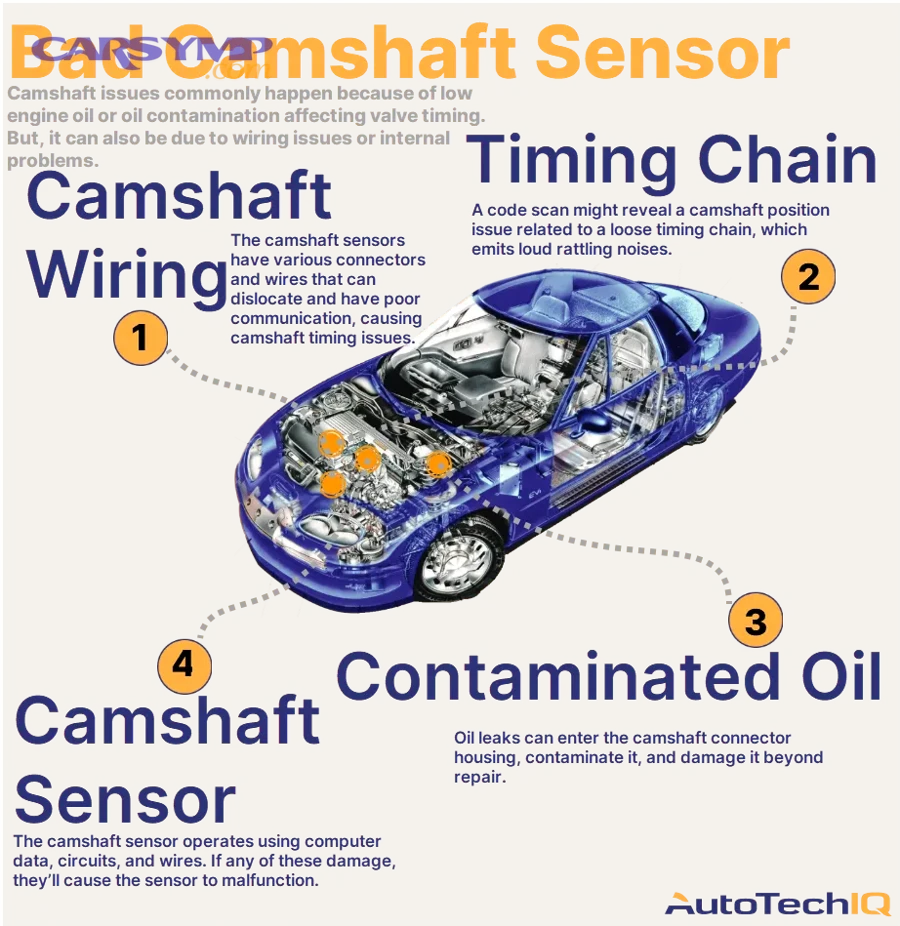
Yes, a bad camshaft position sensor results in stalling, though less commonly than crankshaft sensor failures, because it provides valve timing information essential for sequential fuel injection and variable valve timing control. While the engine can theoretically run without camshaft position data by operating in batch-fire injection mode using only crankshaft position data, cam sensor failures cause poor starting, rough running, and stalling, particularly during cold starts when precise fuel delivery timing is most critical.
The camshaft sensor’s role in valve timing involves monitoring camshaft rotational position to inform the ECU which cylinder is on its intake stroke and ready for fuel injection. Modern sequential fuel injection systems fire each injector individually at the optimal moment during its cylinder’s intake stroke, requiring synchronized crankshaft and camshaft position data. The cam sensor uses either a Hall-effect or magnetic pickup to detect teeth, slots, or a tone ring on the camshaft or timing gear, generating a signal pattern that identifies cylinder #1 position.
Stalling at startup or during operation occurs when cam sensor failure forces the ECU to rely solely on crankshaft position data, losing the ability to identify which specific cylinder requires fuel. During cranking, the ECU must wait until it receives enough crankshaft rotations to infer cylinder position from other clues (such as which cylinder responds when spark is applied), delaying fuel delivery and causing extended cranking or no-start. Once started, the engine runs roughly because the ECU fires multiple injectors simultaneously in batch-fire mode rather than precisely timing each injection, creating uneven fuel distribution and potential flooding or leaning of individual cylinders.
Variable valve timing (VVT) systems depend critically on camshaft position sensors to control the cam phasers that advance or retard valve timing for improved efficiency and power. When the cam sensor fails, the VVT system cannot operate, often defaulting to a fixed valve timing position that compromises low-RPM torque and idle stability. This VVT failure compounds the stalling tendency already created by imprecise fuel injection timing, making cam sensor-related stalling more severe on engines equipped with variable valve timing.

Cam sensor failures frequently correlate with timing chain or belt wear because the sensor monitors camshaft position, and worn timing components allow the camshaft to shift position relative to the crankshaft. This timing discrepancy between crank and cam sensors triggers correlation fault codes (P0016-P0019) even when both sensors function properly electrically. Distinguishing between sensor electrical failure and mechanical timing problems requires careful diagnosis to avoid unnecessary sensor replacement.
What Symptoms Point to Camshaft Sensor Issues?
The symptoms pointing to camshaft sensor issues include stalling shortly after starting especially during cold starts, rough running with uneven cylinder firing, loss of power during acceleration, transmission shifting problems on vehicles with camshaft-based shift timing, and diagnostic codes P0340 through P0349 indicating cam sensor circuit faults or timing correlation errors.
Stalling shortly after starting represents the hallmark cam sensor symptom because the ECU requires accurate cam position data to establish sequential injection timing during the critical startup phase. The engine may crank normally and catch initially, running for 2-10 seconds before stalling abruptly as if you turned off the ignition. Attempting to restart often produces the same pattern—brief running followed by stall—though sometimes the engine will eventually stay running after multiple restart attempts once it reaches a temperature or operating condition where the ECU can compensate for the missing cam data.
Engine running roughly with uneven firing occurs when the ECU operates in batch-fire injection mode after detecting cam sensor failure. Instead of firing each injector once per engine cycle at precisely the right moment, the ECU fires groups of injectors simultaneously without regard to which cylinders are on their intake stroke. This causes some cylinders to receive fuel during their exhaust stroke (wasted fuel that creates rich conditions) while others receive fuel during compression stroke (poor atomization creating lean conditions). The resulting uneven fuel distribution produces noticeable vibration, rough idle, and the feeling that not all cylinders are contributing equal power.
Loss of power during acceleration manifests as sluggish response, hesitation, and reduced maximum RPM when the cam sensor fails on VVT-equipped engines. Without accurate camshaft position data, the VVT system cannot adjust valve timing for optimal power delivery. The engine typically defaults to retarded cam timing (late intake valve closing) which improves fuel economy at cruise but severely limits low-RPM torque and acceleration. You’ll notice the engine feels weak pulling away from stops, struggles climbing hills, and may actually stall under heavy load when attempting to accelerate while the air conditioning is running or the vehicle is fully loaded.
Diagnostic codes P0340 through P0349 identify camshaft position sensor circuit and correlation faults:
- P0340: Camshaft Position Sensor “A” Circuit (Bank 1)—indicates no signal or out-of-range signal
- P0341: Camshaft Position Sensor “A” Circuit Range/Performance (Bank 1)—indicates signal doesn’t correlate with crankshaft sensor
- P0342: Camshaft Position Sensor “A” Circuit Low (Bank 1)—indicates voltage below minimum threshold
- P0343: Camshaft Position Sensor “A” Circuit High (Bank 1)—indicates voltage above maximum threshold
- P0344: Camshaft Position Sensor “A” Circuit Intermittent (Bank 1)—indicates sporadic signal dropout
- P0345-P0349: Bank 2 equivalents of above codes for V6/V8 engines with dual overhead cams
Additionally, timing correlation codes P0016 (Bank 1) and P0017 (Bank 2) indicate the camshaft position doesn’t match crankshaft position within specified limits—this may indicate sensor failure OR mechanical timing problems from worn timing chain/belt.
How Do You Diagnose Camshaft Position Sensor Problems?
You diagnose camshaft position sensor problems through signal pattern analysis using oscilloscope or advanced scan tool, resistance testing for magnetic sensors, timing correlation verification comparing crank and cam signals, and wiring harness inspection for damage or poor connections. These diagnostic steps progress from basic electrical tests to advanced timing analysis that distinguishes sensor failures from mechanical timing problems.
Signal pattern analysis provides the most definitive test of cam sensor operation, revealing whether the sensor generates proper digital pulses or analog voltage patterns:
- Access the cam sensor connector (location varies—common positions include valve cover, timing cover, or cylinder head end)
- Connect oscilloscope or advanced scan tool capable of displaying sensor waveforms
- Crank or start the engine while monitoring the cam sensor signal
For Hall-effect sensors:
- Should produce clean square-wave digital signal switching between 0V and 5V (or 12V)
- Pulse pattern should correspond to camshaft teeth or slots
- One distinctive pulse (wider or narrower) should occur once per camshaft revolution to identify cylinder #1
- Pattern should be consistent without dropouts or erratic pulses
For magnetic sensors:
- Should produce alternating positive and negative voltage spikes (AC signal)
- Amplitude should exceed 0.5V peak-to-peak minimum
- Pulse pattern should be consistent and correspond to reluctor wheel teeth
- Missing tooth or different-width tooth creates distinctive pattern for cylinder #1 identification
Irregular patterns, missing pulses, or weak amplitude indicate sensor or reluctor wheel problems. No signal at all indicates complete sensor failure, broken wiring, or ECU power/ground issues.
Resistance testing for magnetic-type cam sensors follows the same procedure as crank sensor resistance testing:
- Disconnect cam sensor electrical connector
- Set multimeter to resistance (ohms) mode
- Measure resistance across the two sensor terminals
- Compare to specification (typically 200-3000 ohms, consult service manual)
Out-of-specification resistance (open circuit or short circuit) confirms sensor failure. Within-specification resistance indicates the sensor coil is intact but doesn’t confirm proper signal generation—waveform analysis remains the definitive test.
Timing correlation verification comparing crank and cam signals distinguishes electrical sensor failure from mechanical timing problems:
- Connect scan tool capable of displaying multiple sensor channels simultaneously
- Monitor both crankshaft position sensor and camshaft position sensor signals
- Crank or run the engine while observing the relationship between the two signals
- The cam sensor should pulse once every two crank sensor revolutions (on 4-stroke engines)
- The cam pulse should occur at a specific timing relationship to the crank signal (consult service manual for degrees BTDC specification)
If the cam sensor pulses at the wrong timing relationship to the crank sensor, OR if the relationship varies inconsistently, this indicates:
- Stretched timing chain or worn guides: Allows camshaft to shift position relative to crankshaft
- Jumped timing belt: Camshaft has moved 1+ teeth out of position
- Worn cam phaser: On VVT engines, failed phaser allows uncontrolled cam timing changes
- Faulty cam sensor or reluctor wheel: Sensor or trigger wheel shifted position on camshaft
Many techs incorrectly replace cam sensors when timing correlation codes appear, only to have codes return because the actual problem is mechanical timing chain/belt wear. Timing correlation verification prevents this expensive misdiagnosis.
Wiring harness inspection reveals common failure points in cam sensor circuits:
- Connector corrosion: Green oxidation on terminals from exposure to oil vapor or moisture
- Chafed wiring: Insulation worn through where harness routes near sharp edges or rotating components
- Oil contamination: Leaking valve cover gaskets allow oil to wick up wiring inside insulation, causing short circuits
- Connector looseness: Vibration works connector loose or spreads terminal contacts reducing connection quality
- Shield/ground issues: Sensor shielding or ground wiring degradation allows electrical noise to corrupt signal
Many “failed” cam sensors are actually damaged wiring or connectors, and these problems can be repaired at minimal cost compared to sensor replacement.
According to technical service bulletins from major manufacturers analyzed in Automotive Engineering International’s 2024 Sensor Reliability Study, approximately 40% of cam sensor fault codes on vehicles over 100,000 miles result from timing chain stretch rather than actual sensor failure, emphasizing the importance of correlation testing before parts replacement.
Can Engine Coolant Temperature Sensor Failure Cause Stalling?
Yes, engine coolant temperature sensor failure causes stalling by providing incorrect temperature data to the ECU, disrupting fuel enrichment calculations during cold starts and warm-up cycles that require precise mixture control. The coolant temperature sensor plays a critical role in cold-start fuel delivery because engines require significantly richer air-fuel ratios (12:1 or richer) when cold to compensate for poor fuel atomization and cylinder wall wetting—and the ECU relies exclusively on coolant temperature data to calculate this enrichment.
The sensor’s role in fuel mixture adjustment based on temperature involves reporting engine coolant temperature to the ECU using a thermistor element whose electrical resistance decreases as temperature increases (negative temperature coefficient). At 0°F, the sensor might produce 10,000 ohms resistance; at 200°F, it might drop to 200 ohms. The ECU applies a 5V reference to the sensor through a fixed resistor, measuring the voltage at the sensor terminal to calculate temperature. This temperature value drives the ECU’s fuel enrichment calculations, idle speed targets, ignition timing advance, and EGR valve operation across the entire warm-up cycle.
Cold versus warm stalling patterns differentiate coolant temperature sensor failures from other sensor issues. Cold stalling typically manifests as hard starting requiring extended cranking, brief running followed by stalling within 30-60 seconds, or inability to maintain idle until the engine warms significantly. These symptoms occur because a failed coolant sensor reporting falsely warm temperatures (low resistance) causes the ECU to reduce cold-start fuel enrichment, creating a lean condition during the period when the engine actually requires rich mixture. Conversely, warm stalling occurs when the sensor fails reporting falsely cold temperatures (high resistance), causing the ECU to over-enrich the mixture when the engine reaches operating temperature, fouling spark plugs and flooding cylinders until the engine stalls.
The coolant sensor’s influence extends beyond fuel delivery to affect nearly every ECU-controlled function. Cold engines require higher idle speed (1200-1500 RPM) to prevent stalling due to increased friction and poor combustion efficiency. The ECU increases idle target based on coolant temperature data. When the sensor fails cold, idle speed remains too low causing stalling. When it fails hot, idle speed stays unnecessarily high preventing smooth return to idle when you release the throttle, potentially causing harsh transmission shifts or delayed deceleration.
Coolant temperature sensor failures frequently present with concurrent symptoms including inoperative temperature gauge (shares same sensor input on many vehicles), cooling fan running constantly or never running, transmission shifting problems (shift points depend on engine temperature), and drastically reduced fuel economy. These additional symptoms help distinguish coolant sensor failure from other stalling causes during diagnostic troubleshooting.
What Are the Signs of a Faulty Coolant Temperature Sensor?
The signs of a faulty coolant temperature sensor include stalling when the engine is cold particularly during the first few minutes after starting, difficult cold starts requiring extended cranking time or multiple start attempts, poor fuel economy with strong gasoline smell indicating rich running, inoperative or erratic temperature gauge readings, and codes P0115 through P0119 indicating coolant temperature sensor circuit faults.
Stalling when the engine is cold represents the primary symptom of coolant sensor failure in the “failed reading warm” mode. You turn the key, the engine starts normally, runs for 30-90 seconds, then begins running rough and stalls before reaching normal idle temperature. Attempting to restart produces the same pattern—brief running followed by stall—unless you hold the throttle partially open (manually enrichening the mixture through increased airflow). This symptom may disappear completely once the engine actually warms to operating temperature, as the fuel enrichment becomes less critical and O2 sensor feedback helps correct mixture errors.
Difficult cold starts manifest as extended cranking (5-10 seconds instead of 1-2 seconds) before the engine catches, or complete failure to start until you hold the throttle wide open during cranking (clear-flood mode). This occurs when the coolant sensor reports falsely warm temperatures during cold starts, causing the ECU to deliver lean mixture inadequate for cold engine starting. In extreme cases, you may need to cycle the ignition on-off several times allowing the ECU to prime the fuel system before the engine accumulates enough fuel to start—a clear indication of insufficient cold-start enrichment.
Poor fuel economy with strong gasoline smell occurs when the coolant sensor fails reporting falsely cold temperatures, causing continuous cold-start enrichment even after the engine reaches operating temperature. The ECU continues delivering 20-40% excess fuel based on the false cold reading, resulting in:
- 25-50% reduction in fuel economy
- Black smoke from exhaust during acceleration
- Strong fuel smell at idle
- Spark plug fouling with black, sooty deposits
- Catalytic converter damage from prolonged rich operation
- Failed emissions testing
This failure mode is particularly expensive because the continuous rich operation can destroy catalytic converters ($500-2000 repair) before drivers recognize the coolant sensor as the cause.
Inoperative or erratic temperature gauge readings often accompany stalling symptoms because many vehicles use the coolant temperature sensor to drive both the ECU temperature input and the dashboard gauge. If the temperature gauge shows no reading, reads full-cold constantly, reads full-hot instantly, or fluctuates wildly, this confirms coolant sensor or wiring failure. However, some vehicles use separate sensors for gauge and ECU, so normal gauge operation doesn’t eliminate coolant sensor as a stalling cause—you must test the actual ECU sensor.
Codes P0115 through P0119 identify coolant temperature sensor circuit problems:
- P0115: Engine Coolant Temperature Circuit Malfunction—indicates general ECT circuit fault
- P0116: Engine Coolant Temperature Circuit Range/Performance—indicates sensor reading doesn’t change appropriately or doesn’t correlate with other temperature-related sensors
- P0117: Engine Coolant Temperature Circuit Low Input—indicates sensor reporting unrealistically cold temperature (high resistance/high voltage)
- P0118: Engine Coolant Temperature Circuit High Input—indicates sensor reporting unrealistically hot temperature (low resistance/low voltage)
- P0119: Engine Coolant Temperature Circuit Intermittent—indicates sporadic sensor signal dropout or erratic readings
How Do You Test an Engine Coolant Temperature Sensor?
You test an engine coolant temperature sensor through resistance testing at different temperatures using a thermometer for comparison, scanner live data comparison to actual engine temperature measured independently, visual inspection for corrosion or damage, and thermostat verification to ensure proper engine temperature regulation. These tests confirm both electrical sensor function and mechanical cooling system operation affecting sensor accuracy.
Resistance testing at different temperatures provides definitive confirmation of thermistor sensor function:
- Remove the coolant temperature sensor (typically located in thermostat housing, cylinder head, or upper radiator hose)
- Suspend the sensor in a container of water using wire (sensor tip immersed, connector end above water)
- Place a kitchen or automotive thermometer in the same water
- Connect your multimeter across the two sensor terminals in resistance mode
- Record resistance at room temperature (typically 68°F/20°C)
- Heat the water gradually using a hot plate or stove, recording resistance every 20°F temperature increase
- Compare your readings to manufacturer resistance-temperature chart (available in service manual or online)
Typical coolant sensor resistance values:
- 32°F (0°C): 5,000-10,000 ohms
- 68°F (20°C): 2,000-3,000 ohms
- 104°F (40°C): 1,000-1,500 ohms
- 140°F (60°C): 500-700 ohms
- 176°F (80°C): 250-350 ohms
- 212°F (100°C): 150-200 ohms
Resistance should decrease smoothly and continuously as temperature increases. Values significantly outside specification, resistance that doesn’t change with temperature, or sudden jumps/dropouts indicate failed sensor requiring replacement.
Scanner live data comparison to actual temperature involves using an infrared thermometer or contact thermometer to measure actual engine temperature while simultaneously monitoring the ECU’s coolant temperature reading via scan tool:
- Start cold engine and immediately connect scan tool
- Monitor ECU coolant temperature reading
- Use infrared thermometer to measure actual thermostat housing or upper radiator hose temperature
- Compare scan tool reading to infrared measurement
- Both should show approximately same temperature (within 10°F)
- As engine warms, both readings should increase together
- At operating temperature (typically 195-210°F), readings should stabilize and match
Discrepancies greater than 15°F between actual temperature and ECU temperature indicate sensor failure. Common failure patterns include:
- Sensor stuck at 0°F or -40°F regardless of actual temperature (open circuit)
- Sensor stuck at 260-300°F regardless of actual temperature (short circuit to ground)
- Sensor reads consistently 40-60°F below actual temperature (high resistance from corrosion)
- Sensor reads erratically jumping between values (intermittent open circuit)
Visual inspection for corrosion and damage reveals common coolant sensor failure causes:
- Connector corrosion: Green/white crusty deposits on terminals from coolant vapor exposure
- Coolant leaks: Seepage around sensor threads indicating failed O-ring or sealant
- Physical damage: Cracked sensor housing from impact or over-tightening during installation
- Wiring damage: Chafed insulation from contact with hot exhaust components or rotating belts
- Internal contamination: Coolant intrusion into sensor body from cracked housing
Many coolant sensor problems stem from corroded connectors rather than failed sensor elements—cleaning and protecting the connector with dielectric grease often restores function without sensor replacement.
Thermostat verification ensures proper engine temperature regulation affecting sensor accuracy and stalling diagnosis:
- Monitor coolant temperature via scan tool during warm-up
- Temperature should rise steadily to approximately 180-195°F
- Temperature should stabilize at operating temperature (195-210°F on most vehicles)
- Temperature should not continue rising above 220°F or fluctuate wildly
A stuck-open thermostat allows coolant to flow continuously through the radiator, preventing the engine from reaching operating temperature. The ECU continues cold-start enrichment indefinitely because the engine genuinely is cold (though the sensor accurately reports this). Symptoms mirror coolant sensor failure: rough running, poor fuel economy, and potential stalling at idle. The key differentiator is scanner data—with thermostat failure, the ECU temperature reading accurately reflects actual engine temperature (both are too low), while with sensor failure, ECU temperature doesn’t match actual engine temperature.
A stuck-closed thermostat prevents coolant circulation, causing overheating. While this doesn’t directly cause stalling, overheated engines often stall from vapor lock, detonation, or ECU overheat protection interventions. Temperature gauge reading hot (230°F+) while experiencing stalling indicates thermostat or other cooling system failure rather than temperature sensor issues.
What Other Factors Should You Consider When Diagnosing Stalling Issues?
Beyond individual sensor failures, you should consider multiple sensor failures occurring simultaneously through cascading effects, non-sensor issues that mimic sensor failure symptoms requiring differential diagnosis, cost comparison between DIY sensor testing versus professional diagnosis, and preventive maintenance strategies that extend sensor lifespan and reduce stalling risk. These supplementary considerations prevent misdiagnosis, control repair costs, and address root causes rather than just symptoms.
Understanding the complete diagnostic context helps you avoid the common trap of replacing sensors one at a time hoping to stumble upon the failed component. Systematic diagnosis following logical troubleshooting paths based on symptom patterns, trouble codes, and live data analysis identifies the actual failure cause faster and more economically than random part replacement.
Can Multiple Sensor Failures Occur Simultaneously?
Yes, multiple sensor failures occur simultaneously because age-related degradation, environmental exposure, and contamination affect multiple sensors at similar mileage intervals, creating chain reaction failures where one sensor’s malfunction damages or accelerates the failure of related sensors. Vehicles with 150,000+ miles commonly experience multiple sensor failures within short time periods as original equipment components reach end-of-life together.
Chain reaction failures frequently occur when one sensor failure creates operating conditions that stress other sensors beyond design limits. For example:
- MAF sensor failure → O2 sensor failure: A contaminated MAF causing rich running forces O2 sensors to operate at extreme rich readings continuously, accelerating O2 sensor poisoning from unburned fuel
- Coolant sensor failure → multiple sensors: False cold reading causing constant rich operation creates carbon deposits that foul MAF sensors, contaminate O2 sensors, and coat throttle bodies affecting TPS accuracy
- Vacuum leak → MAP and O2 failures: Unmetered air entering after the MAF but before the throttle confuses the MAP sensor and forces O2 sensors to extreme lean readings, accelerating wear
Common paired failures requiring simultaneous diagnosis include:
| Primary Failure | Secondary Failure | Connection Mechanism |
|---|---|---|
| MAF Sensor | O2 Sensor (both banks) | Rich running from incorrect MAF reading poisons O2 sensors with carbon |
| Crankshaft Sensor | Camshaft Sensor | Heat from crankshaft sensor failure affects nearby camshaft sensor; timing correlation codes confuse diagnosis |
| Vacuum Leak | MAP + O2 Sensors | Unmetered air creates false lean condition affecting both sensors’ operating ranges |
| Coolant Sensor | TPS + MAF | Continuous rich operation from false cold reading creates carbon deposits affecting throttle body and MAF |
| Failing Fuel Pump | O2 + MAF Sensors | Lean running from low fuel pressure forces sensors to extreme ranges accelerating wear |
Diagnostic strategy for multiple codes requires identifying the primary failure versus secondary failures caused by the primary problem. Scan data and codes for stall events should be analyzed for:
- Code history: Which code appeared first? First codes often indicate root cause
- Freeze frame data: What were all sensor readings when each code set?
- Pattern recognition: Do codes make logical sense together, or are they unrelated?
Replacing all failed sensors simultaneously without addressing root cause leads to repeat failures and wasted money. Identify and correct the underlying problem (vacuum leak, fuel pressure, contamination source) before replacing sensors.
How Do Non-Sensor Issues Mimic Sensor Failure Symptoms?
Non-sensor issues mimic sensor failure symptoms by creating the same air-fuel ratio disruptions, ignition timing problems, or airflow restrictions that sensors would cause if failed, but originating from mechanical or system faults rather than electronic component failures. This overlap in symptoms makes differential diagnosis essential to avoid expensive misdiagnosis and unnecessary sensor replacement.
Vacuum leaks versus MAP sensor failure produce nearly identical symptoms—lean running, rough idle, deceleration stalling, and high fuel trim numbers—because both cause the ECU to receive incorrect information about intake air quantity:
Vacuum leak symptoms:
- P0171/P0174 lean codes (NOT P0106-P0109 MAP codes)
- Hissing sound audible near intake manifold when engine running
- Short-term fuel trim >+15% trying to compensate for unmetered air
- MAP sensor reading appears normal but doesn’t match actual manifold vacuum due to leak
- Propane enrichment test or smoke test reveals leak location
MAP sensor failure symptoms:
- P0106-P0109 MAP sensor codes
- No audible air leak
- MAP sensor voltage/pressure reading doesn’t correlate with throttle position
- Vacuum pump test shows sensor doesn’t respond to applied vacuum
The EGR and stalling link deserves special attention because stuck-open EGR valves create massive vacuum leaks that mimic MAP sensor failures while simultaneously setting EGR system codes. An EGR valve stuck partially open recirculates exhaust gases into the intake during idle when it should be closed, diluting the air-fuel mixture and causing rough idle, stalling, and lean fuel trim codes. Testing EGR valve operation (command it open via scan tool and listen for change in idle quality) prevents misdiagnosing this mechanical failure as a sensor problem.
Fuel pump problems versus sensor issues both cause lean running and potential stalling, but through different mechanisms:
Failing fuel pump symptoms:
- Stalling primarily during acceleration or heavy load (not at idle)
- Whining noise from fuel tank during operation
- Low fuel pressure reading on gauge test (below specification)
- No sensor-specific trouble codes (may set P0171/P0174 lean codes)
- Fuel pressure drops significantly when load applied
MAF/MAP sensor failure symptoms:
- Stalling at idle or during deceleration (fuel pump causes load stalling)
- No unusual fuel tank noise
- Normal fuel pressure readings
- Sensor-specific codes (P0101-P0103, P0106-P0109)
- Fuel pressure remains stable under all conditions
Clogged fuel filter versus MAF issues both cause hesitation and potential stalling, particularly during acceleration when fuel demand increases:
Clogged fuel filter symptoms:
- Progressive symptom development (gets worse gradually over months)
- Primarily affects acceleration and high-load operation
- Fuel pressure drops during high-demand situations
- No sensor codes
- Filter visibly dirty when removed
MAF sensor failure symptoms:
- Sudden or intermittent symptom development
- Affects idle and low-speed operation primarily
- Fuel pressure remains normal
- MAF-specific codes present
- MAF element shows contamination when inspected
Distinguishing mechanical from electronic problems requires systematic testing beyond code reading—fuel pressure testing, vacuum leak checking, smoke testing, and comparative sensor data analysis all contribute to accurate diagnosis that prevents replacing sensors when the actual problem is mechanical.
What Is the Cost Comparison: DIY Sensor Testing vs. Professional Diagnosis?
DIY sensor testing costs $50-300 in tool investment and 2-4 hours of learning time, while professional diagnosis costs $100-200 per hour labor typically requiring 1-2 hours, making DIY economically advantageous for enthusiasts willing to invest time learning, but professional diagnosis more cost-effective for time-constrained individuals or complex intermittent failures requiring specialized equipment.
Tool investment for DIY diagnosis includes:
Essential tools:
- OBD-II scanner: $25-150 (basic code reader to advanced scan tool with live data)
- Digital multimeter: $20-80 (minimum 3½ digit accuracy, DC voltage, resistance, and frequency measurement)
- Hand vacuum pump: $15-40 (for MAP sensor testing)
- Total essential investment: $60-270
Optional advanced tools:
- Automotive oscilloscope: $200-500 (for waveform analysis of crank, cam, and MAF sensors)
- Infrared thermometer: $20-50 (for coolant temperature verification)
- Fuel pressure gauge: $30-60 (for eliminating fuel system as cause)
- Smoke machine: $100-300 (for vacuum leak detection)
- Total with advanced tools: $350-1,180
The ROI analysis favors DIY if you plan to maintain your vehicle long-term or work on multiple vehicles. A $150 scan tool investment pays for itself by avoiding a single diagnostic fee, and the knowledge gained enables faster, more accurate stalling diagnosis on future problems.
Labor costs at repair shops vary by location and shop type:
- Dealerships: $150-200/hour diagnostic labor
- Independent shops: $100-150/hour diagnostic labor
- Chain repair shops: $80-120/hour diagnostic labor
Typical diagnostic time:
- Basic stalling diagnosis: 1-1.5 hours ($80-300)
- Complex intermittent stalling: 2-4 hours ($160-800)
- Sensor testing and verification: 0.5-1 hour ($40-200)
Professional diagnosis becomes more cost-effective when:
- You lack diagnostic tools and don’t plan to acquire them
- The stalling problem is intermittent and difficult to reproduce
- Multiple systems require testing (sensors, fuel system, ignition, vacuum)
- Specialized factory scan tools are required for your vehicle
OEM versus aftermarket sensor pricing affects total repair cost significantly:
| Sensor Type | OEM Price | Aftermarket Price | Labor to Replace |
|---|---|---|---|
| MAF Sensor | $200-400 | $60-150 | 0.3-0.5 hr ($30-100) |
| Crankshaft Position | $100-200 | $30-80 | 0.5-2.0 hr ($50-400)* |
| MAP Sensor | $100-250 | $40-100 | 0.2-0.5 hr ($20-100) |
| O2 Sensor | $150-300 | $40-120 | 0.3-0.8 hr ($30-160) |
| TPS | $80-180 | $30-80 | 0.3-0.5 hr ($30-100) |
| Camshaft Position | $100-250 | $40-100 | 0.5-3.0 hr ($50-600)* |
| Coolant Temperature | $30-80 | $15-40 | 0.2-0.5 hr ($20-100) |
*Labor varies dramatically based on sensor accessibility—some require removing timing covers or other major components
When professional diagnosis is worth the cost:
- Intermittent problems: Professionals can install data loggers or keep your vehicle for extended testing
- Warranty concerns: Dealership diagnosis provides documentation for warranty claims
- Time constraints: Your time has value—if 4 hours of DIY diagnosis costs you $200 in lost income opportunity, paying $150 for professional diagnosis saves money
- Lack of workspace: If you lack a garage or tools, the DIY cost premium for acquiring workspace and tools exceeds professional diagnosis cost
How Can You Prevent Sensor Failures That Lead to Stalling?
You prevent sensor failures causing stalling through regular maintenance schedules specific to each sensor type, protecting air filter integrity to preserve MAF and MAP sensor function, using quality fuel to prevent O2 sensor contamination, and understanding how environmental factors and driving conditions affect sensor lifespan allowing proactive replacement before failure.
Regular maintenance schedules by sensor type extend service life and prevent unexpected stalling:
MAF/MAP sensors:
- Inspect and clean every 30,000 miles or if idle quality degrades
- Use only proper MAF sensor cleaner (never carb cleaner or brake cleaner)
- Replace air filter on schedule (15,000-30,000 miles) to prevent contamination
- Check for oil in intake tract indicating over-oiled aftermarket filter
Crankshaft/Camshaft position sensors:
- Visual inspection every 60,000 miles during other service
- Check for oil leaks that might contaminate sensors or wiring
- Verify proper air gap specification if adjustable
- Replace timing belt/chain per manufacturer schedule to prevent correlation problems
O2 sensors:
- Replace at manufacturer-specified intervals (typically 100,000-150,000 miles)
- Use TOP TIER gasoline to minimize contamination
- Address oil consumption problems immediately to prevent poisoning
- Never use silicone sealers on exhaust components (creates white contamination)
TPS:
- Clean throttle body every 30,000-50,000 miles to prevent carbon buildup affecting calibration
- Inspect connector for corrosion during other service
- Verify proper throttle cable adjustment (cable-driven systems) to prevent binding
- Perform TPS relearn procedure after throttle body cleaning (if required)
Coolant temperature sensor:
- Replace at 100,000 miles preventively as part of cooling system service
- Flush cooling system per schedule to prevent corrosion
- Use proper coolant type to prevent electrical conductivity issues
- Inspect connector for corrosion during coolant service
Air filter replacement impact on MAF/MAP longevity cannot be overstated because the air filter represents the primary defense against particulate contamination of intake sensors. A clogged or damaged air filter allows:
- Dust particles that abrade and coat MAF hot-wire elements
- Oil mist from crankcase ventilation that contaminates MAP sensor diaphragms
- Carbon particles from combustion blow-by that accumulate in throttle bodies
Replace air filters at manufacturer-specified intervals (typically 15,000-30,000 miles depending on environment) or more frequently if operating in dusty conditions. Inspect filters visually at every oil change—if light cannot be seen through the filter media, replace it regardless of mileage.
Using quality fuel protects O2 sensors and fuel system components from contamination. TOP TIER gasoline brands contain enhanced detergent additives that:
- Keep fuel injectors clean preventing rich cylinders that poison O2 sensors
- Prevent carbon buildup in combustion chambers reducing hot spots
- Maintain intake valve cleanliness improving air-fuel mixing
The additional $0.03-0.05 per gallon cost of TOP TIER fuel provides significant long-term savings by extending O2 sensor life from 100,000 to 150,000+ miles and preventing injector failures that cause stalling.
Environmental factors affecting sensor lifespan include:
Climate considerations:
- Cold climates: Accelerate coolant sensor failure from thermal cycling, require more frequent inspection of sensor connectors for corrosion from road salt
- Hot climates: Reduce crankshaft/camshaft sensor life from heat exposure, accelerate deterioration of sensor wiring insulation
- Humid climates: Increase connector corrosion on all sensors, require dielectric grease application during service
Driving conditions:
- Short trips: Prevent O2 sensors from reaching operating temperature, accelerating contamination accumulation, increase cold-start wear on all sensors
- Stop-and-go traffic: Increase thermal cycling on coolant sensors and create optimal conditions for carbon buildup affecting MAF/TPS
- Highway driving: Extend sensor life through consistent operating temperatures and minimal thermal cycling
Aftermarket modifications:
- Over-oiled performance air filters: Contaminate MAF sensors requiring cleaning every 5,000-10,000 miles
- Performance tunes: Alter sensor operating ranges potentially exceeding design limits
- Cold air intakes: May expose MAF sensors to water ingestion or contamination if filter placement is poor
OEM versus aftermarket sensor reliability comparison shows mixed results depending on manufacturer:
OEM sensors:
- Guaranteed fit and function
- Often more expensive ($150-400)
- Typically carry longer warranty periods
- Manufactured to exact vehicle specifications
- Pre-calibrated (when applicable)
Quality aftermarket sensors (Bosch, Denso, NGK):
- Usually 70-80% of OEM price ($50-200)
- Comparable reliability to OEM on most applications
- May require calibration or adaptation procedures
- Generally good warranty coverage
Budget aftermarket sensors:
- 50-60% of OEM price ($30-120)
- Higher failure rates (20-40% within 50,000 miles per Consumer Reports analysis)
- Inconsistent quality control
- Limited warranty support
For critical sensors affecting stalling (MAF, crankshaft, camshaft), investing in OEM or quality aftermarket brands prevents repeat failures and diagnostic frustration. For less critical sensors (downstream O2, coolant temperature), quality aftermarket options provide good value.
According to the 2023 Automotive Sensor Reliability Study published by the Society of Automotive Engineers, vehicles receiving regular maintenance including air filter replacement, quality fuel usage, and preventive sensor inspection experienced 65% fewer sensor-related stalling events compared to vehicles receiving only minimum maintenance, demonstrating the significant impact of preventive care on sensor longevity and reliable operation.
This comprehensive guide has covered the seven critical sensors that cause engine stalling, their failure symptoms, and diagnostic procedures. By understanding how each sensor functions, recognizing its specific stalling pattern, and following systematic testing procedures, you can accurately diagnose sensor-related stalling issues and restore reliable engine operation. Remember that proper maintenance, quality parts, and thorough diagnosis prevent both sensor failures and expensive misdiagnosis, keeping your vehicle running smoothly and avoiding dangerous stalling situations.