


power steering leak repair costs range from $150 to $670 on average, with expenses varying based on the leak’s location, required parts, labor rates, and vehicle type. The total cost breaks down into two main components: parts (ranging from $10 for O-rings to $500 for rack and pinion assemblies) and labor (typically $40 to $200 per hour depending on your location and shop type). Most car owners spend between $500 and $650 for complete power steering leak repair, though simple fixes like hose clamp replacements may cost as little as $20, while extensive repairs involving rack and pinion replacement can exceed $1,000.
Understanding the individual component costs helps you evaluate repair quotes and avoid overpaying. Different repair scenarios carry significantly different price tags—a leaking O-ring might require only $50 in parts and an hour of labor, while a failing power steering pump demands $250 in parts plus two to three hours of professional work. Dealerships typically charge 20-40% more than independent mechanics for identical repairs, and luxury vehicles incur higher costs due to specialized parts and complex systems.
Vehicle-specific factors dramatically influence your final bill. Trucks and SUVs generally cost more to repair than sedans due to accessibility challenges and larger components, while European luxury vehicles like BMW and Mercedes-Benz can double or triple repair costs compared to domestic or Japanese brands. Geographic location also plays a role, with urban areas commanding higher labor rates than rural shops.
Smart car owners can reduce expenses through early detection and informed decision-making. Catching leaks early through regular fluid level checks and visual inspections prevents minor issues from escalating into major system failures. Below, we’ll examine exactly what you’ll pay for each component, compare different repair options, and show you how to identify fair pricing from inflated quotes.
How Much Does Power Steering Leak Repair Cost?
Power steering leak repair costs between $150 and $670 for most standard repairs, with the national average settling around $500 to $650 when including both parts and labor. This cost range covers common scenarios like hose replacements, seal repairs, and pump fixes, though more extensive damage requiring rack and pinion replacement can push expenses beyond $1,000.
The total expense depends on several interconnected factors that determine both parts costs and labor hours. Let’s break down what determines your final bill and what you should expect to pay in 2026.
What Is the Average Cost Range for Power Steering Leak Repairs in 2026?
The average cost range for power steering leak repairs in 2026 spans from $150 for minor hose and seal repairs to $670 for more complex component replacements, with most car owners paying between $500 and $650. This range reflects current parts pricing and prevailing labor rates across the United States, accounting for both independent mechanics and dealership service departments.
Specifically, the cost breakdown follows these typical scenarios:
- Simple hose clamp tightening or minor seal leak: $100 to $220
- Single hose replacement: $200 to $350
- Power steering pump replacement: $300 to $550
- Rack and pinion replacement: $500 to $1,200
- Complete system overhaul: $800 to $1,500
These figures include both parts and labor costs. The lower end of each range typically applies to domestic vehicles serviced at independent shops, while the upper end reflects dealership pricing or repairs on luxury vehicles. Labor typically accounts for 40-60% of the total cost, with diagnostic fees adding $50 to $100 when shops need to locate the leak source using specialized equipment or dye testing.
What Factors Determine the Total Repair Cost?
Several key factors determine your total power steering leak repair cost, with vehicle make and model, leak location, shop type, and geographic area being the most significant variables. These factors can swing your final bill by hundreds of dollars even for identical repairs.
Vehicle make and model create the largest cost variance. Luxury brands like BMW, Mercedes-Benz, Audi, and Lexus require specialized parts that cost 50-150% more than standard vehicles. A power steering pump for a Honda Civic might cost $120, while the same component for a BMW 5 Series runs $350. European vehicles also demand more labor hours due to complex engine bay layouts and specialized tools.
Leak location directly impacts labor costs. A leaking high-pressure hose near the pump might require only 30 minutes to replace, while accessing rack and pinion seals can demand 4-5 hours of work involving removal of multiple components. Front-wheel-drive vehicles generally cost less to repair than all-wheel-drive systems due to simpler access.
Shop type creates predictable pricing patterns. Independent mechanics charge $75 to $150 per hour for labor, while dealerships command $100 to $200 per hour. Mobile mechanics fall in between at $80 to $160 per hour but add convenience fees. Chain repair shops like Jiffy Lube or Midas typically price competitively with independent shops but may push additional services.
Geographic location influences both parts and labor costs. Urban areas in California, New York, and Massachusetts see labor rates 20-30% higher than rural areas in the Midwest or South. A repair costing $450 in rural Oklahoma might run $650 in San Francisco for identical work.
System type also matters. Traditional hydraulic power steering systems cost less to repair than modern electro-hydraulic power steering (EHPS) systems, which include electronic sensors and computer modules that increase diagnostic complexity and parts costs by 15-25%.
According to data compiled by carsymp.com, repair costs have increased approximately 8-12% since 2024 due to inflation in parts pricing and rising labor rates, making 2026 one of the more expensive years for automotive maintenance.
What Are the Individual Parts Costs for Power Steering Leak Repairs?
Individual power steering parts range from $10 for basic O-rings and seals to $500 for complete rack and pinion assemblies, with most components falling in the $50 to $250 range. Understanding these specific part costs helps you evaluate whether repair quotes are reasonable and identify which component is failing in your system.
These parts costs represent aftermarket or OEM-equivalent parts from reputable manufacturers. Dealer OEM parts typically add 20-40% to these base prices. Below, we’ll examine each major component’s cost and replacement considerations.
How Much Do Power Steering Hoses Cost to Replace?
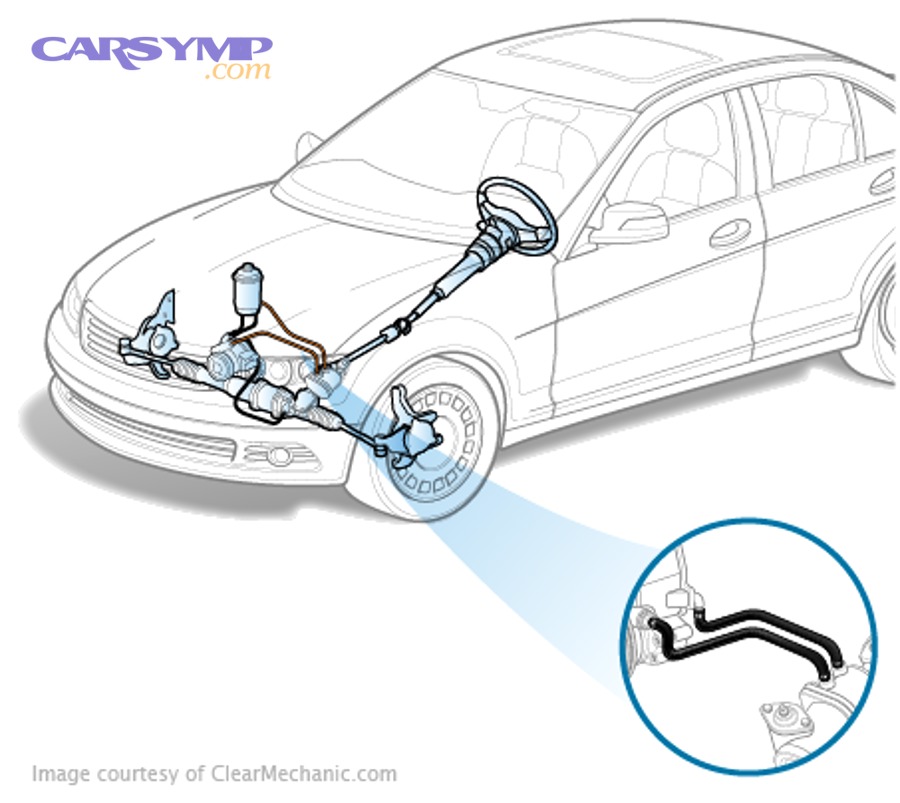
Power steering hose replacement costs between $80 and $250 for parts and labor combined, with high-pressure hoses running $50 to $150 and low-pressure return hoses costing $30 to $100. Labor adds another $50 to $150 depending on hose accessibility and whether both hoses require replacement.
High-pressure hoses carry fluid from the pump to the steering rack at pressures reaching 1,000 to 2,500 PSI, making them more expensive and prone to failure than return hoses. These hoses feature reinforced construction with multiple layers of synthetic rubber and braided steel, explaining their higher cost. Signs of high-pressure hose failure include visible fluid leaks near connection points, hose bulging, or cracks in the rubber exterior.
Return hoses operate under minimal pressure, simply carrying fluid back to the reservoir. These hoses cost less but fail more frequently at connection points where hose clamps loosen over time. Many car owners save $100 to $150 by replacing worn hose clamps ($5 to $15 for quality stainless steel clamps) rather than the entire return hose.
Total replacement time ranges from 0.5 to 2 hours depending on vehicle design. Some vehicles provide easy access to hoses, while others require removing air intake components, engine covers, or even raising the vehicle to access hoses from underneath. Front-wheel-drive vehicles with transverse engines typically require more labor than rear-wheel-drive configurations.
What Does a Power Steering Pump Replacement Cost?
Power steering pump replacement costs between $300 and $550 total, with the pump itself ranging from $100 to $250 and labor adding $100 to $300 depending on pump location and drive belt configuration. Rebuilt pumps offer a budget alternative at $75 to $150, though new pumps provide longer service life.
The power steering pump creates hydraulic pressure that makes steering effortless, operating continuously whenever the engine runs. Pump failure typically occurs gradually, announced by whining noises when turning the steering wheel, especially at low speeds or when stationary. A failing pump may also cause stiff steering, particularly when cold, or create a groaning sound during sharp turns.
Pump replacement involves several critical steps beyond simple removal and installation. Mechanics must drain existing power steering fluid, disconnect high-pressure and return lines, remove the serpentine belt, unbolt the pump from its mounting bracket, and reverse the process with the new pump. After installation, flushing the system becomes crucial to remove any contamination and metal debris that may have circulated before pump failure.
Labor time varies significantly by vehicle. Honda and Toyota models typically allow pump replacement in 1.5 to 2 hours, while European vehicles or trucks may require 3 to 4 hours due to tight engine compartments. Vehicles with Pump shaft seal leak diagnosis might need only seal replacement ($20 to $40 in parts) rather than complete pump replacement, potentially saving $200 to $300.
How Much Does Rack and Pinion Replacement Cost?
Rack and pinion replacement represents the most expensive common power steering leak repair, costing between $500 and $1,200 total, with parts ranging from $300 to $500 and labor adding $200 to $700 depending on vehicle type and drive configuration. Front-wheel-drive vehicles with transverse engines typically cost more due to complex removal procedures.
The rack and pinion assembly converts steering wheel rotation into lateral wheel movement, containing precision-machined gears, hydraulic seals, and tie rod connections. This component rarely fails completely but develops leaks at the internal seals (rack seals) or boot connections as vehicles age beyond 100,000 miles. Symptoms include fluid accumulation inside the rubber boots at each end of the rack, visible fluid dripping near the front wheels, or increasingly loose steering feel.
Replacement requires extensive disassembly. Mechanics must raise the vehicle, remove both front wheels, disconnect tie rod ends, detach brake line brackets, unbolt the rack from the subframe, and carefully maneuver the assembly out through limited clearance. All-wheel-drive vehicles and trucks add complexity through interference with driveshafts and differential components.
After installation, wheel alignment becomes mandatory, adding $80 to $150 to the total cost. Without proper alignment, your vehicle will pull to one side and experience accelerated tire wear. Some shops include alignment in their rack replacement quote, while others bill it separately.
Rebuilt rack and pinion assemblies cost $150 to $300, offering potential savings of $150 to $200 compared to new units. However, rebuilt units carry shorter warranties (typically 1 year versus 3 years for new) and may require replacement sooner. For vehicles with high mileage or uncertain future ownership, rebuilt units provide adequate service at reduced cost.
What Do Power Steering Seals and O-Rings Cost to Fix?
Power steering seal and O-ring replacement costs between $50 and $200 total, with the seals themselves priced at $10 to $50 but labor varying dramatically based on accessibility. Simple reservoir O-rings or suction hose O-rings take 15 to 30 minutes to replace, while internal pump seals or rack seals require substantial disassembly.
O-rings serve as the primary sealing mechanism at hose connections, pump inlets, and reservoir caps. These small rubber rings deteriorate from heat exposure, age, and contact with power steering fluid over time. The suction inlet O-ring on Honda and Acura vehicles represents a notorious failure point, causing leaks that mimic more serious problems but cost only $5 to $15 in parts plus 20 to 40 minutes of labor.
Rack seals present a different scenario. These internal seals sit inside the rack and pinion housing, preventing high-pressure fluid from escaping past the piston. When rack seals fail, fluid accumulates inside the protective rubber boots. Technically, mechanics can replace rack seals without replacing the entire rack, but this repair requires rack removal, disassembly, seal installation, and reassembly—labor that often costs more than installing a rebuilt rack. Most mechanics recommend complete rack replacement when internal seals fail.
Pump shaft seals prevent fluid from leaking where the pump shaft protrudes from the housing. These seals cost $15 to $30 but require pump removal for replacement. The decision between seal replacement and complete pump replacement depends on pump age, overall condition, and labor costs. If the pump shows wear or the vehicle has high mileage, replacing the entire pump makes more economic sense than investing labor in seal replacement on an aging component.
How Much Does Power Steering Reservoir Replacement Cost?
Power steering reservoir replacement costs between $90 and $200 total, with reservoirs priced at $40 to $100 and labor adding $50 to $100 for straightforward replacements. This component rarely requires replacement unless physically cracked or the cap assembly fails irreparably.
The reservoir stores power steering fluid and includes a filter screen or cartridge that prevents debris from entering the pump and steering system. Most reservoirs mount directly on the power steering pump or attach to a nearby bracket with a single hose connecting to the pump inlet. Reservoir caps incorporate a dipstick for fluid level checks and may include a filter element.
Replacement becomes necessary when the plastic reservoir develops cracks from age, impact damage, or excessive heat exposure. Coolant leaks or engine overheating can warp plastic reservoirs, creating leak paths. Some vehicles use integral reservoir designs where the reservoir forms part of the pump assembly, requiring complete pump replacement rather than separate reservoir service.
Labor time typically ranges from 30 minutes to 1.5 hours. Simple remote-mounted reservoirs with single-hose connections take minimal time, while integral designs or reservoirs buried under intake manifolds demand more extensive work. After replacement, mechanics must bleed the power steering system to remove air, adding 15 to 30 minutes to the job.
How Do Labor Costs Break Down for Power Steering Leak Repairs?
Labor costs for power steering leak repairs range from $40 to $200 per hour depending on shop type and location, with total labor charges varying from $50 for simple repairs to $700 for complex rack and pinion replacement. Understanding labor rate structures and time requirements helps you budget accurately and identify fair pricing.
Labor represents 40-60% of most power steering repair bills, making it essential to understand how shops calculate these charges. Below, we’ll examine specific labor rates and time requirements for common repairs.
What Are Typical Mechanic Labor Rates for This Repair?
Typical mechanic labor rates for power steering leak repair range from $75 to $150 per hour at independent shops, $100 to $200 per hour at dealerships, and $80 to $160 per hour for mobile mechanics. These rates vary significantly based on geographic location, shop reputation, and technician certification level.
Independent repair shops offer the most competitive labor rates while maintaining quality standards comparable to dealerships. These shops operate with lower overhead costs and build their reputations on fair pricing and honest service. Independent shops staffed with ASE-certified technicians deliver reliable repairs at rates 20-30% below dealership pricing.
Dealerships charge premium labor rates justified by manufacturer training, specialized diagnostic equipment, and access to technical service bulletins. For power steering leak repair, dealerships make sense when warranty coverage applies or when your vehicle requires brand-specific tools or procedures. Outside warranty scenarios, dealerships rarely offer better outcomes for straightforward component replacement.
Mobile mechanics bring convenience directly to your location, performing repairs in your driveway or workplace parking lot. Their labor rates typically fall between independent shops and dealerships, with added convenience fees of $25 to $50. Mobile services work well for accessible repairs like hose replacement but may decline complex jobs requiring lifts or specialized tools.
Chain repair facilities like Jiffy Lube, Midas, or Pep Boys price competitively with independent shops but vary widely in quality. These operations rely on volume business and may push unnecessary services. If using a chain shop, request itemized quotes and compare prices with independent alternatives.
According to automotive labor rate surveys compiled in 2025, urban areas show the highest rates: San Francisco ($120-$180), New York City ($110-$170), Los Angeles ($105-$165), and Boston ($100-$160). Rural areas in the Midwest and South average $70-$120 per hour. These regional differences can create $100 to $200 variations in total repair costs for identical jobs.
How Long Does Each Type of Power Steering Repair Take?
Power steering repair time ranges from 0.5 hours for simple hose clamp tightening to 5 hours for complex rack and pinion replacement with alignment. Understanding typical time requirements helps you verify quoted labor charges and avoid shops that inflate labor hours.
Hose replacement takes 1 to 2 hours for most vehicles. High-pressure hose replacement typically requires 1.5 hours, while return hose replacement takes 45 minutes to 1 hour. Vehicles with easily accessible hoses may complete in 30 to 45 minutes, while those requiring air intake removal or subframe lowering can extend to 2.5 hours.
Power steering pump replacement requires 2 to 3 hours on average. Simple pump layouts on rear-wheel-drive vehicles with longitudinal engines allow replacement in 1.5 to 2 hours. Front-wheel-drive vehicles with transverse engines typically need 2.5 to 3.5 hours due to restricted access and the need to remove multiple components for clearance.
Rack and pinion replacement demands 3 to 5 hours of labor. Standard passenger cars with conventional front-wheel-drive systems typically require 3 to 4 hours. Trucks, SUVs, and all-wheel-drive vehicles extend to 4 to 6 hours due to larger components, additional clearance requirements, and interference from transfer cases or driveshafts. This time includes rack removal, installation, system bleeding, and post-repair testing but excludes wheel alignment, which adds 45 minutes to 1 hour.
Seal and O-ring replacement varies dramatically. External O-rings at hose connections take 15 to 30 minutes. Pump inlet O-rings on Honda vehicles require 20 to 45 minutes. Internal rack seals technically take 2 to 3 hours but rarely make economic sense compared to rack replacement.
Diagnostic time adds 0.5 to 1 hour when leak sources aren’t obvious. Mechanics may need to clean the engine bay, add UV dye to the system, run the vehicle, and inspect with UV light to pinpoint leak locations. Some shops include diagnostic time in the repair quote, while others charge separately at $50 to $100.
Flushing the system after leak repairs adds 30 to 45 minutes but ensures contamination and metal debris from the old component don’t damage new parts. This step proves especially critical after pump failure, where metal particles may circulate throughout the system.
How Do Different Repair Scenarios Compare in Cost?
Different power steering leak repair scenarios show dramatic cost variations, with DIY repairs potentially costing $20 to $200 for parts only, professional repairs at independent shops ranging from $150 to $670, and dealership services reaching $300 to $1,200 for identical work. Smart comparison shopping and understanding when each option makes sense can save hundreds of dollars.
Making informed decisions between repair approaches requires understanding not just costs but also complexity, risk, and long-term value. Let’s examine the most common scenarios car owners face.
DIY Repair vs Professional Mechanic: Which Costs Less?
DIY power steering leak repair costs $20 to $200 for parts only, potentially saving $100 to $500 compared to professional mechanics, but requires mechanical knowledge, specialized tools, and time investment that many car owners lack. Professional repair costs $150 to $670 but includes proper diagnosis, warranty coverage, and guaranteed results.
DIY cost breakdown includes only parts:
- Hose clamps: $5 to $15
- O-rings: $10 to $30
- Power steering hose: $30 to $150
- Power steering pump: $100 to $250
- Rack and pinion: $150 to $500 (rebuilt)
However, DIY repairs require tools that add to initial costs: jack and jack stands ($50-$150), serpentine belt tool ($15-$30), line disconnect tools ($20-$40), and potentially specialized tools like rack removal sockets. First-time DIYers often spend $150 to $300 on tools, eliminating cost advantages unless they plan multiple future repairs.
Professional repair cost breakdown includes both parts and labor:
- Simple hose clamp tightening: $50 to $100 (mostly labor)
- Hose replacement: $150 to $350
- Pump replacement: $300 to $550
- Rack and pinion replacement: $500 to $1,200
The DIY decision depends on repair complexity and your mechanical ability. Simple tasks like tightening hose clamps, replacing external O-rings, or swapping an accessible hose suit capable DIYers with basic tools. These repairs carry low risk and offer genuine savings. However, pump replacement and rack replacement require significant mechanical knowledge, proper bleeding procedures, and in the case of rack replacement, post-repair alignment.
Complexity assessment helps determine DIY feasibility:
- Beginner-friendly: Hose clamp tightening, reservoir cap replacement, adding stop-leak additive
- Intermediate difficulty: External O-ring replacement, accessible hose replacement
- Advanced projects: Pump replacement, buried hose replacement requiring component removal
- Professional-only: Rack and pinion replacement, internal seal replacement, complex diagnostic work
Risk factors favor professional repair for expensive vehicles, complex systems, or when misdiagnosis could cause additional damage. A $50 DIY mistake on a 2010 Honda Civic creates minor inconvenience, but the same error on a 2024 Mercedes-Benz could cascade into thousands in additional repairs.
According to repair data from carsymp.com, approximately 30% of DIY power steering repairs require professional intervention afterward, typically because the initial diagnosis was incorrect or the repair proved more complex than anticipated. This suggests moderate to complex repairs often cost less when done professionally the first time rather than attempting DIY followed by professional correction.
Dealership vs Independent Mechanic vs Mobile Service: Price Comparison
Dealerships charge 20-40% more than independent mechanics for identical power steering leak repairs, with mobile services falling in between but adding convenience value. For a typical power steering pump replacement costing $450 at an independent shop, expect to pay $600 to $700 at a dealership and $500 to $600 for mobile service.
Price comparison table for common repairs:
| Repair Type | Independent Shop | Dealership | Mobile Service |
|---|---|---|---|
| Hose Replacement | $150-$250 | $200-$350 | $175-$300 |
| Pump Replacement | $300-$450 | $450-$650 | $350-$550 |
| Rack & Pinion | $500-$900 | $700-$1,200 | $600-$1,000 |
| O-ring Replacement | $50-$100 | $100-$180 | $75-$150 |
These price differences stem from several factors. Dealerships carry higher overhead costs including facility expenses, specialized equipment investments, and manufacturer training requirements. They exclusively use OEM parts priced 20-40% higher than aftermarket equivalents. However, dealerships provide benefits including manufacturer warranties on parts (often 3 years versus 1-2 years for aftermarket), access to technical service bulletins, and brand-specific expertise.
Independent mechanics operate with lower overhead and greater pricing flexibility. Many use quality aftermarket parts meeting or exceeding OEM specifications at lower costs. Established independent shops build reputations on fair pricing and quality work, often developing loyal customer bases through personalized service. The best independent shops feature ASE-certified technicians with decades of experience across multiple brands.
Mobile mechanics eliminate facility overhead entirely, passing some savings to customers while charging convenience premiums. They excel at straightforward repairs in accessible locations but may decline complex jobs requiring specialized equipment. Mobile services make sense when your vehicle isn’t drivable, your time carries high value, or the repair is simple enough not to require lifts or extensive tools.
Decision criteria by scenario:
- Choose dealerships when: Vehicle is under warranty, recalls apply, manufacturer-specific issues exist, or you own a rare luxury vehicle
- Choose independent shops when: Warranty has expired, you value cost savings, or you’ve found a trusted local mechanic
- Choose mobile service when: Vehicle won’t drive safely, you need evening/weekend service, or repair is relatively simple
Quality varies more within each category than between categories. A mediocre dealership service department may deliver worse results than a skilled independent mechanic, while an inexperienced mobile technician might struggle with repairs an established shop handles routinely. Customer reviews, ASE certifications, and years in business provide better quality indicators than shop type alone.
Stop Leak Additives vs Mechanical Repair: When Is Each Option Worth It?
Stop leak additives cost $10 to $30 and work for minor seepage from worn seals, potentially delaying mechanical repairs by months or years, but fail to address mechanical damage, cracked hoses, or significant leaks. Mechanical repair costs $150 to $670 but permanently fixes the issue and prevents progressive damage to other steering components.
Power steering stop leak additives contain seal conditioners that soften and swell hardened rubber seals, closing minor leak paths. Products like Lucas Power Steering Stop Leak, ATP AT-205 Re-Seal, or BlueDevil Power Steering Stop Leak work through chemical action rather than physical sealing. When seals harden and shrink from age and heat exposure, these additives can restore flexibility and create temporary seals.
When stop leak additives work:
- Minor seepage (a few drops over several days) from pump shaft seals
- Small leaks from rack seals showing early warning signs
- Aged O-rings that have hardened but not failed completely
- Vehicles nearing end of ownership where temporary fixes suffice
When additives fail:
- Cracked or broken hoses
- Damaged pump housings or rack bodies
- Loose or missing hose clamps
- Complete seal failure with rapid fluid loss
- Metal-to-metal wear in pumps or racks
Application requires simply pouring the additive into the power steering reservoir according to product directions. The additive circulates through the system, and results typically appear within 100 to 200 miles of driving. Success rates vary—some users report complete leak elimination for months or years, while others see no improvement.
The decision between additives and mechanical repair depends on leak severity and vehicle plans. For a vehicle you’re selling soon or one with minor seepage that doesn’t require frequent fluid addition, a $15 bottle of stop leak makes economic sense. For daily drivers you plan to keep or when leaks require weekly fluid addition, mechanical repair provides the reliable solution.
Warning signs requiring immediate mechanical repair:
- Steering wheel becomes noticeably harder to turn
- Audible whining or groaning from the pump
- Visible fluid puddles under the vehicle
- Rapid fluid loss requiring addition more than once per week
- Dashboard warning lights for power steering system
Contamination and metal debris warnings apply to stop leak additives. Some mechanics argue these products gum up systems and make future repairs more difficult, though quality additives from reputable manufacturers rarely cause problems. If using additives, choose products specifically formulated for power steering systems rather than universal seal treatments, and avoid using multiple different products simultaneously.
Does Vehicle Type Affect Power Steering Leak Repair Costs?
Yes, vehicle type significantly affects power steering leak repair costs, with luxury vehicles costing 50-150% more than economy cars and trucks generally costing 15-30% more than sedans due to component size, accessibility, and parts pricing. A pump replacement costing $350 on a Honda Civic might reach $750 on a BMW 5 Series, while the same repair on a Ford F-150 costs $450 due to larger components.
Vehicle manufacturers design power steering systems with varying complexity, parts availability, and service considerations that directly impact repair costs. Understanding these differences helps set realistic budget expectations.
How Much More Do Luxury Vehicle Power Steering Repairs Cost?
Luxury vehicle power steering repairs cost 50-150% more than comparable repairs on economy vehicles, with typical repairs ranging from $400 to $1,500 compared to $150 to $650 for mainstream brands. This premium reflects higher parts costs, specialized labor requirements, and complex system designs incorporating advanced features.
Luxury brand repair costs:
- BMW: $500 to $1,200 for pump replacement, $900 to $1,800 for rack replacement
- Mercedes-Benz: $550 to $1,300 for pump replacement, $1,000 to $2,000 for rack replacement
- Audi: $475 to $1,150 for pump replacement, $850 to $1,600 for rack replacement
- Lexus: $400 to $900 for pump replacement, $700 to $1,400 for rack replacement
Mainstream brand repair costs:
- Honda: $250 to $500 for pump replacement, $500 to $900 for rack replacement
- Toyota: $275 to $525 for pump replacement, $525 to $950 for rack replacement
- Ford: $300 to $550 for pump replacement, $550 to $1,000 for rack replacement
- Chevrolet: $275 to $525 for pump replacement, $500 to $950 for rack replacement
Several factors drive luxury vehicle repair premiums. European luxury brands use proprietary parts unavailable through standard aftermarket channels, forcing reliance on expensive OEM components. These vehicles often integrate power steering with other systems like active suspension or driver assistance, requiring specialized diagnostic equipment and programming after repairs.
Engine bay packaging in luxury vehicles prioritizes performance and aesthetics over service accessibility. A power steering pump tucked behind multiple components requires hours of disassembly on a BMW that would take 45 minutes on a Honda. Complex turbocharging systems, sophisticated emission controls, and densely packed engine compartments all add labor time.
Additionally, luxury vehicles increasingly use electro-hydraulic or fully electric power steering systems that cost more to repair than conventional hydraulic systems. These systems include electronic control modules, pressure sensors, and sophisticated programming that independent shops may lack equipment to service, forcing dealership visits at premium rates.

Do Trucks and SUVs Cost More to Repair Than Sedans?
Yes, trucks and SUVs typically cost 15-30% more for power steering leak repairs than sedans due to larger components, increased fluid capacity, and accessibility challenges, with average repairs ranging from $200 to $750 compared to $150 to $650 for sedans. Full-size pickups and body-on-frame SUVs carry the highest costs within this category.
Trucks and SUVs use larger, more robust power steering components designed to handle increased weight and towing loads. A power steering pump for a Ford F-150 costs $150 to $250 compared to $100 to $180 for a Ford Fusion. Rack and pinion assemblies for trucks run $400 to $600 versus $300 to $450 for sedans. These larger components handle higher hydraulic pressures and flow rates, explaining their premium pricing.
Accessibility presents the primary labor cost driver. Body-on-frame trucks position the rack and pinion high in the chassis, sometimes requiring removal of skid plates, differential covers, or driveshafts for access. Many trucks use recirculating ball steering gearboxes instead of rack and pinion, located differently and requiring different procedures. Lifted trucks add complexity, as aftermarket suspensions alter geometry and complicate component access.
Four-wheel-drive and all-wheel-drive systems common in trucks and SUVs add labor hours. Transfer cases, front differentials, and CV axles interfere with rack access, requiring partial disassembly. Some 4WD systems require disconnecting and later reconnecting the front driveshaft to remove the rack, adding 1 to 2 hours of labor.
Truck/SUV-specific considerations:
- Larger fluid capacity (often 50-75% more) increases fluid costs by $10 to $25
- Heavy-duty components designed for towing cost more than passenger car equivalents
- Lifted or modified vehicles may require custom parts or additional labor
- Commercial-grade trucks (3/4-ton and larger) use specialized components with limited availability
Compact and midsize crossover SUVs like Honda CR-V, Toyota RAV4, or Mazda CX-5 use car-based platforms with repair costs similar to sedans. These unibody designs offer easier access and use standard passenger car components, avoiding the premiums associated with body-on-frame trucks.
How Can You Reduce Power Steering Leak Repair Costs?
You can reduce power steering leak repair costs through early detection, preventive maintenance, quote comparison, and warranty utilization, potentially saving $200 to $500 on repairs that might otherwise cost $500 to $1,000. Smart car owners who catch leaks early and shop carefully avoid both emergency repairs and inflated pricing.
Cost reduction strategies require proactive attention to your vehicle’s power steering system and informed decision-making when repairs become necessary. Below, we’ll explore proven methods for minimizing expenses.
What Are the Warning Signs to Catch Leaks Early and Save Money?
Early power steering leak warning signs include whining or groaning noises when turning, stiff or difficult steering especially when cold, visible fluid puddles beneath the vehicle, declining power steering fluid levels, and unusual smells from burning fluid on hot engine components. Catching these signs within days rather than months prevents $100 repairs from escalating into $1,000 replacements.
Audible warning signs appear first for most drivers. A high-pitched whining noise when turning the steering wheel at low speeds indicates low fluid levels or air in the system, both consequences of leaking seals or hoses. This whining intensifies as the leak worsens and fluid levels drop. A groaning or moaning sound during turns suggests the pump is struggling to generate pressure, often from low fluid starving the pump of lubrication.
Steering performance changes provide clear indicators. Steering that feels noticeably heavier when starting the vehicle cold, then loosens as the engine warms, points to leaking seals that harden in cold temperatures. Increased steering effort at parking lot speeds suggests insufficient system pressure from fluid loss. These changes progress gradually, so comparing current steering feel to how the vehicle felt six months ago reveals deterioration.
Visual inspection catches leaks early. Check under your vehicle after it’s been parked overnight for reddish-pink or clear fluid puddles near the front wheels or center of the vehicle. Power steering fluid has a distinctive burnt smell and slick feel. Open the hood and inspect hose connections, the pump body, and around the rack boots for wetness or fluid accumulation. Power steering fluid appears bright and transparent when new, turning dark and cloudy as it ages.
Fluid level monitoring provides the simplest early warning system. Check your power steering fluid reservoir monthly by locating the reservoir (typically mounted on or near the pump), cleaning the cap area, removing the cap with integrated dipstick, and checking the level against MIN/MAX marks. Declining fluid levels between checks indicate leaks requiring investigation.
Dashboard warnings on modern vehicles include power steering warning lights that illuminate when system pressure drops or electronic steering components fail. Never ignore these warnings, as continued driving with insufficient fluid damages the pump, rack, and related components rapidly.
Early intervention saves money through several mechanisms. A $50 hose clamp repair addressed immediately prevents pump damage costing $400. A $150 hose replacement stops rack seal deterioration that would require $800 rack replacement. Most importantly, early repairs prevent the catastrophic pump failure that sends metal debris throughout the system, potentially necessitating complete system replacement at $1,200 to $2,000.
Does Regular Maintenance Prevent Expensive Power Steering Repairs?
Yes, regular power steering maintenance prevents expensive repairs by extending component life 50-100% and catching problems before failure, with routine fluid changes every 50,000 to 75,000 miles costing $80 to $150 but potentially avoiding $500 to $1,200 in premature component replacements. Preventive maintenance represents the most cost-effective strategy for power steering longevity.
Power steering fluid degrades over time and mileage, accumulating moisture, metal particles, and oxidized components that accelerate wear. Fresh fluid maintains proper viscosity, provides corrosion protection, and lubricates internal pump components. Most manufacturers recommend fluid changes every 50,000 to 75,000 miles, though severe service conditions (towing, extreme temperatures, off-road use) warrant more frequent service.
Maintenance schedule:
- Fluid level check: Monthly visual inspection (costs nothing)
- Visual leak inspection: Every oil change or 6 months (costs nothing)
- Fluid condition assessment: Annually, checking color and smell (costs nothing)
- Complete fluid change: Every 50,000-75,000 miles ($80-$150)
- System flush: When fluid shows contamination or after component failure ($120-$200)
Professional fluid changes involve draining old fluid from the reservoir and system, flushing with new fluid to remove residual contamination, refilling with manufacturer-specified fluid type, and bleeding air from the system. Some shops use vacuum systems to ensure complete old fluid removal, while others employ flush machines that force new fluid through while extracting old fluid.
The Flushing system after leak repairs proves especially critical. When a pump fails, metal particles circulate throughout the system, embedding in seals and scoring internal surfaces. Simply replacing the pump without flushing leaves these particles to damage the new pump, often causing failure within months. A $150 flush performed with pump replacement protects your $400 investment.
Additional preventive measures include:
- Inspecting hoses and connections for deterioration during oil changes
- Replacing hoses showing cracking, bulging, or softening before they leak
- Maintaining proper belt tension on vehicles with belt-driven pumps
- Avoiding extreme steering wheel positions (fully turned) for extended periods
- Addressing squealing belts immediately to prevent pump overheating
According to long-term reliability studies, vehicles receiving regular power steering fluid changes every 60,000 miles average 180,000 to 250,000 miles on original pumps and racks. Vehicles never receiving fluid changes typically require component replacements by 120,000 to 150,000 miles, representing $400 to $800 in additional lifetime costs avoided through $240 to $450 in preventive maintenance.
When Should You Get Multiple Quotes to Avoid Overpaying?
You should obtain multiple repair quotes whenever the estimated cost exceeds $300, when dealerships quote significantly higher prices than expected, or when shops recommend extensive repairs for minor symptoms, as quote shopping saves $100 to $400 on typical power steering repairs. Three quotes from different shop types provides sufficient data for informed decisions.
Situations demanding multiple quotes:
- Any repair quote exceeding $500
- Dealership recommendations during routine service
- Shops diagnosing “complete system failure” without clear evidence
- New or unfamiliar repair facilities
- Quotes that seem disproportionate to symptoms
The multiple quote process requires specific information requests to enable accurate comparisons. When obtaining quotes, request itemized pricing showing parts cost separate from labor, specific parts being replaced (with part numbers if possible), labor hours required, and warranty coverage on both parts and labor. This breakdown reveals whether high quotes reflect expensive parts, inflated labor hours, or premium labor rates.
Warning signs of inflated quotes include:
- Dealer quoting $2,000 for rack replacement when symptoms suggest simple hose leak
- Shop recommending complete system replacement for single component failures
- Quotes double or triple typical ranges without clear justification
- Pressure to approve repairs immediately without time for quote comparison
- Refusal to provide itemized pricing breakdowns
Real-world example: A Toyota forum user reported a dealer diagnosis of $2,000 rack and pinion replacement for “fluid collecting in boots.” After obtaining second opinions, they discovered the actual issue was a $5 hose clamp at the reservoir, demonstrating how dealer service departments sometimes push expensive repairs for simple problems.
Smart quote comparison involves more than accepting the lowest price. Consider shop reputation through online reviews, warranty coverage (longer warranties justify slightly higher prices), mechanic certifications (ASE-certified technicians command higher rates but deliver better results), and parts quality (OEM versus aftermarket). The lowest quote using inferior parts may cost more long-term through premature failure.
Timing affects quote accuracy. Morning appointments typically receive more thorough diagnosis than rush jobs near closing time. Avoid approving major repairs during initial diagnosis visits—instead, request detailed written quotes you can review and compare at home.
Are Warranties or Insurance Ever Applicable to Power Steering Repairs?
Yes, power steering repairs qualify for warranty coverage under bumper-to-bumper warranties (typically 3 years/36,000 miles), powertrain warranties (sometimes 5-10 years/60,000-100,000 miles if power steering is included), and extended warranties, potentially saving $300 to $1,200 on covered repairs. Insurance rarely covers power steering repairs except in accident-related damage scenarios.
Warranty coverage types:
Manufacturer bumper-to-bumper warranties cover most power steering components for 3 years or 36,000 miles on most new vehicles. These comprehensive warranties include pumps, racks, hoses, and seals when failures result from defects rather than normal wear. If your vehicle remains within this coverage period, dealership repairs cost only your deductible (if any), making dealerships the appropriate choice despite higher standard pricing.
Powertrain warranties occasionally include power steering components, though coverage varies by manufacturer. Some brands classify power steering under powertrain (covering 5-10 years or 60,000-100,000 miles), while others exclude it. Review your warranty documentation or call your manufacturer’s customer service to determine coverage.
Extended warranties (also called service contracts) purchased through dealers or third parties may cover power steering repairs depending on contract terms. Comprehensive plans typically include steering components, while powertrain-only plans usually exclude them. Before purchasing extended warranties, calculate whether potential savings justify the $1,500 to $3,000 contract cost.
Certified Pre-Owned (CPO) warranties provided with manufacturer-certified used vehicles typically include power steering coverage for 1-2 years beyond purchase. These warranties often prove valuable as used vehicles approach the age where power steering components commonly fail.
Insurance coverage applies only in specific scenarios:
- Accident damage to steering components from collision
- Comprehensive coverage for vandalism affecting steering systems
- Some mechanical breakdown insurance policies (rare and expensive)
Standard auto insurance never covers wear-and-tear repairs like typical power steering leaks. Mechanical breakdown insurance, offered by some insurers as an add-on, covers mechanical failures including power steering but costs $100+ annually and includes deductibles of $100 to $250, making economic value questionable.
Maximizing warranty benefits:
- Keep detailed maintenance records proving required service completion
- Report symptoms immediately rather than delaying until warranty expires
- Use warranty-authorized service centers (usually dealerships)
- Document all communications with warranty providers
- Appeal denials in writing with supporting evidence
According to consumer warranty data, approximately 15-20% of power steering repairs on vehicles under 5 years old qualify for warranty coverage, representing significant potential savings. However, manufacturers deny many claims based on “lack of maintenance” or “normal wear” arguments, making thorough documentation essential.
Power steering leak repair costs vary dramatically based on leak location, vehicle type, and service provider, but informed car owners can navigate these repairs strategically. By understanding component-specific costs, recognizing early warning signs, comparing quotes across service providers, and maintaining systems proactively, you can minimize both immediate repair expenses and long-term ownership costs. Whether you’re facing a simple $50 hose clamp repair or a complex $1,200 rack replacement, the knowledge in this guide empowers you to make decisions that balance cost, quality, and reliability. Regular fluid changes costing $80-$150 every 50,000-75,000 miles represent the single most effective investment, potentially avoiding premature component failures that cost five to ten times more. When repairs become necessary, obtain multiple itemized quotes, verify warranty coverage, and choose service providers based on reputation and value rather than price alone—an approach that ensures your power steering system delivers reliable, affordable service throughout your vehicle’s lifetime.