


A failing starter motor announces itself through seven distinctive warning signs: clicking or grinding noises when turning the key, complete failure to crank the engine, dimming dashboard lights during start attempts, burning smell or visible smoke, slow or sluggish cranking, intermittent starting problems, and unusual whining sounds. Recognizing these bad starter signs early prevents unexpected breakdowns and helps you avoid costly roadside emergencies that leave you stranded in unsafe locations.
Understanding the electrical symptoms of starter failure separates informed drivers from those who waste money replacing the wrong components. Dashboard lights that dim excessively during ignition attempts, smoke emerging from under the hood, and burning electrical smells all point directly to starter motor problems rather than battery or alternator issues. These electrical indicators signal internal resistance, short circuits, or overheating within the starter assembly itself.
Intermittent starter problems represent the most frustrating diagnostic challenge because symptoms appear and disappear without clear patterns. Your vehicle might start perfectly on Monday morning but refuse to crank on Tuesday afternoon, even though nothing else has changed. These sporadic failures typically indicate worn internal components like brushes, commutators, or solenoid contacts that work inconsistently as they heat up and cool down throughout the day.
Environmental factors and vehicle technology significantly influence how starter failure symptoms manifest in real-world conditions. Next, we’ll explore each critical symptom in detail, teaching you exactly what to listen for, what to observe, and when to seek immediate professional diagnosis.
What Are the Most Common Starter Failure Symptoms?
The seven most common starter failure symptoms are clicking sounds when turning the key, grinding or whining noises during cranking, complete engine crank failure, dashboard lights dimming excessively, burning smell or smoke, slow cranking speed, and intermittent starting problems. To better understand these warning signs, each symptom corresponds to specific mechanical failures within the starter motor assembly.
The clicking sound represents the most frequently reported starter symptom because it occurs in both early-stage failures and complete breakdowns. When you turn the ignition key and hear a single loud click, the starter solenoid engages but lacks sufficient power to turn the motor. Rapid clicking sounds indicate the solenoid repeatedly attempts to engage but cannot maintain connection, usually due to low voltage reaching the starter or internal contact failure. This symptom differs from battery-related clicking because it persists even after jump-starting or charging the battery fully.
Grinding noises signal mechanical interference between the starter drive gear and the engine flywheel. Specifically, the Bendix drive mechanism fails to engage smoothly, causing metal-on-metal contact that damages both components. This symptom requires immediate attention because continued attempts to start the vehicle can strip flywheel teeth, transforming a simple starter replacement into an expensive transmission removal job. Some drivers describe this sound as similar to grinding gears in a manual transmission, while others compare it to metal scraping against concrete.
Complete failure to crank occurs when absolutely nothing happens after turning the key—no sounds, no movement, no electrical response whatsoever. This total silence indicates either a completely dead starter motor with open internal circuits or a failed ignition switch that prevents power from reaching the starter system. However, if your dashboard lights illuminate normally and other electrical systems function properly, the starter motor itself has likely suffered catastrophic internal failure rather than experiencing an upstream electrical problem.
Dashboard light dimming during start attempts reveals excessive current draw by a struggling starter motor. A healthy starter draws 150-200 amperes momentarily during cranking, but a failing unit may demand 400+ amperes while producing inadequate torque. This excessive draw causes voltage drop throughout the electrical system, dimming lights and sometimes causing radio presets to reset. Unlike alternator problems that dim lights while driving, starter-related dimming occurs only during the cranking process itself.
According to research by the Car Care Council published in 2023, starter motors typically last between 100,000 and 150,000 miles, with failure symptoms appearing gradually over the final 10,000-20,000 miles of service life.
What Does a Clicking Sound When Starting Your Car Indicate?
A clicking sound when starting your car indicates the starter solenoid engages but cannot generate enough force to turn the engine, typically due to worn contacts, insufficient voltage, or mechanical binding within the starter motor. More specifically, the electromagnetic coil pulls the plunger forward successfully, creating the audible click, but lacks power to maintain engagement or rotate the armature.
The distinction between single clicks and rapid clicking reveals different failure mechanisms. A single loud click per key turn suggests the solenoid activates fully but the motor portion cannot overcome engine compression resistance due to worn brushes, damaged armature windings, or seized bearings. Meanwhile, rapid clicking—often described as a machine-gun sound—indicates the solenoid repeatedly cycles on and off because voltage drops below the holding threshold each time it attempts to engage under load.
Severity assessment depends on whether the clicking accompanies any cranking motion. If you hear clicking but the engine rotates slowly, the starter retains some functionality and might work intermittently, giving you time to schedule repair. However, clicking with zero engine movement signals imminent complete failure, and you should not rely on that vehicle for essential transportation. Many drivers make the mistake of repeatedly turning the key when hearing clicks, but this practice damages the solenoid contacts further and accelerates failure.
The clicking symptom also helps differentiate starter problems from battery depletion. After jump-starting a vehicle with a weak battery, clicking that immediately returns when disconnecting jumper cables confirms the starter draws excessive current due to internal resistance. In contrast, clicking that disappears after charging indicates the battery was indeed the problem, not the starter assembly.
What Does Grinding or Whining Noise Mean for Your Starter?
Grinding or whining noise from your starter means the Bendix drive gear fails to mesh properly with the flywheel ring gear, or internal components spin without engaging the engine crankshaft. Specifically, grinding indicates tooth-on-tooth contact between misaligned gears, while whining suggests the starter motor spins freely without transferring torque to the engine—a condition mechanics call “freewheeling.”
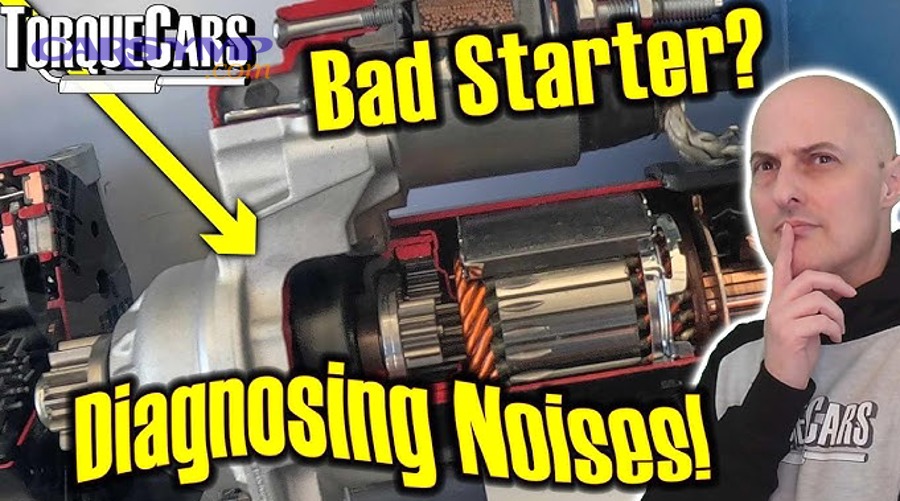
The grinding sound occurs during the brief moment when you first turn the key, as the Bendix drive extends to engage the flywheel. When this mechanism wears, the drive gear extends too slowly, at the wrong angle, or incompletely, causing it to clash against the spinning flywheel teeth. Each grinding incident removes metal from both components, progressively worsening the problem. Drivers often describe this sound as similar to starting a car that’s already running, which creates the same gear-clash effect.
Whining or high-pitched spinning indicates complete disengagement between the starter and engine. The starter motor itself runs at normal speed—producing the whining sound—but the Bendix drive either never extends or slips past the flywheel without catching. This freewheeling condition means the one-way clutch within the Bendix assembly has failed, allowing the drive gear to spin independently rather than locking to transfer rotation to the engine. Unlike grinding, which damages the flywheel, freewheeling primarily affects only the starter itself.
Immediate failure risk escalates dramatically with grinding symptoms because flywheel damage progresses exponentially. The first few grinding starts remove protective hardening from gear teeth tips, subsequent starts chip and deform the softened teeth, and within 10-20 grinding starts, teeth may break off entirely. Once flywheel teeth strip completely, the vehicle becomes unstartable even with a new starter, and repair requires removing the transmission to access and replace the flywheel—a job costing $800-$1,500 compared to $200-$400 for starter replacement alone.
Why Won’t Your Engine Crank Even with a Good Battery?
Your engine won’t crank even with a good battery because the starter motor has suffered complete internal failure, preventing it from converting electrical energy into mechanical rotation regardless of voltage supply. To verify the battery isn’t the issue, check that headlights shine brightly, the radio powers on normally, and dashboard warning lights illuminate with standard intensity—all confirming adequate battery voltage reaching electrical systems.
Dead starter motor indicators include absolute silence when turning the key, no clicking sounds, no grinding noises, and zero mechanical movement from the engine. This total lack of response differs markedly from slow cranking (which indicates a struggling but functional starter) and from clicking sounds (which show the solenoid works but the motor portion fails). The silent failure typically results from open circuits in the armature windings, completely worn-out brushes that no longer contact the commutator, or seized bearings that physically lock the armature shaft.
Testing procedures help confirm starter failure versus wiring problems. First, verify battery voltage exceeds 12.4 volts with the engine off using a multimeter. Second, check that voltage appears at the starter motor terminal when someone turns the key—if voltage arrives but nothing happens, the starter itself has failed internally. Third, tap the starter housing lightly with a wrench while someone holds the key in the start position; if this tapping suddenly makes the starter work, worn brushes are stuck in their holders and the starter needs replacement soon.
The distinction between starter failure and ignition switch problems confuses many vehicle owners. An ignition switch failure prevents voltage from reaching the starter, but it also disables other key-on systems like fuel pumps and injectors. If your fuel pump primes normally when you turn the key to “on” (you hear a brief buzzing from the rear of the vehicle), but the starter remains silent in the “start” position, the ignition switch works correctly and the starter has failed. Conversely, if no electrical systems activate in the “start” position, the ignition switch or starter relay requires diagnosis.
How Do You Identify Electrical Symptoms of Starter Failure?
You identify electrical symptoms of starter failure by observing dashboard light dimming beyond normal levels during cranking, detecting burning smells or visible smoke from the starter area, and measuring voltage drop exceeding 0.5 volts across starter connections during start attempts. These electrical behaviors indicate internal resistance, short circuits, or thermal breakdown within the starter assembly rather than normal high-current operation.
Normal starter operation causes slight dimming of interior lights as the battery redirects current to the starter motor—this brief dimming is expected and acceptable. However, problematic dimming occurs when headlights drop to barely visible, dashboard lights fade to near-black, and the radio shuts off completely during cranking. This excessive voltage drop signals the starter draws far beyond its design specifications, typically 300-500 amperes versus the normal 150-200 amperes, due to increased internal resistance from worn components or shorted windings.
The relationship between electrical symptoms and mechanical failure follows a progressive pattern. Initially, slightly increased resistance causes minor additional dimming that most drivers ignore. As resistance grows, the starter requires multiple attempts to crank the engine, with lights dimming more each time. Eventually, resistance becomes so severe that the starter draws maximum available current while producing minimal torque, causing dramatic dimming but insufficient power to rotate the engine.
Distinguishing starter electrical symptoms from alternator or battery problems requires observing when symptoms occur. Starter-related dimming happens only during the cranking process—turning the key to start—and lights return to normal brightness immediately after releasing the key. Alternator problems cause dimming while driving, especially when operating high-load accessories like air conditioning and headlights simultaneously. Battery problems manifest as progressive dimming over several start attempts as the battery depletes, whereas starter problems show consistent severe dimming on every attempt regardless of battery charge state.
What Causes Dashboard Lights to Dim When Starting?
Dashboard lights dim when starting because the starter motor draws excessive current from the battery, creating voltage drop throughout the electrical system that reduces available power for lights, displays, and accessories. Specifically, a failing starter with increased internal resistance demands 300-500 amperes instead of the normal 150-200 amperes, causing battery terminal voltage to sag from 12.6 volts to 9 volts or lower.
The electrical physics behind dimming involves Ohm’s Law and internal resistance. Every battery has internal resistance that opposes current flow, and this resistance causes voltage drop proportional to current draw. When a healthy starter draws 200 amperes, the battery voltage drops approximately 1.5-2 volts, which dims lights slightly but maintains adequate voltage for all systems. However, when a worn starter draws 400+ amperes due to binding, shorted windings, or seized bearings, the voltage drop reaches 3-4 volts or more, plunging the electrical system into brownout conditions where lights barely glow.
Normal dimming versus problematic dimming requires careful observation. Acceptable dimming shows headlights reducing to about 70-80% brightness for 1-2 seconds during cranking, with dashboard lights remaining clearly visible and readable. Problematic dimming reduces headlights to 20-30% brightness or less, makes dashboard lights nearly invisible, and may cause digital displays to flicker, reset, or shut off entirely. Some vehicles with sophisticated electronics enter “low voltage protection mode” during extreme starter current draw, displaying warnings like “Electrical System Fault” or “Battery Voltage Low.”
Temperature influences on excessive current draw create patterns that aid diagnosis. Starter motors with worn bushings draw more current when hot because thermal expansion increases internal friction and binding. Consequently, morning starts when the starter is cold may show moderate dimming, while afternoon starts after the engine has run show severe dimming. This progressive dimming throughout the day confirms starter mechanical wear rather than battery capacity loss, which would improve after the alternator recharges the battery during driving.
Is Smoke or Burning Smell from Your Starter Dangerous?
Yes, smoke or burning smell from your starter is dangerous because it indicates electrical short circuits, overheating components reaching combustion temperatures, or insulation breakdown that can ignite nearby materials and cause vehicle fires. These symptoms demand immediate action—stop attempting to start the vehicle, disconnect the battery if safe to do so, and call for professional towing rather than roadside repair.
Electrical short circuit and overheating causes stem from several failure modes. When armature windings short circuit, current bypasses the intended electromagnetic path and flows through damaged insulation, generating extreme heat that burns the copper wire coating and produces acrid smoke. Similarly, when the starter binds mechanically but continues receiving voltage, the stalled motor converts all incoming electrical energy into heat rather than rotational motion, rapidly reaching temperatures exceeding 400°F that ignite grease, oil residue, and plastic components near the starter.
The immediate danger assessment depends on smoke color and smell characteristics. Blue-gray smoke with an acrid, electrical odor indicates burning wire insulation and circuit components—this smoke is toxic and the starter has likely suffered catastrophic damage. Black smoke with an oily smell suggests external contamination (oil or grease on the starter housing) burning off from extreme surface temperatures—this is slightly less critical but still indicates dangerous overheating. White smoke typically means water or moisture vaporizing from the starter, which is less dangerous but confirms the unit operates far hotter than design specifications.
When to stop attempting starting becomes critical for safety and damage limitation. After the first instance of smoke or burning smell, immediately turn off the ignition and do not retry starting. Continuing attempts risks electrical fire, complete wiring harness damage, or even battery explosion if hydrogen gas accumulates and ignites from starter sparks. Many vehicle fires begin with ignored electrical burning smells because drivers repeatedly try to start the car “just one more time” despite obvious danger signals. Heat soak no-start issues and starter health deteriorate rapidly once thermal damage begins, as overheating degrades all components simultaneously rather than creating isolated failures.
According to the National Fire Protection Association’s 2022 vehicle fire statistics, electrical failures and malfunctions caused 12% of highway vehicle fires, with starter motors representing a significant portion of pre-ignition electrical fires.
How Can You Recognize Intermittent Starter Problems?
You can recognize intermittent starter problems through sporadic starting failures where the vehicle starts normally most times but randomly refuses to crank on some attempts, often following patterns related to temperature, humidity, or vibration. Specifically, intermittent failures occur when worn components like brushes, commutator segments, or solenoid contacts make inconsistent electrical connection depending on their position, thermal expansion state, or oxidation level.
Sporadic starting issues explanation centers on the progressive wear mechanism inside starter motors. As carbon brushes wear down through normal use, they eventually reach a length where spring pressure barely maintains contact with the spinning commutator. In this marginal state, vibration from closing the car door, bumps during parking, or thermal expansion from engine heat can shift the brush position just enough to break contact, causing a no-start condition. Minutes later, after the starter cools or settles, contact restores and the starter works perfectly, leaving no obvious fault for mechanics to diagnose.
Why intermittent problems challenge diagnosis relates to their unpredictable nature and the difficulty of testing components that work normally during inspection. Professional technicians struggle to condemn a starter that cranks the engine perfectly on the shop floor, even if the customer experienced five failures at home the previous week. Advanced diagnosis requires understanding failure patterns—does the problem occur only when hot, only when cold, only after short trips, or seemingly at random? These patterns guide technicians toward specific components: hot-failure indicates thermal expansion issues, cold-failure suggests moisture infiltration, and truly random failure points to worn brushes catching on damaged commutator segments.
The frustration factor for vehicle owners escalates because intermittent problems destroy confidence in vehicle reliability without providing clear direction for repair. You cannot distinguish between a $300 starter replacement that solves the problem permanently and a $150 battery replacement that proves useless after the next failure. This uncertainty leads many drivers to replace multiple components sequentially—battery, then cables, then starter, then ignition switch—wasting money on unnecessary parts before identifying the actual fault.
What Does Slow or Sluggish Engine Cranking Indicate?
Slow or sluggish engine cranking indicates the starter motor operates with reduced torque due to worn brushes, weak permanent magnets, damaged armature windings, or increased mechanical resistance from bearing wear. To distinguish slow cranking from battery issues, observe whether cranking speed remains consistently slow even after fully charging the battery or jump-starting from another vehicle—persistent sluggishness confirms starter degradation rather than insufficient power supply.
Progressive starter motor wear symptoms follow a predictable timeline. Initially, cranking speed decreases slightly but remains sufficient to start the engine within 2-3 revolutions—drivers rarely notice this early stage. As wear progresses, cranking slows to half the normal speed, requiring 5-8 revolutions before the engine fires, and producing a labored “rurrr-rurrr-rurrr” sound instead of the healthy “rrrrrrr” of rapid cranking. In the final stage before complete failure, the starter barely rotates the engine at perhaps one revolution per second, and many engines cannot build sufficient compression and momentum to start at such low speeds.
Temperature influence on cranking speed creates diagnostic confusion because cold temperatures affect both batteries and starters. At 0°F, battery capacity drops to roughly 40% of rated capacity while engine oil viscosity increases 10-fold, creating a perfect storm of reduced available power and increased required torque. However, a healthy starter should still crank a properly-maintained engine adequately even at 0°F if the battery maintains at least 12.4 volts. If cranking becomes excessively slow only in cold weather but remains acceptable when warm, suspect battery capacity loss first; if cranking is slow in all temperatures, the starter itself has deteriorated.
Measuring actual cranking speed provides objective data for diagnosis. Mechanics use inductive tachometers or scan tools to measure engine RPM during cranking—healthy starters should achieve 200-250 RPM minimum, while degraded units may produce only 100-150 RPM. Some advanced scan tools also measure starter current draw simultaneously, revealing whether slow cranking results from low torque production (normal current but low RPM indicates worn motor components) or excessive mechanical resistance (high current and low RPM indicates binding or bearing failure).
Why Does Your Car Start Sometimes But Not Others?
Your car starts sometimes but not others because worn brushes and commutator create inconsistent electrical contact that varies based on armature position, temperature, and vibration, causing the starter to work only when internal components align in specific favorable positions. Specifically, as the armature rotates, worn brush tips either make good contact with undamaged commutator segments (allowing starting) or land on pitted, grooved, or oxidized segments (preventing starting) in an unpredictable pattern.
Heat cycling effects on intermittent failure intensify as starters age because different internal materials expand at different rates during operation. The armature shaft expands slightly when hot, potentially binding in worn bushings that provide adequate clearance when cold. Similarly, brush springs lose tension with age and heat exposure, so they press adequately when cold but relax when hot, reducing contact pressure below the threshold needed for reliable current transfer. Many drivers report their vehicle starts perfectly when cold each morning but fails to restart after running errands, then mysteriously works again after cooling for 30 minutes—this pattern definitively indicates heat-related starter failure.
Pattern recognition for diagnosis requires documenting failure circumstances systematically. Keep a log noting ambient temperature, whether the engine was hot or cold, how long since the previous start, weather conditions, and any unusual sounds or behaviors. After collecting 10-15 data points, patterns typically emerge: “always fails when hot,” “only fails in high humidity,” “fails randomly regardless of conditions,” or “fails more often after short trips than long drives.” Each pattern points toward specific internal failures that professional diagnosis can confirm.
The psychological impact of intermittent starting problems deserves acknowledgment because they create anxiety that affects vehicle usage patterns. Drivers begin avoiding short trips to prevent hot-restart situations, refuse to park in remote areas where failure means long walks, and compulsively turn the key multiple times “just to check” before leaving secure locations. This anxiety proves justified—intermittent problems always progress to consistent failure eventually, and the final failure invariably occurs at the worst possible moment: during vacation, before important meetings, or in unsafe locations. Recognizing intermittent symptoms early enables choosing the timing of starter replacement rather than having failure choose for you.
How Do You Differentiate Starter Symptoms from Battery or Alternator Issues?
You differentiate starter symptoms from battery or alternator issues by observing when problems occur (during cranking vs. while driving), testing voltage levels at specific points, and analyzing sound patterns that uniquely identify each component failure. Specifically, starter problems manifest during the cranking process and persist despite full battery charge, battery problems show progressive deterioration over multiple start attempts, and alternator problems cause issues while driving rather than during starting.
The diagnostic decision tree begins with a simple voltage test. Use a multimeter to measure battery voltage with the engine off—readings above 12.4 volts indicate adequate charge, while readings below 12.0 volts suggest battery depletion or failure. Next, measure voltage during a cranking attempt—healthy systems maintain voltage above 9.5 volts while cranking, whereas drops below 9.0 volts indicate either severe starter current draw or insufficient battery capacity. Finally, start the engine and measure voltage with the engine running—readings of 13.5-14.5 volts confirm proper alternator charging, while readings below 13.0 volts or above 15.0 volts signal alternator problems.
Sound pattern differences provide immediate clues without tools. Starter failures produce clicking, grinding, whining, or complete silence during cranking attempts. Battery failures cause progressively slower cranking over multiple attempts as the battery depletes, often accompanied by dimming lights that grow dimmer with each try. Alternator failures rarely affect starting directly but cause the battery warning light to illuminate while driving, progressive dimming of headlights at idle, and complete electrical system shutdown after the battery depletes completely from lack of charging—typically 20-60 minutes of driving depending on electrical load and battery condition.
Simple tests drivers can perform without professional equipment include the headlight test, jump-start test, and tap test. For the headlight test, turn on headlights and observe brightness during cranking—if lights dim drastically but cranking remains strong, the battery may be weak; if lights maintain brightness but cranking fails, the starter has likely failed; if both lights dim severely and cranking is weak, either the battery or starter (or both) has problems requiring further testing. The jump-start test involves attempting to start with jumper cables connected—if the vehicle starts immediately and the problem doesn’t return after disconnecting cables, the battery was depleted; if clicking or slow cranking continues despite jump-starting, the starter draws excessive current. The tap test involves gently tapping the starter motor with a wrench while someone holds the key in start position—if tapping makes it suddenly work, worn brushes are stuck and the starter needs replacement.
Is It Your Starter or Your Battery? Key Differences
The starter is the problem if the vehicle fails to crank even after jump-starting or fully charging the battery, while the battery is the problem if cranking becomes progressively slower over multiple attempts or if jump-starting immediately restores normal cranking speed. These key differences help drivers and technicians focus diagnosis on the correct component and avoid unnecessary replacement costs.
Voltage testing basics require only an inexpensive digital multimeter available at any auto parts store. Set the meter to DC voltage (typically a setting marked “20V” or with a “V⎓” symbol), connect the red probe to the positive battery terminal and black probe to negative terminal, and observe the reading. A healthy, fully charged battery shows 12.6-12.8 volts when the engine has been off for at least 2 hours. Readings of 12.4-12.6 volts indicate 75% charge (acceptable for starting), 12.2-12.4 volts show 50% charge (marginal), and below 12.0 volts signify depletion requiring immediate charging. The critical test occurs during cranking—have someone turn the key to start while you watch the meter. Voltage should drop to 9.5-10.5 volts during cranking then immediately recover when cranking stops; drops below 9.0 volts indicate inadequate battery capacity or excessive starter current draw.
Sound pattern differences between starter and battery problems become obvious with experience. A weak battery produces steadily decreasing cranking speed—the first attempt cranks normally for 2-3 seconds then slows, the second attempt starts slow and gets slower, and subsequent attempts barely rotate the engine or produce only clicking. In contrast, a bad starter produces consistent symptoms on every attempt—if it clicks, it clicks every time; if it grinds, it grinds every time; if it’s silent, it remains silent regardless of how many times you try. Battery problems improve temporarily with rest as chemical reactions partially recover, so waiting 5-10 minutes between attempts shows improvement; starter problems remain constant regardless of rest periods.
Dashboard behavior comparison reveals additional clues. Battery depletion dims dashboard lights progressively across multiple start attempts and may eventually prevent any electrical systems from functioning. Starter failure maintains normal dashboard illumination before and after the cranking attempt, with excessive dimming only during the actual cranking moment when the starter draws current. Some modern vehicles display “Battery Low” or “Charging System Fault” warnings specifically for battery and alternator problems but rarely flag starter issues unless sophisticated engine control modules detect abnormal cranking patterns.
Jump-start response testing provides the most definitive differentiation. Connect jumper cables properly (positive to positive, negative to ground), attempt to start the vehicle, and observe the results carefully. If the engine cranks strongly and starts immediately, the battery was depleted and either needs charging or replacement depending on age and condition. If clicking, grinding, or slow cranking persists even with jumper cables connected to a known-good vehicle, the starter draws excessive current due to internal failure and requires replacement. If the vehicle starts with jumper cables but symptoms return within hours despite minimal driving, the alternator fails to charge the battery and needs diagnosis before addressing the battery itself.
According to a 2023 study by AAA, battery-related issues account for approximately 34% of roadside assistance calls, while starter motor failures represent about 8%, with the remaining starting system calls involving alternator problems, ignition switch failures, and fuel system issues.
Can a Bad Alternator Cause Starter-Like Symptoms?
Yes, a bad alternator can cause starter-like symptoms because alternator failure depletes the battery over time, eventually reducing available voltage below the threshold needed for proper starter operation. However, the symptom progression differs markedly—alternator-caused starting problems worsen gradually over days or weeks as the battery slowly discharges, whereas true starter failure appears suddenly or shows consistent symptoms from the first instance.
Alternator failure cascade effects follow a predictable sequence. Initially, the alternator produces insufficient charging current, causing the battery to discharge slightly during each drive rather than recharging fully. After several drive cycles, the battery charge level drops from 100% to 75%, which still provides adequate cranking power. Continued driving further depletes the battery to 50%, then 25%, until eventually the voltage falls below 12.0 volts and cranking becomes sluggish or impossible. Throughout this progression, the battery warning light typically illuminates on the dashboard, providing advance notice that distinguishes alternator problems from sudden starter failure.
Charging system versus starting system distinction clarifies which components handle which functions. The starting system—battery, starter motor, starter relay, ignition switch, and connecting cables—operates only during the brief cranking period when you turn the key to start. The charging system—alternator, voltage regulator, and associated wiring—operates continuously while the engine runs, replenishing energy the battery discharged during starting and powering all electrical accessories. These systems share only the battery as a common component, so charging system failure manifests primarily while driving (dimming lights at idle, battery warning light, electrical accessory issues), whereas starting system failure manifests during cranking attempts.
Secondary symptoms unique to alternator problems help separate them from starter failures. Alternator issues cause the battery warning light (typically showing a battery symbol or the letters “ALT” or “GEN”) to illuminate while driving, indicate gradually dimming headlights when idling at stoplights, create flickering interior lights, cause radio static or display dimming, and may produce squealing sounds from worn alternator bearings or loose drive belts. None of these symptoms occur with starter failure, which produces no warning lights, no while-driving symptoms, and no belt noise—only cranking-related problems.
Testing sequence for alternator diagnosis should precede battery replacement when symptoms develop gradually. First, check battery voltage with the engine off (should be 12.4+ volts for a charged battery). Second, start the engine and immediately measure voltage again—it should rise to 13.5-14.5 volts, confirming the alternator charges properly. Third, turn on high-load accessories (headlights, air conditioning, rear defroster) and observe voltage while the engine idles—it should remain above 13.0 volts under load. If voltage drops below 13.0 volts with accessories on, or never rises above 12.8 volts even with accessories off, the alternator fails to provide adequate charging and requires replacement before addressing any other components.
What Should You Do When You Experience These Symptoms?
When you experience starter failure symptoms, immediately stop attempting to start the vehicle after 2-3 unsuccessful tries, assess symptom severity to determine if the situation requires immediate towing or allows time to schedule repair, and contact professional diagnostics for vehicles under warranty or DIY assessment for older vehicles when you have mechanical knowledge and tools. Taking immediate appropriate action prevents additional damage, reduces repair costs, and ensures your safety.
Immediate actions organized by symptom severity follow this priority structure. For critical symptoms—smoke, burning smell, or grinding noises—stop starting attempts immediately, do not drive the vehicle, disconnect the battery if you can do so safely, and call for professional towing to prevent fire risk or flywheel damage. For serious symptoms—clicking with no cranking, complete silence, or severe light dimming—limit starting attempts to verify the problem, check battery connections for looseness or corrosion, and arrange for diagnosis within 24-48 hours since the vehicle may fail completely without warning. For moderate symptoms—intermittent starting or slow cranking—document the pattern, attempt to identify triggering conditions, and schedule repair within one week while the vehicle remains semi-reliable for essential transportation.
Safety considerations take precedence over all other factors. Never crawl under a vehicle to inspect or tap the starter motor unless you’ve secured it with jack stands—never trust a jack alone. Disconnect the negative battery cable before performing any starter electrical tests to prevent accidental short circuits that can cause severe burns or fires. Avoid repeatedly cranking a non-starting engine because this can flood the cylinders with fuel, creating fire risk if the engine suddenly backfires. If stranded in an unsafe location, prioritize personal safety over vehicle concerns—lock yourself in the vehicle, call for professional assistance, and wait in a safe location rather than attempting roadside repairs in dangerous areas.
Professional diagnosis versus DIY assessment depends on your mechanical skill level, available tools, and vehicle complexity. Modern vehicles with electronic throttle control, push-button starting, and integrated body control modules require professional scan tools and technical service information to diagnose properly—attempting DIY repair risks damaging expensive electronic components. Older vehicles with conventional key ignition and simple electrical systems suit DIY diagnosis if you own a multimeter and basic hand tools. Professional diagnosis typically costs $100-150 and conclusively identifies the problem, while DIY diagnosis saves money but requires time investment and carries risk of incorrect conclusions leading to unnecessary parts replacement.
When to call for roadside assistance becomes clear when evaluating location, time, weather, and personal safety. Call immediately if stranded on busy highways, in extreme weather conditions, at night in unfamiliar areas, or anywhere you feel unsafe. Most roadside assistance programs cover towing to a repair facility of your choice, and the $100-150 towing cost proves worthwhile compared to risks of injury, vehicle vandalism, or making hasty repairs in poor conditions. Many insurance policies, credit cards, and auto manufacturers provide roadside assistance at no additional charge—check your coverage before you need it so you know the contact number and towing distance limits. DIY starter replacement might seem economical, but without proper tools and safety knowledge, attempting this repair can cause injury, and following DIY starter replacement safety tips becomes essential for those who proceed.
According to the National Safety Council’s 2022 data, approximately 11% of roadside breakdowns occur in locations classified as “unsafe” (high-traffic highways, isolated areas, or high-crime locations), emphasizing the importance of professional assistance over DIY repairs in such circumstances.
How Do Starter Failure Symptoms Vary by Vehicle Type and Conditions?
Starter failure symptoms vary by vehicle type and conditions because modern vehicles use sophisticated electronics that modify symptom presentation, environmental factors like temperature and humidity affect component behavior, and different powertrain configurations place unique demands on starter systems. Understanding these variations prevents misdiagnosis and helps you communicate effectively with technicians about intermittent problems that appear only under specific circumstances.
Contextual and environmental variations affect how symptoms manifest in real-world driving. High ambient temperatures accelerate starter motor heat soak, causing thermal expansion that binds worn bearings and creates hot-no-start conditions that disappear after cooling. High humidity promotes corrosion on electrical connections and internal commutator segments, creating intermittent contact failures that improve in dry conditions. Extreme cold increases oil viscosity and battery resistance while simultaneously reducing battery capacity, making marginal starters that work adequately in warm weather fail completely in winter. Vehicles operated in dusty or off-road conditions accumulate debris in starter motor vents, blocking cooling airflow and causing premature thermal failure.
Vehicle-specific variations introduce complexity because manufacturers implement different starter designs, mounting locations, and control strategies. Luxury vehicles often use larger, more powerful starters to crank high-compression engines, and these heavy-duty units develop different wear patterns than economy car starters. Diesel engines require starters with nearly double the torque capacity of gasoline engines due to higher compression ratios, and diesel starter symptoms often involve slow cranking rather than clicking because the heavy-duty motors seldom fail completely—they gradually lose torque until unable to overcome compression resistance. Performance vehicles with aftermarket modifications may have upgraded engines requiring more cranking torque than the factory starter provides, creating chronic slow-cranking symptoms that owners mistake for starter failure when the problem is actually inadequate starter capacity for the modified application.
Heat soak no-start issues and starter health connect directly because starter motors generate significant heat during operation, and this heat accumulates in the confined engine compartment long after shutdown. The starter might work perfectly when cold but fail to restart a hot engine after short drives where the engine compartment reaches maximum temperature before the starter has adequately cooled. This specific pattern—starts fine when cold, fails after short trips, works again after extended cooling—points definitively to heat-related starter failure rather than battery, ignition, or fuel system problems.
What Are the Differences Between Starter Failure in Modern vs. Older Vehicles?
Modern vehicles show different starter failure symptoms than older vehicles because they use push-button start systems with electronic control modules that interpret symptoms differently, display diagnostic codes that specifically identify starter problems, and implement protective algorithms that limit cranking attempts to prevent damage. In contrast, older vehicles with conventional key-ignition systems provide direct mechanical connection between the key and starter, offering simpler cause-and-effect symptom patterns but less diagnostic information.
Push-button start versus key ignition symptom differences fundamentally change how failures present themselves. In older key-ignition vehicles, turning the key directly energizes the starter relay and sends power to the starter motor, so symptoms appear immediately and consistently—you hear clicking, grinding, or silence directly corresponding to the starter’s condition. Modern push-button systems interpose multiple electronic modules between the start button and starter motor, and these modules often display “Key Not Detected,” “Shift to Park,” or “Press Brake to Start” messages even when the actual problem is starter failure. The vehicle computer may refuse to energize the starter if it detects low battery voltage, creating a no-start condition that appears identical to starter failure but actually represents programmed protection logic.
Computer diagnostic codes in modern vehicles provide specific fault identification impossible with older systems. When a starter fails in a vehicle with OBD-II diagnostics (1996 and newer), the powertrain control module may store codes like P0615 (Starter Relay Circuit), P2808 (Pressure Control Solenoid ‘G’ Performance/Stuck Off), or various manufacturer-specific codes that point directly to starter circuit problems. Technicians connect scan tools, retrieve these codes, and immediately narrow diagnosis to specific components. Older vehicles lack this capability, requiring technicians to perform manual voltage tests, current draw measurements, and mechanical inspections to isolate starter problems from other starting system faults.
Relay and electronic component involvement increases failure points in modern vehicles. Where older vehicles used a single starter relay controlled directly by the ignition switch, modern vehicles may employ multiple relays, the body control module, engine control module, immobilizer system, transmission range sensor, and brake pedal position switch in the starting circuit. Failure of any of these components can prevent starter operation while the starter itself remains perfectly functional, creating symptoms indistinguishable from starter failure. This complexity necessitates professional diagnosis with factory scan tools capable of interrogating individual modules and commanding the starter circuit for testing.
Diagnostic approach differences mean that while older vehicle starters can often be diagnosed and replaced by DIY mechanics with basic tools, modern vehicles increasingly require professional equipment and technical service information. Simple multimeter voltage tests that conclusively identify starter problems in 1980s-1990s vehicles may prove inconclusive in current models where electronic modules mask the true fault location. This technological evolution makes professional diagnosis more valuable for modern vehicles, even though the actual starter replacement procedure remains fundamentally similar once the failed component is correctly identified.
How Does Cold Weather Affect Starter Failure Symptoms?
Cold weather affects starter failure symptoms by increasing engine oil viscosity 10-fold, reducing battery capacity to 40-60% of rated power, and causing marginal starters that function adequately in warm conditions to fail completely when ambient temperatures drop below 32°F. Specifically, these combined effects mean a borderline worn starter that cranks sluggishly at 70°F may click uselessly or remain completely silent at 0°F, even with a recently charged battery.
Oil viscosity and cranking resistance create the mechanical challenge that reveals marginal starter weakness. At 70°F, 5W-30 motor oil flows easily, offering minimal resistance to engine rotation, allowing even worn starters to crank adequately. At 0°F, that same oil thickens to the consistency of honey, increasing rotational resistance by 300-1000% depending on oil formulation. The starter must generate substantially more torque to overcome this resistance, and any weakness from worn brushes, weak magnets, or damaged armature windings becomes immediately apparent. Drivers often interpret this as sudden starter failure, but the starter was already degraded—cold weather simply exceeded its remaining capability threshold.
Battery capacity reduction compounds the mechanical difficulty with electrical insufficiency. Lead-acid batteries generate current through chemical reactions that slow dramatically in cold temperatures. A battery rated for 600 cold cranking amps at 32°F may deliver only 240 amps at -20°F, while simultaneously the thickened oil requires 800+ amps to crank the engine at normal speed. This mismatch between available power and required power creates the perfect condition for starter failure symptoms to emerge. The battery cannot supply enough current for the weakened starter to generate sufficient torque against the resistant cold oil, resulting in clicking, slow cranking, or complete failure.
True starter failure versus cold-weather starting difficulty requires careful differentiation because symptoms appear similar but require different solutions. True starter failure produces consistent symptoms regardless of temperature—if the starter clicks at 0°F, it will also click (or nearly click) at 70°F, though warm-weather symptoms may be less severe. Cold-weather starting difficulty shows dramatic temperature correlation—the vehicle starts readily at 50°F+, becomes difficult at 32°F, fails at 0°F, but immediately starts fine after towing into a heated garage. This temperature-dependency pattern indicates the starter retains marginal function and may survive another season with battery charging system verification and synthetic oil conversion, whereas temperature-independent symptoms demand immediate starter replacement.
Preventative measures for cold-climate operation include using synthetic motor oil (5W-20 or 0W-20) that maintains fluidity at low temperatures, ensuring the battery maintains full charge above 12.6 volts, parking in garages when available to moderate temperature extremes, using battery tender devices during extended parking periods, and replacing batteries proactively every 3-4 years in cold climates rather than waiting for complete failure. These measures reduce stress on aging starters and extend their functional life through multiple winter seasons.
Do Hybrid and Electric Vehicles Show Different Starter Symptoms?
Yes, hybrid and electric vehicles show different starter symptoms because they use 12-volt auxiliary systems differently than conventional vehicles, often eliminate the traditional starter motor entirely in favor of integrated starter-generators, and may display symptoms related to high-voltage battery systems rather than traditional starting components. Understanding these differences prevents unnecessary diagnostic confusion and expensive misdiagnosis.
The 12-volt auxiliary starter systems in hybrids serve limited functions compared to conventional vehicles. Many hybrid vehicles use the main drive motor to start the gasoline engine, relegating the 12V system to powering accessories and control modules rather than cranking the engine. When the 12V battery fails in these vehicles, symptoms include inability to shift out of park, “Ready” mode failure, error messages on the dashboard, and complete electrical system non-function—but never the clicking, grinding, or slow cranking sounds associated with traditional starter failure because no conventional starter exists. Toyota Prius models from 2001-2015, for example, use this architecture exclusively, confusing owners who expect starter-like symptoms during starting system failures.
Unique diagnostic considerations for alternative powertrains require understanding system architecture before attempting diagnosis. Full electric vehicles have no starter motor at all—the drive motor operates in reverse as a generator during regenerative braking and forward to propel the vehicle from standstill, so starter failure symptoms cannot occur by definition. Hybrid vehicles fall into categories: series hybrids that start the engine using the main motor-generator, parallel hybrids with conventional starters for the gasoline engine, and mild hybrids with integrated starter-generators replacing traditional starters. Each architecture presents different failure modes and symptom patterns.
Symptom translation between conventional and alternative powertrain vehicles helps owners recognize equivalent problems. The conventional “clicking starter” translates to “ready mode won’t engage” in many hybrids. The conventional “grinding noise” has no hybrid equivalent because motor-generators engage electronically without mechanical Bendix drives. The conventional “slow cranking” becomes “engine cranks slowly after ready mode” in parallel hybrids with traditional starters, or “engine starts roughly after ready light” in hybrids using motor-generator starting. These symptom translations require referring to owner’s manuals and manufacturer technical service bulletins to interpret correctly.
High-voltage system interactions introduce additional complexity in hybrid diagnosis. A failing high-voltage traction battery can prevent the hybrid system from engaging, which then prevents the gasoline engine from starting, creating a symptom that appears identical to 12V starting system failure but requires completely different repair. Similarly, failure of the DC-DC converter that charges the 12V battery from the high-voltage battery creates progressive 12V battery depletion that mimics alternator failure in conventional vehicles. Professional diagnosis with manufacturer scan tools becomes essential for hybrid and electric vehicles because symptom patterns alone cannot reliably identify the failing component.
According to a 2023 Consumer Reports reliability survey, hybrid vehicles show 15% fewer starting system failures than conventional vehicles over equivalent mileage periods, primarily because motor-generator starting systems eliminate the wear mechanisms inherent in conventional starter motors.
What Causes Starter Failure and How Can You Prevent It?
Starter failure occurs due to normal wear of carbon brushes and commutator segments, bearing deterioration from age and contamination, electrical winding insulation breakdown from heat cycling, and mechanical damage to the Bendix drive assembly from flywheel misalignment or repeated grinding engagements. These root causes progress gradually over 100,000-150,000 miles of normal use, or accelerate dramatically under conditions like frequent short trips, extreme temperatures, or attempts to start with low battery voltage.
Wear mechanisms follow predictable patterns based on usage. Carbon brushes gradually erode through friction against the spinning commutator, losing approximately 1mm of length per 25,000 miles depending on starting frequency. When brushes wear to less than 7-8mm length, spring pressure becomes insufficient for reliable contact, creating intermittent starting problems that eventually progress to complete failure. The commutator surface develops grooves, pitting, and oxidation from arc erosion where current transfers from brushes, further degrading contact quality. Bearings wear from radial loads during cranking, accumulated contamination from road spray and engine bay heat, and inadequate lubrication in sealed units designed for “lifetime” service that rarely achieves 150,000-mile vehicle lifetimes.
Corrosion effects accelerate starter degradation in coastal environments and areas using road salt for ice control. Salt-laden moisture penetrates starter housings through ventilation openings, attacking copper windings, steel components, and electrical connections. Surface corrosion on solenoid terminals creates resistance that reduces voltage reaching the motor, requiring higher total current draw to achieve the same cranking torque. Internal corrosion on the commutator segments creates insulating oxide layers that block current transfer from brushes, causing intermittent failure as the armature rotates through corroded and clean segments during cranking attempts.
Heat damage patterns emerge from operating conditions and design limitations. Starters generate tremendous heat during cranking—converting 2-3 kilowatts of electrical energy while confined in a small housing with limited cooling. Normal operation allows adequate cooling between starts, but repeated cranking attempts on non-starting engines (due to fuel system or ignition problems) overheat the starter without the normal cooling from engine operation. This sustained heat degrades winding insulation, causing shorts between coils that reduce motor efficiency and increase current draw. Permanent magnets in modern reduction-gear starters can partially demagnetize from excessive heat, permanently reducing starter torque output.
Preventative maintenance strategies extend starter life significantly:
- Maintain battery charge above 12.4 volts to ensure adequate voltage for efficient starting without excessive current draw
- Address engine starting problems immediately rather than repeatedly cranking a non-starting engine
- Use correct viscosity motor oil for your climate to reduce cranking resistance
- Verify secure starter mounting bolts and clean electrical connections annually
- Replace batteries proactively every 4-5 years before complete failure subjects the starter to repeated low-voltage starting attempts
- Inspect flywheel teeth during transmission service to prevent grinding damage to the starter drive
- Avoid “dry starts” by ensuring the engine has adequate lubrication before winter storage cranking
Lifespan expectations vary by vehicle type and usage pattern. Heavy-duty truck starters cranking large diesel engines typically last 100,000-120,000 miles before requiring replacement. Economy car starters in moderate climates often exceed 150,000 miles with proper maintenance. Performance vehicles and those subjected to frequent short trips may require starter replacement at 75,000-100,000 miles. Vehicles in severe-duty service—taxi use, delivery vehicles, extreme climate operation—may need starters every 50,000-75,000 miles due to accelerated wear from constant starting cycles.
Replacement timing decisions should favor proactive replacement when approaching 120,000-150,000 miles on original starters, especially before major trips or winter season in cold climates. Waiting for complete failure risks being stranded in unsafe locations, often at premium expense for after-hours service. A scheduled starter replacement costs $200-400 for parts and labor at an independent shop, compared to $400-800 for emergency roadside service, towing, and rushed repair at dealership rates. The economics and convenience strongly favor planned replacement of aging starters showing early symptoms rather than emergency replacement after complete failure.
This comprehensive guide has equipped you with the knowledge to recognize seven critical starter failure symptoms, differentiate them from battery and alternator problems, understand how environmental factors and vehicle types affect symptom presentation, and take appropriate action when symptoms appear. By identifying bad starter signs early and understanding the underlying causes, you protect yourself from unexpected breakdowns, make informed repair decisions, and maintain reliable transportation. Remember that intermittent symptoms always progress to consistent failure, so addressing problems proactively—whether through professional diagnosis or informed DIY assessment—saves money and prevents the inconvenience and safety risks of roadside emergencies.