


A hard start followed by stalling is often a fuel delivery problem, but it’s only “fuel starvation” when the engine isn’t getting the right fuel pressure and volume at the right time—so the fastest fix is to diagnose, not guess.
Next, you’ll learn how to separate fuel delivery faults from look-alike ignition and sensor issues, so you don’t replace parts that were never broken in the first place.
Then, we’ll narrow the cause to the most common restrictions and failures—fuel pump vs fuel filter—using symptoms, quick tests, and reading patterns that point to one or the other.
Introduce a new idea: below is a step-by-step checklist that takes you from “long crank + stall” to a confident root cause (or a clear reason to stop DIY and call a shop).
Is your hard start and stalling actually a fuel delivery problem?
Yes—hard start and stalling can be a fuel delivery problem when (1) the pump can’t build/hold pressure, (2) flow is restricted, or (3) pressure bleeds off after shutdown and the engine starts “dry.” In addition, you can save hours by verifying fuel delivery before chasing electronics.
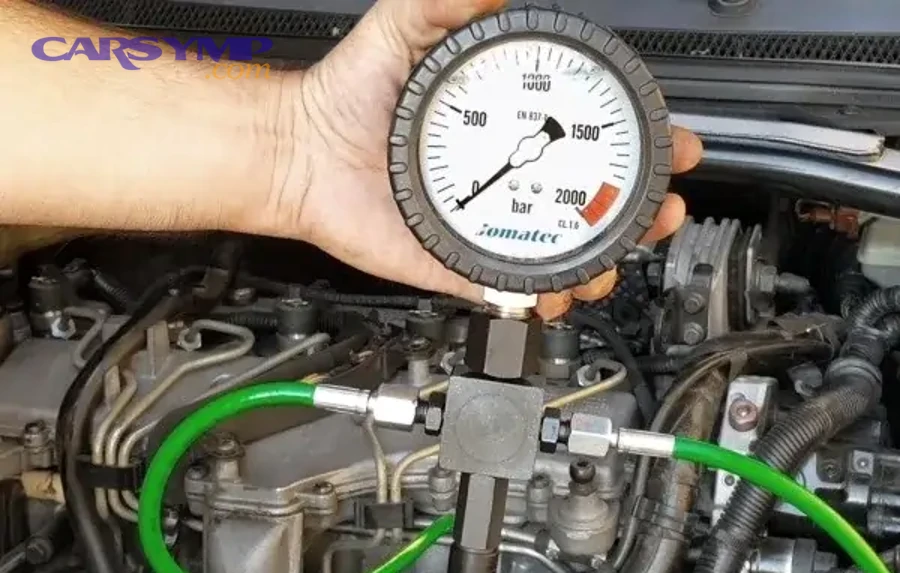
Do hard-start + stall symptoms always mean fuel starvation?
No—hard start and stalling do not always mean fuel starvation, because “stalling” is a general outcome that can happen when spark, air, or timing fails too. However, fuel delivery becomes the leading suspect when you see a pattern like these:
- Long crank after sitting (especially overnight), then it starts and dies within seconds.
- It runs better if you cycle the key (ON → OFF → ON) before cranking (suggests weak prime or pressure bleed-down).
- It stalls under load (uphill, acceleration) and may restart after a brief wait (suggests borderline flow/pressure).
- You smell fuel or find wetness (suggests a leak causing pressure loss or rich flooding—still a “delivery system” issue, but a different failure mode).
A practical rule: fuel starvation tends to worsen when demand increases (load, RPM), while many sensor faults are more random—or come with warning lights and codes.
Can ignition or sensor issues mimic fuel delivery failures?
Yes—ignition and sensors can mimic fuel delivery failures because the driver experience (crank, stumble, stall) feels identical from the seat. More importantly, these common mimics can trick you into replacing a pump:
- Crankshaft position sensor / cam sensor issues: can cause “starts then dies” or “no start” because the ECU stops triggering spark/injectors.
- MAF/MAP faults: can create extreme fueling errors (too lean or too rich) that look like a supply problem.
- Vacuum leaks: can lean out idle so badly the engine stalls—even if fuel pressure is perfect.
- Security/immobilizer faults: can allow start then cut fuel after a second or two.
Your best protection is to test fuel delivery directly (pressure/prime/leak-down) before calling the pump guilty.
Is it safe to keep driving when you suspect fuel delivery problems?
No—it’s not safe to keep driving with suspected fuel delivery problems, because (1) stalling can remove power steering/brake assist, (2) lean running can overheat the engine and catalytic converter, and (3) fuel leaks raise fire risk. Meanwhile, if it only fails intermittently, you still risk getting stranded in traffic.
If you must move the vehicle briefly, choose low-speed, low-load routes and stop immediately if you smell fuel, see smoke, or the engine begins surging hard.
What does “fuel delivery” mean in a hard start/stall diagnosis?
Fuel delivery is the system that stores, pumps, filters, regulates, and meters fuel to the cylinders, starting at the tank and ending at injector spray—where pressure and flow must stay within a usable range across cranking, idle, and load. To better understand hard starts and stalls, you need to think in “pressure + volume + timing,” not just “pump or filter.”
What is the fuel delivery path from tank to cylinder?
The path is usually:
- Fuel tank (fuel)
- Pickup sock/strainer (keeps big debris out)
- In-tank pump module (electric pump + check valve often lives here)
- Fuel lines (supply line, sometimes return line)
- Fuel filter (may be in-line, in tank, or integrated into module depending on vehicle)
- Fuel rail (feeds injectors)
- Fuel pressure regulator (return-style systems) or in-tank regulator (returnless systems)
- Injectors (electrically pulsed valves spraying fuel into intake or cylinder)
Hard starting happens when pressure/volume isn’t ready at the moment you crank, or when residual pressure can’t be held after shutdown.
How do pressure, volume, and injector pulse work together?
Pressure, volume, and injector pulse work like a team:
- Pressure is “push” at the rail. Injectors are calibrated for a target pressure range.
- Volume/flow is “how much fuel can arrive over time,” especially under load. A system can show okay pressure at idle but still starve at high demand if flow is weak.
- Injector pulse (timing/duty) is “how long injectors stay open.” The ECU changes pulse width based on sensor feedback.
This is why a diagnosis that only checks “pressure at idle” can miss a low-flow problem. You need multiple readings and conditions.
What does ‘prime’ and ‘residual pressure’ mean for starting?
Prime is the brief pump run when you turn the key ON (or open the door in some cars) to build rail pressure before cranking. Residual pressure is what remains in the rail after shutdown—held by check valves, regulator sealing, injectors sealing, and tight lines.
When residual pressure is lost too quickly, the next start can require extended cranking because the system must refill and re-pressurize before injectors can deliver a correct spray.
Which symptoms point to a weak fuel pump vs a clogged fuel filter?
A weak fuel pump usually fails on pressure/flow under demand, while a clogged fuel filter usually fails on flow first, especially when you ask for more fuel (acceleration, uphill). However, the fastest path is matching symptom patterns to quick confirmation tests.
What are common fuel pump symptoms (including a whining noise from the tank)?
Common fuel pump symptoms often cluster around “inconsistent supply”:
- Long crank, especially after sitting (slow prime or leaking check valve)
- Stalling at higher demand (merging, climbing, towing)
- Surging at steady throttle (pressure oscillation)
- Loss of power that improves when you lift off the throttle
- Whining noise from tank diagnosis: a pump that suddenly becomes loud (high-pitched whine) can be struggling, running dry, or wearing internally
- No start with no pump sound (could also be relay, wiring, or pump itself)
A key insight: pump noise alone doesn’t convict the pump, but “new noise + new drivability issues” is a strong correlation.
How do clogged fuel filter symptoms differ from pump symptoms?
A clogged fuel filter tends to look like “the engine runs, but can’t keep up”:
- Starts okay, idles okay, but falls on its face under load
- Gradual worsening over weeks/months rather than sudden failure
- More pronounced high-RPM power loss
- Sometimes hard start if restriction is severe (because prime can’t build quickly enough)
In practice, a severely clogged filter can make the pump louder and shorten pump life because the pump is forced to work against restriction.
What quick tests separate low pressure from low volume?
Quick separators you can do before deep disassembly:
- Key-cycle test (prime test)
If cycling the key ON 2–3 times makes it start immediately, suspect poor prime or pressure bleed-down. - Pressure reading behavior
Low pressure at key-on and idle suggests pump, regulator, or power supply. Normal pressure at idle but drop during snap throttle/load suggests flow restriction (filter, sock, collapsing hose) or weak pump. - Return-line pinch test (return-style only; use caution)
If pinching the return line makes pressure jump sharply, pump may be capable and regulator may be bleeding off too much. If pressure barely changes, suspect pump weakness or supply restriction.
What step-by-step checklist can you follow to confirm fuel delivery and isolate the cause?
Use a checklist that verifies supply integrity, then measures pressure behavior, then confirms pump electrical health, because that sequence isolates leaks, restrictions, regulation faults, and power issues with minimal guesswork. Next, follow the steps in order so each result narrows the suspect list.
How do you do a safe visual inspection for leaks, kinks, and tank vent issues?
Start with safety and simple wins:
- Work outside or in a well-ventilated area. No smoking, no hot lamps.
- Check for wet fuel, stains, or strong odor around:
- tank seams, filler neck, and cap
- underbody fuel lines
- engine bay rail/injectors/regulator area
- Inspect lines for kinks, crushing, or rub-through (especially near clamps and underbody brackets).
- Confirm the fuel cap seals and the EVAP system isn’t obviously damaged.
Tank vent problems can show up as stalling or fuel starvation when the tank can’t breathe; if removing the cap causes a huge inrush of air and symptoms change, that’s a clue (not a final diagnosis).
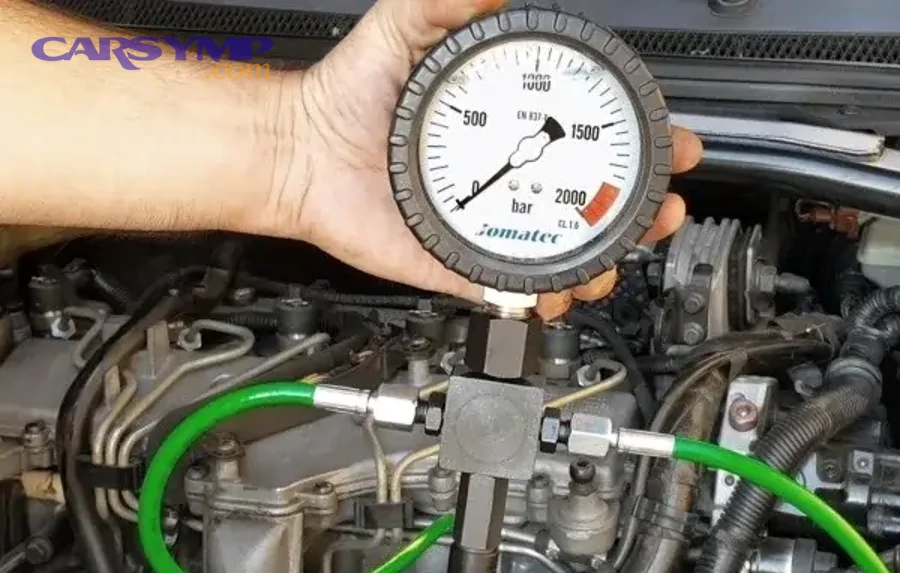
How do you perform Fuel pressure test basics correctly?
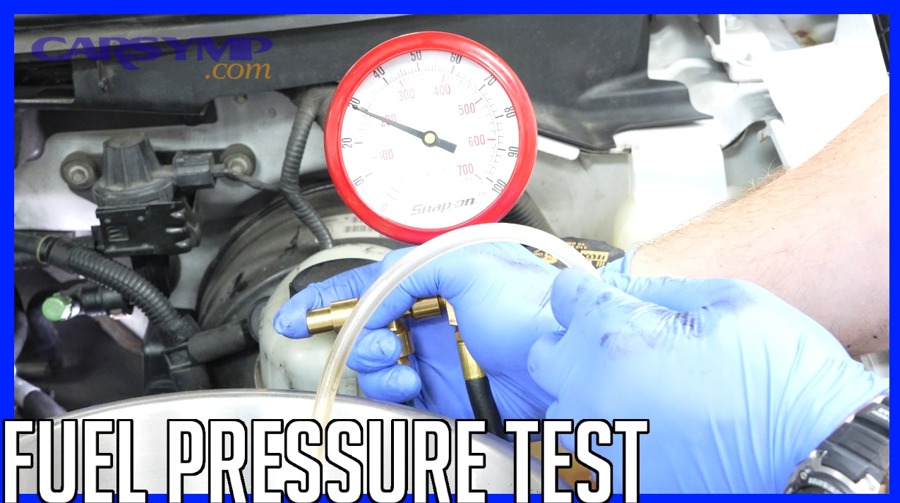
Here are Fuel pressure test basics that keep the test meaningful (and safe):
- Find the correct test point
Many vehicles have a Schrader valve on the rail. Others require a tee fitting in the line. - Relieve pressure safely
Follow service info when possible. A common method is removing the pump fuse/relay and cranking briefly (varies by car). - Connect a rated fuel pressure gauge
Tight connections only. Use rags to catch any seepage. - Run these four conditions
Key ON (prime), engine OFF; cranking ; idle; snap throttle / quick rev (and if possible, load test). - Avoid open sparks and keep a fire extinguisher nearby
Fuel mist is dangerous.
The point is not only the number—it’s how fast pressure builds, how stable it is, and how it behaves when demand changes.
How do you interpret key readings: key-on prime, idle, snap throttle, and leak-down?
Interpretation is pattern-based:
- Key-on prime low or slow to build
Suspect weak pump, clogged sock, restricted filter, low voltage to pump, or a big internal leak. - Idle pressure low
Suspect pump weakness, regulator fault (stuck open/bleeding), or electrical supply issue. - Pressure drops during snap throttle / load
Suspect restricted filter, clogged sock, collapsing hose, weak pump, or voltage drop under load. - Leak-down (residual pressure) drops quickly after shutdown
Suspect check valve in pump module, leaking injector(s), or regulator not sealing (on some designs).
A practical tip: record pressure at shutdown, then at 1 minute, 5 minutes, and 20 minutes. Fast drop is more diagnostic than slow drift.
Evidence: According to a thesis by South Dakota State University from the Electrical Engineering and Computer Science department, in 2007, a long-duration fuel-system test reported about a 5.8% worst-case fuel pressure decline over months of operation—showing that tracking pressure trends is a practical way to spot gradual supply degradation.
How do you check electrical supply to the pump (relay, ground, voltage drop)?
Electrical checks matter because a healthy pump can act weak if it’s underpowered:
- Listen for prime: no sound doesn’t prove a bad pump—could be relay, fuse, inertia switch, wiring, or ECU control.
- Check fuses and relays: swap with a known-good identical relay if available.
- Voltage at pump connector during prime/crank: you want near battery voltage under load.
- Ground integrity: a corroded ground can cause intermittent stalls.
- Voltage drop test: measure voltage drop across power and ground paths while pump runs; high drop means resistance (corrosion, weak connector, failing relay contacts).
If voltage is low only during cranking, also evaluate battery health and starter draw—low system voltage can reduce pump output enough to create a “starts then dies” scenario.
What other fuel-supply parts can mimic pump/filter problems?
Several components can mimic pump or filter failure by changing pressure regulation, causing internal leaks, or corrupting fuel quality, leading to the same hard-start and stall symptoms. Moreover, these are often cheaper and faster to verify than dropping a tank.
Can a failed fuel pressure regulator cause hard starting or stalling?
Yes—a failed regulator can cause hard starting or stalling because it can:
- Bleed off pressure (stuck open), causing long cranks and lean stalls
- Over-pressurize (stuck closed), causing rich running, flooding, and rough idle
- Leak fuel into a vacuum line (common on vacuum-referenced regulators), causing rich starts and fuel smell
A quick clue: if you find liquid fuel in the regulator vacuum line, the diaphragm has likely failed.
Can injectors, O-rings, or a stuck-open injector cause long cranking?
Yes—injector leaks create long cranking because they can:
- Lose residual pressure (fuel drains off through a leaking injector)
- Flood a cylinder (too much fuel after shutdown), causing extended crank and rough start
- Create fuel smell and sometimes smoke at startup
Signs include fuel odor in oil, misfire on cold start, or one plug that’s unusually wet/clean compared to others.
Can contaminated fuel or water in gas create intermittent stalling?
Yes—contaminated fuel can cause intermittent stalling because water and debris disrupt combustion and can restrict flow at the sock/filter over time. If the issue began right after refueling, consider:
- Water-contaminated fuel (rough running, random stall)
- Sediment stirred up in the tank (restriction worsens)
- Wrong fuel (less common but severe)
A fuel sample test (clear container) can sometimes show phase separation or debris, but use safe handling and local disposal rules.
When should you stop DIY and take it to a shop?
Yes—you should stop DIY and take it to a shop when (1) you have safety risks, (2) the car stalls unpredictably, or (3) the tests require specialized tools or access (like tank removal) beyond your setup. More importantly, knowing when to stop prevents fires, towing bills, and expensive secondary damage.
Is it risky to run the engine lean while troubleshooting?
Yes—it’s risky to run lean while troubleshooting because:
- Lean mixtures raise exhaust temperatures, which can damage the catalytic converter.
- Lean misfire under load can create dangerous hesitation in traffic.
- Detonation risk increases in some conditions, which can harm the engine.
If your tests suggest low fuel pressure/flow, keep run-time short and avoid load testing on the road until you confirm the supply is stable.
What symptoms require immediate towing?
Tow it (or at least don’t drive it) if you have:
- Fuel leaks, wetness, or strong fuel odor
- Stalling in intersections / at speed
- No-start combined with repeated cranking attempts (can flood and damage starter/battery)
- Severe surging or backfiring tied to suspected fuel supply interruption
Safety beats diagnosis speed every time.
What does a typical Fuel pump replacement cost estimate include?
A Fuel pump replacement cost estimate usually includes:
- Pump module (often includes level sender, strainer, sometimes regulator)
- New seals/O-rings and possibly a new lock ring
- Labor (tank drop or access through rear seat/trunk panel depending on vehicle)
- Optional but common add-ons: fuel filter (if serviceable), wiring pigtail if connector is heat-damaged, and tank cleaning if contamination is found
Costs vary wildly by vehicle design; the important takeaway is that accurate diagnosis protects you from paying pump labor when the real culprit was a relay, ground, regulator, or restriction.
What uncommon fuel-delivery edge cases can cause hard start and stalling even after you “checked the pump and filter”?
Yes—edge cases exist, and they usually hide in heat, hoses, EVAP behavior, or voltage, where a basic idle pressure check looks “fine” but real-world conditions break the system. Especially, if your symptoms are intermittent, these are worth considering.
Could vapor lock or heat soak be the real cause?
Yes—heat-related fuel boiling (vapor formation) can cause hard starts and stalling because vapor pockets reduce liquid fuel delivery and create lean conditions until the system cools. This is more likely when:
- symptoms occur after a hot shutdown (hot soak)
- ambient temperatures are high
- the vehicle has known hot-fuel-handling sensitivity
- ethanol blends and volatility behavior contribute in some setups
A strong clue is “won’t restart hot, restarts after cooling,” while cold starts are normal.
Could a restricted tank pickup sock or collapsing hose be intermittent?
Yes—an intermittently restricted sock or collapsing hose can cause stalling because restriction can change with fuel level, temperature, and suction demand. Common patterns include:
- worse when the tank is below 1/4
- worse on long pulls (high demand)
- improves temporarily after sitting
- pressure looks okay at idle but drops during demand
If you suspect this, a controlled load test with pressure monitoring (safely) is often more revealing than idle readings.
Could EVAP purge faults or a stuck vent valve affect fuel delivery?
Yes—EVAP faults can influence drivability by forcing the engine to ingest vapor unexpectedly (purge stuck open) or by affecting tank pressure behavior (venting issues). Symptoms can overlap with fuel delivery problems:
- hard start after refueling
- rough idle and stalling at stoplights
- strong fuel vapor smell
This is where scan data (purge duty, trims) and targeted EVAP tests help more than guessing.
Could low battery voltage during cranking drop pump output enough to stall?
Yes—low cranking voltage can reduce pump output enough to cause “starts then dies,” because the pump and ECU both operate worse under voltage sag. Clues include:
- slow crank sound
- problem worse in cold weather
- problem disappears with a jump start or after charging the battery
Evidence: According to a dissertation by University of Wisconsin–Madison from Mechanical Engineering, in 2018, filtration modeling validated with experimental data emphasized predicting pressure drop as filters load—reinforcing that restriction-related pressure losses can become meaningful under certain operating conditions.