


Bent condenser fins usually cause airflow restriction, while an internal leak causes refrigerant loss; you can separate the two by combining a careful visual inspection with a few confirmatory tests.
To reduce misdiagnosis, you’ll learn what “normal wear” looks like versus damage that actually changes pressures, vent temps, and fan behavior.
You’ll also get a practical testing order—starting with what you can see and measure quickly, then escalating to dye, electronic detection, and controlled pressure checks.
Giới thiệu ý mới: Below is a step-by-step diagnostic flow that keeps you from “guessing” and helps you decide whether the issue is fixable or a replacement-level fault.
What is the difference between bent fins and an internal condenser leak?
Bent fins are external air-side damage that reduces heat rejection by limiting airflow, while an internal leak is a sealed-system failure that lets refrigerant and oil escape (often without obvious surface damage at first).
To connect the dots, think of the condenser as two systems stacked together: air moving through fins outside, and refrigerant moving through tiny passages inside.
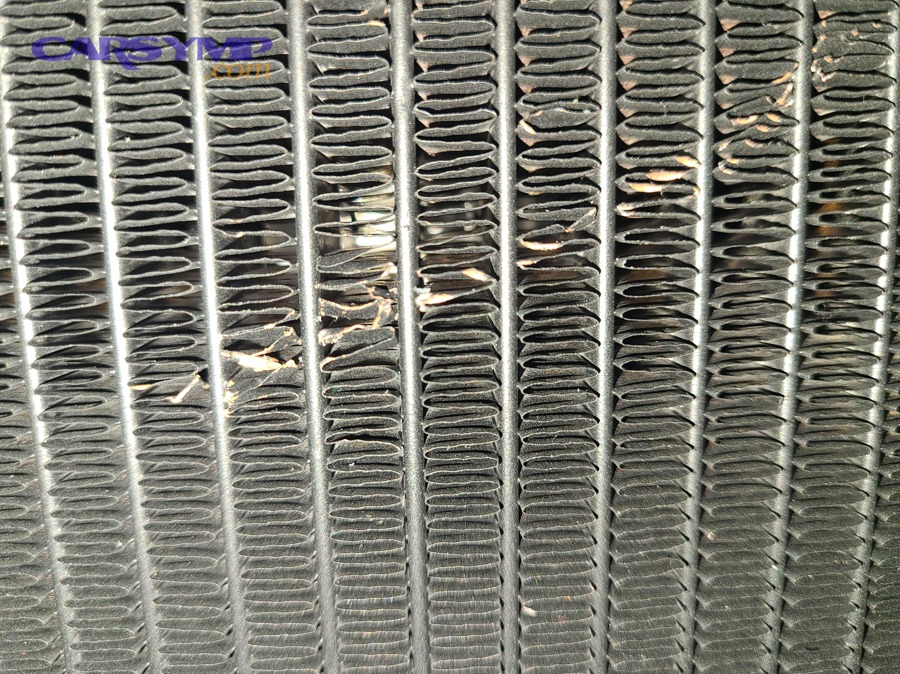
In practice, airflow problems tend to show up as higher high-side pressure and weaker cooling at idle, while leak problems show up as low charge symptoms (cycling, low pressures, oil residue, or dye traces).
To keep the terminology consistent, this guide uses:
- Bent fins = flattened/closed fin area that blocks air and reduces surface efficiency.
- Internal leak = leak path in tubes, headers, braze joints, or microchannels that reduces refrigerant mass.
- Airflow restriction = anything that reduces air across the core (bent fins, debris, shrouding gaps, weak fans).
Theo nghiên cứu của JSAE (Automotive Technology Literature Abstracts), từ mục tổng hợp hội nghị, vào 11/2016, các nghiên cứu về “condenser airflow blockages” được xem là yếu tố có thể “impact on A/C system performance,” cho thấy tắc gió/giảm lưu lượng qua dàn có thể làm thay đổi hiệu suất ngay cả khi hệ kín vẫn còn gas.
What symptoms point to bent fins causing real airflow restriction?
Bent fins are likely the main problem when cooling is weakest at idle or slow traffic, the radiator/condenser fans run hard, and the high-side pressure trends high compared with normal behavior for the same ambient temperature.
To narrow it down, focus on symptoms that change with vehicle speed, because speed increases airflow and can “mask” fin-related restriction.
Look for these patterns (a single symptom is rarely enough):
- Idle-only weakness: vents are cool while cruising, then warm quickly when stopped.
- Fan overwork: fans stay on high longer than usual, especially after a heat soak.
- Heat “bottleneck” clues: the line leaving the condenser stays hotter than expected for longer, and under-hood heat feels excessive near the condenser area.
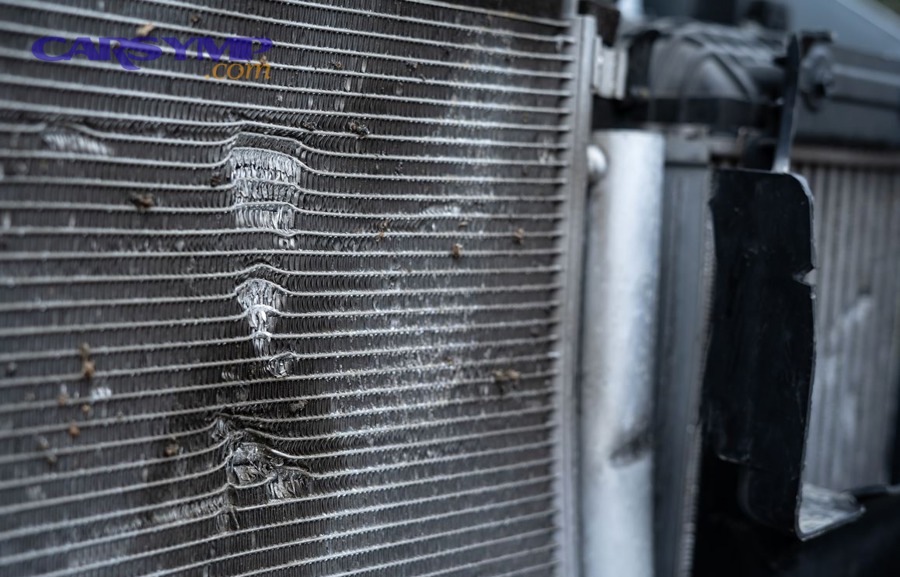
- Visible blockage shape: fins are “closed” in a patch, often from a pressure washer, rock strike, or front-end impact.
To make the diagnosis more objective, compare temperature behavior across the face of the condenser: a “dead zone” of fins often shows as a localized area that stays hotter (less air passing) or fails to shed heat evenly.
Theo nghiên cứu của Caterpillar Inc. (Technical Center), vào 09/2005, báo cáo về “Radiator Airfiltration for Heat Exchangers” nhấn mạnh rằng sự tắc nghẽn/giảm lưu lượng qua cụm trao đổi nhiệt có thể làm giảm hiệu quả và thay đổi đặc tính vận hành của hệ thống làm mát, củng cố nguyên tắc: khi đường gió bị chặn, hiệu suất thải nhiệt giảm đáng kể.
What symptoms suggest an internal condenser leak instead of fin damage?
An internal leak is the leading suspect when the system repeatedly loses charge, the compressor cycles rapidly, you see oily residue at fittings/joints, or dye/electronic detection indicates refrigerant escape even though the fins look mostly open.
To avoid false conclusions, treat “low cooling” as a result, then prove whether the cause is lost refrigerant mass rather than reduced airflow.
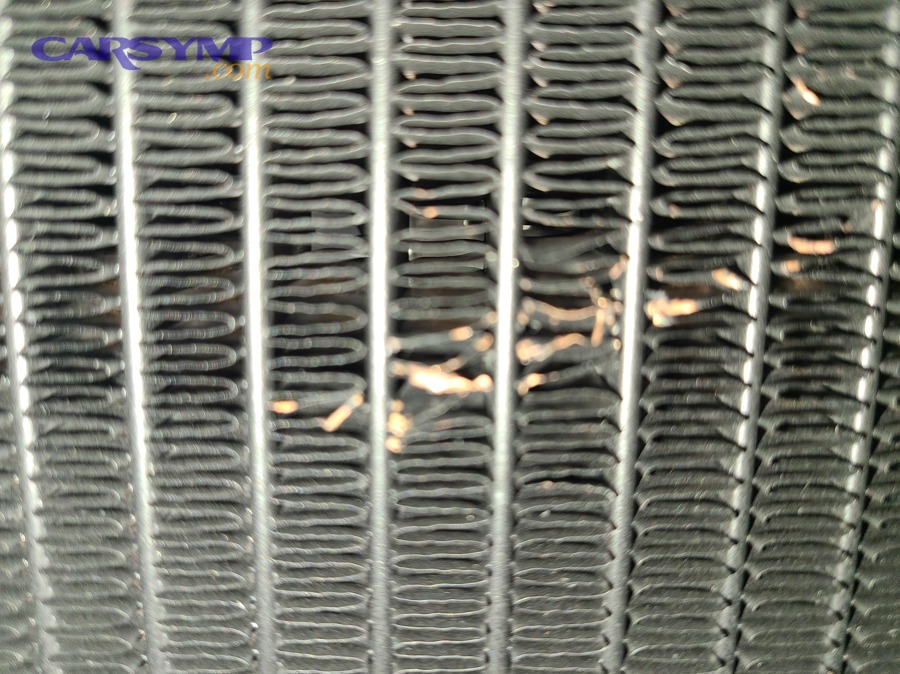
Common leak-forward cues:
- Recurring recharge history: AC works after service, then fades over days/weeks/months.
- Short cycling: compressor engages briefly then drops out as pressures hit protection thresholds.
- Oil/dirt “paste”: refrigerant oil collects dust at a pinpoint seam (often a header, braze joint, or line connection).
- Cabin symptom mix: sometimes cold on one side, sometimes not, depending on charge level and valve behavior.
If you smell a faint chemical odor, don’t rely on that alone—many smells are unrelated. Instead, use physical evidence: oil traces, dye fluorescence, and confirmation tests that show loss of pressure over time.
For a quick visualization of dye-based diagnosis, note how UV-activated residue stands out even on dark components under a UV light, especially around seams and connections.
How do you inspect fins safely and tell “cosmetic” bends from performance-limiting damage?
Inspecting fins is a 4-step method—clean, light, map, and measure—so you can tell whether the bent area is small and superficial or large enough to choke airflow and reduce heat rejection.
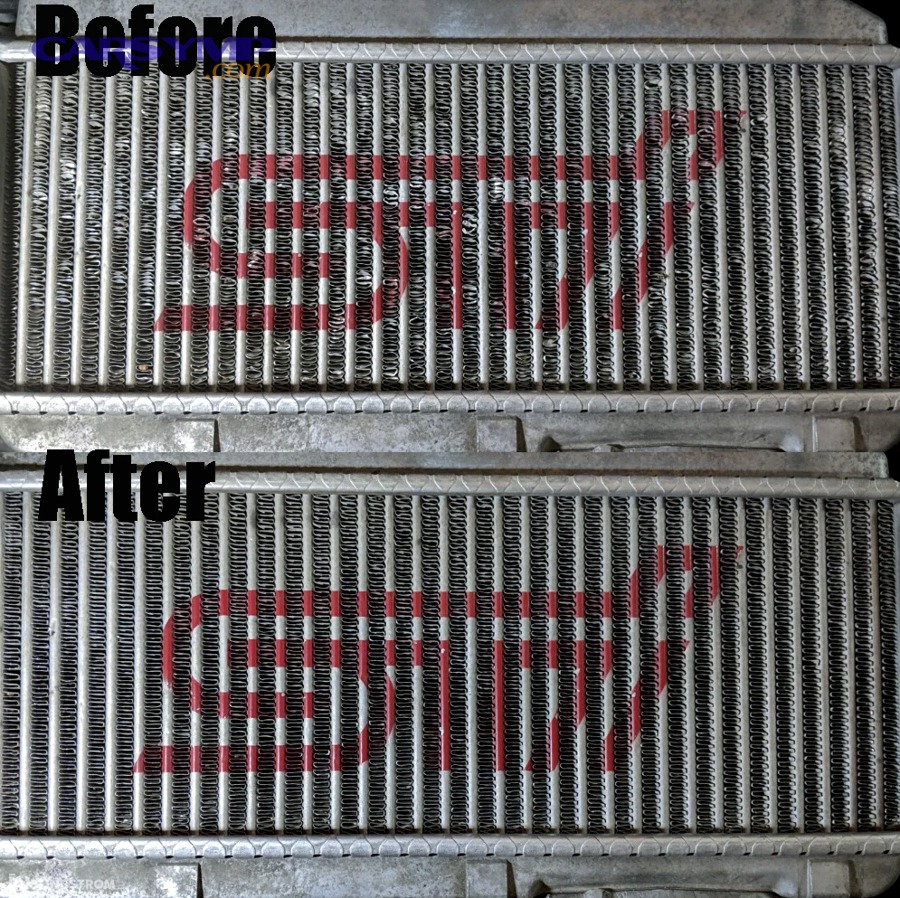
To begin, avoid aggressive brushing or high-pressure spraying, because soft aluminum fins deform easily and you can create the very restriction you’re trying to diagnose.
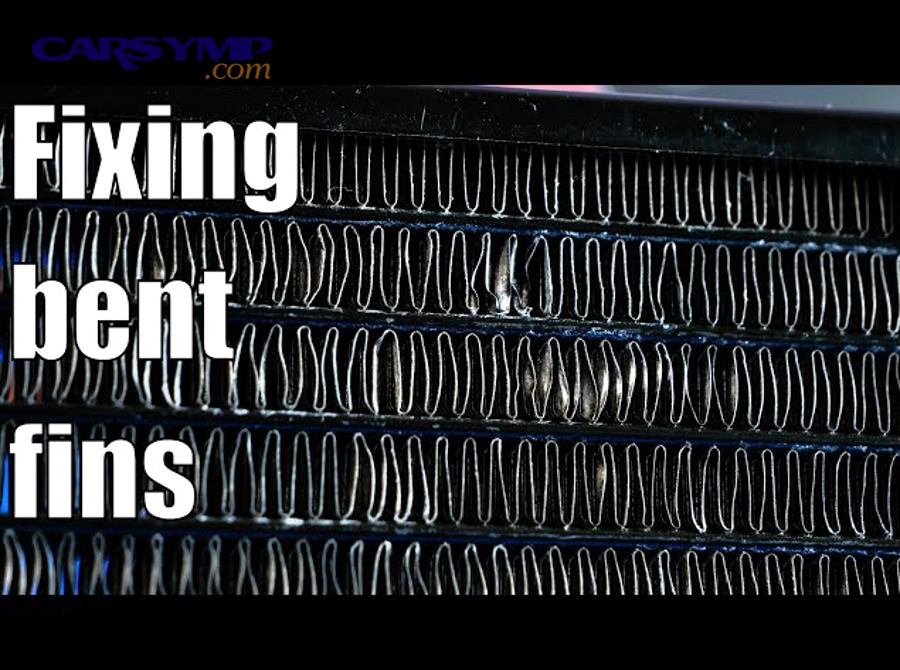
Step 1: Clean without crushing fins
Use low-pressure water from the engine side outward when possible, and let debris soften before rinsing; this preserves fin spacing and prevents “fin matting” that blocks air.
To connect this to diagnosis, a condenser that looks “dirty” can mimic bent-fin restriction, so cleaning is part of separating debris from deformation.
Step 2: Backlight and map the blocked percentage
Shine a bright light behind the condenser and observe from the front; areas that transmit much less light often indicate closed fins or packed debris.
To keep it measurable, mentally divide the condenser into a grid and estimate the percentage of “dark” (blocked) squares.
Step 3: Identify fin damage patterns that matter
Damage near the center can matter more than edge damage because airflow tends to be highest and most uniform there, so center restriction disrupts more effective area.
To deepen the check, look for “creases” that fully fold fin channels shut—those are more restrictive than shallow ripples.
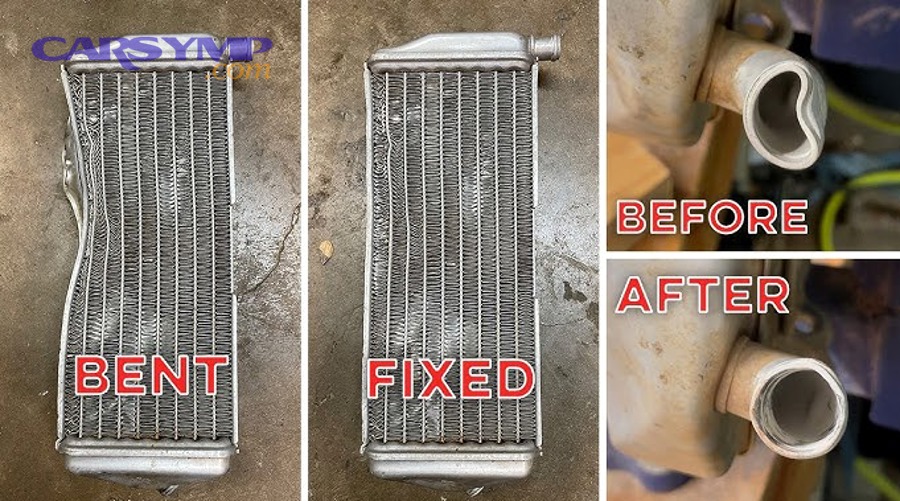
Step 4: Straighten only when the fins are merely folded, not torn
A fin comb can reopen channels if the fins aren’t ripped; torn fins often worsen turbulence and can reduce effective surface area even if you “open” them.
To avoid collateral damage, straighten in short strokes, working with the fin direction, and stop if you feel the comb snag repeatedly (likely torn fin edges).
How do you test for an internal leak when you can’t see refrigerant escaping?
Testing for an internal leak is a 3-layer process—visual/oil clues, detection tools, and pressure verification—so you can confirm a leak even when it’s too small to hear or spot.
To get reliable results, do tests in a consistent order and under stable conditions, because wind, heat, and residual chemicals can create false readings.
Layer 1: Visual and oil-trace inspection
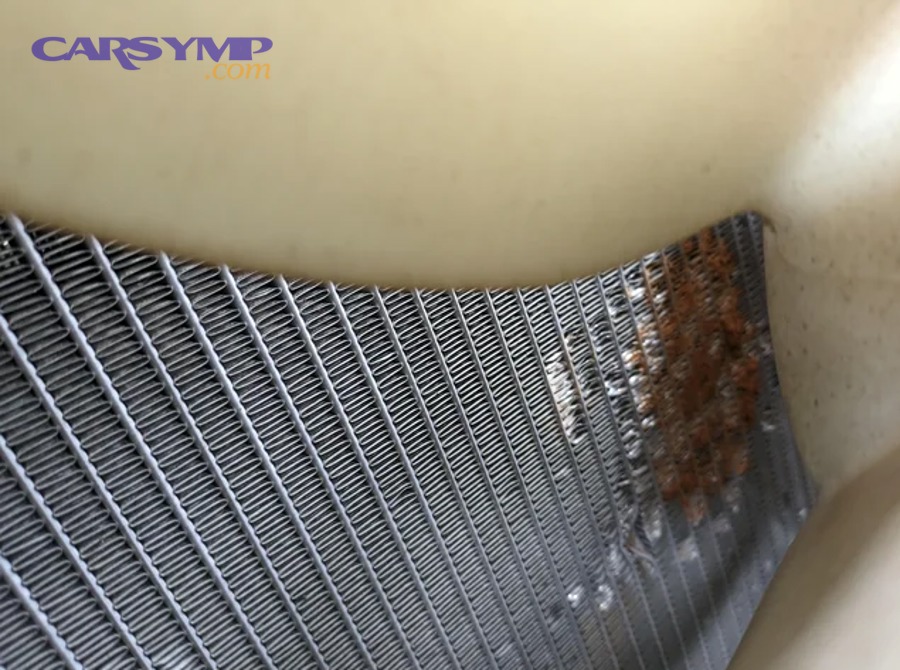
Scan condenser headers, tube-to-header joints, and line connections for oily residue that collects dust; refrigerant oil is often the “breadcrumb trail” a slow leak leaves behind.
To connect this to fin damage, note that fin bending doesn’t usually create oily residue—oil traces point toward a sealed-system issue.
Layer 2: Dye and UV confirmation
Add dye only if appropriate for your system and follow product instructions; then run the system long enough for dye to circulate before scanning with a UV light in low ambient light.
To avoid missing a leak, check the lower edge of the condenser and nearby splash areas—oil/dye can migrate with airflow and water runoff.
Layer 3: Electronic detection and bubble checks
Use an electronic leak detector slowly around suspected seams and fittings, then confirm with a bubble method where accessible, because bubbles show a physical leak path under pressure.
To make bubble testing meaningful, the system must have a pressure differential—otherwise even a real leak may not bubble visibly.
How can pressure readings separate “restricted airflow” from “low charge” in minutes?
Pressure readings help separate the two because bent-fin restriction often pushes the high side higher (heat can’t leave), while low charge often lowers both pressures and causes cycling or unstable readings.
To keep it actionable, don’t chase exact numbers without a vehicle-specific chart; instead, compare behaviors: stability, fan response, and how pressures change with RPM and airflow.
Fast comparison logic you can trust
Pattern A (airflow restriction likely): high side climbs quickly at idle, vent temps worsen at stops, fans go high, and improvement is noticeable when you increase airflow (higher speed or external fan).
To link this back to fins, bent/closed areas reduce effective airflow cross-section, raising condensing temperature and stressing the system during low-airflow conditions.
Pattern B (low charge/leak likely): pressures may be low or unstable, the evaporator may underfeed, and the compressor may short-cycle—especially if the pressure sensor or control logic sees low suction.
To reduce confusion, remember that a severely restricted condenser can also cause abnormal pressures—so you confirm with the physical inspection and leak tests, not gauges alone.
For a visual reference of gauge sets and hookup basics, note how common manifold sets allow high/low observation during diagnosis.
When do you stop troubleshooting and decide the condenser is replacement-level?
You should stop “trying to make it work” when fin damage blocks a large portion of airflow, tubes/headers are physically compromised, or leak confirmation shows a failure in a section that isn’t reliably repairable.
To decide confidently, combine condition severity with repeatability: if the symptom returns after temporary fixes, the underlying defect remains.
Replacement triggers for bent fins
Replace when the fin field is crushed across broad areas, fins are torn and shedding, or the core is kinked from impact—these are structural deformations that continue to restrict airflow and reduce heat transfer even after partial straightening.
To connect it to risk, severe restriction can raise system pressures, increasing wear on seals and the compressor over time.
Replacement triggers for internal leaks
Replace when dye/electronic detection repeatedly points to the condenser body (not just O-rings), or when pressure decay testing confirms loss that can’t be traced to service ports or line connections.
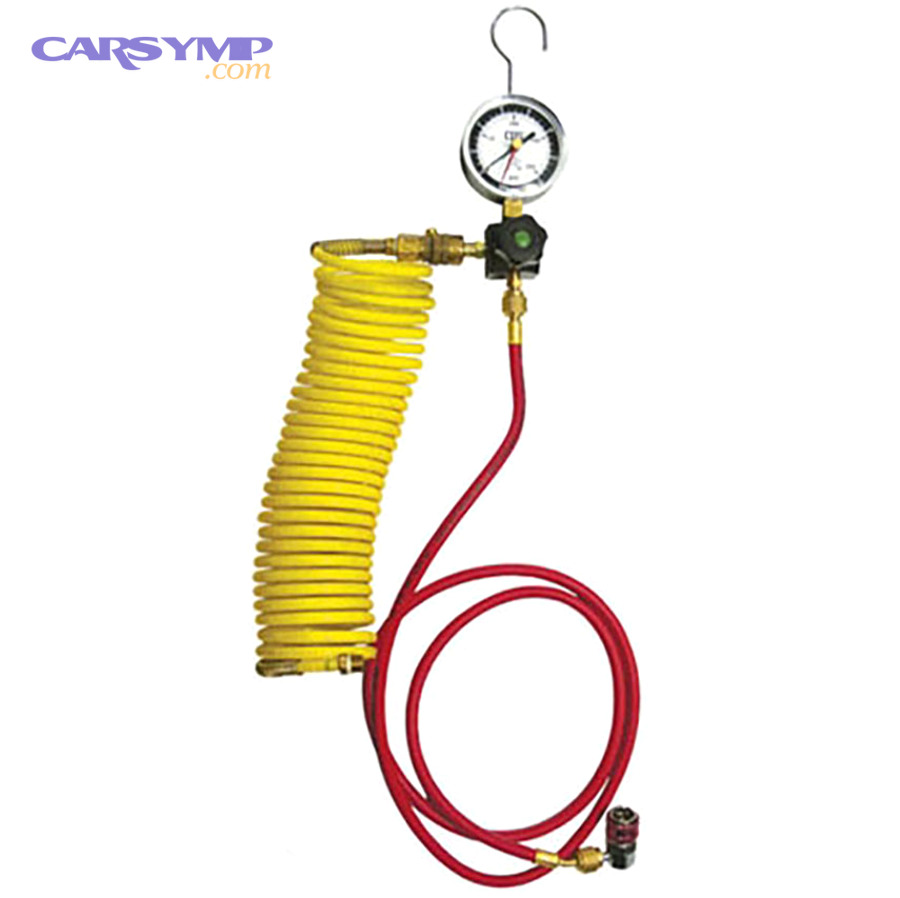
To validate under controlled conditions, a nitrogen pressure setup can be used to hold pressure safely and watch for decay—this is particularly useful when refrigerant has already escaped.
Before any pressurization work, use proper regulators and follow safety practices—pressurized gases can be dangerous, and refrigerant handling is regulated in many regions.
Contextual border: Up to this point, you’ve separated fin restriction (air-side) from internal leakage (refrigerant-side). Next, we expand into design-specific pitfalls and the most common “repeat-failure” causes that make diagnostics look confusing.
What design details make some condensers easier to damage or harder to diagnose?
Some condensers—especially microchannel/parallel-flow designs—are more sensitive to contamination, restricted passages, and uneven airflow, which can amplify the effect of both fin damage and small leaks.
To keep it practical, this section focuses on the rare attributes that change your decision-making and prevent repeat failures.
Why “microchannel” style cores can behave differently
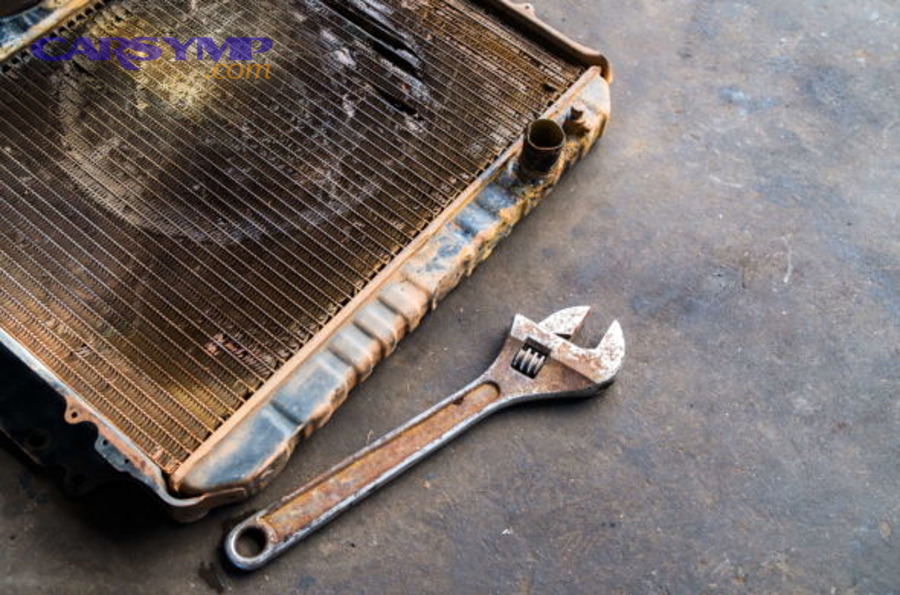
Microchannel/parallel-flow cores use many small passages; that improves efficiency but can make them less forgiving of debris, internal contamination, or localized damage that reduces effective flow paths.
To reduce repeat issues, treat any confirmed internal contamination as a system-level concern, not just a “swap the part” event.
Why uneven airflow can mimic a leak symptom
Uneven airflow can cause inconsistent vent performance and unusual high-side behavior, which some people misread as “low refrigerant,” especially if cooling improves while driving faster.
To anchor this in evidence, the 2016 SAE World Congress listing highlights experimental work on condenser airflow blockages and their measurable impact on A/C performance, reinforcing that airflow problems alone can produce major symptoms even without a leak.
How to avoid repeat failures after service
After a repair, keep the system clean and verify stability under real heat load; this is where AC condenser replacement decisions should be paired with correct oil balance and contamination control to prevent rapid comebacks.
To protect the new part on modern designs, follow manufacturer guidance—especially Parallel-flow condenser flushing rules, because many parallel-flow/microchannel condensers are not flush-friendly when contamination is present and may require replacement instead of cleaning attempts.
How to verify the fix without guessing
Verification means confirming no detectable leak signals and stable pressures/temps across multiple conditions; Post-repair pressure test and recharge steps should include controlled pressure checks, proper evacuation, and performance observation at idle and at speed.
To make verification stick, recheck for residue/dye after several drive cycles and confirm the system doesn’t drift back into low-charge behavior.
Frequently asked questions
These quick answers address the most common confusion points after you’ve run the core diagnostics above.
Can bent fins alone cause the A/C to blow warm?
Yes, bent fins can cause warm air, especially at idle, because reduced airflow raises condensing temperature and reduces how effectively refrigerant turns back into liquid; however, you should confirm by observing speed-dependent improvement and inspecting the fin field.
Is oily residue always a condenser leak?
No, oil can migrate and collect from nearby connections or line joints, so you confirm by tracing the highest concentration point and using dye/electronic methods rather than relying on oil alone.
Will straightening fins “fix it” permanently?
Sometimes, if the fins are only folded and not torn; but if the core is heavily crushed or the tubes are impacted, straightening may not restore airflow enough, and it can even damage fins further if done aggressively.
What’s the safest DIY stopping point?
Stop at visual inspection, gentle cleaning, and basic airflow checks if you lack proper equipment; refrigerant recovery, charging, and high-pressure testing should be done with the correct tools and safety practices.