


Preventing premature mount wear comes down to one core goal: reduce unnecessary stress on your engine mounts while catching small problems before they turn into a torn, collapsed, or leaking mount that shakes the whole car. When you keep mounts in their “normal” working range—clean, properly supported, and not constantly overloaded—you get smoother rides and fewer repeat failures.
Engine mounts wear out early when their rubber or hydraulic internals are forced to do jobs they were never designed to do—like compensating for fluid leaks, drivetrain misalignment, harsh torque spikes, or repeated impacts. Understanding what the mount is supposed to do makes it much easier to protect it.
The fastest way to align your habits and maintenance with longer mount life is to connect causes to symptoms: vibration at idle, clunks on acceleration, and excessive engine movement are all “early warning” signals that mounts are being overstressed or have already started failing.
Introduce a new idea: instead of waiting until the car shakes badly, you can use simple, safe checks at home, adjust a few daily-driving behaviors, and—if you do need a replacement—avoid the common mistakes that cause the next set of mounts to fail early.
What does an engine mount do, and why does it wear out prematurely?
An engine mount is a vibration-isolating support that holds the engine and transmission in the correct position while absorbing torque movement and reducing noise, vibration, and harshness (NVH). Next, once you see a mount as both a “support” and an “isolator,” the reasons for premature wear become much easier to predict.
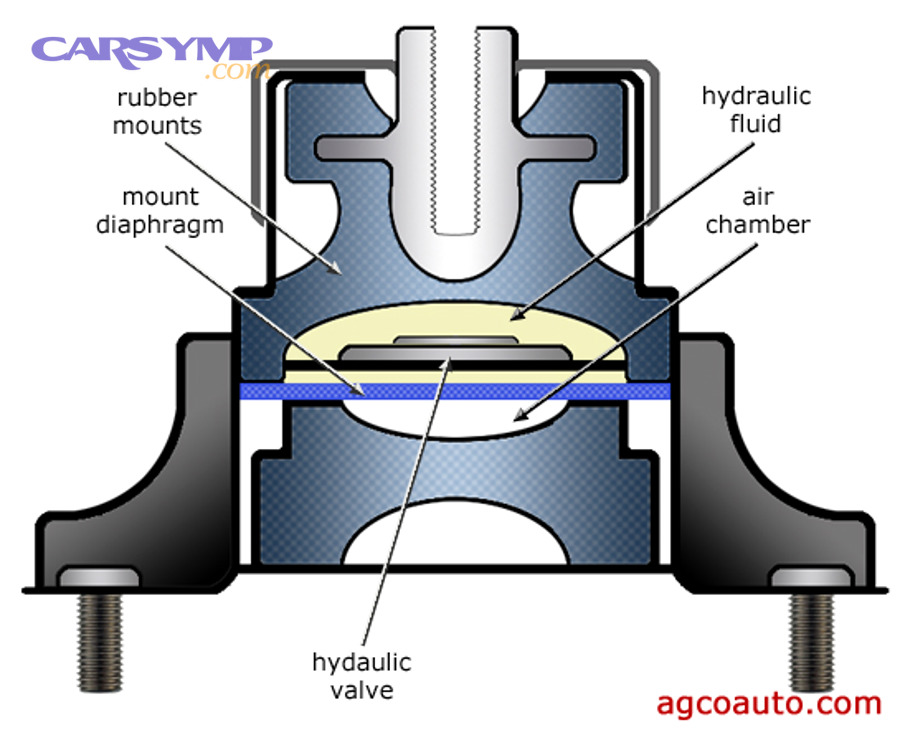
At a basic level, mounts do three jobs at the same time:
- Carry static load: the weight of the engine/transmission.
- Control dynamic load: engine torque that rocks the powertrain during acceleration, shifting, and braking.
- Isolate vibration: rubber or hydraulic systems reduce vibrations transmitted to the chassis and cabin.
Premature wear usually happens when one of those loads becomes excessive or constant. For example, a small torque movement during normal acceleration is expected; repeated harsh launches, wheel hop, or aggressive shifting can slam the mount through a much larger range of motion—tearing rubber, collapsing voids, or damaging internal hydraulic membranes and valves.
Is engine mount wear always caused by mileage and age?
No—premature engine mount wear is often caused by stressors other than mileage and age, mainly repeated torque spikes, contamination from fluid leaks, and misalignment or binding that keeps the mount “preloaded” even at rest. In addition, a mount can look “old” because it’s dirty, but fail early because it is constantly being twisted beyond its designed travel.
Here’s how to think about it:
- Age-related wear is slow: rubber hardens, micro-cracks grow, hydraulic fluid slowly degrades.
- Premature wear is fast: a leak swells rubber, a misaligned drivetrain keeps the mount in a constant bind, or impacts stretch and tear bonded rubber.
A useful mental model: mileage wears mounts out; events kill mounts early. One curb strike, a long-term oil leak, or a single poorly supported installation can shorten lifespan dramatically.
What are the most common failure modes in rubber vs hydraulic engine mounts?
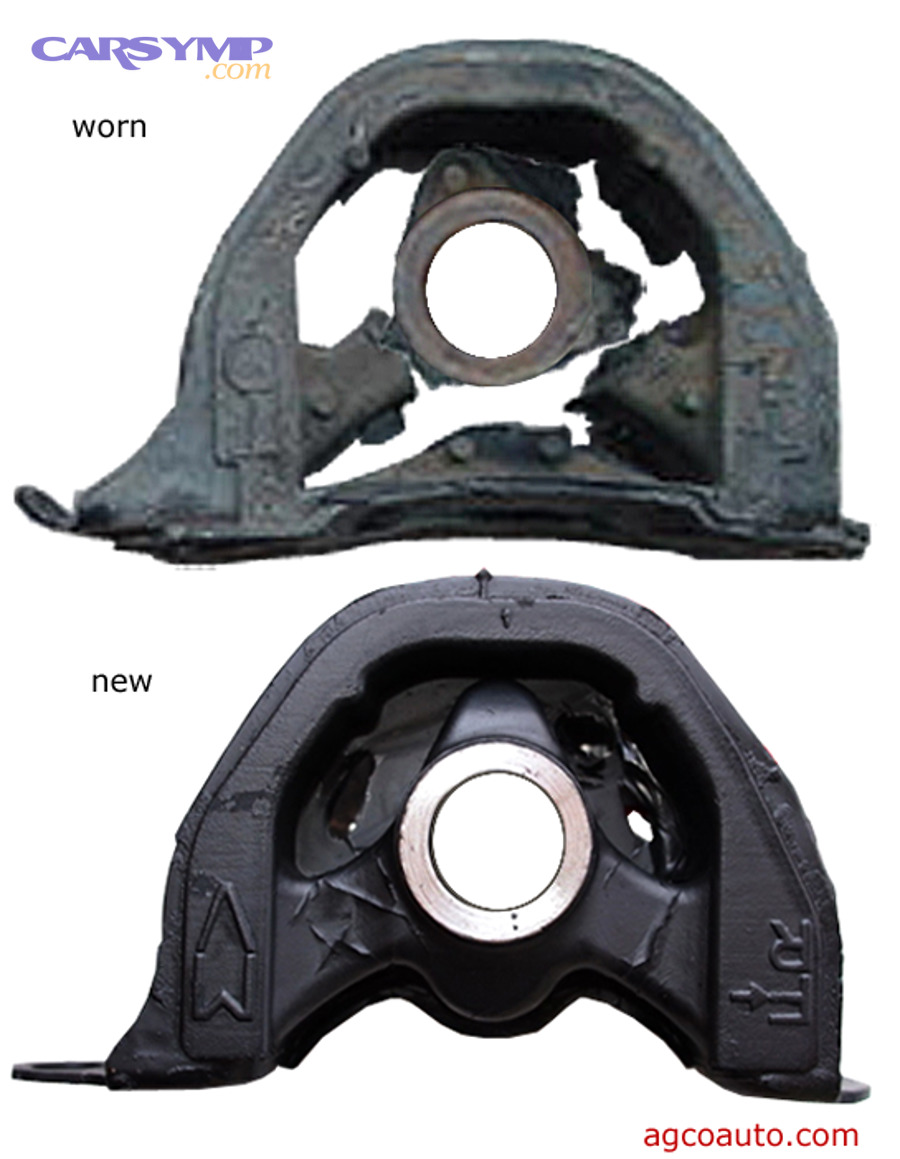
Rubber mounts most commonly fail by tearing, separating from metal, or collapsing, while hydraulic mounts often fail by leaking fluid, internal valve/diaphragm damage, or collapse that mimics a “solid” mount. More specifically, the difference comes from what each mount is made to do:
- Rubber (solid/voided) mounts
- Typical failures: torn rubber, bond separation, collapse, cracking
- What you feel: thump/clunk, harsh vibration that worsens with load
- Why it fails early: over-travel, contamination (oil/coolant), repeated impacts
- Hydraulic mounts
- Typical failures: fluid leak, diaphragm rupture, valve malfunction, internal collapse
- What you feel: strong vibration at idle, booming/rumble, inconsistent behavior (sometimes “fine,” sometimes awful)
- Why it fails early: heat, age + leak, incorrect installation orientation/torque, contamination, over-travel
A quick way to identify the “mode”: if you see oily residue and the mount looks wet or stained, suspect hydraulic leakage or fluid contamination; if rubber looks ripped or pulled away from the metal shell, suspect over-travel or impact/torque abuse.
What causes premature engine mount wear in daily drivers?
Premature mount wear in daily drivers is most commonly caused by repeated high-torque events, fluid contamination, drivetrain imbalance between mounts, and impact damage from potholes or curb strikes. Then, once you sort causes into “habit,” “maintenance,” and “damage,” you can fix the real problem instead of just replacing parts.
Which driving habits are most likely to shorten engine mount life?
Driving habits that shorten mount life the most are hard launches, aggressive throttle on/off transitions, and repeated harsh shifting, because they repeatedly spike torque and slam the powertrain against its travel limits. Specifically, these habits create the most mount stress:
- Full-throttle launches from a stop
- The engine torques hard against the mounts before the car has momentum.
- “Stabbing” the throttle and abruptly lifting
- The mount gets loaded, unloaded, then loaded in the opposite direction.
- Wheel hop
- Rapid traction loss/regain creates violent oscillation that can tear mounts fast.
- Aggressive downshifts (especially without rev-matching in manuals)
- Sudden driveline shock transfers into the mount system.
- Bumping curbs while parking
- It sounds minor, but repeated side loads can shift brackets and preload mounts.
Daily-driver takeaway: you don’t need to drive “slow”—you need to drive smooth. Smooth torque transitions dramatically reduce mount fatigue.
Can oil, coolant, or power steering leaks destroy engine mounts faster?
Yes—fluid leaks can destroy engine mounts faster because many automotive elastomers swell, soften, or lose strength after chemical exposure, and that makes tearing and collapse much more likely under normal torque loads. More importantly, contamination doesn’t need to be dramatic; slow seepage over months can do real damage.
A practical cause-and-effect chain looks like this:
- Leak drips onto mount or sits in a pocket
- Rubber changes properties (softens, swells, loses tensile strength)
- Mount deflects more under the same torque
- Over-travel increases
- Tear/collapse happens earlier
If you want a concrete, data-driven reason to take leaks seriously: materials exposed to harsh chemical environments can show measurable swelling and reduced tensile strength retention. According to a study by Politehnica University of Timișoara from the Department of Materials and Manufacturing Engineering, in 2025, EPDM samples in aggressive aging conditions showed swelling exceeding 4.5% and tensile strength retention as low as 68% in some cases. (pmc.ncbi.nlm.nih.gov)
Even though that study focuses on EPDM in fuel-cell-like acidic aging, it reinforces the core point: chemical exposure changes rubber performance, and mounts depend on stable rubber behavior to control movement.
Does a bad transmission mount or torque mount cause engine mounts to fail early?
Yes—a bad transmission mount or torque mount can cause premature engine mount wear because mounts function as a system, and when one mount stops controlling movement, the remaining mounts are forced to absorb loads they weren’t designed to carry. Moreover, the “good” mounts begin to see higher peak forces and larger motion cycles.
Common system-level scenarios:
- Transmission mount collapses → engine mounts take extra rotational load
- Torque strut (dogbone mount) wears → powertrain rocks more → side mounts tear
- One mount replaced with a stiffer design → others see uneven load sharing
- Loose mount bracket bolts → mount shifts and binds → early tearing
A simple way to spot system imbalance: if one mount looks new and another is cracked or torn quickly, it’s often because the underlying motion problem wasn’t fixed.
How do potholes, curb strikes, and minor accidents contribute to early mount failure?
Impacts contribute to early mount failure by shifting brackets, bending mount “ears,” and creating constant pre-load (binding) that keeps the mount stressed even when the car is sitting still. Especially, what looks like “no damage” from the outside can still push a mount out of its neutral position.
What impacts can do:
- Bracket misalignment: mount bolts no longer sit naturally in the mount holes.
- Crossmember shift: small movement changes mount geometry.
- Exhaust contact: impacts can move exhaust hangers so the exhaust hits under load—often misdiagnosed as mount failure.
- Subframe shift: changes drivetrain angles and increases stress on mounts and axles.
If you’ve hit something hard and suddenly notice vibration at idle or a new clunk, treat that as a system-alignment issue first, not just “the mount got old overnight.”
What symptoms indicate your engine mounts are wearing out early?
Early-wearing engine mounts usually show up as vibration at idle, clunks or thumps during acceleration/braking, and noticeable engine movement—often before you can see obvious damage. However, symptoms overlap with suspension and drivetrain issues, so you need a symptom-to-cause filter.

To make diagnosis easier, the table below maps common Car Symptoms to what they most often mean for mounts versus other systems:
| Symptom (what you feel/hear) | More likely mount-related when… | More likely NOT mounts when… |
|---|---|---|
| Vibration at idle | Worse in Drive/Reverse; improves when RPM rises slightly | Changes with road speed; felt mainly through seat at speed |
| Clunk on accel/brake | Happens on throttle tip-in/tip-out; feels like a “shift” in drivetrain | Happens on bumps; more of a rattle; tied to suspension travel |
| Thud shifting D↔R | Single knock plus visible engine rock | Multiple knocks; delayed engagement; transmission issue |
| Steering wheel shake | Mostly at idle/in gear | Mostly at 55–70 mph; wheel balance/tires |
| Exhaust boom/drone | Changes with engine load and gear | Constant at certain road speed; exhaust resonance or tire noise |
Is vibration at idle a reliable sign of worn engine mounts?
Yes—vibration at idle is a reliable sign of worn mounts when the vibration is strongest at idle, changes noticeably between Park/Neutral and Drive/Reverse, and reduces as RPM increases slightly. Specifically, mounts are most critical at idle because the engine produces low-frequency vibration that mounts must isolate.
Use this quick “reliability check”:
- Mount-likely vibration:
- Strong at idle
- Worse in gear (automatic)
- Reduced at 1,200–1,500 RPM
- Mount-unlikely vibration:
- Appears mainly at cruising speed
- Scales with road speed, not engine speed
- Changes with tire rotation, braking, or cornering
If idle vibration suddenly appears after a repair, suspect mount misalignment, missing bolts, or incorrect torque—not just “the mount is old.”
What does a “clunk” on acceleration or braking usually mean for mounts?
A clunk on acceleration or braking usually means the drivetrain is shifting because a mount is torn/collapsed or a torque mount has excessive play, allowing the engine/transmission to rotate and then hit a stop or rebound. For example, the clunk often happens at these moments:
- Throttle tip-in (accelerating from steady speed)
- Throttle lift (engine braking)
- First engagement after a stop
- Shift events (especially D↔R on automatics)
The clunk is basically the sound of movement plus a hard limit: a loose mount lets the powertrain move farther, then something contacts or the mount hits its internal stop.
Which symptoms suggest a mount problem vs a suspension or drivetrain problem?
Mount symptoms tend to be engine-load dependent, while suspension symptoms tend to be road-input dependent. In other words:
- Mount-related clues
- Changes with throttle input
- Changes with shifting into gear
- Can be reproduced in place (parked) by load changes
- Suspension-related clues
- Changes with bumps and turning
- Mostly tied to vehicle speed and road condition
- Drivetrain/axle-related clues
- Clicking in turns (CV joints)
- Vibration that increases with speed (axles, wheels)
- Shudder under acceleration at speed (axles, misfire, drivetrain)
A strong separator test (without getting risky): if you can reproduce the symptom without moving the car, mounts become much more likely.
How can you inspect engine mounts safely at home to catch wear early?
You can inspect engine mounts safely at home by combining a visual check, controlled load changes, and a cautious engine-movement check using proper support—without putting yourself under an unsupported vehicle. To better understand what “safe” looks like, focus on reducing risk before you focus on finding the fault.
Before any inspection: prioritize DIY mount replacement safety considerations even if you’re “just checking.” That means:
- Work on level ground.
- Use wheel chocks.
- Keep hands and tools away from belts/fans.
- Never get under a vehicle supported only by a jack.
- If you must lift the car, use jack stands on proper lift points.
Here’s one helpful walkthrough video for DIY checks and diagnosis:
Can you visually confirm a bad engine mount without lifting the engine?
Yes—you can often visually confirm a bad mount without lifting the engine by looking for torn rubber, separated bonding, collapsed height, or fluid leakage on hydraulic mounts. However, some mounts fail internally and look “fine,” so a clean visual doesn’t guarantee the mount is healthy.
Look for:
- Rubber tearing or chunking
- Gap where rubber pulled away from the metal
- Mount sitting “lower” than expected compared to other mounts
- Shiny contact marks where the engine bracket has been hitting
- Hydraulic mounts that look wet or oily (possible fluid leak)
Pro tip: use a flashlight and take a phone video. Slow-motion playback sometimes reveals movement or separation that’s hard to see live.
What is the safest way to check for excessive engine movement?
The safest way is to have a helper apply controlled load changes (idle in gear for automatics, light throttle blips in neutral, or gentle clutch engagement for manuals) while you observe engine movement from a safe position away from rotating parts. Specifically, you want to observe how far and how abruptly the engine rocks.
Safe observation setup:
- Hood open, parking brake on, wheels chocked.
- You stand to the side—never leaning over belts/fans.
- Helper applies load changes gently.
What you’re looking for:
- Smooth, small movement is normal.
- Large, abrupt movement (especially a quick “jump” followed by a stop) suggests excessive play.
- Asymmetry (rocking much more one direction) suggests a failed torque mount or side mount.
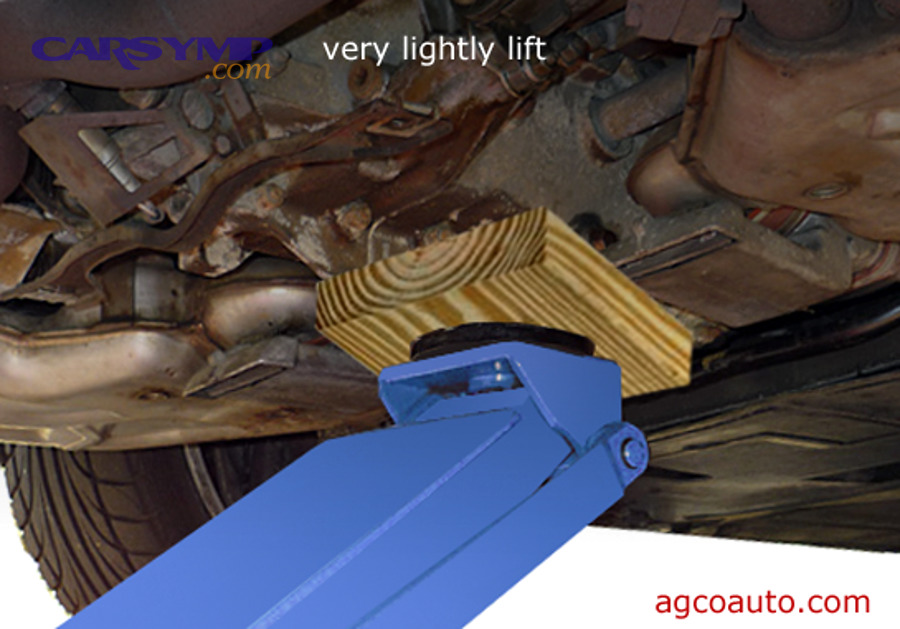
If you must slightly support the engine to isolate vibration, use a jack with a wood block and only take a small amount of weight, not lift the engine significantly (to avoid pan damage and unsafe shifts).
Should you do the “power brake test” to diagnose mounts?
No—the traditional “power brake test” is not recommended as a first-choice diagnostic because it can be risky and can overstress mounts, brakes, and driveline components if done incorrectly. Meanwhile, you can get safer diagnostic value from milder load changes and controlled observation.
If someone insists on the concept, the safer alternative is:
- Gentle load in gear with minimal throttle (automatic), or
- Light clutch take-up without launching (manual), and
- Stop immediately if you see excessive movement.
Mount diagnosis should not involve intentionally creating violent torque events—because that’s one of the reasons mounts fail early in the first place.
How do you prevent (avoid) premature engine mount wear with maintenance and habits?
You prevent premature engine mount wear by stopping fluid contamination, reducing torque spikes, keeping mounts aligned and correctly torqued, and addressing mount-system issues (transmission mount, torque strut) as a set. Especially, prevention is cheaper than repeated engine mount replacement because it tackles the root stressors.

What maintenance actions prevent mount wear the most?
The highest-impact maintenance actions are fixing leaks early, maintaining correct engine operation, and keeping surrounding components from adding extra vibration or movement. For example:
- Fix oil/coolant/power steering leaks quickly
- Leaks can soften rubber and accelerate tearing (chemical exposure risk). (pmc.ncbi.nlm.nih.gov)
- Repair misfires and rough idle
- A rough-running engine creates higher vibration that mounts must isolate continuously.
- Check and tighten mount hardware to spec after repairs
- Loose bolts allow movement, shifting, and binding.
- Inspect exhaust hangers and clearances
- Exhaust contact can mimic mount failure and add stress.
- Replace worn torque struts or transmission mounts when needed
- The system shares load; one weak link overloads the others.
A practical schedule: whenever you do a major service that disturbs the drivetrain (subframe work, clutch, transmission, oil pan, timing service), add a quick mount and bracket check.
What driving changes reduce mount stress without sacrificing everyday drivability?
The best driving changes are smooth throttle application, avoiding wheel hop, and minimizing abrupt on/off torque transitions, because mounts hate sharp reversals of load. More specifically:
- Roll into throttle instead of stabbing it
- Avoid “launching” the car on cold tires or wet pavement
- If wheel hop starts, lift and reset
- Wheel hop is mount abuse in fast-forward.
- In manuals: rev-match downshifts
- Reduces driveline shock.
- Avoid bumping curbs while parking
- Repeated small impacts can shift mount geometry.
This isn’t about driving slow—it’s about reducing the peak torque impulse that the mount has to absorb.
Does replacing one mount at a time prevent or cause premature wear?
It depends—replacing one mount at a time can be fine if the other mounts are healthy and alignment/torque is correct, but it can also contribute to premature wear if the remaining mounts are weak, misaligned, or if one new stiff mount forces extra load into older mounts. More importantly, the bigger risk is not “one at a time” itself—it’s uneven load sharing and binding.
A good decision rule:
- Replace one mount when:
- The failed mount is clearly isolated (torn/leaking)
- The others show no cracking, collapse, or excessive play
- The vehicle has low-to-moderate mileage and no major impacts
- Replace mounts as a set (or at least in pairs) when:
- Multiple mounts show age/collapse
- You have strong vibration at idle plus clunks under load
- A torque mount/trans mount is also worn
- You’re correcting a repeat-failure problem
If budget is the constraint, prioritize the mount that controls torque reaction (often the torque strut/dogbone or the primary side mount), because torque reaction is what tears mounts fastest.
If your mounts are already worn, what steps prevent the new mounts from failing again?
To prevent new mounts from failing again, you need to choose the right mount type for your use case, correct the underlying cause (leaks, misalignment, driving shocks), and install/torque mounts correctly at ride height without preloading. More importantly, successful engine mount replacement is a system reset—not just a parts swap.

Should you choose OEM rubber, hydraulic, or polyurethane mounts for daily driving?
OEM rubber usually wins for balanced comfort and durability, hydraulic is best for refined idle isolation on vehicles designed for it, and polyurethane is best for performance response but often increases NVH for daily drivers. However, “best” depends on what you’re trying to solve.
Use this daily-driver decision guide:
- OEM rubber (or OEM-equivalent rubber)
- Best for: stock feel, balanced isolation, predictable behavior
- Good choice when: you want long-lasting mounts without extra vibration
- Hydraulic (OEM-style)
- Best for: vehicles designed with hydraulic mounts for idle refinement
- Watch out for: higher cost, potential leakage, more sensitivity to heat/age
- Polyurethane
- Best for: performance builds, reduced engine movement, sharper shifting feel
- Tradeoff: increased vibration/harshness; can be annoying in commuter use
If you’re trying to stop repeated tearing from torque events, you may be tempted by stiffer mounts—but stiffer mounts can transfer more vibration into the cabin and other components. If your car is a true daily driver, “slightly stiffer” is usually safer than “race stiff.”
When budgeting, include an Engine mount replacement cost estimate that accounts for parts and the fixes that prevent repeat failure (leak repair, torque mount, hardware, alignment). Many repeat failures happen because the estimate only covers the mount, not the cause.
What installation mistakes most often lead to repeat premature mount wear?
The most common installation mistakes are torquing mounts with the drivetrain out of position, preloading/binding the mount, and supporting the engine incorrectly during the job, which can damage mounts or misalign brackets. Specifically, avoid these repeat-failure triggers:
- Tightening mount bolts while the engine is lifted or twisted
- This “locks in” a stressed position.
- Not seating dowels or alignment pins
- Causes constant shear load and early tearing.
- Reusing stretched/weak hardware where spec requires replacement
- Loose bolts = movement = impact loading.
- Improper torque sequence
- Bracket shifts, mount sits crooked.
- Skipping leak repair
- New mount gets chemically attacked again.
- Overlifting by the oil pan
- Risk of pan damage and distorted positioning.
A simple best practice: loosely install all mount bolts, settle the drivetrain into neutral position, then torque to spec in the correct order—often at normal ride height or with the drivetrain supported in its natural resting position (model-specific).
When should you stop DIY and see a mechanic for mount-related symptoms?
You should stop DIY and see a mechanic when you have safety risk (unsupported lifting, uncertain lift points), signs of bracket/subframe damage, repeated failures, or symptoms that could indicate drivetrain issues beyond mounts (axle bind, misalignment, severe vibration). Especially, if you’re unsure about supporting the engine safely, professional help is the smart move.
Escalate to a mechanic if:
- You see bent brackets, cracked mounts, or shifted subframe evidence
- The engine moves excessively (looks like it could contact radiator/fans)
- You have persistent clunks after mounts are replaced
- There’s axle bind, unusual CV angles, or transmission shifting issues
- You’re dealing with active/electronic mounts that require specialized testing
DIY can be great, but mount work sits in a high-risk zone because you’re supporting heavy components. If the “support plan” is unclear, that’s the cutoff.
Which less-common factors can cause repeated premature engine mount wear even after replacement?
Repeated premature mount wear after replacement is often caused by hidden alignment issues, heat damage, or mount-type mismatches that keep stress high even with new parts. Besides, these are the problems that make people feel like they’re “cursed” with mounts—when the real issue is a constant stressor the new mount can’t escape.
Can drivetrain misalignment or bushing pre-load accelerate new mount wear?
Yes—drivetrain misalignment or bushing pre-load can accelerate new mount wear because the mount is forced to hold a twisted position at rest, so every acceleration adds stress on top of stress. More specifically, pre-load can come from:
- Subframe slightly shifted after impact or repair
- Engine/transmission sitting crooked due to bracket deformation
- Incorrectly tightened mounts while the drivetrain was lifted
- Worn control arm/subframe bushings changing geometry under load
According to a study by Concordia University from the Department of Mechanical and Industrial Engineering, in 2004, optimizing mount control in an active mount model reduced a vibration-related target value from 304.30 to 27.25, representing a reduction ratio of about 91.1%. (spectrum.library.concordia.ca)
The practical connection: when the mount system is correctly “tuned” and aligned, the vibration and stress environment can change dramatically—which is exactly why misalignment and pre-load can be so destructive.
Do turbo heat and missing heat shields shorten mount lifespan?
Yes—turbo heat and missing heat shields can shorten mount lifespan because elevated temperature accelerates rubber aging, hardening, and cracking, and heat can also degrade hydraulic mount fluids and internal membranes. Moreover, radiant heat near the mount can create uneven aging: one side becomes brittle, then tears under normal torque.
If your vehicle has:
- A turbocharger close to a mount,
- A missing or damaged heat shield,
- Heat-soaked wiring or hoses nearby,
…treat mount heat management as part of prevention. Heat shielding is cheaper than repeat mount failures.
Can overly stiff aftermarket mounts reduce wear but increase vibration (NVH) for daily drivers?
Yes—overly stiff aftermarket mounts can reduce visible engine movement and some types of tearing, but they often increase NVH because they transmit more vibration into the chassis instead of absorbing it. Meanwhile, higher NVH can create secondary issues: rattles, interior buzzes, and sometimes faster wear of adjacent components.
A balanced approach for daily drivers:
- Mildly stiffer torque mount to control rocking
- Keep primary isolation mounts closer to OEM compliance
- Avoid “full race” stiffness unless the car is purpose-built for it
Are active/electronic engine mounts different to diagnose than standard mounts?
Yes—active/electronic mounts are different because failure can come from the mount or the control system (valves, solenoids, sensors, wiring, ECU commands), so you can’t diagnose them by rubber condition alone. More importantly, an active mount may look physically intact but behave like it’s failed because the control function is offline.
If your car uses electronically controlled mounts, diagnosis often requires:
- Scanning for codes
- Commanding mount states (where supported)
- Checking wiring/connectors and vacuum lines (for vacuum-controlled types)
- Verifying the mount isn’t leaking or collapsed
When active mounts fail, replacement can be expensive—so it’s worth confirming whether it’s a mount issue or a control issue before buying parts.