


Most drivers can expect a professional injector-cleaning-related service to land somewhere between about $70 and $200 in many mainstream cases, but the “right” estimate depends on what kind of cleaning you’re actually buying and how your engine is built. (meineke.com)
If you’re trying to decide whether that money is worth spending, the best way is to compare cleaning vs replacement using the same symptoms, the same diagnostic clues, and the same “probability of success” logic—because some injector problems are fixable with cleaning and some are not. (meineke.com)
Next, cost accuracy comes from understanding the pricing drivers shops use—like injection type (port vs direct), injector access, diagnostic time, and common add-ons—so you can tell whether a quote is fair or padded. (meineke.com)
Introduce a new idea: once you know the cost range, the decision logic, and the pricing factors, you can choose the right method (on-car vs bench) and ask for the right proof—so you get real value instead of paying for a vague “fuel service.”
What does fuel injector cleaning typically cost at a shop (and what is the “normal” price range)?
A typical professional fuel injector cleaning-related service often falls in the $70–$200 range for many vehicles, but the “normal” price depends on whether you’re paying for an in-tank additive, an on-car pressurized cleaning, or a broader fuel system cleaning package. (meineke.com)
To better understand why that price swings, it helps to translate shop language into service “tiers,” because most invoices are priced by method and bundle, not by the word “injector.”
What is a “fuel injector cleaning service” in shop terms?
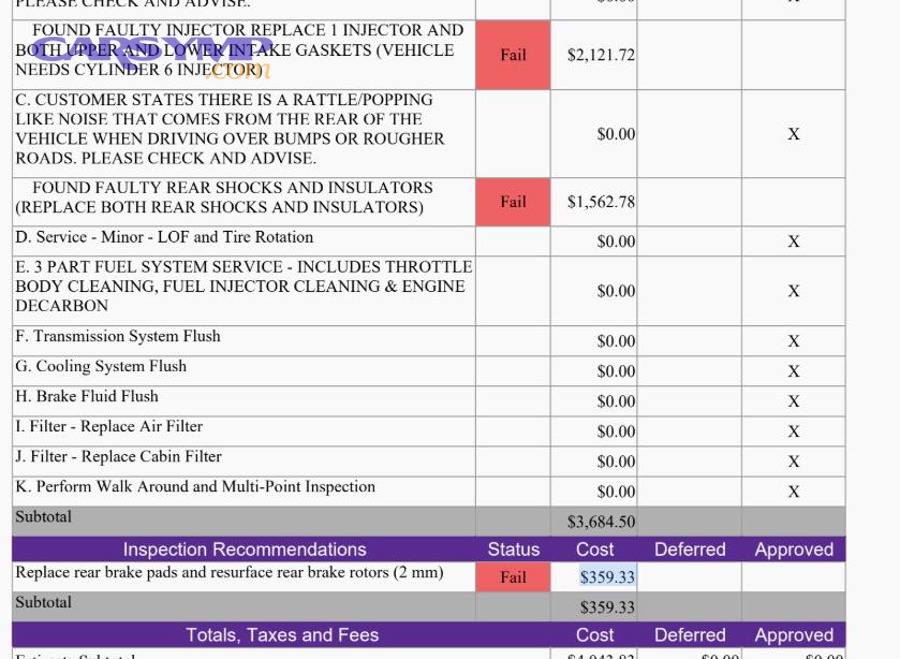
A “fuel injector cleaning service” is a maintenance procedure that uses detergents and/or pressurized solvent to reduce deposits in the fuel delivery path, often sold under labels like “fuel injection service,” “fuel system cleaning,” or “induction service,” with scope varying by shop. (jiffylube.com)
Specifically, many shops bundle injector-focused work with other deposit-related steps because fuel delivery and intake airflow problems often show up as the same complaints (rough idle, hesitation, poor mileage). That’s why “fuel injector cleaning” can mean different things on different estimates:
- In-tank cleaner (additive): a detergent added to the fuel tank; low labor, low cost, light cleaning.
- On-car pressurized rail cleaning: a machine feeds cleaner through the fuel rail while the engine runs; moderate labor, stronger cleaning.
- Fuel system cleaning package: multi-step product/service that may include intake/throttle body steps plus injector-related cleaning; higher price due to added labor and materials. (jiffylube.com)
This matters because a fair estimate is only fair if you know what’s included.
What are the 3 common price tiers for injector cleaning (additive, on-car pressurized, full fuel system service)?
There are 3 main tiers of injector-related cleaning—in-tank additive, on-car pressurized cleaning, and full fuel system cleaning packages—based on the criterion of how directly the cleaner is delivered and how much labor is involved. (meineke.com)
However, a tiered view is only useful if you can connect each tier to real “what you get” outcomes. Here’s what each tier usually looks like in the real world.
Tier 1: In-tank additive (lowest cost, lowest certainty)
- Typical use: mild drivability issues or prevention.
- What’s included: detergent poured into tank; minimal labor.
- What it can do: help with light deposits and injector cleanliness over time.
- What it cannot do well: heavy deposits, severe clogging, mechanical faults.
Tier 2: On-car pressurized cleaning (mid cost, stronger cleaning)
- Typical use: moderate drivability complaints where fuel delivery is suspected.
- What’s included: cleaner is run through the fuel rail (often with the fuel pump disabled) so the engine burns the solvent directly.
- Why it costs more: setup time, adapters, chemicals, shop procedure.
Tier 3: “Fuel system cleaning” package (highest cost among common services)
- Typical use: bundled preventive maintenance sold at quick-lube and shops.
- What’s included: may involve injectors, combustion chamber, and sometimes intake/throttle body steps (varies widely).
- Why it costs more: multiple products + multiple labor steps. (jiffylube.com)
To make this immediately actionable, the following table summarizes what you’re usually paying for by tier.
Table context: This table compares common injector-cleaning tiers by scope, cost drivers, and what “proof” you can reasonably expect after service.
| Tier | What the shop typically does | Main cost drivers | Best-fit situation | What proof you can ask for |
|---|---|---|---|---|
| In-tank additive | Adds cleaner to fuel tank | Product cost | Preventive maintenance, mild issues | Receipt + product used |
| On-car pressurized cleaning | Runs solvent through rail while engine runs | Labor + chemical + setup | Suspected deposit-driven drivability | Before/after trims, idle quality notes |
| Fuel system cleaning package | Multi-step service (varies) | Labor + bundled steps | When deposits suspected across system | Itemized steps + product list |
Is there a reliable cost estimate without knowing the exact vehicle?
Yes—you can get a reliable ballpark estimate for fuel injector cleaning without the exact vehicle because many mainstream services cluster into common tiers, but your accurate quote still depends on injection type, engine access, and whether diagnostics or add-ons are included. (meineke.com)
Moreover, you can tighten the estimate fast by providing a shop (or your content) with a simple checklist:
- Year/make/model/engine
- Port injection vs direct injection (if known)
- Symptoms and when they occur (cold start, idle, under load)
- Check engine light codes (if scanned)
- Any recent maintenance (spark plugs, fuel filter where applicable)
When you do that, the shop can quote the method instead of guessing based on a vague request for “injector cleaning.”
Which factors raise or lower injector cleaning cost (so your estimate is accurate)?
Injector cleaning cost rises or falls based on engine design, injector access, injection type, labor time, and service scope, because the invoice is really a combination of “method + time + add-ons,” not a single flat rate for all vehicles. (highlinewarren.com)
Next, you can treat these pricing drivers like knobs: if you know which knobs your vehicle turns up, you can predict the estimate before you hear it.
What vehicle and engine details most affect injector cleaning price?
The biggest vehicle-side price drivers are injector count, packaging/access difficulty, and required disassembly, because those determine labor minutes and whether a shop can do an on-car procedure quickly or must plan deeper work.
Specifically, these are the details that most often change the number on your estimate:
- Cylinder count / injector count: more injectors can mean more time if individual testing or removal is involved.
- Access difficulty: tight engine bays, turbo plumbing, or intake components can increase labor.
- Injection system architecture: direct injection hardware may change procedure and risk.
- Condition-based complexity: a vehicle with long-neglected maintenance may need diagnostics first, not “blind cleaning.”
A useful way to write this in an article is to separate “invoiced complexity” from “mechanical complexity.” Sometimes an engine is mechanically complex but still easy to service; other times it’s simple but buried under packaging that costs labor.
How does port injection cleaning cost compare with direct injection cleaning cost?
Port injection cleaning usually costs less for comparable services, while direct injection tends to cost more when the service expands beyond injectors into deposit-related drivability issues, because DI engines can involve different deposit patterns and sometimes more complex service decisions. (research.birmingham.ac.uk)
However, it’s important not to oversimplify the comparison. Two key realities influence cost:
- Procedure differences
- Port injection often responds well to methods that clean along the typical fuel path to the injector tips.
- Direct injection injectors operate at different conditions and can experience deposit behavior that affects spray and flow in specific ways. (research.birmingham.ac.uk)
- Diagnosis differences
- DI drivability complaints may be caused by injector-related spray changes or by issues that look similar (like ignition problems), so some shops add diagnostic time before recommending cleaning.
Evidence: According to a study by University of Birmingham from the Mechanical Engineering subject area, in 2020, test injectors that were mildly fouled showed an average 1.5% flow rate loss, and removing injector tip deposits reduced particulate emissions by up to around 45% in the tested GDI engine setup. (research.birmingham.ac.uk)
What shop choices and add-ons commonly change the total (diagnostic fee, throttle body, induction, new seals)?
The most common line items that change the total are diagnostic time, bundled intake/throttle cleaning, and parts like seals/O-rings, because they add measurable labor and materials beyond the base cleaning method. (highlinewarren.com)
In addition, these add-ons tend to appear on estimates in predictable ways:
- Diagnostic fee (often worth it when a check engine light is present)
A good shop will confirm whether your symptoms match fuel delivery issues before selling cleaning. - Throttle body / intake service add-on
Frequently bundled with fuel system packages; sometimes helpful, sometimes just upsold. - Bench-service parts (O-rings, filters/baskets, caps depending on injector type)
If you’re paying for off-car cleaning and flow testing, replacing wear items can be part of doing the job correctly. (theinjectorshop.com)
This is where many “overpay” scenarios come from: the base service may be reasonable, but the bundle grows without a clear explanation of the benefit.
Is injector cleaning worth it, or should you replace the injectors instead?
Injector cleaning is worth it when deposits are the likely cause and the injectors are mechanically healthy, but replacement is the better choice when there’s evidence of electrical failure, leakage, or persistent cylinder-specific misfire—because cleaning can’t repair damaged hardware. (meineke.com)
More importantly, the decision becomes much easier when you anchor it to symptoms + diagnostic clues, instead of guessing. This is where “Injector clog symptoms” become your practical filter, not just a list in a blog post.

Does injector cleaning actually work for rough idle, misfires, and poor MPG?
Yes, fuel injector cleaning can work for rough idle, misfires, and poor MPG when deposits are mild-to-moderate, because it can restore spray pattern and flow; No, it won’t work when the issue is electrical failure, mechanical leakage, or ignition-related—three common non-deposit causes. (meineke.com)
Specifically, here are three reasons cleaning does help in the right scenario:
- Deposit removal can restore flow and atomization
Better atomization supports more complete combustion and smoother idle. - Improved consistency between cylinders
When injectors behave more evenly, the engine’s trims and balance improve. - Reduced “fueling guesswork” by the ECU
When injectors respond predictably, the ECU doesn’t have to compensate as aggressively.
Then, here are three reasons cleaning does not help (and why replacement or other repairs win):
- Electrical faults (coil/open/short) can’t be cleaned away
A faulty coil is a parts problem. (theinjectorshop.com) - Leaking/stuck injectors are mechanical failures
They may pass solvent but still fail sealing. - Misfires are often ignition or air-related
Plugs, coils, compression issues, or vacuum leaks can mimic fueling problems.
A strong article moves from symptoms to decisions with clarity. So a practical “fast filter” looks like this:
- If the misfire follows a coil swap → ignition likely, not injector.
- If fuel trims are extreme and injector balance is suspected → cleaning/testing becomes more justified.
- If there’s evidence of leak-down or electrical fault → replacement rises to the top.
Fuel injector cleaning cost vs fuel injector replacement cost—what’s the break-even logic?
Cleaning wins in lower cost and lower commitment, replacement wins in certainty when failure is confirmed, and bench testing/cleaning is optimal when you want measured results (before/after)—so the break-even logic depends on how confident you are that deposits are the root cause. (meineke.com)
To illustrate that logic, start with baseline ranges often cited in consumer-facing service descriptions:
- Professional cleaning is commonly described as about $70–$200 depending on vehicle and service type. (meineke.com)
- Replacement is often described as hundreds of dollars, commonly $300–$900+ in parts and labor depending on vehicle. (meineke.com)
From there, the break-even question becomes: How likely is cleaning to solve the problem? If the likelihood is high, cleaning is a rational first step. If likelihood is low, you’re paying twice.
A practical break-even framework:
- Try cleaning first when:
- Symptoms match deposit behavior (gradual loss of MPG, hesitation under load).
- There’s no hard evidence of injector electrical failure.
- The car has high mileage and unknown fuel quality history.
- Replace first when:
- A scan and diagnosis point to a specific injector failure.
- There’s leak-down evidence or strong cylinder-specific fueling imbalance.
- Cleaning has already been tried (properly) without improvement.
What are the red flags that point to replacement instead of cleaning?
The clearest red flags are electrical injector faults, confirmed leakage, and persistent cylinder-specific misfire after basic ignition checks, because those failures indicate hardware damage rather than removable deposits. (meineke.com)
Moreover, these red flags tend to show up as repeatable patterns:
- Electrical codes or failed resistance tests (shop may mention ohm testing; bench services list this explicitly) (theinjectorshop.com)
- Fuel smell, wet plug, or leak-down test failure
- Misfire that remains after swapping coils/plugs
- Injector doesn’t respond consistently under pulse tests (bench services often measure this)
This is also where “cheap cleaning” becomes expensive: if replacement is inevitable, delaying it can waste time, add towing risk, and increase catalyst damage risk from misfires.
What’s the difference between on-car cleaning and off-car ultrasonic cleaning ?
On-car cleaning is best for convenience and moderate deposit removal, off-car ultrasonic bench cleaning is best for measured restoration and verification, and the costs differ because bench work includes testing, reporting, and often parts replacement—so you’re paying for certainty, not just solvent. (theinjectorshop.com)
Meanwhile, this section is where your required phrase fits naturally: On-car cleaning vs ultrasonic bench cleaning is not just a preference—it’s a different service category with different promises.
What is on-car pressurized injector cleaning?
On-car pressurized injector cleaning is a fuel-rail cleaning method where a machine or canister supplies concentrated cleaner to the fuel system while the engine runs, aiming to dissolve deposits at the injector tips without removing injectors. (reddit.com)
Specifically, reputable descriptions of a “true” on-car procedure emphasize that the cleaner replaces gasoline temporarily so the engine consumes the solvent directly, rather than diluting it in a full tank. (reddit.com)
What it’s good for:
- Moderate deposit issues
- Faster turnaround (often same visit)
- Lower labor than removal
Limitations:
- It cannot physically inspect injector internals
- It cannot confirm per-injector flow matching
- It will not repair failed seals, cracked bodies, or electrical faults
This is why your estimate can be “reasonable” but still not deliver results if the wrong method is chosen.
What is off-car ultrasonic cleaning + flow testing?
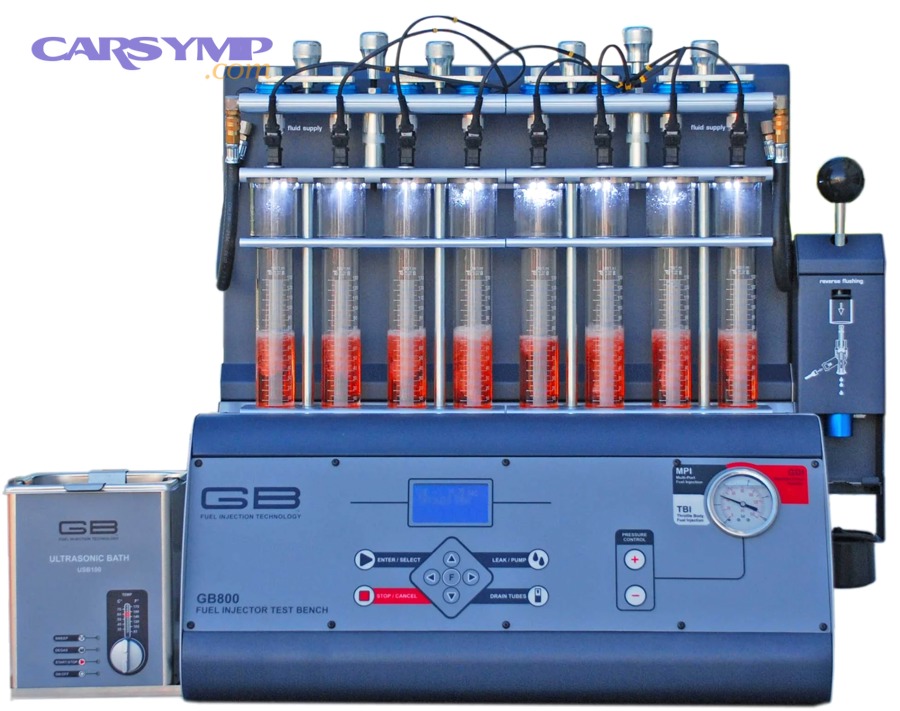
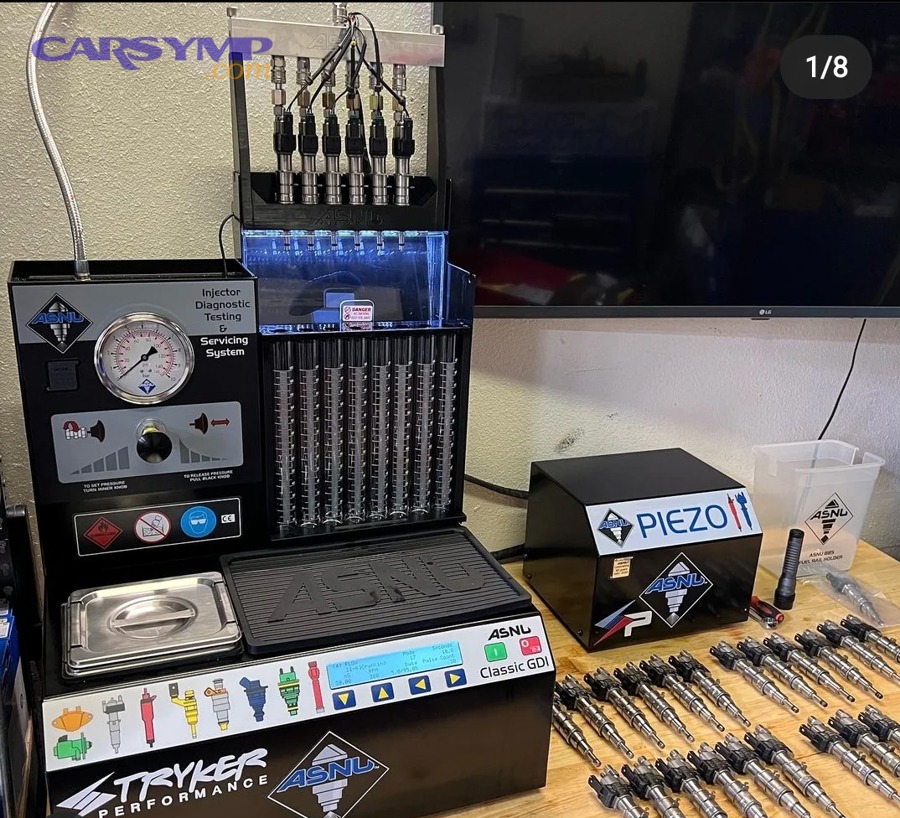
Off-car ultrasonic cleaning with flow testing is a bench service where injectors are removed, tested (leak, spray pattern, resistance), cleaned in an ultrasonic bath (often pulsed), back-flushed, then re-tested with before/after reporting to verify performance. (theinjectorshop.com)
For example, injector service pages commonly list steps like:
- Ohm testing (coil resistance)
- Ultrasonic cleaning (multi-stage)
- Back-flush process
- Spray pattern analysis
- Static and dynamic flow testing
- Component replacement (O-rings, filters, seals as needed)
- Detailed before/after reporting (theinjectorshop.com)
That is why bench services are priced “per injector” in many cases—because the service is measured and repeatable per unit. One example lists about $26.95 per injector for testing and cleaning, with reporting and certain shipping policies. (theinjectorshop.com)
Which method is cheaper, and which gives more certainty?
On-car cleaning is usually cheaper for a single visit, ultrasonic bench cleaning is usually more certain because it verifies injector performance, and the best choice depends on whether your goal is “quick deposit reduction” or “confirmed injector restoration.” (theinjectorshop.com)
However, “cheaper” can flip when removal labor is high. A bench service might have a low per-injector fee, but the vehicle labor to remove and reinstall injectors can dominate the total depending on engine design.
A clean comparison by criteria looks like this:
- Cost (typical path): on-car often lower labor; bench may add remove/reinstall labor.
- Downtime: on-car often same-day; bench can take longer (shipping or scheduling).
- Evidence: on-car rarely provides per-injector data; bench commonly provides before/after metrics. (theinjectorshop.com)
- Best fit: on-car for mild-to-moderate deposit suspicion; bench for performance builds, repeat misfires, or when you want proof.
Evidence: According to a study by University of Nottingham from its engineering research repository, in 2017, an accelerated injector deposit test reported 23.5% fuel rate loss accompanied by large increases in HC and CO emissions and a measurable increase in fuel consumption in the cited dirty-up conditions. (eprints.nottingham.ac.uk)
How do you get an accurate injector cleaning cost estimate from a shop (without overpaying)?
You get an accurate injector cleaning cost estimate by asking for an itemized quote that states method, inclusions, labor time, and proof, because “injector cleaning” is a label while the real price is determined by what the shop will actually do and measure. (meineke.com)
Especially with fuel injector cleaning, small wording differences change the invoice—so the fastest way to avoid overpaying is to control the wording yourself.
What questions should you ask to confirm what’s included in the price?
You should ask what method is used, what parts/steps are included, and what results will be verified, because those answers reveal whether you’re buying real diagnostic value or just a generic add-on. (theinjectorshop.com)
For example, use questions that force clarity:
- “Is this in-tank additive, on-car pressurized cleaning, or off-car ultrasonic bench cleaning?”
(This single question can prevent a $150 invoice for a $15 product.) - “Will you disable the fuel pump and run the engine on cleaner, or is it poured into the tank?” (reddit.com)
- “Is diagnostic time included, and what data supports injectors being the cause?”
Good shops explain why the recommendation matches symptoms. - “If injectors are removed, do you replace seals/O-rings or filters, and is reporting included?” (theinjectorshop.com)
- “What’s the warranty or expectation after service?”
Bench services often clarify what they can and can’t guarantee once injectors are back in service. (theinjectorshop.com)
Should you pay for injector cleaning before diagnosing a misfire code?
No, you should not pay for injector cleaning before diagnosing a misfire code because misfires are frequently caused by ignition or air problems, and paying for cleaning first often leads to unnecessary cost; diagnose first, then clean only if fuel delivery evidence supports it. (meineke.com)
Then, a practical diagnostic order that protects your wallet looks like this:
- Scan codes and freeze frame (P030x misfire, fuel trim clues)
- Check simple ignition items (plugs, coils, gaps, known failures)
- Look for vacuum/air leaks (unmetered air can imitate fueling problems)
- Only then move toward injector-related testing/cleaning if evidence points there
If your content needs a clear “reason chain,” keep it simple: 1) Misfires have multiple causes → 2) Cleaning only addresses one cause → 3) Diagnosing first prevents paying twice.
What proof or results should you expect after the service (and what’s realistic)?
You should expect measurable improvement in drivability indicators (smoother idle, reduced hesitation, more stable fuel trims) when deposits were the root cause, but it’s not realistic to expect instant miracles, major power gains, or a guaranteed MPG jump without data and time. (theinjectorshop.com)
More specifically, what “proof” looks like depends on the method:
- In-tank additive: minimal proof; you’re mainly paying for prevention and mild cleaning.
- On-car cleaning: ask for a short note on symptoms before/after and any scan data trends.
- Bench cleaning/testing: this is where proof is strongest—before/after flow data, leak-down notes, spray pattern observations, and coil test results are commonly listed as part of the service description. (theinjectorshop.com)
To help readers visualize the topic, here’s a single video embed that discusses cost expectations.
Contextual Border: By now, you have a usable cost range, a method-based way to interpret quotes, and a decision framework for cleaning vs replacement. Next, we’ll widen the lens to clear up common confusion around “injector cleaning” and show how to reduce the likelihood you’ll need it again.
What else is often confused with “injector cleaning,” and how can you reduce the need for it over time?
“Injector cleaning” is often confused with broader fuel or intake services, and you can reduce the need for it by improving fuel quality habits and maintaining the upstream components that prevent deposits—because prevention is the antonym of repeated repair spending. (jiffylube.com)
Next, this section strengthens semantic coverage by connecting related services and explaining why the same symptoms can originate from different deposit locations.

Is “fuel system cleaning” the same as injector cleaning, or a broader service?
Fuel system cleaning is usually broader than injector cleaning, while injector cleaning is a subset that targets injector performance specifically—so the same words can describe very different scopes depending on the shop’s package and products. (jiffylube.com)
However, the practical takeaway is simple: ask for the step list. A broader service might be worth it if your vehicle’s issues involve multiple deposit areas; it might be wasted money if your symptoms are unrelated.
A good semantic clue:
- If the service description talks about multiple steps and multiple areas (injectors + combustion chamber + intake path), it’s broader. (jiffylube.com)
- If it talks about injector test data and flow, it’s injector-specific. (theinjectorshop.com)
What is the difference between injector deposits and GDI intake valve carbon buildup?
Injector deposits are deposits that affect injector spray/flow behavior, while GDI intake valve carbon buildup is deposit accumulation on intake valves in direct-injection engines due to fuel not washing the valve backs—so cleaning injectors may not fix valve-related airflow problems. (research.birmingham.ac.uk)
Specifically, this is where many drivers get disappointed: the car runs rough, they buy “injector cleaning,” and the symptom remains because the deposit that matters is elsewhere. For DI engines, injector condition can still matter a lot, but the “deposit story” is more complex than it was in older port-injected designs. (research.birmingham.ac.uk)
Does using Top Tier gas or fuel additives reduce injector cleaning frequency?
Yes, using higher-detergency gasoline and appropriate additives can reduce injector cleaning frequency because detergents help prevent deposit accumulation; No, it’s not a guaranteed substitute for proper diagnosis or for bench cleaning when deposits or faults are already severe.
Then, the practical rule is: prevention products are best used before you have serious symptoms. Once the vehicle is already experiencing strong Injector clog symptoms—like persistent hesitation, recurring misfires, or sharp MPG decline—your best next step is verification (diagnosis, testing) rather than hoping a bottle solves everything.
What maintenance habits help prevent injector issues (filters, driving patterns, storage, diagnostics)?
The most effective prevention habits are using good fuel, keeping upstream filtration healthy, avoiding long fuel aging, and diagnosing misfires early, because injector health depends on the cleanliness and stability of the fuel supply long before it reaches the injector tip.
More specifically, a short, high-impact prevention list looks like this:
- Use quality fuel consistently (detergency matters over time)
- Replace filters where applicable (vehicle-dependent, but filtration upstream always matters)
- Avoid long storage with stale fuel (fuel aging can contribute to deposit formation)
- Don’t ignore early symptoms (catching small drivability changes prevents bigger repair chains)
- Choose the right method when service is needed (On-car cleaning vs ultrasonic bench cleaning should match the severity and the need for proof)
Evidence: According to a study by the University of Birmingham from the Mechanical Engineering subject area, in 2020, removing injector tip deposits in the tested setup reduced particulate emissions by up to around 45%, showing how deposit condition can meaningfully influence outcomes even when flow loss appears “mild.” (research.birmingham.ac.uk)