


A misfire with a rough idle can be caused by clogged fuel injectors when three things line up: uneven cylinder fueling, unstable combustion at low RPM, and scan data that points to a cylinder balance problem rather than a single “random” glitch.
Then, the fastest way to avoid guessing is to learn the symptom patterns that are typical of injector restriction versus injector leaking—because the “feel” at idle often tells you whether the cylinder is running lean, rich, or intermittently dead.
Next, you need a test ladder that starts with OBD2 clues and ends with a confirmation step (like a swap test or balance test) so you can make a confident repair decision instead of throwing parts at the car.
Introduce a new idea: once you’ve fixed the cause, you still have to prove the idle is actually stable again—because the most expensive mistake is celebrating too early when the underlying imbalance is still there.
Is a misfire and rough idle likely caused by clogged fuel injectors?
Yes—misfire and rough idle can be caused by clogged fuel injectors because restriction skews air-fuel ratio, weakens atomization at idle, and creates cylinder-to-cylinder imbalance that the engine cannot “average out” at low RPM.
Next, the key is to recognize when those three mechanisms show up in real-world driving so you can prioritize injector diagnostics at the right time.
A rough idle is basically the engine telling you it can’t keep combustion events evenly spaced and equally strong. At cruising RPM, momentum smooths small differences between cylinders. At idle, the engine has the least rotational energy available, so even a modest injector flow mismatch can cause a shake, a stumble, or a repeated misfire counter increase.
Here’s the core logic:
- Restriction (clogging) reduces delivered fuel mass to one cylinder, especially at short pulse widths used at idle. That cylinder runs leaner than the rest, combustion becomes unstable, and misfires become more likely.
- Spray pattern distortion (from deposits on the injector nozzle) produces larger droplets and poorer mixing, which again hits hardest at idle because there’s less airflow and less time to mix.
- Cylinder imbalance increases engine vibration because one cylinder contributes less torque than its neighbors—so the crankshaft speed fluctuates more each rotation.
To ground your symptoms in something actionable, use this quick “screening table.” It summarizes what to look for before you touch anything.
| What you notice at idle | What it often means | Why it points toward (or away from) injectors |
|---|---|---|
| Roughest at idle, improves slightly above ~1,200–1,500 RPM | Combustion instability at low airflow | Injectors (restriction/spray) often show up most at idle |
| One-cylinder misfire code (P0301–P0308) repeats at idle | A specific cylinder is underperforming | Could be injector, plug, coil, compression—needs confirming test |
| Fuel smell, black soot, wet spark plug on one cylinder | Rich condition on that cylinder | More consistent with a leaking/stuck-open injector than clogging |
| Fuel trims strongly positive at idle | Lean correction by ECU | Can be injector restriction or vacuum leak—separate with tests |
Do injector-related misfires usually get worse at idle and improve with RPM?
Yes—injector-related misfires often feel worst at idle because short injector pulse widths and low airflow make mixture quality fragile, while higher RPM increases airflow and mixing, partially masking a mild restriction.
More specifically, this pattern becomes clearer when the restriction is moderate and the injector still flows “enough” at longer pulses, but struggles at idle-level fueling.
What this looks like in practice:
- Cold start: the engine may stumble or idle unevenly for the first 10–60 seconds because deposits and poor atomization are most punishing when fuel doesn’t vaporize easily.
- Light throttle: you might feel hesitation or a “soft” response just off idle.
- Mid RPM: symptoms can fade, especially if the ECU can correct with fuel trims.
But don’t treat this as a rule that can’t be broken. A severely clogged injector can misfire under load too. And a leaking injector can make idle worse and cause a hot restart problem because excess fuel floods the cylinder.
Can a single clogged injector cause a cylinder-specific misfire code?
A single clogged injector can cause a cylinder-specific misfire code when its reduced flow makes that cylinder consistently leaner than the rest, triggering repeated misfire detection for that cylinder rather than random misfires across multiple cylinders.
However, a code alone never proves “injector,” because the ECU only sees crankshaft speed changes—it does not know why that cylinder contributed less torque.
Use the code as a pointer, not a verdict:
- P030x (single-cylinder) often means “one cylinder is weaker,” which could be injector, ignition, compression, or air leak local to that runner.
- P0300 (random/multiple) can still be injectors, but more often points to a broader issue (fuel pressure, MAF, vacuum leak, EGR, etc.), unless multiple injectors are equally dirty.
What do fuel injectors do, and how does clogging create rough idle and misfire?
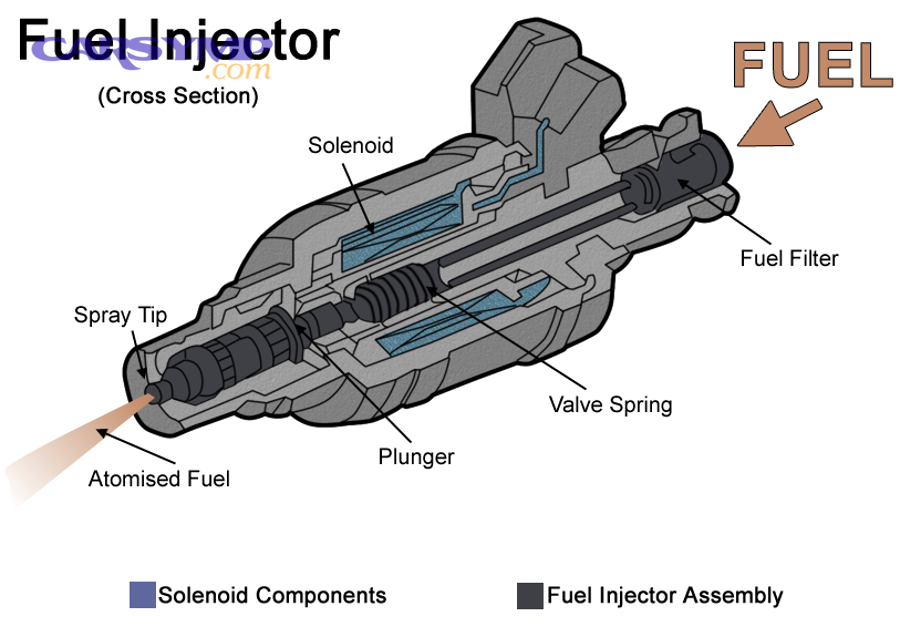
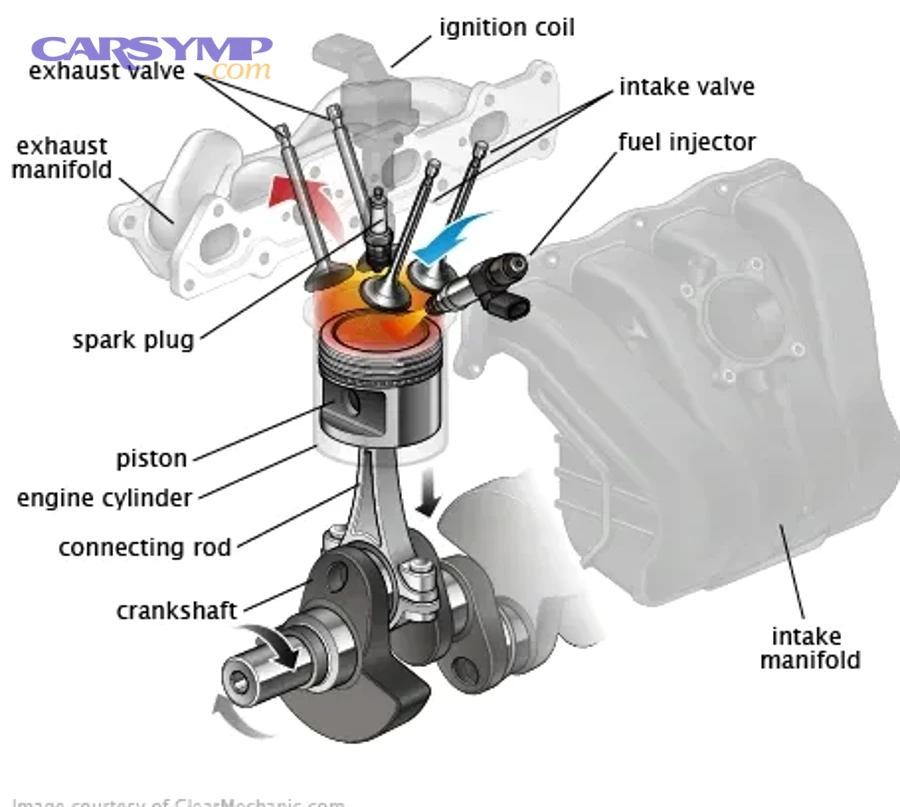
Fuel injectors are electronically controlled valves that meter and atomize fuel into the engine, and clogging disrupts flow and spray quality—especially at idle—creating uneven mixtures that produce combustion instability, rough idle, and misfire.
To better understand the misfire behavior, you need to connect “injector deposits” to how the engine actually burns fuel cycle-by-cycle.
At idle, the injector is typically operating with:
- Short pulse widths (very small “on” time)
- Low manifold airflow
- High sensitivity to mixture preparation and droplet size
That means a small mechanical change at the injector nozzle—like varnish, coking, or debris—can have a big effect on how evenly the cylinder burns.
A useful way to think about it: the engine doesn’t just need “fuel volume.” It needs repeatable fuel delivery and repeatable mixture formation across cycles and across cylinders.
What is “injector spray pattern” and why does it matter most at idle?
Injector spray pattern is the shape and distribution of fuel droplets exiting the injector nozzle, and it matters most at idle because low airflow provides less mixing energy—so poor atomization creates pockets of too-lean or too-rich mixture that misfire easily.
Specifically, idle is where your engine has the least tolerance for uneven droplet size and uneven fuel placement.
What deposits can do to the spray:
- Restrict holes (less total fuel flow)
- Distort plume angle (fuel hits the wrong area or doesn’t mix well)
- Increase droplet size (slower evaporation, worse mixing)
In controlled research on GDI injector coking, deposits were shown to change spray characteristics and mixture repeatability, contributing to poorer combustion stability. (etheses.bham.ac.uk)
What’s the difference between a clogged injector and a leaking injector at idle?
A clogged injector wins for creating a lean, unstable idle; a leaking injector is best known for rich misfire and fuel odor; and an electrically failing injector is optimal for intermittent “dead cylinder” behavior that comes and goes.
Meanwhile, the quickest separator is to look at which direction the engine is correcting and what the spark plug looks like.
Here’s the practical comparison:
- Clogged/restricted injector (lean tendency):
- Rough idle, stumble, sometimes “popping” through intake
- Fuel trims often positive (ECU adding fuel)
- Plug may look chalky/white compared to neighbors
- Leaking/stuck injector (rich tendency):
- Fuel smell, black smoke, poor MPG
- Fuel trims can go negative (ECU pulling fuel)
- Plug can be wet/sooty, cylinder may wash down (oil dilution risk)
- Electrical injector issue (intermittent):
- Sudden miss that appears/disappears
- Misfire counter spikes, may be harness-related
- Often tied to heat/engine movement
Which injector symptoms help you separate injectors from other causes?
There are 4 main injector-related symptom groups—idle-dominant instability, lean-restriction signals, rich-leak signals, and cylinder-imbalance patterns—based on whether the injector’s problem is flow loss, spray distortion, leakage, or intermittency.
Besides making diagnosis faster, this grouping keeps you from confusing injector problems with ignition faults or vacuum leaks.
These groups are especially useful when you’re collecting “story evidence” before you test.
What symptoms point to a lean misfire from restricted injector flow?
There are 5 common Injector clog symptoms for restricted flow: idle shake, hesitation off-idle, higher positive fuel trims, cylinder-specific misfire at idle, and improved feel at higher RPM—based on the engine’s struggle to maintain stable combustion with too little fuel in one cylinder.
For example, a mild restriction may only show up as a rough idle with occasional misfire counts, while a heavier restriction can cause a persistent P030x.
Look for these details:
- Idle is worst symptom (especially warm idle in gear on automatics)
- Tip-in hesitation (the first 5–15% throttle)
- Fuel trims positive at idle and may improve with RPM
- One cylinder “acts different” (plug color, exhaust pulse feel)
- No strong fuel smell (lean problems usually don’t smell like raw gas)
One reason people miss this: they expect a clogged injector to always feel like “lack of power.” But at idle, power demand is tiny; the bigger issue is repeatability of combustion.
What symptoms point to a rich misfire from a leaking/stuck injector?
There are 5 common rich-leak symptoms: fuel odor, hard hot restart, blackened plug/soot, poor MPG, and a single cylinder that runs “wet”—based on excess fuel entering one cylinder even when it shouldn’t.
More importantly, a leaking injector can create problems that look like ignition failure, but the root cause is over-fueling.
Watch for:
- Fuel smell near tailpipe or in oil (serious warning)
- Hard hot start (engine flooded after sitting briefly)
- Black smoke on startup or during miss
- Misfire that worsens after extended idling
- Oil level rising (possible fuel dilution—stop driving and diagnose)
What tests can confirm injector issues without replacing parts?
There are 6 practical tests to confirm injector issues without replacing parts: OBD2 trim review, misfire counters, cylinder swap, injector balance/pressure-drop testing, electrical checks, and post-cleaning validation—based on moving from least invasive to most conclusive.
Let’s explore a test ladder that fits DIY tools, yet still ends with a real confirmation.
A good diagnostic ladder follows two rules:
- Prove the cylinder is weak (misfire data / contribution).
- Prove the weakness follows the injector (swap or balance test), or prove the injector cannot deliver correctly (pressure drop / electrical).
Can OBD2 fuel trims and misfire counters confirm injector imbalance?
OBD2 fuel trims and misfire counters can strongly suggest injector imbalance by showing lean/rich correction patterns and cylinder-specific misfire accumulation at idle, but they confirm “imbalance,” not the exact part—so you still need a targeted injector test.
Specifically, you’re looking for patterns that change with RPM and load.
How to read the clues:
- Misfire counters (Mode $06 or enhanced data):
- A single cylinder consistently climbing at idle is a strong lead.
- Fuel trims (STFT/LTFT):
- Big positive trims at idle that improve when revved can imply a lean condition at idle (injector restriction or vacuum leak).
- Negative trims combined with fuel smell points toward rich conditions (possible leaking injector).
If your scanner provides cylinder contribution or power balance tests, use them to identify the weakest cylinder before you do anything invasive.
Should you do a cylinder swap test to verify a bad injector?
Yes—you should do a cylinder swap test to verify a bad injector because it can (1) make the misfire follow the injector, (2) reduce guesswork versus replacing coils/plugs blindly, and (3) confirm the injector is the variable when other conditions stay the same.
However, this only works when injectors are accessible and you can do it safely without introducing leaks.
A swap test is powerful because it answers a simple question: Does the problem move with the part?
Best-practice swap logic:
- Identify the misfiring cylinder (misfire counters + code + symptom).
- Swap the suspect injector with a neighboring cylinder.
- Clear codes, run the same idle conditions, and re-check misfire counters.
- If the misfire moves, the injector is the likely cause.
Cautions:
- Always use new O-rings if required by your engine design.
- Lubricate seals properly and seat injectors squarely.
- For GDI high-pressure systems, follow manufacturer safety procedures.
What is an injector balance test and what does “pressure drop” mean?
An injector balance test is a controlled comparison where each injector is pulsed for the same duration and the resulting fuel rail pressure drop is measured, and “pressure drop” means how much pressure each injector consumes—revealing restricted or leaking injectors by imbalance.
More specifically, equal pulse commands should create similar pressure drops across cylinders if injectors flow evenly.
If you have a scan tool that supports it, this is one of the cleanest proofs of injector imbalance—especially when you suspect restriction but don’t want to pull injectors yet.
Interpretation basics:
- Lower-than-others pressure drop: injector may be restricted (less fuel delivered).
- Higher-than-others pressure drop: injector may be leaking or flowing too much.
- Uneven results: confirms a balance problem that can cause rough idle.
How do you check injector electrical health (resistance/noid light) safely?
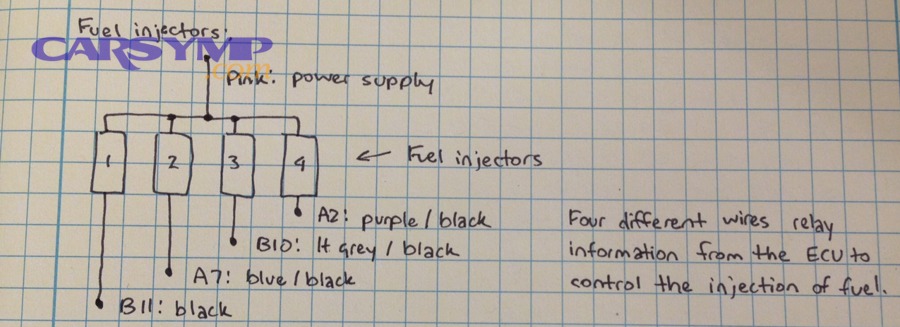
Checking injector electrical health means verifying the injector coil and control signal are intact using resistance measurement and/or a noid light, and it’s done safely by disabling fuel/ignition as needed and testing connectors without shorting pins—so you can separate injector failure from wiring or ECU driver issues.
More importantly, electrical confirmation prevents you from chasing “clogging” when the injector simply isn’t being commanded correctly.
Two practical DIY checks:
- Resistance check (engine off, connector unplugged):
- Compare the suspect injector’s resistance to others. A large deviation can indicate an internal coil issue.
- Noid light or signal check (cranking/running):
- Confirms the injector is being pulsed by the ECU.
If resistance is normal and the signal is present, the injector can still be clogged or leaking—but you’ve ruled out a purely electrical “no fire” cause.
Evidence: According to a study by University of Birmingham from the School of Mechanical Engineering, in 2018, coked GDI injectors showed about a 5.6% reduction in mass flow rate compared with clean injectors at a comparable test condition, alongside poorer combustion stability—showing how deposits can create a meaningful cylinder fueling deficit. (etheses.bham.ac.uk)
How do you fix injector-caused misfire and rough idle: clean, service, or replace?
In-tank cleaner wins for mild deposits, on-car pressurized cleaning is best for moderate restriction, and ultrasonic bench service or replacement is optimal for severe clogging, leakage, or repeat failures—because each option restores injector performance at a different depth and certainty.
Then, the smartest repair is the one that matches your test result rather than your hope.
The fix choice should be driven by severity and proof:
- If you only have mild symptoms and no clear cylinder is failing, start conservative.
- If one cylinder is repeatedly misfiring and tests suggest injector imbalance, choose a method that can actually correct imbalance.
- If the injector leaks or fails electrically, cleaning is the wrong tool.
To make this decision easier, here’s a quick framework. This table explains what each method can realistically accomplish.
| Fix option | Best for | What it can’t fix | Confidence level |
|---|---|---|---|
| In-tank additive | Light varnish, maintenance | Electrical faults, leaks, heavy nozzle coking | Low–medium |
| On-car pressurized cleaning | Moderate restriction, drivability issues | Some severe deposits, mechanical wear | Medium |
| Ultrasonic bench cleaning + flow test | Proven imbalance, nozzle deposits | Cracked body, coil faults, persistent leakage | High |
| Replace injector | Leaks, electrical failure, repeated imbalance | Won’t fix vacuum leaks/ignition/compression | Highest (when diagnosis is correct) |
Does fuel injector cleaner in the tank actually fix a misfire?
Yes—an in-tank cleaner can fix a misfire in mild cases because it (1) dissolves light deposits gradually, (2) improves spray quality over multiple heat cycles, and (3) can restore small flow losses that only show up at idle—yet it won’t fix mechanical or electrical injector failure.
However, the word “mild” is doing a lot of work here.
Use in-tank cleaner when:
- Misfire is intermittent, not constant
- No strong evidence of a single dead cylinder
- Fuel trims are only slightly off
- The issue appeared after a period of short trips / storage
Avoid relying on it when:
- You have persistent P030x on one cylinder
- A balance test suggests strong injector mismatch
- You smell fuel or see a wet plug (possible leak)
This is where the phrase matters: fuel injector cleaning is not one single action; it’s a range of methods with different power levels and different proof standards.
What is the difference between in-tank cleaner, on-car pressurized cleaning, and ultrasonic service?
In-tank cleaner wins for convenience and prevention, on-car pressurized cleaning is best for restoring flow without removal, and ultrasonic service is optimal for verified imbalance because it pairs deep cleaning with flow testing that proves results.
On the other hand, convenience isn’t the same as certainty—especially when rough idle is severe.
Key differences:
- In-tank cleaner:
- Works slowly, depends on chemistry and drive time
- Best for light deposits
- Cheap, easy, but results can be subtle
- On-car pressurized cleaning:
- Delivers cleaner directly through the fuel rail
- More aggressive than in-tank methods
- Useful when restriction is moderate and you want improvement fast
- Ultrasonic bench service (often with backflushing):
- Injector is removed and cleaned in a controlled way
- Flow is measured before/after
- Best for cylinder-to-cylinder balance issues
If you care about proof, bench service is where you get it—because you can see whether injectors are matched after cleaning.
When should you replace an injector instead of cleaning it?
Yes—you should replace an injector instead of cleaning it when (1) it leaks and causes rich misfire, (2) it fails electrically or shows abnormal resistance, or (3) it repeatedly fails balance/flow checks after cleaning—because those conditions indicate damage or wear, not removable deposits.
More importantly, replacement becomes the cheaper path when repeated cleaning attempts cost time and still don’t stabilize idle.
Clear replacement triggers:
- Fuel dilution risk (gas smell in oil, wet plug, hard hot start)
- Electrical fault (open/short coil, no pulse confirmed at injector)
- Persistent imbalance after verified cleaning
- Physical damage (cracked body, damaged connector, torn sealing surfaces)
What should you do after the fix to confirm the misfire is solved?
Use a simple 5-step validation method—warm idle check, misfire counter review, fuel trim review, controlled road test, and re-scan after a drive cycle—to confirm the misfire is solved and the rough idle is gone under the same conditions that originally triggered it.
In addition, this is the stage where you prove you didn’t just “change the symptom,” but actually corrected cylinder balance.
Many DIY repairs fail emotionally, not mechanically: the idle feels “better,” so people stop checking. But injector issues are about repeatability, and repeatability is measurable.
Which post-repair checks prove the injectors are balanced again?
There are 5 post-repair checks that prove injectors are balanced again: stable warm idle, near-zero misfire accumulation at idle, normalized fuel trims, equal cylinder contribution feel, and consistent restart behavior—based on confirming both combustion stability and ECU correction returning to normal.
Specifically, this is where Verifying improvement after cleaning becomes more than a feeling—it becomes a repeatable result.
Do these checks in this order:
- Warm idle for 2–3 minutes (AC on/off if applicable).
- Check misfire counters at idle and at a light steady RPM (e.g., 1,500 RPM).
- Check fuel trims at idle vs 2,500 RPM (pattern matters).
- Road test: steady cruise, gentle acceleration, then a brief harder pull.
- Re-scan after the drive: confirm no pending misfire codes.
If you did injector-focused work (cleaning, swap, replacement), the best sign is that the same cylinder no longer racks up misfires under the same idle conditions.
How can you prevent injector clogging from coming back?
There are 4 practical ways to prevent injector clogging from returning: consistent fuel quality, avoiding extended stale-fuel storage, maintaining filtration and fuel system health, and driving patterns that reduce hot-soak deposit formation—based on minimizing the conditions that create deposits at the injector tip.
Especially if your driving is mostly short trips, prevention is not optional; it’s maintenance.
Practical prevention habits:
- Use quality fuel consistently (top-tier where available)
- Avoid letting fuel sit for months; use stabilizer for seasonal storage
- Fix upstream issues (fuel pressure problems, dirty tank, failing filter where serviceable)
- Drive long enough occasionally to fully warm engine and reduce repeated hot-soak cycles
If your engine is direct-injected, injector tip deposits can be more stubborn because of the operating environment at the nozzle—so disciplined maintenance matters even more.
What if it’s not the injectors—or the rough idle started after injector work?
Vacuum leaks win as the most common injector look-alike, sealing errors are best at explaining rough idle after injector work, and GDI-specific factors are optimal to check on direct-injection engines—because each one mimics misfire through a different path than injector clogging.
To sum up, this final section helps you avoid the “false positive” where you blame injectors simply because the symptoms match loosely.
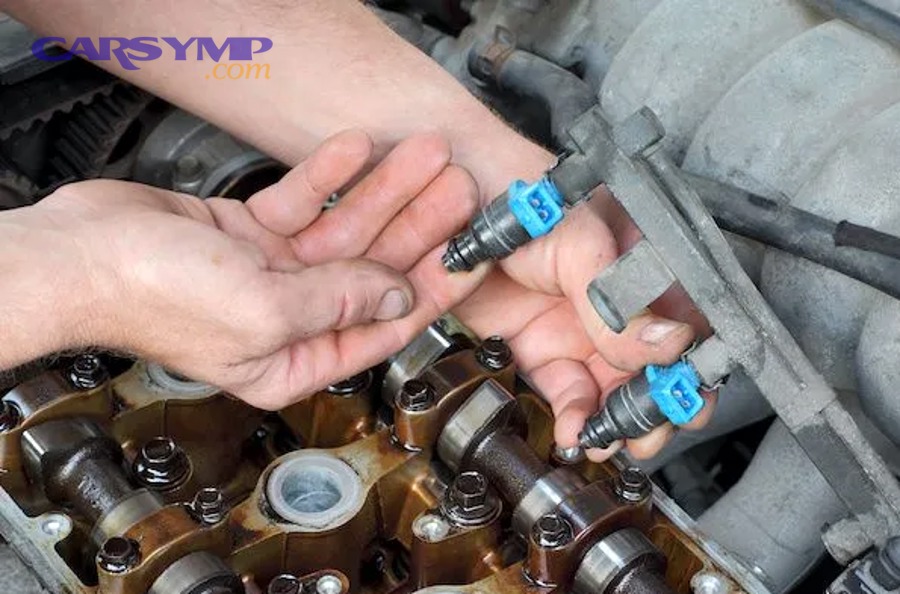
Can vacuum leaks mimic injector misfire and rough idle symptoms?
Yes—vacuum leaks can mimic injector misfire and rough idle because they (1) lean out the mixture at idle, (2) force positive fuel trims, and (3) create unstable combustion that feels like a weak cylinder—especially when the leak is near one intake runner.
However, a vacuum leak usually changes behavior noticeably with small airflow changes.
Fast separators:
- Fuel trims: vacuum leaks often show very positive trims at idle that improve significantly with RPM.
- Idle response: spraying appropriate leak-check fluid near suspect areas (carefully, safely) may change idle.
- Sound/whistle: sometimes audible near hoses, intake gasket areas.
If trims are positive and you have a rough idle, don’t assume injectors until you’ve ruled out unmetered air.
Is rough idle after injector replacement usually caused by O-rings or sealing issues?
Yes—rough idle after injector replacement is often caused by sealing issues because (1) a pinched O-ring creates a vacuum leak, (2) a torn seal causes fuel leakage or pressure loss, and (3) an injector not seated squarely changes fuel delivery—so the “repair” introduces a new imbalance.
More specifically, the most common DIY failure is not lubricating or aligning seals correctly during installation.
What to check immediately after injector work:
- Visual inspection around injector bases for wetness or smell
- Listen for hiss near the injector and intake area
- Recheck fasteners (rail bolts, clamps) to spec
- Scan trims: sudden positive trims after injector work often scream “air leak”
If the rough idle started right after the job, prioritize installation integrity before you blame the injector itself.
How is diagnosing injector issues different on GDI vs port injection?
Port injection wins for easier DIY testing and swapping, GDI is best known for higher-pressure safety constraints, and mixed systems are optimal for confusion because symptoms can overlap—so your diagnostic approach must match injector type and fuel pressure system.
Meanwhile, GDI systems often require more caution and different tools.
Key differences:
- PFI (port fuel injection):
- Injectors are typically easier to access and swap
- Rail pressure is lower than GDI
- Spray issues often show as idle quality and trims
- GDI (direct injection):
- High pressure demands correct safety steps
- Deposits can strongly affect spray and mixture preparation
- Balance tests may involve different pressure readings and procedures
If you’re not sure which system you have, look for high-pressure fuel lines and a high-pressure pump on the engine (common on GDI).
When should you stop DIY diagnostics and seek professional injector testing?
Yes—you should stop DIY diagnostics and seek professional injector testing when (1) you suspect a leaking injector with fuel dilution risk, (2) GDI high-pressure work exceeds your tools/safety comfort, or (3) repeated cleaning doesn’t stabilize misfire counters—because flow bench data can confirm balance faster and safer.
More importantly, professional testing gives you measured before/after results that remove doubt.
Good “handoff” moments:
- Persistent cylinder misfire after plug/coil confirmation
- Conflicting trim patterns that don’t fit injectors or vacuum leaks cleanly
- Need for ultrasonic bench service with flow matching
- High-pressure system concerns on GDI platforms
At that point, your goal shifts from “DIY everything” to “get definitive injector flow evidence,” then repair with confidence.
Evidence (if any)
According to a study by University of Birmingham from the School of Mechanical Engineering, in April 2018, injector coking in a GDI research context was associated with reduced injector mass flow (including about 5.6% reduction at a comparable operating point) and poorer combustion stability versus clean injectors—supporting the real-world link between injector deposits, unstable idle combustion, and misfire. (etheses.bham.ac.uk)