


A cooling system pressure test is the fastest way to confirm whether your engine is losing coolant and where it’s escaping, because it pressurizes the system (with the engine cold) so leaks reveal themselves as drips, seepage, or a measurable pressure drop.
Next, the same test becomes far more useful when you also learn how to interpret the gauge—because “pressure dropped” is not the same as “found the leak,” and different drop patterns point you toward different parts.
Then, you’ll avoid the most common DIY mistakes by using the right pressure tester, adapter, and PSI target (based on the radiator cap rating), so you don’t under-test, over-pressurize, or miss a reservoir-style system connection.
Introduce a new idea: once you can run the test correctly, you can also check the radiator cap (a key pressure-holding component) and apply advanced tactics for intermittent leaks that don’t show up in a simple cold test.
What is a cooling system pressure test (coolant leak test)?
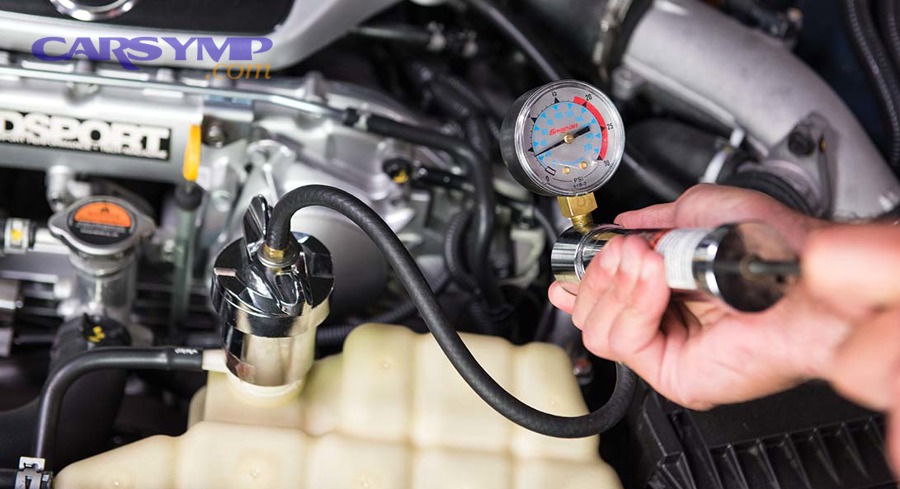
A cooling system pressure test is a diagnostic procedure that uses a hand pump and gauge to pressurize the radiator/expansion tank to the cap’s rated pressure so you can confirm coolant leaks and verify the system can hold pressure without overheating or boiling off.
Specifically, the value of a pressure test is that it turns a vague complaint like “coolant keeps disappearing” into proof: either the system holds pressure (no leak detected under test), or it doesn’t (a leak path exists).
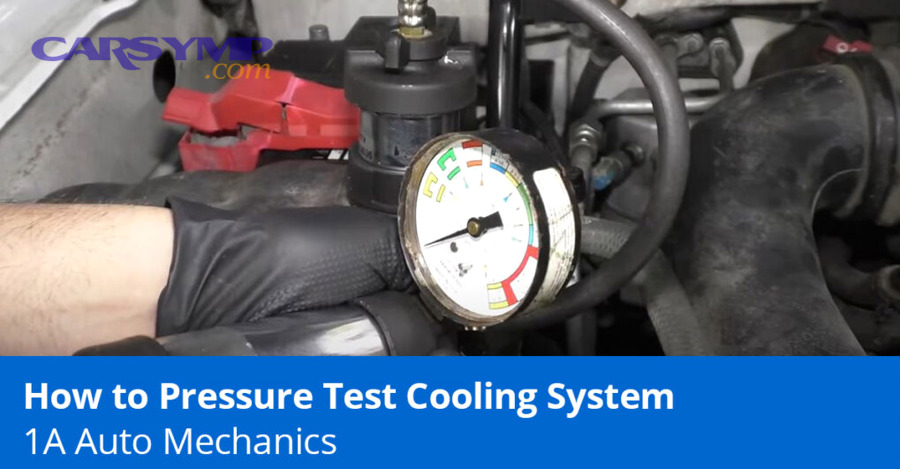
Does a cooling system pressure test find leaks you can’t see?
Yes— a cooling system pressure test can find leaks you can’t see because (1) it forces coolant toward weak seals under controlled pressure, (2) it creates a measurable pressure drop even when the leak is too small to drip, and (3) it lets you inspect the engine bay while the system is “working” without heat, airflow, or road splash masking the evidence.
Next, here’s how those three reasons play out in real DIY troubleshooting:
- Reason 1: Pressure exposes weak seals early.
A tiny split in an upper radiator hose may not drip when the engine is cold and off, but under pressure it can begin to sweat coolant along the crack line. You’ll often see a glossy wet band that wasn’t present before pumping. - Reason 2: The gauge reveals “micro-leaks.”
If you pump to the cap rating and the gauge slowly falls, you’ve learned something important even before you see a drop on the floor. That pressure loss tells you coolant (or pressure) is escaping somewhere—external or internal. - Reason 3: You can inspect slowly and safely.
With the engine cold, you can use a flashlight and mirror to inspect seams, hose ends, the thermostat housing, and the water pump area without the hazard of hot coolant spray.
To make this even more effective, wipe suspect areas dry before you pump—fresh wetness becomes obvious.
What problems can a pressure test confirm—and what can it miss?
There are 6 main problem groups a cooling system pressure test can confirm or suggest: (1) external hose leaks, (2) radiator tank/seam leaks, (3) thermostat housing and crossover leaks, (4) water pump weep/seal leaks, (5) heater core or heater hose leaks, and (6) radiator cap sealing issues—based on whether pressure holds and where moisture appears.
However, a pressure test can still miss a few scenarios, and that matters for clean decision-making:
- It confirms external leaks best.
If coolant appears on a hose end, clamp, radiator seam, or under the water pump, the test has done its job: it turned guesswork into a visible leak. - It can suggest (but not “prove”) some internal issues.
A pressure drop with no external wetness can point toward internal loss, but you’ll usually need follow-up testing (like a combustion-gas/block test) if you suspect head gasket or EGR cooler issues. - It may miss “hot-only” leaks.
Some plastic tanks, thermostat housings, or gaskets leak only after heat expansion. A cold pressure test might look normal even though the vehicle loses coolant on long drives.
That’s why this article later adds advanced strategies for intermittent and temperature-dependent leaks.
When should you do a cooling system pressure test?
There are 5 common timing triggers for a cooling system pressure test: (1) unexplained coolant loss, (2) repeated low coolant warnings, (3) overheating events, (4) sweet coolant smell/steam, and (5) after cooling-system service—because each trigger indicates the system might not be sealed or might not be holding pressure.
Then, you can treat the pressure test as a core step in overheating diagnosis when you want to confirm whether a leak is the root cause or a side effect.
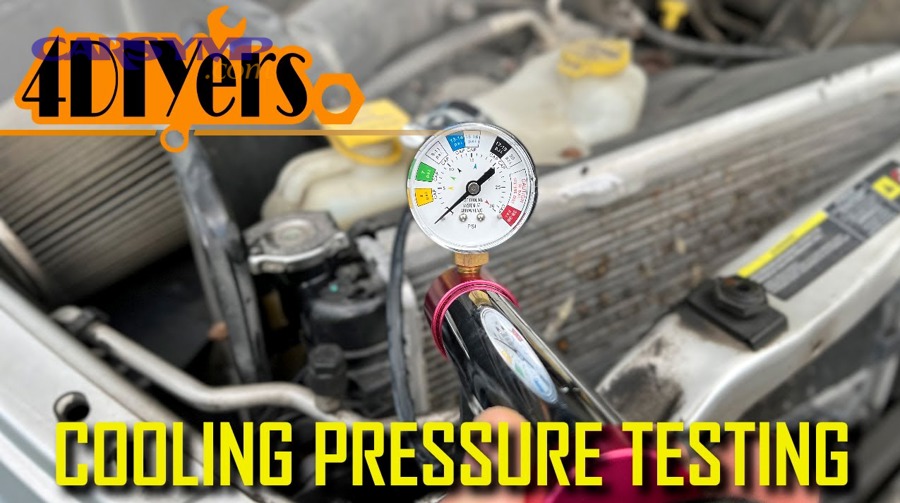
Is it safe to pressure test a cooling system when the engine is hot?
No—do not pressure test a hot cooling system because (1) hot coolant is pressurized and can spray violently when opened, (2) heat expands components and can give misleading results, and (3) you can damage plastic reservoir necks or seals when they’re softened by temperature.
Next, the safe approach is simple and consistent:
- Wait until the engine is fully cold.
“Cold” means the upper hose is cool to the touch and the radiator/expansion tank is not warm. - Relieve any residual pressure slowly.
If your system has a radiator cap, use the first detent to vent before removing fully. If it has a pressurized reservoir cap, loosen slowly while standing to the side. - Treat “still hot” as a stop sign.
If you’re already dealing with an active overheat, let the vehicle cool completely before touching caps or testers.
What signs indicate you need a coolant leak test right now?
There are 8 practical signs that you need a coolant leak test right now: (1) you add coolant repeatedly, (2) the reservoir level drops after every drive, (3) you smell sweet coolant, (4) you see white crusty residue near seams, (5) the heater output becomes inconsistent, (6) puddles appear under the front of the car, (7) the temperature climbs at idle, and (8) you see steam from the engine bay—based on how coolant loss shows up in daily driving.
Next, use these signs to guide where you inspect first during the test:
- Repeated top-offs + no puddles: inspect radiator end tanks, thermostat housing, heater core (cabin fogging), and water pump weep area.
- Idle temperature rise: check for coolant loss plus airflow/fan issues—because leaks can lower coolant level and introduce air pockets.
- Heater changes: the heater core is a “mini-radiator,” so small leaks can show up as sweet smell or damp carpet.
If you want a quick workflow, treat the pressure test as step 2 in a Step-by-step overheating diagnostic checklist:
- confirm coolant level and condition,
- pressure test for leaks,
- verify fan operation and airflow,
- verify thermostat and flow,
- confirm cap function and coolant mix.
What tools do you need to pressure test a cooling system correctly?
There are 6 core tools/items you need to pressure test correctly: (1) a cooling system pressure tester with gauge and hand pump, (2) the correct adapter for your radiator or reservoir neck, (3) a radiator cap testing adapter (or cap tester), (4) flashlight, (5) shop towels and a catch pan, and (6) basic safety gear (gloves/eye protection)—based on the need to pressurize safely and inspect precisely.
Moreover, the “correct adapter” matters as much as the pump, because an imperfect seal at the neck will make you chase a leak that isn’t real.
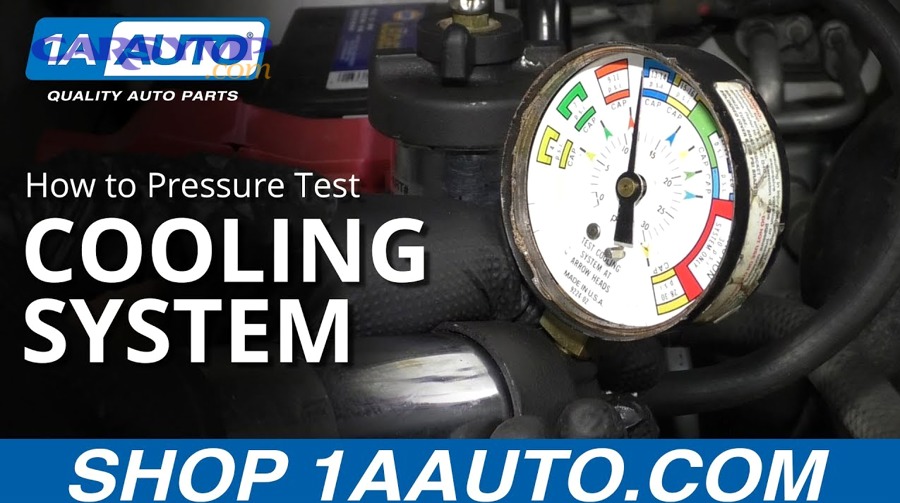
Which type of cooling system pressure tester should DIY car owners use?
A hand-pump pressure tester kit wins for most DIY car owners because it offers (1) control over pressure rise, (2) a gauge you can watch for decay, and (3) broad compatibility with adapters—while shop pneumatic systems are best for high-volume work and speed.
However, you should compare testers on the criteria that actually affect your result:
- Compatibility (best deciding factor):
A cheap kit that doesn’t fit your filler neck is worse than no kit. Prioritize kits that include your vehicle’s style (radiator cap neck vs threaded reservoir adapters). - Gauge readability and accuracy:
You want a clear PSI scale and a stable needle. A “jittery” gauge can hide slow decay. - Pressure release/bleed control:
A controlled release valve makes the end of the test safer and cleaner.
If you only test occasionally, borrow/rent a quality kit—just verify the adapters and seals are in good condition.
What PSI should you pump to for an accurate test?
The correct PSI target is the radiator cap’s rated pressure (or the system spec), because that rating defines the maximum normal operating pressure the system is designed to hold—so pumping above it can create new leaks or damage components.
Next, use this simple PSI method:
- Find the cap rating.
Many caps show a PSI or kPa rating on top (for example, 13–16 psi is common), and service information confirms the exact value for your model. - Pump up gradually to the rating.
Approach the target slowly; don’t “slam” it to pressure. - Never exceed the rating.
Over-pressurizing can split a weak radiator tank or pop a hose.
This is also where coolant choice matters: Coolant mixture ratio and overheating are connected because the mixture affects boiling point and heat transfer. A proper 50/50 mix and a functioning pressure cap work together to prevent boiling and loss under heat load.
How do you perform a cooling system pressure test step-by-step?
A correct cooling system pressure test is a step-by-step method with 7 steps—prep, access, connect, pressurize, hold, inspect, and depressurize—that reliably reveals leaks and verifies pressure retention without the risks of testing a hot system.
Below, the key is to treat the test like controlled diagnostics, not like “pump it and hope,” because control is what makes the result trustworthy.
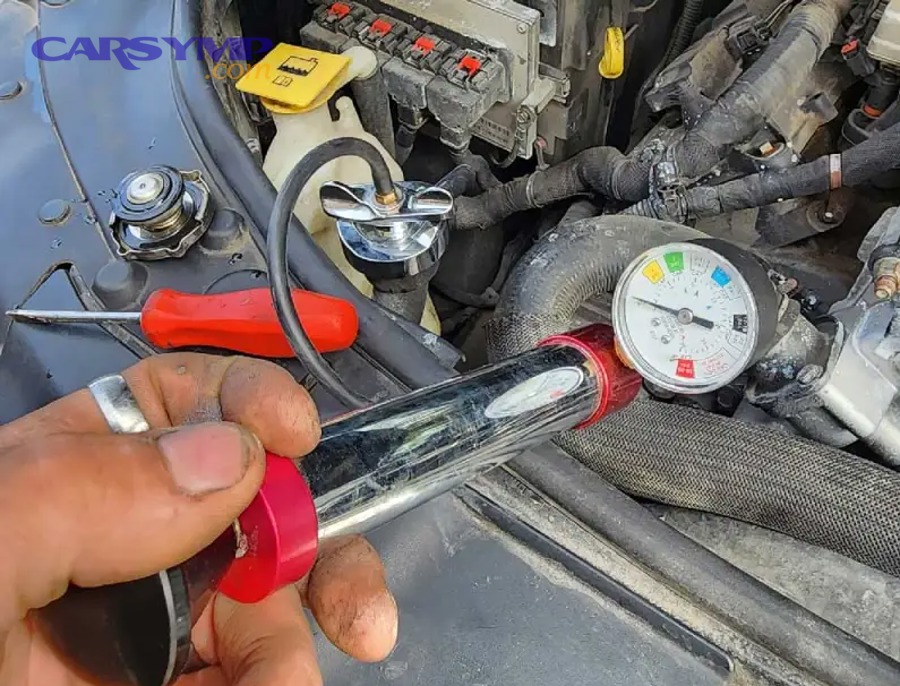
- Let the engine go fully cold.
- Check coolant level and top up if needed (to ensure the system can pressurize properly).
- Remove the radiator cap or pressurized reservoir cap slowly.
- Select the correct adapter and seat it firmly on the filler neck.
- Connect the hand pump/gauge to the adapter.
- Pump up to the cap rating and stop.
- Hold pressure and inspect every leak-prone area.
- Release pressure slowly using the tool’s bleed valve, then remove the adapter.
Then, if you repair something, repeat the test to confirm the fix—because “looks dry” is not as reliable as “holds pressure.”
How do you pressure test a radiator-cap system vs a pressurized reservoir system?
A radiator-cap system is tested at the radiator filler neck, while a pressurized reservoir system is tested at the reservoir’s threaded neck, and each wins in accuracy only when you connect to the correct point for that design.
Next, apply this comparison so you don’t “test the wrong hole”:
- Radiator-cap system (traditional):
You remove the radiator cap and attach the tester to the radiator neck. This pressurizes the whole system directly and often makes external leaks easy to spot at the radiator seam and upper hose. - Pressurized reservoir/expansion tank system (common on modern cars):
You attach to the reservoir cap neck (often threaded). This design may not have a radiator cap at all. If you try to test at a non-pressurized overflow bottle, you’ll get false results.
Practical tip: if you’re unsure, look for a warning label like “Do not open when hot” on the cap—pressurized caps carry that warning because they’re part of the sealed pressure boundary.
How long should you hold pressure and what should you watch for?
You should hold pressure long enough to observe two things at once: (1) the gauge behavior and (2) the appearance of fresh wetness—because some leaks show immediately while others show as slow seepage.
Next, use a simple hold strategy:
- Immediate check (first 30–60 seconds):
Rapid pressure drop usually indicates a larger external leak, an adapter seal problem, or a cap/neck sealing issue. - Short hold (a few minutes):
Slow decay suggests seepage, hairline cracks, or small gasket leaks that require careful inspection. - Inspection route (repeatable):
Start high (radiator neck, upper hose, thermostat housing), then move to radiator seams, then water pump/weep hole, then lower hoses, then heater hoses/firewall area, and finally the cabin (fogging/smell) for heater core clues.
If pressure drops but you see nothing, don’t jump to a head gasket immediately—first confirm your tester seal, then check hidden areas (under splash shields, behind fans), then consider dye or internal tests.
How do you interpret cooling system pressure test results?
Cooling system pressure test interpretation comes down to three outcomes—holds steady, drops quickly, or drops slowly—and each outcome points to a different set of likely causes you can verify with inspection.
To better understand what your gauge is telling you, you can treat pressure behavior as a map: the gauge shows whether pressure is escaping, and your inspection reveals where.
Before the table below, note what it contains: it links common gauge behaviors to the most likely leak categories and the best next action so you can move from symptom to confirmation quickly.
| Gauge behavior during hold | Most likely meaning | Best next action |
|---|---|---|
| Holds steady near target | No leak detected under cold pressure test | Recheck later for hot-only leak; verify cap; consider dye if coolant still disappears |
| Drops fast immediately | Large external leak or poor adapter seal | Confirm adapter seal; inspect hoses, radiator seam, loose clamp, cracked neck |
| Drops slowly over minutes | Small seepage or micro-leak | Inspect for wetness/crust; check water pump weep hole; use UV dye if needed |
| Drops with no external wetness | Possible internal loss or hidden external leak | Check under shields; inspect heater core signs; consider block test if symptoms match |
If the gauge drops, where are the most common leak points to check first?
There are 7 most common leak zones to check first: (1) radiator end tanks and seams, (2) upper and lower radiator hoses and clamps, (3) thermostat housing/crossover, (4) water pump weep hole and gasket area, (5) heater hoses at the firewall, (6) radiator neck/cap seat, and (7) reservoir seams (if pressurized)—based on typical failure frequency and how pressure exposes weak seals.
Next, work “easy and likely” before “rare and complex”:
- Radiator seams/end tanks: look for wet fins, crusty deposits, or a line of moisture at the plastic-to-aluminum crimp.
- Hose ends/clamps: re-check clamp tension and look for seepage tracks.
- Thermostat housing: common for slow leaks; look around bolt flanges and sensor ports.
- Water pump: inspect below the pulley area; the weep hole often leaves a trail.
- Heater core circuit: check firewall hose joints and sniff for sweet odor in the cabin.
This approach keeps your flow tight: gauge → likely zones → visible confirmation.
Cooling system pressure test vs block test: which is better for suspected head gasket issues?
A cooling system pressure test wins for external leak detection, while a block (combustion gas) test is best for confirming combustion gases in coolant, and each test is optimal for a different suspicion.
However, you can decide quickly using these criteria:
- Choose a pressure test first if:
You have coolant loss, wetness, puddles, crusty deposits, or overheating after a top-off. Many “head gasket scares” are just hose, radiator, or water pump leaks. - Choose a block test sooner if:
You have repeated air in the system, unexplained pressure build-up, overheating under load, sweet exhaust steam, or coolant loss with no external signs. Those symptoms are more consistent with combustion-gas intrusion.
In real-world DIY work, the best strategy is sequential: pressure test first (cheap, fast, safe cold), then block test if pressure loss remains unexplained.
How do you test the radiator cap as part of the pressure-holding system?
Radiator cap testing is the process of confirming the cap holds pressure to its rated value and releases correctly, because the cap controls system pressure, boiling margin, and coolant recovery—so a weak cap can mimic leaks and cause overheating symptoms.
Next, treat the cap as a component you can test, not a guess:
- Inspect the seals: rubber should be pliable and uncracked.
- Inspect the spring and valve movement: it should resist and return smoothly.
- Test with a cap tester (best): confirm the release pressure is near the cap rating.
Can a bad radiator cap cause coolant loss or overheating without an obvious leak?
Yes—a bad radiator cap can cause coolant loss or overheating without an obvious leak because (1) it can vent coolant early into the overflow/recovery path, (2) it can fail to hold pressure so the coolant boils sooner, and (3) it can fail to pull coolant back during cool-down, creating low level and air pockets.
Next, match these causes to symptoms you can observe:
- Early venting: reservoir overfills or spits coolant after a drive.
- Lower boiling margin: the temperature climbs faster, especially under load or at idle heat soak.
- Poor recovery: coolant level seems “fine” hot but low when cold; you may hear gurgling and see bubbles.
This is why cap testing belongs in a complete leak-and-overheat workflow—not as an afterthought.
What’s the difference between a pressure test failure from the cap vs a system leak?
A cap-related failure usually shows up as pressure loss at the neck/cap seat or incorrect relief behavior, while a system leak shows up as wetness at hoses, radiator, pump, or housings, and you can isolate the difference by testing the cap and system separately.
However, here’s the practical isolation sequence:
- Confirm your tester seal. A poor adapter seal looks like a leak but isn’t.
- Pressure test the system at the neck/reservoir. Identify external wetness.
- Test the cap with a cap adapter/tester. Confirm it holds near its rating and releases properly.
If the system holds pressure with the tester but the vehicle loses coolant in use, the cap becomes a prime suspect—especially if you see overflow behavior.
What advanced tips help diagnose intermittent coolant leaks when a pressure test looks normal?
There are 4 advanced strategies for intermittent coolant leaks when a cold pressure test looks normal: (1) add UV dye and re-check under pressure and after driving, (2) reproduce hot-only conditions safely, (3) confirm you’re testing the correct pressurized circuit (especially in multi-loop designs), and (4) shift your suspicion from external to internal only after you’ve ruled out hidden leaks—based on how real leaks behave across temperature, load, and time.
Then, you can use these strategies as “micro-semantics” that extend your core method without replacing it.
Should you combine UV dye with a cooling system pressure test for slow leaks?
Yes—combining UV dye with a cooling system pressure test improves slow-leak finding because (1) dye highlights seepage that evaporates quickly, (2) pressure pushes dyed coolant through hairline cracks, and (3) UV light can reveal leak trails in dark, hidden areas like under the intake or behind the radiator fan.
Next, follow a clean, repeatable dye routine:
- Add the correct dye type for coolant, run the engine to circulate, then let it cool.
- Pressure test again and scan with a UV light.
- Focus on “edge zones”: plastic seams, gasket edges, and clamp boundaries.
Dye is especially helpful when road spray or engine heat makes normal wetness hard to distinguish.
What’s the difference between cold leaks and hot leaks in cooling systems?
Cold leaks are leaks that appear under static pressure at low temperature, while hot leaks appear only after heat expansion, vibration, and operating pressure cycling, and hot leaks often involve plastic housings, radiator tanks, or gaskets that change shape when hot.
However, you can recognize the pattern:
- Cold-leak behavior: pressure drop and visible wetness during a cold hold test.
- Hot-leak behavior: pressure test holds cold, but coolant loss happens after long drives; you may see residue rather than wetness.
To chase hot leaks safely, combine dye with a post-drive inspection (after cool-down), and re-run the pressure test while components are warm-but-not-hot if the service procedure allows it.
How do you pressure test vehicles with pressurized expansion tanks or multiple cooling circuits (hybrid/EV)?
You pressure test these vehicles by identifying the correct pressurized cap/adapter point for each circuit, because many modern designs use pressurized expansion tanks and, in hybrids/EVs, may separate cooling loops for the engine, power electronics, or battery thermal management.
Next, keep it practical and safe:
- Use the correct threaded adapter for the pressurized expansion tank (do not force a universal rubber plug onto a threaded neck).
- Test one circuit at a time if the design is separated. A single pressure test might not cover every loop.
- Follow service guidance when multiple caps or bleed points exist, because mis-testing can create air pockets.
Evidence: According to a study by RMIT University from the School of Engineering, in 2017, adding 0.5 vol% TiO₂ nanoparticles to a 50/50 water–ethylene glycol coolant increased thermal conductivity by just over 10% compared to the base fluid, showing how modern thermal-management fluids and circuits can differ from traditional “one-loop” systems.
When does a “no external leak” result suggest an internal issue instead?
There are 4 internal-issue clue groups when you have no external leak but coolant still disappears: (1) repeated air pockets and gurgling after bleeding, (2) unexplained pressure build-up soon after start-up, (3) sweet-smelling exhaust steam or persistent white vapor after warm-up, and (4) coolant contamination signs (oil/coolant mixing)—based on symptoms that can’t be explained by external seepage.
Next, treat these clues as a threshold—not a conclusion:
- If the pressure test holds and you still overheat under load, add a combustion-gas/block test.
- If the cabin smells sweet or windows fog with oily film, inspect heater core signs.
- If coolant level changes without a trace, check hidden areas under splash shields before calling it “internal.”
Finally, tie it back to fundamentals: a stable cooling system depends on a sealed pressure boundary, a working cap, and the correct coolant mix. When Coolant mixture ratio and overheating problems show up (wrong mix, excessive water, or poor cap pressure), symptoms can mimic leaks—so your best diagnostic flow is still: confirm mix and level, pressure test, cap test, then escalate only if the evidence demands it.