


Recurring overheating is almost never “random”—it’s usually the same weak point in the cooling system re-triggering under the same conditions (idle, traffic, towing, hot weather). The fastest way to prevent it is to stop guessing and verify each cooling-system link in a repeatable order.
Next, you’ll learn how to prevent repeat overheat events with a practical checklist that starts with the highest-probability, lowest-cost checks (coolant level, leaks, cap pressure) and only then moves toward parts replacement.
Then, you’ll see a clear “Thermostat vs radiator vs water pump diagnosis” approach so you can separate airflow problems, flow problems, and pressure/boiling problems—without swapping parts blindly.
Introduce a new idea: once you know which failure pattern is happening, you can lock in a maintenance routine and verification tests that make overheating diagnosis and prevention predictable.
What does “recurring overheating” mean in a car cooling system?
Recurring overheating is a repeated rise in engine temperature beyond normal operating range caused by an unresolved cooling-system weakness that reappears under similar loads (idle, climbing, A/C use), typically involving coolant level/pressure, heat exchange (radiator/airflow), or coolant circulation (thermostat/water pump).
To connect the problem to a fix, focus on “when” it happens and “how fast” the temperature climbs—because that pattern points to whether the issue is airflow, flow, or pressure.
A recurring pattern usually falls into one of these buckets:
- Overheats mostly at idle/traffic: often airflow or fan control.
- Overheats at speed/high load: often restricted radiator, low coolant, or circulation issues.
- Overheats after a recent coolant service: often air pockets or incorrect bleeding.
- Overheats with A/C on: often fan staging, condenser airflow blockage, or marginal radiator performance.
The practical goal is not just “cool it down once,” but to remove the repeat trigger—so the same drive conditions don’t recreate the overheat.
How can you prevent recurring overheating with a step-by-step checklist?
You can prevent recurring overheating by following a 7-step cooling-system checklist that (1) confirms coolant level/mixture, (2) eliminates leaks and cap pressure loss, (3) verifies Fan operation and relay troubleshooting, (4) confirms thermostat function, (5) checks radiator heat rejection, (6) verifies water pump circulation, and (7) validates the repair with real-world conditions.
To keep the process efficient, start with checks that cost little and catch the most common repeat causes.
Step 1: What quick checks stop overheating before deeper diagnosis?
- Verify coolant level when cold: low coolant creates hot spots and can mimic bigger failures.
- Inspect for obvious leaks: wet hoses, crusty residue near clamps, radiator seams, water pump weep hole area.
- Confirm the correct coolant type and mix: wrong mix can reduce boiling protection and corrosion resistance.
- Look for airflow blockage: leaves/debris between the A/C condenser and radiator.
Step 2: How do you do a leak and pressure test the right way?
A proper overheating diagnosis often starts with pressure testing because recurring overheating is frequently recurring coolant loss.
- Use a cooling-system pressure tester to pressurize the system to the cap’s rating.
- Watch for pressure drop and inspect for seep points (hose ends, radiator tanks, heater core lines).
- If no external leaks appear, consider internal leak indicators (coolant odor in exhaust, persistent bubbles).
Step 3: What maintenance habits prevent repeat overheating long-term?
- Replace coolant on schedule (and use the correct spec).
- Keep the radiator/condenser fins clean and straight.
- Address small seep leaks early (they become big heat events later).
- Replace weak caps/aging hoses before summer or towing season.
What are the highest-probability root causes of recurring overheating?
There are 6 main types of recurring overheating root causes—low coolant/air pockets, pressure loss (cap), airflow/fans, thermostat faults, radiator restriction/inefficient heat exchange, and weak circulation (water pump/belt)—based on whether the failure reduces coolant volume, pressure, airflow, heat transfer, or flow rate.
To turn symptoms into decisions, match the “when it overheats” pattern to the most likely root cause.
Is low coolant or trapped air the most common trigger for repeat overheating?
Yes—low coolant and air pockets are among the most common repeat triggers because they reduce heat carrying capacity and create localized boiling, especially after coolant service or a slow leak.
Do cooling fans and fan control failures cause recurring overheating at idle?
Yes—when fans don’t engage at the right temperature (or at the right speed stage), heat builds rapidly at idle because the radiator isn’t getting enough airflow.
Can thermostat faults cause overheating that repeats under the same conditions?
Yes—sticky or failed thermostats can create repeatable temperature spikes because coolant flow to the radiator becomes delayed, restricted, or inconsistent.
According to a study by Helwan University from the Automotive Engineering Department, in 2022, a test engine with a thermostat stuck closed showed coolant temperature increasing from 64.33°C to 74.89°C (~16%), while coolant flow rate decreased by ~80% compared with a healthy condition.
How do you check coolant level, leaks, and cap pressure first?
You should check coolant level, leaks, and cap pressure first by verifying the cold fill level, inspecting common leak points, pressure testing the system, and confirming the radiator cap holds its rated pressure—because pressure loss lowers the boiling margin and makes overheating recur under the same loads.
Next, treat this as the foundation: if volume or pressure is unstable, every other test can mislead you.
How do you diagnose coolant loss versus normal expansion?
- Cold engine: coolant should be at the “COLD” mark in the reservoir (or at the neck if it’s a cap-style system).
- After driving: the reservoir rises; that’s normal expansion.
- Red flag: needing to top off repeatedly, even if you never see a puddle.
Where do recurring leaks hide during overheating diagnosis?
Common “repeat offenders”:
- Radiator end tanks and seams
- Upper/lower radiator hoses near clamps
- Heater hose T-fittings
- Water pump weep hole area (often leaves crusty residue)
- Plastic thermostat housings and O-rings
How do you test the radiator cap and why does it matter?
A weak cap can cause early boiling and repeated overheating even if everything else is “okay.”
- Inspect the rubber seals for cracks/hardening.
- Use a cap tester (or swap with a known-good, correct-rated cap) to confirm it holds pressure.
- If you see coolant pushed out into the overflow without recovery, suspect cap or combustion gas intrusion.
How do you verify thermostat operation without guessing?
You verify thermostat operation by confirming warm-up behavior, checking hose temperature change when it opens, and bench-testing opening temperature if needed—because a thermostat that opens late, sticks, or never closes can cause repeat overheating in predictable patterns.
To make the thermostat test meaningful, you must eliminate low coolant and air pockets first.
What symptoms suggest a thermostat problem (stuck closed vs stuck open)?
- Stuck closed / opening late: rapid overheat, upper hose stays cool longer than expected, heater output may fluctuate.
- Stuck open: slow warm-up, weak cabin heat, temperature may run low at speed but can still overheat under load if the system is marginal.
How do you test a thermostat safely at home?
- Remove the thermostat.
- Suspend it in water with a thermometer.
- Heat the water and watch for opening near the stamped temperature.
When should you replace the thermostat housing too?
Replace the housing when:
- It’s plastic and warped or cracked.
- The sealing surface is pitted.
- The integrated sensor port leaks.
A housing leak can reintroduce air and recreate the overheating cycle after you “fix” the thermostat.
Is your radiator restricted, or is airflow the real problem?
A radiator/airflow issue is best diagnosed by separating restriction (internal flow/heat exchange loss) from airflow loss (dirty fins, blocked condenser, missing shrouds) because both cause overheating but show different patterns at idle versus speed.
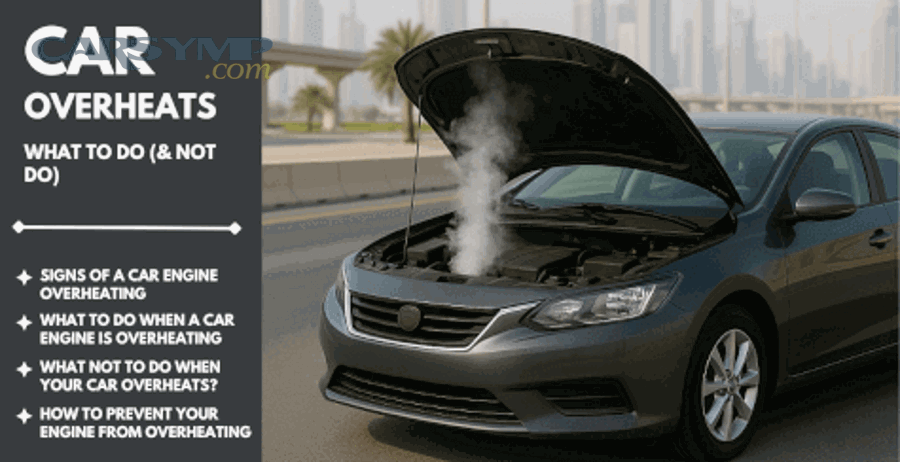
More specifically, recurring overheating at idle often screams airflow; overheating at speed often suggests restriction or low coolant.
What signs point to internal radiator restriction?
- Overheating worse at highway speeds or long climbs.
- Coolant looks rusty/sludgy (history of neglected coolant).
- Uneven radiator temperature distribution (hot inlet side, cool areas elsewhere).
How do you check external airflow and fin condition?
- Inspect the front of the condenser and radiator for debris.
- Check for bent fins that reduce effective airflow.
- Confirm shrouds/air guides are installed—missing ducting can reduce airflow at idle.
When does a radiator need cleaning vs replacement?
- External cleaning helps when debris blocks fins.
- Internal restriction often requires professional flushing or replacement; repeated clogging suggests corrosion/contamination upstream.
Are your radiator fans turning on correctly (and are relays/sensors the issue)?
Yes—fans must turn on at the correct temperature and at the correct speed stage, and recurring overheating at idle often happens because fan operation and relay troubleshooting are incomplete or misdiagnosed.
To move from symptom to cause, confirm what the fan should do and compare it to what it actually does.
How do you confirm fan operation under real conditions?
- Let the engine idle to operating temperature while monitoring coolant temp (scan tool preferred).
- Turn A/C on: many vehicles command fans immediately or at a higher duty cycle.
- Verify both fans (if dual) run and ramp correctly.
What common electrical faults cause intermittent fan failure?
- Worn fan motors (high current draw, slow start)
- Relays with heat-soak failure
- Corroded connectors or broken wiring near the fan shroud
- Faulty coolant temp sensor or control module logic
How do you test relays and fuses without replacing parts blindly?
- Swap identical relays (only if same part number/function).
- Check for voltage at the fan connector when commanded on.
- If voltage is present but fan doesn’t spin reliably, suspect the motor.
Typical repair costs by root cause
The table below summarizes common cooling-system repairs and typical cost ranges so you can plan a prevention-minded fix order (cheaper verification first, expensive parts last).
| Root cause (most common repair) | Typical cost range (parts + labor) | Notes |
|---|---|---|
| Thermostat replacement | $574–$667 | Often paired with housing/seal work. |
| Radiator fan assembly replacement | $1,026–$1,144 | Includes shroud/assembly on many vehicles. |
| Radiator replacement | $1,307–$1,471 | Wide vehicle-to-vehicle variance. |
| Water pump replacement | $857–$1,106 | Can be much higher if timing-belt driven. |
Is coolant circulation weak because of the water pump or drive belt?
Yes—weak circulation happens when the water pump can’t move enough coolant (impeller wear, bearing failure, cavitation) or when the drive system slips, and it often presents as overheating under load or at higher RPM while looking “fine” at idle—until it isn’t.
Next, treat circulation like a flow problem: the radiator can’t cool what it never receives.
What are “weak water pump” symptoms versus radiator restriction?
- Water pump weak flow symptoms: temperature rises under load; heater output may drop at higher RPM; sometimes you see a small leak from the pump.
- Radiator restriction: persistent overheating at speed; uneven radiator cooling; fan operation may be normal.
How do you check for pump issues without tearing the engine apart?
- Listen for bearing noise and check for wobble/play.
- Look for seepage at the weep hole.
- Observe whether temperature drops quickly when RPM rises (sometimes indicates airflow vs flow differences—interpret carefully).
- If the vehicle is known for impeller failures, weigh replacement sooner.
When does belt slip create recurring overheating?
- Glazed belt, weak tensioner, or misaligned pulleys can reduce pump speed.
- Symptoms can worsen with A/C load or wet weather (belt slip).
How do you confirm the fix and prevent the same overheating from returning?
You confirm the fix by reproducing the original overheating conditions, verifying stable coolant level and pressure, confirming fan engagement, and validating temperature stability across idle, traffic, and sustained load—so the original trigger no longer causes a temperature runaway.
Then, turn the fix into prevention by locking in a repeatable routine.
What post-repair validation steps prove the overheating is gone?
- Cold-start, warm-up, and idle test to fan-on temperature.
- Short highway drive, then immediate idle (heat soak test).
- Check coolant level the next morning (cold) for stability.
How do you prevent air pockets from restarting the overheating cycle?
- Use the correct bleeding procedure for your vehicle.
- Use a spill-free funnel or factory bleed screw method if equipped.
- Run the heater while bleeding when recommended (some systems trap air in heater circuits).
What maintenance schedule reduces the chance of recurrence?
- Coolant service at the correct interval and spec.
- Inspect hoses/cap annually (especially before summer).
- Clean radiator/condenser fins seasonally if you drive in debris-heavy areas.
What less-common causes can mimic recurring overheating?
Less-common causes can mimic recurring overheating, including head-gasket combustion gas intrusion, collapsed hoses, heater-core restrictions, incorrect coolant mixture, and sensor/reporting errors—because they either add heat, trap pressure, restrict flow, or misreport temperature.
To shift from common to uncommon without missing the basics, only go here after volume, pressure, airflow, and flow checks are verified.
Can a head gasket cause “mysterious” repeat overheating without visible leaks?
Yes—combustion gases can pressurize the cooling system, push coolant out, and create repeat overheating that looks like “random coolant loss.” A chemical block test and pressure behavior can help confirm it.
Can temperature sensors or gauge behavior cause a false overheating diagnosis?
Yes—some vehicles damp the gauge (it stays “normal” until very hot), and a faulty sensor or wiring can mislead you. Always verify with scan-tool temperature data when possible.
Are collapsed hoses a real thing under load?
Yes—an aging lower radiator hose without an internal spring can collapse at higher RPM, restricting flow and creating a repeatable “overheats on the highway” pattern.
According to a study by Wuhan University of Technology (Hubei Key Laboratory of Advanced Technology for Automotive Components) in 2023, ethylene glycol is a critical component of automotive engine coolant and is directly tied to heat dissipation performance, highlighting why correct coolant condition and composition matter in overheating prevention.