Most drivers don’t need a perfect number to plan a repair—they need a realistic range tied to the real reason the car is acting up. This guide shows you how to estimate typical car repair costs by underlying cause (root cause), so you can budget without guessing and avoid paying for the wrong fix.
Next, you’ll see how repair costs “cluster” by system (cooling, electrical, brakes, engine, transmission) and why the same symptom can lead to very different bills. The goal is to help you spot whether you’re likely in a low-, mid-, or high-cost scenario before you start calling shops.
Then, you’ll learn what “typical cost” actually includes—diagnostic fees, labor, parts choices—and why online numbers often disagree. We’ll also show how to compare quotes in a way that keeps the root cause in focus.
Introduce a new idea: once you can estimate cost ranges by cause, you can decide what’s urgent, what can wait briefly, and what’s likely to snowball into a much bigger repair if you delay.
What does “typical car repair cost by root cause” mean (and what’s included in the estimate)?
“Typical car repair cost by root cause” is an estimate range that groups repairs by the underlying failure (not just the symptom) and includes the common cost components—diagnosis, parts, and labor—so drivers can budget realistically across different scenarios.
To connect the idea to real-world bills, you have to separate what you feel (symptom) from what’s broken (root cause), because the cost follows the cause.
What is a root cause (underlying cause) vs a symptom in car repairs?
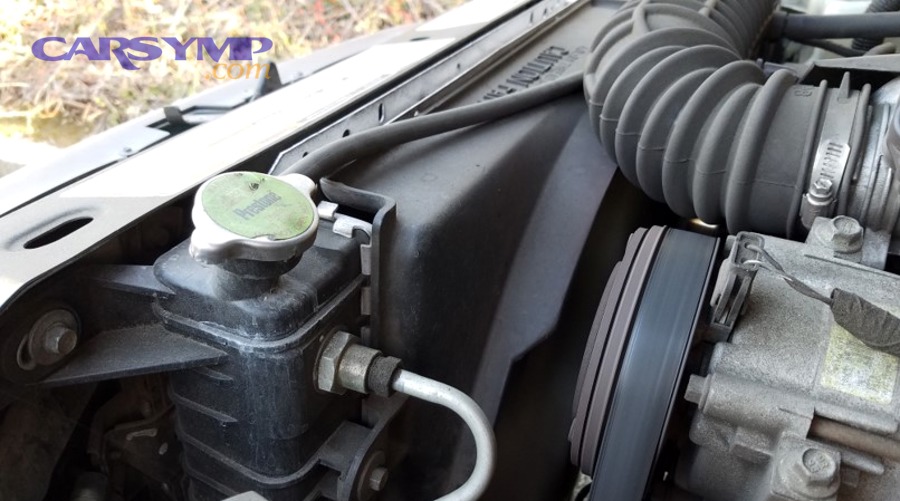
A symptom is what you notice (overheating, rough idle, grinding noise), while a root cause is the component or condition that creates that symptom (coolant leak, failing ignition coil, worn wheel bearing).
Specifically, this distinction matters because two different root causes can create the same symptom—and the repair costs can be hundreds or thousands apart.
A practical symptom → root cause chain :
- Symptom: Temperature gauge climbs at idle
Possible root causes: radiator fan not running, low coolant, stuck thermostat, restricted radiator, weak water pump - Symptom: Car won’t start (clicking)
Possible root causes: weak battery, corroded terminals/ground, failing starter, charging problem from alternator - Symptom: Check engine light + rough running
Possible root causes: spark plugs/coils, vacuum leak, injector issue, sensor fault, low fuel pressure
When you ask for a quote using only a symptom, you often get a wide range because the shop is silently covering multiple potential causes.
What costs are usually included (and excluded) in a repair quote?
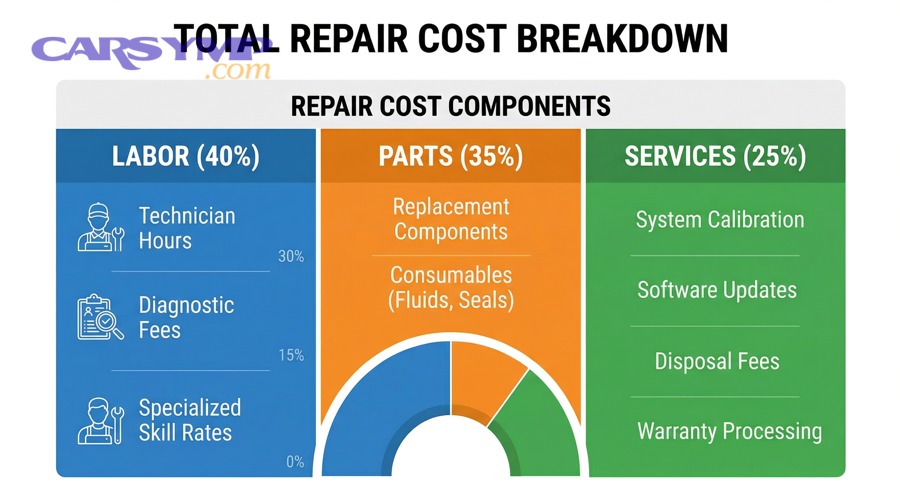
A repair quote usually includes diagnosis (sometimes a separate fee), parts, labor, and fluids, but it may exclude towing, taxes/fees, and any “while-you’re-in-there” items discovered after disassembly.
Then, the quote becomes clearer when you know the standard cost “buckets”:
Commonly included
- Diagnostic fee (scan, inspection time, pinpoint testing)
- Parts (OEM, aftermarket, remanufactured)
- Labor (hours × shop rate)
- Fluids & shop supplies (coolant, brake fluid, sealants, disposal fees)
Often excluded or conditional
- Towing / roadside
- Taxes
- Additional damage found after teardown
- Add-on maintenance you choose to bundle (belts, hoses, gaskets nearby)
If you want the “typical cost” to be meaningful, you’re really asking: What’s the likely labor scope + the likely parts scope for this root cause?
Do online “average repair costs” match what drivers actually pay?
No—online averages rarely match your exact bill, because they blend different vehicles, labor rates, parts grades, and even different root causes that share the same symptom.
However, online averages are still useful for setting a budget band (low vs mid vs high). For example, Kelley Blue Book has cited a national “average repair cost” figure used as a broad benchmark, but it’s not a root-cause-specific quote. (kbb.com)
Three reasons averages miss your number
- Labor rate spread (metro vs rural, dealer vs independent) can swing the same job significantly.
- Access difficulty (tight engine bays, AWD packaging, rust) changes labor hours.
- Parts selection (OEM vs aftermarket vs reman) can double—or halve—the parts line.
So the right way to use online numbers is: start with the average, then narrow by your likely root cause and your local variables.
Which root-cause categories most often drive repair costs ?
There are three main cost groups of root causes—low-, mid-, and high-cost—based on a simple criterion: how much labor time and component complexity the repair typically requires.
To better understand where your likely repair lands, it helps to group causes by vehicle systems, then map those systems into cost bands.
Which root causes are usually low-cost fixes (and why)?
There are five common low-cost root cause types—minor maintenance items, simple sensors, small leaks, basic electrical connections, and easy-access wear parts—because they require limited labor time and relatively inexpensive components.
Then, the key is recognizing that “low-cost” often means low labor hours, not necessarily “easy to DIY.”
Typical low-cost root causes (examples)
- Battery/terminal corrosion or loose connections
- Worn spark plugs (on easy-access engines)
- Loose/damaged gas cap triggering EVAP codes
- Small vacuum leak in a hose
- Simple sensors (depending on location) like an O2 sensor on accessible exhaust sections
CarMD-style reporting often highlights that some check-engine-related fixes can be relatively inexpensive compared to major failures (e.g., fuel cap vs catalytic converter), reinforcing how much the root cause matters. (carpro.com)
Which root causes are typically mid-cost repairs (and what pushes them higher)?
There are six common mid-cost root cause types—charging/starting components, brakes, bearings, cooling components, suspension parts, and moderate-access engine repairs—because they mix moderate labor hours with mid-priced parts.
Next, the “push higher” factors are predictable: seized fasteners, added diagnostics, and bundled parts you replace to prevent repeat labor.
Typical mid-cost root causes (examples)
- Alternator or starter replacement
- Brake job (pads/rotors, sometimes calipers)
- Wheel bearing or hub assembly
- Thermostat or radiator fan issues
- Struts/shocks, control arms, tie rods
What pushes mid-cost into high-cost
- Rust/corrosion increasing labor time
- A “secondary damage” discovery (e.g., overheated coolant damaging hoses)
- Choosing OEM parts on a part-heavy repair
Which root causes are high-cost repairs (and what’s the “big money” list)?
There are five common high-cost root cause types—major engine internal failures, transmission failures, forced induction failures, AC system contamination, and emissions hardware replacements—because they involve high labor hours, high parts cost, or both.
More importantly, high-cost root causes often include diagnostic complexity and risk of escalation if you keep driving.
The big-money list (typical categories)
- Transmission rebuild/replace
- Head gasket / warped head from overheating episodes
- Timing chain/belt failures with collateral damage
- Turbocharger replacement (plus oil/coolant line issues)
- Catalytic converter replacement (often expensive) (aftermarketmatters.com)
This is why cost planning works best when you ask, “Which root cause is most likely?” instead of “What does this symptom usually cost?”
How much does it typically cost to fix root causes by system (with ranges drivers can budget)?
There are five main system-based cost buckets—cooling, electrical, brakes/steering/suspension, engine fuel/air/ignition, and transmission/drivetrain—and each bucket has predictable low-to-high ranges based on parts intensity and labor hours.
Below, we’ll translate those buckets into budget bands you can use when you request quotes and compare repair plans.
What are typical repair costs for cooling-system root causes (overheating-related)?
Cooling-system root causes typically range from low-cost (simple leak fixes) to high-cost (overheat damage), depending on whether the repair is a component swap or an engine-saving intervention after severe overheating.
Then, the best budgeting move is to treat overheating as a “risk multiplier,” because delay can turn a $150 problem into a $2,000+ outcome.
Typical cooling root causes + cost band logic
- Low band (often <$300–$500):
- Coolant top-off + proper bleed (if no leak)
- Hose clamp replacement, small hose replacement
- Radiator cap replacement
- Mid band (often ~$300–$1,200):
- Thermostat replacement
- Radiator fan motor / relay / resistor repair
- Radiator replacement
- Water pump replacement (varies widely by engine layout)
- High band (often $1,500–$4,000+):
- Head gasket repair after overheating
- Warped head machining + related gasket sets
- Engine replacement in worst cases
This is where overheating diagnosis must be systematic, because guessing wrong wastes money and time.
Cooling system pressure test explained (why it matters):
A pressure test adds controlled pressure to the cooling system so you can spot leaks that only appear under operating pressure and temperature. It’s one of the fastest ways to confirm whether “low coolant” is a symptom or a root cause.
Step-by-step overheating diagnostic checklist (quick version)
- Confirm coolant level (cold engine) and look for obvious leaks.
- Check radiator fan operation at idle when warm.
- Verify thermostat behavior (temperature rise pattern).
- Pressure-test cooling system to find hidden leaks.
- Inspect radiator flow and signs of restriction.
- If overheating persists, test for combustion gases in coolant (shop-level test).
What are typical repair costs for electrical/starting/charging root causes?
Electrical/starting/charging root causes typically range from low-cost connection fixes to mid-cost component replacements, because the biggest cost swing comes from diagnostic time and the price of major components like alternators and starters.
Next, the key is separating “no-start” into electrical supply vs mechanical cranking issues.
Common root causes and cost bands
- Low band:
- Battery terminal cleaning and securing
- Ground strap repair
- Battery replacement (varies by type)
- Mid band:
- Alternator replacement
- Starter replacement
- Parasitic draw diagnosis + repair (can add diagnostic hours)
- Can become high band:
- Complex wiring harness faults
- Control module issues (less common, more specialized)
A practical budgeting tip: if you have intermittent electrical symptoms, expect a higher diagnostic share because intermittent faults take longer to reproduce and prove.
What are typical repair costs for brakes, steering, and suspension root causes?
Brake/steering/suspension root causes typically fall in the mid-cost band, but they can become high-cost when multiple worn components stack together or when safety-critical parts (like steering racks) require more labor and alignment.
Then, your urgency decision should lean conservative here, because these systems directly affect stopping and control.
Typical root causes
- Brakes: pads/rotors, calipers, brake hoses, fluid leaks
- Steering: tie rods, ball joints, power steering leaks, rack-and-pinion
- Suspension: struts/shocks, control arms, bushings, wheel bearings
Cost drivers you can ask about in quotes:
- Are you replacing one component or a set (left/right)?
- Does the quote include alignment?
- Are they using loaded assemblies (faster) or component-level rebuilds (sometimes cheaper parts, more labor)?
What are typical repair costs for engine fuel/air/ignition root causes (misfire, stalling, rough idle)?
Engine fuel/air/ignition root causes range from low-cost tune-up items to mid-cost fuel delivery repairs, because the system includes both inexpensive wear parts (plugs) and more expensive components (injectors, pumps).
Next, your best cost control move is making sure the shop is fixing the root cause, not “parts swapping.”
Common root causes
- Ignition: spark plugs, coils, plug wires (where applicable)
- Air: vacuum leaks, intake boot tears, throttle body issues
- Fuel: clogged injectors, failing fuel pump, pressure regulator issues
- Sensors: MAF/MAP, oxygen sensors (varies by access)
CarMD-style data shows how check-engine-light repairs can range from inexpensive fixes (fuel cap) to expensive fixes (catalytic converter), which is why root cause drives cost inside the engine/emissions world. (aftermarketmatters.com)
What are typical repair costs for transmission/drivetrain root causes?
Transmission/drivetrain root causes often have the widest cost spread, because some issues are maintenance-level (fluid service) while others require major internal repair or replacement.
Then, the budgeting rule is simple: if the transmission is slipping, harsh-shifting, or setting internal fault codes, treat it as a potentially high-cost category until proven otherwise.
Common root causes
- Lower band / preventive: fluid and filter service (when appropriate)
- Mid band: CV axles, mounts, driveline components
- High band: internal transmission failures, rebuild/replace, complex AWD component failures
A useful expectation-setter: if a shop recommends “diagnosis first” for a shifting complaint, that’s often a sign the symptom can originate from multiple causes (fluid condition, solenoids, software adaptations, internal wear).
Why do repair costs vary so much for the same root cause?
Repair costs vary because the same root cause can require different labor hours, different parts grades, and different diagnostic depth depending on your vehicle design, your local labor market, and the repair strategy (replace one part vs refresh the system).
In addition, knowing the “cost levers” helps you ask better questions and get quotes you can actually compare.
Does labor rate or parts choice affect the total more?
Labor rate wins for labor-heavy repairs, while parts choice wins for parts-heavy repairs—and the “winner” depends on which category your root cause falls into.
However, the easiest way to predict it is to ask one question: Is this job mostly time, or mostly components?
Labor-heavy examples (labor rate matters more)
- Timing chain jobs
- Head gasket repairs
- Hard-to-access water pumps
- Complex electrical diagnosis
Parts-heavy examples (parts choice matters more)
- Catalytic converters
- Some alternators/starter assemblies
- Certain suspension jobs with many components
- Batteries (especially AGM or specialized fitments)
This is why you can get two very different totals for “the same root cause” while both shops are being honest—one is quoting more labor time, the other is quoting higher-grade parts (or both).
Is OEM always more expensive than aftermarket or reman parts?
No—OEM is not always more expensive, but OEM is often priced higher because it’s built to the manufacturer’s spec and can come with stronger fitment confidence, while aftermarket can be cheaper (or sometimes premium-priced) depending on brand and warranty.
Moreover, you should treat parts choice as a risk management decision, not just a price decision.
Three reasons OEM may be worth it
- Critical fitment and calibration (certain sensors, electronic modules)
- Better longevity on some components
- Warranty simplicity through the dealer network
Three reasons aftermarket/reman may be smart
- Strong aftermarket brands with equal/better warranties
- Cost control on older vehicles
- Quick availability when OEM is backordered
Your best move is to ask the shop to quote two options—OEM and a reputable aftermarket alternative—so you can see the tradeoff clearly.
Do dealerships cost more than independent shops for the same repair?
Yes, dealerships often cost more overall, because labor rates and parts pricing can be higher—yet independent shops can be the better value for many root causes, especially routine mechanical repairs.
Meanwhile, dealerships may win when the root cause requires factory scan tools, software updates, warranty coverage, or specialized brand-specific procedures.
KBB and industry reporting frequently highlight how overall repair costs and averages are influenced by inflation and labor/parts trends, which is one reason shop type and location matter so much. (kbb.com)
How can drivers estimate their cost from symptoms without getting misled?
Drivers can estimate cost from symptoms by using a symptom-to-root-cause workflow that narrows the most likely causes first, then confirms them with basic checks (or paid diagnostics) before approving repairs.
To better understand why this works, remember the core rule: symptoms are shared, but root causes are specific—and specificity is what makes estimates accurate.
What’s a quick symptom-to-root-cause checklist drivers can use before getting quotes?
A quick checklist is a triage tool, not a diagnosis, but it can reduce “estimate fog” by helping you describe conditions that point toward certain root causes.
Then, when you call a shop, you’ll sound like someone who wants the cause confirmed—not someone shopping for a random price.
Triage checklist (useful details to capture)
- When does it happen? (cold start, hot idle, highway speed, turning, braking)
- Is it consistent or intermittent?
- Any warning lights? (check engine, battery, temp, ABS)
- Any smell? (sweet coolant, fuel, burning oil, hot brakes)
- Any fluid loss under the car?
Examples (symptom → better description → likely cause bucket)
- “Overheats at idle, cools at speed” → “Temp climbs when stopped; fan sound absent” → likely fan control or airflow problem (cooling)
- “Clicking no-start” → “Lights on, single click when key turned” → starter/connection/battery (electrical)
- “Vibration under braking” → “Steering wheel shakes during braking from 60–40 mph” → rotors/pads/suspension (brakes)
This checklist makes your estimate requests sharper because it reduces the number of plausible root causes.
Should you pay for diagnostics first before approving repairs?
Yes, you should usually pay for diagnostics first, because it prevents wasted money on the wrong root cause, reduces repeat visits, and gives you a written basis to compare quotes.
In addition, diagnostics often pays for itself when symptoms have multiple plausible causes (especially electrical issues and overheating complaints).
Three reasons diagnostics is typically worth it
- It turns a symptom-based guess into a root-cause-based plan.
- It reduces parts-swapping and repeat labor charges.
- It gives you evidence to approve only what’s necessary.
A real-world benchmark: check-engine-light repair reporting shows how the same light can correspond to dramatically different repairs and costs, which is why confirmation matters before you commit. (cars.com)
Which root causes are “safe to delay,” and which should be repaired immediately?
Some root causes are not safe to delay because they create immediate safety risks or rapid escalation (overheating, braking faults, severe misfires), while others can sometimes be delayed briefly if symptoms are mild and monitored.
More importantly, the right decision depends on the root cause category and escalation risk—not on the size of the current quote.
Is it safe to keep driving if the car is overheating or losing coolant?
No, it is not safe to keep driving while overheating or losing coolant, because it can warp engine components, destroy head gaskets, and turn a manageable cooling repair into a major engine repair.
Next, treat overheating as an emergency budgeting scenario: stopping early often saves thousands.
Three reasons overheating is urgent
- Metal warps when overheated, changing tolerances and sealing surfaces.
- Coolant loss introduces air pockets, making cooling unstable and unpredictable.
- Escalation is fast—a short drive can cause long-term damage.
This is where proper overheating diagnosis matters most: you’re not just chasing comfort; you’re preventing engine destruction.
What repairs are often cheaper if you fix them early (prevent escalation)?
There are six repair categories that are usually cheaper early—cooling leaks, charging issues, brake wear, wheel bearing noise, misfires, and small fluid leaks—because early action prevents collateral damage and avoids repeat labor.
Then, the best way to “save money” is to fix the root cause before it spreads.
Early-fix savings examples
- Coolant leak → prevents overheating and gasket damage
- Misfire → prevents catalytic converter damage
- Brake pads worn → prevents rotor/caliper damage
- Bearing noise → prevents hub failure and unsafe driving
- Alternator weak → prevents battery damage and roadside tow
What repairs are usually expensive no matter what (even if you catch them early)?
There are three repair categories that can remain expensive even when caught early—major transmission internal wear, some engine internal failures, and certain emissions hardware replacements—because parts and labor are inherently high and replacement scope is large.
However, catching them early still helps you avoid the worst outcome (total failure, towing, broader collateral damage).
CarMD-related reporting consistently lists catalytic converter replacement as one of the more expensive common check-engine repairs, showing how certain categories stay costly even when identified promptly. (aftermarketmatters.com)
How can drivers reduce repair costs and avoid paying for the wrong root cause?
Drivers can reduce repair costs by using a confirm-first approach , choosing parts strategically, and bundling only the repairs that share labor—so you spend on the true root cause, not on repeated guesses.
To better understand how to do that, think in opposites: prevent vs repair and confirmed diagnosis vs assumption.
What’s the difference between preventive maintenance costs and corrective repair costs?
Preventive maintenance is typically predictable and smaller, while corrective repair is often surprising and larger, because preventive work reduces the chance that a small root cause escalates into a major failure.
In addition, preventive work also reduces diagnostic uncertainty, because systems are already in known-good condition.
Prevent (lower, planned) examples
- Coolant service where recommended
- Belt and hose inspections
- Brake fluid flushes
- Battery health checks
Repair (higher, reactive) examples
- Overheat-induced head gasket repairs
- Roadside no-start events
- Brake failures that require calipers/rotors
- Misfire damage that takes out the catalytic converter
According to a study by the University of Michigan (reported in its research coverage of lifetime vehicle costs), electric vehicles can have lower maintenance and repair costs compared with gasoline vehicles—an example of how design and routine service demands can shift the prevent-vs-repair equation over a vehicle’s life. (news.umich.edu)
How can you compare quotes fairly (labor hours, parts grade, warranty)?
You can compare quotes fairly by forcing an “apples-to-apples” match on root cause confirmation, labor hours, parts grade, and warranty, because those four variables explain most price differences between legitimate estimates.
Next, use this simple quote comparison checklist:
Quote comparison checklist
- What is the confirmed root cause (test results, codes, observations)?
- What are the labor hours and labor rate?
- What exact parts brand/grade (OEM/aftermarket/reman)?
- What warranty is included (parts + labor, duration, conditions)?
- Are fluids, shop supplies, disposal fees included?
- Does it include required follow-ups (alignment after suspension work)?
If one shop won’t specify parts grade or labor hours, you don’t have a comparable quote—you have a number.
What are common misdiagnosis traps that inflate costs ?
There are four common misdiagnosis traps—symptom-based parts swapping, skipping confirmation tests, ignoring “when it happens” context, and not checking basics first—and each one can inflate costs through repeat labor and unnecessary parts.
Moreover, these traps are especially common in overheating complaints and intermittent electrical issues.
Misdiagnosis traps (and the fix)
- Replacing a thermostat without checking fan operation → confirm fan control at idle
- Replacing a battery without checking alternator output → confirm charging system
- Chasing misfire with random parts → confirm spark, fuel, air, and compression basics
- Ignoring slow leaks → use a pressure test to find hidden coolant loss
When does a “bundle repair” actually save money (and when is it upsell)?
Yes, bundling can save money when repairs share labor access, but no, it’s not always worth it if the added parts don’t meaningfully reduce future risk or if the parts are not actually in the labor path.
Then, the simplest way to decide is to ask: Would I pay most of the same labor again later to replace this?
Legitimate money-saving bundles
- Water pump + thermostat + coolant service (when the same teardown is required)
- Timing belt + tensioners + water pump (common access overlap on many engines)
- Struts + mounts + alignment (shared labor and required follow-up)
Common upsell patterns
- Adding unrelated flushes without evidence
- Replacing parts “just because” they’re nearby, with no wear indicators
- Bundling premium parts without giving an alternative option
Evidence (if any)
According to recent industry reporting, average repair costs and common check-engine repair costs are often summarized using large datasets (e.g., KBB averages and CarMD-style check-engine reports), which helps set budgeting expectations but still requires root-cause confirmation to price your specific repair. (kbb.com)