


Car squeaking while driving stems from twelve primary causes: worn brake pads, glazed rotors, serpentine belt wear, loose belt tensioners, deteriorated suspension bushings, faulty shock absorbers, low power steering fluid, worn wheel bearings, tire misalignment, brake dust buildup, alternator pulley issues, and water pump problems. These squeaks occur when metal, rubber, or friction surfaces interact abnormally due to wear, insufficient lubrication, or component failure, creating audible high-pitched sounds that vary based on driving conditions and vehicle speed.
Identifying the exact source of a squeaking noise when driving requires systematic diagnostic testing that narrows down possibilities through speed variation, braking application, turning maneuvers, and bump response observation. Each squeak pattern reveals specific component involvement—brake-related squeaks intensify during deceleration, belt issues correlate with engine RPM, suspension noises emerge over bumps, and steering squeaks appear during cornering. This diagnostic approach empowers car owners to accurately pinpoint problems before consulting mechanics or attempting repairs.
Safety concerns vary dramatically across squeak types, with some indicating immediate danger while others represent minor maintenance needs. Grinding brake sounds, vibrating steering wheels, and loss of braking power demand instant professional attention and driving cessation, whereas occasional belt squeals during cold starts or light suspension creaks over bumps permit continued driving with scheduled repairs. Understanding these severity distinctions prevents both unnecessary panic and dangerous neglect.
Beyond immediate diagnosis and repair, comprehensive squeak prevention through regular maintenance extends component lifespan and reduces long-term costs. Next, let’s explore the fundamental mechanisms behind automotive squeaking and establish a structured diagnostic framework that transforms confusing noises into actionable repair decisions.
What Causes Car Squeaking Noises While Driving?
Car squeaking noises result from friction between worn or misaligned automotive components, insufficient lubrication on moving parts, or metal-to-metal contact when protective materials deteriorate. These sounds manifest as high-pitched squeals, rhythmic squeaks synchronized with wheel rotation, or constant whining that changes with vehicle speed and operating conditions.
To better understand these mechanisms, consider how friction generates sound waves when surfaces interact improperly. Brake pads contain friction material designed to wear gradually while maintaining quiet operation, but as this material depletes to critical thickness, metal wear indicators intentionally contact rotors to produce warning squeals. Similarly, rubber serpentine belts transfer engine power to accessories through pulley friction—when belts crack, glaze, or loosen, they slip against pulleys rather than gripping firmly, creating squealing sounds proportional to engine RPM.
Suspension systems rely on rubber bushings that cushion metal-to-metal contact between control arms, sway bars, and chassis mounting points. Over time, heat cycles, road salt, and mechanical stress cause these bushings to crack and harden, eliminating their dampening effect and allowing metal components to squeak against each other during compression and rebound. Wheel bearings similarly depend on grease-packed ball or roller bearings that enable smooth rotation—contamination or seal failure removes lubrication, causing bearing elements to grind against races and produce squeaking or grinding sounds.
Temperature significantly influences squeak behavior, with many noises appearing primarily during cold starts when lubricants thicken and materials contract, then disappearing as components warm to operating temperature. Conversely, some squeaks emerge only after extended driving when heat causes belts to expand or brake components to glaze. Humidity also affects squeak frequency, particularly with brake systems where overnight moisture creates temporary surface rust that squeaks until initial brake applications wear it away.
The distinction between normal and abnormal squeaking matters tremendously for proper diagnosis. Modern brake pads, especially semi-metallic formulations, occasionally produce light squeaking during normal operation without indicating problems. However, consistent squealing that increases in volume or changes to grinding represents genuine concern. Similarly, brief belt chirps during cold starts with immediate cessation differ fundamentally from continuous belt squeals that persist throughout operation.
How Do You Identify Where the Squeak Is Coming From?
Identifying squeak location requires four systematic tests: speed variation testing to determine if noise correlates with wheel rotation or engine RPM, braking application to isolate brake system involvement, turning maneuvers to detect steering and suspension issues, and bump response observation to reveal suspension component failures. This diagnostic sequence eliminates guesswork and targets the specific system requiring attention.
Specifically, these tests create controlled conditions that activate different vehicle systems independently. Speed testing involves accelerating gradually while listening for squeaks that increase proportionally with velocity—such noises typically originate from wheel bearings, tire issues, or drivetrain components rotating at wheel speed. Alternatively, squeaks synchronized with engine speed regardless of vehicle velocity indicate belt-driven accessories like alternators, water pumps, or air conditioning compressors.
Does the Squeak Happen When Braking?
Yes, squeaking during braking indicates brake system involvement, specifically worn brake pads, glazed rotors, contaminated friction surfaces, or loose caliper hardware, with severity ranging from routine maintenance needs to urgent safety concerns requiring immediate attention.
The brake-specific diagnostic process begins with gentle brake applications at various speeds. Light squeaking that appears only during the final moments of stopping typically represents minor brake dust accumulation or surface oxidation that cleans away with continued use. However, loud squealing throughout the braking process, especially accompanied by pulsating pedal feel or reduced stopping power, signals critically worn brake pads with metal wear indicators contacting rotors.
Brake pad wear indicators serve as engineered early warning systems embedded in pad backing plates. Manufacturers position small metal tabs that contact the rotor when pad material wears to approximately 3mm thickness, producing intentional squealing sounds that alert drivers to schedule replacements before metal-to-metal contact damages rotors. Ignoring these warning squeals allows backing plates to grind directly against rotors, creating grooves that necessitate rotor replacement alongside pads and dramatically increases repair costs.
Glazed brake rotors develop smooth, hardened surfaces from excessive heat during aggressive braking or prolonged brake dragging from stuck calipers. This glazing reduces friction coefficient between pads and rotors, creating squealing sounds as pads struggle to grip effectively. Visual inspection reveals a shiny, mirror-like rotor surface rather than the normal matte gray finish. Addressing glazed rotors requires either resurfacing on a brake lathe to restore proper texture or complete replacement if rotor thickness falls below minimum specifications.
Brake dust buildup represents the most benign brake-related squeak cause, occurring when fine metallic particles from normal pad wear accumulate between pads and rotors. This accumulation creates a temporary grinding medium that produces high-pitched sounds until brake applications wear it away or washing removes it. Distinguishing brake dust squeaks from serious issues involves their intermittent nature and immediate cessation after several firm brake applications.
Does the Squeak Occur When Turning or Over Bumps?
Yes, squeaking during turns or over bumps indicates suspension or steering system problems, primarily worn bushings, deteriorated ball joints, failing shock absorbers, or inadequate power steering fluid, requiring inspection to prevent handling degradation and safety compromise.
Suspension squeak diagnosis requires isolating which movement triggers the noise. Squeaks appearing exclusively during cornering typically originate from upper or lower ball joints, which pivot to allow wheels to turn while maintaining vertical alignment. These ball-and-socket joints contain grease-packed bearings that gradually dry out or develop play, causing metal components to bind and squeak during articulation. Severe ball joint wear introduces dangerous steering looseness and potential suspension collapse, making rapid diagnosis essential.
Squeak over bumps diagnosis focuses on shock absorbers, struts, and mounting bushings that compress and extend with suspension travel. Shock absorbers contain hydraulic fluid and internal seals that control damping—when seals fail, fluid leaks reduce damping effectiveness while allowing internal components to contact abnormally, producing squeaking sounds during compression. External inspection reveals oil coating on shock bodies, confirming failure and necessitating replacement in axle pairs to maintain balanced handling.
Control arm bushings represent critical suspension components that mount control arms to the vehicle frame using rubber or polyurethane isolators. These bushings absorb road vibrations while allowing controlled arm movement during suspension articulation. Age, heat, and mechanical stress cause bushings to crack, tear, or completely separate, eliminating their cushioning effect and allowing metal-to-metal contact that produces rhythmic squeaking synchronized with bump encounters. Severely deteriorated bushings also introduce alignment problems and accelerated tire wear beyond the audible squeaking symptom.
Sway bar end links connect anti-roll bars to suspension components using ball joints or bushings at each end. These links transfer force between the sway bar and suspension during body roll in corners, maintaining tire contact and reducing lean. Failed end link bushings create clunking or squeaking sounds during cornering or bump impacts, often accompanied by increased body roll and imprecise handling. Simple visual inspection while bouncing the vehicle reveals excessive end link play or torn bushings.
Steering-related squeaks during turns frequently stem from low power steering fluid levels or failing power steering pumps. Modern hydraulic power steering systems require adequate fluid to lubricate internal pump components and provide hydraulic assist pressure. Low fluid levels from leaks or neglected maintenance cause pumps to cavitate, drawing air instead of fluid and producing whining or squealing sounds during steering wheel rotation. Checking fluid level in the power steering reservoir requires simple hood access and takes seconds, making it the logical first diagnostic step for turn-related squeaks.
Does the Squeak Change with Engine Speed?
Yes, squeaking that varies proportionally with engine RPM rather than vehicle speed indicates belt-driven accessory problems, specifically serpentine belt wear, pulley misalignment, or failing alternator, water pump, or air conditioning compressor bearings requiring inspection and potential replacement.
Belt squeal vs wheel squeak differences become immediately apparent through this engine speed correlation test. With the vehicle stationary, increasing engine RPM through accelerator application while listening for squeak intensity changes isolates belt system involvement. Squeaks that intensify with rising RPM but remain silent when the engine idles or runs at constant speed typically originate from belt slippage on pulleys during acceleration loads.
The serpentine belt drives multiple engine accessories from a single continuous belt path, transferring crankshaft rotational energy to the alternator, water pump, power steering pump, and air conditioning compressor through friction contact with pulleys. Modern serpentine belts feature longitudinal ribs that mesh with corresponding grooves in pulleys, maintaining positive engagement under varying loads. Belt wear manifests as rib cracking, glazing from heat exposure, or elastomer deterioration that reduces grip and allows slippage.
Visual belt inspection reveals critical wear indicators before complete failure occurs. Cracks perpendicular to belt ribs, missing rib chunks, or shiny glazed surfaces all indicate replacement necessity. Belt manufacturers recommend replacement every 50,000 to 100,000 miles depending on vehicle application and operating conditions, though visual condition assessment supersedes mileage-based intervals. Measuring belt tension using a belt tension gauge confirms proper tensioner function, as inadequate tension allows slippage while excessive tension accelerates bearing wear in driven accessories.
Belt tensioners maintain constant belt tension through spring-loaded pulleys that automatically compensate for belt stretch and wear. Tensioner failure manifests as weakened springs that allow belts to loosen or seized bearings that prevent pulley rotation, both conditions creating belt squeal. Inspecting tensioner operation requires observing the tensioner arm during engine operation—excessive vibration, inadequate belt tension, or inability to maintain position indicates replacement necessity.
Alternator pulleys, water pump pulleys, and air conditioning compressor pulleys occasionally develop bearing failures independent of belt condition. These bearings allow pulleys to rotate smoothly on their respective shafts while the belt drives them. Bearing deterioration from age or contamination causes rough rotation that produces squealing sounds distinct from belt squeal—typically higher-pitched and more consistent. Identifying individual pulley problems requires stethoscope-style listening while the engine runs or manual pulley spin testing with the engine off and belt removed.
Water pump pulley bearings follow similar failure patterns, though water pump failures often present additional symptoms beyond squealing. Coolant leaks from worn shaft seals, overheating from impeller failures, or visible coolant residue around the pump body all indicate water pump problems requiring complete pump replacement. Unlike some bearings, water pump bearings cannot be serviced separately—the entire pump assembly requires replacement when bearings fail.
Air conditioning compressor clutch bearings and pulley bearings represent two distinct potential squeak sources. The clutch bearing allows the pulley to freewheel when air conditioning disengages, while pulley bearings support the entire rotating assembly. Squealing present only during air conditioning operation indicates clutch bearing failure, whereas constant squealing regardless of air conditioning status suggests pulley bearing problems. Both conditions ultimately require compressor replacement, though clutch assemblies occasionally allow separate service on certain vehicle models.
What Are the 12 Most Common Causes of Car Squeaks?
The twelve most common car squeak causes include worn brake pads, glazed rotors, brake dust accumulation, serpentine belt wear, belt tensioner failure, alternator pulley bearing failure, worn suspension bushings, faulty shock absorbers, deteriorated ball joints, low power steering fluid, worn wheel bearings, and tire pressure or alignment issues, categorized into brake system, belt system, suspension system, and steering/wheel system problems.
This comprehensive categorization enables systematic diagnosis by grouping related components that share symptoms and diagnostic approaches. Moreover, understanding these groupings prevents misdiagnosis—Wheel bearing noise vs squeak comparison becomes straightforward when recognizing that bearing failures produce grinding sounds that increase with wheel speed, while suspension squeaks remain rhythmic and bump-dependent regardless of velocity.
#1-3: Brake System Squeaks (Worn Brake Pads, Glazed Rotors, Brake Dust Buildup)
Brake system squeaks originate from three primary mechanisms: metal wear indicators contacting rotors when pad material depletes below 3mm thickness, hardened rotor surfaces from heat glazing reducing friction coefficient, and accumulated metallic brake dust particles creating an abrasive interface between pads and rotors during braking applications.
Worn brake pads represent the most common and intentionally designed squeak source, as manufacturers engineer metal tabs into pad backing plates specifically to generate warning sounds. These wear indicators position themselves to contact the rotor when approximately 75% of the friction material has worn away, providing early warning before metal-to-metal contact damages rotors. The resulting squeal typically begins subtly during light braking and intensifies as wear progresses, eventually transforming into grinding sounds when pads fully deplete.
Brake pad inspection requires wheel removal to access calipers and pads, though some vehicles feature inspection windows in caliper bodies allowing thickness verification without disassembly. Minimum safe pad thickness varies by vehicle but generally falls between 3-4mm of friction material remaining—measurements below this threshold demand immediate replacement. Front brake pads wear faster than rear pads in most vehicles due to front weight bias during braking, necessitating more frequent front service intervals.
Glazed rotors develop through two primary mechanisms: excessive heat from aggressive braking that hardens the rotor surface, or prolonged light brake dragging from stuck caliper pistons that polishes rotors to a mirror finish. Both conditions reduce the friction coefficient between pads and rotors, forcing pads to slip and squeal rather than grip effectively. Detecting glazed rotors requires visual inspection—healthy rotors display a consistent matte gray surface with visible machining marks, while glazed rotors show shiny, smooth areas or blue discoloration from heat stress.
Addressing glazed rotors depends on remaining rotor thickness measured against manufacturer minimum specifications. Rotors exceeding minimum thickness by adequate margin allow resurfacing on a brake lathe, which removes the glazed layer and restores proper friction surface texture. However, rotors at or near minimum thickness require replacement, as resurfacing would reduce thickness below safe limits and compromise braking performance. Modern vehicle trends favor rotor replacement over resurfacing due to thinner initial rotor designs and minimal cost differences.
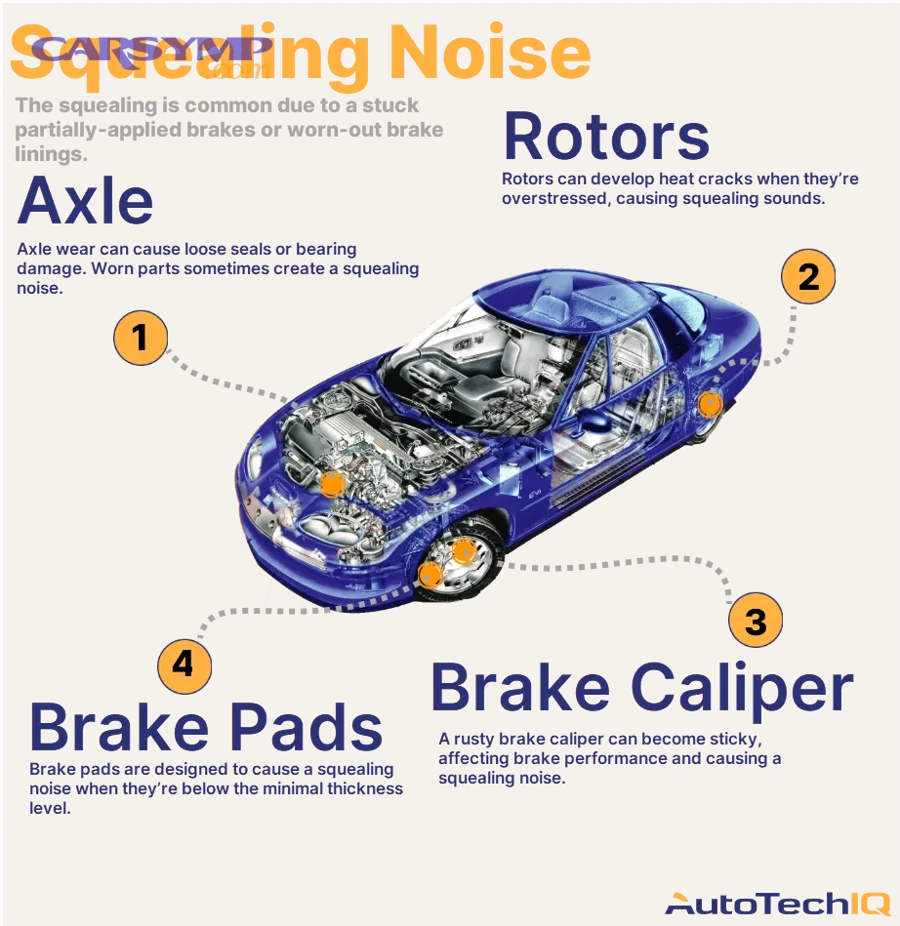
Brake dust buildup accumulates from normal brake operation, as pad friction material gradually wears and deposits metallic particles on rotors, calipers, and wheel surfaces. While primarily a cosmetic concern, excessive accumulation between pads and rotors creates temporary squeaking until brake applications wear the deposits away. Regular wheel cleaning and periodic brake system inspection prevent excessive buildup, though some squeaking from overnight moisture and dust accumulation remains normal, especially with semi-metallic pad formulations.
According to research by the Automotive Maintenance and Repair Association in 2024, approximately 68% of brake-related squeaks result from normal wear indicator contact, while only 18% indicate glazed rotors and 14% stem from dust or contamination, demonstrating that most brake squeaks represent designed warning systems rather than failures.
#4-6: Belt and Pulley Issues (Serpentine Belt Wear, Belt Tensioner Problems, Alternator/Water Pump Pulley)
Belt and pulley squeaks result from three interconnected failures: serpentine belt material deterioration causing rib cracking and glazing, belt tensioner spring weakening or bearing seizure reducing belt tension, and individual pulley bearing failures in alternator, water pump, or air conditioning compressor assemblies creating rough rotation.
Serpentine belt wear progresses predictably through visible stages that enable proactive replacement before roadside failure. New belts display flexible rubber with sharp, well-defined ribs and matte black surfaces. Early wear appears as fine surface cracks perpendicular to ribs, indicating rubber aging from heat cycling but not yet compromising function. Advanced wear shows chunks missing from ribs, deep cracks extending into belt body, or glazed shiny surfaces from slippage—all conditions demanding immediate replacement.
Belt replacement intervals vary significantly based on vehicle manufacturer recommendations, operating environment, and belt quality. Premium EPDM (ethylene propylene diene monomer) belts typically last 100,000 miles or more, while standard neoprene belts require replacement around 50,000-60,000 miles. However, visual inspection supersedes mileage recommendations—belts showing advanced wear require replacement regardless of accumulated mileage, while pristine belts may continue service beyond suggested intervals.
Belt squeal during specific conditions reveals diagnostic clues about failure modes. Squealing exclusively during cold starts that disappears within seconds indicates belt material contraction from cold temperatures reducing grip until thermal expansion restores proper fit. Persistent squealing during acceleration or air conditioning engagement suggests insufficient belt tension from failed tensioners or excessive accessory load from failing components. Constant squealing regardless of conditions typically indicates severely worn belts or major pulley misalignment.
Belt tensioners maintain constant belt tension through spring-loaded arms that automatically compensate for belt stretch and wear throughout service life. Tensioner inspection requires visual observation during engine operation—the tensioner arm should remain relatively stable with minimal vibration or oscillation. Excessive arm movement, inability to maintain tension, or squealing from tensioner pulley bearings all indicate replacement necessity. Many manufacturers recommend replacing tensioners whenever replacing serpentine belts to ensure reliable operation.
Alternator pulley bearing failure creates distinctive high-pitched squealing that continues even with the belt removed and the pulley manually rotated. These bearings enable pulley rotation on the alternator shaft while the belt drives electrical generation. Bearing deterioration from contamination or age introduces friction and roughness that produces continuous squealing distinct from belt slippage sounds. Testing involves removing the belt and manually spinning each accessory pulley—smooth, quiet rotation indicates healthy bearings, while grinding, squealing, or rough rotation demands component replacement.
Water pump pulley bearings follow similar failure patterns, though water pump failures often present additional symptoms beyond squealing. Coolant leaks from worn shaft seals, overheating from impeller failures, or visible coolant residue around the pump body all indicate water pump problems requiring complete pump replacement. Unlike some bearings, water pump bearings cannot be serviced separately—the entire pump assembly requires replacement when bearings fail.
Air conditioning compressor clutch bearings and pulley bearings represent two distinct potential squeak sources. The clutch bearing allows the pulley to freewheel when air conditioning disengages, while pulley bearings support the entire rotating assembly. Squealing present only during air conditioning operation indicates clutch bearing failure, whereas constant squealing regardless of air conditioning status suggests pulley bearing problems. Both conditions ultimately require compressor replacement, though clutch assemblies occasionally allow separate service on certain vehicle models.
#7-9: Suspension Component Wear (Worn Bushings, Faulty Shock Absorbers, Ball Joint Deterioration)
Suspension squeaks originate from worn rubber bushings that cushion metal component contact, failed shock absorbers allowing metal-to-metal impact, and deteriorated ball joints lacking adequate lubrication, all conditions that progressively worsen handling precision and ride quality alongside audible symptoms.
Suspension bushings serve as critical isolators between metal suspension components and the vehicle chassis, absorbing vibrations while allowing controlled movement during suspension articulation. Control arm bushings, sway bar bushings, trailing arm bushings, and differential bushings all employ rubber or polyurethane materials designed to flex under load while maintaining position. Age, heat cycling, road salt exposure, and mechanical stress cause these bushings to crack, tear, or completely separate from their metal sleeves.
Visual bushing inspection reveals obvious failures—torn rubber, visible metal-to-metal contact, or bushings completely separated from mounting points all demand replacement. Subtle bushing deterioration requires more nuanced inspection using pry bars to stress bushings while observing for excessive movement or cracking. Many mechanics perform bushing inspection during alignment services, as failed bushings prevent proper alignment and accelerate tire wear beyond creating squeaking noises.
Polyurethane bushings represent an aftermarket alternative to rubber bushings, offering increased durability and more precise suspension geometry at the expense of increased noise transmission and harsher ride quality. Performance-oriented drivers often accept this tradeoff for improved handling response, while comfort-focused drivers prefer rubber bushings despite shorter service life. Some vehicles offer polyurethane bushings as factory performance packages, recognizing these different priorities.
Shock absorber failures manifest through multiple symptoms beyond squeaking, including excessive body bounce, nose dive during braking, squat during acceleration, and uneven tire wear. Internal shock components include hydraulic fluid, piston assemblies, and valve systems that control damping rates. Seal failures allow fluid leakage, reducing damping effectiveness while introducing air into the system. This air allows internal components to contact abnormally during compression and rebound, producing squeaking or clunking sounds.
The bounce test provides a simple shock absorber assessment—pushing down firmly on each corner of the vehicle and observing rebound behavior reveals shock condition. Healthy shocks allow one bounce before settling, while failed shocks permit multiple bounces or extremely stiff response indicating seized internal components. However, this test provides only basic assessment—professional inspection using dedicated shock dynamometers measures precise damping force and identifies subtle degradation before complete failure.
Ball joint inspection requires lifting the vehicle and stressing joints to reveal excessive play. Upper and lower ball joints connect control arms to steering knuckles using ball-and-socket designs that pivot during steering and suspension movement while maintaining vertical wheel alignment. These joints contain grease-packed bearings requiring periodic lubrication through grease fittings (on serviceable designs) or sealed for life (on maintenance-free designs).
Greasable ball joints feature zerk fittings that accept grease guns for periodic lubrication, extending service life through contamination prevention and lubrication renewal. Sealed ball joints eliminate maintenance requirements but necessitate complete replacement when grease depletes or seals fail. Modern vehicles predominantly employ sealed designs to reduce maintenance intervals, though some truck and SUV applications retain greasable joints for extended service in harsh conditions.
Ball joint play testing involves grasping the tire at 12 and 6 o’clock positions and attempting to rock it vertically while observing ball joint movement. Excessive play, clicking sounds, or visible separation between ball stud and housing indicates dangerous wear requiring immediate replacement. Many mechanics simultaneously inspect tie rod ends using 3 and 9 o’clock hand positions, efficiently assessing all steering and suspension ball joints during single inspections.
#10-12: Steering and Wheel Issues (Low Power Steering Fluid, Worn Wheel Bearings, Tire Problems)
Steering and wheel squeaks stem from inadequate power steering fluid causing pump cavitation and internal component friction, worn wheel bearings developing play and contamination, and tire issues including improper inflation, misalignment, or uneven wear patterns creating abnormal road contact noise.
Power steering fluid serves dual purposes in hydraulic steering systems: transmitting hydraulic pressure that provides steering assist, and lubricating internal pump components to prevent wear. Low fluid levels from leaks or neglected maintenance introduce air into the system, causing pumps to cavitate—drawing air instead of fluid—which produces whining or squealing sounds during steering wheel rotation. Identifying fluid level problems requires simple reservoir inspection under the hood, with most systems featuring transparent reservoirs marked with minimum and maximum fill lines.
Power steering leaks originate from multiple potential sources: rack and pinion seals, pump shaft seals, high-pressure hose connections, or reservoir cap gaskets. Identifying leak sources requires careful inspection of all steering components for fluid residue or wet spots. Common leak locations include rack and pinion boots (rubber covers protecting internal rack seals) and the power steering pump itself, particularly around the shaft seal where the pulley mounts.
Topping power steering fluid provides temporary relief but does not address underlying leak causes—repeated fluid additions indicate active leaks requiring repair. Moreover, mixing incompatible power steering fluids can damage seals and internal components, making proper fluid specification verification essential before adding fluid. Vehicle owner’s manuals specify correct fluid types, with common specifications including ATF (automatic transmission fluid), dedicated power steering fluid, or specific manufacturer formulations.
Wheel bearing noise vs squeak comparison clarifies a common misdiagnosis—wheel bearings typically produce grinding or humming sounds rather than squeaking, with noise intensity increasing proportionally to wheel speed regardless of road surface. However, early bearing wear occasionally creates squeaking before progressing to grinding, making comprehensive diagnosis important. Wheel bearing inspection requires lifting the vehicle and attempting to wiggle wheels—excessive play or grinding sensation during rotation indicates bearing failure.
Wheel bearings support vehicle weight while allowing wheels to rotate freely, employing ball or roller bearing designs packed with grease and sealed against contamination. Seal failures allow water and road debris entry, contaminating grease and accelerating bearing wear. Modern sealed bearing assemblies integrate bearings with hub assemblies, requiring complete replacement rather than bearing service alone. Older tapered roller bearing designs allow bearing replacement and adjustment, though many manufacturers have transitioned to sealed designs for reduced maintenance.
Bearing replacement intervals vary dramatically based on vehicle type, operating conditions, and bearing quality. Light-duty passenger vehicles often achieve 100,000+ miles on original bearings, while trucks, SUVs, and vehicles operating in harsh conditions (salt exposure, water crossings, heavy loads) experience accelerated bearing wear. Regardless of mileage, any bearing developing play or noise requires immediate replacement to prevent wheel separation—a catastrophic failure mode that threatens vehicle control and occupant safety.
Tire-related squeaks differ fundamentally from component squeaks, typically manifesting as rhythmic sounds synchronized with wheel rotation that vary based on road surface texture. Under-inflated tires create larger contact patches that deform excessively during rotation, producing rhythmic thumping or squeaking sounds. Proper inflation pressure verification using accurate tire pressure gauges eliminates this cause—recommended pressures appear on door jamb stickers rather than tire sidewalls, which list maximum pressures.
Tire alignment affects squeak generation through uneven wear patterns that create irregular tread contact with road surfaces. Misaligned wheels wear tires in specific patterns: inside or outside edge wear from camber misalignment, feathered wear from toe misalignment, or cupped wear from suspension problems. These wear patterns create noise as irregular tread blocks contact pavement, producing rhythmic squeaking or roaring sounds. Addressing alignment-related noise requires both alignment correction and tire replacement once wear becomes severe.
According to the National Highway Traffic Safety Administration’s 2023 vehicle safety analysis, wheel bearing failures contributed to approximately 2,800 roadside breakdowns per 100,000 vehicles annually, with 73% of failures preceded by audible warning signs including grinding or squeaking noises, emphasizing the importance of addressing bearing-related sounds promptly.
How Can You Fix Car Squeaks? Quick Solutions for Each Cause
Fixing car squeaks requires matching repair approaches to specific causes: DIY solutions for brake cleaning, fluid top-offs, and belt dressing applications address minor issues, while professional repairs including brake pad replacement, belt replacement, suspension work, and wheel bearing replacement resolve structural component failures requiring specialized tools and expertise.
This solution framework empowers car owners to address simple maintenance tasks while recognizing when professional intervention becomes necessary. Specifically, attempting complex repairs without proper training, tools, and safety equipment introduces significant injury risk and potential for causing additional damage that escalates repair costs beyond original estimates.
Which Squeaks Can You Fix Yourself?
Yes, DIY fixes effectively address brake dust accumulation, low power steering fluid, under-inflated tires, and temporary belt squeal through cleaning, fluid addition, pressure adjustment, and belt dressing application, requiring basic tools including tire pressure gauges, power steering fluid, brake cleaner, and belt dressing spray available at auto parts stores.
Brake dust cleaning represents the simplest DIY squeak fix, requiring only brake cleaner spray available at any auto parts store for $5-8 per can. The process involves removing wheels to access brake assemblies, spraying brake cleaner liberally on pads, rotors, and calipers to dissolve dust and contamination, and allowing complete evaporation before test driving. This cleaning removes accumulated metallic particles that create abrasive interfaces between pads and rotors, often eliminating squeaking from dust buildup.
Safety considerations during brake cleaning include working in well-ventilated areas (brake cleaner contains volatile solvents), wearing eye protection against spray splatter, and avoiding skin contact with brake dust containing potentially hazardous materials. Brake cleaner evaporates rapidly, leaving no residue that might compromise braking performance—this quick drying distinguishes it from general-purpose cleaners unsuitable for brake service.
Power steering fluid top-off requires locating the power steering reservoir under the hood, verifying the correct fluid specification in the owner’s manual, and adding fluid to the maximum fill line while avoiding overfilling. The reservoir typically positions near the front of the engine bay, connected to the power steering pump with clearly visible fluid level markings. Adding fluid takes minutes and costs $5-10 per bottle, making it one of the most economical squeak fixes.
Fluid verification after addition requires starting the engine and turning the steering wheel lock-to-lock several times to circulate new fluid throughout the system and purge air bubbles. Rechecking fluid level after this cycling often reveals the need for slight additional fluid as the system fills completely. However, repeated fluid additions within short timeframes indicate active leaks requiring professional diagnosis and repair rather than continued top-offs.
Tire pressure adjustment eliminates squeak causes from under-inflation using tire pressure gauges available for $10-30, with digital gauges providing more accurate readings than mechanical designs. Proper pressure verification requires checking tires when cold (before driving or at least three hours after driving), as operating heat increases pressure readings and creates false high values. Door jamb stickers specify recommended pressures for front and rear tires, which often differ to account for weight distribution.
Seasonal pressure adjustments account for temperature effects on tire inflation—tire pressure decreases approximately 1 PSI per 10°F temperature drop, necessitating winter pressure increases to maintain proper inflation. Conversely, summer heat increases pressures, potentially requiring slight reduction to prevent over-inflation. Regular monthly pressure checks prevent gradual deflation from natural air permeation through tire materials and maintain optimal contact patches that minimize irregular wear and noise.
Belt dressing spray provides temporary relief from belt squeal through lubricant application that improves belt-to-pulley friction, though this represents a short-term fix rather than permanent solution. Application involves spraying the product directly onto the belt’s ribbed surface while the engine runs at idle, allowing the belt to distribute the dressing across all pulleys. Belt dressing costs $8-15 per can and provides several weeks of relief, buying time to schedule proper belt replacement.
Important limitations regarding belt dressing include its inability to repair structural belt damage—cracked, frayed, or glazed belts require replacement regardless of dressing application. Additionally, excessive dressing application can cause belt slippage or contaminate pulleys, potentially worsening squeal rather than eliminating it. Conservative application with observation of results prevents overuse, and persistent squealing after dressing confirms the need for belt replacement rather than continued dressing additions.
Which Squeaks Require Professional Repair?
Yes, professional repair becomes necessary for worn brake pads, serpentine belt replacement, suspension component replacement, wheel bearing replacement, and major steering system repairs due to safety criticality, specialized tool requirements, and technical expertise needed for proper installation and adjustment.
Brake pad replacement requires professional service for most car owners due to safety implications and specialized procedures. The replacement process involves removing wheels, retracting caliper pistons, removing old pads, inspecting rotors and calipers, installing new pads, and performing post-installation bed-in procedures that transfer even friction material layers onto rotor surfaces. Professional mechanics complete this service in 1-2 hours per axle, charging $150-300 for standard brake pad replacement including parts and labor.
Brake service complexity increases significantly for vehicles equipped with electronic parking brakes or brake pad wear sensors requiring computer integration. These systems demand specialized scan tools to retract electronic parking brake calipers or reset brake pad wear monitoring systems after service. Attempting replacement without proper tools can damage expensive electronic components or prevent proper brake function, making professional service essential for modern vehicles.
Serpentine belt replacement appears deceptively simple but introduces complications from tensioner access, proper belt routing, and tensioner replacement decisions. Professional mechanics possess belt routing diagrams, specialized tools for tensioner release, and experience recognizing when tensioners require concurrent replacement. Belt replacement costs typically range $100-200 including parts and labor, with tensioner addition increasing costs by $50-100 depending on vehicle complexity.
The belt routing challenge intensifies on modern engines featuring complex accessory arrangements with belts threading through numerous pulleys in specific sequences. Incorrect routing can cause belts to track improperly, accelerate wear, or fail to drive essential accessories. Many engine bays feature belt routing diagrams on labels affixed to radiator supports or hood undersides, though faded or missing diagrams necessitate reference to service manuals or online resources.
Suspension component replacement demands professional service due to safety criticality and specialized procedures including spring compression, alignment requirements, and torque specifications. Spring compression represents the most dangerous DIY suspension repair—compressed coil springs store tremendous energy that can cause severe injury or death if released unexpectedly during disassembly. Professional shops employ spring compressors designed to safely contain spring force during removal and installation.
Alignment services necessarily follow most suspension repairs, as component replacement alters suspension geometry and wheel angles. Professional alignment equipment uses laser or camera systems to measure camber, caster, and toe angles with precision impossible using DIY methods. Alignment costs typically range $75-150, though this becomes essential rather than optional after suspension work—driving misaligned vehicles accelerates tire wear and compromises handling.
Wheel bearing replacement complexity varies by vehicle design—older vehicles with serviceable tapered roller bearings allow individual bearing replacement with proper tools and procedures, while modern sealed bearing assemblies integrate with hub assemblies requiring complete unit replacement. Professional bearing service costs $200-400 per wheel including parts and labor, with prices varying based on whether vehicles require individual bearing replacement or complete hub assembly replacement.
Bearing installation requires precise torque specifications and proper installation procedures to ensure adequate preload without overtightening—excessive torque damages bearings and causes premature failure, while insufficient torque allows play and noise. Professional mechanics employ torque wrenches calibrated to manufacturer specifications and follow detailed installation procedures that prevent common installation errors leading to rapid bearing failure.
According to Automotive Service Association data from 2024, the average cost for brake pad replacement on both axles totals $320 for standard vehicles, while complete brake service including rotor replacement averages $485, with these professional services providing warranty coverage averaging 12-24 months that DIY repairs cannot match.
Is a Squeaking Car Dangerous? When Should You Stop Driving?
Squeaking danger levels range from benign maintenance reminders to critical safety failures, with grinding brake noises, vibrating steering wheels, and loss of braking power demanding immediate driving cessation and professional service, while minor belt squeaks during cold starts or light suspension creaks permit continued driving with scheduled repairs within days to weeks.
Understanding these severity distinctions prevents both unnecessary vehicle abandonment and dangerous continued operation. More importantly, several specific warning signs indicate immediate danger requiring roadside stopping rather than continued driving to reach repair facilities or home destinations.
What Are Warning Signs of Dangerous Squeaks?
Dangerous squeak warning signs include grinding brake sounds indicating metal-to-metal contact, steering wheel vibrations during braking suggesting warped rotors, brake pedal pulsation indicating rotor damage, complete loss of braking power from hydraulic failure, and severe wheel wobble from bearing failure, all conditions requiring immediate professional service and potential towing rather than continued driving.
Grinding brake sounds represent the most critical audible warning, signaling complete brake pad depletion with metal backing plates contacting rotors directly. This metal-to-metal contact rapidly damages rotors through deep groove formation, transforming affordable pad replacement into expensive rotor replacement while compromising braking effectiveness. Continuing to drive with grinding brakes risks brake failure through rotor cracking or complete pad separation, either scenario creating extreme danger.
The progression from squeaking to grinding provides clear warning stages most drivers ignore despite obvious severity escalation. Initial squeaking from wear indicators appears weeks or months before grinding begins, creating ample opportunity for preventive pad replacement. Drivers who dismiss initial squeaks inevitably face grinding sounds, yet many continue driving even then, rationalizing short trips or delayed service until rotors sustain damage requiring replacement.
Steering wheel vibration during braking indicates warped brake rotors from excessive heat or uneven pad deposits, creating thickness variations that cause pulsating brake pedal feel and steering wheel feedback. Warped rotors compromise braking effectiveness through uneven pad contact and may suddenly worsen, particularly during emergency braking situations demanding maximum performance. While less immediately dangerous than complete brake failure, warped rotors necessitate rapid service within days rather than weeks.
Rotor warping mechanisms include heat-induced metallurgical changes from repeated aggressive braking, uneven pad material deposits from incomplete bed-in procedures, or manufacturing defects creating thickness variations. Severe warping prevents effective resurfacing due to excessive material removal requirements, necessitating rotor replacement. Preventing warpage requires proper brake bed-in procedures after pad installation and avoiding extended brake applications that overheat rotors.
Complete braking power loss represents the ultimate brake system failure, though modern dual-circuit hydraulic systems provide redundancy preventing total failure from single component faults. Warning signs preceding complete failure include extremely soft brake pedals, pedals traveling to the floor, or dramatic braking power reduction requiring excessive pedal force. Any of these symptoms demands immediate safe stopping and professional service—attempting to continue driving risks complete brake loss in traffic.
Wheel wobble or severe vibration from bearing failure creates dangerous handling unpredictability and risks complete wheel separation if bearings disintegrate completely. Early bearing failure symptoms include humming or grinding sounds increasing with speed, but advanced failures introduce visible wobble or extremely rough bearing operation. Driving with severely failed wheel bearings risks catastrophic bearing disintegration that separates wheels from vehicles—an outcome causing complete loss of control.
Bearing failure progression typically provides weeks or months of audible warning before reaching dangerous stages, though sudden failures occasionally occur from seal damage allowing rapid contamination. Any noticeable wheel play discovered during tire rotation or vehicle service demands immediate bearing replacement regardless of mileage or noise presence—play indicates advanced wear approaching failure thresholds.
Steering looseness or wandering from failed ball joints similarly threatens vehicle control through progressive handling degradation culminating in potential suspension collapse. Ball joints experiencing severe wear develop excessive play that introduces steering imprecision, requiring constant steering corrections to maintain straight-line tracking. Complete ball joint separation allows control arms to separate from steering knuckles, causing immediate suspension collapse and total loss of control.
Can You Continue Driving with Minor Squeaks?
Yes, minor squeaks including belt chirps during cold starts, light suspension creaks over bumps, or intermittent brake dust noise permit continued driving for days to weeks pending scheduled repairs, provided squeaks remain stable without progression in severity, frequency, or accompanying symptoms indicating worsening conditions.
Cold start belt chirps represent normal behavior in many vehicles, particularly during winter months when contracted belts require seconds to warm and expand to proper operating dimensions. These brief squeaks disappear within 10-30 seconds of engine start and cause no damage or safety concerns. However, belt chirps persisting beyond initial warm-up or occurring during driving indicate genuine belt problems requiring attention within weeks.
Distinguishing temporary cold-start noise from persistent belt problems involves monitoring squeak duration and operating conditions. Cold-start squeaks should disappear completely once the engine reaches operating temperature, while genuine belt problems persist or worsen during driving. Additionally, cold-start squeaks should remain consistent rather than progressively worsening—escalating squeak severity indicates deteriorating belt condition requiring accelerated replacement timelines.
Light suspension creaks over bumps, particularly from rubber bushings in older vehicles, represent normal aging behavior that poses no immediate danger despite being audible and annoying. These squeaks indicate bushing deterioration warranting eventual replacement for optimal ride quality and handling precision, but rarely introduce safety concerns requiring urgent service. Scheduling suspension service within several weeks to months provides adequate response to these maintenance-level squeaks.
The distinction between maintenance-level suspension squeaks and dangerous failures involves accompanying symptoms and squeak severity. Simple squeaking without handling changes, alignment drift, or visible component damage typically indicates benign bushing aging. Conversely, squeaking accompanied by steering looseness, excessive body lean, or visible suspension damage demands immediate inspection and potential service before continued driving.
Intermittent brake dust squeaking during initial morning brake applications represents another benign squeak source, occurring when overnight moisture creates temporary surface oxidation on rotors that squeaks until initial braking removes it. This phenomenon appears most commonly in humid climates or during seasonal transitions, affecting vehicles parked outdoors overnight. The squeaking disappears after several brake applications and causes no damage or safety concerns.
Risk assessment for continued driving with squeaks requires monitoring for progression indicators: increasing squeak frequency, volume escalation, new accompanying symptoms, or expanding operating condition range where squeaks occur. Stable squeaks maintaining consistent characteristics permit scheduled service, while progressive squeaks demand accelerated service timelines and potential immediate attention if progression appears rapid.
How Can You Prevent Car Squeaks Through Regular Maintenance?
Preventing car squeaks requires scheduled maintenance addressing wear patterns before audible symptoms develop: brake inspections every 10,000-15,000 miles, serpentine belt replacement every 50,000-100,000 miles, suspension component inspection during tire rotations, and power steering fluid checks during oil changes, combined with prompt attention to initial squeak symptoms preventing progression to major failures.
This preventive approach dramatically reduces repair costs by addressing component wear during planned maintenance rather than emergency failures requiring towing and expedited service. Moreover, preventing squeaks maintains optimal vehicle performance and safety rather than tolerating degraded operation while awaiting repairs.
What Is the Recommended Maintenance Schedule to Prevent Squeaking?
The recommended maintenance schedule includes brake system inspection every 10,000-15,000 miles with pad replacement at 25,000-70,000 miles depending on driving style, serpentine belt replacement every 50,000-100,000 miles based on visual condition, suspension component inspection during tire rotations every 5,000-7,500 miles, and wheel bearing inspection at 100,000 miles or when noise develops.
Brake inspection intervals balance early problem detection against service visit frequency and costs. Many mechanics perform complementary brake inspections during tire rotations or oil changes, providing no-cost early warning of developing pad wear before squeaking begins. These inspections measure remaining pad thickness, assess rotor condition, and verify proper caliper function, enabling scheduled pad replacement before wear indicators contact rotors.
Brake pad lifespan varies dramatically based on driving patterns—aggressive drivers with frequent hard braking may require pad replacement every 25,000-30,000 miles, while gentle drivers achieve 60,000-70,000 miles from identical pads. Urban driving with frequent stops accelerates pad wear compared to highway driving with minimal braking. Understanding personal driving patterns enables accurate prediction of brake service needs and prevents squeak development through proactive replacement.
Serpentine belt replacement follows two parallel schedules: time-based replacement every 5-7 years regardless of mileage to address age-related deterioration, and mileage-based replacement at manufacturer-specified intervals typically ranging 50,000-100,000 miles. However, visual inspection supersedes both schedules—belts showing cracks, fraying, or glazing require immediate replacement regardless of age or mileage.
Visual belt inspection should occur during every oil change or service visit, requiring only seconds to identify obvious wear indicators. Mechanics typically include belt inspection during routine service, though car owners can perform basic inspections by examining visible belt surfaces for cracks or damage. Flashlight use improves belt underside visibility, revealing wear not visible from above.
Suspension component inspection during tire rotations provides efficient problem detection without dedicated service appointments. Tire rotation procedures require lifting vehicles and removing wheels, creating ideal opportunities for suspension visual inspection and basic component testing. Mechanics observe bushings for cracks or separation, test for ball joint play, and verify shock absorber integrity during these services.
The tire rotation schedule of 5,000-7,500 miles aligns perfectly with suspension inspection needs, creating multiple annual opportunities for problem detection. This frequency enables early identification of developing suspension wear before squeaking begins, allowing planned component replacement during scheduled maintenance rather than emergency repairs.
Wheel bearing inspection at 100,000-mile intervals or when noise develops follows manufacturer recommendations for sealed bearing assemblies designed for extended service life. Earlier inspection becomes necessary for vehicles operating in harsh conditions including salt exposure, deep water crossings, or sustained heavy loads that accelerate bearing wear. Proactive bearing inspection during brake service or tire rotation allows early problem detection before complete failure.
According to a 2023 study by the Car Care Council, vehicles receiving manufacturer-recommended preventive maintenance experienced 37% fewer roadside breakdowns and 42% lower total maintenance costs over 100,000 miles compared to vehicles receiving only reactive repairs, demonstrating significant long-term savings from scheduled maintenance adherence.
How Does Driving Style Affect Squeak Development?
Aggressive driving accelerates squeak development through excessive brake temperatures from hard braking, increased belt stress from rapid acceleration, and amplified suspension loads from high-speed cornering, while gentle driving extends component lifespan by 30-50% through reduced thermal stress, gradual acceleration minimizing belt slippage, and smooth cornering preserving suspension bushings.
Brake system wear escalates dramatically with aggressive braking patterns that generate excessive heat through rapid kinetic energy conversion. Hard braking from high speeds produces rotor temperatures exceeding 600°F, causing pad material to glaze and rotor surfaces to harden or warp. These temperature cycles accelerate pad wear and introduce squeaking from glazed surfaces long before normal wear indicators contact rotors.
Gentle braking techniques extending brake lifespan include progressive brake application beginning well before stopping points, avoiding unnecessary braking through anticipatory driving, and utilizing engine braking on downhill grades rather than continuous brake application. These approaches reduce brake system temperatures while distributing wear more evenly across pad surfaces, preventing the localized heating that causes glazing and squeaking.
Acceleration patterns affect belt longevity through rapid throttle application creating sudden belt tension spikes that stress belt materials and cause slippage on pulleys. Aggressive acceleration from stops particularly stresses belts as alternators suddenly produce maximum output to recharge batteries while air conditioning compressors engage simultaneously. Gradual acceleration allows belt tension to build progressively, reducing slippage and extending belt service life.
Cornering forces influence suspension component wear through lateral loads compressing and extending suspension bushings. High-speed cornering on curved highway ramps generates sustained lateral forces that fatigue bushings and accelerate wear, while moderate cornering speeds reduce these forces proportionally. Additionally, aggressive cornering over bumps combines lateral and vertical forces that compound bushing stress beyond either force individually.
Highway versus city driving creates dramatically different component wear patterns affecting squeak development timelines. Highway driving emphasizes sustained operation with minimal braking and constant speeds, reducing brake wear while maintaining consistent belt temperatures and minimal suspension articulation. City driving introduces frequent braking, stop-and-go acceleration, pothole impacts, and constant speed variations that accelerate wear across all systems.
Understanding these driving style impacts enables conscious behavior modification that extends component lifespan without sacrificing safety or reasonable performance. Anticipatory driving, gradual inputs, and avoiding unnecessary aggressive maneuvers collectively reduce wear rates while improving fuel economy and ride comfort—benefits extending beyond simple squeak prevention.
What Are the Best Products for Squeak Prevention?
The best squeak prevention products include ceramic brake pads reducing dust and noise, high-performance synthetic brake fluids resisting heat fade, premium EPDM serpentine belts extending service life to 100,000+ miles, polyurethane suspension bushings offering superior durability, and synthetic power steering fluids providing better lubrication and temperature stability compared to conventional formulations.
Ceramic brake pads represent premium brake friction materials that produce significantly less dust than semi-metallic formulations while operating more quietly across temperature ranges. Ceramic compounds generate fine, light-colored dust that doesn’t adhere to wheels as aggressively as the dark metallic dust from traditional pads. Additionally, ceramic pads typically operate more quietly due to materials that dampen vibration and reduce high-frequency squeal.
The ceramic advantage comes with tradeoffs—these pads typically cost 30-50% more than semi-metallic alternatives and may provide slightly less aggressive initial bite, though modern ceramic formulations have largely eliminated early performance concerns. For daily drivers prioritizing quiet operation and clean wheels, ceramic pads justify premium pricing through reduced maintenance and superior noise characteristics.
Premium EPDM serpentine belts utilize advanced rubber compounds that resist cracking, glazing, and stretching significantly better than standard neoprene belts. Manufacturers like Gates, Continental, and Dayco produce EPDM belts rated for 100,000+ miles under normal operating conditions, effectively doubling or tripling standard belt service life. These belts cost $10-20 more than economy alternatives but eliminate mid-service belt replacements and associated labor costs.
Visual identification of EPDM belts involves checking belt packaging or markings rather than appearance, as EPDM and neoprene belts look nearly identical. However, EPDM belts typically feature different ribbing patterns and reinforcement structures that improve durability. When replacing belts, specifying EPDM formulations ensures maximum service life regardless of slight cost premiums.
Polyurethane suspension bushings provide dramatically extended service life compared to rubber bushings in exchange for slightly harsher ride quality and increased noise transmission. Performance applications benefit from polyurethane’s resistance to deterioration from oil, heat, and aging—these bushings can last the vehicle’s lifetime while maintaining tight tolerances that preserve suspension geometry and handling precision.
The ride quality tradeoff from polyurethane bushings varies by vehicle type and personal preference. Sports cars and performance vehicles typically benefit from increased precision despite reduced comfort, while luxury vehicles prioritize ride isolation making rubber bushings more appropriate. Some enthusiasts compromise by installing polyurethane in specific locations experiencing highest wear (lower control arm bushings) while retaining rubber elsewhere.
Synthetic power steering fluids resist oxidation and maintain viscosity across wider temperature ranges compared to conventional mineral-based fluids, reducing pump wear and extending service life. These fluids cost $8-15 per bottle versus $5-8 for conventional fluids, though synthetic formulations typically allow longer service intervals offsetting initial cost differences. Additionally, synthetic fluids’ superior lubrication properties reduce pump wear that causes squealing from inadequate lubrication.
How Much Does It Cost to Fix Common Squeak Causes?
Fixing common squeak causes costs $50-150 for DIY brake pad replacement, $150-350 for professional brake service including pads and rotor resurfacing, $100-200 for serpentine belt and tensioner replacement, $200-600 for suspension component replacement per corner, $250-450 for wheel bearing replacement, and $75-200 for power steering system service, with costs varying by vehicle complexity, regional labor rates, and parts quality selection.
Brake pad replacement costs divide sharply between DIY and professional service—purchasing quality brake pads costs $40-80 per axle for ceramic formulations, while professional installation adds $100-200 in labor charges. DIY service requires basic tools including jack, jack stands, lug wrench, C-clamp for piston retraction, and approximately 1-2 hours per axle. However, professional service includes warranty coverage, proper bed-in procedures, and rotor inspection that DIY service may lack.
Rotor replacement adds significant costs when rotors exceed minimum thickness specifications or display damage preventing resurfacing. New rotors cost $40-100 each for standard passenger vehicles, though premium performance rotors reach $150-250 each. Many mechanics recommend replacing rotors rather than resurfacing due to minimal cost differences and new rotors providing optimal braking performance without concerns about remaining thickness.
Serpentine belt replacement costs combine relatively inexpensive parts ($25-60 for quality EPDM belts) with labor charges varying based on belt accessibility and tensioner replacement decisions. Simple belt-only replacement requires 30-60 minutes labor costing $50-100, while concurrent tensioner replacement adds $50-100 in parts plus 15-30 minutes additional labor. Given tensioner importance to proper belt operation, many mechanics recommend replacement during belt service despite increased costs.
Belt routing complexity significantly affects labor time and costs on modern engines featuring belts threading through numerous accessories with limited workspace access. Some vehicles require removing wheel well liners, raising engine mounts, or disconnecting accessories to access tensioners—procedures adding significant labor time. Obtaining labor estimates specific to vehicle make and model prevents cost surprises during service.
Suspension component replacement costs escalate quickly due to safety-critical nature and specialized procedures. Simple control arm bushing replacement averages $200-400 per corner including parts and labor, while complete control arm replacement reaches $300-500 per corner. Shock absorber replacement costs $200-400 per axle for standard shocks, with premium performance shocks increasing parts costs significantly.
Alignment services necessarily follow suspension work, adding $75-150 to total repair costs. However, operating misaligned vehicles after suspension work rapidly destroys tire investments while compromising handling and safety. Combining alignment with suspension repairs provides necessary geometry restoration preventing accelerated tire wear worth hundreds of dollars.
Wheel bearing replacement costs vary based on bearing design—serviceable tapered roller bearings allow individual bearing replacement at $150-250 per wheel including labor, while sealed bearing assemblies integrated with hub units cost $250-450 per wheel due to more expensive parts and complex installation procedures. Modern vehicles predominantly employ sealed assemblies, though some trucks retain serviceable designs.
Regional labor rate variations create significant cost differences for identical services—metropolitan areas with high living costs charge $120-150 hourly labor rates, while rural areas average $75-100 per hour. These rate differences can create $100-200 cost variations on major services, though parts costs remain relatively consistent across regions.
According to RepairPal data from 2024, the national average cost for common squeak repairs includes brake pad replacement at $157 per axle, serpentine belt replacement at $138, control arm bushing replacement at $376 per corner, and wheel bearing replacement at $352 per wheel, with actual costs varying ±20% based on vehicle type and regional factors.
Final Thoughts
Addressing car squeaks promptly prevents minor maintenance issues from escalating into expensive repairs or dangerous failures. The systematic diagnostic approach outlined in this guide empowers car owners to identify squeak sources accurately, assess safety implications realistically, and make informed decisions about DIY fixes versus professional service. Regular preventive maintenance following manufacturer-recommended schedules combined with gentle driving habits significantly extends component lifespan while maintaining optimal vehicle performance and safety. Remember that squeaks serve as valuable early warning systems—responding appropriately to these audible signals protects both your investment and your safety on the road.