


Timing belt failure on an interference engine is one of the most destructive — and most preventable — mechanical events a car owner can face. When the belt snaps, the engine does not simply stall. In the fraction of a second that follows, pistons collide with open valves at high speed, bending metal, shattering components, and in the worst cases, turning a running engine into scrap. The financial damage mirrors the mechanical: repair bills routinely run from $1,500 to over $8,000, and they frequently exceed the market value of the vehicle itself.
Understanding why interference engines carry this risk begins with the belt’s role in the engine. The timing belt is the sole mechanism keeping the crankshaft and camshaft synchronized. In an interference engine, that synchronization is not just a performance preference — it is the only thing preventing the pistons and valves from occupying the same space at the same moment. Remove that belt, and the engine’s internal geometry becomes a collision course.
What makes this failure so costly is not just the parts involved but the cascade of damage that follows a single break. A bent valve does not stay in the valve seat. It can snap, send fragments into the cylinder, score the walls, damage the piston crown, and in severe cases crack the cylinder head. Each additional point of damage adds to the repair estimate, which is why shop quotes after a belt failure so rarely come in at the low end.
The critical insight most car owners miss is that this scenario is entirely preventable. Replacing the timing belt on schedule — typically every 60,000 to 100,000 miles depending on the manufacturer — costs a fraction of what a single failure event will demand. Next, this article explains every stage of that failure, quantifies the damage costs at each severity tier, and shows you exactly what decisions to make whether you are trying to prevent a failure or already dealing with one.
What Is an Interference Engine and Why Does the Timing Belt Matter?
An interference engine is a type of internal combustion engine in which the pistons and valves share overlapping spatial territory inside the cylinder, operating safely only because their movements are precisely timed never to occupy that space simultaneously.
To better understand why this design makes the timing belt so critical, it helps to look at how the two components interact at the mechanical level.
How Does the Timing Belt Keep an Interference Engine Safe?
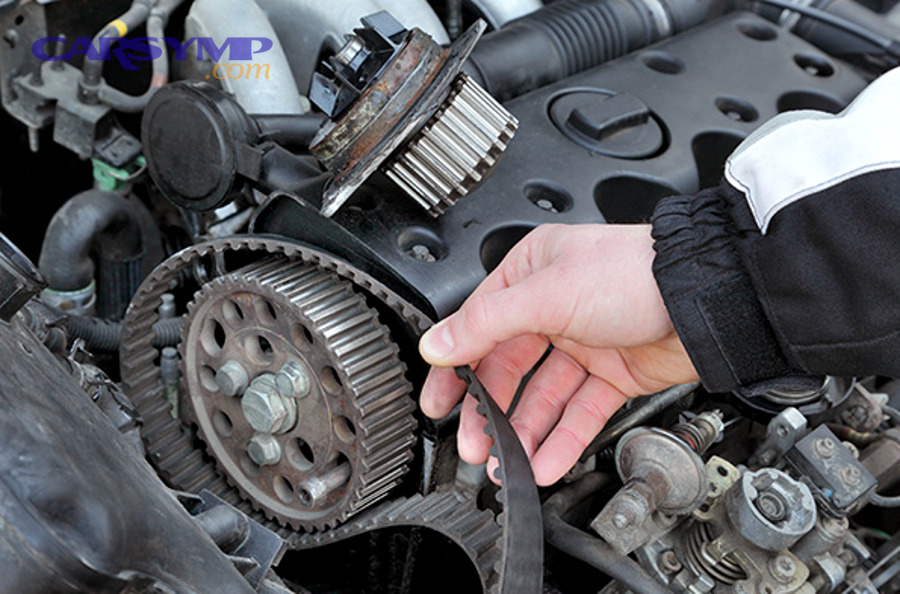
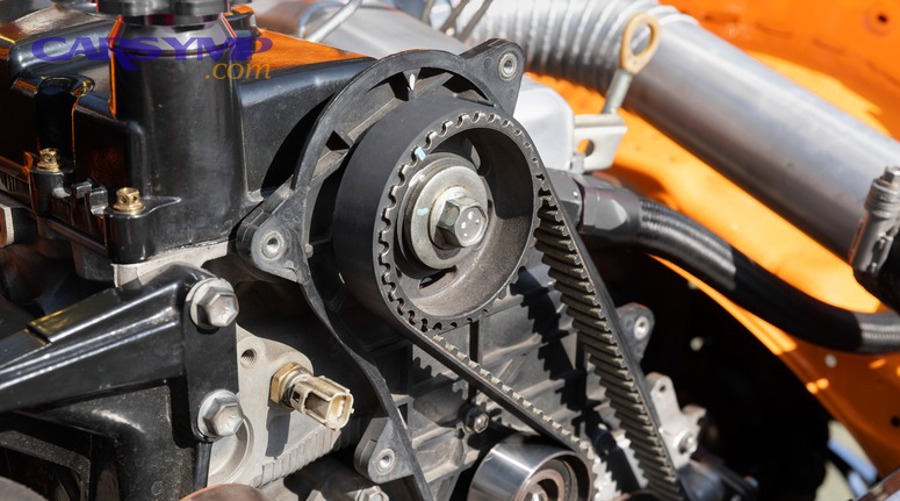
The timing belt keeps an interference engine safe by maintaining exact rotational synchronization between the crankshaft and the camshaft — two components that must never fall out of phase with each other. The crankshaft is driven by the pistons as they rise and fall through combustion cycles. The camshaft controls the opening and closing of intake and exhaust valves. In an interference engine, the physical travel path of a rising piston overlaps with the physical space occupied by a fully open valve. The only reason they never collide under normal operation is that the timing belt guarantees the camshaft rotates in perfect lockstep with the crankshaft, ensuring every valve is closed before any piston reaches the top of its stroke.
This precision is measured in degrees of crankshaft rotation. In most interference engines, the tolerance between a piston at top dead center and a fully open valve is effectively zero. There is no mechanical buffer, no spring that catches a collision, no sensor that shuts things down in time. The system works entirely because the belt holds the timing relationship intact. The moment that relationship breaks — whether from a snapped belt, a slipped tooth, or a failed tensioner — the engine has no protection against internal contact.
Which Vehicles Commonly Use Interference Engines?
Interference engines are used by the majority of major automakers, including Honda, Toyota, Volkswagen, Audi, Subaru, BMW, Chrysler, and Ford across a wide range of their model lineups. Industry data cited by repair professionals consistently estimates that approximately 90% of modern passenger vehicles use an interference engine design. This means that for most drivers on the road today, a timing belt failure is not a minor inconvenience — it is a potential engine-ending event.
Owners often do not know whether their specific engine is an interference design. The most reliable way to confirm is to consult the vehicle owner’s manual or look up the engine code against published interference engine lists maintained by organizations such as the Automotive Engine Rebuilders Association (AERA) and parts manufacturers like Gates Corporation. Knowing your engine type before a failure occurs is one of the simplest and most important steps in protecting your vehicle.
What Happens When a Timing Belt Fails on an Interference Engine?
When a timing belt fails on an interference engine, the camshaft stops rotating instantly while the crankshaft continues spinning under inertia, causing the pistons to rise and strike the open valves within milliseconds — producing internal engine damage that ranges from bent valves to total engine destruction.

Specifically, this sequence of mechanical events is what separates a timing belt failure on an interference engine from nearly every other common automotive breakdown.
What Is the Mechanical Sequence of Events After Belt Failure?
The mechanical sequence of events after timing belt failure follows four stages that unfold faster than any driver can react:
- Belt snaps or loses tension — The belt either breaks completely or slips enough teeth to lose synchronization. This can happen at highway speed, at idle, or anywhere in between.
- Camshaft stops immediately — Without the belt driving it, the camshaft halts. Any valves that were open at the moment of failure remain open, held in position by their cam lobes.
- Crankshaft continues rotating — The crankshaft does not stop. It continues spinning due to the rotational momentum stored in the engine’s mass. The pistons keep rising.
- Pistons strike open valves — With valves frozen in the open position and pistons still moving upward, contact is inevitable. The impact occurs at high velocity and with enormous force.
A critical point that surprises many car owners: pulling over immediately and switching off the ignition does not prevent the damage. The collision between pistons and valves happens in the same instant the belt fails — before the driver has any awareness that something is wrong. The engine does not give a warning beep. It simply destroys itself and stops.
What Types of Engine Damage Result From Timing Belt Failure?
There are five main categories of engine damage that result from timing belt failure on an interference engine, ranging in severity from repairable valve damage to total engine loss. The table below summarizes each damage category by type, description, and severity level.
| Damage Type | Description | Severity |
|---|---|---|
| Bent intake/exhaust valves | Most common outcome; valves deform on piston impact | Moderate |
| Broken valve heads | Valves shatter rather than bend, sending fragments into cylinder | High |
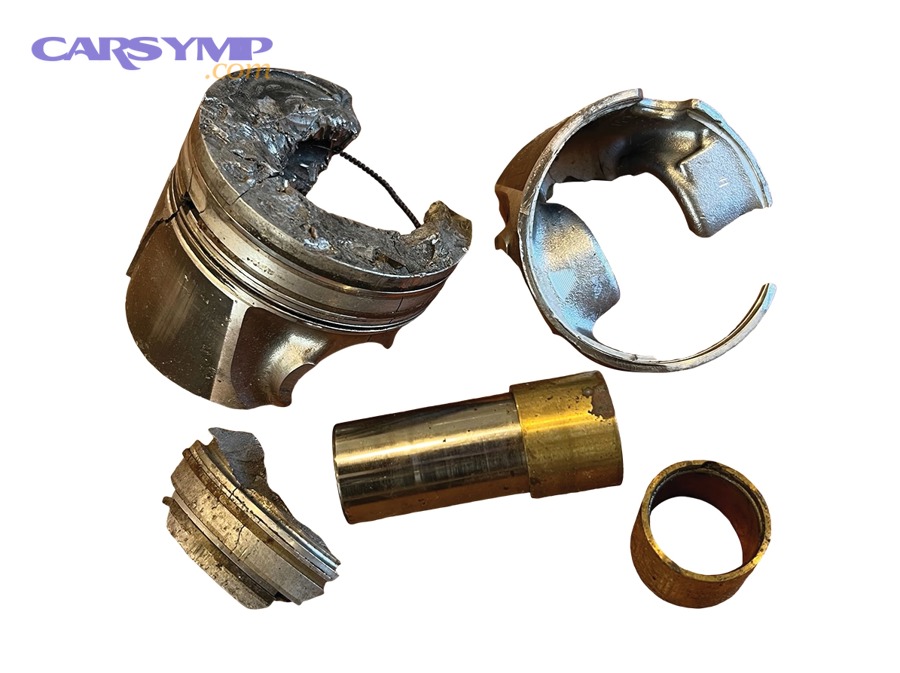
| Gouged or punctured pistons | Valve impact deforms or pierces the piston crown | High |
| Scored cylinder walls | Debris from broken valves scores the cylinder bore | Very High |
| Cracked cylinder head | Extreme impact force fractures the head casting | Catastrophic |
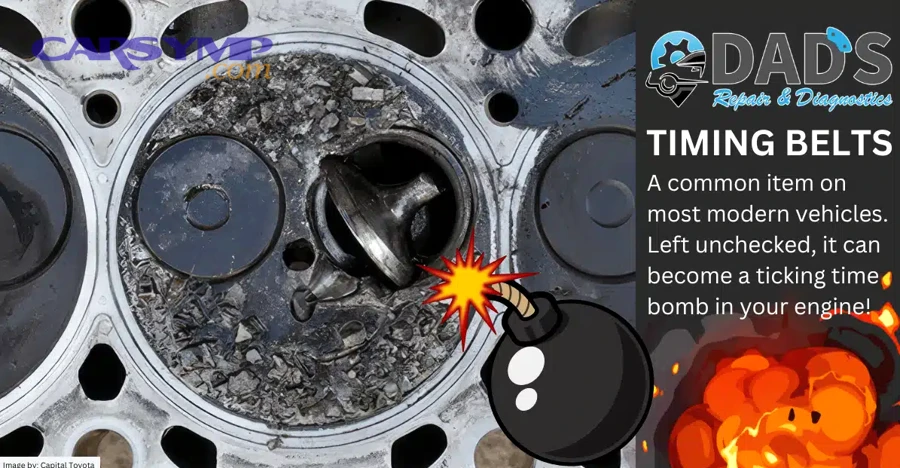
In practice, multiple damage types occur simultaneously. A broken valve does not produce a single clean fracture — it releases metal fragments that travel through the combustion chamber, contacting everything in their path. The connecting rods themselves can sustain damage in the most severe cases, when the forces involved are great enough to bend or fracture the rod body.
According to repair professionals cited by GMB North America, approximately 80% of timing belt failures on interference engines require major engine work beyond a simple belt replacement.
How Much Does It Cost to Repair Engine Damage From Timing Belt Failure?
Repairing engine damage from timing belt failure on an interference engine costs between $500 and $8,000 or more, depending on the severity of internal damage — and in many cases, the total repair bill exceeds the market value of the vehicle.
The timing belt replacement cost itself is relatively modest when performed preventively. The financial catastrophe arrives when the belt is allowed to fail first.
What Are the Repair Cost Ranges by Damage Severity?
There are three primary cost tiers for interference engine damage repair, based on which components were damaged and to what extent.
Tier 1 — Minor Damage (Bent Valves Only): $500–$1,500
In the best-case outcome, only a small number of intake valves are bent, and the pistons, cylinder walls, and head are undamaged. The repair involves removing the cylinder head, replacing the bent valves, resurfacing the head if needed, and installing a new timing belt kit. This scenario is relatively uncommon because most belt failures occur at driving speeds where impact forces are higher.
Tier 2 — Moderate Damage (Multiple Valves + Piston Damage): $1,500–$4,000
When multiple valves are damaged and one or more pistons show impact gouging, the repair scope expands significantly. The head requires a full rebuild or replacement, and the pistons may need replacement depending on the depth of damage. At this tier, labor costs rise sharply because the engine must be largely disassembled.
Tier 3 — Catastrophic Damage (Engine Rebuild or Replacement): $3,000–$8,000+
When valve fragments have scored the cylinder walls, cracked the head, or damaged the connecting rods, the engine is effectively destroyed. Repair at this tier means either a full engine rebuild — machining the block, replacing all internal components — or installing a replacement engine. On older vehicles, this cost consistently surpasses the car’s resale value.
For context, a preventive timing belt replacement cost on most vehicles runs $300–$800 including the belt, tensioner, idler pulley, and often the water pump. The math between prevention and repair is not close.
When evaluating quotes for timing belt service, always ask whether the Water pump add-on cost and value has been factored into the estimate. Replacing the water pump during the same service appointment adds relatively little to the labor cost because the engine is already disassembled to the same depth. Doing it separately later requires the same teardown all over again, effectively doubling the labor charge. A transparent shop will break this out clearly on any quote for timing belt service, and knowing How to evaluate quotes for timing belt service can save hundreds of dollars on what should be a single combined job.
Is It Worth Repairing an Interference Engine After Timing Belt Failure?
Yes, repairing an interference engine after timing belt failure is worth it in specific circumstances — primarily when the vehicle is newer, has low mileage, or when repair costs fall below 50–75% of the vehicle’s current market value. However, the answer is no for a significant portion of cases involving older, higher-mileage vehicles.
The decision framework works as follows. First, obtain a written diagnostic estimate that specifies which components are damaged — not a verbal guess before the head has been removed. Many shops cannot confirm the full extent of damage until they have performed a compression test and leak-down test with a new timing belt installed. Once the damage scope is confirmed, compare the total repair estimate against the vehicle’s current market value using a source such as Kelley Blue Book or a local dealer appraisal.
If the repair estimate exceeds 60–70% of what the vehicle would sell for in running condition, scrapping or selling the car for parts is often the more financially sound choice. A salvage engine swap — sourcing a used engine from a yard with verified low mileage — can serve as a middle-ground option when the vehicle body and other systems are in good condition. Any salvage engine installed should have its timing belt replaced before the engine is put into service, since the service history of a yard engine is unknown.
Does a Timing Belt Failure Always Destroy an Interference Engine?
No, a timing belt failure does not always destroy an interference engine — but the probability of serious damage is high enough that survival should be treated as luck rather than expectation, with real-world repair data suggesting that the majority of failures result in significant internal damage.
That said, understanding the variables that influence damage outcomes helps car owners and mechanics assess the situation more accurately after a failure event.
What Factors Determine Whether Engine Damage Occurs?
Three primary factors determine whether a timing belt failure on an interference engine causes catastrophic damage or — in rare cases — leaves the engine intact.
1. Engine RPM at the Moment of Failure
This is the single most influential factor. A belt that snaps at highway speed (2,500–4,000 RPM) means the pistons are traveling at their full velocity when they strike open valves. The impact forces are enormous. A belt that fails at idle (600–900 RPM) involves much lower piston speed, and in some documented cases, the valves have had just enough time to move toward a closed position before contact. Several experienced mechanics have reported seeing interference engines survive idle-speed belt failures with no internal damage — but this is a minority outcome, not a reliable one.
2. The Specific Engine’s Valve-to-Piston Clearance Design
Not all interference engines have the same degree of overlap. Some are designed with very tight clearances (common in high-compression performance engines), while others have slightly more margin. An engine with less valve-to-piston overlap at the critical moment has a marginally higher chance of surviving a low-speed failure without contact.
3. Belt Slippage vs. Complete Snap
A belt that skips one or two teeth rather than breaking entirely may cause the engine to misfire, run roughly, or throw a check engine light — without causing the full piston-valve collision. In this scenario, the driver may notice symptoms and get the vehicle to a shop before the belt fails completely. However, a belt that has already jumped timing is under extreme stress and should be treated as a near-failure emergency.
Can You Check for Engine Damage Without Replacing the Timing Belt First?
No, you generally cannot perform a definitive engine damage assessment on an interference engine after belt failure without first installing a new timing belt, because the engine cannot be cranked for compression or leak-down testing without a belt in place.
Visual inspection through a borescope — a flexible camera inserted through the spark plug holes — can reveal obvious damage such as bent valves visible through the combustion chamber or piston crown deformation. This is a useful first step that some shops use to give owners a preliminary damage read before committing to the belt replacement cost. However, borescope inspection alone cannot confirm whether valve seating is intact or whether cylinder wall scoring has occurred below the visible area. A formal compression test and leak-down test, which require the engine to turn over with a functioning timing belt, remain the definitive diagnostic tools. Car owners should ask their mechanic to explain the inspection sequence before authorizing any labor charges.
How Can Timing Belt Failure on an Interference Engine Be Prevented?
Timing belt failure on an interference engine can be prevented through three consistent practices: replacing the belt at the manufacturer’s recommended mileage interval, replacing wear-related companion components at the same service appointment, and monitoring for the early warning signs that indicate belt degradation before failure occurs.
Prevention is not a passive measure. It requires knowing the specific service interval for your vehicle and actively tracking it.
What Are the Warning Signs That a Timing Belt Is About to Fail?
Four warning signs indicate a timing belt may be approaching failure on an interference engine:
- Ticking or clicking noise from the engine bay — A rhythmic ticking sound, particularly one that changes with engine RPM, can indicate that the timing belt has loosened or that the tensioner is failing. This sound can have other causes, but it should never be dismissed without inspection.
- Engine misfires or rough idling — If the timing belt has slipped even one tooth, the camshaft timing is thrown off. This produces misfires in one or more cylinders, causes uneven idling, and typically triggers a check engine light with a timing-related fault code.
- Difficulty starting, especially in cold weather — A worn timing belt can stretch slightly under the reduced flexibility of cold rubber, causing the timing to drift enough at startup to make the engine difficult to turn over.
- Visible wear on the belt surface — On vehicles where the timing belt cover can be partially removed for inspection, cracks, fraying, glazing, or missing teeth on the belt are all direct indicators of imminent failure.
The most important caveat about warning signs is this: in the majority of timing belt failures, there are no warning signs. The belt does not squeal before it breaks. It does not throw a fault code on the dashboard. It simply fails without notice, which is why adherence to the replacement interval — rather than symptom monitoring — is the only reliable prevention strategy.
When Should You Replace the Timing Belt on an Interference Engine?
The timing belt on an interference engine should be replaced according to the vehicle manufacturer’s recommended interval, which typically falls between 60,000 and 100,000 miles, or every 5 to 7 years — whichever comes first — regardless of whether any symptoms are present.
Older OHC engines manufactured before approximately 1995 commonly specified 60,000-mile intervals. From the mid-1990s onward, improved EPDM rubber compounds allowed manufacturers to extend intervals to 90,000 or 100,000 miles. However, a longer interval does not mean the belt is immune to earlier failure. Oil contamination, heat cycling, and tensioner wear can cause a belt to fail well before its mileage target is reached, which is why calendar-based replacement (every 5–7 years) operates as a parallel safeguard for vehicles that are driven infrequently.
When scheduling a timing belt replacement, the standard best practice is to replace the water pump, tensioner pulley, and idler pulley at the same appointment. These components operate in the same system and share similar service lifespans. Replacing them together during a single labor event adds modest parts cost but eliminates the risk of returning for a related failure within the same interval — and avoids paying full labor a second time for identical disassembly work.
How Does Timing Belt Failure Differ Between Interference and Non-Interference Engines?
Interference engine belt failure causes immediate and often catastrophic internal engine damage, while non-interference engine belt failure causes the engine to stall without any internal component damage — making the design of the engine the single most important factor in determining the consequences of a broken timing belt.
This comparison is not academic. For car owners deciding how urgently to address an overdue belt replacement, knowing which engine type they have is the deciding variable between a $400 repair and a $6,000 one.
What Happens When a Timing Belt Breaks on a Non-Interference Engine?
When a timing belt breaks on a non-interference engine, the engine stalls immediately and cannot be restarted, but no internal damage occurs because the pistons and valves operate in separate spatial zones that do not overlap. The resolution is straightforward: the vehicle is towed to a shop, a new timing belt is installed, and the engine returns to normal operation. Total repair cost for a non-interference belt failure typically falls in the $200–$500 range, covering the belt, basic hardware, and labor. There is no compression test required, no head removal, and no risk of discovering $4,000 in hidden damage. The non-interference design functions as a built-in safety margin — timing failure equals engine stop, not engine destruction.
Why Do Automakers Still Design Interference Engines If They Carry Higher Risk?
Automakers continue to design interference engines because the engineering trade-off strongly favors performance and efficiency over failure-mode safety. Interference designs allow higher compression ratios within the same engine displacement. Higher compression produces more power output per combustion cycle and extracts more energy from each unit of fuel, directly improving fuel economy. In practical terms, an interference engine can produce more horsepower and better mileage in a smaller, lighter package than a non-interference equivalent. As emissions regulations tighten and fuel efficiency standards rise globally, these advantages have made the interference design the dominant architecture in modern passenger vehicles. The risk is real but manageable — as long as the timing belt is replaced on schedule.
What Hidden Causes Can Trigger Timing Belt Failure Earlier Than Expected?
There are four hidden causes that can trigger timing belt failure significantly earlier than the manufacturer’s recommended mileage interval.
1. Oil or Coolant Contamination
An oil leak from the crankshaft or camshaft seal, or a coolant leak from the water pump, can saturate the timing belt in fluid. Rubber exposed to oil degrades rapidly — swelling, losing tensile strength, and becoming prone to cracking or delamination. A belt in a contaminated environment may fail at half its rated service life or less. This is one of the strongest arguments for replacing the water pump during a timing belt service, since a failing pump can contaminate a brand-new belt within months.
2. Worn Tensioner or Idler Pulleys
The tensioner maintains the correct belt tightness throughout the service interval. An idler pulley guides the belt path. When either component develops bearing wear, they can seize or wobble — generating localized belt stress, heat, and abrasion. A seized idler pulley can shred a belt in seconds. Because these pulleys are hidden inside the timing cover, there is no external warning before they fail.
3. AC Compressor or Accessory Seizure
In some engine configurations, a seized air conditioning compressor or other belt-driven accessory can transfer abrupt torsional shock through the serpentine belt system into the timing belt drive. This is less common but has been documented in several engine families as a cause of premature timing belt failure unrelated to the belt’s own condition.
4. Chronic Engine Overheating
Sustained high operating temperatures accelerate the degradation of rubber compounds in the timing belt. An engine that has experienced overheating events — even ones that appeared to resolve — may have a compromised timing belt that is far more brittle than its mileage suggests.
When Does a Salvage Engine Make More Sense Than Repairing Interference Engine Damage?
A salvage engine swap makes more sense than repairing interference engine damage when the repair cost for the existing engine exceeds approximately 60–70% of the vehicle’s market value, and when the vehicle’s body, transmission, and electrical systems are otherwise in serviceable condition.
The salvage engine route typically costs $1,200–$3,500 all-in for a used engine from a reputable yard plus installation labor, compared to $4,000–$8,000+ for a full rebuild of a severely damaged engine. The critical requirement when installing a salvage engine is to replace the timing belt before the engine goes into service. The service history of a yard engine is unknown by definition — there is no way to verify whether the belt was maintained on schedule, how many miles it has remaining, or whether the tensioner and water pump are in acceptable condition. Installing a salvage engine with its existing timing belt intact means accepting all of the unknown risk that caused the original failure in the first place. Any reputable shop performing a salvage engine swap should include a complete timing belt kit replacement as a non-negotiable part of the installation job, and owners should verify this is explicitly included when evaluating quotes for timing belt service on a replacement engine.
In short, timing belt failure on an interference engine is a mechanical and financial event with very few favorable outcomes — but it is one of the most preventable failures in modern automotive maintenance. The replacement interval exists precisely because the belt will fail eventually, and the only variable within a driver’s control is whether that failure happens in a shop on a scheduled appointment or on the side of a highway at 70 miles per hour.