


timing chain repair cost typically falls between $1,600 and $2,700 for most vehicles in 2026, with labor accounting for the largest share of that bill. If you’ve just been handed a repair estimate and felt your stomach drop, you’re not alone — this is one of the most expensive routine engine services a car owner will face. The good news is that understanding where the money goes puts you in a far stronger position to budget accurately, compare quotes, and avoid being overcharged.
Several key factors determine whether your final bill lands at the lower or higher end of that range. The make and model of your vehicle, the hourly labor rate at your chosen shop, whether additional components like tensioners or guides need replacement, and the extent of any existing engine damage all push the total cost in different directions. Knowing which of these apply to your situation before you walk into a repair shop can save you hundreds of dollars.
Recognizing the warning signs of a failing timing chain early is just as important as understanding the price tag. A rattling engine noise at startup, persistent misfires, or a Check Engine light triggered by timing-related codes are your car’s way of telling you the chain is worn — and catching these symptoms before the chain snaps is the difference between a $2,000 repair and a $6,000 engine rebuild.
Finally, many car owners wonder whether a timing chain repair is a job they can tackle themselves or whether it is always worth hiring a professional. The answer depends on your mechanical experience, the tools you have available, and the specific engine architecture in your vehicle. Next, this guide walks through every dimension of timing chain repair cost so you can make a fully informed decision about what to budget, when to act, and how to approach the repair.
What Is a Timing Chain and Why Does Its Repair Cost So Much?
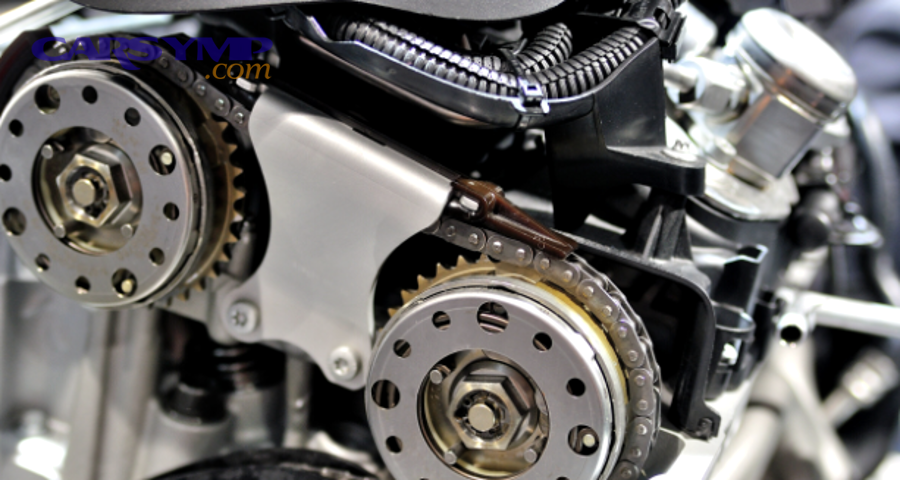
A timing chain is a metal loop — similar to a bicycle chain — that synchronizes the rotation of the crankshaft and camshaft inside your engine, ensuring valves open and close at precisely the right moment during each combustion cycle.

To better understand why timing chain repair carries such a high price tag, it helps to look at where the chain actually lives inside your engine. Unlike most serviceable components that sit within easy reach, the timing chain is buried deep inside the engine block, submerged in oil and sandwiched behind the timing cover. Accessing it requires a mechanic to disassemble a significant portion of the front of the engine — removing accessories, cooling fans, sometimes even motor mounts — before the timing components become visible. That disassembly time is precisely why labor costs dominate every timing chain repair estimate.
What Does a Timing Chain Do Inside Your Engine?
The timing chain is the mechanical link that keeps your engine’s internal components working in perfect synchrony. On one end, it connects to the crankshaft — the rotating shaft driven by the pistons. On the other, it drives the camshaft, which controls the opening and closing of intake and exhaust valves. Every time the crankshaft completes two full rotations, the camshaft completes one, and the timing chain enforces that precise 2:1 ratio without interruption.
When that synchronization is even slightly off, the results range from rough running and misfires to, in worst-case scenarios, valves colliding with pistons at high speed. This is why a failing timing chain is never a “wait and see” situation — the downstream damage it can cause far exceeds the cost of replacing the chain itself.
Unlike a timing belt, which is mounted externally and relatively easy to access, a timing chain runs inside the engine where it is constantly bathed in engine oil. This lubrication is what gives timing chains their longevity — most last between 100,000 and 250,000 miles — but it also means that any repair requires opening up the engine internals, driving labor time and cost significantly higher than a belt replacement.
Is a Timing Chain Repair the Same as a Timing Chain Replacement?
Yes — in practice, timing chain repair and timing chain replacement are the same service. Unlike a tire patch or a brake adjustment, a worn or stretched timing chain cannot be repaired in the traditional sense; the entire chain must be removed and replaced with a new one.
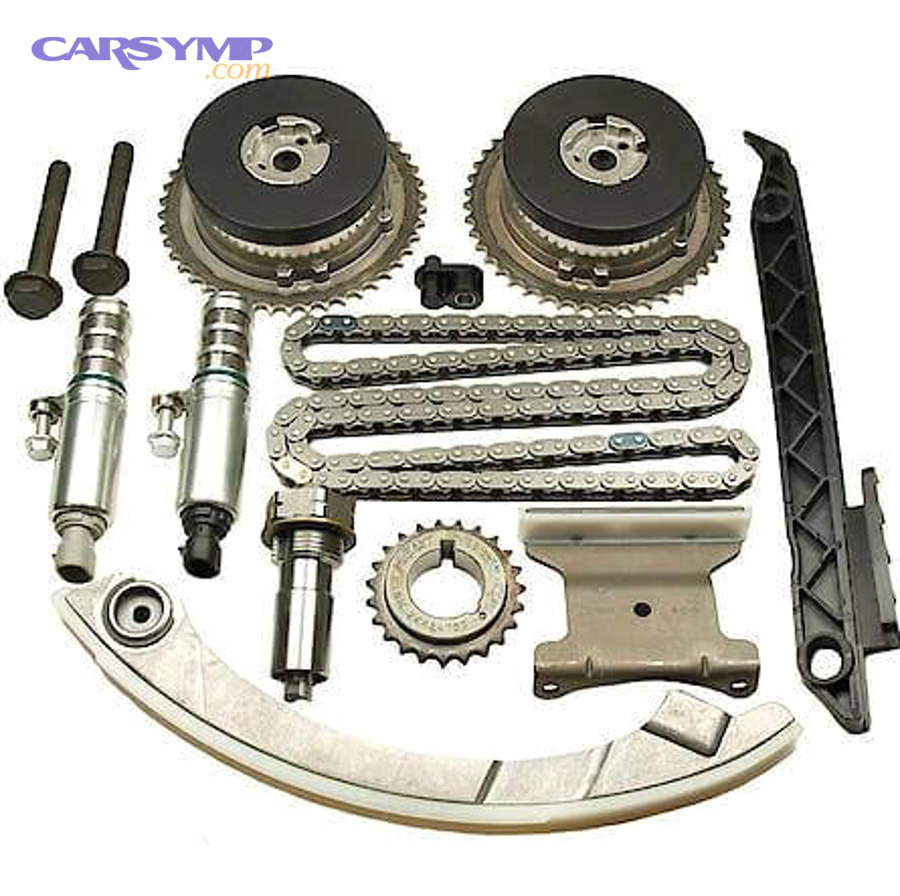
More importantly, a proper timing chain repair almost never involves replacing the chain alone. Because the timing cover must be removed to access the chain, mechanics strongly recommend replacing all related components at the same time — including the timing chain tensioner, which maintains correct chain tension; the chain guide rails, which keep the chain tracking in the right path; and the crankshaft and camshaft sprockets, which the chain rides on. Replacing these components together is far more cost-effective than returning for a second repair when a tensioner fails six months later.
This is why repair estimates include a full timing chain kit rather than a single chain link — and why the parts portion of the bill typically runs $600 to $800 even before labor is factored in.
How Much Does Timing Chain Repair Cost on Average in 2026?
There are three cost tiers for timing chain repair in 2026: a low estimate of around $1,600, an average range of $2,000–$2,700, and a high-end total of $3,500 or more when additional components require replacement.
Specifically, the total cost breaks down into two components — labor and parts — and labor is consistently the larger of the two. Understanding each component separately helps you evaluate whether a shop’s quote is reasonable or inflated.
What Is the Average Labor Cost for Timing Chain Replacement?
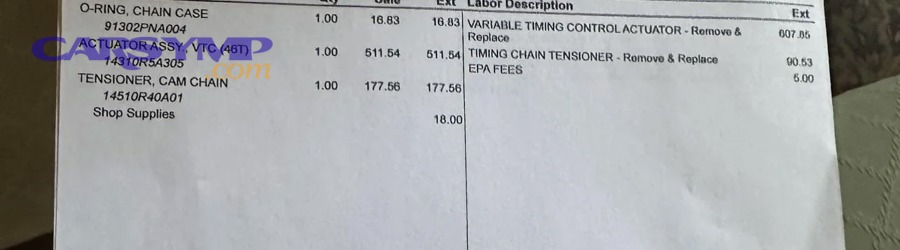
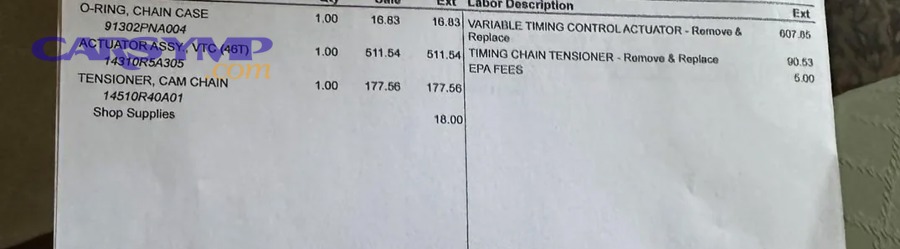
Labor for a timing chain replacement typically costs between $1,300 and $1,900, based on a job that takes 5 to 8 hours at shop rates ranging from $75 to $175 per hour.
The wide range in labor cost reflects two key variables: the complexity of the engine and the shop’s hourly rate. A straightforward inline-4 engine with a front-mounted timing chain at an independent shop in a mid-size city might take 5 hours at $100/hour — totaling $500 in labor. A V8 engine at a dealership in a major metropolitan area, charged at $175/hour over 8 hours, produces a $1,400 labor bill on its own. Geographic location plays a significant role: urban shops in cities like New York, San Francisco, or Chicago charge measurably more than independent mechanics in smaller markets.
It is worth noting that labor time can also increase if the mechanic encounters additional complications during disassembly — seized fasteners, damaged timing covers, or related components that are more worn than expected. Always ask your shop for an itemized, written estimate before authorizing any work.
How Much Do Timing Chain Parts Cost?
A complete timing chain kit — including the chain itself, tensioner, guide rails, and sprockets — typically costs between $100 and $500, depending on the vehicle and whether you choose OEM or aftermarket parts.
OEM (Original Equipment Manufacturer) parts are made to the exact specifications of your vehicle’s original components. They cost more — sometimes two to three times the price of aftermarket equivalents — but they offer assured fit, quality, and often come with a manufacturer warranty. For high-mileage vehicles or luxury brands, OEM parts are generally the safer investment. Aftermarket kits from reputable suppliers can offer genuine value on economy vehicles, but quality varies considerably between brands, so it pays to ask your mechanic which kit they recommend.
Beyond the timing chain kit itself, many mechanics recommend replacing the water pump and front crankshaft seal at the same time, since the engine is already disassembled and these components share the same access point. Replacing the water pump during a timing chain service adds between $400 and $925 to the total bill but prevents the need to re-open the engine for a separate water pump failure later.
What Is the Total Timing Chain Repair Cost Including Additional Parts?
The table below provides a realistic cost summary across three scenarios — budget, average, and comprehensive — to help you set your financial expectations before getting a quote.
The following table outlines what a car owner might realistically pay depending on the scope of work performed and the type of shop chosen:
| Scenario | Labor | Chain Kit (Parts) | Additional Parts | Total Estimate |
|---|---|---|---|---|
| Low (economy car, indie shop) | $500–$800 | $100–$200 | None | $600–$1,000 |
| Average (mid-size car, standard repair) | $1,300–$1,500 | $300–$500 | Tensioner | $1,600–$2,000 |
| Comprehensive (full service + water pump) | $1,500–$1,900 | $500–$800 | Water pump + seals | $2,000–$3,500+ |
According to RepairPal, the national average cost for a timing chain replacement falls between $2,047 and $2,674 across thousands of verified repair data points, with labor representing approximately 60 to 70 percent of the total bill.
What Factors Affect the Cost of Timing Chain Repair?
There are five main factors that affect timing chain repair cost: vehicle make and model, shop type (dealership vs. independent), local labor rates, the extent of engine damage, and whether related components need simultaneous replacement.
Understanding these variables before you contact a mechanic gives you a practical framework for evaluating quotes and identifying where savings are possible — and where cutting corners carries real risk.
How Does Your Vehicle’s Make and Model Affect Timing Chain Repair Cost?
Your vehicle’s make and model is the single largest determinant of timing chain repair cost, primarily because engine design dictates how many labor hours are required to access the timing components.
Economy vehicles with straightforward inline-4 engines — such as a Honda Civic, Toyota Corolla, or Chevrolet Cruze — typically sit at the lower end of the cost range. These engines are compact, the timing chain is usually front-mounted and accessible, and total labor time is manageable. European luxury vehicles such as BMW, Audi, and Mercedes-Benz occupy the opposite end of the spectrum. Their engines are more complex, often require specialist tools, and may use dual overhead camshaft (DOHC) configurations that demand significantly more disassembly time. Labor alone on a BMW N47 engine timing chain job, for example, can exceed $2,000 at a dealership.
Some specific engine configurations present exceptional cost challenges:
- Ford 4.0L SOHC (Explorer, Ranger, Mustang): Uses timing chains on both the front and rear of the engine. Accessing the rear chain requires engine removal, pushing total repair costs to $4,200 or more.
- V6 and V8 engines with rear-mounted chains: Similar issue — the chain’s position behind the engine block significantly increases labor hours.
- Inline engines with front-mounted chains: The most accessible configuration; generally the least expensive to repair.
Does Going to a Dealership vs. an Independent Mechanic Change the Price?
Yes — dealerships consistently charge more for timing chain repair than independent mechanics, typically by 20 to 40 percent, primarily due to higher flat-rate labor fees and mandatory use of OEM parts.
However, cost is not the only consideration. A dealership employs factory-trained technicians who specialize in your specific brand, use manufacturer-approved procedures, and have immediate access to OEM parts. For vehicles still under powertrain warranty, dealership service may be required to maintain warranty validity. For out-of-warranty vehicles, a reputable independent shop certified by organizations such as ASE (Automotive Service Excellence) offers comparable workmanship at a meaningfully lower price.
The most effective strategy is to obtain at least two to three written, itemized quotes — one from a dealership and one or two from certified independent shops — before authorizing any work. Ask each shop to specify which timing chain kit they plan to use, the estimated labor hours, and whether the water pump and seals are included.
How Does the Extent of Engine Damage Influence the Final Bill?
The extent of existing engine damage is the variable with the greatest potential to escalate your timing chain repair cost — from a manageable $2,000 to an engine-threatening $6,000 or more.
A worn or stretched timing chain caught before it breaks typically requires straightforward replacement of the chain and related components. However, if the chain has already snapped — especially in an interference engine — the damage cascades quickly. In an interference engine, the piston and valve paths overlap, meaning a broken timing chain immediately allows valves to collide with pistons at engine speed. The result is bent valves, damaged valve seats, and potentially broken pistons — damage that requires a full engine rebuild or replacement rather than a simple chain swap.
This is the single most compelling reason to act on timing chain warning signs immediately. A $2,000 timing chain repair addressed at the first sign of rattling is an entirely different financial outcome than a $7,000 engine replacement after the chain breaks on the highway.
What Are the Warning Signs That Your Timing Chain Needs Repair?
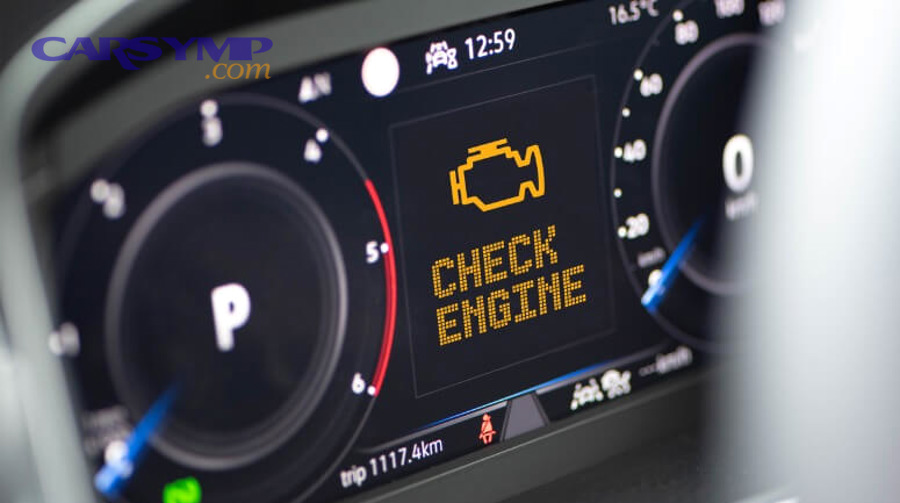
There are five primary warning signs that a timing chain needs repair: a metallic rattling noise from the engine, misfires, a triggered Check Engine light, difficulty starting, and metal shavings in the engine oil.
Catching these symptoms early is the most effective cost-control strategy available to any car owner. Below are the two most diagnostic categories of symptoms, starting with the one most people notice first.
What Does a Failing Timing Chain Sound Like?
A failing timing chain most commonly produces a distinct metallic rattling or clattering noise from the front or top of the engine, particularly noticeable at startup when oil pressure is low and the chain is at its slackest.
This sound occurs because a worn or stretched chain no longer fits tightly around the sprockets. Instead, it slaps against the guide rails or timing cover as it rotates. The noise may fade after the engine warms up and oil pressure stabilizes — which can lead owners to dismiss it as insignificant. This is a critical mistake. A chain that rattles at cold start is already beyond its optimal tension range, and continued operation accelerates wear on the guides and tensioner.
It is important to distinguish a timing chain rattle from other common engine noises. A valve train tick tends to be rapid and rhythmic, originating from the top of the engine. A rod knock is a deeper, heavier knock that typically worsens under load. The timing chain rattle is usually a loose, metallic chain-slapping sound specific to startup conditions and the front of the engine.
What Are the Other Common Symptoms of a Bad Timing Chain?
Beyond the characteristic rattle, a failing timing chain produces four additional symptoms that car owners should recognize:
1. Engine Misfires and Poor Acceleration
A worn timing chain can skip a tooth on the camshaft or crankshaft sprocket, throwing the valve timing out of phase. When valve timing is off, fuel and air are no longer injected and ignited at the correct moment — producing misfires, hesitation during acceleration, and noticeably reduced engine power.
2. Check Engine Light — Timing-Related Codes
Modern vehicles monitor camshaft and crankshaft position with sensors. When the timing chain stretches or slips, the ECU (Engine Control Unit) detects the positional discrepancy and triggers a Check Engine light. Diagnostic codes P0008, P0009, P0016, P0017, P0018, and P0019 are all directly associated with timing chain stretch or camshaft-to-crankshaft correlation errors.
3. Difficulty Starting and Rough Idle
Incorrect valve timing caused by a stretched chain disrupts the engine’s compression cycle, making cold starts harder and producing a rough, unstable idle once the engine is running.
4. Metal Shavings in Engine Oil
During an oil change, metal particles in the oil — particularly fine shavings consistent with chain or guide rail material — indicate advanced internal wear. This is a late-stage symptom and suggests the timing chain and guides have been deteriorating for some time.
Is It Worth Repairing a Timing Chain, or Should You Replace the Engine?
Timing chain repair is worth doing when the repair cost represents less than the vehicle’s current market value — a common guideline is that repairs should not exceed 50 to 70 percent of the car’s value.
This decision framework gives car owners a clear financial threshold, but several additional factors refine the calculation.
At What Point Does Timing Chain Repair Cost More Than the Car Is Worth?
If your vehicle is worth $3,000 to $4,000 on the open market and you’ve received a timing chain repair estimate of $2,500 or more, the economics of repair become difficult to justify — particularly if the vehicle has other deferred maintenance needs.
To make this assessment accurately, follow these two steps:
- Get the repair estimate first. Ask your mechanic for a written, itemized quote covering all recommended parts (chain kit, tensioner, guides, water pump, seals) and total labor hours.
- Check the vehicle’s current market value. Use Kelley Blue Book (KBB) or a comparable valuation tool to find the fair market value for your specific make, model, year, and mileage in your region.
If the repair cost exceeds 60 percent of the vehicle’s market value — and the car has additional known issues — redirecting that budget toward a replacement vehicle is typically the more financially sound decision. Conversely, a well-maintained vehicle worth $12,000 to $15,000 with a $2,500 timing chain repair estimate is almost always worth fixing, since the repair restores the engine to full health and protects the remaining value of the car.
Can Warranty Coverage Reduce Your Timing Chain Repair Cost?
Yes — warranty coverage can eliminate or significantly reduce your timing chain repair cost, and checking your coverage before authorizing any paid repair is an essential first step.
Most new vehicle manufacturer powertrain warranties cover the timing chain and related engine components for a defined period — commonly 5 years or 60,000 miles, though some manufacturers like Hyundai and Kia offer 10-year/100,000-mile powertrain coverage. If your vehicle is within these limits and the timing chain failure is not attributable to owner negligence (such as severe oil change neglect), the repair may be fully covered at no cost to you.
Extended warranties — whether purchased from the manufacturer, a dealership, or a third-party provider — often include powertrain components, but the fine print varies considerably. Some policies exclude wear items or require pre-authorization before repairs begin. Always contact your warranty provider before the repair, confirm that timing chain replacement is a covered component, and ask whether the work must be performed at a specific type of shop to maintain coverage validity.
Can You Save Money by Doing a Timing Chain Repair Yourself?
Yes, a DIY timing chain repair is technically possible and can reduce costs to $150–$600 in parts only, but it carries significant risk of engine damage if performed incorrectly and is generally not recommended for the average car owner.
The potential savings are real, but so are the stakes. Here is an honest assessment of what DIY timing chain repair requires — and where the risks become prohibitive.
What Tools and Skills Are Required for a DIY Timing Chain Replacement?
A DIY timing chain replacement requires a specific set of specialty tools and a strong working knowledge of internal engine components — requirements that go well beyond basic mechanical competence.
The essential tools include:
- Camshaft locking tools (engine-specific, used to hold the camshaft in the correct position during chain installation)
- Crankshaft positioning pins (to lock the crankshaft at top dead center)
- Torque wrench (for precise fastener torque specifications)
- Timing chain tensioner reset tool
- Engine support bar or hoist (required on some vehicles where motor mount removal is necessary)
- Standard socket sets, extension bars, and breaker bars
Beyond tools, the job demands familiarity with engine timing procedures — specifically, the ability to correctly position the crankshaft and camshaft before installing the new chain, verify timing marks, and reset the tensioner to correct tension. A single error in camshaft timing can cause immediate and catastrophic engine damage the moment the engine is started.
Preventing timing chain problems with maintenance — particularly staying current with oil changes — is far easier and cheaper than any level of DIY repair. Consistent oil changes keep the chain, tensioner, and guide rails properly lubricated, dramatically extending service life.
What Are the Risks of DIY Timing Chain Repair?
The primary risk of a DIY timing chain repair is incorrect engine timing — a mistake that causes valve-to-piston contact and destroys the engine the moment it is started.
Oil change neglect and timing chain wear are directly linked: when oil becomes contaminated or oil pressure drops due to missed service intervals, the timing chain tensioner loses hydraulic pressure, the chain slackens, and wear accelerates on both the chain and guide rails. This background context is important for DIY repairs — a chain that appears intact may have been operating under poor lubrication conditions, meaning guides and tensioners are in worse condition than a visual inspection suggests. A DIY mechanic without professional diagnostic experience may replace the chain while missing critically worn surrounding components.
Additional DIY risks include:
- Stripped or snapped fasteners on the timing cover or camshaft caps, which require machining or head replacement to repair
- Incorrect torque application on timing components, leading to premature failure of the new chain
- Undetected oil leaks from improperly seated front seals or a water pump gasket
- Extended vehicle downtime — what takes a professional 5 to 8 hours can occupy a home mechanic for an entire weekend or longer, particularly on a first attempt
For most car owners, the financial savings of DIY do not justify the risk of a $7,000 engine replacement if the installation goes wrong. Professional repair is always the recommended choice unless the mechanic has direct experience with internal engine timing work on the specific engine in question.
How Does Timing Chain Repair Cost Compare Across Different Scenarios?
Timing chain repair cost varies widely across scenarios: luxury brands cost the most, vehicles with rear-mounted chains cost significantly more than front-mounted equivalents, interference engines carry the highest damage risk, and timing chain replacement consistently costs more than timing belt replacement due to labor complexity.
These scenario-based comparisons are where the micro-details of your specific situation matter most. The sections below break down each cost dimension.
How Much Does Timing Chain Repair Cost by Car Brand?
Brand is one of the clearest predictors of timing chain repair cost, because it directly determines engine complexity, parts pricing, and dealer versus independent shop dynamics.
The table below provides a representative cost range by brand based on aggregated repair data:
| Vehicle Brand | Estimated Total Cost Range | Notes |
|---|---|---|
| Toyota / Honda | $800 – $1,500 | Simple engine layouts, affordable OEM parts |
| Chevrolet / Ford | $1,200 – $2,500 | Varies significantly by engine (4.0L SOHC much higher) |
| Hyundai / Kia | $1,000 – $1,800 | Broad powertrain warranty often covers this repair |
| BMW | $2,500 – $4,500+ | High labor rates, complex DOHC engines, N47 notorious |
| Audi / Mercedes | $2,000 – $4,000+ | European specialist labor required, expensive OEM parts |
| Ford 4.0L SOHC | $4,200+ | Dual chain (front + rear); engine removal required |
These ranges are general estimates. Always obtain a vehicle-specific quote from a qualified mechanic, as even different models within the same brand can vary dramatically based on engine configuration.
How Does a Front-Mounted vs. Rear-Mounted Timing Chain Affect Repair Cost?
Front-mounted timing chains are significantly less expensive to repair than rear-mounted ones — the cost premium for a rear-mounted chain can add $1,000 to $3,000 to the standard repair estimate due to the additional labor required.
A front-mounted timing chain is accessible after removing the front timing cover, which requires disassembling engine accessories from the front of the engine. While labor-intensive, this is a well-understood and relatively contained procedure. A rear-mounted timing chain, by contrast, sits at the back of the engine block — between the engine and transmission. To access it, the mechanic must either remove the transmission entirely or, in some cases, lift the engine out of the vehicle.
Vehicles known for rear-mounted timing chains include certain Cadillac Northstar V8 models, select Audi V8 configurations, and some European inline-6 designs. If you own a vehicle with a rear-mounted chain, your repair estimate will reflect that significantly higher labor investment, and it is important to confirm this detail when comparing quotes between shops.
How Much More Does Timing Chain Repair Cost on an Interference Engine?
On an interference engine, a broken timing chain does not just require chain replacement — it can trigger $5,000 to $10,000 in additional engine damage, including bent valves, broken pistons, and damaged valve seats.
In a non-interference engine, the piston and valve paths are designed with clearance between them, meaning that if the timing chain fails, the engine simply stops running without physical component contact. Repair in this scenario is limited to replacing the timing components.
In an interference engine, the piston travels into the space that the valve occupies when fully open. Under normal operation, the timing chain ensures that the valve is never fully open when the piston is at the top of its stroke. When the chain breaks or slips severely, that synchronization is lost instantly — and at engine speeds of 1,000 to 4,000 RPM, the impact between valve and piston is violent and destructive.
Most modern gasoline engines are interference designs, including virtually all European engines and many Japanese and domestic units. If you are unsure whether your engine is an interference design, your owner’s manual, a dealership service advisor, or a quick model-specific search will confirm it.
Timing Chain vs. Timing Belt Replacement Cost: Which Is More Expensive?
Timing chain replacement is consistently more expensive than timing belt replacement — typically two to three times higher in total cost — because the chain’s internal engine position demands far more labor to access.
The comparison breaks down as follows:
| Component | Typical Replacement Cost | Location | Average Labor Time |
|---|---|---|---|
| Timing Belt | $500 – $1,000 | External, front of engine | 2–4 hours |
| Timing Chain | $1,600 – $2,700+ | Internal, inside engine block | 5–8 hours |
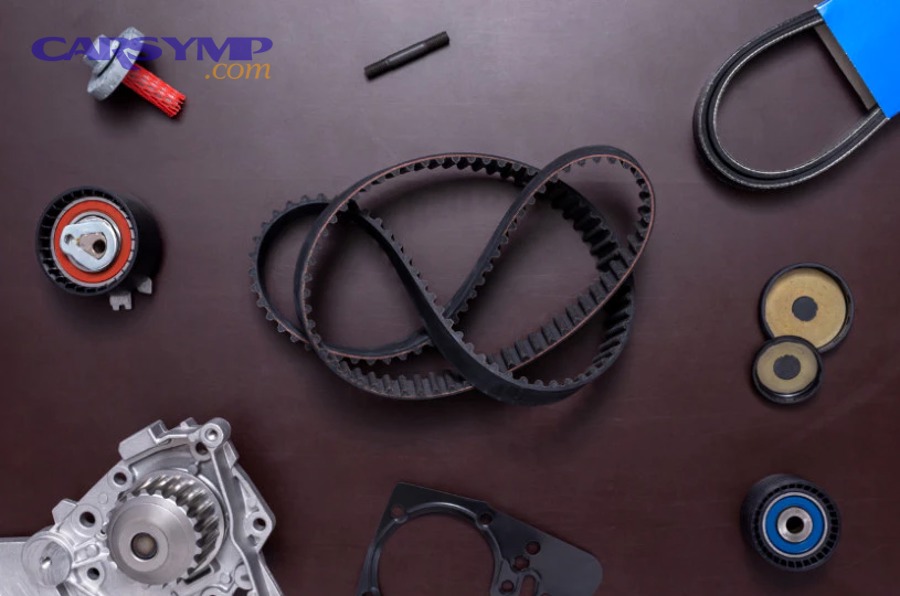
A timing belt is mounted on the outside of the engine block and covered by a simple plastic cover. Replacement is a relatively straightforward procedure requiring modest disassembly. A timing chain, as discussed throughout this guide, requires opening the engine itself — explaining the significant difference in labor time and total cost.
However, timing chains offer one significant cost advantage over the long term: they are designed to last the life of the engine and do not have a scheduled replacement interval the way timing belts do (which typically require replacement every 60,000 to 100,000 miles). A car owner who never experiences timing chain failure pays nothing extra for this component across the vehicle’s lifespan. A timing belt owner, by contrast, will pay for replacement services multiple times over the course of ownership.
According to data from AutoNation Mobile Service’s 2026 repair cost guide, the average timing chain replacement in the United States costs between $1,980 and $2,680, while the average timing belt replacement ranges from $500 to $1,000 — confirming that chain-equipped engines carry a higher per-incident repair cost, offset by longer component life expectancy.