


Cold start rattle is a brief metallic clattering noise that occurs within the first one to five seconds of starting a cold engine, and in the majority of cases, it points directly to a problem within the timing chain and tensioner system. When an engine sits overnight, oil drains back into the sump and leaves the hydraulic tensioner temporarily starved of pressure — the timing chain goes slack, slaps against the timing cover or guides, and produces that distinctive rattling sound until oil pressure rebuilds. The good news is that catching this symptom early almost always means an affordable, straightforward repair. The risk is that ignoring it leads to a failure chain that can end in catastrophic engine damage costing several times more than the original fix.
Understanding what causes cold start rattle requires knowing the four main culprits: a weakened hydraulic tensioner that can no longer hold oil pressure at rest, a stretched or worn timing chain that exceeds the tensioner’s travel range, an oil filter lacking an effective anti-drain-back valve, and incorrect oil viscosity that slows tensioner response during cold starts. Each cause produces a similar symptom but demands a different repair strategy, which is why diagnosing the source correctly before spending money on parts is the most important first step.
Fixing cold start timing chain rattle follows a logical, cost-escalating sequence — starting with an oil change and filter upgrade, then tensioner replacement, and finally a full timing chain kit replacement if the chain itself has stretched beyond acceptable limits. The duration of the rattle, the presence of OBD fault codes, and the vehicle’s mileage all inform where on that repair ladder you need to start.
What many drivers underestimate is how quickly a “minor” cold start rattle can escalate. A two-second rattle that is ignored for several months can evolve into a chain that jumps a tooth on the crankshaft sprocket, throwing valve timing out of synchronization and bending valves — a repair that costs thousands rather than hundreds. The sections below walk through every layer of this problem, from the mechanical basics to engine-specific vulnerabilities, so you can make an informed decision before the rattle makes it for you.
What Is a Cold Start Rattle and Why Does It Happen?
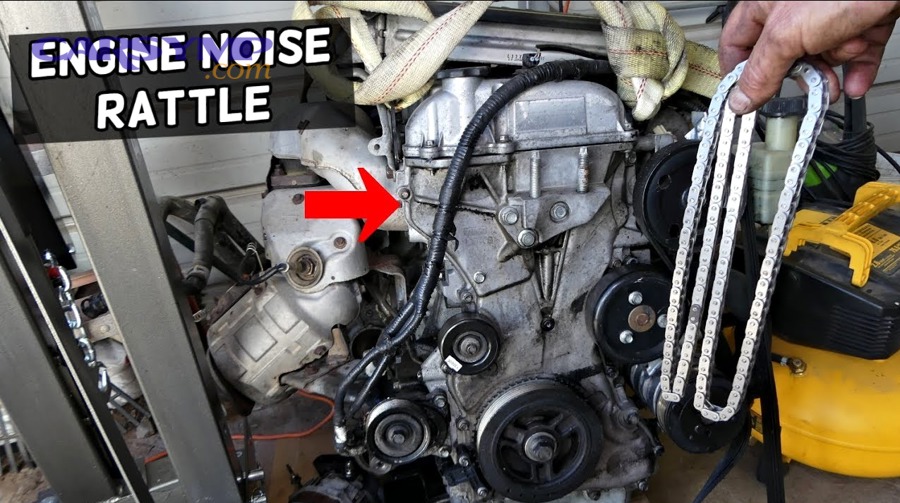
Cold start rattle is a mechanical noise category caused by temporary loss of tension in the timing chain system due to oil drain-back from the hydraulic tensioner after the engine has been off for several hours.
To better understand why this happens, it helps to visualize what is occurring inside the engine during those critical first seconds of a cold start. When the engine shuts down, oil pressure drops to zero almost immediately. The hydraulic chain tensioner — which depends entirely on pressurized oil to push a spring-loaded piston against the chain guide — begins to lose its oil supply as that oil drains back down through the engine galleries and into the sump. By the time the engine has sat overnight, the tensioner piston has retracted, and the timing chain has no force holding it taut.
On the next cold start, the chain is effectively loose for the first one to three seconds while the oil pump builds pressure and begins refilling the tensioner. During that window, the chain slaps against the timing cover wall, the chain guide, or the sprocket teeth — and that slapping produces the metallic rattle that owners hear from the front or rear of the engine bay.
Is Cold Start Rattle Always a Timing Chain Problem?
No — cold start rattle is not always a timing chain problem, though the timing chain and tensioner system is responsible in the majority of cases. There are three other common sources that can mimic the sound closely enough to cause misdiagnosis.
Hydraulic tappets (lifters) are the second most common cause. Like the tensioner, hydraulic tappets depend on oil pressure to maintain their operating clearance. When oil drains back, the tappets collapse slightly and produce a rapid ticking sound during the first seconds of a cold start. This noise originates from the top of the engine near the valve cover rather than from the front of the block, which is the key locating difference.
CVVT or VVT cam phasers are a third possibility. Variable valve timing actuators are also hydraulically operated, and a worn phaser can generate a flutter or chirp that is easily confused with timing chain slap. On some engines, the phaser noise and tensioner noise occur simultaneously.
Exhaust heat shield rattles are the simplest cause and the easiest to eliminate. These produce a tinny, vibrating rattle rather than a rhythmic metallic clatter, and they typically persist as a light buzz rather than resolving within a few seconds.
The defining diagnostic clue for a true timing chain rattle is location combined with duration: the noise comes from the front or rear of the engine block (behind the timing cover), it is clearly metallic and rhythmic, and it stops completely within one to five seconds as oil pressure builds. If the rattle persists beyond five seconds or continues into warm operation, the situation has progressed beyond simple oil drain-back.
What Does a Timing Chain Actually Do — and What Breaks First?
The timing chain is a precision roller chain that synchronizes the rotation of the crankshaft and one or more camshafts, ensuring that the engine’s intake and exhaust valves open and close at exactly the correct moment relative to piston position.
More specifically, the timing chain links the crankshaft sprocket at the bottom of the engine to the camshaft sprocket or sprockets at the top. On engines with two camshafts per cylinder head and multiple cylinder banks, there can be two or more separate chains running in sequence. The entire system is enclosed behind a timing cover filled with oil.
The components that break first, in order of typical failure frequency, are:
- The hydraulic tensioner — spring fatigue and oil drain-back cause this to fail before any other part
- The chain guides — plastic guides that direct the chain’s path wear gradually under constant chain contact
- The timing chain itself — individual link pins elongate over high mileage, causing measurable chain stretch
- The camshaft and crankshaft sprockets — teeth wear on very high-mileage engines or after sustained chain slack
Understanding this failure sequence is what makes early timing chain repair so cost-effective: catching the problem at the tensioner stage means replacing a single component. Waiting until the chain has stretched means replacing the entire kit.
What Are the Main Causes of Cold Start Timing Chain Rattle?
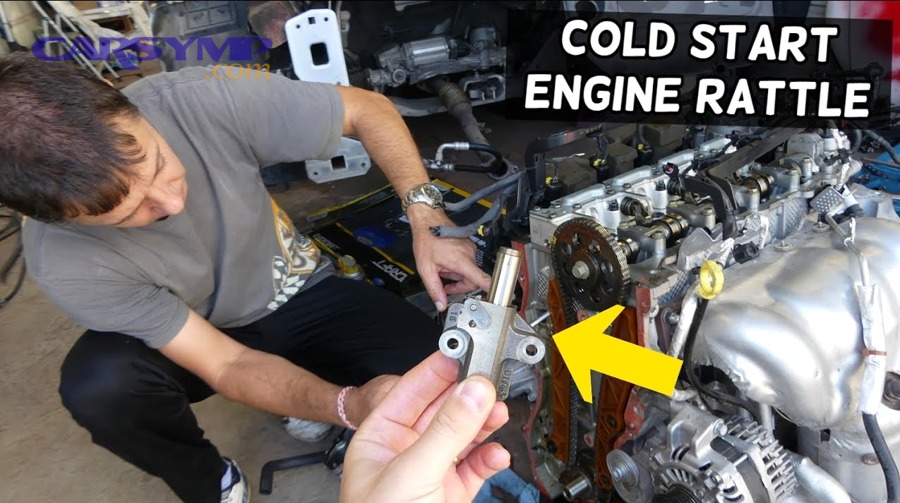
There are four primary causes of cold start timing chain rattle: hydraulic tensioner failure, stretched or worn timing chain, oil filter drain-back, and incorrect oil viscosity — each acting on the chain’s tension through a different mechanism.
These causes are not mutually exclusive. In practice, most vehicles presenting with cold start rattle have at least two of these factors operating simultaneously, which is why addressing only one often produces incomplete results.
Hydraulic Tensioner Failure — Why Oil Pressure Loss Is the #1 Cause
Hydraulic tensioner failure is the single most common cause of cold start timing chain rattle, occurring when the tensioner’s internal spring weakens to the point where it can no longer maintain chain tension without active oil pressure.
Specifically, the hydraulic tensioner operates by combining a mechanical spring with hydraulic oil pressure to push a piston against the chain guide. The spring provides passive preload tension, and the oil pressure supplements it to maintain correct chain tension under all operating conditions. When the spring weakens — a natural result of thermal cycling over tens of thousands of miles — the tensioner becomes entirely dependent on oil pressure to function. The moment oil pressure drops to zero at engine shutdown, the tensioner piston retracts and the chain goes slack until the next startup.
There are two primary tensioner designs, and their cold start behavior differs significantly. The table below compares the two types across the criteria most relevant to cold start rattle:
| Tensioner Type | Ratcheting Pawl | Cold Start Behavior | Cold Start Rattle Risk |
|---|---|---|---|
| Ratcheting pawl tensioner | Yes | Pawl locks piston in extended position at shutdown | Lower — chain stays tensioned |
| Non-ratcheting (spring only) | No | Piston fully retracts when oil pressure drops | Higher — chain goes slack immediately |
Replacing a failed tensioner with an updated OEM unit — sometimes one that incorporates a ratcheting pawl where the original did not — is often the single most effective timing chain repair available.
Stretched or Worn Timing Chain — When Slack Becomes Structural
A stretched timing chain develops when the individual link pins and bushings in the chain elongate microscopically over time, increasing the chain’s total length beyond its design specification.
This form of wear is cumulative and largely invisible until the chain has stretched enough to produce measurable slack. A tensioner can compensate for moderate stretch by extending its piston further along its travel range. However, once the chain stretches beyond the tensioner’s maximum extension, no amount of tensioner pressure can restore correct tension — and the cold start rattle becomes structural rather than hydraulic.
The practical consequence is that chain stretch causes rattle to gradually worsen over months. A one-second rattle that was present at 80,000 miles becomes a two-second rattle at 100,000 miles and a four-second rattle at 120,000 miles. At the four-to-five-second threshold, the chain is slack enough to slap aggressively and begins generating cam/crank correlation codes — fault codes that indicate the chain has shifted the camshaft’s timing relationship with the crankshaft. At this stage, the Timing chain vs tensioner vs guide failure diagnosis shifts clearly toward full chain assembly replacement.
Oil Drain-Back Through the Filter — The Overlooked Cause
An oil filter without an effective anti-drain-back valve allows oil to siphon back from the filter housing into the sump during engine-off periods, accelerating the rate at which the tensioner loses its oil supply.
On engines where the oil filter sits horizontally or at an angle, the oil column inside the filter and adjacent galleries drains back toward the sump by gravity when the pump stops. A silicone anti-drain-back valve inside the filter prevents this by creating a one-way seal that holds the oil column in place. Many aftermarket filters use a less effective rubber or paper valve, or omit the check mechanism entirely in budget units.
The result for the timing chain system is that the tensioner loses its oil supply faster and more completely after engine shutdown. On engines already running a marginal tensioner spring, this can be the difference between a one-second rattle and a three-second rattle. Multiple owners across automotive forums have documented complete elimination of cold start rattle simply by switching from a budget aftermarket filter to an OEM unit or a quality filter confirmed to carry a silicone anti-drain-back valve.
Wrong Oil Viscosity — How Oil Grade Affects Tensioner Response Time
Using an oil viscosity grade heavier than the manufacturer’s specification increases the time it takes for oil to flow through the engine’s galleries and reach the hydraulic tensioner on a cold start.
Oil viscosity directly determines how quickly the lubricant moves through the oil pump and distribution network at low temperatures. A 0W-20 oil specified by the manufacturer flows almost immediately at cold temperatures, reaching the tensioner within a fraction of a second. A 15W-40 oil, by contrast, is significantly thicker at cold temperatures and may take two to three times as long to pressurize the tensioner’s hydraulic circuit.
This extended delay does not cause mechanical wear to the tensioner itself, but it extends the window during which the chain is under-tensioned on every cold start. On an engine where the tensioner spring is already marginally weak, running a heavier-than-specified oil can transform a barely audible rattle into a clearly noticeable one. Correcting oil viscosity to the manufacturer’s specification is always the first and cheapest diagnostic step before committing to mechanical repairs.
How Do You Diagnose the Source of Cold Start Rattle?
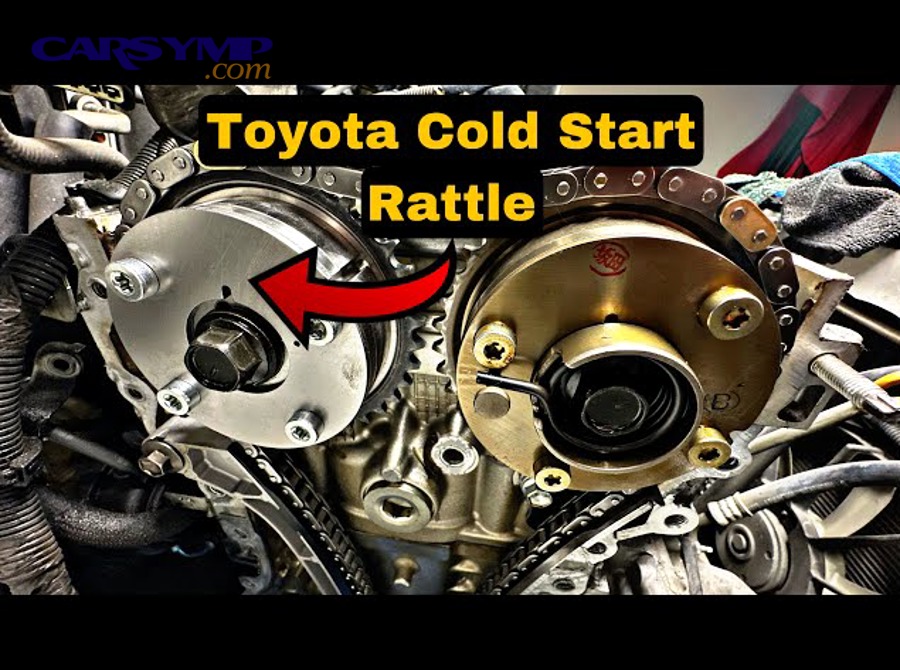
Diagnosing cold start rattle follows a structured five-step process — recording the rattle, measuring its duration, scanning for OBD fault codes, locating the noise source physically, and ruling out non-chain causes — with an expected outcome of pinpointing whether the tensioner, chain, or another component requires attention.
This diagnostic process is designed to move from the least invasive and least expensive steps toward the more involved ones, ensuring that you do not replace a full timing chain kit when a tensioner or oil filter change would have solved the problem.
How Long Should a Cold Start Rattle Last Before It Becomes a Problem?
Yes, the duration of cold start rattle is the most reliable first indicator of problem severity, and rattle lasting more than two to three seconds consistently warrants a formal mechanical inspection.
The following threshold table provides a practical reference for interpreting rattle duration:
| Rattle Duration | Severity Assessment | Recommended Action |
|---|---|---|
| Under 2 seconds, stops completely | Low urgency — likely normal tensioner drain-back | Monitor; verify oil viscosity and filter quality |
| 2–3 seconds, daily occurrence | Moderate — tensioner spring weakening | Inspect tensioner; consider replacement within 2–3 months |
| 3–5 seconds | High — tensioner failing or early chain stretch | Inspect tensioner and chain; replace tensioner immediately |
| Over 5 seconds | Critical — significant chain stretch or tensioner failure | Full diagnosis required; do not delay repair |
| Present on warm starts as well | Severe — chain wear structural | Immediate professional inspection; risk of chain jump |
It is important to note that frequency matters as much as duration — a rattle that occurs on every cold start is more concerning than one that occurs only after the vehicle has sat for more than 12 hours, even if both last the same number of seconds.
What OBD Fault Codes Are Associated With Timing Chain Problems?
There are four primary OBD-II fault codes associated with timing chain wear: P0008, P0009, P0016, and P0017, all of which relate to camshaft-to-crankshaft timing correlation errors caused by chain stretch or tensioner failure.
These codes appear when the engine’s camshaft position sensor and crankshaft position sensor report a timing relationship that falls outside the acceptable design range. In plain language, they mean the chain has stretched enough to shift the camshaft’s rotational position relative to the crankshaft — a condition that affects valve timing, combustion efficiency, and can trigger misfires.
The Cam/crank correlation codes explained in full are:
- P0008 — Engine position system, bank 1: The camshaft timing on bank 1 is retarded beyond the acceptable threshold
- P0009 — Engine position system, bank 2: Same condition on bank 2 (V-engines and flat engines only)
- P0016 — Crankshaft/camshaft timing correlation, bank 1, sensor A: Intake camshaft timing is out of range on bank 1
- P0017 — Crankshaft/camshaft timing correlation, bank 1, sensor B: Exhaust camshaft timing is out of range on bank 1
A critical point for owners is that cold start rattle can exist for months — and the underlying chain wear can progress significantly — without triggering any of these codes. The codes appear only after chain stretch has reached a degree that produces measurable timing deviation during normal operation. Using an OBD-II scanner as the first diagnostic step is valuable, but a clean scan result does not rule out a timing chain problem if audible cold start rattle is present.
How to Locate the Rattle — Chain vs. Tappet vs. Exhaust
To locate the source of cold start rattle, use a mechanic’s stethoscope or a long metal screwdriver as an acoustic probe, placing the tip against specific engine surfaces while the engine is cold-starting and the noise is present.
The technique works because metal transmits vibration efficiently — touching the probe to the timing cover amplifies chain-related noise, while touching the valve cover amplifies tappet or camshaft noise. The following location guide maps noise source to component:
Timing chain rattle presents as a rhythmic metallic clatter or slapping sound localized to the timing cover — at the front of most inline engines, or at the rear of the engine on some transversely-mounted designs. The noise is loudest when the probe touches the timing cover directly and diminishes significantly when moved to the valve cover.
Hydraulic tappet tick presents as a rapid, repetitive ticking sound concentrated at the valve cover or cylinder head. It is typically higher-pitched than chain rattle and may affect only one cylinder bank. Like chain rattle, it resolves within a few seconds as oil pressure fills the tappets.
Exhaust heat shield rattle does not follow the oil pressure timeline. It may start rattling at idle and continue intermittently regardless of engine temperature. It produces a tinny, buzzing vibration rather than a metallic clatter, and it does not localize to the timing cover.
Recording the cold start on a smartphone placed near the engine bay is strongly recommended for intermittent rattles that a mechanic cannot reproduce during a shop visit. Video evidence of the specific sound and its duration significantly accelerates professional diagnosis, and resources like carsymp.com can help owners compare their recorded symptoms against known engine-specific rattle patterns before committing to a workshop appointment.
How Do You Fix Cold Start Timing Chain Rattle?
Fixing cold start timing chain rattle follows three escalating repair stages: first, an oil change with a quality filter (lowest cost); second, hydraulic tensioner replacement (moderate cost); and third, full timing chain kit replacement (highest cost) — with the correct starting point determined by rattle duration, fault codes, and mileage.

This staged approach ensures that you begin with the intervention most likely to resolve the problem without overspending, while preserving the option to escalate if the first step does not eliminate the rattle.
Should You Replace the Tensioner First Before the Full Chain?
Yes — in most cases, replacing the hydraulic tensioner before committing to a full chain replacement is the correct first mechanical step, because the tensioner is the most common failure point and is significantly less expensive to replace than the full chain assembly.
Specifically, a new OEM tensioner typically costs between $50 and $150 for parts, with labor adding $100 to $300 depending on engine accessibility — a total repair cost of $150 to $450 in most cases. A full timing chain kit, by contrast, involves the chain, guides, tensioner, and sprockets, with parts and labor commonly totaling $800 to $2,500 on accessible engines and $2,000 to $4,000 on engines requiring significant disassembly.
The logical repair sequence is as follows:
- Perform an oil change with the correct viscosity grade and a quality filter confirmed to have a silicone anti-drain-back valve — resolve any oil-related contributing factors first
- If rattle persists after 1–2 cold starts: Replace the hydraulic tensioner with an OEM or upgraded unit
- If rattle persists after tensioner replacement: Inspect the chain for stretch and guides for wear; proceed to full chain kit replacement
- If fault codes P0008/P0009/P0016/P0017 are present before tensioner replacement: The chain has stretched structurally — replace the full kit in a single procedure rather than staging the repair
One important caution: if the chain is already visibly slack during tensioner inspection, or if the vehicle has over 150,000 miles with no prior chain service, replacing the tensioner alone is likely to produce a temporary improvement followed by recurring rattle as the stretched chain continues to wear. In high-mileage scenarios, completing the full kit replacement during the same labor visit avoids paying twice for the same disassembly.
When Is a Full Timing Chain Replacement Necessary?
A full timing chain replacement is necessary when rattle duration exceeds four to five seconds consistently, when OBD cam/crank correlation codes are present, when visual inspection reveals visible chain slack or worn guides, or when the vehicle has exceeded 150,000 miles without a prior chain service.
A complete timing chain kit includes four component categories: the timing chain itself, the hydraulic tensioner, all chain guides, and the camshaft and crankshaft sprockets. On some engines, updated guide designs or tensioner specifications have been released by the manufacturer to address known weaknesses in the original design — fitting these updated components as part of the repair provides a longer service life than restoring to the original specification.
The table below outlines the typical cost structure of a full timing chain replacement to help owners budget for the repair:
| Cost Component | Typical Range |
|---|---|
| Timing chain kit (parts) | $150 – $600 |
| Labor (accessible engine) | $600 – $1,500 |
| Labor (complex/engine-out) | $1,500 – $3,000+ |
| Total (mid-range estimate) | $800 – $2,500 |
Addressing the problem at the tensioner stage costs a fraction of a full kit replacement. And a full kit replacement, even at $2,000, is a fraction of the cost of an engine rebuild or replacement triggered by a jumped or snapped chain — a failure that can cost $5,000 to $15,000 or more depending on the severity of valve damage.
Can Switching Oil Grade or Filter Brand Fix Cold Start Rattle?
Sometimes — switching to the manufacturer-specified oil viscosity and an OEM-quality filter with a silicone anti-drain-back valve can eliminate cold start rattle in mild cases where the tensioner spring is marginally weak but not yet failed, though it will not mechanically repair a worn tensioner or stretched chain.
This approach works as a first diagnostic step for two reasons. First, it corrects any oil-related contributing factors cleanly and inexpensively before mechanical components are replaced. Second, if the rattle disappears after the oil and filter change, it confirms that the root cause was hydraulic drain-back rather than structural component wear — valuable information that prevents unnecessary parts replacement.
The practical recommendation is to complete an oil and filter service using the exact viscosity specified in the owner’s manual, choosing an OEM filter or a well-regarded aftermarket filter known to include a silicone anti-drain-back valve. If the rattle does not improve within three to five cold starts, proceed directly to tensioner inspection and replacement. Using this sequence prevents spending $400 on a tensioner before confirming whether a $60 oil change would have solved the problem.
What Happens If You Ignore Cold Start Timing Chain Rattle?
Ignoring cold start timing chain rattle triggers a predictable mechanical failure progression — from tensioner wear to chain slack, chain stretch, timing deviation, misfires, chain jump, and ultimately catastrophic engine damage — a sequence that converts a $200–$500 repair into a potential $5,000–$15,000 engine replacement.

This failure progression is not a theoretical worst case; it is the documented outcome for a significant percentage of vehicles where cold start rattle was dismissed as “normal engine character.” The chain’s condition deteriorates with every cold start cycle where it operates under-tensioned, accelerating wear at a rate that compounds over months.
More specifically, the progression follows these stages:
Stage 1 — Tensioner drain-back (early): Rattle lasts one to two seconds. Chain is momentarily slack but returns to correct tension once oil pressure builds. No measurable harm per cycle, but cumulative wear begins.
Stage 2 — Tensioner spring fatigue (developing): Rattle extends to three to four seconds. The tensioner can no longer fully compensate even with oil pressure. Chain begins to wear the guides and sprocket teeth under increased tension variation.
Stage 3 — Chain stretch (advanced): Rattle exceeds four seconds and fault codes appear. The chain has physically elongated, retarding camshaft timing. Engine begins to run inefficiently; fuel economy and performance decline. Misfires may appear at cold idle.
Stage 4 — Chain jump (critical): The stretched chain slips one or more teeth on the crankshaft or camshaft sprocket during a cold start. Valve timing shifts dramatically and immediately. Symptoms include sudden rough running, loss of power, loud mechanical noise, and multiple fault codes. On interference engines — where valves and pistons occupy the same space at different moments — a chain jump causes piston-to-valve contact, bending valves and potentially damaging the cylinder head.
Stage 5 — Chain snap (catastrophic): In extreme cases of neglect, the chain breaks entirely. The engine stops immediately. On interference engines, this almost always results in bent valves, damaged valve seats, and sometimes cracked pistons — a rebuild or engine replacement scenario.
The financial argument for early action is straightforward: a tensioner replacement at Stage 1 or 2 costs $150–$500. A full chain kit at Stage 3 costs $800–$2,500. Engine head repair or rebuild at Stage 4 or 5 costs $3,000–$15,000 or more. The rattle is the engine’s earliest warning signal — and it is telling you exactly how much time remains before that cost curve escalates.
Beyond the Basics — Engine-Specific Risks, Prevention, and Long-Term Chain Health
Extending timing chain service life beyond the standard repair requires understanding engine-specific vulnerability patterns, the mechanical role of variable valve timing systems, and the preventative maintenance habits that directly determine how long a timing chain and tensioner system remains trouble-free.
This section moves from the universal principles covered above into the micro-level details that apply to specific engines, specific failure mechanisms, and specific maintenance decisions — information that is particularly valuable for owners of vehicles with documented cold start chain rattle histories.
Which Car Engines Are Most Prone to Cold Start Timing Chain Problems?
There are seven engine families with well-documented cold start timing chain rattle issues: BMW N47 and N20, Audi/VW EA888 2.0T, Ford EcoBoost 1.6T and 2.0T, GM Ecotec, Hyundai/Kia Nu series, and Honda K24, all sharing the common design characteristic of non-ratcheting or weak-spring hydraulic tensioners.
The following table summarizes the key failure profile for each engine family, including whether a manufacturer Technical Service Bulletin or updated fix is available:
| Engine Family | Vehicles Affected | Known Weak Point | TSB / Updated Fix Available |
|---|---|---|---|
| BMW N47 2.0d | 1/3/5 Series diesel (2007–2014) | Rear-mounted chain, weak tensioner | Yes — updated chain kit |
| BMW N20 2.0T | 3/5 Series petrol (2012–2016) | Plastic guides crack under heat | Yes — revised guide design |
| Audi/VW EA888 2.0T | A4/A5/Golf/Passat | Tensioner spring preload, oil drain-back | Yes — updated tensioner |
| Ford EcoBoost 1.6T/2.0T | Focus ST, Escape, Fusion | Tensioner drain-back at low mileage | Partial TSB — filter recommendation |
| GM Ecotec 2.0/2.4 | Cruze, Malibu, Equinox | Guide wear accelerated by oil interval | No official TSB |
| Hyundai/Kia Nu 2.0 | Elantra, Forte, Optima | CVVT phaser combined with tensioner | Limited — OEM filter recommended |
| Honda K24 2.4 | CR-V, Accord, Element | Oil drain-back at high mileage | No TSB — OEM filter critical |
Owners of these vehicles should verify whether their vehicle’s VIN falls within a TSB’s affected range before ordering standard replacement parts, as fitting the updated tensioner or chain guide design may resolve the problem more permanently than a like-for-like replacement.
Does Parking Angle Affect Cold Start Timing Chain Rattle?
Yes — parking angle affects cold start timing chain rattle on engines with rear-mounted timing chains, most notably the Audi B8/B8.5 platform V6 engines, where parking with the front of the vehicle lower than the rear accelerates oil drain-back from the rear tensioner.
The mechanism is straightforward: on a rear-mounted timing chain design, the tensioner oil supply gallery runs along the top of the engine toward the rear. When the front of the vehicle sits lower than the rear, gravity draws oil away from this gallery and toward the front of the engine, leaving the tensioner’s oil circuit more depleted than it would be on level ground.
Several Audi S4 owners have documented a diagnostic test using this principle: parking with the front wheels elevated on ramps or boards (raising the front of the vehicle above the rear) and observing whether cold start rattle frequency decreases or disappears. If it does, the test confirms that oil drain-back from the tensioner is the direct cause — and that the tensioner, the oil filter’s anti-drain-back valve, or both, require attention. This is a diagnostic confirmation tool, not a permanent solution, but it provides useful evidence before committing to parts replacement.
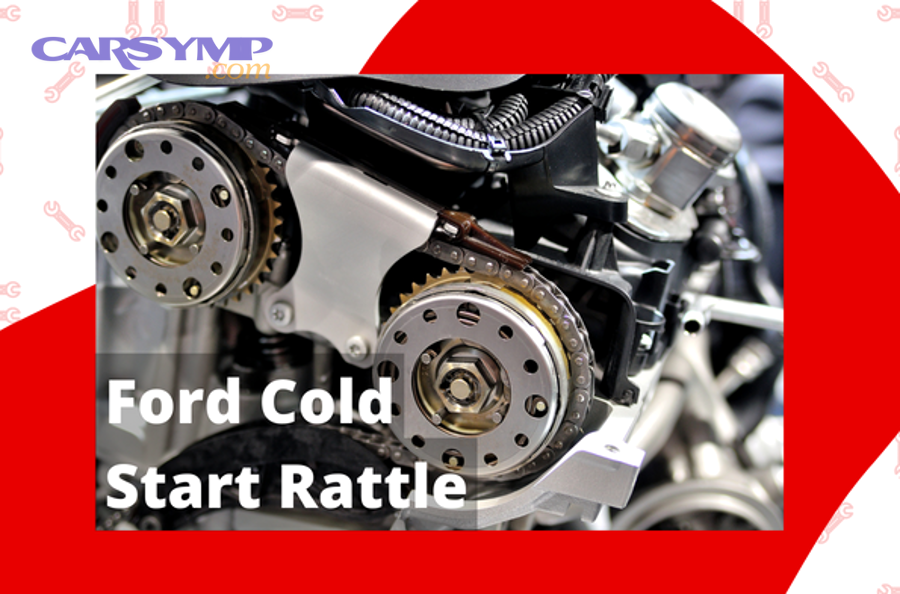
How Does Variable Valve Timing (VVT/CVVT) Make Cold Start Rattle Worse?
Variable valve timing systems worsen cold start timing chain rattle because VVT cam phasers are hydraulically operated by the same oil pressure circuit as the chain tensioner, meaning both systems are simultaneously under-pressurized during the first seconds of a cold start, compounding chain slack and generating overlapping noise patterns.
More specifically, a VVT or CVVT cam phaser uses oil pressure to rotate the camshaft within a specific range, advancing or retarding valve timing in response to engine load and speed demands. At cold start, before oil pressure has built, the phaser defaults to its mechanical lock position — but worn phasers may not lock cleanly, producing a flutter, rattle, or chirp that overlaps with any timing chain slap noise present at the same moment.
This overlap creates a diagnostic challenge: the total cold start noise may sound louder or more complex than pure chain rattle, leading owners to overestimate the severity of chain wear. Distinguishing the two requires a mechanic with VVT-specific experience who can interpret the acoustic characteristics of each — chain slap has a lower-pitched, rhythmic “thwacking” character, while phaser noise tends to be higher-pitched and more irregular. On engines like the Hyundai Nu 2.0, both problems frequently occur together, and addressing only the chain without inspecting the phaser can leave a persistent rattle that is incorrectly attributed to a failed repair.
What Preventative Maintenance Habits Extend Timing Chain Life?
There are five evidence-backed preventative maintenance habits that directly extend timing chain and tensioner life: maintaining short oil change intervals, using the manufacturer-specified viscosity grade, selecting a quality oil filter with a silicone anti-drain-back valve, avoiding frequent short cold-weather trips, and addressing the first signs of cold start rattle immediately rather than monitoring them.
These habits reflect the antonym relationship at the heart of timing chain health — prevention and repair are opposite outcomes produced by opposite behaviors. The maintenance choices made over the life of the vehicle determine whether the owner is managing a system that runs cleanly at 200,000 miles or replacing an engine at 130,000 miles.
Short oil change intervals are the most impactful single habit. Engine oil degrades thermally and chemically over time, losing its viscosity stability and anti-wear additive content. Degraded oil flows more slowly at cold temperatures and provides less effective hydraulic pressure to the tensioner during the critical cold start window. Following the manufacturer’s recommended interval — or shortening it by 20–25% in high-cycle stop-start driving conditions — keeps the oil in a state where it can reach the tensioner fast and hold pressure effectively.
Correct viscosity grade ensures the oil reaches the tensioner within the minimum possible time on cold starts. Using the exact grade specified in the owner’s manual — not a “close enough” alternative — should be treated as a non-negotiable maintenance standard rather than a preference.
Quality oil filter with a silicone anti-drain-back valve prevents the oil column from siphoning back through the filter during engine-off periods. This single component choice can meaningfully reduce the degree of tensioner drain-back on every cold start over the vehicle’s lifetime.
Avoiding frequent short trips in cold climates prevents the engine from fully reaching operating temperature, which means the oil never fully circulates through the system or purges condensation — both conditions that accelerate wear on chain system components.
Acting at first rattle rather than adopting a “wait and see” posture is the behavioral habit with the greatest financial impact. The difference between a $300 tensioner replacement and a $3,000 chain kit replacement is often measured in months of ignored cold start noise. Every cold start cycle on a failing tensioner is a cycle of chain wear that cannot be reversed — only stopped.