


When your engine starts failing, the decision between repair and replacement is one of the most consequential — and expensive — choices you will face as a vehicle owner. The right answer depends not on a single variable, but on a combination of seven critical factors: damage severity, cost, vehicle age and mileage, how long you plan to keep the car, warranty implications, resale value impact, and long-term financial outcomes. Weigh all seven before committing to either path, and you dramatically reduce the risk of making a decision you will regret.
Understanding the difference between these two options starts with knowing what each actually involves. Engine repair targets specific, isolated component failures — a blown gasket, a worn timing belt, a faulty ignition coil. Engine replacement, by contrast, swaps the entire powerplant for a new, rebuilt, or remanufactured unit. Between these two extremes sits the engine rebuild, which involves full disassembly, inspection, and selective parts replacement. Each option carries a distinct cost structure, timeline, and long-term reliability profile that must be matched against your specific situation.
The financial dimension of this decision runs deeper than the sticker price on a repair estimate. Upfront costs for engine repair can range from a few hundred dollars for minor fixes to several thousand for complex work, while full engine replacement can exceed $10,000 when labor is included. However, total cost of ownership over three to five years often tells a very different story than the initial invoice, and car owners who focus only on today’s bill frequently end up spending more over time.
Beyond money, the decision carries implications for your vehicle’s reliability, resale value, warranty coverage, and even environmental footprint. Next, this article walks through each of the seven critical factors in detail — giving you a structured, expert-backed framework to make a confident, informed decision rather than an emotional or rushed one.
What Is the Difference Between Engine Repair and Engine Replacement?
Engine repair is a targeted service that addresses specific failed or worn components within an existing engine, while engine replacement involves installing an entirely different powerplant — new, rebuilt, or remanufactured — in place of the original.

To better understand which option suits your situation, it helps to first draw clear boundaries between the three main service paths available to you.
What Does Engine Repair Actually Involve?
Engine repair is the most conservative and typically least disruptive option. A mechanic diagnoses a specific failure point — a leaking head gasket, a worn timing belt, a damaged ignition coil, or a failing fuel injector — and replaces or restores that component without removing the entire engine from the vehicle.
Common engine repair types and their approximate cost ranges include:
| Repair Type | Estimated Cost Range |
|---|---|
| Head gasket replacement | $1,000 – $2,000 |
| Timing belt replacement | $400 – $900 |
| timing chain repair | $600 – $1,800 |
| Fuel system repair | $200 – $1,200 |
| Ignition coil replacement | $150 – $500 |
| Valve cover gasket | $100 – $400 |
The table above reflects typical parts-plus-labor costs in the United States and will vary by vehicle make, model, and regional labor rates. Timing chain repair labor time alone can account for 40–60% of the total bill on many V6 and V8 engines, given the accessibility challenges involved.
Engine repair is the right call when damage is genuinely isolated — meaning the rest of the engine’s internals are sound, compression is within spec, and there are no cascading signs of systemic wear. It is not a permanent solution when the same component has already been repaired once, or when multiple systems are failing simultaneously.
What Does Engine Replacement Mean — New, Rebuilt, or Remanufactured?
Engine replacement is not a single, uniform service — it encompasses three distinct replacement types, each with meaningfully different cost, quality, and reliability profiles.
Rebuilt engine: A mechanic disassembles the existing engine, inspects all components, and replaces only the worn or damaged parts. The result is a selectively restored engine, not a factory-fresh one. Typical cost: $3,500 – $6,000, including labor.
Remanufactured engine: Performed in a specialized facility, remanufacturing involves tearing down the engine completely, re-machining all critical tolerances (crankshaft bearings, piston rings, cylinder walls), and rebuilding to original OEM specifications using new components throughout. Typical cost: $5,000 – $9,000, plus $1,200 – $1,500 in installation labor.
New OEM engine: Sourced directly from the vehicle manufacturer, a new engine matches original factory specifications exactly. It is the most expensive option, often pushing total costs past $10,000 for mainstream vehicles and significantly higher for performance or luxury models.
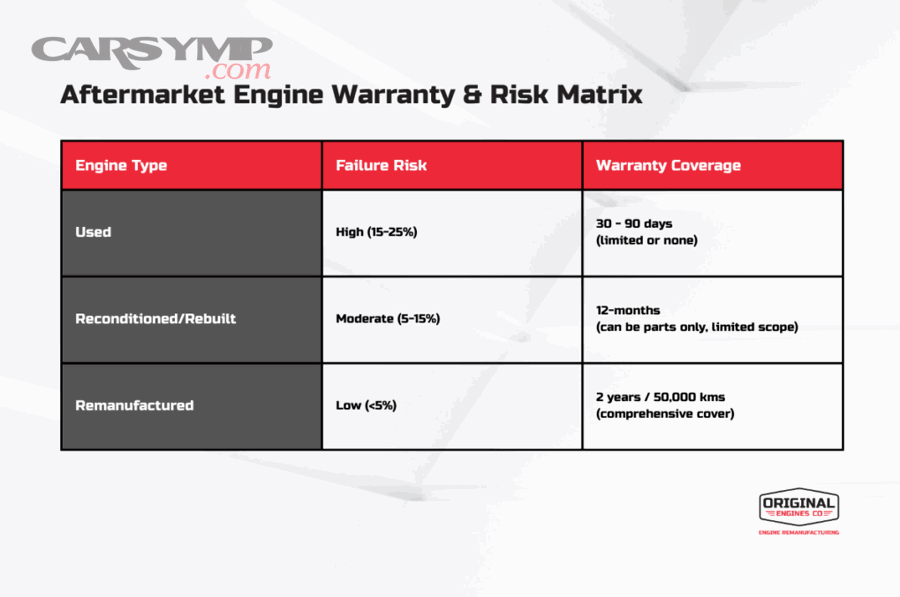
The key differentiator across these three options is warranty coverage. New and remanufactured engines typically carry robust 1–3 year warranties covering both parts and labor. Rebuilt engines may offer limited or no warranty, depending on the shop.
When Should You Repair Your Engine Instead of Replacing It?
You should repair your engine instead of replacing it when the damage is minor, isolated to a specific component, and the total repair cost does not exceed 50% of your vehicle’s current market value.
Repair makes the most financial and practical sense under a well-defined set of circumstances. Specifically, consider repair when all of the following conditions apply.
Is Engine Repair Worth It If the Damage Is Minor and Isolated?
Yes — engine repair is absolutely worth it when the problem is confined to a single, identifiable component and the rest of the engine’s internals remain mechanically sound.
Minor and isolated damage typically includes failures like a leaking valve cover gasket, a worn serpentine belt, a degraded oxygen sensor, or outdated spark plugs. These are straightforward repairs that a competent mechanic can complete in a few hours, and they restore engine performance without requiring removal of the entire powerplant.
The 50% rule is widely used in the automotive repair industry as a practical benchmark: if the total repair cost exceeds half the vehicle’s current market value — as determined by tools like Kelley Blue Book or NADA Guides — the repair is generally not a sound financial investment. Below that threshold, repair is almost always the smarter short-term choice.
It is also worth noting that Oil change neglect and timing chain wear are closely linked. Vehicles that have not received consistent oil changes are at elevated risk of accelerated timing chain wear, which can turn what starts as a minor repair into a much costlier one if left unaddressed. Catching timing chain wear early — before it causes secondary damage to the camshaft or tensioner — is a clear case where timely repair prevents a far larger bill.
Does a High-Mileage Vehicle Benefit More from Repair Than Replacement?
Yes — but only when the vehicle has been consistently well-maintained throughout its life.
A high-mileage vehicle that has received regular oil changes, coolant flushes, and scheduled service is mechanically very different from a high-mileage vehicle that has been neglected. In the well-maintained case, the engine’s core components — the block, crankshaft, and cylinder walls — may still be within acceptable tolerances despite the odometer reading. A targeted repair in this scenario can realistically extend the vehicle’s service life by another 50,000 to 100,000 miles.
However, a high-mileage engine with a history of deferred maintenance tells a different story entirely. Sludge buildup, worn bearings, and compromised seals throughout the engine mean that fixing one component often reveals — or accelerates — failure in adjacent parts. In these cases, repair becomes a false economy, and replacement or a full rebuild deserves serious consideration.
When Does Engine Replacement Make More Sense Than Repair?
Engine replacement makes more sense than repair when the engine has suffered catastrophic internal damage, when the cost of a thorough repair approaches or exceeds the cost of a replacement unit, or when the vehicle is relatively new and long-term reliability is the priority.
There are clear, well-defined scenarios where continuing to repair a failing engine is simply not a rational path forward. Understanding them protects you from throwing good money after bad.
Is Engine Replacement the Better Choice After Catastrophic Engine Failure?
Yes — engine replacement is the correct choice when the engine has experienced catastrophic failure that renders a rebuild impractical or uneconomical.
Catastrophic failure scenarios that typically necessitate replacement include:
- Cracked engine block: A structural failure that compromises the entire engine’s integrity; machining a cracked block is rarely cost-effective.
- Warped or cracked cylinder head: Can sometimes be machined, but severe warping often makes a full replacement more reliable.
- Seized engine: Caused by severe oil starvation, a seized engine locks the crankshaft and destroys bearings, rods, and cylinder walls simultaneously.
- Spun bearing: Results in scoring of the crankshaft journals; while rebuildable in some cases, the machining costs often approach replacement pricing.
- Hydraulic lock (hydrolocked engine): Water or fluid ingestion at high RPM can bend connecting rods and destroy pistons throughout the engine.

New or remanufactured engines installed after catastrophic failure can reliably deliver 200,000 or more miles of service life, provided routine maintenance — particularly consistent oil changes and coolant system care — is followed after installation.
Should You Replace the Engine If Your Car Is Relatively New or Under Warranty?
Yes — for newer vehicles that are otherwise in sound mechanical condition, engine replacement typically offers the best return on investment.
A vehicle that is three to seven years old with low-to-moderate mileage still has significant service life remaining in its body, suspension, transmission, and electrical systems. Investing in a new or remanufactured engine preserves that remaining value and avoids the cost and disruption of purchasing a replacement vehicle.
The warranty argument is particularly compelling here. A remanufactured engine installed in a relatively new vehicle comes with warranty coverage that mirrors the reliability assurance of a new car powertrain. You are, in effect, resetting the engine’s clock while retaining a vehicle whose other systems are still in good health.
What Are the 7 Critical Factors to Weigh When Deciding Between Repair and Replacement?
There are 7 critical factors to weigh when deciding between engine repair and replacement: damage severity, true cost of each option, vehicle age and condition, how long you plan to keep the vehicle, warranty and reliability implications, resale value impact, and long-term financial outcomes.
These seven factors function as an interconnected decision framework. No single factor should be evaluated in isolation — the right decision emerges from the intersection of all seven, assessed honestly against your specific situation.
Factor 1 — How Severe Is the Engine Damage?
Damage severity is the first and most determinative factor in the repair-vs-replacement decision. It functions as a gateway variable: if the damage is catastrophic, the remaining six factors become largely confirmatory.
A practical diagnostic framework places engine damage on a three-tier scale:
- Minor (Repairable): Isolated component failures — gaskets, belts, sensors, spark plugs — with no evidence of internal damage. Compression test results are within spec. No metal-in-oil contamination.
- Moderate (Rebuild Candidate): Worn internal components across multiple systems — bearings, piston rings, valve seals — but the engine block and crankshaft remain structurally sound. A full rebuild can restore function.
- Catastrophic (Replacement Territory): Cracked block, seized engine, spun bearings with journal scoring, hydrolocking damage. Machining and parts costs for a full rebuild approach or exceed replacement pricing.
Before making any financial decisions, get a comprehensive diagnostic — including a compression test, leak-down test, and oil analysis — from a trusted, independent mechanic. A proper diagnosis is the foundation everything else rests on.
Factor 2 — What Is the True Cost of Repair vs. Replacement?
The true cost of repair versus replacement extends well beyond the initial estimate and must account for labor, parts quality, downtime, and the probability of recurring failures.
The following table summarizes typical cost ranges for each service path to give you a clear comparative baseline:
| Service Path | Parts Cost | Labor Cost | Total Estimated Range |
|---|---|---|---|
| Minor engine repair | $100 – $800 | $200 – $700 | $300 – $1,500 |
| Major engine repair (e.g., timing chain repair) | $400 – $1,200 | $500 – $1,500 | $600 – $1,800 |
| Engine rebuild | $1,500 – $3,500 | $1,500 – $2,500 | $3,000 – $6,000 |
| Remanufactured engine (installed) | $2,500 – $5,000 | $1,200 – $1,500 | $5,000 – $9,000 |
| New OEM engine (installed) | $5,000 – $9,000+ | $1,200 – $2,000 | $7,000 – $12,000+ |
The numbers above represent averages — actual costs vary significantly by vehicle make, model, engine size, and regional shop rates. More importantly, the table illustrates that the cost gap between a thorough repair and a quality replacement is often narrower than car owners assume, particularly for complex repairs involving the timing system or internal engine components.
Hidden costs frequently catch car owners off guard. On the repair side, the risk is recurrence: a repaired engine that fails again in 18 months doubles your effective cost. On the replacement side, ECU reprogramming, exhaust system modifications, and ancillary component replacement (mounts, hoses, sensors) can add $500 – $1,500 beyond the engine and installation quote.
Factor 3 — What Is the Vehicle’s Age, Mileage, and Overall Condition?
Vehicle age, mileage, and overall mechanical condition collectively determine whether an engine investment — repair or replacement — will yield a proportional return.
The governing principle is straightforward: the money you invest in an engine must be justified by the remaining useful life of the vehicle as a whole. A $5,000 engine replacement makes financial sense in a vehicle worth $12,000 with sound suspension, transmission, and body. The same investment in a vehicle worth $3,500 with a rusting frame and failing transmission does not.
A useful decision checkpoint is the vehicle’s current fair market value as listed on Kelley Blue Book or a similar valuation tool. Compare that figure against the repair or replacement estimate. If your investment exceeds 70–80% of the vehicle’s value, you are approaching the point where purchasing a replacement vehicle deserves serious comparison.
Mileage matters, but condition matters more. A well-maintained 150,000-mile vehicle can be a better candidate for engine investment than a poorly maintained 80,000-mile vehicle with multiple deferred service items.
Factor 4 — How Long Do You Plan to Keep the Vehicle?
Your intended ownership timeline is one of the most decisive personal factors in the repair-versus-replacement decision, and it is frequently overlooked in purely cost-focused analyses.
- Selling within 12–24 months: A targeted repair that restores drivability and passes a pre-sale inspection is typically the smarter investment. A full engine replacement rarely adds enough to resale value to justify its cost, particularly on older vehicles.
- Keeping the vehicle for 3–5 more years: The calculus shifts. A quality rebuild or remanufactured engine replacement becomes a legitimate investment when amortized across years of continued use, especially when it eliminates the need for a new car payment.
- Long-term ownership (5+ years): Replacement with a new or remanufactured engine — carrying a full warranty and factory-grade reliability — becomes the most cost-effective path when you factor in avoided vehicle payments, lower insurance costs, and the absence of a loan.
Factor 5 — What Are the Warranty and Reliability Implications?
Warranty coverage is a concrete, quantifiable measure of reliability assurance — and it differs dramatically across the repair and replacement options.
Engine repairs carry no standardized warranty. Individual shops may guarantee their labor for 90 days or 12 months, but the repaired component itself — a resurfaced head, a replaced gasket — carries no manufacturer warranty. If the same component fails again outside the shop’s guarantee window, you pay again.
Rebuilt engines are similarly variable. A reputable shop rebuilding your engine may offer a 12-month, 12,000-mile warranty on their work. A less scrupulous operation may offer nothing in writing. Quality of parts — new OEM components versus salvage yard parts — determines both actual reliability and the shop’s willingness to stand behind their work.
Remanufactured and new OEM engines represent the gold standard for warranty coverage. Jasper Engines, one of the largest remanufacturers in the United States, offers a 3-year/100,000-mile parts-and-labor warranty on most of their products — a level of assurance that approaches new vehicle powertrain coverage.
Factor 6 — What Is the Impact on Resale Value?
The relationship between engine work and resale value is nuanced and depends significantly on the type of vehicle and the type of service performed.
For classic, vintage, or collector vehicles, an engine rebuild that retains the original block and internal components actively preserves — and in some cases enhances — resale value. Collector car buyers place a significant premium on originality. Replacing a matching-numbers engine in a classic car with a different unit can reduce its value by thousands of dollars, regardless of the replacement engine’s quality.
For mainstream daily drivers, the picture is more mixed. A new or remanufactured engine in a relatively new vehicle can support resale value by offering the next buyer documented powerplant reliability. A used engine installed as a replacement — with unknown prior maintenance history and no warranty — may raise concerns for prospective buyers and reduce offers accordingly.
For high-mileage older vehicles, engine work rarely adds proportional value to resale price. Buyers of older vehicles factor in the age and overall condition; a new engine in a 15-year-old car does not make it a 15-year-old car with a new engine in the buyer’s mind — it makes it a 15-year-old car that recently had engine trouble.
Factor 7 — What Are the Long-Term Financial Impacts Beyond Upfront Cost?
The long-term financial reality of the repair-versus-replacement decision is best understood through a total cost of ownership lens — not a single invoice comparison.
Consider two scenarios for a vehicle worth $8,000:
Scenario A — Repair Path: A $1,200 repair resolves the current issue. However, the engine has 140,000 miles with a history of inconsistent maintenance. Over the next three years, additional repairs averaging $800–$1,200 per year are likely. Total three-year cost: $3,600 – $4,800.
Scenario B — Replacement Path: A $6,500 remanufactured engine replacement resolves the issue comprehensively and carries a 3-year warranty. Additional engine-related costs over three years are minimal. Total three-year cost: $6,500 — with substantially greater reliability and the protection of warranty coverage.
The repair path appears cheaper until you account for the recurring cost of maintaining a mechanically compromised engine. The replacement path is more expensive upfront but can deliver a lower total cost of ownership across a multi-year horizon — particularly when the alternative to replacement would otherwise be a monthly car payment.
How Do the Costs of Engine Repair and Replacement Compare Side by Side?
Engine repair wins on upfront cost for minor and moderate damage scenarios, while remanufactured engine replacement offers the best long-term cost-per-mile value for severely damaged or high-mileage engines.
Understanding the complete cost picture — not just the initial estimate — is what separates car owners who make sound decisions from those who spend the same money twice.
Is Engine Repair Always Cheaper Than Replacement in the Short Term?
Yes — engine repair is almost always cheaper than replacement in the short term, but this cost advantage narrows significantly as the scope of repair increases.
For minor repairs — spark plugs, a valve cover gasket, a minor oil leak — the cost difference between repair and replacement is enormous: $200 to $600 versus $5,000 to $9,000. The short-term case for repair is overwhelming.
However, as damage severity escalates, the repair cost tipping point approaches rapidly. Timing chain repair, for instance, can cost $600 to $1,800 depending on the engine design and whether secondary damage has occurred. A full internal repair involving pistons, rings, and bearings on an older engine can reach $3,000 to $4,500 — territory where a quality remanufactured replacement begins to compete on total value, especially given the warranty advantages.
The repair cost tipping point — the threshold at which replacement becomes more economical on a total-value basis — typically occurs when repair estimates exceed 60–70% of the cost of a remanufactured engine for the same vehicle.
Which Option Saves More Money Over the Long Term — Repair or Replacement?
Replacement saves more money over the long term when the engine is significantly worn, has a history of recurring failures, or when the vehicle will be kept for five or more years.
The long-term cost advantage of replacement is driven by three factors. First, a new or remanufactured engine eliminates the probability of cascading failures — the chain reaction where repairing one component reveals deterioration in the next. Second, warranty coverage on a replacement engine transfers the financial risk of failure back to the manufacturer or shop for the warranty period. Third, a comprehensively restored powerplant reduces the total maintenance burden on the vehicle over subsequent years.
Conversely, repair saves more money in the long term when the damage truly is isolated, when the rest of the engine’s internals are confirmed to be in sound condition, and when the vehicle owner intends to sell within two years. In these scenarios, the premium paid for a full replacement engine — with its warranty and extended service life — is not recouped before the vehicle changes hands.
How Should You Make the Final Decision Between Engine Repair and Replacement?
The final decision between engine repair and replacement should follow a four-step process: get a comprehensive diagnostic, compare true total costs, apply the seven-factor framework, and consult at least two independent mechanics before committing.

This decision framework exists precisely because most car owners face this choice under stress, with a non-functional vehicle and time pressure to resolve the situation. A structured process counteracts the tendency to make an emotionally driven or rushed decision.
What Questions Should You Ask Your Mechanic Before Deciding?
Before committing to either repair or replacement, ask your mechanic the following specific questions — and document the answers in writing:
- “What is the exact diagnosis, and how was it confirmed?” A compression test, leak-down test, and oil analysis should underpin any major engine recommendation. Vague answers based solely on symptoms are insufficient.
- “What are all the repair options, from least to most invasive?” A trustworthy mechanic presents a range of options rather than immediately recommending the most expensive service.
- “What is the total estimate — parts, labor, and any ancillary costs?” Request a written, itemized estimate. Any shop unwilling to provide one in writing is a red flag.
- “What warranty do you offer on this work?” Confirm both the labor warranty and the parts warranty, and get it documented.
- “In your professional opinion, if we repair this today, what is the likelihood of another major repair within the next 12 months?” This forces an honest conversation about the engine’s overall health, not just the current failure.
For any estimate exceeding $2,000, seeking a second opinion from a different independent shop is not just advisable — it is financially prudent. Second opinions frequently reveal either a more targeted (and less expensive) repair path, or confirmation that the original estimate was accurate and fair.
Is There a Point Where Neither Repair nor Replacement Is Worth the Investment?
Yes — there is a clearly defined financial threshold beyond which neither repair nor replacement represents a rational investment, and selling or trading in the vehicle becomes the correct decision.
That threshold is reached when the combined cost of repair or replacement equals or exceeds the vehicle’s current fair market value. For example, if your vehicle is valued at $4,500 and the engine replacement quote is $5,200, you are effectively paying more than the vehicle is worth to restore it — and that equation rarely makes financial sense regardless of sentimental attachment.
At this point, three alternative paths deserve consideration:
- Sell the vehicle as-is: Many buyers — mechanics, hobbyists, parts resellers — actively seek vehicles with engine problems at below-market prices. A vehicle worth $4,500 running might sell for $1,500 to $2,500 with a declared engine failure, which can be applied toward a replacement vehicle.
- Trade in at a dealership: Many dealerships will accept non-running trade-ins, applying whatever value they assess toward a new or certified pre-owned purchase.
- Part the vehicle out: If the body, transmission, interior, and electronics are in good condition, selling components individually can yield more than a wholesale trade-in — though it requires time and logistical effort.
Calculating vehicle value before making any engine decision is a non-negotiable step. Use Kelley Blue Book, Edmunds, or NADA Guides to establish a realistic current market value for your vehicle in its present condition, then measure every repair and replacement estimate against that baseline.
What Else Should Car Owners Know Before Committing to Engine Repair or Replacement?
Beyond the seven core decision factors, several specialized considerations significantly affect outcomes in specific situations — including ECU compatibility after a swap, authenticity concerns in collector vehicles, performance upgrade opportunities during a rebuild, and the environmental dimension of each option.

Can an Engine Replacement Cause ECU or Electrical Compatibility Issues?
Yes — engine replacement can trigger ECU and electrical compatibility issues, particularly in vehicles from 2005 onward that rely on close communication between the engine control unit and the powertrain.
Modern engines are deeply integrated with a vehicle’s electronic architecture. The ECU is programmed to the specific calibration parameters of the original engine — fuel trim values, ignition timing maps, emissions control settings. When a different engine unit is installed — even a factory-correct remanufactured version — the ECU may require reprogramming to align with the replacement unit’s specifications.
In some cases, particularly when swapping to an engine from a different model year or variant, the original ECU may be incompatible with the replacement engine entirely, requiring replacement of the control unit itself. This adds $200 to $500 for reprogramming, or $800 to $1,500 or more for a full ECU replacement, to the total cost of the engine swap. Always ask your mechanic to specifically address ECU compatibility as part of the pre-replacement assessment.
Is an Engine Rebuild a Better Option for Classic or Vintage Cars?
Yes — for classic and vintage vehicles, an engine rebuild is almost universally the preferred option over replacement, because originality is a primary driver of both market value and collector desirability.
In the collector car world, a “matching numbers” vehicle — one in which the engine block’s casting number matches the vehicle’s original documentation — commands a significant premium over a vehicle whose original engine has been replaced. This premium can range from 20% to 50% of vehicle value depending on the model, era, and desirability of the specific car.
Replacing a classic car’s original engine with a remanufactured or used unit from a different vehicle eliminates the matching-numbers status permanently. Even if the replacement engine is mechanically superior, the authenticity loss is irreversible and typically not recoverable in resale price.
A rebuild performed by a specialist in period-correct engine restoration — using correct replacement parts and proper machining techniques — preserves the original block and internal architecture while restoring mechanical soundness. For classic car owners, this is not merely a financial decision but a matter of honoring the vehicle’s history.
Can You Use an Engine Repair or Rebuild as an Opportunity to Upgrade Performance?
Yes — an engine rebuild presents a unique opportunity to incorporate performance upgrades that would not be available through simple repair or direct replacement.
Because a rebuild involves complete disassembly of the engine to its individual components, a skilled engine builder can replace factory-specification parts with performance-grade alternatives during the reassembly process. Common upgrade opportunities during a rebuild include:
- Forged pistons: Stronger than cast OEM pistons; better suited for higher-compression or forced-induction applications.
- Performance camshafts: Modify valve timing and lift to improve power output and throttle response.
- Ported and polished cylinder heads: Improves airflow efficiency for meaningful horsepower gains.
- Upgraded connecting rods: Forged rods handle higher RPM and cylinder pressure loads more reliably than OEM cast rods.
- High-flow oil pump: Ensures consistent lubrication under elevated performance demands.
For enthusiasts who plan to keep their vehicle long-term and want more performance alongside restored reliability, a performance-oriented rebuild can deliver both objectives in a single service event — at a fraction of the cost of purchasing a performance vehicle.
Does the Environmental Impact of Engine Repair vs. Replacement Matter?
Yes — the environmental impact of your decision is a legitimate and increasingly relevant consideration, particularly for fleet operators, eco-conscious car owners, and those evaluating sustainability alongside financial factors.
Engine repair and rebuilding are inherently more resource-efficient than full engine replacement. Reusing the existing engine block, crankshaft, and major castings avoids the energy-intensive manufacturing processes required to produce new engine components. According to the Motor & Equipment Manufacturers Association, remanufacturing an engine saves approximately 85% of the energy required to produce an equivalent new engine from raw materials.
Full engine replacement — particularly with a new OEM unit — generates a retired engine that must be disposed of, rebuilt for resale, or processed for scrap. While remanufactured replacement engines partially offset this through their own remanufacturing process, the total material and energy footprint remains higher than a targeted repair or rebuild.
For fleet managers operating multiple vehicles, the cumulative environmental benefit of a repair-and-rebuild preference — where mechanically viable — can be substantial and may align with corporate sustainability reporting requirements. For individual car owners, the environmental consideration rarely overrides financial factors, but it reinforces the case for repair in situations where both options are otherwise comparable.
In Summary
The decision between engine repair and replacement is never one-dimensional. It requires an honest, structured evaluation of all seven critical factors — damage severity, true cost, vehicle condition, ownership timeline, warranty implications, resale impact, and long-term financial outcomes — weighed against each other in the context of your specific vehicle and situation.
Minor, isolated damage in a well-maintained vehicle almost always points toward repair. Catastrophic internal failure in a vehicle you intend to keep for years points toward quality replacement. Everything in between demands the full seven-factor analysis, a written diagnostic from a trusted mechanic, and — for any estimate exceeding $2,000 — a second professional opinion before you commit.
The car owners who consistently make sound engine decisions are not those with the most mechanical knowledge. They are the ones who ask the right questions, understand the full cost picture, and resist the pressure to decide before they have the information they need.