


Metal and rubber TPMS valve stem sensors differ in material, construction, durability, and installation method — and choosing the wrong type can lead to air leaks, sensor failure, or a persistent TPMS warning light. Metal stems use a rigid clamp-in design secured through the wheel rim with a nut and sealing grommet, while rubber stems snap directly into the rim hole using a molded EPDM rubber body. Both types house the same core technology — a sensor that monitors tire air pressure and transmits data wirelessly to your vehicle’s onboard system — but they perform very differently under stress, temperature extremes, and long-term use.
For most drivers, the decision between metal and rubber comes down to vehicle type, driving conditions, and the specific TPMS sensor brand installed on their wheels. Trucks, motorcycles, and RVs operating at high PSI or high speed benefit significantly from the rigid support that metal clamp-in stems provide, while standard passenger cars running OEM rubber snap-in configurations perform reliably for everyday commuting. Compatibility is not always interchangeable — some sensor bodies are engineered specifically for one stem type and cannot be swapped without affecting system function.
Troubleshooting is another major reason drivers research this topic. A cracked rubber stem, a corroded metal base nut, or an improperly torqued clamp-in stem can each trigger a TPMS warning light causes and fixes scenario that seems unrelated to the stem itself. Understanding which failure modes belong to each stem type helps drivers and technicians diagnose problems faster and avoid unnecessary sensor replacements.
Beyond the basic comparison, there are maintenance practices, service intervals, and rare failure scenarios — such as galvanic corrosion on aluminum stems or centrifugal stress on rubber stems at highway speed — that every driver should understand before their next tire service. Next, this article breaks down every key difference so you can make the right choice with confidence.
What Are TPMS Valve Stem Sensors?
A TPMS valve stem sensor is an electronic component integrated into the tire valve stem that measures air pressure inside each tire and transmits that data wirelessly to your vehicle’s onboard monitoring system, alerting the driver when pressure drops below a safe threshold.
To better understand how these sensors function, it helps to see them not just as air valves but as dual-purpose devices that combine two critical jobs: maintaining the airtight seal of the tire and continuously monitoring tire pressure. This dual role is what makes valve stem type so important — the stem must be mechanically strong enough to hold the sensor securely while remaining airtight under all driving conditions.
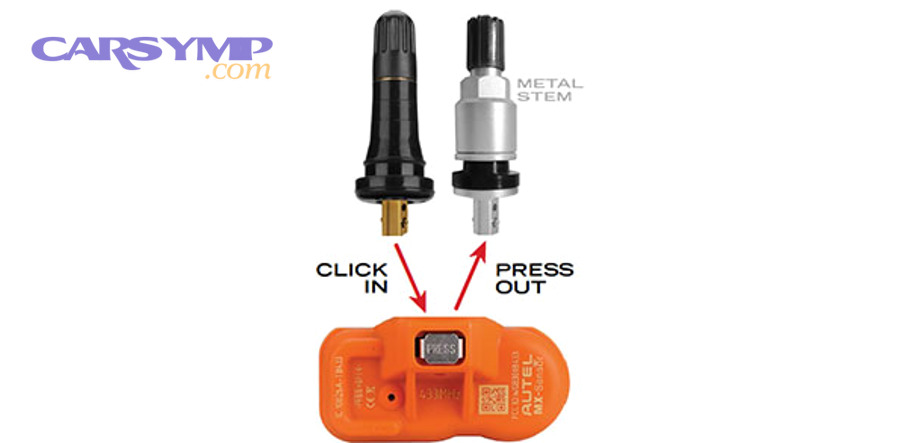
The tire pressure monitoring system service performed at your local shop typically includes inspecting, reseating, or replacing these valve stem sensors — not just the tires themselves. When a technician replaces tires, they are expected to evaluate the condition of the valve stem sensor as part of standard TPMS sensor replacement overview protocol, since disturbing the wheel assembly can dislodge sealing grommets or stress aging rubber.
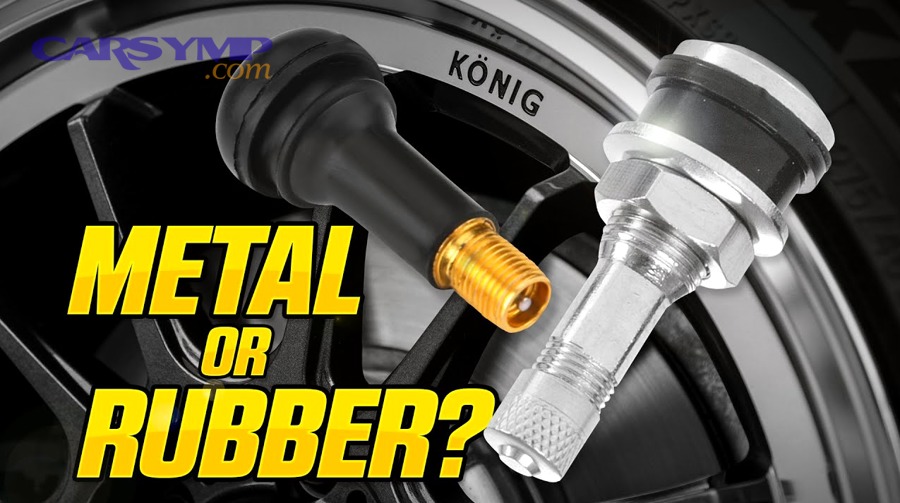
There are two primary stem designs in use today: the metal clamp-in stem and the rubber snap-in stem. Each attaches the sensor to the wheel rim through a different mechanical method, and each has distinct strengths and weaknesses depending on the vehicle application.
What Is a Metal (Clamp-In) TPMS Valve Stem Sensor?
A metal clamp-in TPMS valve stem sensor is a rigid stem — typically machined from aluminum or brass — that passes through the valve hole in the wheel rim and is secured from the outside using a threaded base nut that compresses a rubber sealing grommet against the rim surface.
- The sensor body attaches to the inner end of the stem using a torque screw, typically requiring a preset Torx or hex driver to reach manufacturer-specified torque
- The base nut torque range varies widely across manufacturers, typically spanning 35 to 80 inch-pounds — technicians must look up the exact specification rather than estimating
- Every time the metal stem is removed from the rim, the sealing grommet and base nut must be replaced with a new service kit — reusing old seals is a common source of slow leaks
- Metal stems are common as OEM fitment on performance vehicles, trucks, RVs, and motorcycles, where the added rigidity supports heavier sensor bodies under high-speed rotation
What Is a Rubber (Snap-In) TPMS Valve Stem Sensor?
A rubber snap-in TPMS valve stem sensor is a molded EPDM rubber stem that is pulled through the valve hole in the wheel rim using an installation tool, where the rubber body’s tapered shoulder seats against the rim to form an airtight seal without nuts or clamps.
- The molded rubber does not extend to the threaded tip — this is a key visual distinction from a standard non-TPMS rubber valve stem
- The snap-in design requires no torque tool and is relatively straightforward to install, making it the most common OEM choice for passenger cars globally
- EPDM rubber compound resists ozone, heat, and cold, which extends service life compared to older rubber formulations
- Rubber stems are lighter than metal stems and are well suited for standard passenger car applications where sensor weight is low and rotational forces are moderate
What Are the Key Differences Between Metal and Rubber TPMS Valve Stems?
Metal stems win in rigidity and high-load durability, rubber stems are best for corrosion resistance and ease of installation, and the right choice depends on the specific combination of vehicle type, sensor weight, PSI rating, and environmental conditions.
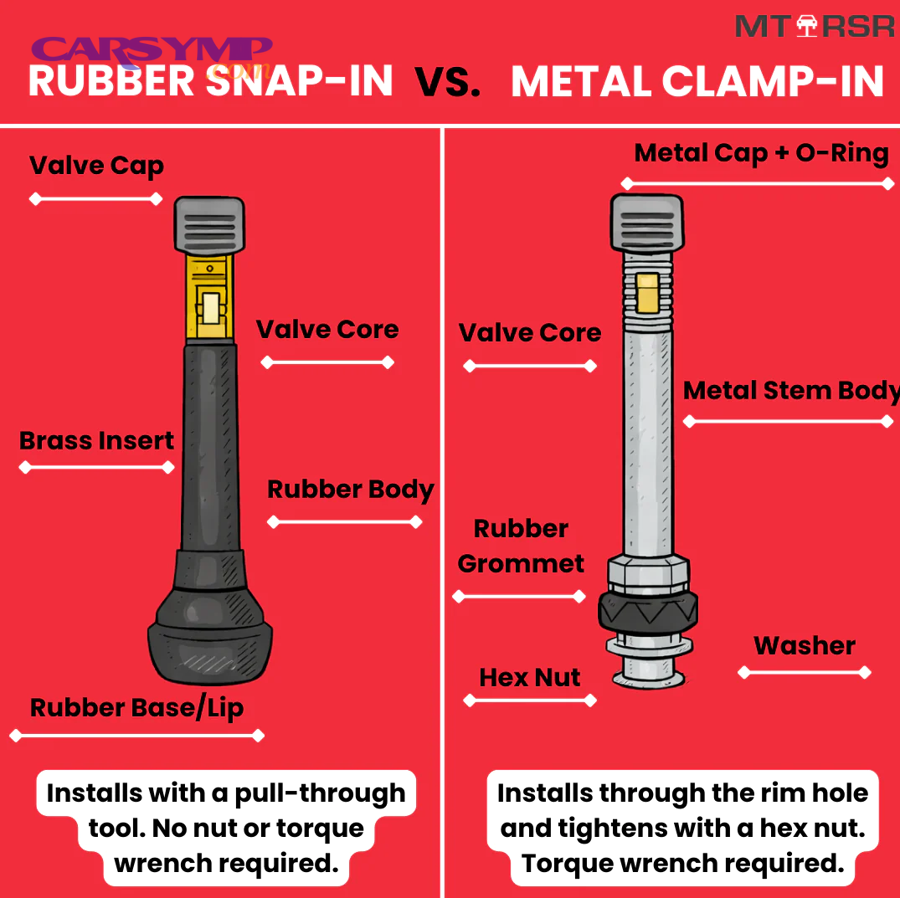
Specifically, this comparison covers the attributes most likely to affect a driver’s real-world experience — not just engineering specifications. The table below summarizes the primary differences across the most important criteria before each attribute is explored in detail.
| Attribute | Metal (Clamp-In) | Rubber (Snap-In) |
|---|---|---|
| Material | Aluminum or brass | EPDM rubber |
| Installation | Torque nut + grommet | Snap-through, no tools |
| Corrosion resistance | Moderate (galvanic risk) | High |
| Durability under load | High | Moderate |
| PSI tolerance | High (100+ psi) | Moderate (60–100 psi) |
| Cost | Higher | Lower |
| Replacement frequency | Lower (if maintained) | Every tire change |
| Best application | Trucks, motorcycles, RVs | Passenger cars |
This table provides a quick-reference comparison of the key attributes that separate metal clamp-in and rubber snap-in TPMS valve stems across material, installation, performance, and cost.
How Do Metal and Rubber Valve Stems Compare in Durability and Lifespan?
Metal stems outlast rubber stems in structural durability under mechanical stress, but rubber stems resist environmental degradation better than metal when road chemicals and moisture are the primary threats.
However, durability is not a simple win for either type — it depends heavily on the stress factor involved. Metal stems are rigid and hold their shape under the weight and centrifugal force of a mounted TPMS sensor at high speed, which is why motorcycle and RV TPMS manufacturers often warn against using rubber stems with external sensors. The rubber body can flex, fatigue, and eventually crack at the base where the sensor mass concentrates rotational stress. On the other hand, metal stems are vulnerable to physical breakage if a technician handles them roughly during air inflation or tire mounting — a careless pull on an air chuck has broken more than a few aluminum clamp-in stems.
For rubber stems specifically, industry best practice is replacement at every tire change — approximately every five to six years or every 50,000 to 60,000 miles — because the rubber compound hardens and loses flexibility over time even if no visible cracking is present. Metal stems can be reused if the stem body is intact, but the sealing grommet and base nut must always be replaced with a new service kit to prevent leaks.
How Do Metal and Rubber Valve Stems Differ in Corrosion Resistance?
Rubber snap-in stems are inherently more corrosion-resistant than metal clamp-in stems because they contain no metallic components exposed to road moisture, salt, or electrochemical reactions.
Metal stems — particularly aluminum alloy clamp-in stems — are vulnerable to a specific failure mode called galvanic corrosion, which occurs when two dissimilar metals make electrical contact in the presence of a conductive electrolyte such as road salt water. When drivers replace aluminum valve caps with standard brass caps, or when salt-treated road spray contacts the junction between an aluminum stem and a steel wheel rim, the electrochemical reaction gradually weakens the stem at its base. This was documented as a significant OEM problem on early GM vehicles, where broken valve stem tips led to the development of re-coring service kits that allowed technicians to salvage the sensor body without removing the corroded stem.
Drivers in northern states, Canada, and other high-salt road environments should be especially attentive to this risk. Using non-metallic valve caps, applying anti-corrosion coatings on the stem base nut threads, and inspecting the mounting area during every tire service are the most effective preventive measures.
Which Is Easier to Install — Metal or Rubber TPMS Valve Stems?
Rubber snap-in stems are significantly easier to install than metal clamp-in stems because they require no torque tools, no service kit components, and no precise fastener specifications.
Installation of a rubber snap-in stem involves pulling the stem through the rim hole with a dedicated installation tool until the tapered shoulder seats flush against the rim surface — a process that takes seconds and requires no measurement. Metal clamp-in stems, by contrast, involve threading the stem through the rim, positioning the sensor body toward the wheel interior, fitting the sealing grommet over the stem, and then tightening the base nut to manufacturer-specified torque using a preset torque driver. Under-tightening leads to slow leaks; over-tightening crushes the grommet and can hairline-crack the aluminum nut. Neither outcome is immediately obvious, which is why metal stem installation errors often surface as gradual pressure loss days after the service.
It is also worth noting that when replacing a TPMS sensor on a metal stem, the valve itself must be attached using a torque screwdriver with a self-tapping screw that can only be used once — meaning the entire stem must be replaced if the sensor is being swapped, adding both time and cost to the service.
How Do Metal and Rubber TPMS Stems Compare in Cost?
Rubber snap-in stems have a lower per-unit cost than metal clamp-in stems, but the total cost of ownership over a vehicle’s lifetime may be comparable when accounting for mandatory service kits and replacement frequency.
A rubber snap-in TPMS stem typically costs between $5 and $15 per unit at retail, and most technicians include stem replacement in a standard tire change. Metal clamp-in stems range from $15 to $40 per unit depending on material and sensor compatibility, and each reinstallation requires a service kit (new grommet + nut) priced at $3 to $10 per wheel. Over three or four tire change cycles, the recurring service kit cost for metal stems adds up — while rubber stems simply get replaced in full at each service without additional components. For the average passenger car driver, rubber stems are the more economical choice. For commercial vehicle operators and motorcycle riders who change tires less frequently but demand higher reliability under load, metal stems often justify their higher upfront cost.
Are Metal or Rubber TPMS Valve Stems Compatible With All Sensors?
No — metal and rubber TPMS valve stems are not universally compatible with all sensors; compatibility depends on the sensor body design, the rim hole size, and whether the vehicle uses an OEM-specified clamp-in or snap-in configuration.
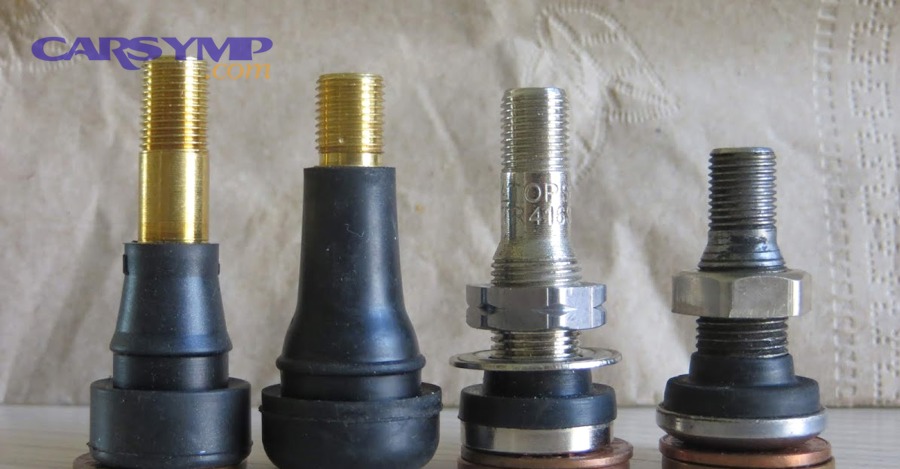
This is one of the most misunderstood aspects of TPMS sensor replacement overview. Many drivers and even some technicians assume that any stem can be paired with any sensor, but the sensor body itself is engineered for a specific attachment method. Mixing incompatible stems and sensors can result in air leaks, sensor misalignment inside the wheel, or complete TPMS system faults. TPMS relearn procedures by vehicle also vary — and if the replacement sensor type differs from the OEM configuration, the relearn process may fail or require a dealer-level scan tool.
Which TPMS Sensors Require Metal Valve Stems?
There are two main categories of sensors that require metal clamp-in valve stems: OEM sensors on vehicles factory-configured with clamp-in designs, and aftermarket sensors with clamp-in sensor bodies that physically cannot accept a snap-in rubber stem.
- OEM clamp-in sensors are found on many trucks, performance cars, motorcycles, and European vehicles. Brands including CONTI-VDO and certain Schrader sensor lines use clamp-in configurations where the sensor body threads directly onto the metal stem
- Aftermarket clamp-in sensors are sold as direct replacements for these OEM units and are not compatible with rubber snap-in stems due to the sensor body’s attachment geometry
- Hybrid snap-in stems exist as a middle-ground solution for certain multi-vehicle applications (e.g., combined GM/Ford fitment), but these are purpose-built designs, not improvised cross-compatibility
- Always verify the OEM stem type before ordering replacement sensors — the vehicle’s service manual, a TPMS tool with vehicle database coverage, or the sensor manufacturer’s fitment guide are the most reliable references
Can You Replace a Metal TPMS Valve Stem With a Rubber One (or Vice Versa)?
No — in most cases, you cannot directly substitute a metal TPMS valve stem with a rubber one or vice versa, because the sensor body, rim hole size, and OEM system architecture are matched to a specific stem type.
The clearest example of this limitation involves certain GM and Chevrolet models where the OEM TPMS sensors are mounted on special internal rubber stems that physically interface with the sensor in a way that metal stems cannot replicate. Drivers who have attempted to swap these to metal stems at independent tire shops have been turned away — and confirmed by dealerships — that the swap breaks system function. Similarly, BMW’s Flat Tire Monitor (FTM) system uses rubber stems without internal sensors, while BMW’s full TPMS uses metal clamp-in sensors — these two systems are architecturally different and the stems are not interchangeable.
In situations where a driver wants to change stem type for practical reasons (such as needing more wheel clearance for an external TPMS sensor), the correct approach is to verify with the sensor manufacturer whether an alternative stem is approved, and then follow TPMS relearn procedures by vehicle after installation to ensure the system recognizes the replacement.
What Are the Pros and Cons of Metal vs. Rubber TPMS Valve Stems?
There are four main evaluation criteria for comparing TPMS valve stem types: structural performance, corrosion behavior, installation practicality, and cost — and each criterion produces a different winner depending on the use case.
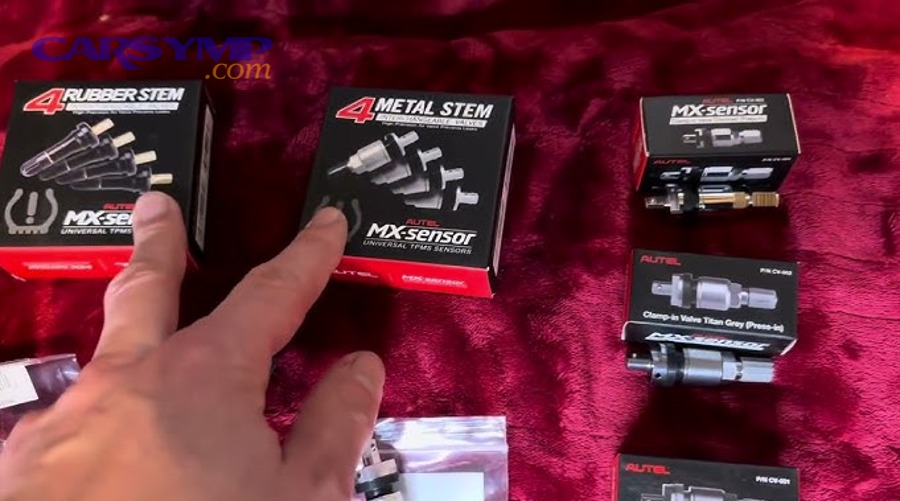
Moreover, understanding the full picture of advantages and disadvantages — rather than defaulting to a single “best” answer — is what allows drivers and technicians to make informed decisions across different vehicle types and service scenarios.
What Are the Advantages and Disadvantages of Metal TPMS Valve Stems?
Metal clamp-in TPMS valve stems offer superior structural rigidity and pressure tolerance, making them the preferred choice for high-load, high-speed applications — but they require precise installation and carry a higher risk of corrosion and installation damage.
Advantages:
- Rigid support for heavier TPMS sensor bodies, preventing flex and fatigue under centrifugal force at speed
- High PSI tolerance — aluminum and brass stems can handle 100+ psi without deformation, making them essential for commercial trucks, RVs, and performance vehicles
- Longer structural lifespan when properly maintained and protected from galvanic corrosion
- Better resistance to physical deformation from road debris impact compared to rubber
Disadvantages:
- Vulnerable to galvanic corrosion when paired with dissimilar metals in salt-road environments
- Require precise torque application — over-tightening or under-tightening causes leaks or cracking
- Higher cost per unit plus mandatory service kit expense on each reinstallation
- Physical breakage risk if mishandled during air inflation or tire mounting
- Self-tapping attachment screw is single-use, meaning stem replacement is required whenever the sensor is changed
What Are the Advantages and Disadvantages of Rubber TPMS Valve Stems?
Rubber snap-in TPMS valve stems offer excellent corrosion resistance, low cost, and simple installation — but they degrade over time and are not suitable for applications involving heavy external sensors or sustained high-speed operation.
Advantages:
- Naturally corrosion-resistant — no metallic components to react with road salt or moisture
- Fast, tool-free snap-in installation reduces service time and eliminates torque specification errors
- Lower unit cost makes routine replacement at every tire change economically practical
- Widely compatible with most passenger car OEM sensor configurations
- EPDM rubber compound resists ozone, UV, heat, and cold across a broad service range
Disadvantages:
- Degrades with age, heat, and chemical exposure — hardening and cracking even without visible damage
- Lower PSI threshold (typically 60–80 psi for standard stems) compared to metal
- Not suitable for heavy external TPMS sensor caps — the rubber flexes under sensor weight at speed, increasing blowout risk
- Must be replaced at every tire change (every 5–6 years), adding a recurring labor and parts cost
- Can cause the sensor body to shift position inside the wheel if the rubber fatigues and allows stem movement
Which TPMS Valve Stem Should You Choose — Metal or Rubber?
Metal stems are the right choice for high-load, high-speed, and high-PSI applications; rubber stems are the right choice for standard passenger car use with OEM snap-in sensor configurations — and the deciding factors are vehicle type, sensor weight, PSI requirements, and driving environment.
In addition to these practical criteria, drivers should always verify what their vehicle’s OEM configuration specifies before making a substitution. Following TPMS relearn procedures by vehicle after any sensor or stem replacement ensures the system recalibrates correctly and extinguishes the TPMS warning light causes and fixes scenario that often follows improper installation.
When Should You Choose a Metal TPMS Valve Stem?
Choose a metal clamp-in TPMS valve stem when your vehicle operates under high rotational stress, elevated PSI, or with heavy external sensors — conditions where rubber stems cannot maintain adequate structural integrity over time.
Specific situations that call for metal stems include:
- Motorcycles with external TPMS sensors: The rapid rotation of motorcycle wheels generates significant centrifugal force even at moderate speeds. Forum reports from FJR and other motorcycle communities consistently document rubber stem failures — including mid-ride deflation — when external TPMS sensor caps are mounted without upgrading to metal stems
- RVs and trailers running 80+ psi: Standard rubber stems are often rated only to 60–65 psi in lower-grade configurations. Underrated rubber stems can split and eject from the rim under pressure, especially during high-temperature highway travel
- Commercial trucks and heavy-duty vehicles: The combination of high PSI, heavy sensor bodies, and sustained highway speed makes metal stems the industry-standard choice
- Performance and off-road vehicles: Road shock and wheel impacts at speed benefit from the rigidity of a metal stem that cannot flex and fatigue the way rubber does
- OEM-specified clamp-in configurations: If your vehicle left the factory with metal stems, replace them with the same type to maintain TPMS system integrity and avoid triggering TPMS relearn complications
When Should You Choose a Rubber TPMS Valve Stem?
Choose a rubber snap-in TPMS valve stem when your vehicle is a standard passenger car, your OEM sensor is designed for snap-in fitment, and your operating conditions involve moderate speeds, standard PSI, and a light integrated sensor body.
Rubber stems are the practical default for the majority of everyday drivers because:
- Most passenger cars are factory-equipped with rubber snap-in TPMS sensors, and replacing them with OEM-equivalent rubber stems maintains full system compatibility without triggering TPMS warning lights
- The lower installation complexity reduces the risk of human error during tire pressure monitoring system service visits
- Budget-conscious maintenance schedules benefit from the lower cost of rubber stems, especially when replacing all four sensors at once
- For vehicles in high-moisture or high-salt environments where galvanic corrosion poses a real risk to aluminum metal stems, rubber’s inherent corrosion resistance is a meaningful practical advantage
- When a tire shop cannot fit metal stems due to wheel rim design constraints — a genuine limitation reported on several aluminum aftermarket wheel profiles — rubber stems are not just the default but the only viable option
How Do You Maintain and Troubleshoot TPMS Valve Stem Sensors?
Maintaining TPMS valve stem sensors involves scheduled inspection at every tire service, replacing wear components according to stem type, and diagnosing early failure signs before they escalate into air leaks or TPMS warning light causes and fixes situations that require full sensor replacement.
Beyond scheduled maintenance, troubleshooting is often triggered by a TPMS warning light that stays on after a tire inflation adjustment — which can indicate stem failure rather than simple pressure loss. Understanding which failure mode belongs to which stem type allows technicians and informed drivers to identify the root cause quickly rather than defaulting to a full TPMS sensor replacement overview unnecessarily.
How Often Should TPMS Valve Stems Be Replaced?
Rubber snap-in stems should be replaced at every tire change (approximately every 5–6 years or 50,000–60,000 miles); metal clamp-in stems should have their sealing components replaced at every removal, with the stem body replaced when corrosion or physical damage is detected.
For rubber stems, the replacement interval is non-negotiable in professional tire service settings. Even when the stem appears intact, the EPDM compound hardens over years of heat cycling and UV exposure, losing the flexibility needed to maintain an airtight seal. A stem that looks acceptable on visual inspection can fail days later when road vibration works against a slightly hardened seal.
For metal stems, the stem body itself can often be reused through multiple tire changes if it remains physically undamaged — but the sealing grommet and base nut must be treated as single-use components. Reusing an old grommet after it has been compressed and removed is one of the most common sources of post-service slow leaks. Many TPMS service kits sold to professional technicians include the grommet, nut, valve core, and valve cap as a single packaged set to ensure no component is reused by mistake.
An additional timing consideration comes from sensor battery life. Most integrated TPMS sensors have lithium batteries designed to last 5–10 years. When the sensor battery approaches end of life, the entire sensor assembly typically requires replacement — and this is often the most practical time to also upgrade or change the stem type if the driver has been considering doing so.
What Are the Signs of a Failing TPMS Valve Stem?
There are five key warning signs that a TPMS valve stem is failing: visible cracking or hardening of the rubber body, slow tire pressure loss without an apparent puncture, TPMS warning light activation despite correct inflation, stem movement or wobble when touched, and corrosion or white powdering visible at the base of a metal stem’s mounting area.
For rubber stems specifically:
- Visible cracking: Surface cracks at the base of the rubber stem or along the body indicate UV and ozone degradation — replacement is immediate
- Stem bending at base: A rubber stem that bends more than 45 degrees from vertical under light finger pressure has lost structural integrity and should be replaced before the next drive
- Slow leak pattern: Pressure loss of 1–3 psi per week without a puncture often traces back to a fatigued rubber seal at the rim contact point
For metal stems specifically:
- White or gray powdering at the base nut: This is the earliest visible sign of galvanic corrosion — the aluminum oxide byproduct of electrochemical degradation. Left unaddressed, it progresses to structural weakening of the stem at the rim contact zone
- Hairline cracks near the nut: Often caused by over-torque during a previous service, these cracks are not always visible to the naked eye but can be detected by applying light bending pressure to the stem
For both types, any stem that shows damage should be replaced before reinflating the tire, as a failed stem under pressure can eject rapidly and cause injury.
Can Galvanic Corrosion Damage Metal TPMS Valve Stems?
Yes — galvanic corrosion can and does damage metal TPMS valve stems, particularly aluminum clamp-in stems installed on steel wheel rims in environments where road salt or de-icing chemicals are regularly used.
Galvanic corrosion occurs when two metals with different electrochemical potentials — such as aluminum (the stem) and brass (the valve cap) — are in physical contact in the presence of a conductive electrolyte like saltwater. The less noble metal (aluminum) acts as the anode and corrodes preferentially, weakening the stem at the most structurally critical point: the base where it passes through the wheel rim. Early GM metal-stem TPMS systems experienced this failure mode broadly enough that Kent Moore developed a specialized re-coring service kit that allowed technicians to drill out the corroded valve body, re-tap new internal threads, and install a new valve core — preserving the sensor without disturbing the corroded stem.
Modern mitigation strategies include:
- Using plastic or nickel-plated valve caps instead of raw brass caps to eliminate the dissimilar-metal contact at the tip
- Applying anti-seize compound or corrosion inhibitor on the base nut threads during installation
- Inspecting the stem base at every tire rotation, not just at tire changes
- Specifying aluminum stems with anodized coatings for vehicles in high-salt climates, or switching to rubber stems entirely if galvanic corrosion has been a recurring issue
Do TPMS Valve Stems Affect Tire Balancing?
Yes — TPMS valve stems, particularly metal clamp-in types with their attached sensor bodies, do affect tire balancing because the sensor assembly adds localized mass to the wheel that must be offset with counterweights placed on the opposite side of the rim.
This is a rare but meaningful concern for drivers who prioritize ride quality and handling precision. A standard internal TPMS sensor assembly typically weighs between 28 and 40 grams — light enough that most balancing machines account for it automatically when the sensor is present during the balance procedure. The critical error to avoid is balancing the wheel without the sensor installed and then mounting the sensor afterward, which introduces an unbalanced mass and can cause vibration at highway speeds.
For motorcycle riders, this effect is amplified significantly. A 6-gram external TPMS sensor cap on a motorcycle wheel generates up to 150 grams of effective force at highway speed due to centrifugal force multiplication — a figure cited in several TPMS product warnings and motorcycle forum analyses. This is precisely why motorcycle TPMS manufacturers specifically recommend metal stems for their products and why some riders add small counterweights directly opposite the sensor position to compensate. For passenger car drivers using standard OEM snap-in rubber stem sensors, the balancing impact is minimal, but it remains best practice to always perform final wheel balancing with the sensor fully installed and secured.