


Most drivers should rotate their tires every 5,000 to 7,500 miles — or roughly every six months — to keep tread wear even and extend the life of all four tires. This interval is the universal baseline recommended by virtually every major tire manufacturer and vehicle OEM, though your exact schedule depends on how and where you drive. Following the correct tire rotation interval is one of the simplest, lowest-cost maintenance decisions that protects both your safety and your wallet.
The interval, however, is not one-size-fits-all. Your drivetrain type — whether your vehicle is front-wheel drive (FWD), rear-wheel drive (RWD), or all-wheel drive (AWD) — fundamentally changes which tires wear fastest and how aggressively you need to rotate them. An AWD driver who follows an FWD schedule is likely underserving their tires by thousands of miles, while a highway commuter in an RWD sedan may find the standard 5,000-mile rule slightly conservative for their actual wear rate.
Beyond the mileage number, tire rotation delivers compounding benefits that go far beyond tread longevity. Even tread wear produces more consistent grip, better braking response, improved fuel economy, and a reduced risk of sudden blowouts. Many drivers overlook How rotation affects ride noise and handling — unevenly worn tires introduce vibration, road hum, and unpredictable cornering behavior that only worsens over time if left unaddressed.
The most practical way to remember your tire rotation schedule is to pair it with your oil change. For most modern vehicles, an oil change falls every 5,000 to 7,500 miles — nearly identical to the rotation window — making it the ideal dual-service appointment. Next, this guide walks through every dimension of the rotation interval, from drivetrain-specific schedules to the warning signs that tell you a rotation is already overdue.
What Is a Tire Rotation Interval?
A tire rotation interval is the recommended mileage or time period after which each tire on your vehicle should be moved to a different wheel position to promote even tread wear across all four tires.
To better understand why the interval matters, it helps to understand what tire rotation actually accomplishes at a mechanical level. Each position on a vehicle — front-left, front-right, rear-left, rear-right — places a different combination of forces on the tire sitting there. Drive axle tires absorb engine torque; front tires handle the brunt of braking and steering forces; and corner-side tires wear differently than center tires due to load transfer during turns. Without regular repositioning, certain tires wear down far faster than others, shortening the overall life of your set and creating uneven handling dynamics.
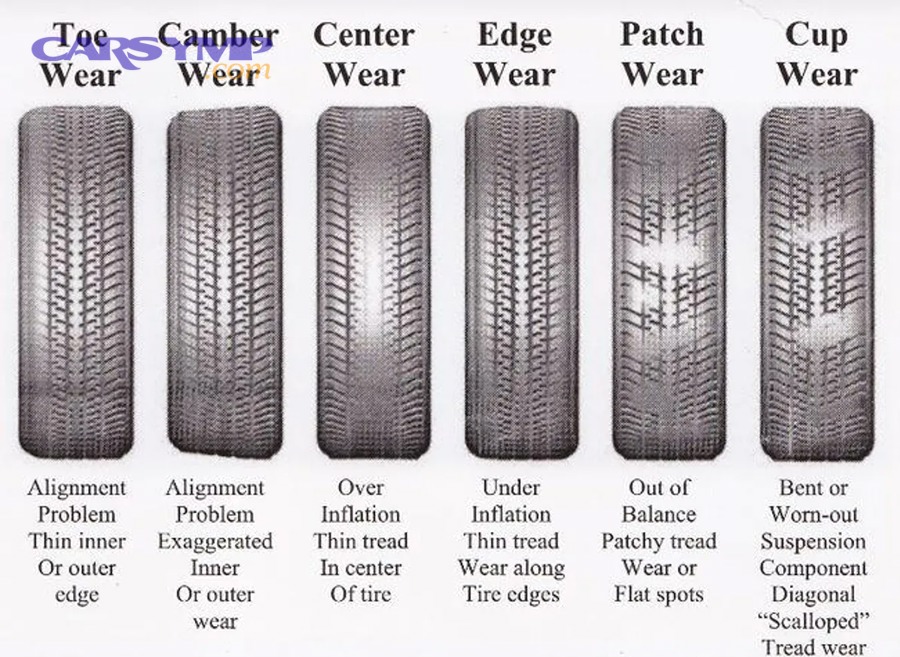
What Does Tire Rotation Actually Do to Your Tires?
Tire rotation redistributes the unequal stress each wheel position places on a tire, allowing all four tires to wear down at a more uniform rate. Here is what that means in practice:
- Drive axle tires experience the highest torque and traction stress. On FWD vehicles, the front tires do triple duty — steering, braking, and driving — causing them to wear significantly faster than the rears.
- Non-drive axle tires carry less rotational load but still wear from braking and cornering forces, particularly on the outer edges.
- Regular rotation cycles each tire through different positions so that no single tire absorbs disproportionate stress over its lifespan.
The cumulative effect is measurable. Even tread depth across all four tires ensures consistent contact patches with the road surface, which directly improves grip uniformity, cornering stability, and wet-weather traction. According to Bridgestone’s tire maintenance documentation, rotating tires at the recommended interval can extend tread life by up to 20%, representing a meaningful delay before a full set replacement is needed.
Is Tire Rotation the Same as Tire Balancing?
No — tire rotation and tire balancing are two distinct services that address different problems, though they are often performed together at the same appointment.
Tire rotation is a positional change: moving each tire to a new wheel location to equalize wear patterns. Tire balancing is a weight correction: adding small counterweights to a wheel-and-tire assembly to eliminate the vibration caused by uneven mass distribution. A third service — wheel alignment — adjusts the angles of the wheels relative to each other and the road, and is separate from both rotation and balancing.
The confusion arises because all three services share a broad relationship with tire health. The following table summarizes each service’s function and general frequency to help clarify which maintenance need applies to your situation.
| Service | What It Does | How Often |
|---|---|---|
| Tire Rotation | Moves tires to new positions to even wear | Every 5,000–7,500 miles |
| Tire Balancing | Corrects weight imbalance in wheel/tire assembly | Every 5,000–7,500 miles or when vibration appears |
| Wheel Alignment | Adjusts wheel angles to specification | Every 12,000 miles or after impact events |
Performing all three at regular intervals provides the most comprehensive tire and suspension care.
How Often Should You Rotate Tires? The Standard Interval Explained
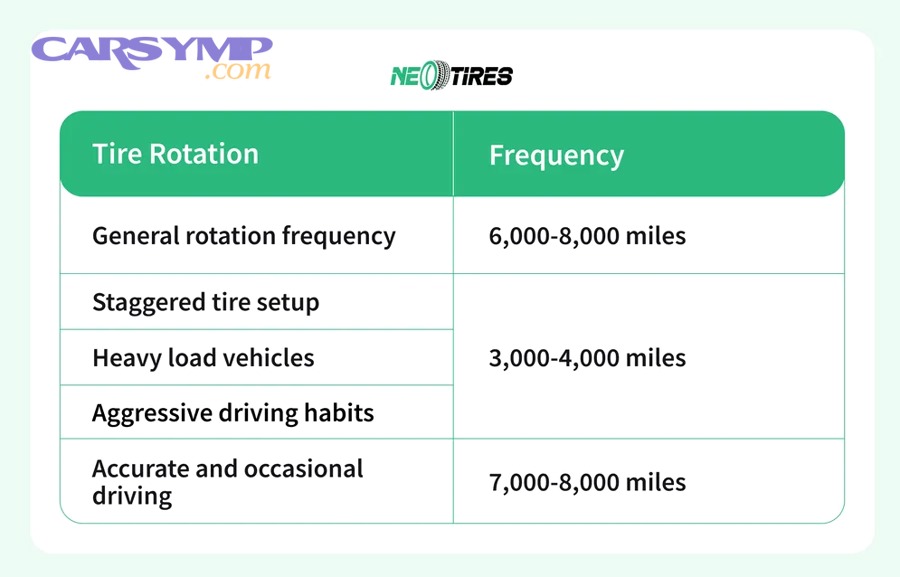
The standard tire rotation interval is every 5,000 to 7,500 miles or every six months, whichever comes first, as recommended by most vehicle manufacturers and major tire brands.
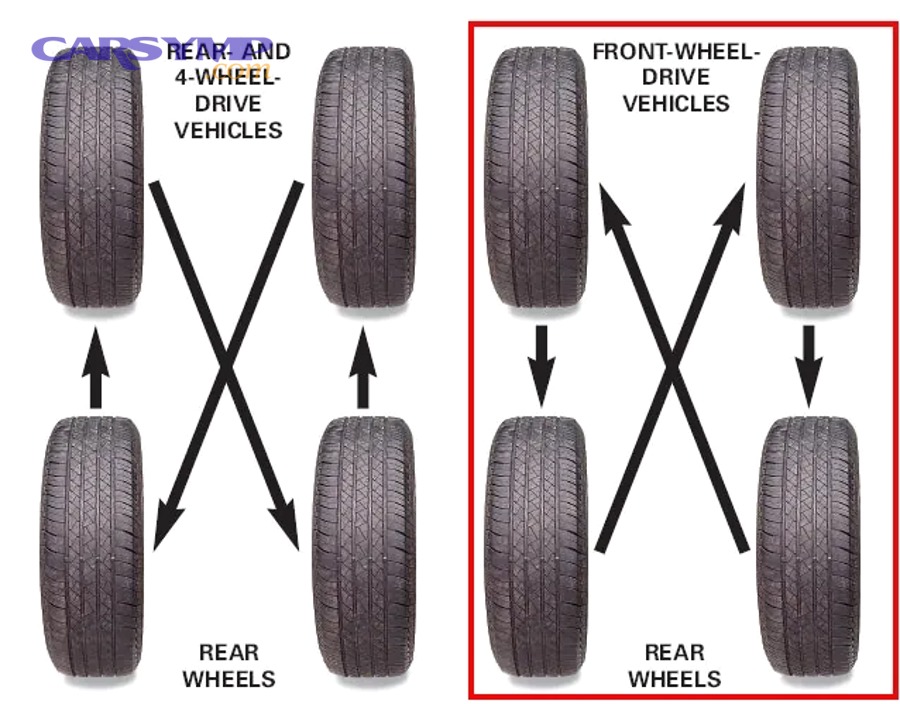
Specifically, this range exists because tire wear rates vary by vehicle weight, tire compound, driving conditions, and load — so a single fixed mileage cannot accommodate every driver equally. The 5,000-mile anchor is the more conservative and broadly safe recommendation; 7,500 miles is acceptable for drivers with more consistent, less demanding driving conditions. The simplest scheduling rule endorsed across brands like Firestone, Bridgestone, and Consumer Reports is to rotate tires every time you get your oil changed, which aligns naturally with this mileage window for most modern vehicles.
Should You Rotate Tires Every 5,000 Miles or Every 7,500 Miles?
The answer depends on how your driving conditions stress your tires. Here is a direct breakdown:
Rotate every 5,000 miles if you:
- Drive primarily in urban stop-and-go traffic with frequent hard braking
- Carry heavy loads regularly (trucks, SUVs with cargo)
- Drive on gravel, poorly paved roads, or other abrasive surfaces
- Notice that your tires have already begun showing uneven wear
Rotate at 7,500 miles if you:
- Log the majority of miles on highways at consistent speeds
- Drive a lighter passenger vehicle with a balanced weight distribution
- Use a modern tire compound rated for higher mileage durability
- Have confirmed even wear across all four tires at your last inspection
For most everyday drivers who split their miles between city and highway, a 5,000 to 6,000-mile interval is the practical midpoint that accounts for variable conditions without being unnecessarily frequent.
Can You Rotate Tires Too Often?
No — rotating your tires more frequently than the recommended interval does not cause mechanical harm to your tires, wheels, or vehicle. The only real cost of over-rotation is the labor fee and time spent at a service center.
More importantly, earlier rotation is generally better than later rotation. Tires that are rotated before severe wear imbalance develops are easier to equalize and retain more usable tread depth on all positions. The concern about “rotating too often” is effectively a non-issue — no study or manufacturer guideline suggests that early rotation creates problems. The one caveat is Post-rotation lug torque and recheck: after rotating tires, lug nuts must be tightened to the vehicle manufacturer’s specified torque rating (typically 80–100 ft-lbs for passenger vehicles), and a recheck at 50 to 100 miles is best practice to confirm no loosening has occurred.
How Does Drivetrain Type Change Your Tire Rotation Schedule?
There are three main drivetrain categories that affect your rotation schedule — FWD, RWD, and AWD — each placing different stress patterns on specific tire positions, requiring different intervals and rotation patterns.
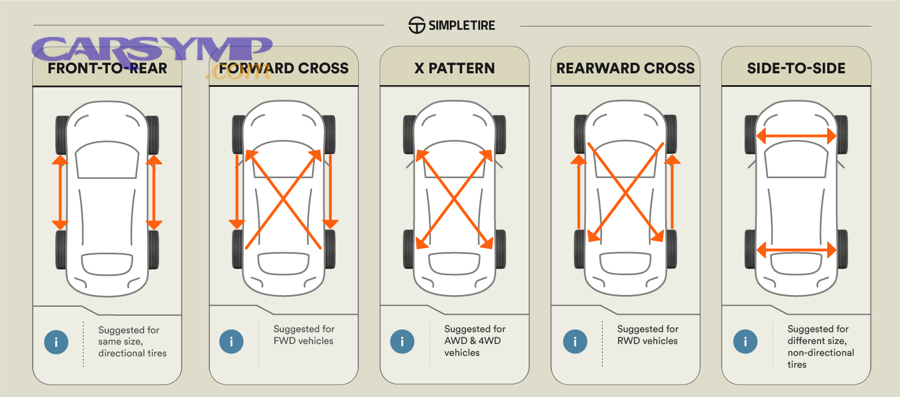
This is the most important variable in personalizing your rotation schedule beyond the universal baseline. The drivetrain determines which tires receive engine torque, which means those tires wear faster and require more frequent repositioning to avoid falling significantly behind the others in tread depth. Let’s explore each drivetrain type in detail.
How Often Should You Rotate Tires on a Front-Wheel Drive (FWD) Vehicle?
FWD tires should be rotated every 5,000 to 7,500 miles. The front tires on an FWD vehicle handle steering input, absorb the majority of braking force, and simultaneously transmit all engine torque to the road — making the front axle the highest-wear position on the vehicle.
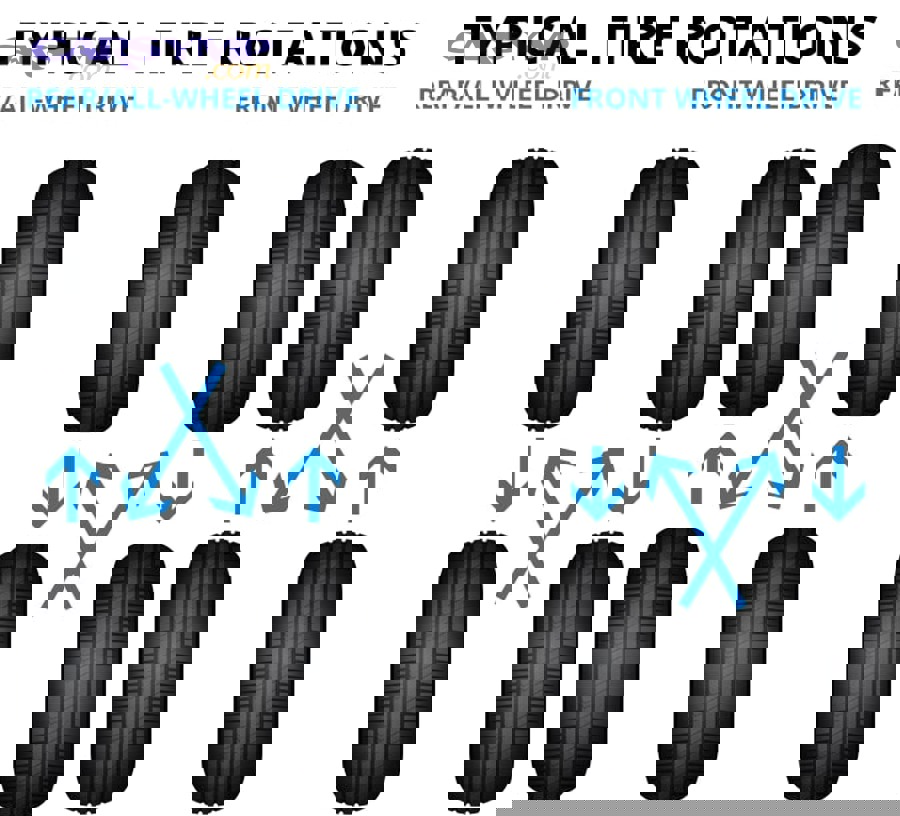
The recommended rotation pattern for FWD vehicles is the forward cross: rear tires move straight forward to the same side, while front tires cross diagonally to the opposite rear position. An X-pattern (all four tires cross diagonally) is also acceptable. The goal is to move those heavily stressed front tires to the lower-demand rear axle on each rotation cycle so cumulative wear averages out across the set’s lifetime.
How Often Should You Rotate Tires on a Rear-Wheel Drive (RWD) Vehicle?
RWD tires should also be rotated every 5,000 to 7,500 miles, with the rear axle bearing the primary drivetrain wear load rather than the front.
On an RWD vehicle, the rear tires absorb all engine torque while the front tires handle steering and a large share of braking. This creates a different but equally significant wear imbalance — rear tires wear faster from torque stress, and front tires wear on the outer edges from steering loads. The recommended pattern is the rearward cross: front tires move straight back to the same side, while rear tires cross diagonally to the opposite front position, which mirrors the FWD process in reverse.
How Often Should You Rotate Tires on an All-Wheel Drive (AWD) Vehicle?
AWD vehicles require tire rotation every 3,000 to 5,000 miles — notably shorter than FWD and RWD intervals — because all four tires receive drivetrain torque simultaneously, and tread depth variance between tires creates a more serious mechanical risk.
The critical issue with AWD systems is tread depth differential. Most AWD differentials and transfer cases are designed to operate within a very small variance in tire circumference across all four wheels. When one or more tires wear significantly more than the others, the rotational speed difference strains the drivetrain components, potentially causing costly differential damage. The industry rule of thumb is that AWD tires should be rotated before any individual tire’s tread depth differs from another by more than 2/32 of an inch.
According to guidance published by the Tire Industry Association, AWD drivetrain damage from unequal tire wear is one of the leading preventable causes of differential service visits — making the shorter 3,000 to 5,000-mile rotation window genuinely important, not merely precautionary.
Is the Tire Rotation Interval Different for AWD vs. 4WD Trucks?
AWD wins in road-use convenience, while 4WD is better optimized for off-road durability — but 4WD vehicles used off-road may actually require the shortest rotation intervals of any drivetrain type.
The following table provides a direct comparison of drivetrain types by use case and recommended interval to help drivers identify where their vehicle falls.
| Drivetrain | Primary Use | Recommended Rotation Interval | Key Wear Driver |
|---|---|---|---|
| AWD | On-road, automatic engagement | 3,000–5,000 miles | Continuous all-wheel torque distribution |
| 4WD (on-road use) | Mixed, selectable engagement | 5,000–7,500 miles | Torque only when 4WD engaged |
| 4WD (off-road use) | Trail, terrain, gravel | 3,000 miles or less | Aggressive terrain + irregular wear patterns |
AWD systems apply torque continuously in varying proportions, which produces more consistent but faster wear across all four tires. 4WD systems in selectable trucks distribute torque only when the driver engages 4WD mode, meaning wear stress is lower during normal highway driving — but off-road use with aggressive terrain rapidly accelerates irregular wear, making frequent rotation essential for vehicles used in those conditions.
What Are the Signs You’ve Already Waited Too Long to Rotate Your Tires?
There are four main signs that indicate an overdue tire rotation: visibly uneven tread wear, vehicle vibration at highway speeds, the car pulling to one side, and increased road noise during normal driving.
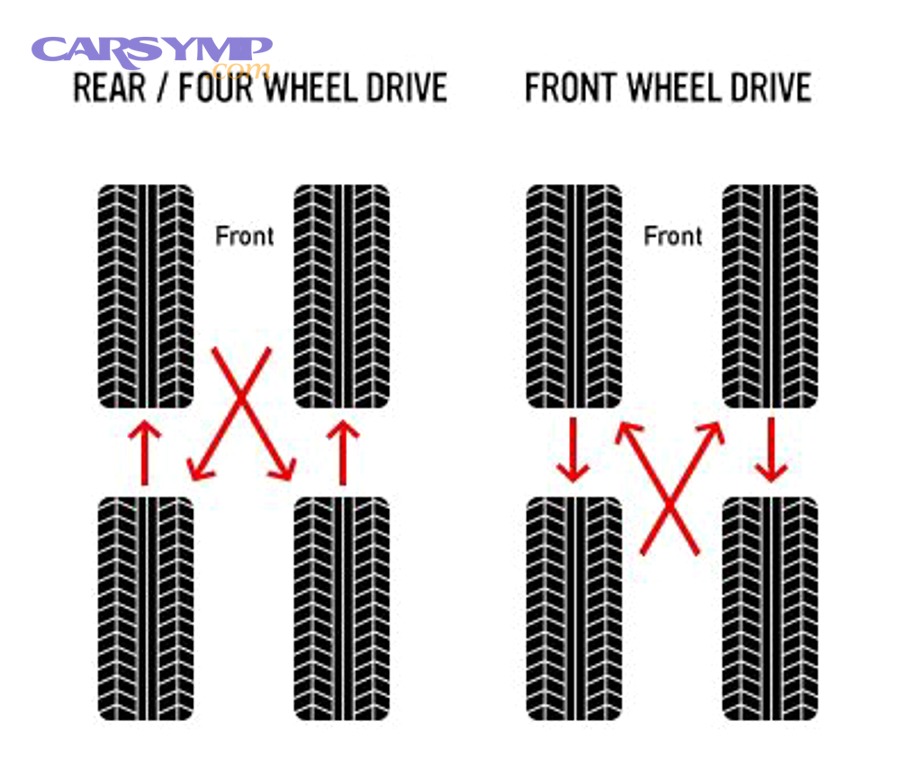
Understanding these Signs you need a rotation is critical because missed intervals compound quickly — a tire that has worn unevenly for 10,000 miles without rotation cannot be fully corrected by a single rotation service. The damage to the tread profile is permanent, though rotation can slow further uneven wear. Catching these symptoms early preserves the maximum remaining tread life.
How Do You Check If Your Tires Need Rotation Now?
You can check whether your tires need rotation now using the penny test, a visual tread inspection, and a comparison of tread depth across all four tires.
1. The Penny/Quarter Tread Depth Test
- Insert a penny into the tread groove with Lincoln’s head pointing down. If the top of Lincoln’s head is visible, the tread is at or below 2/32 of an inch — replace immediately.
- For a more conservative early-warning check, use a quarter: if Washington’s head is fully visible, tread depth is at or below 4/32 of an inch — plan for replacement soon.
2. Visual Inspection for Uneven Wear Patterns
- Center wear: Overinflation. The center tread wears faster than the edges.
- Edge wear (both sides): Underinflation. Edges contact the road more than the center.
- One-sided wear: Alignment issue. The tire is tilted, wearing the inner or outer edge disproportionately.
- Cupping or scalloping: Suspension problem causing the tire to bounce on the road surface.
- Feathering: Misalignment causing tread blocks to wear at an angle.
3. Tread Depth Variance Check Across All Four Tires
Use an inexpensive tread depth gauge (available at any auto parts store) to measure each tire at multiple points. If any two tires differ by more than 2/32 of an inch — especially on AWD vehicles — rotation is overdue and drivetrain stress may already be accumulating.
When uneven wear patterns are severe, a professional technician can identify underlying causes — suspension wear, alignment drift, or improper inflation — that, if unaddressed, will continue to cause irregular wear even after a rotation.
Why Does Following the Correct Tire Rotation Interval Maximize Tread Life?
Following the correct tire rotation interval maximizes tread life because it prevents any single tire from absorbing a disproportionate share of drivetrain, braking, and steering stress — the primary causes of premature tread depletion.
Even tread wear is the mechanical foundation of tire longevity, and regular tire rotation is the most direct way to achieve it. When all four tires wear at roughly the same rate, you replace the full set simultaneously rather than replacing two tires early while the other two still have significant life remaining. This synchronized replacement cycle is more economical and safer, since a new tire paired with a heavily worn tire creates grip asymmetry between axles.
The compounding safety benefits are equally significant. How rotation affects ride noise and handling is one of the most underappreciated aspects of this maintenance task. Tires that have developed uneven wear — particularly cupping or one-sided edge wear — introduce vibration into the steering column, increased road noise at highway speeds, and reduced cornering confidence. A properly maintained rotation schedule prevents these symptoms from developing, keeping ride quality and handling response consistent across the tire set’s entire lifespan.
From a fuel economy standpoint, unevenly worn tires increase rolling resistance asymmetrically, forcing the engine to work harder to maintain speed. The U.S. Department of Energy has noted that proper tire maintenance, including rotation and inflation, can improve fuel economy by up to 3% — a modest figure per trip, but meaningful over 50,000 or more miles of driving. According to Consumer Reports’ automotive testing division, drivers who follow a consistent tire maintenance schedule, including regular rotation, report statistically longer tire service life and fewer unscheduled tire-related service visits compared to those who rotate irregularly.
Are There Exceptions to the Standard Tire Rotation Interval?
There are four main exception categories that override the standard 5,000 to 7,500-mile rotation interval: run-flat tires, staggered fitment setups, tire warranty compliance requirements, and driving habit extremes such as off-road or high-frequency city use.
These exceptions represent the micro-niche layer of tire rotation knowledge — the situations where following the standard rule without adjustment could either waste money, void a warranty, or physically damage tires or drivetrain components. Below is a detailed look at each exception.
Do Run-Flat Tires Have a Different Rotation Interval?
Yes — run-flat tires often have different rotation requirements, and in some configurations they cannot be rotated at all without dismounting them from the wheel, which adds labor cost and complexity.
Run-flat tires are constructed with reinforced sidewalls that allow the vehicle to continue driving at reduced speed after a pressure loss. This construction creates a stiffer sidewall that wears differently from conventional tires, particularly on the inner shoulder. More importantly, many run-flat tires are installed in directional or staggered configurations — especially on performance vehicles — which restricts or eliminates the standard cross-axle rotation patterns. Drivers with run-flat tires should:
- Confirm whether their tires are directional (rotation limited to front-to-rear on the same side only)
- Check whether front and rear tire sizes differ (staggered — may prevent traditional rotation entirely)
- Consult the vehicle manufacturer’s owner’s manual for the OEM-specific rotation recommendation
Should You Rotate Staggered Fitment Tires (Different Front/Rear Sizes)?
No — staggered fitment tires, where the front and rear tires are different widths or diameters, generally cannot be rotated using standard cross-axle patterns without first dismounting and remounting the tires on different wheels.
Staggered setups are common on rear-biased performance cars — many BMW, Porsche, and Corvette models use wider rear tires for improved traction and cornering stability. The width difference means a rear tire physically cannot move to the front axle without being swapped off its current rim. The options for managing staggered fitment tire wear are:
- Side-to-side rotation: Swapping left-rear with right-rear (and left-front with right-front) — possible only with non-directional tires
- Dismount-and-remount rotation: Labor-intensive and costly, but allows a true positional change
- Accepting shorter tire life: Some performance car owners accept more frequent rear tire replacement as a trade-off for the handling benefits of the staggered setup
Does Your Tire Warranty Require a Specific Rotation Interval?
Yes — most tire manufacturer warranties include a documented rotation requirement, and failure to rotate at the specified interval can void the tread life warranty entirely.
This is a rare attribute of tire ownership that many drivers overlook at purchase. Major brands including Michelin, Goodyear, and Continental typically require rotation every 5,000 to 7,500 miles as a condition of mileage warranty coverage. The key requirement is documentation: warranty claims for premature tread wear are evaluated against service records, and a warranty claim submitted without rotation receipts or service history is frequently denied. Practically speaking, this means:
- Always retain your tire rotation service receipts
- If you rotate at home using a floor jack and torque wrench, log the mileage and date in a maintenance record
- Ask your tire retailer at purchase what the specific rotation interval requirement is for your warranty
How Does Driving Habit — Highway vs. City vs. Off-Road — Affect How Often You Should Rotate?
Highway driving is most forgiving of standard intervals, city driving accelerates front tire wear and warrants shorter intervals, and off-road driving creates the most aggressive and irregular wear requiring the most frequent rotation of any driving context.
The following table illustrates how driving context should directly influence how you personalize your rotation schedule beyond the manufacturer baseline.
| Driving Habit | Primary Wear Pattern | Recommended Interval Adjustment |
|---|---|---|
| Highway (consistent speed, straight roads) | Gradual, relatively even across all four | Standard 6,000–7,500 miles acceptable |
| City (stop-and-go, frequent turns, braking) | Front tires wear faster from braking and turning | Shorten to 4,000–5,000 miles |
| Off-Road (gravel, dirt, rocks, uneven terrain) | Rapid, irregular wear — cupping and edge damage common | Shorten to 3,000 miles or inspect after each outing |
City drivers who follow a 7,500-mile interval may find their front tires have developed significant wear asymmetry by the time they arrive at a service center. Off-road drivers who adhere to a standard highway rotation schedule are particularly at risk for premature tire failure and AWD drivetrain damage. In all cases, a visual tread inspection between scheduled rotations is the most reliable real-world check — mileage is a guide, not a guarantee.
In short, the correct tire rotation interval is never just one number. It is a personalized schedule built from your drivetrain type, driving habits, tire construction, and manufacturer requirements — and maintaining it consistently is one of the highest-return maintenance habits a vehicle owner can practice.