The Complete Guide to Tire Rotation: Why It Matters and How to Extend Your Tread Life
Tire rotation is one of the most impactful — and most overlooked — forms of auto maintenance a driver can perform. At its core, tire rotation means periodically moving each tire to a different position on your vehicle so that wear is distributed evenly across all four tires rather than concentrating on one or two. When done consistently, this single service can add tens of thousands of miles to your tire life, reduce your risk of blowouts, and save you hundreds of dollars in premature replacement costs.
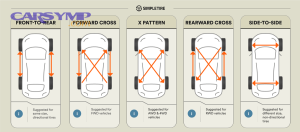
Understanding the correct Tire rotation pattern guide for your specific vehicle is just as important as doing the rotation in the first place. A front-wheel drive vehicle, a rear-wheel drive performance car, and an all-wheel drive SUV each demand a different approach — and using the wrong pattern can actually accelerate uneven wear rather than prevent it. From the forward cross to the rearward cross to the directional front-to-rear method, the pattern you choose directly determines how evenly your tread wears over time.
Knowing how often to rotate tires is the second critical variable. Most manufacturers recommend a rotation interval of every 5,000 to 7,500 miles, but that number shifts depending on your drivetrain type, driving habits, road conditions, and tire construction. Recognizing the Signs you need a rotation — such as vibration, pulling to one side, or visibly uneven tread — can help you act before damage becomes irreversible.
Beyond the basics, there are specialized considerations that go overlooked by most drivers: how rotation interacts with tire pressure monitoring systems, when to include wheel balancing in the same service visit, and how rotation rules change for electric vehicles, run-flat tires, and staggered fitments. Next, this guide will walk you through every layer of this essential tire & wheel service, so you can protect your investment and keep your vehicle performing at its best.
What Is Tire Rotation?
Tire rotation is a preventive maintenance procedure in which each tire is moved from its current wheel position to a different one on the same vehicle, with the goal of promoting even tread wear across all four tires.
To better understand why this matters, it helps to consider what each tire actually does while you drive. The forces acting on your tires are not equal — not between front and rear axles, and not between the left and right sides of the vehicle. Steering input, braking friction, acceleration torque, and cornering load all concentrate stress differently depending on where a tire is mounted. Over time, those concentrated forces carve uneven wear patterns into the rubber, shortening the tire’s usable life and degrading handling performance.

Rotating tires redistributes that stress by giving each tire time in every wheel position. A tire that spent its first 5,000 miles handling the braking and steering demands of the front-left position will then move to the rear-right, where the workload is lighter, allowing the previously stressed rubber to recover a more even wear profile.
What Does Tire Rotation Actually Do to Your Tires?
Tire rotation works by ensuring that no single tire bears a disproportionate share of the vehicle’s mechanical demands over its lifetime. Each wheel position creates a unique wear signature. Front tires on a front-wheel drive vehicle, for example, handle steering, braking, and torque delivery simultaneously — a combination that grinds down tread far more aggressively than the passive load-bearing role of the rear tires.
By moving tires through all four positions over successive rotations, the wear is averaged out. The result is that all four tires reach the wear limit at approximately the same time, which means you can replace them as a complete set. This matters both for handling consistency and for cost — replacing all four tires at once is almost always more economical than staggered individual replacements.
- Prevents cupping, feathering, and one-sided wear patterns
- Maintains uniform tread depth across all four contact patches
- Supports consistent braking distance and cornering grip
- Allows a trained technician to inspect each tire’s sidewall and tread during the service
Is Tire Rotation the Same as Tire Balancing or Wheel Alignment?
No — tire rotation, tire balancing, and wheel alignment are three distinct services that address different problems, although all three work together to support even tread wear and safe vehicle handling.
Tire rotation moves tires between wheel positions to equalize wear. Tire balancing corrects weight imbalances in the wheel-and-tire assembly that cause vibration at highway speeds. Wheel alignment adjusts the angles at which your tires contact the road, preventing the vehicle from pulling to one side and preventing edge wear.
| Service | What It Fixes | How Often |
|---|---|---|
| Tire Rotation | Uneven positional wear | Every 5,000–7,500 miles |
| Tire Balancing | Vibration from weight imbalance | Every 12,000–15,000 miles or when vibration is felt |
| Wheel Alignment | Pulling, edge wear, suspension angle | Every 12 months or after a hard impact |
The table above summarizes the distinction between these three services so you can decide which ones you need on any given visit. Many shops recommend combining all three during a scheduled tire & wheel service visit, since the vehicle is already lifted and the tires are already off — making it efficient to address balance and alignment at the same time. Including balance during rotation is a smart decision, particularly if you have noticed any steering wheel vibration or uneven tire wear patterns developing.
Why Does Tire Rotation Matter for Tread Life and Safety?
Yes, tire rotation significantly matters for both tread life and safety — it extends the usable life of your tires, maintains consistent traction across all four contact patches, and reduces the risk of sudden tread failure due to accelerated wear.

The relationship between tire rotation and safety is more direct than most drivers realize. Tires with uneven tread depth produce inconsistent grip, which becomes especially dangerous during emergency braking or evasive maneuvering. A front tire worn to 3/32″ while the rear tire still has 8/32″ creates a mismatched braking response that can cause the vehicle to rotate unpredictably under hard stopping.
What Happens If You Never Rotate Your Tires?
If you never rotate your tires, the tires in the highest-stress positions — typically the front tires on front-wheel drive vehicles — will wear down significantly faster than the others, leading to premature replacement, degraded handling, and increased safety risk.
The consequences compound over time. Without rotation, front-wheel drive vehicles commonly develop front tires worn to the wear bars (2/32″) while the rear tires still show 6/32″ or more of tread remaining. At that point, the driver faces a choice between replacing only the front pair — which creates a tread-depth mismatch that stresses AWD and 4WD drivetrains — or replacing all four, wasting the remaining life on the rear tires.
Beyond uneven tread depth, skipping rotation allows irregular wear patterns to become permanent. Cupping (scalloped dips around the tread), feathering (rounded edge on one side, sharp on the other), and center wear are all conditions that cannot be reversed once established — they can only be managed or addressed through replacement.
Signs you need a rotation include:
- Noticeable vibration in the steering wheel or seat at highway speeds
- The vehicle pulling left or right without steering input
- Visible tread depth difference between front and rear tires
- Increased road noise, particularly a humming or growling sound
- One tire wearing faster than the others after the same mileage interval
Does Tire Rotation Really Save You Money?
Yes, tire rotation genuinely saves money — a $50 to $100 rotation service can delay a $600 to $1,200 full set replacement by tens of thousands of miles, representing a substantial return on a minimal investment.
Tire rotation cost vs DIY is a common consideration for budget-conscious drivers. A professional rotation at a dealership or tire shop typically runs between $50 and $100. Many tire retailers — including Discount Tire, Costco, and Sam’s Club — offer free lifetime rotations when you purchase a set of tires from them, making the long-term value even more significant. For a driver who owns a set of tires for 60,000 miles and rotates every 6,000 miles, that represents roughly ten free service intervals.
The DIY route is a legitimate option for mechanically inclined drivers with the right tools. A floor jack, a set of jack stands, and a torque wrench represent a one-time investment of approximately $150 to $300, after which every rotation costs nothing but time. The critical caution: never use a scissor jack alone to support a vehicle while tires are removed, and always torque lug nuts to the manufacturer’s specification after reinstalling — typically between 80 and 100 ft-lbs for passenger vehicles. Post-rotation lug torque and recheck is a step that professional technicians perform as a standard part of the service and should never be skipped in a DIY rotation either.
According to Consumer Reports’ tire survey data, 82 percent of members who purchased new tires received at least one complimentary service perk — with free tire rotation being among the most common — highlighting how standard and expected this service has become in the tire industry.
What Are the Different Tire Rotation Patterns?
There are five main tire rotation patterns: forward cross, rearward cross, X-pattern, front-to-rear (straight), and four-tire cross — each suited to a specific drivetrain type and tire construction.

This tire rotation pattern guide exists because the wrong pattern for your vehicle type can actually create uneven wear rather than prevent it. The two governing factors that determine which pattern applies are: (1) your vehicle’s drivetrain — FWD, RWD, AWD, or 4WD — and (2) whether your tires are directional or non-directional. Understanding both factors before each rotation is essential.
Which Tire Rotation Pattern Is Right for Front-Wheel Drive Vehicles?
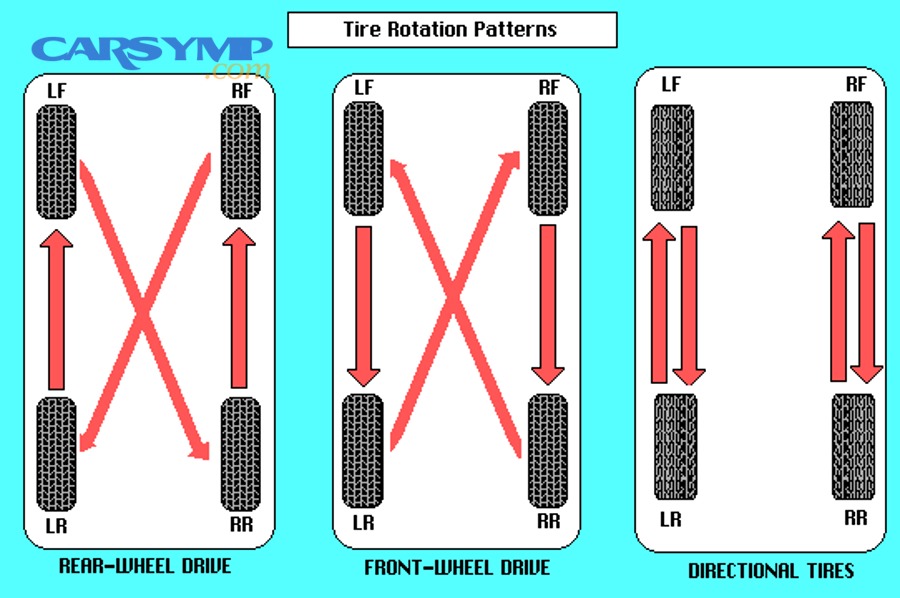
For front-wheel drive vehicles, the forward cross pattern is the standard recommendation — the front tires move straight back to the rear axle, while the rear tires cross diagonally to opposite sides of the front axle.
The logic behind this pattern reflects the mechanical reality of FWD: the front tires carry the combined burden of steering, braking, and powering the vehicle forward, making them wear faster than the rear. By moving the rear tires diagonally to the front, the pattern ensures they rotate to the drive position and begin sharing that stress load. The front tires, now in the rear, get a recovery period in a lower-demand position.
An alternative for FWD vehicles with non-directional tires of uniform size is the X-pattern, in which all four tires move diagonally — rear-left to front-right, rear-right to front-left, and so on. This pattern is particularly useful when significant uneven wear is already developing, as it maximizes the positional change for every tire.
- Forward Cross: Best standard choice for FWD; rear tires cross to front, fronts go straight back
- X-Pattern: Alternative for FWD when more aggressive wear redistribution is needed
- Rotation with directional tires rules apply here: if tires are directional, the X-pattern is not permitted — use front-to-rear only
Which Tire Rotation Pattern Is Right for Rear-Wheel Drive and AWD/4WD Vehicles?
For rear-wheel drive vehicles, the rearward cross pattern is recommended — the rear tires move straight forward to the front axle, while the front tires cross diagonally to the opposite sides of the rear axle. For AWD and 4WD vehicles, the four-tire cross pattern is most commonly used.
RWD vehicles concentrate their acceleration forces on the rear tires, making the rear position the high-stress zone. The rearward cross mirrors the logic of the forward cross but in the opposite direction, giving the worn rear tires a rest in the front while moving the front tires to the drive axle.
AWD and 4WD vehicles distribute power to all four tires, which creates a more complex wear dynamic. These vehicles are particularly sensitive to tread depth differences between axles — a mismatch of more than 2/32″ on an AWD vehicle can strain the center differential and transfer case, leading to expensive drivetrain repairs. For this reason, how often to rotate tires on an AWD vehicle should follow a tighter interval: every 3,000 to 5,000 miles rather than the standard 5,000 to 7,500.
How Do You Rotate Directional Tires vs. Non-Directional Tires?
Directional tires must be rotated front-to-rear only on the same side of the vehicle; non-directional tires can be rotated using any cross-pattern method.
Rotation with directional tires rules is a point of frequent confusion, but the principle is straightforward. Directional tires are engineered with an asymmetric tread pattern designed to channel water in a specific direction — the arrow on the sidewall indicates the required rolling direction. Crossing a directional tire to the opposite side of the vehicle would reverse its rolling direction and defeat the entire purpose of the tread design, compromising wet-weather performance and potentially voiding the tire warranty.
Non-directional tires carry no such restriction and can be freely moved to any position. Their tread pattern is symmetric, meaning rolling direction does not affect their performance or wear characteristics.
The table below summarizes which rotation patterns are permitted based on tire type, providing a quick reference before any rotation service.
| Tire Type | Permitted Rotation Patterns |
|---|---|
| Directional | Front-to-rear only (same side) |
| Non-directional | Forward cross, rearward cross, X-pattern, four-tire cross |
| Staggered fitment | Side-to-side only (if non-directional); often no rotation possible |
How Often Should You Rotate Your Tires?
Tire rotation should be performed every 5,000 to 7,500 miles for most passenger vehicles, or approximately every other oil change — though the correct interval ultimately depends on your vehicle manufacturer’s specific recommendation.
The standard interval has remained consistent across most tire brands and vehicle manufacturers because it aligns well with the rate at which positional wear differences become measurable. At 5,000 miles, the difference in tread depth between front and rear tires on a FWD vehicle is typically in the 1/32″ to 2/32″ range — significant enough to warrant redistribution but not yet severe enough to cause permanent wear patterns. Waiting until 10,000 miles or more allows those differences to deepen into irreversible conditions.
Should You Rotate New Tires Earlier Than Usual?
Yes — new tires should be rotated at or before the 5,000-mile mark because fresh, deep tread rubber is more susceptible to developing permanent uneven wear patterns during the initial break-in period.
New tire tread, typically 10/32″ to 11/32″ deep, is softer and more pliable than partially worn tread. During the first several thousand miles, the tire is conforming to the stresses of its wheel position. If that conforming process runs too long without intervention, the wear pattern established in those early miles becomes the template for the tire’s entire life. An early first rotation interrupts that process, giving each tire time in every wheel position before any single pattern can become fixed.
For new tire owners, the recommended approach is:
- First rotation: at 4,000–5,000 miles
- Subsequent rotations: every 5,000–7,500 miles following the manufacturer’s schedule
- For AWD vehicles: every 3,000–5,000 miles throughout the tire’s life
Extending tire life with proper rotation starts at mile one — not mile 10,000. The investment in an early first rotation pays dividends across the full lifespan of the tire set.
What Factors Can Make You Need to Rotate Tires More Frequently?
Several factors accelerate tire wear and shorten the recommended rotation interval: AWD drivetrain configuration, aggressive driving behavior, heavy payload, high-temperature climates, and degraded suspension components.
AWD systems are particularly sensitive because even minor tread depth differences between tires create torque bind in the differentials, accelerating both tire wear and drivetrain wear simultaneously. Aggressive acceleration, hard cornering, and frequent highway driving all increase the rate at which front and rear tires diverge in wear depth. Vehicles regularly carrying heavy loads — such as pickup trucks used for towing or cargo hauling — place additional stress on rear tires, often reversing the typical front-heavy wear pattern.
Worn suspension components such as shocks, struts, or control arm bushings allow tires to bounce and scrub against the road surface rather than rolling smoothly, causing the cupping wear pattern that produces road noise and handling instability. In these cases, more frequent rotation can slow the progression of cupping wear, but the root cause — the worn suspension component — must be addressed to stop it entirely.
How rotation affects ride noise and handling is often noticeable after a long-overdue rotation: drivers commonly report reduced road noise and improved straight-line tracking after tires are moved from worn positional grooves to fresh positions.
How Is a Tire Rotation Performed Step by Step?
A professional tire rotation is completed using a hydraulic lift, lug nut socket set, and calibrated torque wrench in approximately 20 to 30 minutes, following the pattern appropriate for the vehicle’s drivetrain and tire type.

The service begins with the technician confirming the correct rotation pattern for the vehicle — this is typically found in the owner’s manual or looked up by VIN. The vehicle is raised on a hydraulic lift, all four wheels are removed simultaneously or in pairs depending on the shop’s process, and the tires are repositioned according to the selected pattern. Before reinstalling, the technician typically inspects each tire for tread depth, sidewall cracking, embedded objects, and air pressure discrepancy. After reinstallation, lug nuts are torqued to specification and tire pressure is adjusted to match the vehicle’s recommended PSI.
Tire rotation and TPMS considerations are worth noting here: most modern vehicles are equipped with Tire Pressure Monitoring System sensors mounted inside each wheel. When tires are moved to new positions, the TPMS system may need to be reset or re-learned so it correctly identifies which sensor is at which corner of the vehicle. Many shops perform a TPMS reset as a standard step in the rotation service — if yours does not, ask specifically.
Can You Rotate Tires Yourself at Home?
Yes, you can rotate your own tires at home with the proper equipment — specifically a hydraulic floor jack, at least two jack stands (ideally four), and a calibrated torque wrench — and doing so correctly follows the same steps a professional would take.
The DIY rotation process requires care and attention to safety above all else:
- Park on a flat, level surface and engage the parking brake
- Loosen lug nuts slightly before lifting the vehicle (while tires still contact the ground)
- Raise the vehicle with the floor jack at the manufacturer’s specified jack point
- Support with jack stands — never work under a vehicle supported only by a floor jack
- Remove tires and reposition according to the correct rotation pattern for your vehicle
- Hand-tighten lug nuts in a star pattern before lowering the vehicle
- Lower the vehicle and finish torquing lug nuts to specification (check owner’s manual — typically 80–100 ft-lbs)
- Check and adjust tire pressure on all four tires after reinstallation
- Post-rotation lug torque recheck: drive 25–50 miles and re-torque lug nuts to confirm they have not loosened
Tire rotation cost vs DIY becomes a clear calculation at this point: after the one-time tool investment, every subsequent rotation is free. For a driver who sticks to a 6,000-mile interval over 60,000 miles of tire life, that represents roughly $500 to $1,000 in saved labor costs.
What Should Be Checked During a Tire Rotation Service?
During a tire rotation service, a technician should check tread depth on all four tires, inspect sidewalls for cracking or bulging, verify and adjust tire pressure, assess brake pad depth through the wheel opening, and note any uneven wear patterns that may indicate alignment or suspension issues.
This inspection component is one of the most underappreciated benefits of regular rotation. Because the tires are fully removed and in hand, a technician can examine surfaces and angles that are invisible when the tires are mounted on the vehicle. Sidewall bubbles — a sign of internal structural damage that can lead to a sudden blowout — are only detectable from the inside of the wheel well, making the rotation service one of the few opportunities to catch this hazard before it becomes a roadside emergency.
The inspection checklist during a professional rotation should include:
- Tread depth measurement at three points across each tire (inside, center, outside)
- Sidewall condition: no bulges, cuts, or severe cracking
- Tire pressure adjustment to vehicle-specified PSI
- Visual brake inspection: pad thickness, rotor condition
- Wheel bearing check: spin each tire while off the vehicle and listen for grinding
- TPMS sensor condition and proper function
Are There Special Tire Rotation Rules for Specific Vehicle or Tire Types?
Yes — specific vehicle types and tire constructions require modified rotation rules that deviate from standard patterns, including electric vehicles, run-flat tires, and vehicles with staggered fitments.

Standard rotation guidance assumes four tires of identical size, construction, and directionality. When any of those variables change, the rules change with them. Understanding these exceptions is part of extending tire life with proper rotation across a wider range of vehicles and tire configurations. The following sections address the most important special cases.
How Is Tire Rotation Different for Electric Vehicles (EVs)?
Electric vehicles require more frequent tire rotation than conventional vehicles — typically every 3,000 to 5,000 miles — because instant electric torque delivery and heavier battery-related vehicle weight accelerate tread wear significantly faster than internal combustion engine vehicles.
The electric motor’s ability to deliver maximum torque from a complete stop creates a spike in rotational force on the drive tires at every acceleration event. In rear-wheel drive EVs such as the Tesla Model 3 or Rivian R1T, this concentrates wear on the rear tires. In dual-motor AWD configurations, all four tires experience higher-than-normal torque stress simultaneously. Compounding this is the vehicle weight: a Tesla Model Y, for example, weighs approximately 4,500 lbs — significantly heavier than a comparable gasoline-powered crossover — and that additional mass presses all four tires harder into the road surface with every mile driven.
EV owners who follow the standard 7,500-mile interval borrowed from ICE vehicle guidance often discover their tires wearing out in as few as 20,000 miles. Shortening the interval to 4,000–5,000 miles adds meaningful life to each tire set.
Can You Rotate Run-Flat Tires the Same Way as Regular Tires?
No — run-flat tires cannot always be rotated using the same process as conventional tires, because a run-flat tire that has been driven while deflated may have sustained internal structural damage that is not visible externally and must be professionally assessed before rotation proceeds.
Run-flat tires are engineered with reinforced sidewalls that allow the vehicle to continue driving for up to 50 miles at reduced speed after a pressure loss. This reinforcement is a strength in emergencies but a complication in maintenance. When a run-flat is driven in a deflated or severely under-inflated condition, the sidewall reinforcement can experience stress fractures or heat-related degradation that cannot be seen from the outside. Rotating a structurally compromised run-flat to a different position — particularly the front axle — without inspecting it first creates a significant safety risk.
Best practice for run-flat rotation:
- Always disclose to the technician if any tire has experienced a pressure loss event
- Request a full internal inspection before the tire is repositioned
- Replace any run-flat that has been driven flat, regardless of visible condition
- Follow the vehicle manufacturer’s specific run-flat rotation guidance, as some manufacturers recommend against rotating run-flats entirely
What Happens If Your Vehicle Has Staggered Tire Fitment?
Staggered tire fitment — in which the rear tires are wider or larger than the front tires — typically prevents standard cross-rotation and may make any rotation impossible, depending on whether the tires are directional or non-directional.
Staggered fitments are common on performance vehicles such as the BMW M3, Porsche 911, and Chevrolet Corvette, where wider rear tires are used to maximize traction and handling balance at the limits of grip. Because the rear and front tires are different sizes, they physically cannot be moved to the opposite axle without remounting the tires onto different-width wheels — a labor-intensive and expensive process that most owners do not undertake.
For vehicles with staggered non-directional tires, a side-to-side rotation — moving the right rear to the left rear and the right front to the left front — is possible and provides a limited degree of wear equalization. For vehicles with staggered directional tires, no rotation is typically feasible without a full tire dismount and remount, making these setups the ones most likely to require replacing tires individually as they wear out.
Does Skipping Tire Rotation Void Your Tire Warranty?
Yes — skipping documented tire rotations can void the mileage warranty on your tires, as most major manufacturers require proof of rotation at specified intervals as a condition of warranty coverage.
Tire warranties that include tread life guarantees — commonly ranging from 40,000 to 80,000 miles — typically contain language requiring the owner to maintain the tires in accordance with the manufacturer’s maintenance guidelines, which explicitly includes rotation at the recommended interval. When a warranty claim is filed for premature tread wear, the manufacturer may request maintenance records as proof of compliance. Without documentation showing rotation was performed, the claim can be denied.
Practical steps to protect your tire warranty:
- Keep all rotation receipts with your vehicle service records
- If rotating at home, note the date and mileage in a maintenance log
- Use the same shop or dealership consistently so records are retrievable
- Check your specific tire brand’s warranty document for the exact rotation interval requirement — some specify 5,000 miles maximum, others allow up to 7,500
According to Bridgestone’s published tire care guidelines, following the recommended rotation schedule is among the most effective steps for maintaining tread uniformity and qualifying for treadwear warranty coverage, reinforcing that this is not a formality but a documented maintenance requirement that carries real financial consequences if ignored.
In short, tire rotation is the single highest-value maintenance task you can perform relative to its cost. Whether you follow a strict mileage schedule, pay attention to the signs you need a rotation, or simply align the service with your oil changes, the consistent habit of rotating your tires will extend their life, protect your vehicle’s handling performance, and keep more money in your pocket over the long run.