


A transmission fluid change costs between $80 and $250 at most professional shops in 2026, while a full transmission flush runs anywhere from $125 to $400 depending on your vehicle and service provider. These figures represent the realistic price range most car owners will encounter — not the lowest advertised rate and not the worst-case dealership bill. Understanding where your vehicle falls within that range is the first step toward budgeting confidently and avoiding being overcharged.
The total cost you pay is rarely a single fixed number. It shifts based on several variables: who performs the service, what type of transmission your vehicle has, whether the filter gets replaced at the same time, and what kind of fluid your manufacturer specifies. A Honda Civic owner will pay significantly less than a BMW 5 Series owner — not because one mechanic is cheaper, but because the vehicles have fundamentally different fluid requirements and labor complexity.
Knowing how to compare service providers is just as important as knowing the price range itself. Dealerships, independent shops, and quick-lube chains all charge differently for the same service, and the gap between them can be $200 or more on a single job. Making an informed choice between these options — or deciding to handle the job yourself — requires understanding what each option actually delivers and where the trade-offs lie.
Beyond the dollar figure, many car owners are unsure whether they actually need a transmission fluid change right now, or whether it can wait. Transmission fluid doesn’t follow the same intuitive maintenance rhythm as engine oil. Next, this article walks through everything you need to know: what the service actually involves, what you should realistically expect to pay, and how to make the smartest decision for your vehicle and budget in 2026.
What Is a Transmission Fluid Change and Why Does It Matter?
A transmission fluid change is a scheduled maintenance service in which degraded or contaminated transmission fluid is drained and replaced with fresh fluid to protect the transmission’s internal components from friction, heat, and wear. It is one of the most cost-effective preventive maintenance services available for any vehicle with a manual, automatic, or continuously variable transmission.
To better understand why this service matters, it helps to understand what transmission fluid actually does inside your vehicle. Unlike engine oil, which primarily lubricates moving metal parts, transmission fluid serves a dual role: it acts as both a lubricant for the gears, clutch packs, and shift components, and as a hydraulic fluid that powers the transmission’s internal pressure systems. When the fluid degrades — through heat cycles, contamination, or simple age — it loses viscosity, becomes less effective as a hydraulic medium, and leaves transmission components vulnerable to accelerated wear.
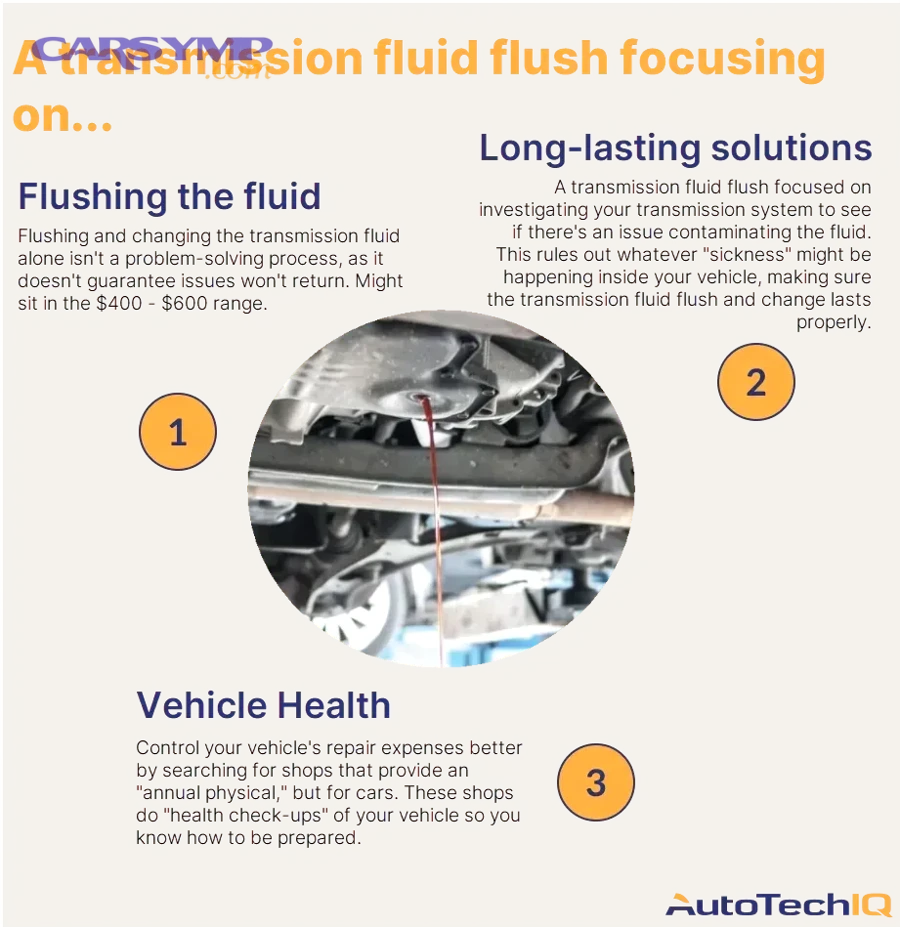
What Is the Difference Between a Transmission Fluid Change and a Transmission Flush?
There are two distinct types of transmission fluid services, and understanding the difference matters both for your wallet and for your transmission’s health.
A transmission fluid change (also called a drain-and-fill) removes the fluid held in the transmission pan — typically 5 to 7 quarts — by either removing the pan entirely or using a drain plug. This method replaces roughly 40–60% of the total fluid volume in the system, because some fluid remains in the torque converter and cooler lines. The pan is cleaned, the filter and gasket are typically replaced, and the system is refilled with fresh fluid.
A transmission flush, by contrast, replaces all of the fluid in the entire system — including the torque converter and cooler lines — using a specialized machine. A flush requires 12 to 22 quarts of fluid, which is why it costs approximately twice as much as a standard drain-and-fill. The Flush vs drain-and-fill for transmission fluid debate is a common one among mechanics: a flush provides more complete fluid replacement, but a drain-and-fill is sufficient for most routine maintenance intervals and carries less risk of dislodging debris in older, high-mileage transmissions.
| Service Type | Fluid Replaced | Typical Cost | Best For |
|---|---|---|---|
| Drain-and-Fill (Change) | ~40–60% (pan only) | $80–$250 | Routine scheduled maintenance |
| Full Flush | ~100% (entire system) | $125–$400 | High-stress driving, neglected fluid |
The table above summarizes the key differences between the two service types so you can quickly identify which one applies to your situation before booking an appointment.
What Happens If You Never Change Your Transmission Fluid?
Yes — neglecting a transmission fluid change will eventually cause serious, expensive damage to your transmission. The consequences range from minor performance issues to complete transmission failure, and they tend to escalate the longer the service is postponed.
When fluid degrades beyond its useful life, it loses the ability to properly lubricate and cool internal components. The results are progressive:
- Early stage: Rough or delayed gear shifts, a slight shudder when accelerating
- Mid stage: Gear slipping, difficulty staying in gear, unusual whining or grinding noises
- Late stage: Overheating, clutch pack failure, irreversible internal damage
The financial argument for staying current on fluid changes is straightforward. A transmission fluid change costs $80 to $250. A transmission rebuild typically runs $1,500 to $4,000. A full transmission replacement can reach $6,000 to $8,000 or more depending on the vehicle. Regular maintenance is not just a best practice — it is the lowest-cost insurance policy available for one of your vehicle’s most expensive components.
How Much Does a Transmission Fluid Change Cost in 2026?
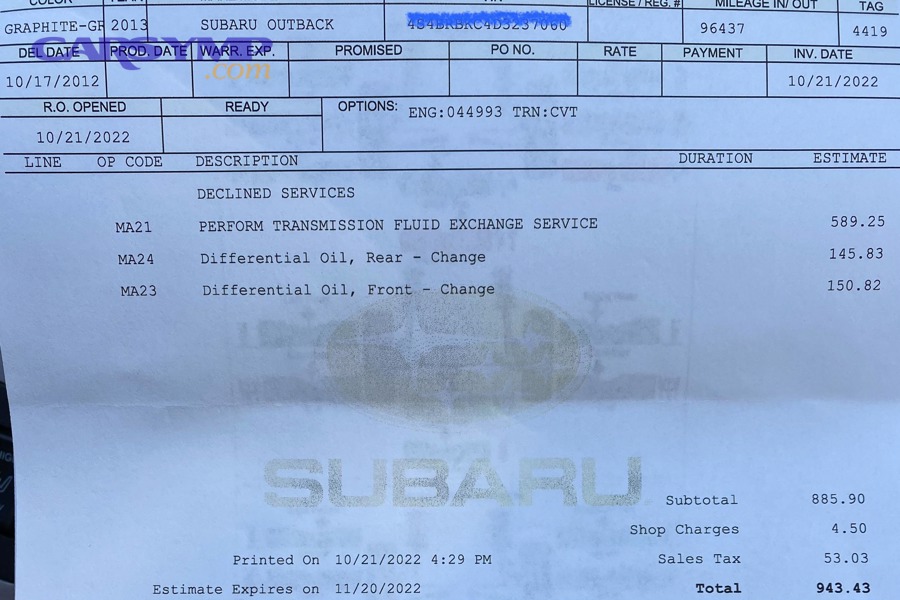
A transmission fluid change costs between $80 and $250 at most shops in 2026, with a full flush ranging from $125 to $400; the exact figure depends on your vehicle, the fluid type required, and where you have the service performed.
Specifically, the total bill breaks down into two components: labor and parts. According to RepairPal’s pricing data, labor for a standard transmission fluid change is estimated between $125 and $183, while parts — primarily the fluid itself and the filter — are typically priced around $107. Combined, this produces an average total of $232 to $290 for a standard automatic transmission service at a professional shop, though simpler vehicles can come in well below that range.
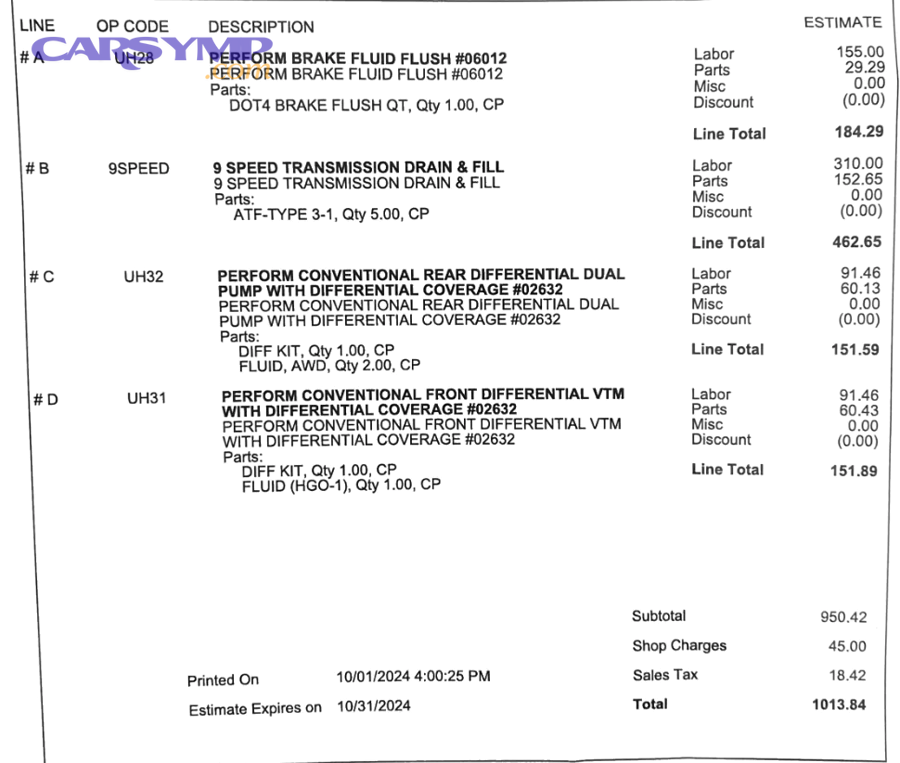
It is important to note that published estimates rarely include taxes, shop fees, or any additional inspections the service provider may recommend. Always request an itemized quote before authorizing work, and use tools like RepairPal’s Fair Price Estimator or Kelley Blue Book’s service pricing tool to benchmark what a fair price looks like in your specific ZIP code.
How Much Does Transmission Fluid Change Cost at a Dealership vs. Independent Shop?
Dealerships win on OEM fluid access and brand-specific expertise; independent shops win on price and value for most routine services; quick-lube chains win on speed and convenience for straightforward drain-and-fill services.
The table below provides a side-by-side comparison across all three provider types so you can match the right option to your priorities:
| Service Provider | Fluid Change Cost | Flush Cost | Key Advantage |
|---|---|---|---|
| Dealership | $150–$500 | $200–$475 | OEM-spec fluid, factory-trained technicians |
| Independent Shop | $80–$200 | $100–$300 | Best overall value, ASE-certified mechanics |
| Quick-Lube Chain | $100–$200 | $125–$250 | Fast turnaround, convenient locations |
| DIY | $40–$100 (fluid only) | N/A | Lowest cost, full control |
Dealerships charge the most because they use manufacturer-specified OEM fluids and employ technicians trained specifically on your vehicle brand. However, for most vehicles, an independent shop using the correct fluid type will deliver identical results at a meaningfully lower price. Independent shops — particularly those with ASE-certified technicians — are generally the best value for transmission fluid service unless your vehicle is under warranty or requires a proprietary fluid that only the dealer stocks.
How Much Does a DIY Transmission Fluid Change Cost?
A DIY transmission fluid change costs $40 to $100 in fluid alone, making it the cheapest option available — but it comes with real risks that make it unsuitable for every driver or every vehicle.
On the cost side, the savings are clear. You eliminate labor charges entirely, paying only for the fluid, a new filter ($15–$50), a replacement pan gasket, and any tools you don’t already own. For a straightforward domestic vehicle with a simple drain plug, the total investment can easily stay under $80.
However, DIY transmission fluid change risks are worth understanding before attempting the service:
- Wrong fluid selection: Transmission fluids are not universally interchangeable. Using the incorrect fluid type can cause severe internal damage within a short driving period.
- Over-tightening the pan fasteners: The transmission oil pan is aluminum or thin steel on most vehicles. Stripping the threads or cracking the pan by over-torquing bolts is a common DIY mistake.
- Incorrect fill level: Overfilling or underfilling the transmission causes its own set of problems — foaming, aeration, and hydraulic pressure issues.
- European vehicle complexity: Many European vehicles require specialized pumps to extract fluid from sealed transmission units that have no traditional drain plug, making DIY service significantly more difficult.
DIY makes the most sense for experienced home mechanics working on common domestic or Japanese vehicles where the correct fluid is readily available and the service procedure is well-documented. For European vehicles, CVTs, or anyone unfamiliar with the process, professional service is the safer and more reliable investment.
What Factors Affect the Cost of a Transmission Fluid Change?
There are five primary factors that affect the cost of a transmission fluid change: your vehicle’s make and model, the type of transmission fluid required, your geographic location, whether the filter is replaced at the same time, and the type of service provider you choose.
Each of these variables can move the final price in either direction, which is why two car owners can describe getting a “transmission fluid change” and report costs that differ by $300. Understanding each factor individually gives you the context to evaluate any quote you receive and identify where potential savings exist.
How Does Your Vehicle’s Make and Model Affect the Price?
Your vehicle’s make and model is the single largest cost determinant for a transmission fluid change, because it dictates the fluid type, fluid volume, and labor complexity involved in the service.
Here are real-world examples of how dramatically cost varies by vehicle:
- Honda Civic / Accord: $120–$200 using Honda DW-1 or HCF-2 CVT fluid. Relatively straightforward drain-and-fill; Honda recommends multiple drain-fill cycles for a thorough exchange.
- Toyota Camry / RAV4: $150–$250 with Toyota WS or CVT Fluid TC. Simple service on most trims.
- Ford F-150: $250–$400 due to the 10-speed transmission’s larger fluid capacity and higher labor time.
- Chevrolet Silverado / Sierra: $200–$350 using Dexron VI or Dexron HP fluid.
- BMW 3 Series / 5 Series: $300–$500 because European-spec ZF Lifeguard fluid is expensive and the labor involved is more complex.
The general pattern is consistent: domestic economy vehicles are cheapest to service, full-size trucks and SUVs fall in the middle, and European luxury vehicles are consistently the most expensive due to fluid costs and labor complexity.
Does the Type of Transmission Fluid Change the Cost?
Yes — the type of transmission fluid specified for your vehicle directly affects the total cost of the service, sometimes by $50 to $150 per service interval.
There are several fluid categories, and they vary meaningfully in price:
- Conventional ATF (e.g., Dexron III/Mercon): The most affordable option, typically used in older domestic vehicles.
- Full synthetic ATF (e.g., Dexron VI, Dexron HP): More expensive per quart but offers better heat resistance and longer service life.
- CVT fluid: Proprietary to the vehicle manufacturer in most cases; Honda, Nissan, and Toyota each specify different CVT fluids that are not interchangeable and are priced at a premium.
- OEM/European-spec fluid (e.g., ZF Lifeguard, Shell M1375.4): The most expensive category; used in BMW, Mercedes-Benz, Audi, and other European vehicles.
Using the correct fluid type is non-negotiable. Substituting a cheaper or incorrect fluid — even temporarily — can cause shift quality issues, accelerated wear, and in some cases, complete transmission failure within a short period of use.
Does Replacing the Transmission Filter Increase the Cost?
Yes — replacing the transmission filter adds cost to the service, but it is a recommended and worthwhile addition that most professional shops include as standard practice during a fluid change.
A transmission filter typically costs between $15 and $50 in parts, depending on the vehicle. When the service includes a pan removal (which most standard drain-and-fill services do), the filter is accessible and easy to replace at that point. Since replacing the filter adds minimal labor time when the pan is already removed, the incremental cost is low relative to the benefit.
The filter’s job is to trap metal particles, friction material, and other debris circulating in the fluid. A clogged or saturated filter restricts fluid flow and reduces the transmission’s ability to maintain proper hydraulic pressure. Replacing it alongside every fluid change — and replacing the pan gasket at the same time — is the complete service that most manufacturers and technicians recommend.
How Often Should Car Owners Change Their Transmission Fluid?
Car owners should change their transmission fluid every 30,000 to 60,000 miles for manual transmissions and every 60,000 to 100,000 miles for automatic transmissions, though the exact interval depends on the vehicle manufacturer’s specifications and real-world driving conditions.
The When to change transmission fluid interval is one of the most misunderstood aspects of vehicle maintenance, partly because transmission service schedules vary so widely across manufacturers. Some automakers specify a fluid change at 30,000 miles; others claim a “lifetime” fill that never needs changing under normal conditions. Most independent transmission specialists dispute the lifetime claim, noting that “lifetime” often means the life of the warranty period — not the life of the vehicle.
The safest approach is to consult your vehicle’s owner’s manual for the manufacturer-recommended interval, then adjust based on how you actually use the vehicle. Vehicles used primarily for highway driving in moderate climates can often stretch toward the upper end of the recommended interval. Vehicles subjected to more demanding use should be serviced closer to the lower end.
Does Driving Style Affect How Frequently You Need a Transmission Fluid Change?
Yes — driving style and conditions significantly affect how quickly transmission fluid degrades, and can shorten the recommended service interval by 30% or more compared to standard driving.
The following driving conditions accelerate fluid degradation and warrant more frequent service:
- Stop-and-go city traffic: Frequent gear changes and low-speed heat cycling degrade fluid faster than steady highway driving.
- Towing or hauling: Pulling a trailer or heavy load creates sustained high-temperature conditions that break down fluid viscosity more rapidly.
- Mountain driving: Repeated climbs and engine braking put additional load on the transmission’s hydraulic system.
- Hot climate operation: Sustained high ambient temperatures compress service intervals for all transmission fluid types.
Beyond mileage-based intervals, there are also condition-based warning signs that indicate a fluid change is needed regardless of where you are in the service schedule:
- Fluid that appears dark brown or black instead of red or light pink
- Fluid with a burnt smell when checked on the dipstick
- Rough, hesitant, or delayed shifts between gears
- A shudder or vibration when accelerating from a stop
- Unexplained gear slipping or sudden disengagement
Any one of these symptoms warrants immediate inspection and likely a fluid change, even if the mileage-based interval hasn’t been reached yet.
What Else Should Car Owners Know Before Booking a Transmission Fluid Service?
Now that you understand what a transmission fluid change costs and what drives that price, there are several deeper considerations — specific transmission types, regional pricing, long-term cost comparisons, and fluid technology — that can help you make a smarter, more financially sound maintenance decision.
How Much Does a CVT Transmission Fluid Change Cost Compared to an Automatic?
A CVT transmission fluid change typically costs more than a standard automatic fluid change — ranging from $150 to $300 at most shops — because CVT fluid is proprietary, more expensive per quart, and the service often requires multiple drain-and-fill cycles to achieve adequate fluid replacement.
Continuously Variable Transmissions use a belt-and-pulley system instead of fixed gear ratios, and they require fluid formulated specifically for that design. Honda specifies HCF-2 fluid for its CVTs; Nissan uses NS-3; Toyota specifies CVT Fluid TC or FE. None of these are interchangeable with standard ATF, and using the wrong fluid in a CVT can cause the belt to slip, leading to catastrophic internal damage.
Because CVT fluid cannot be fully replaced with a single drain-and-fill (the design of the unit traps fluid in the variator assembly), Honda and other manufacturers recommend performing two to three sequential drain-fill cycles to achieve a thorough exchange. This increases both the fluid cost and the labor time, pushing CVT service costs above those of a comparable automatic.
How Does Regional Labor Rate Variation Affect Your Final Bill?
Regional labor rates can shift your total transmission fluid change cost by $50 to $150 depending on whether you’re in a high-cost urban market or a lower-cost rural area.
Labor rates for automotive service in major metropolitan areas — New York, Los Angeles, San Francisco, Chicago — typically run $120 to $180 per hour. In smaller cities and rural areas, the same work might be billed at $75 to $110 per hour. Since a standard transmission fluid change takes approximately one hour of labor, this regional difference directly translates into meaningful cost variation at the bottom of your invoice.
To benchmark what a fair price looks like in your specific location, use RepairPal’s Fair Price Estimator, which adjusts pricing data based on your ZIP code, vehicle, and service type. Getting two or three quotes from local shops before committing to a service appointment is also a straightforward way to validate whether the price you’ve been offered is competitive for your area.
How Does a Transmission Fluid Change Cost Compare to a Full Transmission Rebuild?
A transmission fluid change, costing $80 to $250, is dramatically less expensive than the alternative: a transmission rebuild runs $1,500 to $4,000, and a full replacement can reach $6,000 to $8,000 or more. Regular fluid maintenance is one of the highest-return investments in automotive ownership.
This comparison illustrates the core financial logic behind transmission maintenance. The cost ratio between preventive care and corrective repair is roughly 1:30 to 1:50 — meaning for every dollar spent on routine fluid changes, you are potentially avoiding $30 to $50 in future repair costs. This is not a hypothetical: the majority of premature transmission failures seen by independent shops involve vehicles with no documented transmission service history.
The contrast here is intentional: preventive maintenance and corrective repair represent two entirely different cost trajectories. Staying on the preventive side of that divide — with regular fluid changes at appropriate intervals — is consistently the lower-cost path over the life of the vehicle.
Does Using Synthetic Transmission Fluid Cost More but Save Money Long-Term?
Yes — full synthetic transmission fluid costs more upfront, typically $8 to $15 per quart compared to $4 to $8 for conventional ATF, but it can extend service intervals and deliver measurable protection benefits that reduce long-term maintenance costs for many drivers.
Synthetic ATF offers several performance advantages over conventional fluid:
- Higher thermal stability: Resists breakdown at elevated temperatures more effectively, making it better suited for towing, stop-and-go driving, and hot climates.
- Longer service life: Many synthetic fluids can sustain performance for 50,000 to 100,000 miles under normal conditions, compared to 30,000 to 50,000 miles for conventional ATF.
- Better cold-weather performance: Flows more readily at low temperatures, reducing wear during cold starts.
- Oxidation resistance: Resists the formation of sludge and varnish deposits that can restrict fluid passages and clog the filter.
Whether synthetic is worth the premium depends on your specific vehicle and driving habits. For vehicles subjected to high-stress conditions — towing, mountain driving, hot climates, frequent stop-and-go traffic — the upgrade to synthetic makes practical financial sense and can reduce the total number of service intervals required over the vehicle’s lifetime. For a low-mileage vehicle used primarily in moderate conditions, the benefit may be less pronounced, and conventional fluid may be entirely adequate.
A transmission fluid change is one of the most cost-effective maintenance services in all of automotive ownership. At $80 to $250 for most vehicles, it costs a fraction of what a transmission repair or rebuild demands — and it is the single most reliable way to extend the working life of one of your vehicle’s most complex and expensive components. Whether you choose a dealership, an independent shop, or a DIY approach, the most important decisions are using the correct fluid for your specific transmission, staying within your manufacturer’s recommended service interval, and not waiting for symptoms to appear before acting. Use the pricing benchmarks, service comparisons, and cost factors outlined in this guide to walk into your next service appointment fully informed and confident in what you should expect to pay.