


A wheel balance vs alignment vibration comparison usually points to one practical answer: high-speed shake is more often a balance problem, while pulling, crooked steering, and uneven tread wear more often point to alignment. That core distinction matters because drivers often chase the wrong repair, spend money twice, and still live with the same symptom.
The next layer of the problem is symptom reading. vibration diagnosis works best when you connect the shake to when it appears, where you feel it, and what the car does at the same time. A steering wheel tremor at 60 mph tells a different story than a car that drifts left on a flat road.
A second important layer is decision-making. Many drivers do not just want definitions; they want to know whether to book balancing, alignment, or both. That is why the most useful comparison is not theoretical. It is based on real clues such as recent tire installation, pothole impacts, off-center steering, and unusual tire wear. ([firestonecompleteautocare.com](https://www.firestonecompleteautocare.com/blog/alignment/tire-balance-vs-alignment/?))
A final layer keeps the diagnosis honest. Severe shaking is not always caused by balance or alignment, and Vibration at speed vs idle vs braking diagnosis often reveals a different fault entirely, such as tire damage, suspension looseness, or Brake rotor vibration under braking causes. Next, the article breaks the issue down step by step so you can match symptoms to the right repair path.
What Is the Difference Between Wheel Balancing and Wheel Alignment?
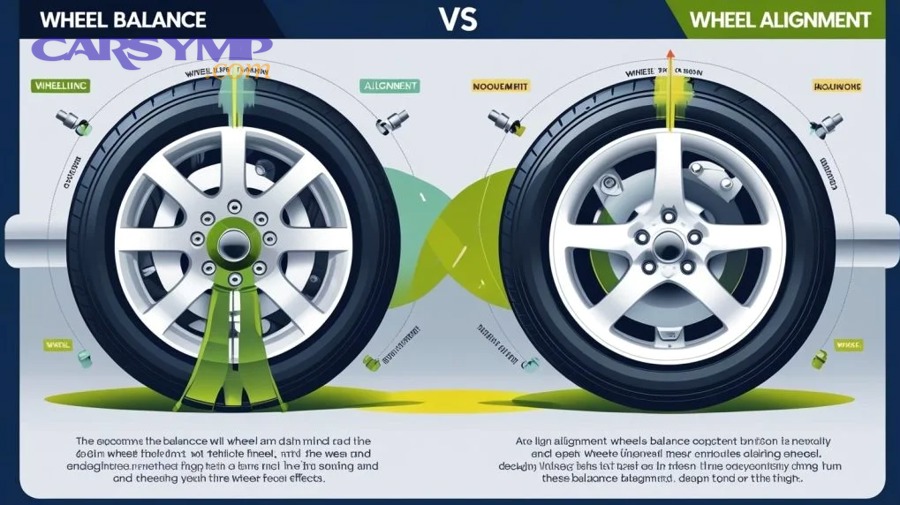
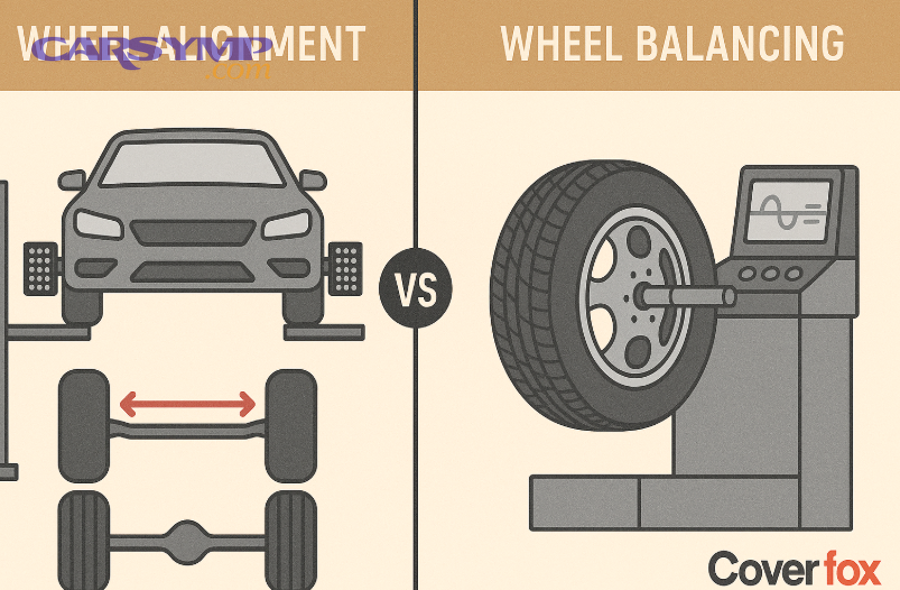
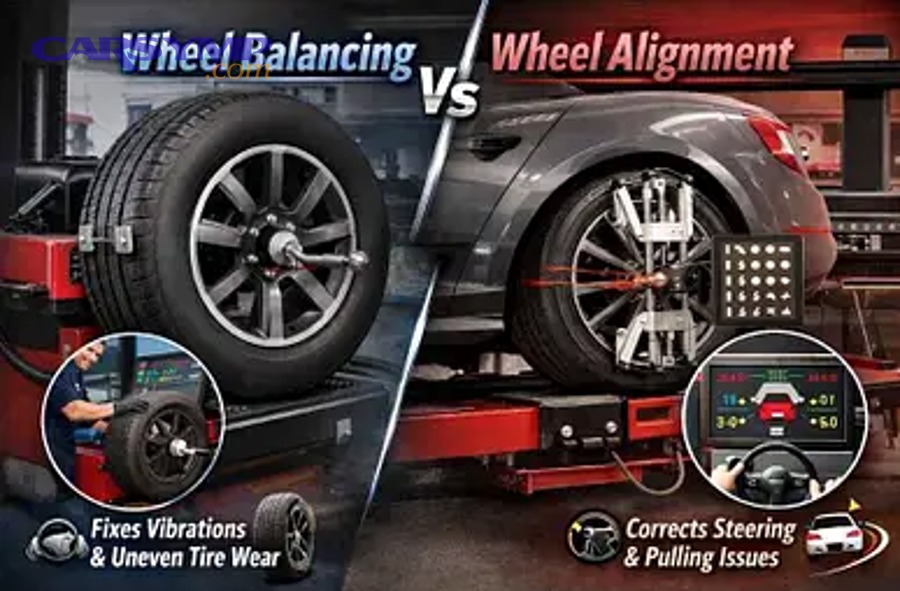
Wheel balancing corrects uneven weight distribution in the tire-and-wheel assembly, while wheel alignment adjusts suspension angles so the wheels point and track correctly.
To better understand the issue, it helps to separate what each service actually changes. Balancing works on the rotating assembly. A technician places the wheel and tire on a balancing machine, measures heavy spots, and adds weights so the assembly spins smoothly. Alignment does something different. It changes how the wheels sit relative to the road and to each other through suspension-angle adjustments.
Is wheel balancing mainly used to fix vibration?
Yes, wheel balancing mainly fixes vibration because it corrects rotating weight imbalance, reduces steering shake, and smooths out speed-related disturbances.
Specifically, an imbalanced wheel creates a repeating force every time it turns. That repeating force becomes more noticeable as road speed rises. The driver may feel it in the steering wheel, the seat, the floor, or the whole cabin depending on which wheel is affected and how severe the imbalance is. This is why many drivers report that the car feels mostly normal in town but starts shaking on the highway.
Balancing also protects the rest of the vehicle. A wheel that is out of balance does not only make the ride unpleasant. It can add stress to tires and suspension components over time. Firestone notes that imbalanced wheels can cause vibration in the steering wheel, floorboard, or seat, and Michelin explains that out-of-balance tires can create vibration that contributes to premature tire wear and unnecessary suspension wear. ([firestonecompleteautocare.com](https://www.firestonecompleteautocare.com/blog/alignment/tire-balance-vs-alignment/?))
Does wheel alignment mainly correct pulling, drifting, and tire wear rather than direct vibration?
Yes, wheel alignment mainly corrects pulling, drifting, and irregular tire wear, although in some cases it can contribute to a shaky or unsettled steering feel.
More specifically, alignment is about wheel direction and tire contact. If camber, toe, or related angles move out of specification, the vehicle may pull left or right, the steering wheel may sit off-center, and the tread may wear unevenly. The car often feels less stable even before the driver notices visible tire wear. Bridgestone highlights uneven tread wear, pulling, and an off-center steering wheel as classic alignment clues. ([bridgestone.co.th](https://www.bridgestone.co.th/en/tire-clinic/drivers-essential/tire-alignment?))
That distinction creates the core hook for the rest of the article: balance usually explains rotational vibration, while alignment more often explains tracking and wear problems.
How Can You Tell if Vibration Is Caused by Wheel Balance or Alignment?
You can usually tell by matching three clues: when the vibration happens, where you feel it, and whether the car also pulls or wears tires unevenly.
However, this heading matters because “the car vibrates” is too vague to diagnose correctly. Good vibration diagnosis starts with timing and behavior, not with guessing.
What vibration symptoms usually point to wheel imbalance?
Wheel imbalance usually shows up as speed-sensitive vibration, steering wheel shake, seat or floor tremor, and symptoms that begin after tire service or appear most strongly between about 40 and 70 mph.
For example, many drivers first notice a shake at a narrow highway-speed range. At 30 mph the vehicle feels fine. At 55 to 70 mph the cabin starts to buzz or the steering wheel shivers. At 80 mph the feeling may change again. That pattern is typical because imbalance creates a rotational disturbance that grows more obvious as wheel speed rises. Mavis identifies vibration between 40 and 70 mph as one of the most telling balancing symptoms. ([mavis.com](https://www.mavis.com/learning-center/tire-balancing-vs-wheel-alignment/?))
Another clue is location. Front-wheel imbalance often speaks through the steering wheel. Rear-wheel imbalance is more likely to come through the seat or floor. A recent tire replacement, wheel swap, puncture repair, or lost wheel weight also increases the odds that balancing is the real answer. Firestone adds that new tires are always balanced before installation and that balancing is often appropriate during tire rotation or after flat repair. ([firestonecompleteautocare.com](https://www.firestonecompleteautocare.com/blog/alignment/tire-balance-vs-alignment/?))
What symptoms usually point to wheel misalignment?
Wheel misalignment usually shows up as pulling, drifting, an off-center steering wheel, irregular tread wear, and a car that resists tracking straight.
More importantly, alignment symptoms often continue even when the road is smooth and the wheels do not feel obviously “out of round.” Instead of a repeating shake, the car may need constant steering correction. The steering wheel may look crooked while the vehicle moves straight, or the car may wander when the driver briefly relaxes steering pressure on a flat, safe road.
Tire wear is often the tie-breaker. If one shoulder wears faster, or if the tread looks scrubbed rather than evenly worn, alignment becomes more likely. NHTSA advises drivers to inspect tires for uneven wear patterns, and Bridgestone lists uneven tread wear and off-center steering among the main signs of alignment problems. ([nhtsa.gov](https://www.nhtsa.gov/sites/nhtsa.dot.gov/files/brochure.pdf?))
Which Driving Symptoms Should Be Grouped Under Balance Problems vs Alignment Problems?
There are two main symptom groups: balance-related symptoms center on speed-sensitive shake, while alignment-related symptoms center on direction, steering position, and tread wear.
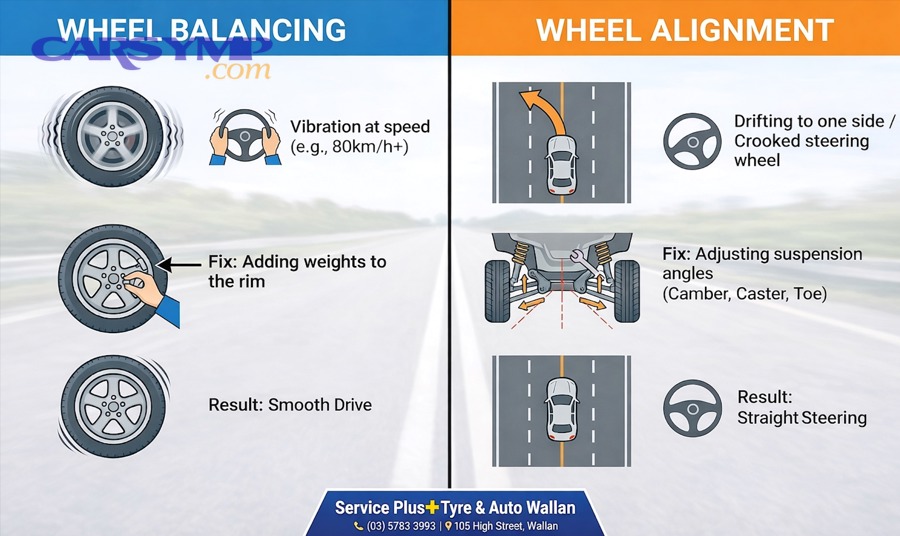
To illustrate that comparison clearly, the table below groups the most common clues drivers notice first.
| Symptom clue | More likely balance | More likely alignment |
|---|---|---|
| Vibration increases with speed | Yes | Sometimes, but less typical |
| Steering wheel tremor at highway speed | Yes | Possible, but secondary |
| Seat or floor vibration | Yes | Less common |
| Car pulls left or right | Rare | Yes |
| Steering wheel off-center | Rare | Yes |
| Uneven shoulder wear | Possible over time | Yes |
| Symptoms started after tire install/repair | Yes | Less likely |
| Symptoms started after pothole or curb hit | Possible | Yes |
This table compares the most practical symptom patterns drivers can use before booking service.
Which symptoms belong in the “likely wheel balance” group?
The likely wheel-balance group includes highway-speed shake, rhythmic vibration, seat or steering tremor, and symptoms tied to the rotating assembly rather than the steering path.
A balance issue often feels mechanical and repetitive. The vibration may come in waves, but it usually grows with speed. The car may not pull. The steering wheel may still look centered. The driver often says, “It is smooth around town but rough at 60 mph.” That sentence alone does not confirm imbalance, but it points strongly in that direction.
Which symptoms belong in the “likely alignment” group?
The likely alignment group includes pulling, drifting, off-center steering, tire scrub, and a vehicle that feels directionally wrong even when the road surface is good.
Meanwhile, alignment complaints are often less about shaking and more about correction. The driver keeps nudging the steering wheel to hold a lane. The car may feel unstable after hitting potholes, climbing curbs, or replacing suspension parts. If the tires also show inner-edge or outer-edge wear, alignment moves higher on the list of suspects. ([bridgestone.co.th](https://www.bridgestone.co.th/en/tire-clinic/drivers-essential/tire-alignment?))
Is Vibration at Highway Speed More Likely Balance Than Alignment?
Yes, vibration at highway speed is more likely a balance issue because it is speed-sensitive, rotational, and commonly strongest in the 40 to 70 mph range.
However, the key phrase is “more likely,” not “always.” The reason balance becomes the leading suspect is that wheel imbalance creates a repeating force every wheel revolution. As speed rises, that force becomes easier to feel. Multiple automotive service sources identify highway-speed vibration as one of the clearest balancing clues. ([firestonecompleteautocare.com](https://www.firestonecompleteautocare.com/blog/alignment/tire-balance-vs-alignment/?))
Does vibration that starts around 50 to 70 mph usually indicate imbalance?
Yes, vibration that begins around 50 to 70 mph usually indicates imbalance because that speed window commonly amplifies rotating mass errors and makes them easy for drivers to feel.
More specifically, the vehicle may pass through a resonance range where the rotating disturbance excites the steering or body structure enough to become obvious. Commercial tire-service guidance and manufacturer education pages repeatedly point to vibration as a major sign of imbalance, especially once speed increases. Research literature also supports the link between wheel imbalance and vehicle body vibration analysis. ([commercialtire.com](https://commercialtire.com/blog/tire-balancing-vs-alignment-whats-the-difference/?))
Can alignment still contribute to instability even when speed-related vibration feels like a balance issue?
Yes, alignment can still contribute to instability because poor toe or camber can make the vehicle feel nervous, wear the tire unevenly, and create conditions that coexist with a balance problem.
On the other hand, alignment usually does not create the same clean, repeatable highway-speed shake pattern by itself. In many real cases, drivers have both issues at once: a tire that needs balancing and a front end that needs alignment after impact or suspension work. That is why the best repair decision comes from symptom grouping, tire inspection, and recent service history rather than from one clue alone.
What Checks Help Confirm Whether You Need Balancing or Alignment?
The best confirmation method uses four checks: inspect tire wear, note steering-wheel position, track when vibration occurs, and review recent tire or impact history.
Let’s explore these checks in the same order a careful driver would.
What should you inspect on the tires, steering wheel, and road behavior first?
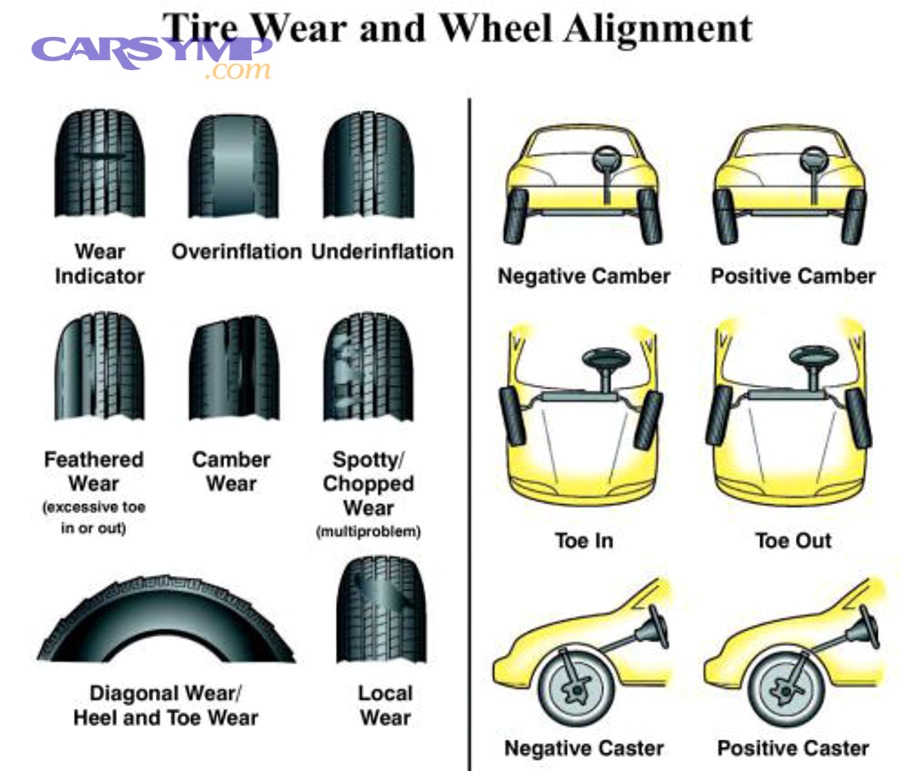
First, inspect the tread for uneven wear, missing chunks, bulges, or feathering. Then look at steering-wheel centering during straight driving, and finally note exactly when the vibration appears.
This sequence works because each observation narrows the diagnosis. Uneven shoulder wear pushes alignment higher. A centered steering wheel with a strong 60 mph shake pushes balancing higher. A vibration that appears only while braking points elsewhere and should not be lumped into a simple balance-versus-alignment comparison. NHTSA advises drivers to inspect tires for uneven wear and other signs of wear or trauma, which makes tread inspection a smart first step before booking service. ([nhtsa.gov](https://www.nhtsa.gov/sites/nhtsa.dot.gov/files/brochure.pdf?))
A useful notebook-style checklist looks like this:
- Does the steering wheel shake, or does the seat/floor shake?
- Does the car pull on a flat road?
- Is the steering wheel crooked while driving straight?
- Does the vibration begin at a specific speed?
- Did the issue start after new tires, a flat repair, pothole impact, or curb strike?
- Do the tires show edge wear, feathering, or cupping?
When should you ask for balancing, alignment, or both?
Ask for balancing when the symptom is mainly speed-related vibration; ask for alignment when the symptom is mainly pulling, crooked steering, or uneven wear; ask for both when symptoms overlap or recent work could have changed both conditions.
For example, a fresh set of tires with an immediate 65 mph shake usually deserves a rebalance check first. A car that started pulling after a pothole impact usually deserves an alignment inspection first. A vehicle with highway vibration plus obvious feathered tread may need both a balance correction and an alignment correction, especially if irregular wear has already changed how the tire rolls.
This is also where practical safety judgment matters. Safe-to-drive guidance with severe vibrations is simple: if the steering wheel shakes violently, the vibration gets worse quickly, the vehicle feels unstable, or you see tire bulges or wheel damage, do not treat it as routine maintenance. Stop driving at highway speed and have the vehicle inspected as soon as possible. Michelin notes that tire vibration can increase driver fatigue and unnecessary wear, and severe vibration may indicate a fault beyond simple balancing. ([michelinman.com](https://www.michelinman.com/auto/auto-tips-and-advice/tire-damage/tire-inspector-tool-handling?))
Can Something Other Than Balance or Alignment Cause Similar Vibration?
Yes, many other faults can mimic balance or alignment problems, including tire damage, bent wheels, suspension wear, wheel-bearing issues, and brake-related problems.
Moreover, this is the section that prevents misdiagnosis. A driver can lose time and money by booking alignment for a problem caused by a damaged tire, or by asking for a rebalance when the vibration only appears under braking.
What problems are often mistaken for wheel balance or alignment issues?
The most commonly mistaken problems are separated tires, bent rims, worn suspension joints, loose components, and brake-system faults.
A tire with internal belt damage can create a shake that feels like imbalance but does not disappear after repeated balancing. A bent wheel can do the same. Worn suspension parts can let a small vibration become a big one because the wheel no longer stays controlled over the road surface. Michelin lists steering and suspension malfunction alongside out-of-balance tires as a possible source of vibration, and service guidance from TIRECRAFT also points to loose parts, poor alignment, uneven wear, separated tread, and worn suspension joints as causes of lingering vibration. ([michelinman.com](https://www.michelinman.com/auto/auto-tips-and-advice/tire-damage/tire-inspector-tool-handling?))
When should drivers stop comparing balance vs alignment and inspect another repair path?
Drivers should move beyond the balance-versus-alignment comparison when vibration appears only under braking, when clunks or wobble accompany the shake, or when severe vibration starts suddenly.
This is where Brake rotor vibration under braking causes become important. If the steering wheel or pedal pulses mainly when the brakes are applied, the issue often points toward brake rotors, pad deposits, hub runout, or other brake and hub concerns rather than routine balance or alignment. Likewise, Vibration at speed vs idle vs braking diagnosis helps separate categories quickly: speed-only vibration suggests rotating wheel/tire issues, idle-only vibration suggests engine or mount issues, and braking-only vibration suggests brake-system faults.
In short, the comparison in the title works best when the symptom truly belongs to the wheel-and-tire category.
What Advanced Factors Can Make Wheel Balance vs Alignment Vibration Harder to Diagnose?
Advanced diagnosis becomes harder when the problem involves road-force variation, wheel or tire defects, mounting issues, or multiple smaller faults occurring at the same time.

Besides the common causes, some vehicles keep vibrating even after a standard balancing or alignment service. That usually means the basic diagnosis caught only part of the story.
What is the difference between standard wheel balancing and road force balancing?
Standard balancing corrects weight imbalance, while road force balancing also measures how the tire-and-wheel assembly behaves under simulated load.
More specifically, road force equipment can reveal issues that a normal spin balance may miss, such as force variation from tire stiffness changes or wheel-and-tire interaction problems. This matters when a driver says, “The shop balanced it twice, but it still shakes.” Hunter’s widely referenced road-force concept and related service education exist because not every vibration comes from simple weight imbalance alone, and engineering literature on wheel-induced vibration also points to force variation and tire nonuniformity as important contributors. ([open.clemson.edu](https://open.clemson.edu/cgi/viewcontent.cgi?article=1020&context=all_theses&))
Can a bent wheel or damaged tire mimic both alignment and balance symptoms?
Yes, a bent wheel or damaged tire can mimic both because it can create vibration, pulling sensations, irregular wear, and a general loss of smooth tracking.
For example, a tire with a separated belt may create a repeating thump, steering shimmy, or directional oddness that seems to overlap both categories. A bent wheel can cause runout that feels like imbalance but also changes how the tire contacts the road. These cases are the reason a good shop inspects wheels and tires visually and mechanically before assuming that added weights or angle adjustment will solve everything.
Does hub-centric vs lug-centric mounting affect vibration diagnosis?
Yes, mounting method can affect vibration diagnosis because improper centering during installation can create a shake even when the wheel has technically been balanced.
This is a rarer issue for everyday drivers, but it matters in aftermarket-wheel situations. If the wheel does not center properly on the hub or with the correct hardware, the vehicle can develop a vibration that feels like poor balance. The symptom can become especially confusing if it appears right after wheel changes and the balance numbers themselves look acceptable.
Why can a car still vibrate after balancing or alignment?
A car can still vibrate after balancing or alignment because the original diagnosis missed tire nonuniformity, wheel damage, suspension looseness, brake issues, or a second overlapping fault.
Thus, persistent vibration should trigger a wider inspection, not repeated guessing. The right next step may be road-force testing, wheel runout measurement, brake inspection, or a suspension check rather than another basic alignment printout. That is the most practical conclusion for everyday drivers: use the symptom pattern to make the first decision, but let persistent or severe vibration push the diagnosis deeper.
According to a study published in Sensors in 2023, researchers were able to identify tire-wheel imbalance based on vehicle-body vibration signals, supporting the idea that imbalance creates measurable vibration patterns that can be distinguished analytically. ([pmc.ncbi.nlm.nih.gov](https://pmc.ncbi.nlm.nih.gov/articles/PMC9965739/?))