



Moisture inside a headlight housing is fixable in most cases: dry the assembly safely, diagnose whether you have normal condensation or a true water leak, then reseal or replace the failed component so the moisture doesn’t return. Manufacturer service guidance commonly uses a “clearing test” with the headlamps on to separate normal fogging from sealing failure. (static.nhtsa.gov)
Then, to make the fix stick, you need to know what “normal” looks like and what “not normal” looks like, because headlights are typically vented (not perfectly sealed), and short-term fogging can happen with sudden temperature changes. (static.nhtsa.gov)
Next, you’ll want a practical troubleshooting path: vents, caps/gaskets, seam seal, and cracks account for the majority of repeat moisture problems, and you can usually find the culprit with a simple inspection sequence before you reach for sealant. (static.nhtsa.gov)
Introduce a new idea: once your headlight is dry and the root cause is handled, you can decide whether a headlight repair is worth it versus replacement, and how to keep condensation from returning—especially with modern LED housings that run cooler and can be more fog-prone in certain conditions. (mdpi.com)
What does “headlight condensation” mean, and when is it actually a problem?
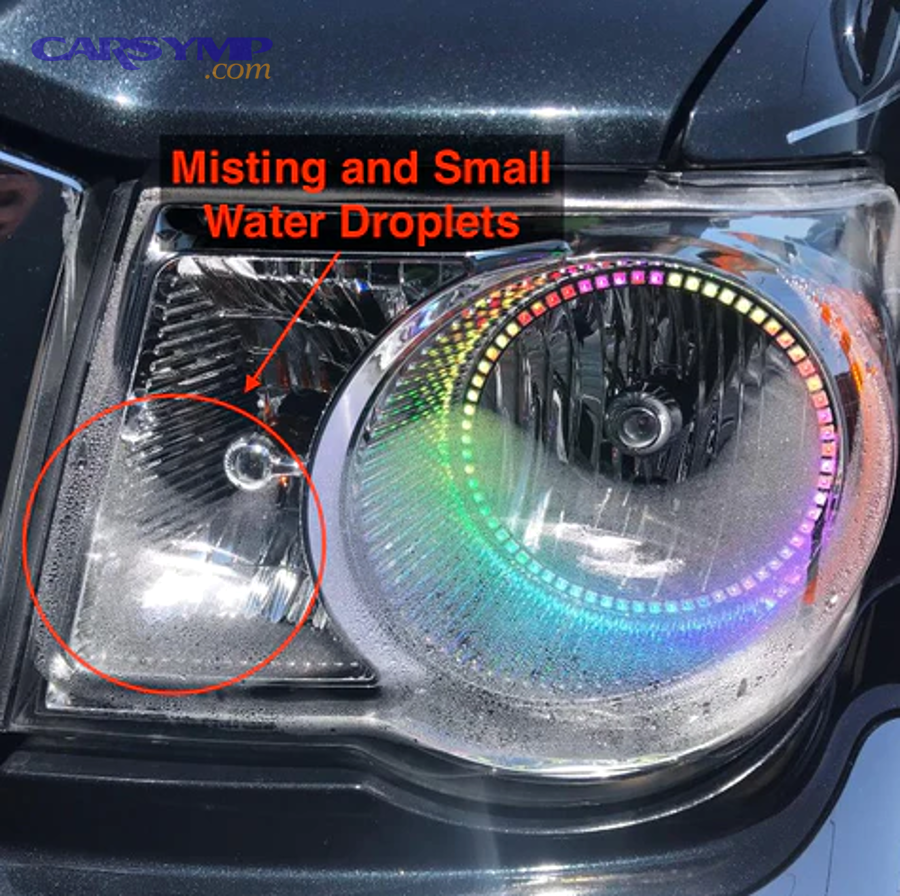
Headlight condensation is water vapor inside a vented headlight assembly turning into a thin fog or droplets on the inner lens when temperatures drop below the air’s dew point, and it becomes a problem when it persists, pools, or causes corrosion and lighting performance loss. (mdpi.com)
To better understand what you’re seeing, it helps to separate “normal fogging” from “water ingress,” because the fix changes depending on which one you have.

Is a little fogging inside headlights normal?
Yes—light, temporary headlight fogging can be normal for three reasons: (1) headlights are vented to equalize pressure, (2) sudden temperature changes can trigger dew formation, and (3) the fog often clears as conditions change or the lamps warm the lens. (static.nhtsa.gov)
Next, the practical rule is simple: normal fogging clears. One manufacturer-style clearing procedure is to dry the exterior lens and run the headlamps for a short period; if fogging begins to clear during that test window, it’s treated as normal venting behavior rather than a breached seal. (static.nhtsa.gov)
What “normal” often looks like:
- A thin mist near the coldest part of the lens
- No visible trails of water
- No puddles at the bottom of the housing
- Clears after driving or lamp operation in a drier environment (static.nhtsa.gov)
What’s the difference between condensation and a leak inside the headlight housing?
Condensation is a uniform fog that forms and clears; a leak is water that enters and behaves like water—it beads, runs, drips, or pools. (static.nhtsa.gov)
However, the most useful “eyes-only” comparison is pattern + persistence:
- Condensation: looks like haze, often across a portion of the lens; changes with weather and heat.
- Leak: looks like distinct droplets, streaks, or a waterline; tends to remain or worsen after rain, washing, or humidity spikes. (static.nhtsa.gov)
A leak also tends to show up after you’ve done something that adds water pressure—like a car wash wand aimed toward the headlight seam—while normal fogging may show up even when the car is just parked through a temperature swing.
What are the common signs that moisture is damaging your headlight (not just cosmetic)?
There are 4 common “damage” signs of moisture inside a headlight housing: (1) reduced illumination, (2) repeated bulb failures or flicker, (3) corrosion on connectors or metal reflectors, and (4) moisture that never clears or forms puddles. (publications.lib.chalmers.se)
Besides appearance, moisture becomes a safety issue because it can:
- Scatter or block light output (haze on the inner lens)
- Promote corrosion and shorten component life inside the housing (publications.lib.chalmers.se)
Evidence: According to a study by Chalmers University of Technology from the Department of Applied Mechanics, in 2011, researchers noted that moisture entering a headlamp can increase wear and corrosion and decrease lighting performance, and they described a climate-tunnel condensation test cycle lasting about five and a half hours. (publications.lib.chalmers.se)
What causes moisture inside a headlight housing?
There are 4 main causes of moisture inside a headlight housing—venting behavior, missing sealing components, seal failure at the lens seam, and physical damage (cracks/holes)—and the correct fix depends on which cause you can confirm. (static.nhtsa.gov)
Below, the goal is to match each cause to a specific “tell,” so you don’t waste time resealing a headlight that simply has a missing dust cap, or replacing a headlight that only needs the vent cleared.

Which entry points usually let water in—vents, seals, caps, or cracks?
There are 4 common entry points for water based on where sealing fails: rear access caps/bulb sockets, vent openings, lens-to-housing seam, and cracked housings/lenses. (static.nhtsa.gov)
Specifically, this is the fastest way to rank them in real DIY work:
- Rear access cap missing or not seated (very common after bulb changes)
- Gasket/O-ring degraded around bulb socket or service door
- Vent obstruction or vent cap issue causing abnormal moisture behavior
- Seam seal failure where the lens meets the housing
- Crack or impact damage that creates a direct water path (static.nhtsa.gov)
If you see clear physical damage, treat it as a leak first; service guidance explicitly lists cracked or broken housings as a leading cause of heavy, abnormal condensation. (static.nhtsa.gov)
Can a clogged or damaged vent cause condensation even without a leak?
Yes—a clogged or compromised vent can cause persistent condensation for three reasons: (1) trapped humid air can’t exchange properly, (2) pressure changes can pull moisture-laden air in, and (3) the lens cools below dew point while moisture remains inside. (static.nhtsa.gov)
Then, the key detail is this: many assemblies are designed to “breathe” (they’re vented, not hermetically sealed), which is necessary to handle air expansion and contraction. If the vent is blocked, the assembly can behave like it’s “sealed wrong”—holding humidity in place and fogging more easily. (static.nhtsa.gov)
A quick vent check looks like:
- Locate vent path (often a small duct, membrane vent, or port)
- Confirm it isn’t packed with dirt, wax residue, leaves, or road grime
- Confirm any vent tube isn’t kinked or pinched during installation
Does bulb type (halogen vs HID vs LED) change why condensation happens?
LED wins for low heat, halogen wins for natural defogging, and HID sits in the middle—because the amount and location of heat affects how quickly the lens warms and drives moisture back into vapor. (mdpi.com)
However, the real-world takeaway is practical:
- Halogen often clears fog faster because it radiates more heat toward the lens.
- LED can be more prone to lingering fogging because it emits far less radiant heat into the lens area (heat is often pulled into heat sinks at the rear). (mdpi.com)
- HID/xenon can still fog depending on venting and lens cooling, but heat behavior differs by housing design. (publications.lib.chalmers.se)
How do you dry out moisture inside the headlight housing safely and effectively?
The safest method is controlled warming plus airflow in 3 steps—(1) open rear access for ventilation, (2) dry with gentle heat or lamp operation, and (3) use desiccant as a booster—so the lens clears without warping plastics or damaging wiring. (static.nhtsa.gov)
Next, you’ll pick a drying approach based on severity: fogging, droplets, or pooling.

What’s the safest way to dry a headlight—hair dryer, heat gun, sunlight, or desiccant packs?
Hair dryer wins for safety, sunlight wins for simplicity, desiccant wins for low-risk finishing, and a heat gun is only optimal when you can control distance and temperature carefully.
However, don’t choose based on speed alone—choose based on risk to the housing:
- Hair dryer (low/medium): best DIY tool; controlled heat; low chance of melting if you keep it moving.
- Sunlight/garage warmth: slow but gentle; great for mild fogging when you can leave the car parked.
- Desiccant packs: helpful after you’ve driven moisture into the air; great for residual humidity.
- Heat gun: fastest but riskiest; too much heat can warp lenses, soften seam sealant, or damage nearby plastics.
A safe “default” sequence that works for many cases:
- Remove rear dust cap (or open service door)
- Run headlamps for 15–30 minutes (or use hair dryer from a distance)
- Add desiccant near the rear opening for a few hours (without letting it contact hot surfaces)
- Reinstall cap/gasket properly once fully dry
Should you remove the bulbs/caps to dry the housing faster?
Yes—removing the rear cap (and sometimes the bulb) can speed drying for three reasons: (1) it increases airflow, (2) it lets humid air escape instead of cycling inside, and (3) it gives you access to check seals that commonly cause leaks. (static.nhtsa.gov)
Then, do it carefully:
- Avoid touching bulb glass with bare fingers (oil reduces bulb life).
- Keep debris out of the housing (work clean; don’t leave it open outdoors).
- If you remove an HID or LED module, protect connectors from moisture and don’t force clips.
If moisture is heavy, a rear-cap inspection is also the fastest way to spot a missing O-ring, torn gasket, or cap that never seated correctly—one of the most common “it came back” causes. (static.nhtsa.gov)
How long should it take for condensation to clear after drying?
Condensation should begin to clear within minutes to about an hour once you apply heat/airflow, and it should stay mostly clear after the housing cools if the root cause is fixed. (static.nhtsa.gov)
However, persistence is the clue:
- Begins to clear quickly: often normal venting behavior.
- Doesn’t begin to clear during lamp operation: points toward sealing failure and true water ingress. (static.nhtsa.gov)
- Clears but returns after every wash/rain: likely a leak path that still exists.
How do you diagnose the root cause so it doesn’t come back?
Use a 4-stage diagnosis—(1) rear cap/gasket check, (2) vent path check, (3) seam inspection, (4) controlled water test—to confirm the leak path before you reseal anything. (static.nhtsa.gov)

Next, you’ll run the checklist in order because it’s optimized for “most common, easiest fix first.”
What is the fastest “diagnosis checklist” for moisture returning after drying?
There are 7 checks that solve most repeat moisture cases:
- Rear dust cap present and locked (no cracks, tabs intact)
- Gasket/O-ring seated (not flattened, torn, or missing)
- Bulb socket fully seated (especially twist-lock designs)
- Vent path open (no dirt plug, no pinched vent tube)
- Lens seam intact (no gaps, no lifted edge, no old sealant voids)
- Housing not cracked (impact marks, hairline fractures)
- Mounting alignment correct (a misaligned install can stress seals)
If you recently did Upgrading to brighter bulbs legally, pay special attention to the rear cap and bulb seating—many moisture complaints start right after a bulb swap because the cap didn’t reseat or the gasket got pinched. (The upgrade can be legal and safe, but only if the bulb type is compatible with the housing and the seals go back exactly as designed.)
Can you do a simple water test to find the leak without damaging anything?
Yes—you can do a gentle water test safely for three reasons: (1) you can target suspected areas, (2) you avoid pressurizing vents directly, and (3) you can confirm the leak path before applying sealant. (static.nhtsa.gov)
However, the method matters:
- Use low pressure (a watering can or light hose flow, not a pressure washer).
- Avoid spraying directly into vents; vents are meant to breathe, not be pressure-tested from the outside.
- Dry the exterior and look for fresh moisture appearing inside afterward.
A clean approach:
- Start with the area above the headlight (hood edge and fender seam)
- Wet the lens seam perimeter lightly
- Wet around the rear cap area (from above, not straight into openings)
- Wait 10–20 minutes and check for new droplets
What should you look for on the lens edge and housing seam to confirm seal failure?
Seal failure shows up as gaps, lifted seam sections, brittle or missing sealant, or evidence of previous repairs that left voids.
Then, confirm it with clues that match service guidance:
- Moisture never disappears
- Large droplets are visible across internal surfaces
- Water trails form and collect lower in the housing (static.nhtsa.gov)
At this point, don’t jump straight to sealing the entire perimeter. You’ll get a more durable result if you first identify whether the seam is truly the failure point—or whether the real issue is a missing cap, bad gasket, or a vent problem.
How do you reseal a headlight housing correctly after moisture issues?
A correct reseal is surface prep + the right sealant + even compression + full cure time, and it works best when you reseal the actual leak path instead of smearing sealant everywhere.
Next, you’ll choose a sealant strategy based on whether you might need to reopen the headlight later (for bulbs, drivers, or future repairs).

Should you reseal with butyl headlight sealant or RTV silicone?
Butyl wins for serviceability, RTV wins for convenience, and neither is “best” unless it matches your use case.
However, the decision is straightforward:
- Butyl (often used in headlamp seams): stays flexible, seals well, and is easier to reopen later for repairs. It’s commonly recommended for headlight seam sealing in DIY guidance.
- RTV silicone: can work well for small leak points and gaskets, but it can be messy, harder to remove, and some users report issues like off-gassing or cleanup difficulty in automotive heat cycles. (hidplanet.com)
Practical rule:
- If you’re resealing the lens-to-housing seam, butyl-type headlamp sealant is often the more forgiving choice.
- If you’re sealing a small localized gap or a non-service area, RTV may be acceptable if applied cleanly and cured fully.
When is replacing a dust cap, gasket, or O-ring enough to stop moisture?
Yes—replacing a dust cap, gasket, or O-ring is often enough for three reasons: (1) these parts are common leak points, (2) they fail from heat and age, and (3) they’re frequently disturbed during bulb changes. (static.nhtsa.gov)
Then, confirm you’re in the “cap/gasket fix” scenario:
- Moisture appears soon after bulb replacement
- No cracks or seam gaps are visible
- Condensation clears when dried but returns after rain/wash
- Cap shows warping, broken tabs, or missing seal ring
This is also the cheapest “first attempt” fix—before you commit to resealing a full perimeter seam.
What are the most common resealing mistakes that cause repeat condensation?
There are 5 common resealing mistakes:
- Sealing vents shut (creates trapped humidity and worse fogging) (static.nhtsa.gov)
- Skipping surface prep (oil/dirt prevents adhesion)
- Uneven bead or compression (leaves micro-gaps)
- Reassembling before full cure (sealant shifts under vibration/heat)
- Overheating the housing during opening (warps mating surfaces)
Besides workmanship, don’t ignore the design reality: headlamps are typically vented, so you’re not trying to create a fish tank—you’re restoring the intended sealing points while preserving the ventilation path. (static.nhtsa.gov)
When should you replace the headlight assembly or call a professional?
Repair is best when the leak point is simple and accessible, replacement is best when the housing is damaged or repeatedly leaks, and a professional is optimal when electronics or aiming safety are at risk. (static.nhtsa.gov)
More specifically, this is where you zoom out: moisture can be a symptom of something bigger, and chasing it forever costs more than one good replacement.
Is it better to repair or replace the headlight housing when water keeps returning?
Repair wins for isolated seal/cap issues, replacement is best for cracks or chronic leaks, and professional service is optimal when you risk electrical damage or incorrect beam aim. (static.nhtsa.gov)
However, you don’t have to guess—use a quick decision matrix. The table below summarizes what you’re deciding between and what it usually implies for time, risk, and money.
Table context: This compares typical DIY paths for recurring headlight moisture, including a rough Repair cost estimate for common headlight problems (parts-only ranges vary widely by vehicle).
| Scenario | Best path | Why | Typical DIY parts cost (rough) |
|---|---|---|---|
| Rear cap loose / gasket torn | Repair | Simple leak point; fastest fix | $5–$30 (cap/gasket/O-ring) |
| Vent clogged / vent tube pinched | Repair | Restores designed breathing | $0–$20 (cleaning/materials) |
| Seam seal failing but housing intact | Repair or rebuild | Reseal can work if surfaces aren’t warped | $15–$60 (butyl/RTV, supplies) |
| Housing cracked / mounting broken | Replace | Direct water path returns quickly | $150–$900+ (assembly varies) |
| Moisture + flicker/corrosion on connectors | Pro diagnosis | Prevents repeat failure and shorts | Varies (inspection + parts) |
If replacement involves removing bumpers, calibrating sensors, or complex LED modules, professional help can prevent expensive mistakes—especially if the headlight integrates driver boards and cooling systems.
Can moisture damage LED drivers/ballasts or wiring inside the headlight?
Yes—moisture can damage drivers/ballasts and wiring for three reasons: (1) water accelerates corrosion at connectors, (2) corrosion increases resistance and heat, and (3) intermittent electrical contact can cause flicker and failure. (publications.lib.chalmers.se)
Then, use symptoms to guide you:
- Flicker that worsens in wet weather
- Intermittent “out” warnings that go away when dry
- Green/white corrosion residue on pins
- A burning smell near connectors (stop and inspect)
This is also where Headlight fuse and relay troubleshooting becomes relevant—not because moisture always blows a fuse, but because repeated flicker or outages should be verified at the power supply path before you assume the bulb is bad. If a fuse is marginal or a relay contact is worn, moisture-driven resistance changes can make the problem look random.
Should you keep driving if there’s water inside the headlight?
No—you should not keep driving with water inside the headlight because (1) visibility can drop as the beam scatters, (2) corrosion can rapidly shorten component life, and (3) electrical faults can become intermittent and harder to diagnose. (publications.lib.chalmers.se)
In addition, moisture problems can affect how well your light is aimed and how clean the cutoff pattern appears. After any repair or replacement, confirm beam aim on a flat surface—good visibility is not just brightness, it’s correct distribution.
How can you prevent headlight moisture from returning in rare or recurring scenarios?
You can prevent repeat moisture by combining vent preservation, seal integrity, and humidity management, especially in climates with big temperature swings or on cooler-running LED housings. (mdpi.com)

Next, you’ll focus on the “why it came back even after you did everything right” cases.
Why does condensation return after a “successful” reseal—humidity cycles, dew point, or hidden vent issues?
Condensation can return after a good reseal when (1) the internal air still contains humidity, (2) the lens cools below dew point during temperature swings, or (3) the vent system can’t exchange air properly under real driving conditions. (mdpi.com)
Then, apply two practical tactics:
- Dry longer than you think you need before sealing up (residual humidity is the enemy).
- Verify vent function after reassembly, not before—because pinched tubes and blocked ports often happen during reinstall.
This is why some manufacturer diagnostics focus on whether fogging begins to clear during lamp operation rather than whether fog exists at a single moment. (static.nhtsa.gov)
Can headlight restoration (sanding/clear coat) make condensation better or worse?
Restoration can make condensation look worse (even if it isn’t) and sometimes behave worse because (1) a clearer lens makes internal fog more visible, (2) aggressive sanding near edges can disturb seam areas, and (3) coatings can change surface temperature behavior slightly.
However, the most important point is mechanical: if you remove the headlight for restoration and reinstall it, you increase the odds of a cap/gasket seating issue. So, treat restoration as a “disturbance event” and re-check caps, seals, and vents afterward.
Are desiccant packs inside headlights a good long-term fix or just a temporary workaround?
Desiccant packs are usually a temporary workaround, not a true fix because (1) they saturate over time, (2) they don’t stop new moisture entering, and (3) they can mask a leak that continues to corrode internal parts.
Then, use desiccant correctly if you choose it:
- Use it after drying to capture residual humidity
- Keep it away from hot components and moving fans (some LED bulbs use active cooling)
- Remove/replace it on a schedule if it’s accessible
If you can’t stop moisture without relying on desiccant, you still have an entry path or a venting issue that needs correction.
What’s the opposite mistake—can over-sealing block vents and create more condensation?
Yes—over-sealing can block vents and create more condensation for three reasons: (1) trapped moisture can’t escape, (2) pressure changes force humid air into weak points, and (3) the lens repeatedly cycles through dew-point conditions without drying out. (static.nhtsa.gov)
More importantly, avoid “sealing everything you can see.” A better strategy is:
- Restore the intended seals (caps, gaskets, seam)
- Keep vents functional and clean
- Confirm clearing behavior under real conditions (drive + weather change)
Evidence (if any)

- Service guidance examples distinguish normal fogging that clears from abnormal moisture that persists, using an “operate lamps and observe clearing” approach and noting that heavy droplets/persistent moisture can indicate sealing failure. (static.nhtsa.gov)
- Research literature explains fogging as a dew point phenomenon and notes that headlamp fogging can reduce performance and safety, especially as cooler-running LEDs become more common. (mdpi.com)
- An engineering thesis from Chalmers University of Technology (Applied Mechanics) discusses headlamp condensation testing and notes that moisture can increase corrosion and reduce lighting performance, including a described condensation test procedure lasting about 5.5 hours. (publications.lib.chalmers.se)