


Directional tires must always be rotated front-to-rear on the same side of the vehicle — never crossed from left to right without first dismounting them from the wheel. This single rule separates directional tire rotation from every other rotation pattern and is the most important thing any driver needs to understand before scheduling service. Getting it wrong doesn’t just waste money; it actively shortens the life of the tire and compromises wet-weather safety.
Understanding why that rule exists starts with the tire itself. Directional tires are engineered with a one-way V-shaped tread pattern that channels water outward as the tire spins forward. That design only works when the tire rotates in its intended direction. The moment it spins the wrong way — even briefly — the hydrodynamic benefit disappears and the tread wears in ways the manufacturer never intended.
Knowing the rule is only half the picture. Drivers also need to know how often tire rotation should happen, what the mileage interval looks like in practice, and how to recognize the early signs of uneven wear before it becomes an expensive problem. Most manufacturers and tire industry bodies agree on a 5,000–7,000 mile rotation schedule, but directional tires can demand closer attention because their limited rotation options mean wear distributes less evenly than with symmetrical or asymmetrical alternatives.
The third layer of this topic covers the mistakes that even experienced DIY mechanics make — mounting a directional tire on the wrong side, assuming a staggered-fitment vehicle can be rotated without dismounting, or including a mismatched spare in the rotation. Next, this article walks through every rule, every pattern, and every common pitfall in full detail so you leave with a complete, actionable understanding of directional tire rotation.
What Are Directional Tires and How Are They Different From Other Tires?
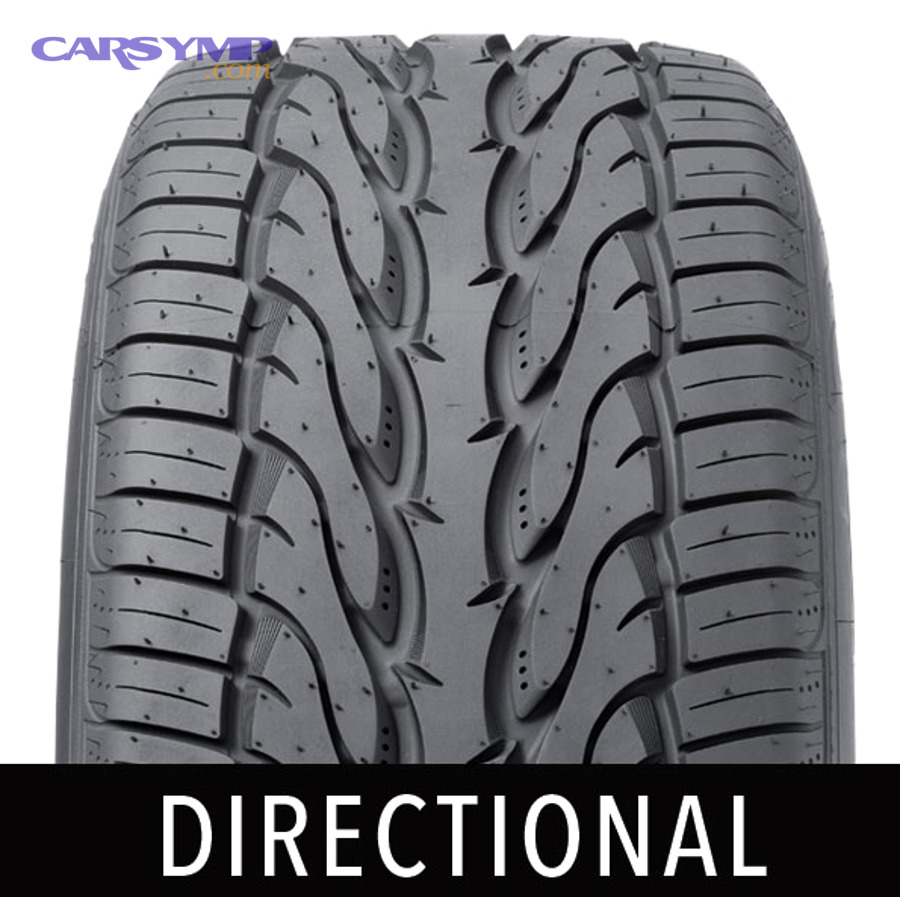
Directional tires are a specialized category of tire defined by a one-way tread pattern — typically V-shaped or chevron-shaped — engineered to rotate in a single forward direction only, delivering superior wet-road traction and hydroplaning resistance compared to standard tread designs.
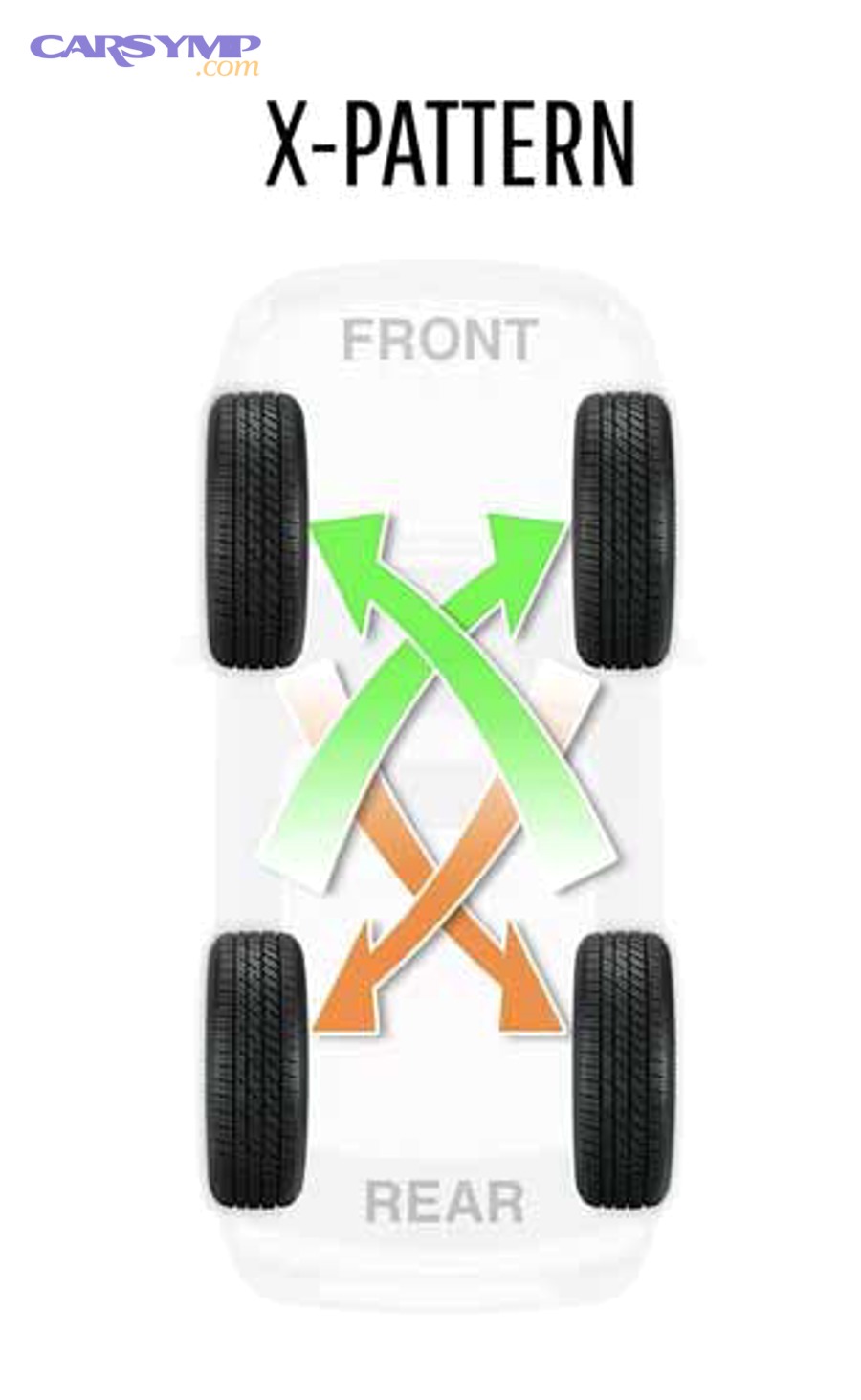
To better understand what makes directional tires unique, it helps to look at what sets them apart physically and functionally from the other two tread families available on the market today.
How Can You Tell If Your Tires Are Directional?
Identifying a directional tire is straightforward once you know what to look for, and there are three reliable indicators you can check in under a minute.
Look for the rotation arrow on the sidewall. Every directional tire has an arrow or triangle molded into the sidewall, usually accompanied by the word “ROTATION” or “→.” This marking points in the direction the tire must spin when the vehicle moves forward. If the arrow on a mounted tire points backward relative to the front of the vehicle, the tire has been installed incorrectly.
Examine the tread pattern shape. Stand in front of the tire and look down at the tread face. A directional tire will show lateral grooves that angle away from a central rib in a clear V or Y formation — like a chevron or an arrowhead pointing toward the ground. Symmetrical tires, by contrast, look the same on both halves of the tread, and asymmetrical tires show a distinct inner-to-outer zone difference with no consistent directional arrow in the groove pattern.
Check the tire’s product specification. The tire sidewall also carries the brand name, model name, and size. A quick search of that model name will confirm whether it is a directional tire. High-performance summer tires and many winter tires are directional; most all-season passenger tires are asymmetrical or symmetrical.
How Do Directional Tires Compare to Symmetrical and Asymmetrical Tires?
Directional tires excel in wet traction and high-speed stability, symmetrical tires offer the most rotation flexibility and lowest cost, and asymmetrical tires strike the best balance between dry grip, wet performance, and rotation freedom.
The table below summarizes the key differences across all three tread types to help drivers understand where rotation restrictions come from and why they matter.
| Feature | Symmetrical | Asymmetrical | Directional |
|---|---|---|---|
| Tread pattern design | Identical on both halves | Inner zone differs from outer zone | V-shape, one direction only |
| Rotation options | All patterns (cross, diagonal, straight) | Same-side or cross, but not flipped | Front-to-rear, same side only |
| Can be crossed without dismounting? | Yes | Yes | No |
| Best for | Economy, everyday driving | All-season performance | Wet roads, high-speed driving |
| Typical fitment | Standard passenger cars | All-season performance vehicles | Sports cars, performance vehicles |
| Tread life | Longest (most rotation flexibility) | Moderate | Shorter (limited rotation options) |
The table above makes clear that the restriction on directional tires is not arbitrary — it is a direct consequence of their tread geometry. Crossing a directional tire to the opposite side of the vehicle would force it to spin backward relative to its designed direction, negating the V-channel water evacuation and accelerating tread wear on the wrong shoulder.
According to the Tire Industry Association, improper tire installation — including mounting directional tires in the wrong rotational direction — is one of the leading causes of premature and uneven tread wear in passenger vehicles.
What Are the Rotation Rules for Directional Tires?
The core rule for rotating directional tires is absolute: always move them front-to-rear on the same side of the vehicle, never side-to-side, because reversing the tread direction eliminates the tire’s engineered water-channeling function and causes uneven, accelerated wear.

Specifically, this means the front-left tire moves to the rear-left position, and the front-right tire moves to the rear-right position — and nothing else changes. No diagonal, no cross, no side swap. This is sometimes called a “straight rotation” or “front-to-rear same-side” pattern, and it is the only factory-approved rotation method for directional tires unless the tires are physically removed from the wheels.
Can You Rotate Directional Tires to the Opposite Side of the Vehicle?
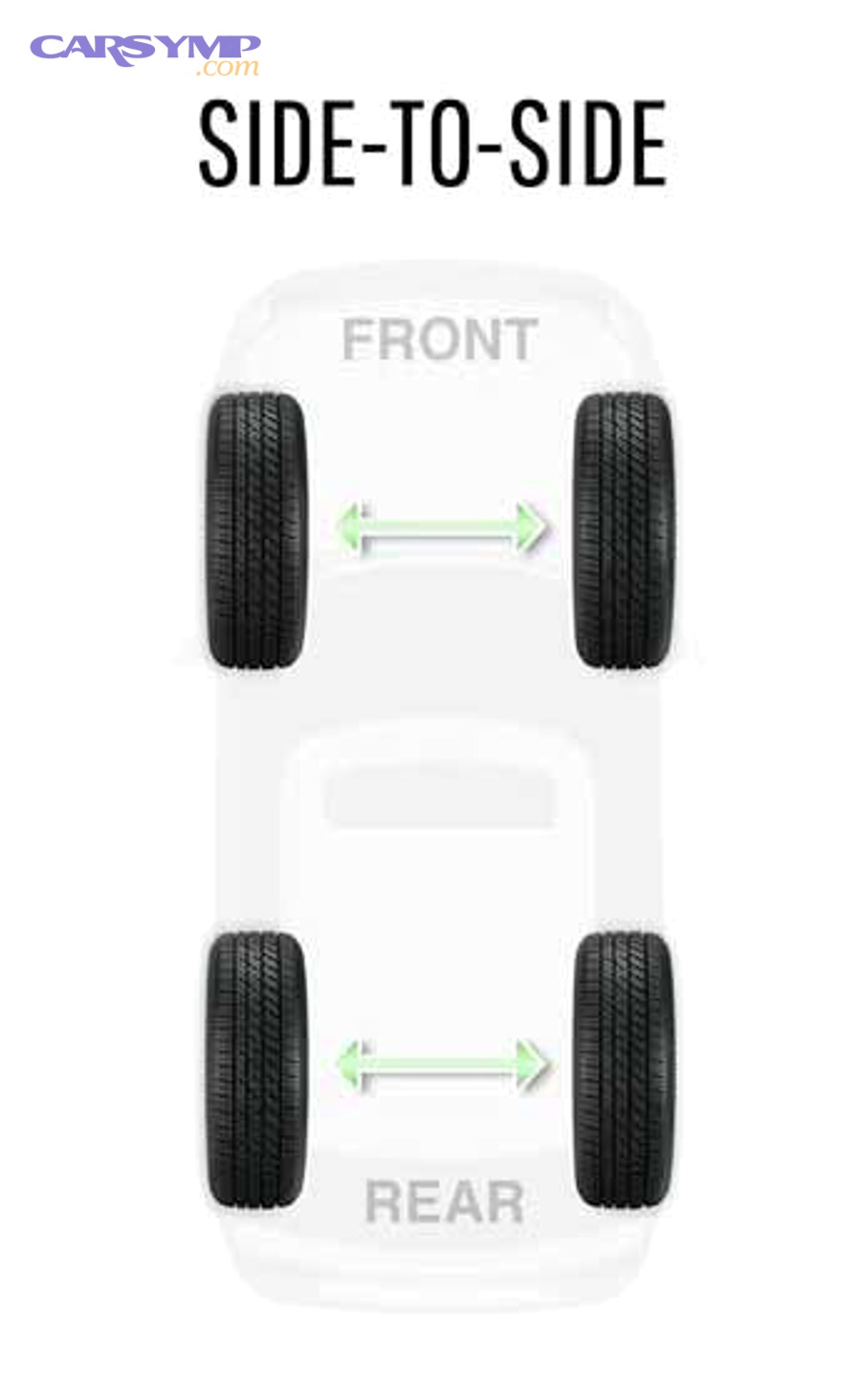
Yes, you can rotate directional tires to the opposite side of the vehicle — but only after dismounting each tire from its wheel, flipping it so the rotation arrow points in the correct new forward direction, and remounting and rebalancing it on the appropriate wheel.
This process is more involved and more expensive than a standard rotation. A technician must use a tire mounting machine to break the bead, flip the tire on the rim, reseat it, and then rebalance the wheel assembly. This adds both labor time and cost, which is why most drivers — and many shops — default to the simpler same-side front-to-rear swap. However, the full cross-rotation through dismounting is the correct approach when significant uneven wear has developed on one side, or when the vehicle has a staggered fitment requiring this procedure.
The decision on whether to include a full dismount-and-cross rotation versus a standard same-side swap is similar to the broader Tire rotation cost vs DIY calculation drivers face: the added expense of a professional dismount-remount service is almost always justified when it prevents a premature full tire replacement.
What Is the Correct Rotation Pattern for Same-Size Directional Tires?
For same-size directional tires, there are exactly 2 moves: front-left goes to rear-left, and front-right goes to rear-right. That is the complete rotation — straight, same-side, no exceptions.
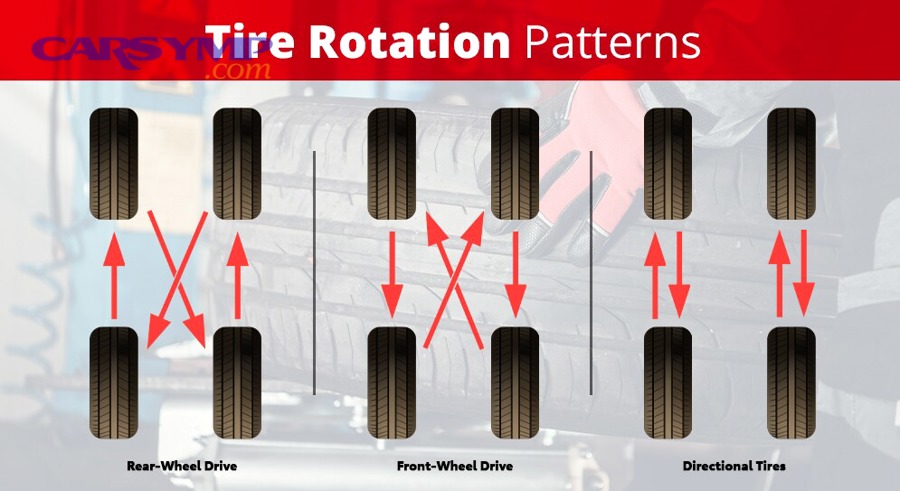
This pattern is sometimes illustrated in owner’s manuals as two vertical arrows running parallel down each side of a vehicle diagram. It is visually simple, but drivers accustomed to cross-rotation patterns (common on FWD vehicles with non-directional tires) sometimes question whether it is “really enough.” It is — provided the rotation is performed on schedule. The reason cross-rotation benefits non-directional tires is that it allows maximum wear redistribution. Since directional tires cannot cross without dismounting, the same redistribution goal is achieved by rotating more frequently and keeping a close eye on tread depth at each service interval.
What Is the Rotation Pattern for Directional Tires With Different Front and Rear Sizes?
For directional tires with different front and rear sizes — a configuration common on sports cars and performance vehicles — the only viable rotation method requires fully dismounting each tire from its wheel, remounting it on the correct-sized wheel for its new axle position, and rebalancing.
This is known as a staggered fitment. A vehicle like a rear-engine sports car might run a 245-width tire on the front and a 275-width tire on the rear. Because the wheel widths differ, you cannot simply swap the tires front-to-rear and bolt them on — the tire won’t fit the wrong-sized rim correctly, and the directional arrow would also point the wrong way on the opposite side. The correct procedure involves:
- Remove all four tires from their current wheels
- Mount the front tires (now moving to the rear) onto rear-sized wheels, verifying the rotation arrow is correctly oriented for the new side of the vehicle
- Mount the rear tires (now moving to the front) onto front-sized wheels, again confirming rotation direction
- Rebalance all four wheel-tire assemblies before reinstalling
This is strictly a job for a professional tire service center. Attempting it without a tire mounting machine will damage the tire bead. It is also worth factoring including balance during rotation as a non-negotiable step here — a remounted tire that isn’t rebalanced will cause vibration and uneven wear from the first mile.
How Often Should You Rotate Directional Tires?
Directional tires should be rotated every 5,000 to 7,000 miles — or at every oil change if that interval aligns — following your vehicle manufacturer’s recommended schedule, with the understanding that their limited rotation pattern may require slightly more frequent checks than non-directional alternatives.
The How often to rotate tires interval question comes up constantly, and for directional tires the standard guidance from both Bridgestone and Michelin aligns at the 5,000–7,000 mile range. However, if your vehicle is front-wheel drive, the front tires carry more load and may benefit from staying closer to the 5,000-mile end of that window. If it’s rear-wheel drive, 6,000–7,000 miles is typically sufficient.
Do Directional Tires Wear Out Faster Than Non-Directional Tires?
Yes, directional tires typically wear out faster than symmetrical non-directional tires, primarily because their restricted rotation pattern — same-side front-to-rear only — limits how evenly wear can be redistributed across all four tire positions over the tire’s lifespan.
More specifically, without the ability to cross-rotate, the tires never get to experience the differing stress patterns from the opposite side of the vehicle. On a front-wheel drive car, for example, the left-front tire handles the majority of torque delivery, braking force, and left-turn cornering load. With a symmetrical tire, a cross-rotation periodically sends that tire to a rear position on the right side, giving it an entirely different wear environment. A directional tire in the same position can only ever go directly backward on the left side — it never escapes the high-stress left-front load cycle.
The practical consequence is that many directional tires, particularly high-performance summer compounds, have a rated tread life of 20,000–30,000 miles compared to 50,000–70,000 miles for a quality all-season symmetrical tire. Staying rigidly on schedule with tire rotation is the most effective way to slow that wear differential.
When Should You Check Directional Tires for Uneven Wear?
Drivers should inspect directional tires for uneven wear at every rotation service — ideally every 5,000 miles — and immediately if any of the following Car Symptoms appear: pulling to one side during straight-line driving, vibration through the steering wheel, or a noticeable humming or growling noise that changes with vehicle speed.
The most common uneven wear patterns to look for on directional tires include:
- Center wear: The center tread rib wears faster than the shoulders — typically caused by chronic overinflation, which concentrates contact pressure in the middle of the tread.
- Shoulder wear: Both outer edges wear faster than the center — usually from chronic underinflation, which spreads the contact patch and loads the edges.
- One-sided shoulder wear: Only one edge wears disproportionately — most often a wheel alignment problem. On directional tires, this is a critical sign because the limited rotation options mean the problem compounds faster than it would with a cross-rotatable tire.
- Cupping or scalloping: Irregular high-and-low patches around the circumference — caused by worn shock absorbers or struts that allow the tire to bounce against the road surface rather than maintaining consistent contact.
If cupping, feathering, or one-sided wear is visible, address the root mechanical cause — alignment, inflation, or suspension — before the next rotation. Rotating a tire with an unresolved alignment problem just spreads the damage.
According to a consumer safety study by the National Highway Traffic Safety Administration (NHTSA), tires with irregular or uneven tread wear patterns are significantly more likely to experience tread separation and blowout events, reinforcing the importance of regular inspection intervals.
What Are the Most Common Mistakes When Rotating Directional Tires?
There are 3 main categories of mistakes drivers and technicians make when rotating directional tires: mounting them in the wrong rotational direction, attempting side-to-side swaps without dismounting, and including an incompatible spare tire in the rotation cycle.
Each of these errors is easy to make, particularly for mechanics more familiar with standard non-directional rotation patterns, and each carries real consequences for tire longevity and vehicle safety.
What Happens If Directional Tires Are Mounted in the Wrong Direction?
Yes, mounting a directional tire in the wrong rotational direction causes measurable harm — specifically, it reverses the water evacuation channels in the tread, reduces wet traction significantly, and accelerates wear in the inner shoulder zone where the tread pattern is working against its designed geometry.
The V-shaped grooves in a directional tire are angled to pump water outward and away from the contact patch as the tire rolls forward. When a tire is mounted backward, those grooves effectively work in reverse — instead of expelling water, they redirect it inward toward the center of the contact patch. The result is a notable reduction in hydroplaning resistance at highway speeds. On dry roads, the performance loss is less dramatic, but the tread will still wear unevenly and more quickly because the lateral groove edges are loading on the wrong side.
In addition, a backward-mounted directional tire often generates a subtle but distinctive road noise — a directional hum that changes pitch with speed. This is one of the early car symptoms that a technician should investigate immediately.
Can You Include a Spare Tire in a Directional Tire Rotation?
No — with rare exceptions, spare tires should not be included in a directional tire rotation because most modern spare tires are temporary compact (“donut”) spares that are neither directional nor the same size as the drive tires, making them mechanically incompatible with any rotation pattern.
The one narrow exception is a vehicle equipped with a full-size matching spare — same brand, same model, same size, same directional tread pattern — where the spare has been maintained at the correct inflation pressure and has comparable tread depth to the other four tires. In that specific case, a five-tire rotation is technically possible, but it must follow the directional rules precisely: the spare can only enter the rotation on the same side as the tire it replaces, and no crossing is permitted without dismounting.
For the overwhelming majority of drivers, the spare lives under the vehicle or in the trunk and stays there during rotation. Using a temporary spare in a rotation not only fails to improve wear distribution — it introduces a tire with different diameter, load rating, and tread compound into the drive system, which can stress differentials and produce dangerous handling imbalances.
Are There Special Rotation Considerations for Directional Tires on Specific Vehicles or Use Cases?
There are 4 specialized scenarios where directional tire rotation requires additional steps or professional judgment beyond the standard same-side front-to-rear rule: all-wheel drive systems, run-flat tires, high-performance track compounds, and the cost-benefit decision of whether to cross-rotate through dismounting versus skipping the cross entirely.
These scenarios fall outside the routine rotation question but represent the cases where getting the decision wrong carries the highest consequences — either in drivetrain damage, structural tire failure, or wasted money on unnecessary labor.
How Do You Rotate Directional Tires on an AWD Vehicle?
Rotating directional tires on an AWD vehicle follows the same same-side front-to-rear rule, but with one critical additional requirement: all four tires must be within 2/32 inch of each other in tread depth at the time of rotation, or the traction differences between axles can damage the vehicle’s center differential or torque-coupling system.
AWD systems are engineered around the assumption that all four tires are rotating at nearly identical speeds. When one axle’s tires have significantly more worn tread than the other axle’s tires, the effective rolling radius differs between front and rear — and the AWD system compensates by continuously transferring torque to equalize speed, which generates heat and wear in the differential. Over time, this causes premature differential failure, which is an expensive repair far exceeding the cost of a new set of tires.
For this reason, tire rotation on AWD vehicles with directional fitments should always be performed by a professional who can measure tread depth on all four positions before and after service. If tread depth variance has already exceeded 2/32 inch between axles, replacing tires in axle pairs (rather than one at a time) is the correct approach.
Can Directional Run-Flat Tires Be Rotated the Same Way as Standard Directional Tires?
Yes, directional run-flat tires follow the same same-side front-to-rear rotation rule — but they require a mandatory full structural inspection before rotation can be confirmed as safe, because run-flat tires that have been driven in a deflated or low-pressure state may have suffered internal damage that is invisible from the outside.
Run-flat tires are constructed with reinforced sidewalls that allow continued driving at reduced or zero air pressure for a limited distance (typically up to 50 miles at 50 mph, depending on the manufacturer). However, that reinforced sidewall can sustain internal stress fractures, delamination, or bead damage during a zero-pressure event that leaves the exterior tread surface looking completely normal. A tire that appears visually sound may be structurally compromised.
Before any run-flat directional tire is moved to a new position, a qualified technician should inspect it — and in many cases, a run-flat that has been driven deflated should be replaced rather than rotated, regardless of apparent external condition.
Do High-Performance and Track Directional Tires Follow the Same Rotation Rules?
Yes, high-performance and track-use directional tires follow the same same-side rotation rules as standard directional tires, but the rotation interval is typically shorter — often 3,000 to 5,000 miles — due to the softer rubber compounds that wear more rapidly under aggressive driving conditions.
Track-oriented tires like ultra-high-performance summer compounds are almost universally directional, and many sports cars that use them are also staggered-fitment vehicles, meaning the front and rear tires are different widths and sizes. This combination makes regular tire rotation impractical without full dismounting at every service — which is why many performance car owners simply do not rotate these tires at all, accepting shorter tread life as a trade-off for maximum grip.
For street-driven performance vehicles where tires are directional but not staggered, maintaining the 4,000–5,000 mile rotation interval is worthwhile. The labor investment in a professional same-side rotation is modest compared to the cost of replacing a full set of performance tires several thousand miles earlier than necessary.
Is It Worth Rotating Directional Tires at All Given the Extra Labor Cost?
Yes, rotating directional tires is worth the extra labor cost in virtually every case, because the alternative — skipping rotation — consistently results in earlier full tire replacement, costing significantly more than the cumulative rotation service fees.
The tire rotation cost vs DIY equation for directional tires looks different than for non-directional tires. A standard same-side front-to-rear directional rotation is no more complicated than a straight rotation on any other tire — most shops charge $20–$50 for the service, or include it free with an oil change package. The extra cost only arises when dismounting and remounting are required for a cross-side rotation, which typically adds $20–$40 per tire in labor.
To put this in perspective: a full dismount-cross-rotation service on four directional tires might cost $80–$160 more than a standard same-side rotation. But skipping rotation entirely on directional tires — given their already-limited wear redistribution ability — can shorten tread life by 15–25%, meaning a tire rated for 25,000 miles might deliver only 18,000–21,000 miles of usable life. On a set of performance tires costing $800–$1,200, that early replacement represents $150–$300 in lost tire value.
The math consistently favors rotation. The only scenario where skipping rotation is arguably rational is on a staggered-fitment performance vehicle where dismounting costs are high, tread life is already short by design, and the driver replaces tires frequently as a matter of course. Even then, regular same-side straight rotations — where the fitment allows it — remain cost-effective.
According to data published by the Rubber Manufacturers Association, regular tire rotation as part of a complete maintenance schedule that includes proper inflation and wheel alignment can extend overall tire life by up to 20%, representing meaningful savings over the lifetime of a vehicle.
In summary, rotating directional tires correctly comes down to one foundational rule — same side, front to rear, every time — applied consistently at the right mileage interval, with the knowledge to recognize when a more involved dismount-and-cross procedure is warranted. Pair that rotation schedule with regular tread depth checks, proper inflation, and attention to alignment, and directional tires will deliver the wet-weather performance and handling precision they were designed to provide for their full service life.