


Your car often tells you it needs a tune-up before it suffers a bigger engine problem. The most common warning signs are rough idling, hard starting, weak acceleration, poor fuel economy, hesitation, stalling, misfiring, and a check engine light that keeps coming back. When several of these symptoms appear together, they usually point to combustion or ignition inefficiency rather than a random one-time glitch.
A modern tune-up is also different from the old idea of simply swapping a few parts. Today, a tune-up usually means inspecting wear items, replacing spark plugs on schedule, checking filters and ignition-related components, and confirming that the engine management system is not masking a growing problem. That is why symptom recognition matters more than relying on an outdated mileage myth alone.
Drivers also need to separate tune-up symptoms from bigger mechanical trouble. Some issues do start with tune-up-like behavior but later reveal sensor faults, fuel delivery problems, vacuum leaks, or internal engine wear. Understanding those differences helps you act sooner, avoid wasted parts replacement, and know when a tune-up is enough versus when diagnosis comes first.
The next step is to connect each symptom with what it usually means, what a tune-up includes today, and how quickly you should respond before repair costs rise. Introduce a new idea: below, the article moves from the most obvious warning signs to the service decisions that protect performance, fuel efficiency, and engine life.
What Are the Warning Signs Your Car Needs a Tune-Up?
Yes, warning signs your car needs a tune-up usually include rough idling, hard starting, weak acceleration, poor fuel economy, and repeated misfiring because these symptoms all point to inefficient combustion, aging ignition parts, or airflow problems.
To better understand those signs, it helps to look at how they show up in daily driving rather than as isolated shop terms.

A tune-up symptom is rarely dramatic at first. In many cases, the engine still runs, but it no longer runs cleanly or consistently. You may notice a longer crank before startup, a shaky idle at stoplights, a lag when you press the accelerator, or a steady decline in fuel economy over a few weeks. These are not random inconveniences. They often signal that spark delivery, air intake, or fuel combustion is becoming less efficient.
Another useful clue is pattern. If the car hesitates only once on a cold morning, that does not automatically mean it needs a tune-up. If it hesitates three or four times a week, idles rough in traffic, and burns more fuel than usual, the pattern becomes much more meaningful. A tune-up is most often justified when multiple drivability symptoms appear together and gradually worsen.
Modern vehicles may also hide early symptoms better than older cars. Engine computers can compensate for small changes in fuel mixture or ignition performance, which means the car may still feel “mostly normal” while efficiency drops and emissions rise. That is one reason many drivers delay service too long. By the time the problem becomes obvious, the vehicle may be misfiring badly enough to trigger more expensive repair risks.
Is rough idling, hard starting, or stalling a sign your car needs a tune-up?
Yes, rough idling, hard starting, and stalling are classic signs your car may need a tune-up because worn spark plugs, weak ignition performance, dirty intake components, or related maintenance issues can disrupt stable combustion.
More specifically, these symptoms matter because they affect the engine when it is under the least margin for error: starting, idling, and low-speed operation.
Rough idling usually feels like a vibration through the steering wheel, seat, or dashboard when the car is stationary. The engine may sound uneven, as if one cylinder is not contributing its share. That can happen when spark plugs are worn, ignition coils are struggling, or the air-fuel mixture is unstable. While rough idling can also come from vacuum leaks or sensor issues, it is still one of the most common warning signs that the vehicle needs tune-up attention.
Hard starting tells a similar story. When the engine cranks longer than normal, starts roughly, or needs multiple attempts to fire, it may be losing combustion efficiency. Spark plugs are a common reason because they wear gradually. As the electrode ages, the spark becomes less reliable, especially under cold-start conditions or when humidity is high. A vehicle that starts poorly but runs somewhat better after warming up often deserves a tune-up review before the problem becomes a no-start condition.
Stalling is more urgent. A stall at idle, in traffic, or during a stop can still be tune-up-related, but it also moves the issue closer to a diagnostic threshold. Repeated stalling suggests the engine is no longer maintaining stable combustion consistently enough for safe everyday driving. At that point, a tune-up may still be part of the solution, but the shop may need to verify whether a fuel, air, or electronic control problem is involved too.
According to AAA, worn spark plugs and ignition components can contribute to misfiring, rough acceleration, rough idling, increased fuel use, and difficulty starting the vehicle. (aaa.com)
What does poor fuel economy or weak acceleration say about tune-up needs?
Poor fuel economy and weak acceleration usually say that your engine is running less efficiently than it should, often because ignition wear, incomplete combustion, or airflow restrictions are reducing the power extracted from each unit of fuel.
Specifically, these symptoms matter because they often appear before a breakdown and before many drivers think of scheduling service.
Fuel economy tends to decline gradually, which makes it easy to ignore. You may not notice it until the same commute starts requiring fuel noticeably sooner. When spark plugs misfire or struggle to ignite the air-fuel mixture cleanly, the engine wastes energy. The car still moves, but it needs more throttle input and more fuel to do the same work. That is why a tune-up often becomes noticeable first at the pump rather than as a dramatic mechanical failure.
Weak acceleration works the same way from the driver’s seat. The car may feel lazy leaving a stop, hesitate when merging, or respond a second late after you press the pedal. If the engine cannot build smooth, strong combustion, it cannot deliver crisp power. A clogged air intake path, worn plugs, or an ignition problem can all contribute to that sensation.
Drivers should also know one important nuance about and fluids in a tune-up. A modern tune-up does not usually center on fluid replacement alone, and declining MPG is not solved by changing random fluids. The key is matching the symptom to the likely maintenance item. For example, a clogged air filter on many modern fuel-injected cars may improve acceleration when replaced, but it does not usually deliver a major MPG gain on its own. Ignition-related issues are often more important than people assume.
The official FuelEconomy.gov guidance says the check engine light should be addressed promptly because engine issues can reduce fuel economy, increase emissions, and lead to costlier repairs later; it also notes that replacing a clogged air filter on modern fuel-injected cars improves performance more than fuel economy. (fueleconomy.gov)
Which Symptoms Most Commonly Point to a Needed Tune-Up?
There are 8 main tune-up warning symptoms: rough idle, hard start, misfire, hesitation, weak acceleration, stalling, poor fuel economy, and a persistent check engine light, based on how directly they reflect combustion and drivability problems.
Let’s explore those symptoms in groups so you can tell which ones are merely annoying and which ones demand faster action.
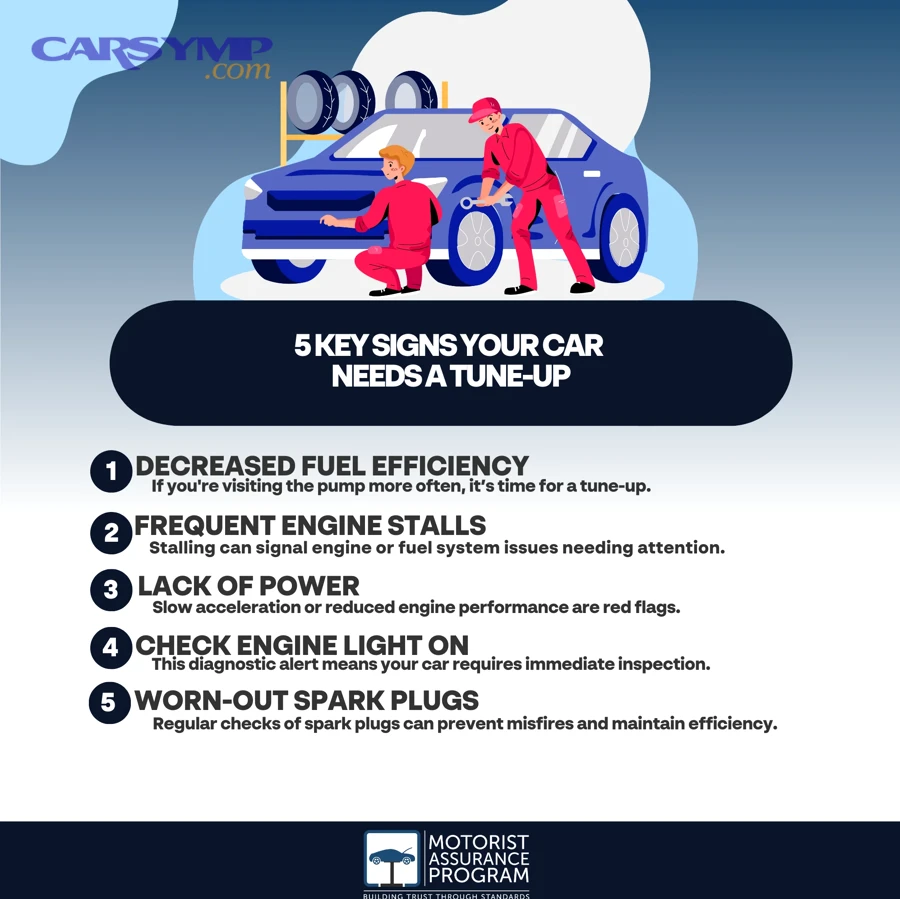
Most tune-up-related symptoms fall into one of two clusters. The first is drivability: the car does not start, idle, or accelerate as smoothly as it should. The second is system feedback: the dashboard warns you, fuel economy drops, or vibrations become more noticeable. When both clusters appear at the same time, the case for tune-up-related service becomes stronger.
Here is a quick way to organize the symptom groups before looking at them in detail:
| Symptom group | Common examples | What it often suggests |
|---|---|---|
| Starting and idle problems | Hard starts, rough idle, stalling | Spark plug wear, ignition weakness, unstable combustion |
| Power delivery problems | Hesitation, sluggish acceleration, misfire | Incomplete combustion, ignition timing or airflow issues |
| Efficiency and warning feedback | Poor MPG, check engine light, vibration | Engine control system detecting or compensating for a fault |
This table groups the most common signs by how drivers actually experience them on the road, making it easier to decide whether your car likely needs a tune-up or a deeper inspection.
Which drivability symptoms belong in the “needs a tune-up” group?
There are 6 common drivability symptoms in the “needs a tune-up” group: hard starting, rough idling, hesitation, misfire, weak acceleration, and stalling, based on how directly they affect combustion quality and power delivery.
In addition, these symptoms tend to appear in a sequence rather than all at once.
Hard starting and rough idling usually arrive first. They are often subtle enough that drivers dismiss them as weather-related or fuel-related. Then hesitation may appear when accelerating from a stop or trying to pass another vehicle. After that, misfire and more obvious power loss become easier to feel. Stalling tends to show up later or in more advanced cases, especially when the engine struggles at low speed.
Misfire deserves special attention. Some drivers describe it as a stumble, buck, shudder, or repeated jerk under load. That description is useful because a misfire often feels different from ordinary sluggishness. When one or more cylinders fail to burn the air-fuel charge correctly, the engine loses smoothness immediately. That can make the car shake during acceleration and can also trigger a flashing check engine light in more severe cases.
A helpful practical rule is this: if the car feels uneven rather than merely slow, misfire moves higher on the list. That does not always mean the repair is major, but it does mean the vehicle should not be driven indefinitely while waiting for the symptom to “clear itself.”
AAA notes that spark plug deterioration can lead to misfiring, rough idling, poor performance, and hard-start symptoms, especially as plugs age over time. (acg.aaa.com)
Which dashboard or performance clues support the same diagnosis?
There are 4 main dashboard or performance clues that support a tune-up diagnosis: a check engine light, lower fuel economy, engine vibration, and reduced smoothness, based on how modern vehicles report and reveal combustion problems.
However, these clues are most useful when they confirm the drivability symptoms you already feel.
The check engine light is the most important electronic clue. On modern vehicles, it connects to the onboard diagnostic system and comes on when the computer detects a condition affecting engine operation or emissions. That does not automatically mean the car only needs a tune-up, but it often supports the idea that something in the combustion or emissions chain is no longer working properly.
Lower fuel economy is the most common long-range clue. It is easy to miss because the car can still feel drivable. But if you are filling up more often without changing routes, traffic patterns, or tire pressure, the engine may be compensating for a problem. Tune-up-related wear is one possible cause, especially if the drop appears alongside roughness or hesitation.
Vibration and reduced smoothness matter because they reflect how evenly the engine is working. A healthy engine delivers steady, repeatable power pulses. When combustion becomes inconsistent, the entire car can feel harsher, especially at idle or low speed. Those clues alone are not enough for a perfect diagnosis, but they strongly support the need for inspection.
AAA explains that the check engine light can illuminate because of spark plug or ignition faults and that misfiring can create emissions issues alongside drivability symptoms.
What Does a Modern Car Tune-Up Actually Include?
A modern car tune-up is a maintenance service centered on combustion efficiency, wear-item replacement, and system inspection, usually involving spark plugs, filters, ignition-related checks, and scan-based verification rather than old-school carburetor adjustments.
Next, it is important to define the service clearly because many drivers still picture a tune-up as something every car got the same way decades ago.
The meaning of tune-up has changed because vehicles have changed. Older engines relied on parts such as distributors, plug wires, points, and manual mixture adjustments that required more regular hands-on tuning. Modern engines use electronic engine controls, precise fuel injection, and long-life components. As a result, a tune-up today is less about constant manual adjustment and more about restoring performance when wear items begin affecting combustion.
That also explains one of the most common misunderstandings in auto care: Tune-up vs diagnostic service differences. A tune-up is a maintenance action based on predictable wear. A diagnostic service is an investigation used when the symptom pattern is unclear or when a fault may involve sensors, fuel pressure, vacuum leaks, compression, or other non-routine causes. Sometimes a vehicle needs only a tune-up. Sometimes it needs diagnosis first, then a tune-up as part of the repair plan.
What is a tune-up in modern vehicles?
A tune-up in modern vehicles is a targeted maintenance package that restores efficient ignition and engine operation by inspecting and replacing worn service items before they create larger drivability, emissions, or reliability problems.
To illustrate, the service usually focuses on components that directly affect the burn process inside the cylinders.
Spark plugs remain the centerpiece because they are consumable components even in advanced engines. As they age, the gap changes, the electrodes wear, and ignition becomes less reliable. Depending on the plug type and engine design, replacement intervals can vary widely, which is why the owner’s manual matters more than a fixed universal rule.
Beyond plugs, the service may include inspection of ignition coils, boots, air intake components, and maintenance records for related items. Shops also use a scan tool to see whether the engine computer has stored codes, even if the dashboard light is off at that moment. That makes the modern tune-up part mechanical and part electronic.
One reason this matters for content clarity is that many people still think of tune-ups as guaranteed fuel-economy packages. In reality, the effect depends on what is actually worn. A properly timed tune-up helps restore lost efficiency and drivability when the underlying problem is maintenance-related. It is not a magic reset for every performance complaint.
AAA describes a modern car tune-up as a service associated with symptoms such as engine misfire, maintenance reminder lights, increased fuel use, rough acceleration and idling, and difficult starting. (aaa.com)
Which parts are usually checked or replaced during a tune-up?
There are 5 common tune-up service areas: spark plugs, ignition-related parts, air intake items, system scanning, and maintenance review, based on which components most directly affect combustion and drivability.
More specifically, the exact list depends on the vehicle’s design, mileage, and symptom pattern.
Spark plugs are the most universal replacement item. If the plugs are due by schedule or show wear consistent with the symptoms, they are usually replaced first. On some vehicles, ignition coils may also be tested or replaced if they show weakness or if misfire data points in that direction. Air filters are inspected because airflow restriction can worsen performance complaints, even though many modern vehicles do not gain a dramatic MPG increase from air filter replacement alone.
A tune-up may also include checking the PCV system on applicable engines, inspecting visible vacuum lines, reviewing recent fuel quality issues, and scanning for diagnostic trouble codes. That scan is important because a tune-up should be informed, not guess-based. If the data suggests a deeper problem, the service plan should shift from routine maintenance to diagnosis.
The phrase and fluids in a tune-up often causes confusion. Most tune-ups are not defined by fluid exchange, though a shop may still inspect engine oil condition, coolant level, and other service items during the visit. Fluids matter to vehicle health, but they are usually supporting checks rather than the central content of a tune-up unless the manufacturer specifies otherwise.
According to FuelEconomy.gov, replacing a clogged air filter on modern fuel-injected cars improves acceleration more than fuel economy, which supports the idea that tune-up parts should be chosen based on symptom relevance rather than assumption. (fueleconomy.gov)
How Can You Tell the Difference Between Tune-Up Symptoms and Bigger Engine Problems?
Tune-up symptoms usually start as drivability or efficiency issues, while bigger engine problems more often include severe knocking, smoke, overheating, major power loss, or persistent fault patterns that routine maintenance alone cannot resolve.
However, the line matters because waiting too long can turn a maintenance issue into a repair issue.

Many engines give an early warning period. During that period, the car may run poorly but still respond to routine corrective maintenance. Once symptoms escalate into flashing warning lights, catalytic converter risk, heavy smoke, overheating, or strong mechanical noise, the problem may have moved beyond the tune-up stage.
This comparison matters because drivers often choose between booking a tune-up or booking diagnostic testing. The right choice depends on symptom intensity, not on the label you prefer. Mild roughness plus overdue spark plugs often supports a tune-up. A flashing check engine light with severe shaking supports immediate diagnosis.
Are tune-up symptoms different from major engine repair symptoms?
Yes, tune-up symptoms are different from major engine repair symptoms because tune-up issues usually center on inefficient combustion and drivability, while major engine faults often involve internal damage, overheating, heavy smoke, or severe and unsafe power loss.
On the other hand, both categories can begin with similar feelings, which is why escalation signs matter.
A tune-up symptom usually begins as annoyance: rough idle, hesitation, harder starts, weaker throttle response, or worse fuel economy. The engine still works, but not smoothly. A major engine symptom usually feels more threatening. The vehicle may overheat, knock loudly, smoke from the exhaust, lose power dramatically, or trigger a flashing warning light while shaking under load.
That distinction becomes important because misfire sits in the middle. A minor misfire can come from worn plugs or coils and may be corrected with tune-up-related work. A severe ongoing misfire can overheat the catalytic converter and raise the risk of more expensive exhaust and emissions-system damage. That is why the severity, frequency, and warning-light behavior matter as much as the symptom name itself.
AAA states that a flashing check engine light typically indicates an ignition malfunction, most likely an engine misfire, and warns that leaving it untreated can damage the catalytic converter. (aaa.com)
What is the difference between a tune-up issue and a fuel, sensor, or compression problem?
A tune-up issue is usually wear-based and maintenance-correctable, while a fuel, sensor, or compression problem is usually diagnosis-driven because it may involve pressure loss, false data, air leaks, or internal mechanical weakness.
Meanwhile, the symptoms can overlap enough that careful comparison is essential.
A tune-up issue tends to follow a predictable life cycle. Spark plugs age. Coils weaken. Filters load up. Performance declines gradually. A sensor or fuel issue often behaves less predictably. The problem may come and go, appear after refueling, worsen only when hot, or trigger specific drivability patterns unrelated to normal service intervals. Compression issues often add another clue: one cylinder persistently underperforms no matter what wear items you replace.
A practical example helps. If a car is overdue for spark plugs, idles rough, hesitates, and has no unusual smoke or overheating, a tune-up is a reasonable first move. If the same car started running rough immediately after a fill-up, contaminated fuel becomes a smarter early suspect. If it runs poorly on one cylinder and keeps returning the same misfire after ignition parts are replaced, compression or injector issues move up the list.
This is also where Car Symp interpretation can go wrong. Drivers often read one symptom and self-diagnose too quickly. A symptom points you in a direction; it does not guarantee a part. The best decision is to match the pattern, severity, and timing before buying parts or booking the wrong service.
AAA notes that contaminated fuel can trigger rough running, misfiring, stalling, and a check engine light shortly after fill-up, which is a useful reminder that not every tune-up-like symptom begins with normal wear.
When Should You Get a Tune-Up After These Signs Appear?
Yes, you should schedule a tune-up soon after repeated warning signs appear because early service can restore performance, protect fuel economy, and reduce the chance that a simple ignition issue will grow into a more expensive repair.
More importantly, the right timing depends on whether the symptoms are mild, persistent, or severe.
Some problems allow a short planning window. If the car starts harder than usual, idles a little rough, and has become less efficient over the past month, booking service soon is reasonable. Other problems deserve immediate attention. A flashing check engine light, pronounced misfire, repeated stalling, or major hesitation in traffic should be treated as urgent because those symptoms affect both drivability and downstream component protection.
Should you schedule a tune-up immediately after noticing these signs?
Yes, you should schedule a tune-up promptly after noticing repeated signs because delay usually increases fuel waste, worsens performance, and raises the chance that a correctable maintenance issue will damage other components.
Specifically, urgency increases when the symptom is repeated, not merely when it appears once.
| Symptom level | Typical examples | Suggested response |
|---|---|---|
| Soon | Mild MPG drop, occasional rough idle, overdue maintenance | Book service in the near term |
| Very soon | Repeated hard starts, noticeable hesitation, frequent rough running | Schedule inspection quickly |
| Immediately | Flashing check engine light, strong misfire, repeated stalling | Stop delaying and get the car checked right away |
This table shows how symptom severity should guide your response, helping you decide when a tune-up appointment is enough and when immediate diagnosis is the safer move.
If the car is still drivable but clearly worsening, do not wait for a breakdown to confirm the problem. A tune-up works best as preventive maintenance, not as a last resort. The earlier you respond, the more likely the repair remains simple and targeted.
FuelEconomy.gov advises drivers to have the vehicle inspected when the check engine light comes on because the problem can reduce fuel economy, increase emissions, and lead to costlier repairs later. (fueleconomy.gov)
What happens if you ignore the signs your car needs a tune-up?
Ignoring the signs your car needs a tune-up usually leads to worsening drivability, more fuel waste, harder starting, higher emissions, and a greater risk that a simple misfire or ignition problem will damage more expensive parts.
Thus, delay changes the economics of the problem as much as it changes the way the car feels.
A small drivability issue often becomes a system issue over time. Weak spark becomes repeated misfire. Repeated misfire sends unburned fuel into the exhaust stream. That can overheat and damage the catalytic converter, which is much more expensive than routine plug service. Even before that stage, the car becomes less reliable and less pleasant to drive.
There is also the hidden cost of compensation. Drivers often press the accelerator harder, accept rough starts, or keep topping off fuel without realizing the engine is no longer operating efficiently. The extra fuel use and worsening responsiveness gradually normalize in the driver’s mind, which makes the eventual repair feel sudden even though the decline was progressive.
For that reason, a tune-up should be viewed as both maintenance and risk control. It protects day-to-day performance, but it also interrupts the chain that turns minor combustion inefficiency into larger emissions, exhaust, or drivability problems.
AAA warns that untreated ignition-related misfire associated with a flashing check engine light can harm the catalytic converter, making delay potentially much more expensive than early service. (aaa.com)
What Else Should Drivers Know About Tune-Ups, Mileage, and DIY Checks?
Drivers should know 4 extra things about tune-ups: mileage still matters, the check engine light can support the diagnosis, DIY inspection has limits, and some symptoms that feel similar may actually come from transmission or driveline problems.
Besides that, these supporting points expand the topic without changing the main answer: the car needs attention when repeated tune-up signs appear.

Mileage matters, but it is no longer the entire story. Some spark plugs last tens of thousands of miles; others last far longer. Engine design, driving conditions, and part quality all influence the service interval. That is why the owner’s manual remains the best baseline, while symptoms tell you whether the car needs attention earlier.
The check engine light also deserves a balanced interpretation. It can absolutely support the need for a tune-up, especially when combined with rough idle, misfire, or poor performance. But it can also point to unrelated issues. That is why a scan tool supports good service decisions rather than replacing them.
DIY inspection is useful, but it should stay within safe boundaries. You can review maintenance records, inspect the air filter, look for obvious loose hoses, note whether symptoms happen only cold or only after refueling, and check whether the dashboard light is steady or flashing. Those observations help. They do not replace diagnosis when symptoms are severe.
Finally, not every rough feeling belongs to the engine. A drivetrain or transmission issue may feel like hesitation or shudder to an inexperienced driver. That comparison matters because the right service path changes completely if the problem comes from gear changes instead of combustion.
How many miles should a car go before it may need a tune-up?
A car may need a tune-up anywhere from roughly 30,000 to 100,000 miles or more, depending on spark plug type, engine design, and manufacturer schedule, but symptoms should always override blanket mileage guesses.
Specifically, mileage is a guideline, not a diagnosis.
Copper spark plugs usually require earlier replacement than platinum or iridium designs. Some modern engines are engineered for long intervals, while others are harder on plugs because of heat, load, or turbocharged operation. That is why two vehicles can need similar tune-up attention at very different mileages.
If a car is within its scheduled range and showing no symptoms, following the manual is usually enough. If it is below the published interval but already showing roughness, hesitation, or hard starts, the symptom pattern deserves more weight. Maintenance schedules are built for normal use, but real-world conditions are not always normal.
AAA notes that many manufacturers recommend spark plug replacement somewhere between 30,000 and 100,000 miles, depending on plug type and engine design. (acg.aaa.com)
Can a check engine light mean you need a tune-up?
Yes, a check engine light can mean you need a tune-up because ignition and combustion faults often trigger the onboard diagnostics system, but the light can also point to unrelated emissions or engine-control issues.
Therefore, the light is best treated as supporting evidence, not as a standalone verdict.
A steady check engine light often means the vehicle should be inspected soon. A flashing light is more urgent and often associated with active misfire. That difference matters because it helps separate “book service” from “stop postponing service.” When the light appears together with rough idle, hard starts, or weak acceleration, a tune-up-related cause becomes more likely.
At the same time, drivers should avoid assuming every light means spark plugs. A loose gas cap, catalyst inefficiency code, oxygen sensor issue, or fuel-related problem can also turn the light on. That is why the smartest approach combines symptom pattern, service history, and scan data before replacing parts.
AAA and FuelEconomy.gov both note that the check engine light may signal issues affecting emissions, fuel economy, or engine operation and should be inspected rather than ignored. (fueleconomy.gov)
What can you inspect yourself before booking a tune-up?
A basic self-check includes 4 safe steps: review maintenance history, inspect the air filter, note exactly when symptoms occur, and watch dashboard-light behavior, all of which help you describe the problem more accurately.
To better understand the issue, focus on observations rather than amateur disassembly.
Start with the service record. If the spark plugs are overdue, that immediately raises tune-up relevance. Then inspect the air filter if it is easily accessible on your vehicle. A heavily dirty filter supports a performance complaint, even if it is not the sole cause. Next, note whether symptoms happen only when cold, only under acceleration, only after refueling, or only at idle. That timing can help separate routine wear from contaminated fuel or sensor issues.
Also pay attention to the dashboard. Is the check engine light steady or flashing? Are there other warning lights? Did the problem begin suddenly or gradually? Those details make professional diagnosis faster and reduce the risk of replacing the wrong part.
Avoid pulling parts at random or continuing to drive a heavily misfiring car in hopes that it will clear up. Safe observation is helpful; uncontrolled experimentation can make the problem harder to diagnose.
What is the difference between tune-up symptoms and transmission or driveline symptoms?
Tune-up symptoms usually feel like combustion weakness, while transmission or driveline symptoms usually feel like shift-related slipping, harsh engagement, gear hunting, or shudder tied to speed and gear changes rather than spark quality.
Meanwhile, the overlap in how drivers describe these problems makes comparison especially useful.
An engine tune-up issue often shows up as rough idle, hard start, stumble on throttle, or misfire under load. A transmission issue more often shows up during shifts: delayed engagement when selecting drive, RPM rising without matching acceleration, banging between gears, or shudder at specific speeds. One feels like the engine is not making power smoothly; the other feels like the power is not being delivered smoothly.
That distinction matters because confusing the two can send you toward the wrong service. If the vehicle idles smoothly but slips while changing gears, a tune-up is unlikely to be the core fix. If it shakes at idle, hesitates on throttle, and shows a misfire-related warning pattern, the engine side deserves attention first.
In short, the smart response to tune-up symptoms is early, pattern-based action. Recognize the signs, understand what a modern tune-up includes, respect Tune-up vs diagnostic service differences, and respond before rough running becomes a larger engine or emissions-system expense.