


You should get a second medical opinion when the decision is high-stakes, the diagnosis is uncertain, or the plan doesn’t feel fully explained—because a fresh, independent review can confirm the first plan or surface a better-defined or different diagnosis. (newsnetwork.mayoclinic.org)
Next, you’ll learn the clearest “key signs” that signal a second opinion is worth your time, including major surgery recommendations, serious or rare conditions, persistent symptoms, and treatment that isn’t working as expected.
Then, you’ll see how to decide on timing—so you can get the value of a second opinion without dangerously delaying urgent care—and how to choose the right clinician or center for the second look.
Introduce a new idea: once you know when to seek a second opinion, you can also learn how to prepare, what to ask, and what to do if two opinions disagree—so the final decision fits both the evidence and your goals.
What does “getting a second medical opinion” mean, and how is it different from a first opinion?
A second medical opinion is an independent clinical review of your diagnosis and treatment plan—often including a fresh history, exam, and records review—so you can confirm, refine, or change the course compared with a first opinion.
To better understand why this matters, it helps to separate “a second opinion” from “more time with the same opinion,” because independence is the feature that changes what you learn.
Is a second opinion simply confirmation, or can it change a diagnosis and treatment plan?
Yes—second opinions can do both: they can confirm the first plan, and they can also refine or change a diagnosis and treatment plan because a new clinician may interpret findings differently, request missing context, or connect symptoms into a more accurate explanation.
More specifically, a second opinion often changes clarity even when it doesn’t change the “headline” diagnosis. Many people don’t seek a second opinion only to hear “you were misdiagnosed.” They seek it to learn:
- How certain the diagnosis is (high confidence vs “probable” vs “unclear”)
- What alternatives were considered (and why they were ruled out)
- What options exist (including watchful waiting, non-surgical paths, or different medication strategies)
- What the risks really are
In practice, the value can look like any of these outcomes:
- Confirmed: the second clinician agrees and explains why, helping you commit with confidence.
- Refined: the core diagnosis stays, but key details change (stage, subtype, cause, severity).
- Changed: the diagnosis or main plan meaningfully shifts, leading to a different next step.
According to a Mayo Clinic analysis of referred cases reported in 2017, only 12% of final diagnoses were fully confirmed, while 66% were refined or redefined and 21% were completely changed. (newsnetwork.mayoclinic.org)
How does a second opinion differ from a referral or specialist consult?
A second opinion differs from a referral because a referral often extends the same care pathway (for example, moving you from primary care to a specialist), while a second opinion asks a different clinician to independently evaluate whether the pathway itself is correct.
However, the difference is not only administrative—it’s functional:
- Referral/specialist consult: “Help manage or treat this problem.”
- Second opinion: “Confirm whether this is the problem and whether this is the best plan.”
That distinction matters most when:
- The first clinician is confident but you still feel uncertain
- The plan is irreversible (surgery) or long-term (chemo, immunosuppression)
- Your symptoms don’t match the explanation
- You suspect missing context (family history, medication interactions, test limitations)
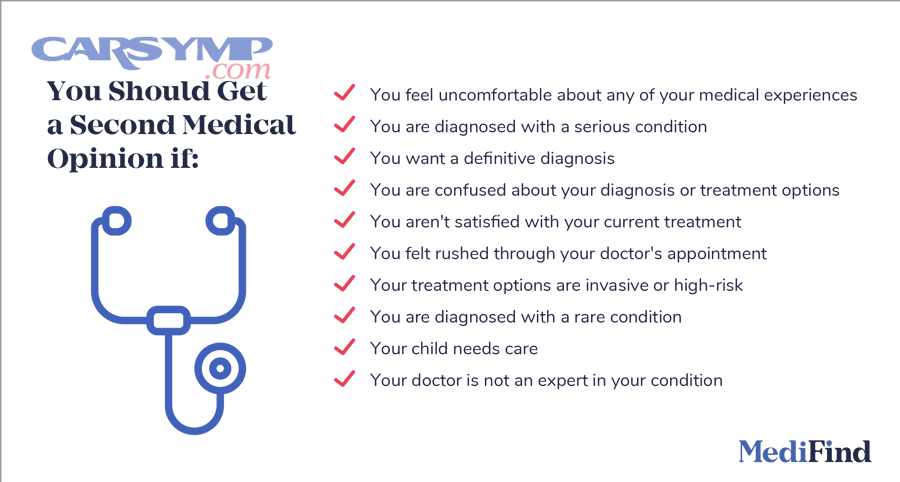
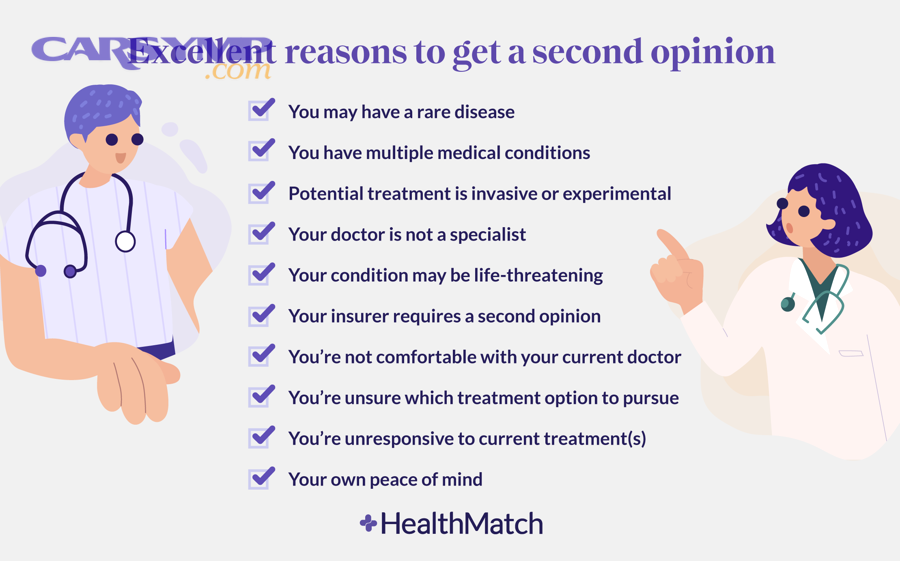
When should you get a second medical opinion: what are the top signs?
There are 6 main signs you should get a second medical opinion—unclear diagnosis, high-risk or elective surgery, serious/rare disease, treatment not working, severe side effects, or breakdown in trust/communication—because each sign increases the chance that another perspective improves your decision.
Let’s explore these signs in a practical order so you can recognize your situation quickly and act without overthinking.
Should you seek a second opinion if the diagnosis is unclear, changing, or not fully explained?
Yes—seek a second opinion when the diagnosis is unclear, changing, or poorly explained because (1) uncertainty can hide an alternative diagnosis, (2) unclear labels can lead to unnecessary or ineffective treatment, and (3) missing explanations make it hard to weigh risk and benefit.
Specifically, watch for these “uncertainty flags”:
- Vague labels without a clear cause (for example, “inflammation,” “stress,” “idiopathic” without a plan)
- Shifting explanations across visits without a coherent reason
- Conflicting test interpretations (“normal” vs “borderline” vs “abnormal”)
- A diagnosis that doesn’t fit the story, such as a treatment that should help but doesn’t
- You can’t repeat the plan back because it was never fully explained
A second opinion helps by forcing the reasoning into the open: what evidence supports the diagnosis, what evidence doesn’t, and what the next “decision point” should be.
Should you get a second opinion before major treatments or surgery (especially elective procedures)?
Yes—get a second opinion before major treatment or elective surgery because (1) irreversible interventions deserve the highest diagnostic certainty, (2) different clinicians may offer less invasive options, and (3) you need a clear understanding of expected benefit versus risk.
To illustrate, surgery decisions often hinge on thresholds:
- How severe is the condition right now?
- What happens if you wait 4–8 weeks?
- What success rate applies to someone like you (age, comorbidities)?
- What are the alternatives and their realistic outcomes?
If you’re on Medicare and the decision involves surgery, Medicare guidance explicitly encourages preparation steps like record transfer, written questions, and bringing a support person. (medicare.gov)
Should you get a second opinion if treatment isn’t working or side effects are severe?
Yes—get a second opinion if treatment isn’t working or side effects are severe because (1) the diagnosis may be incomplete, (2) the treatment may not match the subtype or severity, and (3) the risk-to-benefit balance may have shifted since the plan began.
More importantly, “not working” has patterns that signal what to re-check:
- No improvement at all: raises the question of misdiagnosis or wrong mechanism
- Partial improvement then plateau: suggests missing contributor or incomplete plan
- Worsening despite adherence: calls for re-evaluation, red flags, or escalation
- Side effects limit adherence: requires alternative dosing, drug choice, or supportive strategies
A second opinion here is not “starting over.” It is an audit: the new clinician checks assumptions, confirms what was tried, and decides whether to intensify, switch, or re-test.
Should you get a second opinion if you’ve lost confidence in communication or feel dismissed?
Yes—get a second opinion if you feel dismissed because (1) poor communication increases the chance of misunderstandings and missed details, (2) you may not be able to follow the plan confidently, and (3) shared decision-making requires trust to work.
On the other hand, you don’t need conflict to request a second opinion. A calm, practical framing works:
- “I want to make sure I understand all options.”
- “This is a big decision, and I’d like another perspective.”
- “I’m still worried because my symptoms persist.”
When communication breaks, the second opinion often restores clarity even if the final plan stays similar—because clarity is what makes adherence possible.
When is it a bad idea to wait for a second opinion (and when is it essential not to delay)?
A second opinion is a good idea in many situations, but you should not delay urgent or emergency care to get one because time-sensitive conditions can worsen quickly, and the safest path is stabilization first, second opinion second.
To begin, separate problems into three timing buckets—emergency now, urgent soon, and routine but important—so your second opinion helps rather than harms.
Is it safe to delay treatment while you seek a second opinion?
It depends—delaying treatment can be safe for some stable conditions, but unsafe for rapidly progressive or high-risk scenarios because (1) disease can advance, (2) options can narrow, and (3) preventable complications can develop.
Specifically, ask a timing question that forces clarity:
- “If I wait 7–14 days for another opinion, what is the realistic risk?”
- “What symptoms mean I should go to urgent care or the ER immediately?”
- “Can we start a low-risk stabilization step while I pursue a second opinion?”
This approach keeps you moving while preserving the right to reassess the big decision.
What symptoms or scenarios mean you should seek emergency care instead of a second opinion?
There are 8 common scenario groups where you should seek emergency care first—possible stroke, severe chest pain, severe breathing trouble, uncontrolled bleeding, sudden severe weakness/confusion, severe allergic reaction, sudden severe abdominal pain with instability, or suicidal intent—because these conditions can be time-critical.
More specifically, emergency-first examples include:
- Stroke signs: facial droop, arm weakness, speech difficulty, sudden vision loss
- Heart warning signs: crushing chest pain, fainting with chest pressure
- Breathing danger: severe shortness of breath, blue lips, inability to speak full sentences
- Severe bleeding or trauma
- Anaphylaxis: swelling, hives with breathing trouble, throat tightness
- Severe mental health crisis: intent to harm self or others
If you’re in one of these scenarios, the safest sequence is: emergency evaluation → stabilization → second opinion for the longer-term plan.
When should you get a second opinion immediately (fast-track situations)?
There are 4 fast-track situations where a second opinion should be pursued urgently (without delaying stabilization): suspected cancer/rapid progression, high-risk surgery decisions, rare/complex diagnoses, or persistent unexplained symptoms with escalating severity.
Especially in diagnostic uncertainty, national patient-safety work highlights that serious harms from diagnostic error are often concentrated in specific categories such as cancers, vascular events, and infections—making careful evaluation and timely escalation essential. (hopkinsmedicine.org)
How do you choose the right second-opinion clinician or center?
There are 3 reliable ways to choose the right second-opinion clinician: match the clinician’s specialty to your problem, prefer teams or high-volume centers for complex cases, and ensure the second opinion is truly independent—because expertise, context, and incentives shape what you hear.
Next, you’ll translate “I need another opinion” into a practical choice: who, where, and what level of specialization you need.

Should your second opinion be from a specialist, a subspecialist, or a multidisciplinary team?
A specialist is best for common defined problems, a subspecialist is best for narrow complex subtypes, and a multidisciplinary team is optimal for cases where diagnosis and treatment cross multiple domains (for example, cancer care or complex surgery planning).
To illustrate the logic:
- Specialist helps when the diagnosis is likely correct but options vary (standard-of-care variations).
- Subspecialist helps when small details change the plan (subtype, stage, mechanism).
- Multidisciplinary team helps when trade-offs are multi-dimensional (surgery vs radiation vs systemic therapy; function vs survival vs quality of life).
If your case is “simple but scary,” a specialist may be enough. If it’s “complex and confusing,” go deeper.
Does it matter if the second opinion is in-network, out-of-network, or at a center of excellence?
Yes—it matters because in-network options reduce cost and friction, out-of-network or centers of excellence may increase expertise for rare cases, and independence reduces the risk of echoing the first plan.
Here’s a helpful analogy that many people immediately understand: an independent mechanic may diagnose a problem differently from the original shop because the incentive structure and experience set can differ. The point is not to assume anyone is wrong—it’s to recognize that independence can reveal options. That’s the same logic behind an Independent mechanic vs dealership comparison: dealerships often have deep brand-specific tools and service bulletins, while independents may offer broader pattern recognition and alternative repair paths. In medicine, the parallel is:
- Center of excellence = high-volume, highly specialized experience (like a dealership that sees the same model daily)
- Independent second opinion = fresh lens and less institutional momentum (like an independent shop looking at the whole system)
This doesn’t turn healthcare into car repair—it just clarifies the role of independence in decision quality.
Can telehealth second opinions be reliable, and when do you need an in-person exam?
Telehealth second opinions can be reliable when the decision hinges on records, imaging, labs, and history, but you need in-person evaluation when a physical exam finding is crucial or when testing must be performed directly.
Meanwhile, telehealth tends to work well for:
- Reviewing imaging and reports already completed
- Confirming diagnostic logic and identifying missing tests
- Treatment planning discussions
- Medication plan audits
Telehealth tends to be limited when:
- The clinician must verify neurologic strength/reflexes
- A heart/lung exam or abdominal exam is essential
- A procedure-based assessment is required
If you use telehealth, ask what information would change the recommendation—because that tells you whether an in-person visit is needed.
How do you prepare for a second opinion so you actually get a clear answer?
The best way to prepare for a second opinion is to bring a complete record set, a clear symptom timeline, and a focused list of questions—because second opinions produce clarity when the clinician can see the same evidence and understand your goals.
Then, once preparation is strong, the appointment becomes a decision-making tool instead of a second round of confusion.

What documents and information should you bring to a second opinion appointment?
There are 7 essentials to bring: recent visit notes, lab results, imaging reports and actual images, pathology reports, medication list, symptom timeline, and your key questions—because missing documents force guesswork and repeat testing.
A practical checklist:
- One-page summary: your main concern, the current diagnosis, and the proposed plan
- Timeline: when symptoms started, what changed, what helped, what didn’t
- Medications and supplements: names, doses, start dates, side effects
- Test results: labs, ECGs, pulmonary tests—include dates
- Imaging: reports and the actual images (disc, portal link, upload)
- Pathology: full report; for cancer, ask if slides can be re-reviewed
- Allergies and prior reactions
- Family history relevant to the condition
If you’re coordinating record transfer, Medicare’s “second opinion before surgery” guidance emphasizes sending records ahead, confirming the office received them, writing questions, and bringing a trusted person. (medicare.gov)
What questions should you ask to compare two medical opinions fairly?
There are 10 core questions to compare opinions: diagnosis certainty, key evidence, missing tests, options, benefits, risks, likely outcomes, watchful waiting risk, what would change the plan, and follow-up steps—because fair comparison requires shared criteria.
Use these questions as your “comparison framework”:
- What is the most likely diagnosis and the main alternatives?
- How certain are you (high/moderate/low), and why?
- What piece of evidence supports this most strongly?
- What evidence makes you less sure?
- What test or exam would most reduce uncertainty?
- What are my treatment options, including non-invasive options?
- What is the expected benefit for someone like me?
- What are the major risks and common side effects?
- What happens if I wait or do nothing for a defined time?
- What is the next decision point and the follow-up plan?
These questions transform “two different opinions” into “two sets of reasoning,” which is much easier to evaluate.
How should patients and caregivers communicate the first opinion without sounding confrontational?
Patients and caregivers should communicate the first opinion neutrally by stating facts, goals, and questions—because a calm, collaborative tone encourages a clinician to explain reasoning rather than defend it.
Try a simple script:
- “Here’s what I was told, and here are my records.”
- “I’m hoping you can confirm the diagnosis and explain the options.”
- “I want to understand risks and benefits clearly before choosing.”
If you’re a caregiver, your role is often to:
- Keep notes (what was said, what was not said)
- Ask for definitions (“What does ‘borderline’ mean here?”)
- Reflect the patient’s values (“Quality of life is the priority”)
How do you decide between a first and second opinion when they conflict?
When a first and second opinion conflict, the best decision strategy is to compare the reasoning and evidence, identify what uncertainty remains, and choose next steps (third opinion, re-testing, or re-review) based on risk—because disagreement often reflects uncertainty, not incompetence.
Let’s explore what disagreement actually means and how to move from “conflicting advice” to “a clear plan.”

If two opinions disagree, does that mean one doctor is wrong?
No—two opinions can disagree without either doctor being “wrong” because medicine often operates under uncertainty, evidence can be incomplete, and clinicians can weight risks differently based on experience and your goals.
However, disagreement is a signal that you should locate where the divergence occurs:
- Different diagnosis (they interpret the problem differently)
- Same diagnosis but different severity/stage
- Same diagnosis but different treatment threshold
- Same diagnosis and threshold but different risk tolerance or values alignment
When you identify the divergence point, you usually identify the next best action.
Should you get a third opinion, repeat testing, or request a re-read of results?
Yes—consider a third opinion, repeat testing, or a re-read when conflict persists because (1) a third view can break ties, (2) new data can reduce uncertainty, and (3) re-review of imaging/pathology can correct interpretation differences.
A practical escalation ladder:
- Reconcile records: confirm both clinicians saw the same imaging, labs, and history.
- Identify missing decision data: what test would most change the recommendation?
- Request re-review: pathology slide review or radiology “second read” when interpretation drives the plan.
- Third opinion: ideally at a higher-expertise setting for rare/complex conditions.
According to Medicare’s coverage guidance, Medicare may cover a third opinion if the second opinion differs from the first, with standard Part B cost-sharing. (medicare.gov)
How do you choose a plan when both options seem reasonable?
You choose a plan by matching the best-supported option to your priorities, timeline, and acceptable risk—because when evidence supports multiple approaches, values become the deciding factor.
A simple decision grid helps:
- Goal: symptom relief, function, longevity, avoiding side effects, peace of mind
- Risk tolerance: “avoid worst-case outcomes” vs “avoid over-treatment”
- Time horizon: immediate relief vs long-term prevention
- Burden: recovery time, cost, travel, follow-up intensity
- Reversibility: can you change course later?
This is where a caregiver can be powerful: they can keep the discussion anchored to the patient’s real priorities rather than the loudest fear.
How do costs, insurance rules, and specialized “re-review” services affect second opinions?
Costs, coverage, and specialized re-review services can change how you pursue a second opinion because insurance rules may shape which clinicians are accessible, and re-reads of pathology or imaging can meaningfully shift decisions in complex cases.
In addition, understanding logistics prevents a common failure mode: delaying a second opinion because the process feels overwhelming.
Will insurance or Medicare cover a second opinion, and what common rules apply?
Coverage often exists, but rules vary: Medicare Part B generally covers second opinions with standard cost-sharing, some managed care plans may require referrals, and out-of-network care can increase costs—so you should verify requirements before scheduling.
More specifically, common practical rules include:
- In-network vs out-of-network: affects your out-of-pocket cost and approval steps.
- Referral requirements: more common in managed care; sometimes the second-opinion clinician must be named.
- Medical necessity framing: documentation matters, especially for repeat testing.
- Third opinion rules: may be supported when opinions conflict. (medicare.gov)
If you’re choosing among specialists like you would when Finding specialists for your car make, treat insurance constraints as “fit constraints,” not “quality markers.” A great specialist can exist in-network or out-of-network; the question is how to access them safely and affordably.
What is a pathology re-review, and when can it meaningfully change care decisions?
A pathology re-review is a second evaluation of tissue samples (often slides) by another pathologist, and it can change care decisions when the diagnosis depends on subtype, grade, margins, or biomarkers—because small interpretation differences can change treatment intensity.
This is most relevant when:
- A cancer diagnosis determines surgery vs systemic therapy vs radiation
- The subtype or grade drives medication choice
- The report includes uncertain language or borderline findings
- You’re considering a major, irreversible treatment
According to a University of Michigan report summarizing second-opinion impact in breast cancer care, second opinions have been associated with changes in recommended surgery and treatment planning for a substantial portion of evaluated patients. (news.umich.edu)
What is a radiology “second read,” and when is it worth requesting?
A radiology second read is an independent reinterpretation of your imaging (MRI, CT, X-ray, ultrasound), and it’s worth requesting when the imaging interpretation drives a high-stakes decision or when reports conflict with symptoms—because subtle findings can be missed or weighted differently.
It is especially useful when:
- Surgery hinges on location/extent of disease
- A “borderline” finding changes staging
- The report is non-specific (“cannot rule out…”)
- You have persistent symptoms but “normal” imaging
A second read is not about mistrust; it’s about the reality that imaging interpretation can involve judgment under uncertainty.
How can you reduce bias and miscommunication when seeking a second opinion?
You can reduce bias and miscommunication by sharing complete records, asking for uncertainty ranges, separating symptoms from assumptions, and documenting decision criteria—because clinicians can be influenced by incomplete data or early “anchoring” on an initial diagnosis.
Practical bias-reduction habits:
- Bring the full timeline, not just the most recent episode
- Ask: “What else could this be, and why not?”
- Ask: “What would prove you wrong?”
- Ask for a written summary of the reasoning and next steps
- Bring a caregiver to capture details and confirm understanding
According to Johns Hopkins Medicine researchers, serious harms from diagnostic errors are frequently associated with “big three” categories (cancers, vascular events, infections), reinforcing the value of careful evaluation and clear escalation paths when uncertainty persists. (hopkinsmedicine.org)