Fix ABS Repair Issues: Diagnosis Guide for Drivers, Not Wheel Lockup
ABS repair is the process of restoring your anti-lock braking system so it can correctly sense wheel speed, modulate brake pressure, and help you steer under hard braking instead of skidding.
Beyond a simple warning light, ABS faults can also disable traction/stability features, change pedal feel, and create unpredictable braking behavior—so the “why” matters as much as the “what.”
To help you decide what to do next, this guide walks through diagnosis, the most common failure patterns, how to tell sensors from modules, and what needs to happen after parts replacement so the system works again.
To start, let’s connect the symptom you see to how ABS is supposed to behave in the first place.
What is ABS repair, and what does the system actually do when it works?
ABS repair restores a safety control system that detects wheel slip and rapidly reduces/holds/reapplies brake pressure to prevent lockup and preserve steering control. Next, you’ll see how that definition maps to real parts and real symptoms.
Specifically, ABS is not “extra braking power.” It’s control during braking: the system watches wheel speed signals, estimates slip, and commands hydraulic valves (and sometimes a pump) to modulate pressure so a wheel doesn’t fully stop rotating while the vehicle is still moving.
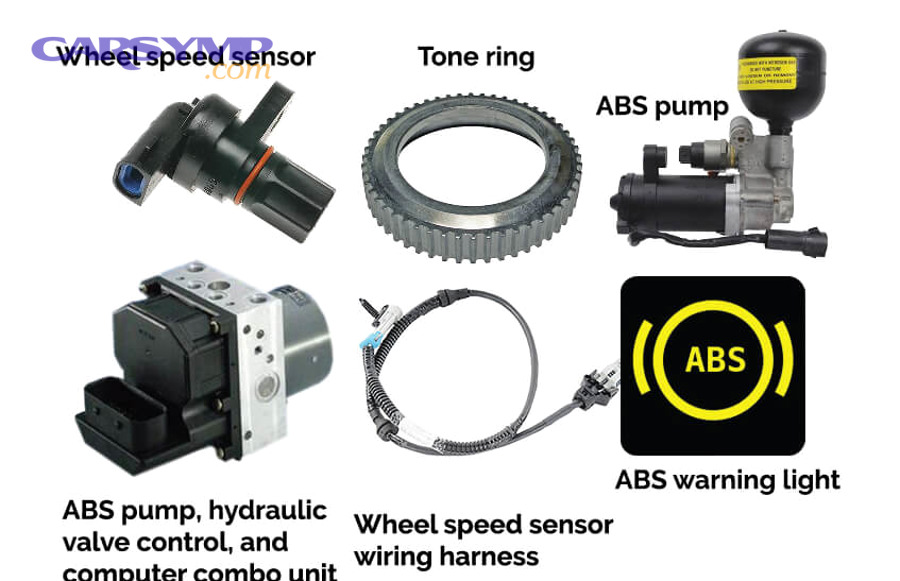
Which parts usually matter most in an ABS repair?
The most common “decision makers” are the wheel speed sensors, the tone/encoder ring they read, wiring/connectors, and the ABS module/hydraulic unit that acts on that data. To connect that to diagnosis, the next step is understanding how wheel speed is measured.

Why wheel speed sensors dominate ABS troubleshooting
Wheel speed sensors provide the “truth” the ABS controller trusts; if the signal is missing, noisy, or implausible, the controller disables ABS and turns the light on. Bosch describes wheel-speed sensors as integral to brake control systems and designed to detect wheel rotational speed using non-contact measurement.

When ABS issues also affect traction and stability control
Many vehicles share wheel-speed inputs across ABS, traction control, and stability control; so one bad input can create multiple dash warnings. In real-world Car Symptoms, drivers often notice traction/stability lights alongside the ABS light, plus a speedometer acting oddly on some models.

Is it safe to drive with the ABS light on?
Sometimes yes, but it’s still a risk: you usually keep normal braking, yet you lose anti-lock control, and you may also lose traction/stability support; the safest answer is “drive gently to diagnosis, not indefinitely.” Next, you’ll learn how to make that decision based on symptoms.
In plain terms, Safe to drive with ABS light on depends on what else is happening. If the pedal is firm and braking feels normal, ABS is likely disabled but base brakes still work; if you have a soft pedal, sinking pedal, grinding, or a red brake warning, treat it as urgent and stop driving.
Three “stop now” situations
Stop driving if you have (1) a red BRAKE light, (2) a suddenly soft/sinking pedal, or (3) obvious fluid loss or severe pulling. To move from “should I drive?” to “what do I test?”, the next section lays out a step-by-step diagnostic path.

Three “drive carefully to a shop” situations
You may be able to drive carefully for diagnosis if (1) only the ABS light is on, (2) braking is consistent and straight, and (3) there are no unusual noises or smells. Still, braking on wet/icy roads is where ABS helps most—so reduce speed and following distance.

How do you diagnose an ABS warning light step-by-step?
The fastest path is: scan for codes, confirm the wheel/component named, validate live wheel-speed data, inspect wiring and tone rings, then test the suspect part before replacing it. Next, you’ll see how to avoid “parts darts” and confirm the real failure.
Think of ABS warning light diagnosis as a funnel: start wide (codes and data) and narrow down (inspection and pinpoint tests). The goal is to replace only what is proven bad, because wiring corrosion and cracked tone rings can mimic sensor failure.

Step 1: Pull codes and freeze-frame data
Use a scan tool that can read ABS codes (not just generic engine codes). Record the exact code(s), which wheel is implicated, and any speed/voltage data. Then, transition to the next step by checking whether the code matches what the live wheel-speed data shows.
Step 2: Compare live wheel-speed signals
With the vehicle safely lifted (or during a controlled, low-speed test), compare all four wheel-speed readings. If one drops out, spikes, or reads far off from the others, you have a strong suspect. CarParts.com notes that faulty wheel speed sensors can trigger an ABS warning light and disable traction/stability features—so data comparisons matter.
Step 3: Inspect the sensor, connector, and harness first
Check for torn insulation, stretched wiring near the knuckle, green corrosion in connectors, and damaged clips. Next, move from “looks okay” to “is okay” by testing the signal quality and the mechanical target the sensor reads.
Step 4: Check the tone ring/encoder ring and sensor gap
Rust buildup, missing teeth, cracks, or debris can create false readings and intermittent ABS activation. One common pattern: ABS “buzzes” at low speed because the sensor signal gets distorted by corrosion on the ring—so confirm the ring condition before ordering parts.
Step 5: Perform a pinpoint electrical test when needed
Depending on sensor type (active vs passive), you may test resistance, power/ground, and signal output. To keep the flow tight, the next section shows a practical way to separate “sensor-side” problems from “module-side” problems without guessing.
How can you tell ABS module vs wheel speed sensor symptoms apart?
In general, a single-wheel code with one erratic speed signal points to a sensor/target/wiring issue, while multiple wheel codes, communication faults, or pump/valve actuator errors point more toward the module or hydraulic unit. Next, you’ll use symptom patterns to shorten troubleshooting time.
When people say ABS module vs wheel speed sensor symptoms, they’re really asking: “Is the system misreading one wheel, or failing to control pressure at all?” The clue is whether the problem is isolated (one corner) or systemic (multiple functions).
Patterns that usually indicate a wheel speed sensor or tone ring issue
Common patterns include: one wheel reads 0 intermittently, ABS activates at slow speed on dry pavement, or the ABS/traction lights come and go with bumps/turns. These frequently trace to sensor wiring, corrosion, or ring damage.
Patterns that more strongly suggest an ABS module or hydraulic unit issue
Signs can include: multiple wheel-signal codes at once, internal module faults, loss of communication, or actuator test failures (pump motor, solenoid valves). In these cases, the “brain” or hydraulic control portion may be failing rather than any single sensor.

Why scan tool actuator tests matter
Actuator tests can command the pump or valves; if a component doesn’t respond as commanded, you’ve moved from “maybe” to “measurable.” To make that actionable, the next section breaks down the most common root causes you’ll actually see in the field.
What are the most common ABS failure causes, and how do they vary by make/model?
Most ABS failures come from sensor signal problems (sensor, ring, wiring), corrosion-related connector damage, or internal hydraulic/module faults; the dominant cause varies with climate, platform design, and hub/bearing layouts. Next, you’ll see a cause-based checklist you can apply to any car.
Here’s a practical way to frame Common ABS failure causes by make/model: focus on what’s exposed to water/salt (sensors/connectors), what’s integrated into wear items (hub bearings with integrated sensors), and what’s stressed thermally (modules/pump motors).
Cause group 1: Sensor signal corruption (rust, debris, cracked rings)
Rust on a tone ring or debris on a sensor face can distort the signal enough to trigger ABS at low speed or set implausible-signal codes. Rick’s Free Auto Repair Advice highlights tone-ring rust, missing teeth, and incorrect air gap as common reasons ABS faults appear.
Cause group 2: Wiring and connector corrosion (especially in salt states)
Harnesses near the wheel see constant flex, water spray, and road grit; corrosion can create intermittent opens that look like a failing sensor. This is why you should inspect and tug-test connectors before replacing parts.
Cause group 3: Hub/bearing-related failures with integrated sensors
Some designs integrate the sensor into the bearing hub, so bearing noise/vibration can take the sensor with it. CarParts.com notes wheel speed sensors can fail because they’re built into the bearing hub on some vehicles, and bearing failure can lead to sensor failure.
Cause group 4: Internal module or hydraulic/pump problems
Heat, vibration, and brake-fluid contamination can contribute to valve sticking or pump motor issues. If actuator tests fail and multiple faults appear, you may be dealing with internal hydraulic control problems rather than any single corner sensor.
When do you need wheel speed sensor replacement versus cleaning or ring repair?
You need replacement when the sensor is electrically failed, physically damaged, or persistently produces bad data after the ring and wiring are confirmed good; you can often clean or repair when the issue is corrosion, debris, or a damaged tone ring/air gap. Next, you’ll get a practical decision tree.
In day-to-day brake service, the highest ROI move is to confirm whether the sensor itself is bad or whether it’s reading a bad target. That’s why the “clean/inspect first” approach can save time and money.
Replace the sensor if you see these conditions
Replace it if the connector pins are damaged, the sensor body is cracked, the harness is internally broken, or live data shows dropouts that persist after cleaning and ring inspection. Also, if the design is hub-integrated and the hub bearing is failing, replacement often involves the entire hub assembly.
Clean/repair first if the failure is signal distortion
If the ring teeth are rusty but intact, cleaning the ring and sensor face may restore stable readings; if the ring is cracked or missing teeth, replace the ring (or hub/axle component) rather than the sensor. Rick’s guidance on tone-ring rust and missing teeth aligns with this approach.
Where “ABS wheel speed sensor replacement” fits in the workflow
ABS wheel speed sensor replacement should come after you’ve verified the code, confirmed live-data mismatch, and inspected ring/wiring—otherwise you may replace a good sensor and keep the same fault. To complete the bigger picture, the next section explains when the hydraulic unit or pump becomes the real suspect.
When should the ABS hydraulic pump/modulator be replaced, and what’s involved?
You replace the hydraulic pump/modulator when actuator tests fail, valves stick, internal hydraulic faults set, or the system can’t build/hold pressure correctly for ABS events; replacement is more involved than a sensor because it can require bleeding and sometimes programming. Next, you’ll understand the “what happens after” part that many repairs miss.
If you need an ABS pump replacement overview, think of it as swapping a hydraulic-and-electronic assembly that sits between the master cylinder and brake lines. It can be mounted in the engine bay with multiple brake hard lines attached—so cleanliness, torque specs, and correct bleeding matter.
Typical reasons pump/modulator replacement becomes necessary
Common triggers include pump motor failure, internal valve issues, and repeated faults that persist after sensor/wiring confirmation. If you can command the pump and hear nothing—or see no pressure response—your diagnosis is moving away from “inputs” and toward “hydraulic control.”
What to expect during replacement
Expect brake line handling, fluid loss management, careful connector transfer, and post-install bleeding. Because air can enter complex hydraulic passages, many vehicles require scan-tool assisted bleeding afterward, which leads directly to the next step.
How do you bleed brakes after ABS repair and restore a firm pedal?
After ABS repair, you bleed the brakes to remove air, and on many vehicles you must use a scan tool to cycle ABS valves/pump so trapped air in the modulator is expelled. Next, you’ll get a safe, structured procedure you can adapt to your vehicle.
This is the practical core of ABS bleeding procedure after repair: normal bleeding removes air from lines and calipers, but ABS components can trap air internally, so cycling the valves/pump is sometimes required for a truly firm pedal.
Baseline bleed: the safe sequence most vehicles use
Start with fresh fluid of the correct DOT rating, keep the reservoir topped up, and bleed in the recommended wheel order (often farthest to nearest—confirm for your model). Then, transition to ABS cycling if the pedal remains spongy or if the service procedure requires it.
ABS-assisted bleed: cycling valves and pump
Many scan tools provide an “ABS bleed” or “auto bleed” function that commands the pump and solenoids while you bleed. Articles about ABS bleeding scan tools emphasize that this capability helps eliminate trapped air more thoroughly than traditional methods on some ABS-equipped vehicles.
A quick video walkthrough to visualize the process
To make the steps easier to picture, this video demonstrates ABS brake bleeding concepts and how scan-tool cycling fits into the workflow.
How do you reset and relearn ABS after parts replacement?
Reset and relearn typically means clearing stored ABS codes, verifying live data returns to normal, and completing any required calibration routines (steering angle, yaw, brake pressure) that your vehicle ties to stability systems. Next, you’ll learn how to do it without masking an active fault.
Many drivers search for ABS system reset and relearn after repair because the light stays on even after parts are changed. The key is that clearing codes only works if the fault is truly gone; otherwise the system will re-detect the issue and relight the warning.
What “reset” should include (not just clearing codes)
A proper reset includes: (1) clearing codes, (2) confirming all wheel-speed signals read plausibly at low speed, and (3) confirming no new codes return after a short road test. Then, transition to relearn/calibration only if your scan tool flags it as required.
When calibration is required
Some vehicles require steering angle sensor calibration, yaw-rate calibration, or brake pressure sensor calibration after certain repairs. If you see multiple stability-related warnings, treat calibration as part of the job—not an optional extra.
Common pitfalls that keep the ABS light on
Common pitfalls include a damaged tone ring left in place, a pinched harness, wrong sensor type, poor connector seating, or a weak wheel bearing that changes sensor gap. If you’re stuck, return to the earlier funnel: data first, then inspection, then pinpoint tests.
How much does ABS repair cost, and what drives the estimate?
ABS repair cost ranges widely because the “ABS” label covers diagnosis time, sensors/wiring, and expensive hydraulic/module assemblies; your estimate depends on which component failed and how accessible it is. Next, the table will help you map symptoms to typical cost bands.
When people ask for an ABS repair cost estimate, they usually want two things: the typical price range, and the reasons their quote might be higher or lower (labor time, rust, integrated hubs, programming, and bleeding).
This table summarizes common ABS-related repairs and what they typically cost, so you can sanity-check a quote and decide what to diagnose first.
| Repair item | Typical “average” range (parts + labor) | What most changes the price |
|---|---|---|
| ABS diagnosis (scan + inspection) | $116–$170 | Shop rate, depth of testing, road-test time |
| Wheel speed sensor replacement | $227–$313 | Rust, seized fasteners, sensor integrated into hub |
| ABS control module replacement | $1,179–$1,268 | Programming needs, part sourcing, access |
| ABS hydraulic pump replacement | $1,315–$1,436 | Bleeding complexity, line condition, labor hours |
Why the same repair can vary so much by vehicle
Two big drivers are packaging (how hard the part is to reach) and integration (sensor built into hub, module built into hydraulic unit). Kelley Blue Book and RepairPal both show module-related work tends to be in the four-figure range, reflecting part cost and labor.
How to use estimates without skipping diagnosis
Use the numbers to set expectations, but still confirm the failure. A high quote for “replace all wheel sensors” is often unnecessary; reputable guidance emphasizes retrieving diagnostic codes and troubleshooting rather than replacing everything at once.
Evidence-style note in the required format
Theo nghiên cứu của RepairPal từ Fair Price Estimator, vào Oct 2025, Wheel Speed Sensor Replacement is typically between $227 and $313, while ABS Control Module Replacement is typically between $1,179 and $1,268.
Deep-dive: Prevent repeat ABS faults and make repairs last
Long-lasting ABS repair is about protecting the signal path: keep connectors clean, control corrosion, maintain hub/bearing health, and verify sensor gaps so your “fixed” system doesn’t return with intermittent faults. Next, you’ll see four practical habits that reduce repeat failures.
Protect connectors from moisture and salt
Use correct sealing practices, replace damaged clips, and route harnesses to avoid rubbing. A small connector issue can look like a big ABS problem—especially when it becomes intermittent.
Address wheel bearing play early
Bearing looseness can alter sensor alignment and introduce noisy signals. If your vehicle uses an integrated hub sensor design, treating bearing noise as “just a noise” can turn into recurring ABS faults.
Use live data after every repair
After any sensor, hub, or module work, confirm all four wheel-speed readings match closely at low speed and remain stable during turns. This verifies the repair in minutes instead of learning about it during the next rainy commute.
Don’t skip the final “system behavior” check
Even when the light is off, confirm braking feel, confirm no unexpected ABS activation, and confirm traction/stability warnings remain off. If the system is functioning, ABS will only intervene near lockup thresholds, as described in NHTSA’s explanation of brake pressure modulation in antilock operation.
FAQ
These questions come up repeatedly in real-world ABS repair decisions, especially when the light appears suddenly or after recent brake work.
Will my regular brakes still work if the ABS light is on?
Usually yes—base braking remains, but ABS intervention may be disabled, and traction/stability features may also be limited depending on the vehicle.
Can a bad wheel speed sensor cause traction control to stop working?
Yes; wheel speed inputs feed multiple vehicle dynamics systems, and CarParts.com lists traction and stability control failure among common outcomes of a faulty wheel speed sensor.
Why does ABS sometimes activate at low speed on dry pavement?
A distorted wheel speed signal—often from rust, debris, incorrect air gap, or a damaged tone ring—can trick the system into thinking a wheel is locking, causing false activation.
Do I need a special scan tool for ABS, or will any OBD2 reader work?
Many basic readers only handle engine emissions codes; ABS diagnosis often requires a tool that can access ABS modules, read live wheel speeds, and run actuator/bleed functions.
After replacing an ABS module or pump, why is bleeding sometimes mandatory?
Air can enter the hydraulic unit and remain trapped in valves/passages; scan-tool cycling can be required to purge air and restore a firm pedal, as discussed in ABS bleeding scan-tool guidance.
What’s the fastest way to avoid replacing the wrong part?
Follow the funnel: codes → live data comparison → ring/wiring inspection → pinpoint test. This approach aligns with technician guidance that codes and troubleshooting should come before replacing multiple sensors.