


If your engine is overheating and you’re worried about a blown head gasket, the safest approach is to look for specific symptom clusters—not just the temperature gauge—because overheating can come from many causes while head gasket failure leaves a distinct trail.
Next, you’ll learn the most common head gasket failure signs during overheating (coolant behavior, oil condition, exhaust clues, and drivability changes) and what each one usually means for the engine.
Then, you’ll see how to separate head gasket symptoms from other overheating causes—so you don’t misdiagnose a bad radiator fan, low coolant, or a weak radiator cap as a major engine failure.
Introduce a new idea: you’ll also get a practical “what to do now” plan and a clear path to confirmation tests—so your next step is based on evidence, not guesswork.
Is it a blown head gasket if your engine overheats?
No—engine overheating does not automatically mean a blown head gasket, because overheating can be caused by cooling-system faults, it can happen without any gasket breach, and head gasket failure usually shows additional coolant/oil/exhaust signs.
To better understand the risk, you need an overheating diagnosis mindset: confirm whether overheating is a “cooling system can’t shed heat” problem or a “combustion pressure is entering the cooling system” problem.
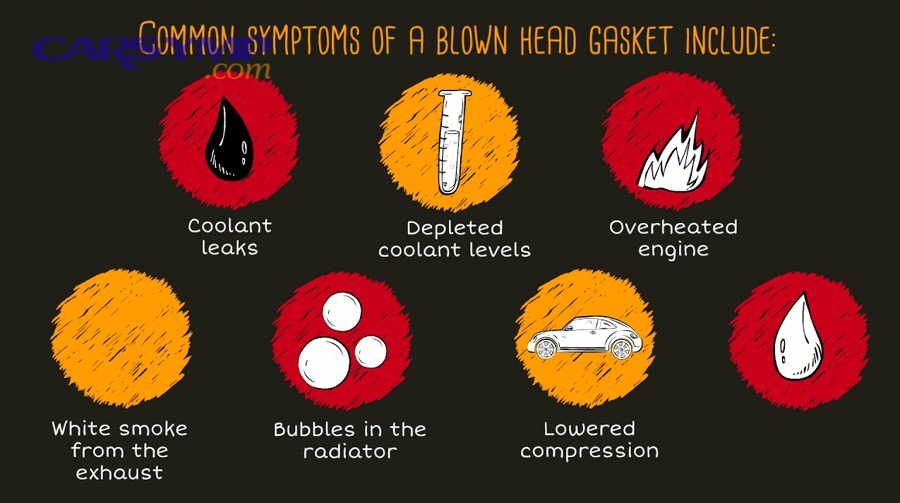
Overheating is a stress test for the head gasket. When metal parts expand under high heat, sealing surfaces can distort. If the head gasket was already weak (age, prior overheating, corrosion, improper torque), the episode can push it over the edge. But plenty of engines overheat due to a fan that never turns on, a stuck thermostat, or coolant loss from a leak—without any internal gasket breach.
A practical way to think about it is probability:
- Overheating alone = low confidence for head gasket failure.
- Overheating + repeated coolant loss + bubbles/pressure = rising suspicion.
- Overheating + “milkshake” oil or persistent white steam = high suspicion.
Can overheating alone confirm head gasket failure?
Overheating alone cannot confirm head gasket failure because (1) many common faults cause overheating, (2) some engines overheat temporarily yet recover when the root cause is fixed, and (3) head gasket failure needs evidence of leakage paths (coolant-to-cylinder, cylinder-to-coolant, or coolant-to-oil).
More specifically, the temperature gauge tells you the engine is hot; it doesn’t tell you why.
Here are the most common “false head gasket alarms”:
- Cooling fan not running (bad fan motor, relay, fuse, wiring, temperature sensor, or control module).
- Low coolant from an external leak (hose, radiator, water pump weep hole, heater core).
- Radiator cap not holding pressure (coolant can boil earlier, pushing fluid out and creating “overheat” symptoms).
- Thermostat issues or flow restrictions (clogged radiator, blocked passages).
- Air pockets after service (improper bleeding) that create hot spots and erratic heater output.
In short, overheating is an urgent warning, but it’s not a diagnosis.
Which symptom combinations most strongly point to a head gasket issue during overheating?
There are 4 main high-suspicion symptom combinations that point to head gasket failure during overheating, based on leak path + consistency of signs:
- Combustion gases → coolant (pressure/bubbles pattern)
- Continuous bubbles in radiator/reservoir while running
- Upper hose gets hard quickly (often even before full warm-up)
- Coolant pushed into overflow or out of cap
- Overheats faster under load
- Coolant → cylinder (steam + misfire pattern)
- White steam that persists after warm-up
- Sweet smell in exhaust
- Rough start or misfire after sitting
- Coolant loss with no external leak
- Coolant ↔ oil (contamination pattern)
- Milky oil on dipstick or under oil cap
- Oil level rises unexpectedly
- Sludge/froth after short running time
- Bearing noise risk increases quickly
- Compression leak between cylinders (paired misfire pattern)
- Two adjacent cylinders show misfire
- Low compression readings on neighboring cylinders
- Loss of power plus overheating under load
When you see one full cluster, suspicion rises. When you see two clusters at once, head gasket failure becomes a leading diagnosis.
What are the most common head gasket failure signs during overheating?
There are 6 main types of head gasket failure signs during overheating—coolant-system pressure clues, bubbling, unexplained coolant loss, oil contamination, exhaust steam, and drivability changes—based on where the gasket is leaking and what fluid/gas is crossing the seal.
Specifically, you’re looking for signs that combustion pressure and engine fluids are mixing in ways they shouldn’t.
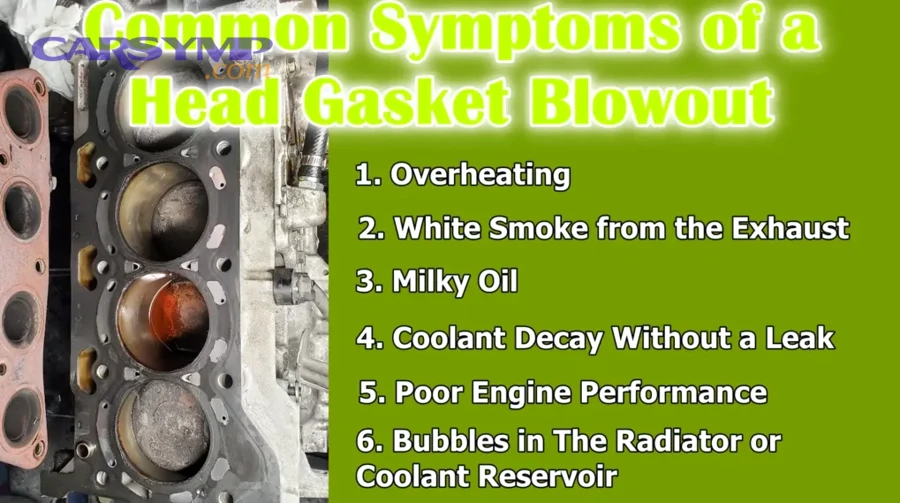
What coolant-system signs suggest combustion gases are entering the cooling system?
Combustion-gas intrusion shows up as pressure and bubbles because the cooling system is being “inflated” by cylinder pressure.
More importantly, these signs tend to be repeatable—not random:
- Continuous bubbles in the radiator neck or reservoir at idle (not just a few burps right after a fill).
- Coolant pushed out into the overflow bottle or out of the cap, even when the system seems full.
- Hoses get firm quickly after startup (pressure rises abnormally fast).
- Heater output fluctuates (hot → cool) as gas pockets move through the heater core.
- Overheating that returns quickly after you top off coolant, especially under acceleration.
This is where Radiator cap and boiling point explanation matters: a healthy system holds pressure to prevent boiling; a compromised system either loses pressure (bad cap/leak) or gains abnormal pressure (combustion gases). A normal warm engine will build pressure gradually. A gas-leak engine often builds pressure too early and too strongly.
Evidence: According to Summit Racing’s technical explanation, a 15-psi radiator cap can raise the coolant boiling point by about 45°F, which shows why pressure control is central to whether coolant boils and vents during overheating. (Source: help.summitracing.com)
What oil and exhaust signs point to coolant–oil mixing or coolant burning?
Oil and exhaust signs are some of the most recognizable—yet they’re also where people get fooled if they don’t check details.
Oil contamination signs (coolant in oil):
- Milky, tan, or frothy oil on the dipstick or under the oil cap.
- Oil level rising without adding oil (coolant dilutes oil).
- Sludge-like residue that returns soon after cleaning.
Exhaust signs (coolant in cylinder):
- White steam that continues after the engine is fully warm (not just morning condensation).
- Sweet smell in exhaust (coolant vapor) and sometimes moisture at the tailpipe.
- Misfire plus steam can indicate a cylinder is ingesting coolant.
One important nuance: light white vapor for the first few minutes on a cold day can be normal condensation. What matters is persistence, coolant loss, and how the engine runs.
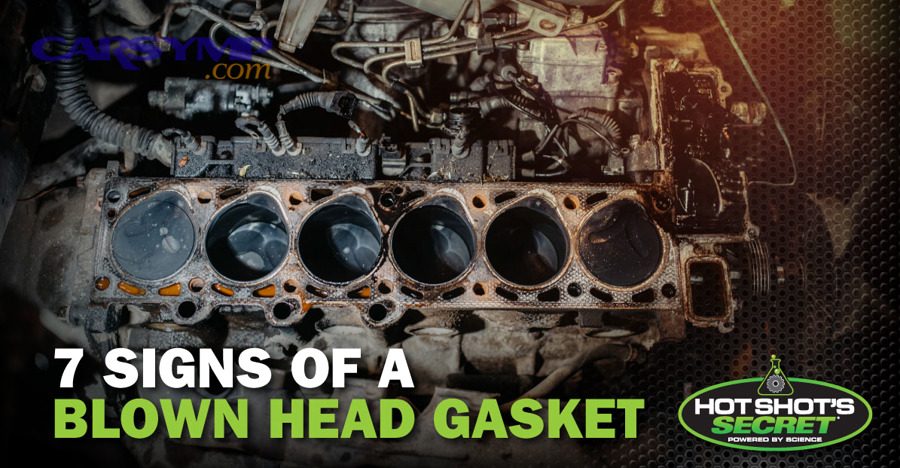
What drivability signs appear when a cylinder is losing compression during overheating?
When the head gasket fails around a cylinder, it can leak compression into the cooling jacket or into a neighboring cylinder. That causes drivability issues that usually worsen with heat and load.
Common drivability signs include:
- Rough idle that gets worse when hot.
- Misfires (often on startup after sitting overnight).
- Loss of power and sluggish acceleration.
- Hard starting if coolant has seeped into a cylinder.
- Check engine light with misfire-related codes.
A quick mental model:
- If the engine runs fine until it overheats, the root cause may still be a cooling system fault.
- If the engine runs poorly and overheats together, the head gasket moves higher on the list.
Evidence: According to a 2017 study from National Cheng Kung University’s Department of Mechanical Engineering, changes to cylinder-head gasket openings altered coolant flow rate up to about 18%, demonstrating how gasket-related geometry interacts with cooling flow and temperature distribution. (Source: researchgate.net)
How do you tell head gasket symptoms from other overheating causes?
Head gasket failure is most likely when you see internal mixing or combustion-gas pressure signs, while other overheating causes usually show external leaks, fan/thermostat patterns, or airflow/heat-transfer limitations.
However, symptom overlap is real—so you need comparisons that focus on patterns, not single clues.
A useful strategy is to compare by:
- When it overheats (idle vs highway vs load)
- How fast it overheats after a cold start
- Whether coolant disappears with no visible leak
- Whether pressure/bubbles behave abnormally
- Whether oil/exhaust shows contamination signs
Head gasket vs. low coolant/leaks: what’s the difference in symptoms?
Head gasket vs external leaks is often the first fork in the road.
External leak pattern (more common):
- Wet spots, crusty residue, or coolant smell under hood
- Coolant drops over days/weeks
- Overheating worsens at idle/slow traffic
- Pressure test may reveal drips
Head gasket pattern (internal loss):
- Coolant drops with no obvious puddles
- Bubbling/pressurizing behavior
- White steam or milky oil may appear
- Overheating can be fast under load
A key tip: If you keep adding coolant and it keeps vanishing, don’t stop at “it must be the head gasket.” Do a systematic cooling-system inspection first.
Head gasket vs. thermostat/radiator fan failure: what changes at idle vs speed?
This is where Fan operation and relay troubleshooting becomes practical.
Radiator fan/relay issue pattern:
- Overheats in traffic or at idle
- Temperature drops when driving at speed (airflow compensates)
- Fan doesn’t come on when expected
- A/C on may trigger fan (or may not, depending on system)
Thermostat issue pattern:
- Temperature may spike suddenly
- Heater output may swing
- Upper radiator hose may stay cool longer than expected, then suddenly get hot
- Can mimic head gasket “hot/cool” behavior if air pockets are present
Head gasket pattern:
- Overheating often worsens under acceleration/load
- Cooling system may pressurize early
- Bubbles remain consistent while running
If you suspect the fan system:
- Check fuses, relays, connectors, and whether the fan can be commanded on (scan tool) or triggered via A/C logic.
- Confirm the fan actually spins at the correct speed; a weak fan motor can spin but move insufficient air.
Head gasket vs. clogged radiator or weak water pump: what are the telltale patterns?
Clogged radiator / restricted airflow:
- Overheats more at speed or under load (can’t shed heat)
- One side of radiator may be cooler than the other
- Heater may be inconsistent
- Coolant may look rusty/contaminated if neglected
Weak water pump / flow problem:
- Overheats at higher RPM or under sustained load
- Heater performance changes with RPM
- May show seepage at the pump, bearing noise, or belt issues (varies by design)
Head gasket:
- Pressure/bubbles and internal mixing clues remain central
- Cooling system behavior becomes “abnormal,” not just “inefficient”
The big difference is that radiators and pumps fail as heat transfer / circulation problems. Head gaskets fail as sealing problems—and sealing problems leave evidence of gases/fluids crossing boundaries.
What should you do immediately if you suspect head gasket failure while overheating?
Yes—you should treat suspected head gasket failure during overheating as urgent because continued driving can warp the cylinder head, contaminate the oil, and escalate damage; the safest plan is to stop overheating, prevent pressure injuries, and choose the next step based on risk.
Next, focus on protecting the engine and yourself before you chase a definitive diagnosis.
When overheating is active, your priorities are:
- Safety (steam burns and coolant eruptions are real)
- Preventing further heat damage
- Avoiding hydro-lock and oil starvation
- Capturing information for diagnosis
Should you keep driving if the temperature is climbing and you see warning signs?
No—you should not keep driving with overheating and head gasket warning signs because (1) extreme heat can warp the head quickly, (2) coolant loss can turn into a sudden overheat or stall, and (3) coolant-in-oil can destroy bearings even if the engine still runs.
More importantly, the “just a little farther” decision is how minor problems become major engine failures.
Safer alternatives:
- Pull over as soon as it’s safe.
- Turn off A/C and reduce load while moving to a safe shoulder (only if you must move).
- Shut the engine down and let it cool.
If the engine has overheated severely, a tow often costs less than a cylinder head replacement—especially if the oil is contaminated.
What quick checks can you do safely before restarting or topping off coolant?
You can do 4 quick checks safely, as long as you wait for temperatures to drop and you never open a hot pressurized cap.
- Look for obvious external leaks
- Radiator end tanks, hoses, heater hoses, water pump area, and the ground underneath.
- Check oil condition
- Dipstick and oil cap: milky/frothy contamination raises concern.
- Check coolant level in the overflow bottle
- An empty overflow doesn’t prove head gasket failure, but it supports a “loss” narrative.
- Observe symptoms after cool-down restart (if you choose to restart)
- Immediate bubbling, fast pressure build, or immediate temp climb can indicate a serious issue.
This is where the Radiator cap and boiling point explanation matters again: opening the system hot can cause instant boiling because pressure drops and coolant flashes to steam. A proper radiator cap is part of safe operation, not just a “lid.”
Evidence: According to MACS (Mobile Air Climate Systems Association), coolant boiling point rises by roughly ~3°F per psi, and a 15 psi cap can add about 45°F of boiling margin—showing why pressure loss or venting changes overheating behavior dramatically. (Source: macsmobileairclimate.org)
What information should you document for a mechanic or diagnosis?
Write down:
- When it overheats: idle, highway, hills, towing, A/C use
- How quickly it overheats: minutes vs gradual rise
- Coolant behavior: does it vanish, vent, or bubble?
- Exhaust behavior: persistent white steam? sweet smell?
- Oil condition: normal, dark, or milky?
- Any codes: misfire codes, cooling fan codes, over-temp events
That data turns a vague complaint into a focused diagnostic plan.
How can you confirm a blown head gasket after overheating?
There are 5 main ways to confirm a blown head gasket after overheating—visual checks, coolant-system pressure testing, combustion-gas detection (block test/CO₂), compression testing, and leak-down testing—based on proving a leak path between cylinder pressure and the cooling/oil systems.
Then, you choose the least invasive test that produces the strongest evidence.
What at-home checks are most reliable (and what’s misleading)?
Reliable at-home clues:
- Milky oil (especially if it appears quickly and repeatedly)
- Continuous bubbles at the radiator neck (engine running, cold start observation)
- Unexplained coolant loss paired with misfire or steam
- Overheats quickly after startup (minutes) despite full coolant
Misleading clues (common traps):
- White vapor on cold mornings (condensation can mimic steam)
- Single overheat event with no repeat symptoms afterward
- Dirty coolant alone (neglect can cause overheating without gasket failure)
- Random temp gauge swings caused by air pockets after service
If you’re trying to avoid a wrong conclusion, consistency is your friend. A failing head gasket usually repeats the same story.
Which diagnostic tests give the strongest confirmation?
A strong confirmation ladder looks like this:
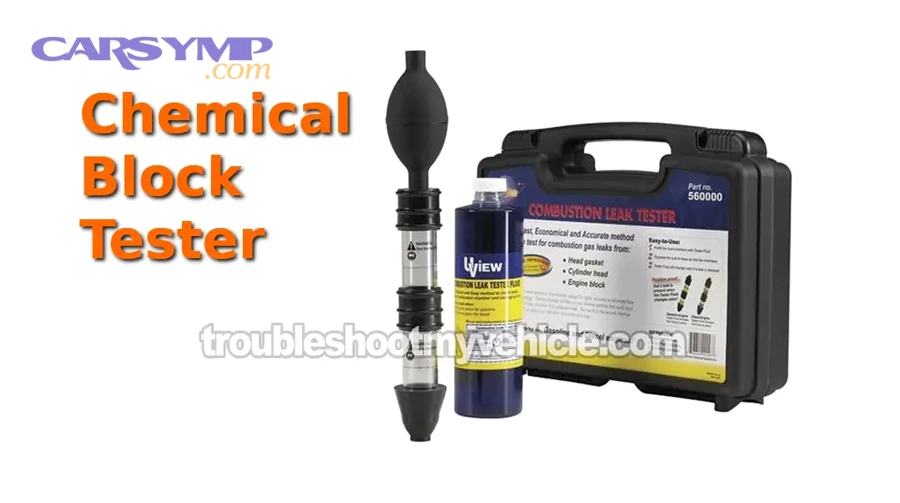
- Chemical block test / combustion leak test
- Detects combustion gases in coolant via chemical reaction.
- Strong indicator when positive.
- CO₂ / exhaust-gas analysis at the radiator neck
- Similar concept: proves combustion products where they shouldn’t be.
- Cooling system pressure test
- Helps identify leaks and can reveal coolant intrusion into cylinders when plugs are removed (advanced/safer-with-experience step).
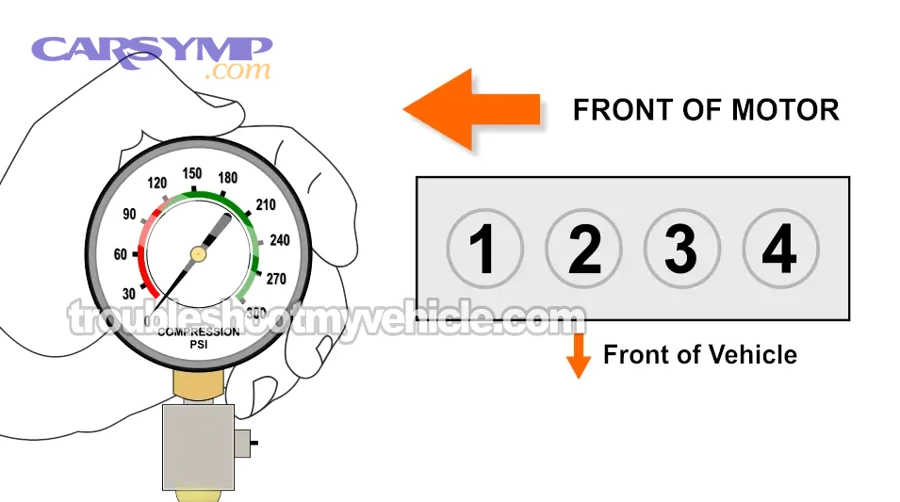
- Compression test
- Reveals low compression; especially meaningful when two adjacent cylinders are low.
- Leak-down test
- Pinpoints where pressure is escaping (coolant jacket, crankcase, intake/exhaust).
One practical note: a positive combustion-gas test strongly supports a head gasket leak, but it doesn’t always tell you whether the leak is in the gasket, the head, or (rarely) the block. That’s where leak-down and professional inspection help.
When should you stop testing and choose professional diagnosis?
Yes—you should stop DIY testing and go professional when (1) overheating is severe or recurring, (2) coolant is entering a cylinder (misfire after sitting, wet plugs, no-crank risk), and (3) oil contamination is present, because these conditions can escalate into catastrophic engine damage quickly.
Moreover, professional shops can combine pressure testing, scan data, and leak-down testing efficiently—and they can evaluate whether the head is warped.
If the engine ever won’t crank after overheating, do not keep forcing starts. Severe coolant intrusion can cause hydro-lock, which can bend connecting rods.
Evidence: A technical article on CO₂-based detection explains that elevated CO₂ in the cooling system is a reliable indicator of combustion gas leakage, supporting the logic behind block-testing and analyzer-based confirmation. (Source: forensicsdetectors.com)
What happens if you ignore head gasket failure signs after overheating, and what are your repair options?
Ignoring head gasket failure signs after overheating is rarely worth it because (1) repeated overheating can warp the head and crack components, (2) coolant-oil mixing can destroy bearings, and (3) coolant loss can strand you or cause sudden failure; repair options range from proper gasket replacement to engine replacement depending on damage level.
In addition, your best choice depends on cost, vehicle value, and how early you caught the problem.
What engine damage can overheating + head gasket failure cause ?
Overheating plus gasket leakage can create a chain reaction:
- Warped cylinder head → worse sealing → more leakage → faster overheating
- Oil contamination → bearing wear → low oil pressure → knock
- Catalytic converter damage if coolant and misfires persist
- Cracked head or block in severe cases
- Hydro-lock if enough coolant enters a cylinder while parked
Escalation speed varies, but it’s common for a “drivable” car to become “tow-only” after just a few overheating cycles. The danger is that a head gasket leak often gets worse with heat—so every over-temp event can increase the leak.
Head gasket repair vs engine replacement: which is more cost-effective in different scenarios?
Head gasket repair wins when:
- The engine didn’t overheat severely or repeatedly
- Oil contamination is minimal and caught early
- The vehicle is in good overall condition
- The head can be machined flat and the block deck is intact
Engine replacement wins when:
- The engine overheated multiple times and now has low compression, persistent misfires, or knock
- There’s heavy oil-coolant contamination and bearing noise
- The head is cracked or the block is compromised
- Labor cost for the specific vehicle is extremely high
A good rule: if you’re paying for major labor either way, the decision often comes down to risk management. A properly repaired head gasket can last a long time—if the overheating root cause is solved and the head is checked for warpage.
Do head gasket sealers work, and when are they the wrong choice?
Yes, head gasket sealers can work in limited cases, but they are the wrong choice when (1) overheating is severe, (2) there is coolant in the oil, and (3) combustion-gas leakage is strong, because sealers can fail under pressure and may complicate later repairs.
Meanwhile, sealers sometimes help with small seepage when used as a temporary measure on a low-value vehicle—but they are not a substitute for proper machining and gasket replacement.
If you consider a sealer:
- Treat it as temporary.
- Watch temperature and coolant level aggressively.
- Understand that it may mask symptoms while damage continues underneath.
How can you reduce the chance of head gasket failure after an overheating episode?
There are 4 main prevention moves after any overheating event, based on reducing heat stress and maintaining pressure/flow:
- Fix the overheating root cause first
- Cooling fan issues, thermostat, radiator flow, leaks, air pockets.
- Restore proper pressure control
- Replace a weak radiator cap if it won’t hold pressure; pressure raises boiling point and prevents local boiling.
- Use correct coolant mix and proper bleeding
- Correct mixture helps heat transfer and boiling protection; bleeding prevents hot spots.
- Verify operation under real conditions
- Idle test, highway test, and load test—watch for fan cycling, stable temps, and consistent heater output.
If you want one takeaway: head gaskets usually fail from heat + time + weakness. Reducing heat stress and maintaining pressure/flow gives the gasket its best chance to survive.
Evidence (if any)
- According to a study by National Cheng Kung University from the Department of Mechanical Engineering, in 2017, altering cylinder head gasket openings changed coolant flow rate by up to 18.30%, highlighting how gasket-related geometry impacts cooling flow and temperature behavior. (Source: researchgate.net)