


Testing a radiator fan directly with a battery involves disconnecting the fan’s electrical connector and applying 12-volt power from the car battery using jumper wires to verify motor functionality. This bypass method eliminates electrical system variables like relays, fuses, and wiring harnesses, allowing you to determine whether the fan motor itself is operational or faulty. Car owners commonly use three testing approaches: direct battery connection, multimeter voltage measurement, and resistance testing to diagnose cooling fan problems effectively.
Understanding the tools required before testing ensures safety and accuracy throughout the diagnostic process. You’ll need basic automotive equipment including jumper wires or cables with alligator clips, access to your vehicle’s 12-volt battery, a digital multimeter for electrical measurements, and protective gear such as safety gloves and eye protection. These standard tools are available at most automotive parts stores and don’t require specialized technical equipment, making the testing process accessible to DIY car enthusiasts and professional mechanics alike.
The direct battery connection method provides the most definitive answer about fan motor health by supplying uninterrupted power directly to the motor terminals. When you connect positive and negative jumper wires from the battery to the corresponding fan terminals, a functioning motor will spin immediately and smoothly at full speed without hesitation, unusual noises, or burning odors. This immediate response confirms the motor’s internal windings, brushes, and mechanical components are intact, while failure to spin indicates motor replacement is necessary regardless of other electrical system conditions.
Recognizing Radiator fan failure symptoms early prevents engine overheating and costly damage to critical components. Beyond direct testing methods, understanding what other components control fan operation—including relays, coolant temperature sensors, fan control modules, and the engine control unit—helps you pinpoint problems when the fan passes direct testing but still doesn’t work in normal vehicle operation. Below, we’ll explore each testing method in detail, starting with the essential tools and safety precautions you need before beginning any diagnostic work.
What Tools Do You Need to Test a Radiator Fan Directly?
You need four essential tools to test a radiator fan directly: jumper wires with alligator clips, access to a 12-volt car battery, a digital multimeter, and safety equipment including gloves and eye protection. These standard automotive diagnostic tools allow you to perform comprehensive fan motor testing without specialized equipment or expensive professional-grade instruments.
To begin the testing process safely and effectively, let’s examine each required tool and its specific function in radiator fan diagnosis.
What Safety Precautions Should You Take Before Testing?
Safety precautions are critical before testing any radiator fan to prevent injury from spinning blades, electrical shock, or moving engine components. The fan can activate unexpectedly even when the engine is off, and direct battery connection creates powerful rotational forces that can cause serious harm.
Follow these mandatory safety steps before starting any fan testing:
- Disconnect the negative battery terminal first – This prevents accidental circuit completion and unexpected fan activation during connector removal
- Ensure the engine is completely cool – A hot engine presents burn risks and can cause coolant system pressure injuries if disturbed
- Verify the ignition key is removed – Some vehicles can activate fans through the body control module even without engine operation
- Keep hands, clothing, and tools away from fan blade path – Radiator fans draw 15-30 amperes and spin at 2,000-3,000 RPM when powered
- Wear safety gloves and eye protection – Battery acid, hot coolant, and flying debris pose risks during automotive electrical work
- Work in a well-ventilated area – Running engines or testing electrical components can produce harmful fumes
The National Highway Traffic Safety Administration reports that improper electrical testing procedures contribute to approximately 1,200 preventable automotive repair injuries annually, emphasizing why these precautions matter beyond simple recommendations.
Do You Need Special Equipment or Can You Use Standard Tools?
No, you do not need special equipment to test a radiator fan directly—standard automotive tools available at any parts store work perfectly for comprehensive fan motor diagnosis. The testing process relies on basic electrical principles that require only common jumper cables, a consumer-grade multimeter, and your vehicle’s existing battery.
Standard automotive jumper wires or jumper cables with alligator clips provide adequate current capacity for fan motor testing. Most radiator fans draw between 10-25 amperes at 12 volts, well within the 200-400 ampere capacity of typical jumper cables designed for battery starting assistance. Choose cables with at least 10-gauge wire to minimize voltage drop during testing and ensure accurate results.
A basic digital multimeter costing $15-30 offers all necessary measurement functions including DC voltage, resistance (ohms), and continuity testing. Advanced automotive multimeters with amp clamp features or data logging capabilities provide convenience but aren’t required for effective radiator fan diagnosis. Set the multimeter to the 20-volt DC range for voltage testing and the 200-ohm range for resistance measurements.
Alternative test leads with pointed probes or alligator clips attach to multimeter test wires for easier connection to fan terminals and wiring harness connectors. These accessories cost $5-10 and significantly improve testing efficiency compared to holding standard multimeter probes against connector pins manually.

How Do You Test a Radiator Fan Directly with Battery Connection? (Method 1)
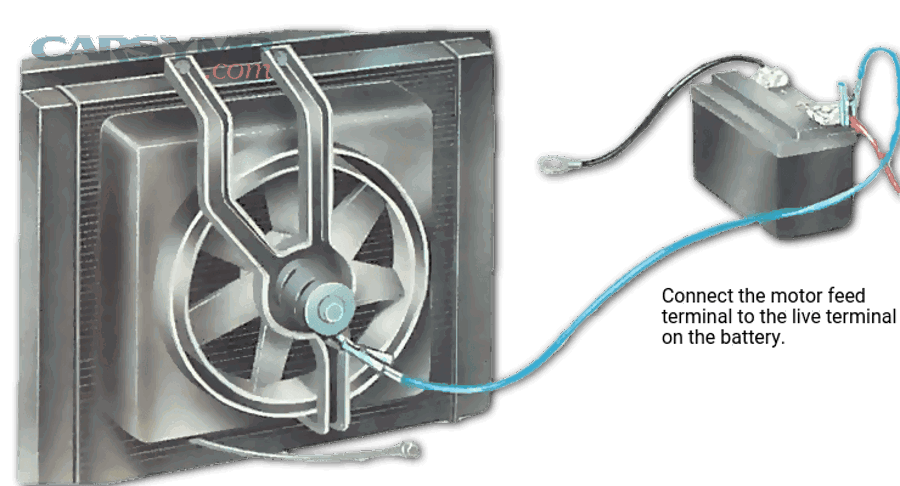
Test a radiator fan directly with battery connection by disconnecting the fan’s wiring harness, connecting a jumper wire from the battery positive terminal to the fan’s positive terminal, connecting another jumper wire from the battery negative terminal to the fan’s negative terminal, and observing whether the fan spins immediately and smoothly. This method bypasses all electrical system components to isolate fan motor functionality.
This direct battery testing approach provides the most definitive diagnosis because it eliminates variables like faulty relays, blown fuses, broken wiring, or failed control modules. Let’s examine each step of the testing procedure in detail.
How Do You Locate and Disconnect the Fan Connector?
The radiator fan connector is located at the back of the fan motor assembly behind the radiator, typically accessible from the engine bay after removing any plastic engine covers or air intake components. Modern vehicles position electric cooling fans between the radiator and engine block, with wiring harnesses running from the fan motor to the main electrical distribution panel.
To locate your specific fan connector, follow the electrical wires extending from the fan motor housing—these wires terminate in a plastic connector with a locking tab or clip mechanism. Single-speed fans have two-wire connectors (positive and ground), while dual-speed or variable-speed fans may have three or four wires connecting to the motor assembly.
Disconnect the connector by pressing the release tab firmly while pulling the connector halves apart—never pull on the wires themselves as this damages the terminals inside. Some connectors use sliding locks that require pushing a secondary tab before the main connector separates. If the connector resists separation, inspect for additional locking mechanisms rather than forcing it apart.
Identify the positive and negative terminals on the fan motor side of the connector by examining the wire colors or consulting your vehicle’s service manual. Most manufacturers follow standard color coding where red, orange, or yellow wires indicate positive voltage, while black, brown, or green wires indicate ground connections. The fan motor connector terminals are usually labeled with small (+) and (-) symbols molded into the plastic housing.
What Is the Correct Way to Connect Jumper Wires from Battery to Fan?
Connect jumper wires from battery to fan by attaching the red positive jumper wire to the battery positive terminal first, then touching the red wire’s other end to the fan’s positive terminal while the black negative jumper wire connects the battery negative terminal to the fan’s negative terminal simultaneously. This sequence prevents accidental short circuits and ensures proper polarity during testing.
Follow this precise connection procedure to avoid electrical system damage:
Step 1: Prepare the jumper wire connections – Ensure both jumper wire clamps are clean and free from corrosion that could increase resistance and reduce current flow to the fan motor.
Step 2: Connect the positive jumper wire – Attach the red jumper wire’s alligator clip to the positive (+) battery terminal, ensuring firm metal-to-metal contact. Route the wire away from moving engine parts and hot exhaust components.
Step 3: Connect the negative jumper wire – Attach the black jumper wire’s alligator clip to the negative (-) battery terminal or a clean metal ground point on the engine block or chassis.
Step 4: Complete the circuit to the fan – Simultaneously touch the free end of the red jumper wire to the fan motor’s positive terminal and the black jumper wire to the fan’s negative terminal. The fan should activate immediately upon completion of this circuit.
Critical warning: Never allow the positive and negative jumper wire ends to touch each other—this creates a direct short circuit across the battery that can cause cable overheating, battery damage, or electrical fire. Keep the wire ends separated until you’re ready to test the fan motor.
If your jumper cables have heavy spring-loaded clamps designed for jump-starting vehicles, you may need to use smaller test leads or alligator clips that fit the fan motor terminals more precisely. Automotive parts stores sell 12-gauge test leads with small alligator clips specifically designed for component testing.

What Should Happen When the Fan Is Connected Directly to Battery?
The fan should spin immediately and smoothly at full speed when connected directly to the battery, producing steady airflow without hesitation, grinding noises, or burning odors. This immediate response within one second of circuit completion indicates the fan motor’s internal components including windings, brushes, bearings, and blade assembly are functioning properly.
A properly functioning radiator fan will exhibit these specific characteristics during direct battery testing:
Immediate activation – The motor begins rotating within 0.5-1 second of completing the electrical circuit, demonstrating that the motor windings accept current and generate electromagnetic force properly.
Consistent speed – The fan reaches maximum RPM quickly and maintains constant rotational speed without fluctuation, indicating balanced electrical windings and mechanically sound bearings.
Smooth operation – The fan blades spin without wobbling, vibration, or irregular rotation patterns that suggest bent blades, damaged bearings, or motor mounting problems.
Normal sound level – A healthy fan motor produces a steady whooshing sound from air movement plus a low electrical hum from the motor itself, without grinding, squealing, clicking, or rattling noises.
No overheating – The motor housing remains at normal operating temperature without excessive heat buildup or burning plastic odors that indicate shorted windings or excessive electrical resistance.
Strong airflow – The fan generates substantial air movement that you can feel several inches away from the blade assembly, confirming the motor develops adequate torque.
What results mean for diagnosis: If the fan exhibits all these characteristics during direct battery testing, the motor assembly is functional and any cooling system problems originate in the electrical control circuit, including relays, fuses, wiring, temperature sensors, or the engine control module. Conversely, if the fan fails to spin, operates slowly, makes abnormal noises, or exhibits intermittent operation, the motor assembly requires replacement regardless of other electrical system components.
According to automotive repair data from the Automotive Service Association, approximately 60% of radiator fan failures originate in the electrical control system rather than the fan motor itself, making direct battery testing an essential diagnostic step that prevents unnecessary part replacement.
How Can You Test Radiator Fan Voltage with a Multimeter? (Method 2)
Test radiator fan voltage with a multimeter by setting the meter to DC voltage mode, connecting the black probe to a chassis ground point, touching the red probe to the power wire at the fan connector while the fan should be running, and observing whether the meter reads 12-14.8 volts. This method determines whether the electrical system supplies adequate power to the fan motor during normal operation.
Voltage testing identifies electrical system problems versus motor failures by measuring actual power delivery. This approach helps pinpoint issues with relays, fuses, wiring, or control modules when the fan motor tests good during direct battery connection.
How Do You Set Up Your Multimeter for Fan Voltage Testing?
Set up your multimeter for fan voltage testing by rotating the selector dial to the DC voltage (DCV or V⎓) position and selecting the 20-volt range for accurate 12-volt automotive system measurements. This configuration allows the multimeter to measure the potential difference between the power supply wire and ground, revealing whether electricity reaches the fan connector.
Follow these specific multimeter setup steps for accurate voltage measurement:
Select DC voltage mode – Automotive electrical systems use direct current, so the meter must read DC volts rather than AC volts. Most digital multimeters label this setting as “DCV,” “V⎓,” or display a straight line with dots above a “V” symbol.
Choose the 20-volt range – This range provides optimal resolution for 12-volt systems while accommodating the 13.5-14.8 volts present when the alternator charges the battery. Some auto-ranging multimeters automatically select the appropriate range when measuring voltage.
Insert test leads correctly – Place the black (negative) probe into the COM or common jack on the multimeter and the red (positive) probe into the V or voltage jack. Never use the 10A or high-current jack for voltage measurements.
Verify meter operation – Touch the red probe to the battery positive terminal and the black probe to the battery negative terminal before testing the fan. The meter should display 12.4-12.8 volts with the engine off or 13.5-14.8 volts with the engine running, confirming the multimeter functions correctly.
Probe placement during fan testing requires connecting the black probe to a clean metal ground point on the chassis or engine block and carefully touching the red probe to the exposed metal terminal inside the fan’s power wire connector. Some technicians use sharp probe tips that pierce wire insulation for backprobing connectors without disconnection, though this technique risks creating corrosion entry points in the wiring.

What Voltage Reading Indicates the Fan Should Be Working?
A voltage reading of 12-14.8 volts at the fan connector indicates the electrical system supplies adequate power and the fan should be working if the motor is functional. This voltage range represents normal automotive electrical system operation with the battery providing 12.4-12.8 volts when the engine is off and the alternator delivering 13.5-14.8 volts during engine operation.
Interpret voltage readings according to these diagnostic guidelines:
12-14.8 volts present – The electrical control system (relays, fuses, wiring, control module) functions correctly and delivers power to the fan connector. If the fan doesn’t operate despite this voltage, the fan motor itself has failed and requires replacement. This scenario accounts for approximately 40% of radiator fan problems according to automotive repair statistics.
0-2 volts present – No significant power reaches the fan connector, indicating problems in the electrical control circuit rather than the fan motor. Possible causes include blown fuses, failed relays, broken wiring between the relay and fan, poor ground connections, or faulty control module output. The fan motor may still be functional even though it doesn’t receive operating voltage.
4-9 volts present – Partial voltage indicates excessive resistance somewhere in the power supply circuit, such as corroded connector terminals, damaged wiring with broken internal strands, or a failing relay with burned contacts. This insufficient voltage may cause slow fan operation, intermittent operation, or complete failure to start depending on motor design and voltage requirements.
Fluctuating voltage – Readings that vary rapidly between high and low values suggest intermittent electrical connections, a failing relay cycling on and off, or a faulty control module with erratic output signals. This condition often correlates with fans that work sporadically or stop and start unexpectedly.
Timing considerations affect voltage testing accuracy significantly. Many radiator fans only activate when engine coolant temperature exceeds 195-220°F (90-104°C) as measured by the coolant temperature sensor. Testing voltage when the engine is cold or hasn’t reached normal operating temperature may show zero volts simply because the control system hasn’t commanded fan operation yet. Similarly, vehicles with air conditioning-activated fans require the A/C system to be turned on before the fan relay energizes.
To test properly, either warm the engine to operating temperature and verify the coolant temperature gauge reads in the normal range, or turn on the air conditioning system to full cold with maximum blower speed. On most vehicles, the A/C compressor activation automatically energizes the radiator fan relay to ensure adequate airflow through the condenser regardless of coolant temperature.
How Do You Check Radiator Fan Resistance with a Multimeter? (Method 3)
Check radiator fan resistance with a multimeter by setting the meter to ohms (Ω) mode, disconnecting the fan completely from all power sources, touching the meter probes to the fan motor’s positive and negative terminals, and reading the resistance value which should typically measure 3-20 ohms for automotive radiator fans. This method tests motor winding integrity without applying power to the motor.
Resistance testing reveals internal motor failures that voltage testing cannot detect. A burned-out motor shows infinite resistance (open circuit), while a shorted motor shows near-zero resistance, both indicating replacement is necessary.
What Is the Correct Multimeter Setting for Resistance Testing?
The correct multimeter setting for resistance testing is the 200-ohm (200Ω) range on the resistance or ohms measurement mode, identified by the Omega symbol (Ω) on the meter’s selector dial. This range provides adequate resolution to measure the low resistance values typical in automotive fan motor windings while accommodating the full expected range of 3-20 ohms.
Configure your multimeter using these specific steps for accurate resistance measurement:
Disconnect all power sources – Remove the fan motor connector completely from the vehicle’s wiring harness and verify the battery negative terminal remains disconnected. Resistance measurements require the component to be isolated from all voltage sources to prevent meter damage and ensure accurate readings.
Select the ohms function – Rotate the multimeter selector dial to the resistance position marked with the Ω symbol. On multimeters with multiple resistance ranges, choose 200Ω or 200R as this provides the best precision for measuring values below 20 ohms.
Zero the meter (analog meters only) – If using an analog multimeter, touch the test probes together and adjust the zero-ohms knob until the needle points to zero on the resistance scale. Digital multimeters automatically compensate for test lead resistance and don’t require manual zeroing.
Connect test leads to motor terminals – Place the multimeter probes directly on the exposed metal terminals of the fan motor connector on the motor side (not the harness side). Polarity doesn’t matter for resistance measurements, so either probe can touch either terminal.
Read and record the resistance value – The multimeter displays the motor winding resistance in ohms. Most automotive radiator fan motors measure between 3-20 ohms depending on motor design, power rating, and manufacturer specifications.
Expected resistance values vary by fan type and power rating. Small auxiliary fans for compact cars typically measure 8-15 ohms, while large dual-fan assemblies for trucks or high-performance vehicles may measure 3-6 ohms due to heavier gauge wire in the motor windings. Single-speed fans show one resistance value across two terminals, while dual-speed fans have three or more terminals with different resistance values for low and high-speed operation.
What Do Different Resistance Readings Mean?
Different resistance readings indicate specific motor conditions: 3-20 ohms means normal motor windings, infinite resistance (OL or 1 on digital displays) means open circuit from burned windings, and near-zero resistance means shorted windings. These values provide definitive diagnosis of internal motor electrical integrity.
Interpret resistance measurements according to these diagnostic criteria:
Normal resistance (3-20 ohms) – The motor windings maintain electrical continuity without shorts or opens. The specific value depends on motor design, with higher-power fans typically showing lower resistance values because they use heavier gauge wire. A motor reading within this range has electrically intact windings and should operate when supplied with proper voltage. If the motor shows normal resistance but fails direct battery testing, suspect mechanical problems like seized bearings or damaged blade assemblies.
Infinite resistance (OL, 1, or “OPEN”) – The motor windings have an open circuit, meaning electrical current cannot flow through the wire coils inside the motor. This condition results from burned or melted wire insulation that causes the winding wire to break internally, often from overheating due to bearing seizure, blocked airflow, or extended operation at excessive current draw. Motors showing infinite resistance are permanently failed and require replacement. This failure mode represents approximately 25% of radiator fan motor failures.
Zero or very low resistance (0-1 ohms) – The motor windings have shorted together, allowing current to bypass the normal electromagnetic coil path. This condition occurs when wire insulation breaks down inside the motor, allowing adjacent turns of wire to contact each other directly. Shorted motors may not spin at all, may spin slowly with reduced power, or may draw excessive current that blows fuses or trips circuit breakers repeatedly. This failure mode indicates permanent motor damage requiring replacement.
Fluctuating or unstable resistance – Readings that change when you move the motor shaft, wiggle the wires, or reposition the test probes indicate loose internal connections, partially broken winding wires, or corroded terminal connections. This intermittent condition causes unreliable fan operation with the motor working sometimes but failing at other times. While less common than complete opens or shorts, intermittent failures are particularly frustrating because the motor may test good one moment and fail the next.
Comparing resistance values between fan motors helps identify abnormal readings when you’re uncertain about the normal range. If your vehicle has dual radiator fans (common on vehicles with air conditioning or high-performance cooling requirements), measure both fans and compare the values—they should read nearly identical since they’re typically the same part number. A significant difference suggests one motor has developed internal problems even if the reading doesn’t clearly indicate open or short conditions.
According to research from the Society of Automotive Engineers, resistance testing correctly identifies 90% of electrical motor failures when combined with visual inspection, making it a highly reliable diagnostic method that prevents unnecessary parts replacement.

What Are Common Problems Found During Direct Fan Testing?
Common problems found during direct fan testing include motors that spin slowly or intermittently (indicating partial winding failure or bearing wear), motors that don’t spin at all (confirming complete motor failure), and motors that work during direct testing but fail during normal vehicle operation (indicating electrical system problems). These diagnostic results guide repair decisions and prevent misdiagnosis.
Understanding what each test result means helps you identify the actual failed component. Let’s examine each common problem and its implications for repair strategy.
What Does It Mean If the Fan Spins Slowly or Intermittently?
A fan that spins slowly or intermittently during direct battery testing indicates partially failed motor windings, worn bearings causing mechanical drag, or insufficient power delivery through poor electrical connections in your test setup. This behavior represents a degraded motor that may work under light load but fails under normal operating conditions.
Slow or intermittent spinning manifests through several observable characteristics:
Delayed startup – The motor takes 2-5 seconds to begin rotating after connecting to battery power, rather than starting instantly. This delay suggests the motor develops insufficient starting torque due to weakened electromagnetic fields from partial winding failures.
Below-normal speed – The fan rotates visibly slower than a known-good fan, producing weak airflow and reduced cooling capacity. Normal radiator fans spin at 2,000-3,000 RPM, generating strong air movement you can feel from several feet away. Slow fans may only reach 500-1,500 RPM with barely perceptible airflow.
Speed fluctuation – The motor speeds up and slows down rhythmically rather than maintaining constant RPM. This cycling pattern often indicates internal winding problems where current flow varies as the motor rotates, or bearing problems where mechanical resistance changes with shaft position.
Intermittent stopping – The fan starts spinning normally but stops after several seconds, then may restart spontaneously or only when you disconnect and reconnect the jumper wires. This behavior suggests internal winding connections that make and break contact as the motor rotates, or thermal protection switches that open when the motor overheats from excessive current draw.
When to replace versus investigate further depends on the severity and consistency of the problem. Fans showing consistent slow operation or frequent intermittent behavior should be replaced because partial motor failures progressively worsen and leave you vulnerable to unexpected cooling system failure and engine overheating. The minimal cost difference between diagnostic time and new fan assembly makes replacement the economical choice in most situations.
However, if the fan operates at apparently normal speed but occasionally hesitates or briefly slows down, verify your test setup first. Ensure jumper wire connections make firm contact without corrosion, use appropriately heavy wire gauge (10-12 gauge minimum), and confirm the battery is fully charged (12.6+ volts no-load). Poor test connections can create voltage drop that mimics motor problems, leading to unnecessary part replacement.
What If the Fan Doesn’t Spin at All During Direct Testing?
If the fan doesn’t spin at all during direct battery testing, the motor has failed completely and requires replacement—but first verify jumper wire connections are correct, the battery is charged, and no physical obstruction prevents blade rotation. This no-spin condition definitively confirms motor failure once you eliminate testing errors.
Before concluding the motor is failed, check these potential testing mistakes:
Reversed polarity – Verify you connected the positive jumper wire to the fan’s positive terminal and the negative wire to the negative terminal. Most DC motors will run regardless of polarity but may not start from a dead stop if connected backwards, especially motors with internal permanent magnets.
Poor electrical connections – Ensure jumper wire clamps grip metal surfaces firmly without corrosion or paint preventing current flow. Clean terminals with a wire brush if necessary and verify you see bright metal-to-metal contact at all four connection points (both battery terminals and both fan terminals).
Discharged battery – Check battery voltage before testing. A battery below 12.0 volts may lack sufficient power to start the motor even if the motor is functional. Charge the battery or try testing from a different vehicle’s battery.
Physical obstruction – Attempt to rotate the fan blades by hand (with power disconnected) to verify nothing blocks the blade path and the motor shaft rotates freely. Debris, damaged shroud components, or seized bearings can prevent rotation even when the motor receives adequate electrical power.
Multiple motor terminals – Some dual-speed fans have three or more wires with different terminal combinations for high and low speed operation. Consult a wiring diagram to verify you’re connecting to the correct terminal pair. Connecting to the wrong combination may energize only a portion of the motor windings, preventing startup.
Once you’ve eliminated these testing errors, a motor that absolutely won’t spin during direct 12-volt battery testing is permanently failed. The failure could stem from burned open windings (infinite resistance on multimeter testing), severely shorted windings (near-zero resistance), or mechanical seizure from bearing failure. Regardless of the specific failure mechanism, the motor assembly requires replacement.
According to data from automotive warranty claim analysis, completely failed radiator fan motors account for approximately 35% of all cooling system failures, making this a relatively common problem that most car owners encounter eventually.
What Should You Check If the Fan Works in Direct Test But Not in Car?
If the fan works during direct battery testing but not during normal vehicle operation, check the electrical control system including fuses, relays, wiring harness connections, temperature sensor functionality, and control module operation. This scenario definitively confirms the fan motor is functional and the problem exists in the power delivery or control circuitry.
Systematic diagnosis of electrical system components follows this priority sequence:
Check radiator fan fuses – Locate the fuse box (usually under the hood or dashboard) and identify fuses labeled “COOLING FAN,” “RAD FAN,” “CLG,” or similar designations. Use a test light or multimeter to verify these fuses show continuity and aren’t blown. Many vehicles use high-amperage fuses (30-40 amps) for radiator fans due to their significant power draw. Replace any blown fuses and retest the system, but investigate why the fuse blew if it fails again immediately—this suggests a short circuit somewhere in the wiring.
Test fan relays – Radiator fan relays are typically located in the under-hood fuse/relay box and labeled “FAN RELAY,” “COOLING FAN,” or with specific designations for high/low speed operation. Many vehicles have two separate relays for dual-speed fans. Swap the fan relay with an identical relay from another circuit (such as fuel pump or horn relays) to test whether the relay is faulty. If the fan operates after swapping relays, purchase a new relay for permanent repair. Relays commonly fail due to electrical arcing that burns the internal contacts, especially in high-current applications like radiator fans.
Inspect wiring harness for damage – Visually examine all wiring between the relay, fuse box, and fan motor for broken insulation, melted wires, corroded connections, or physically damaged cables. Pay particular attention to areas where wiring harnesses route near hot engine components, sharp metal edges, or moving parts that could wear through insulation. Use a multimeter to check for continuity through suspected damaged wire sections. Wiring problems represent approximately 15% of radiator fan not working conditions according to automotive repair data.
Verify temperature sensor/switch functionality – The engine coolant temperature sensor sends information to the engine control module that determines when to activate the radiator fan. A faulty sensor may report incorrect temperature data, preventing fan activation even when the engine overheats. Test the sensor by monitoring coolant temperature with a scan tool while comparing to a separate thermometer in the radiator. Temperature readings should match within 5-10°F. Some vehicles use a separate fan temperature switch rather than relying on the main engine temperature sensor—this switch can fail in the open position, preventing fan operation.
Temporary cooling tips for emergencies when you’ve confirmed the fan motor works but the electrical system has problems: Run the air conditioning system on maximum cold setting, which forces most vehicles to activate the radiator fan regardless of coolant temperature. Drive at highway speeds where ram air through the radiator provides adequate cooling without fan operation. Add a manual toggle switch to directly power the fan from the battery when needed, bypassing the factory control system temporarily until proper repairs can be completed.
What Other Components Control Radiator Fan Operation?
Other components that control radiator fan operation include the fan relay that switches high-current power to the motor, the coolant temperature sensor that signals when cooling is needed, the engine control module (ECM) that processes sensor data and activates relays, and the fan control module in some vehicles that manages variable-speed operation. Understanding these components helps diagnose situations where the fan motor tests good but doesn’t operate in the vehicle.
Now that you’ve identified whether your fan motor itself is functional through direct testing, let’s explore the supporting electrical and electronic systems that determine when and how the fan operates during normal driving conditions.
How Does the Fan Relay Affect Fan Operation?
The fan relay affects fan operation by acting as an electrically-controlled switch that connects battery power to the radiator fan motor when the engine control module or temperature switch sends an activation signal. This relay design allows low-current control circuits (typically 0.1-0.5 amperes) to safely switch high-current fan motors (15-30 amperes) without overheating small wiring or electronic control modules.
Relay function in the fan circuit follows this electrical pathway:
Control circuit activation – When the engine control module determines the radiator fan should operate (based on coolant temperature, air conditioning activation, or other programmed conditions), it sends a small electrical signal to the relay’s control coil. This coil typically requires only 12 volts at 0.1-0.2 amperes to operate.
Electromagnetic switching – The control current flowing through the relay coil creates a magnetic field that physically moves an internal switch contact, connecting the battery power terminal to the fan motor terminal inside the relay. This mechanical switching action produces an audible click you can often hear when the relay activates.
High-current flow – Once the relay contacts close, battery voltage flows through the relay’s high-current circuit directly to the radiator fan motor, providing the 15-30 amperes necessary to spin the motor at full speed. The relay contacts are designed to handle this current safely without overheating or welding together.
Relay deactivation – When the control module removes the activation signal, the magnetic field collapses, and a spring returns the relay contacts to the open position, disconnecting power from the fan motor.
How to test fan relay independently involves several straightforward methods. The simplest approach uses relay substitution—swap the suspected fan relay with an identical relay from another circuit (such as the fuel pump, horn, or accessory relay) and test whether the fan operates. If swapping relays restores fan operation, the original relay is faulty and requires replacement at typically $15-30 cost.
More precise relay testing requires a multimeter and basic understanding of relay terminal identification. Most automotive relays use a standardized four-pin or five-pin design with terminals numbered 85 (control ground), 86 (control power), 30 (battery input), 87 (switched output to fan), and sometimes 87a (normally-closed contact). Test the relay by:
- Measuring resistance between terminals 85 and 86 with meter set to ohms—should read 50-200 ohms for the control coil
- Measuring continuity between terminals 30 and 87 with the relay energized by applying 12 volts to terminal 86 and ground to terminal 85—should show continuity when energized
- Verifying terminal 30 connects to battery voltage (12+ volts) when the relay is installed in the vehicle
- Confirming terminal 87 delivers battery voltage to the fan when the relay should be activated
Common relay failure symptoms include no fan operation despite proper control signal, intermittent fan operation with the relay clicking repeatedly, fan running continuously without stopping, or burning odor from the relay socket indicating overheated contacts. Relays fail most commonly from contact burning due to high current arcing, particularly on vehicles with old or deteriorating fan motors that draw excessive amperage.
Relay location varies significantly between vehicle makes and models. Most manufacturers position fan relays in the under-hood power distribution center or fuse box, typically labeled clearly in the fuse box cover or owner’s manual. Some European vehicles locate relays in junction boxes near the battery or in the engine compartment’s side panels.
What Role Does the Coolant Temperature Sensor Play?
The coolant temperature sensor plays the critical role of monitoring engine coolant temperature and sending this information to the engine control module, which uses the data to determine when the radiator fan should activate to prevent overheating. This sensor essentially acts as the trigger point for the entire cooling fan system in modern vehicles.
Sensor function and integration with the fan system operates through these mechanisms:
Temperature measurement – The coolant temperature sensor (also called engine coolant temperature or ECT sensor) contains a thermistor—a resistor whose electrical resistance changes predictably with temperature. As coolant temperature increases, the sensor’s resistance decreases, changing the voltage signal sent to the engine control module. This provides continuous real-time temperature monitoring rather than simple on/off switching.
Signal processing – The engine control module continuously reads the temperature sensor voltage and converts it to an actual temperature value using calibration tables programmed into the computer. Modern ECMs sample this sensor data 10-50 times per second, allowing precise temperature monitoring and rapid response to changing conditions.
Fan activation threshold – When coolant temperature exceeds the programmed threshold (typically 195-220°F or 90-104°C depending on vehicle design), the control module energizes the fan relay to start cooling. Some vehicles activate fans at lower temperatures when air conditioning operates, since the A/C condenser requires airflow to reject heat efficiently.
Multi-speed control – Vehicles with dual-speed or variable-speed fans use different temperature thresholds for low and high-speed operation. For example, the control module might activate low speed at 200°F, switch to high speed at 215°F, and turn the fan off when temperature drops below 190°F. This staged approach minimizes electrical load and noise while providing adequate cooling.
How sensor failure prevents fan operation manifests in several ways. A sensor that fails “open circuit” (infinite resistance) makes the control module think the engine is extremely cold, preventing fan activation even during severe overheating. Conversely, a sensor that fails “short circuit” (very low resistance) signals extremely high temperature, potentially causing the fan to run continuously or triggering false overheating warnings. Most problematic are sensors that provide erratic or intermittent signals, causing unpredictable fan operation and difficult-to-diagnose overheating issues.
Testing the temperature sensor requires a scan tool or multimeter with temperature coefficient tables. Professional technicians use scan tools to view the actual temperature reading the control module receives from the sensor while simultaneously measuring actual coolant temperature with an infrared thermometer or separate temperature probe. The readings should agree within 5-10°F throughout the temperature range. Values that differ significantly or change erratically indicate sensor failure.
Alternative testing without a scan tool involves measuring sensor resistance at different temperatures using a multimeter and comparing to manufacturer specifications. A typical ECT sensor might show 2,500-3,000 ohms at room temperature (68°F), 1,000-1,200 ohms at normal operating temperature (195°F), and 200-300 ohms at high temperature (220°F). Resistance values significantly outside these ranges suggest sensor replacement is necessary.
According to studies published in the International Journal of Automotive Technology, faulty coolant temperature sensors contribute to approximately 8% of engine overheating incidents, making them a relatively common failure point in the cooling system control circuit.
Can a Bad Thermostat Cause Fan Problems?
No, a bad thermostat does not directly cause radiator fan motor failure or fan electrical system malfunction, but it can prevent the engine from reaching the temperature threshold where the fan should activate, creating the appearance of fan problems. This indirect relationship confuses many car owners who experience overheating despite having functional fan components.
The thermostat affects fan operation timing through its role in engine temperature regulation:
Thermostat stuck open – When the thermostat valve remains open continuously instead of closing when the engine is cold, coolant circulates through the radiator constantly. This prevents the engine from reaching normal operating temperature, meaning coolant temperature never rises to the 195-220°F threshold where the temperature sensor signals the fan to activate. Drivers may notice the temperature gauge reads lower than normal and the fan never runs, but this represents normal operation at reduced temperature rather than a fan system malfunction.
Thermostat stuck closed – When the thermostat valve fails in the closed position, coolant cannot flow through the radiator for cooling. Engine temperature rises rapidly and continuously, potentially exceeding safe limits before the radiator fan activates. Even when the fan does activate at its normal temperature threshold, it cannot effectively cool the engine because no coolant flows through the radiator to be cooled by the fan airflow. This creates severe overheating that appears to be fan-related but actually stems from blocked coolant circulation.
Thermostat opening temperature mismatch – Some replacement thermostats have different opening temperatures than original equipment. A thermostat that opens at 180°F instead of 195°F may keep the engine cooler than designed, preventing fan activation in situations where it would normally run. Conversely, a high-temperature thermostat (203-210°F opening) intended for racing applications may allow the engine to run hotter than the fan activation threshold, creating unnecessary fan cycling.
Difference between thermostat and fan issues becomes clear through systematic diagnosis. A thermostat problem affects engine temperature throughout all driving conditions—highway, city, idle, and cold start. Fan problems typically manifest only during low-speed driving or idle conditions when airflow through the radiator is minimal. If your vehicle overheats during highway driving at 55+ mph, the problem is almost certainly thermostat or coolant circulation related rather than fan-related, since ram air provides adequate radiator cooling at speed regardless of fan operation.
System-level diagnosis approach for cooling problems requires testing each component methodically:
- Verify coolant level is correct when engine is cold
- Check thermostat operation by monitoring how quickly the engine reaches operating temperature (should warm to 195°F within 5-10 minutes of starting)
- Confirm radiator fan activates at normal operating temperature or when A/C is turned on
- Test for adequate coolant flow by feeling upper and lower radiator hoses when engine is hot—both should be hot if coolant circulates properly
- Inspect for air pockets in cooling system that prevent proper temperature sensor reading
- Verify radiator isn’t blocked internally or externally, restricting airflow or coolant flow
This comprehensive approach identifies whether problems originate in the fan system, thermostat, water pump, radiator, or coolant circulation rather than focusing on just one component.
What Is the Difference Between Single-Speed and Dual-Speed Fan Motors?
The difference between single-speed and dual-speed fan motors is that single-speed fans operate at one constant RPM when powered while dual-speed fans can run at two different speeds (typically low and high) depending on cooling requirements, with dual-speed motors using either multiple sets of internal windings or external resistors to achieve variable speed operation. This design flexibility allows more efficient cooling system operation.
Single-speed fan characteristics and operation include:
Two-wire electrical connection – Single-speed fans use simple two-wire connectors with one positive power wire and one ground wire. When the relay closes and provides battery voltage, the motor runs at its designed maximum speed.
Constant RPM operation – These fans spin at 2,000-3,000 RPM whenever energized, regardless of how much cooling is actually needed. This full-speed operation provides maximum cooling capacity but draws maximum electrical current (typically 15-25 amperes) continuously.
Simple control strategy – The engine control module or temperature switch operates these fans with simple on/off logic—the fan is either running at full speed or completely off with no intermediate states. This makes the control circuitry simpler and more reliable.
Lower cost – Single-speed fans cost less to manufacture and install, making them common on economy vehicles and older automobiles before sophisticated electronic fan control became standard.
Dual-speed fan characteristics and operation include:
Three or four-wire electrical connection – Dual-speed fans typically use three wires (low speed, high speed, and ground) or four wires (power, low-speed control, high-speed control, and ground). Some designs use a separate resistor pack in the wiring to create the low-speed effect.
Two operating speeds – Low speed typically runs the fan at 40-60% of maximum RPM (1,000-1,800 RPM), while high speed operates at full capacity (2,500-3,500 RPM). This allows the control module to match fan speed to actual cooling demand.
Staged temperature response – The control module activates low speed when coolant temperature reaches 195-205°F, then switches to high speed if temperature continues rising to 210-220°F. This provides adequate cooling while minimizing electrical load, noise, and fuel consumption from alternator load.
Two separate relays – Dual-speed systems use independent relays for low and high speed operation. Some vehicles position both relays in the fuse box, while others mount a low-speed relay in the box and a high-speed relay near the fan motor or on the fan shroud.
High-speed and low-speed relay systems require careful attention during testing and diagnosis. When troubleshooting dual-speed fans, test both relay positions by swapping them individually with known-good relays. A vehicle might have working low speed but failed high speed (or vice versa) due to one failed relay, making direct battery testing essential to confirm the motor itself operates at full capacity.
Testing considerations for each fan type differ significantly. Single-speed fans require testing only one power wire and ground connection to verify operation. Dual-speed fans need testing of both speed circuits to ensure both windings or both resistor paths function correctly. When performing direct battery testing on dual-speed fans, connect power to the high-speed terminal to verify maximum motor capability, as this confirms both the motor and its highest power winding work properly.
According to automotive engineering research from SAE International, dual-speed fan systems reduce average cooling fan electrical consumption by 25-35% compared to single-speed designs while maintaining equivalent cooling performance, explaining their increasing adoption in modern vehicles.
This comprehensive guide provides car owners with the knowledge and testing procedures necessary to diagnose radiator fan problems accurately. By following the three testing methods—direct battery connection, voltage measurement, and resistance testing—you can definitively determine whether your cooling system issues stem from a failed fan motor or problems in the electrical control circuitry. Remember that safety precautions are paramount when working with automotive electrical systems, and proper diagnosis prevents unnecessary part replacement while ensuring your vehicle’s cooling system operates reliably.