


AC fan repairs improve cooling performance by restoring proper airflow across condenser and evaporator coils, which directly enhances heat exchange, lowers energy consumption, and prevents cascading damage to critical components. When a fan motor malfunctions, the entire air conditioning system loses its ability to transfer heat efficiently, forcing the compressor to work harder and driving up monthly utility bills. For homeowners, understanding this connection between fan health and overall AC performance is the first step toward making informed maintenance decisions that protect both comfort and budget.
Beyond performance gains, timely fan repairs serve as an early warning system for deeper mechanical issues. A grinding noise, a sluggish blade, or warm air blowing through vents are symptoms that, when addressed quickly, prevent minor problems from escalating into full system breakdowns. Recognizing these warning signs empowers homeowners to act before a simple radiator fan repair turns into a compressor replacement costing thousands of dollars.
Homeowners also face a practical decision when a fan motor fails: is it more cost-effective to repair the existing motor or replace it entirely? The answer depends on the age of the unit, warranty coverage, and the frequency of past repairs. Understanding these cost-benefit thresholds helps homeowners avoid overspending on a dying system or prematurely discarding one that still has years of life remaining.
Preventing fan failures through consistent preventive maintenance is equally critical to sustaining long-term AC performance. Next, this article explores every dimension of how AC fan repairs affect your cooling system, from energy savings and warning signs to repair-versus-replace decisions and the specialized differences between condenser and blower motor repairs.
What Are AC Fan Repairs and Why Do They Matter for Cooling Performance?
AC fan repairs are maintenance and restoration procedures performed on the fan motor, blades, capacitor, and wiring of an air conditioning system to restore proper airflow and cooling function. These repairs matter because the fan is the component responsible for moving air across both the condenser coil (outdoors) and the evaporator coil (indoors), making it essential to the entire refrigerant-based heat exchange cycle.
To better understand why fan repairs carry such weight, it helps to examine the individual components involved and the direct consequences of a faulty fan on cooling output.
What Components Are Involved in an AC Fan Repair?
There are six main components involved in an AC fan repair: the fan motor, fan blades, capacitor, wiring, bearings, and lubrication system, each based on its role in sustaining airflow and mechanical operation.
The fan motor is the heart of the assembly. It converts electrical energy into rotational force that spins the fan blades. When the motor overheats or its windings burn out, the entire airflow chain breaks down. Motors in residential AC units are rated to last between 10 and 15 years, but poor maintenance can cut that lifespan dramatically.
Fan blades are the metal or composite components attached to the motor shaft. They are responsible for physically moving air across the coils. When blades become bent, cracked, or unbalanced, they create vibration that accelerates wear on the motor bearings and can strike other internal components. This type of damage often increases Radiator fan repair labor time significantly, as technicians must inspect surrounding parts for secondary damage before completing the repair.
The capacitor stores and releases electrical energy to start the motor and keep it running at a consistent speed. A failing capacitor is one of the most common causes of a fan motor that hums but does not spin. Replacing a capacitor is a relatively inexpensive repair, typically costing between $150 and $300, yet it restores full motor function.
Wiring connects the motor to the electrical supply and the thermostat control system. Over time, vibration, heat, and moisture can cause wires to corrode, fray, or disconnect entirely. Faulty wiring not only prevents the fan from operating but also poses a fire and electrical shock hazard.
Bearings reduce friction between moving parts inside the motor. When bearings wear down due to lack of lubrication or excessive heat, the motor produces grinding or squealing noises and draws more electrical current than normal. Lubrication, the final component, keeps bearings and other moving parts operating smoothly. Many modern motors are sealed and do not require external lubrication, but older units benefit from periodic oiling during maintenance visits.
Each of these components plays a specific role in the cooling cycle, and a failure in any one of them can cascade into broader system problems. According to a 2023 report by the U.S. Department of Energy’s Building Technologies Office, HVAC systems with properly maintained fan assemblies operate up to 15% more efficiently than those with neglected components.
Does a Faulty AC Fan Directly Reduce Cooling Output?
Yes, a faulty AC fan directly reduces cooling output because it disrupts the airflow required for heat exchange across both the condenser and evaporator coils, at least three mechanisms drive this reduction.
First, reduced airflow over the condenser coil prevents the refrigerant from releasing heat into the outdoor air. The condenser fan draws ambient air across the coil to cool the hot, high-pressure refrigerant inside. When the fan slows down or stops, the refrigerant retains heat and enters the expansion valve at a higher temperature than designed. This reduces the system’s ability to absorb heat from indoor air, resulting in warmer temperatures inside the home even though the compressor is still running.
Second, inadequate airflow causes the evaporator coil to drop below its intended operating temperature. Without sufficient warm air passing over the coil, moisture on its surface can freeze, creating a layer of ice that further blocks airflow. A frozen evaporator coil is one of the most common consequences of a failed blower motor, and it forces homeowners to shut down the system entirely until the ice melts.
Third, a struggling fan motor draws excessive electrical current, which strains the compressor and other electrical components. The compressor, which is the most expensive single component in an AC system, relies on consistent airflow to maintain safe operating temperatures. When that airflow drops, the compressor overheats and may trigger its thermal safety switch, shutting the entire system down.
For example, a homeowner who notices that their outdoor unit is running but the indoor vents are blowing warm air is likely experiencing a condenser fan failure. The compressor is working, but without the fan to dissipate heat, the refrigerant cycle cannot function properly. This scenario highlights why even a seemingly minor fan issue demands prompt attention. A Radiator fan replacement overview of the situation often reveals that early intervention could have prevented compressor damage entirely.
How Do AC Fan Repairs Improve Energy Efficiency for Homeowners?
AC fan repairs improve energy efficiency by restoring the system’s ability to move air at its designed volume and pressure, which reduces the electrical load on the compressor and shortens runtime cycles. When the fan operates correctly, the AC unit reaches the thermostat’s set temperature faster and cycles off sooner, consuming less energy per cooling cycle.
Specifically, the relationship between fan condition and energy bills is both measurable and significant. Let’s explore the main ways a properly repaired fan reduces energy costs and what happens when repairs are delayed.
What Are the Main Ways a Repaired Fan Lowers Energy Bills?
There are four main ways a repaired AC fan lowers energy bills: restored airflow reduces system strain, the motor draws correct amperage, short cycling is eliminated, and consistent temperature regulation reduces total runtime.
Restored airflow is the most immediate benefit. When a fan motor is repaired or a bent blade is straightened, the volume of air moving across the coils returns to the manufacturer’s specification. This allows the refrigerant to absorb and release heat at the rate the system was engineered to achieve. The compressor no longer has to run at maximum capacity to compensate for poor heat exchange, which directly reduces its electricity consumption.
Correct amperage draw is the second benefit. A failing fan motor often draws more electrical current than a healthy one because internal friction from worn bearings or a weakened capacitor forces the motor to work harder. After repair, the motor operates within its rated amperage, which can represent a measurable reduction in electricity usage. For homeowners tracking their utility bills, this is often the first noticeable improvement after a fan repair.
Elimination of short cycling is the third benefit. Short cycling occurs when the AC unit turns on and off in rapid succession because it cannot maintain a stable operating temperature. A faulty fan that restricts airflow causes the compressor to overheat and trigger its safety switch, shutting the system down prematurely. Once cooled, the system restarts, only to overheat again. Each startup cycle draws a surge of electricity that far exceeds the energy used during steady-state operation. Repairing the fan breaks this cycle and allows the system to run smoothly.
Consistent temperature regulation is the fourth benefit. When the fan moves air efficiently, the thermostat registers that the desired temperature has been reached and signals the system to cycle off. Without proper airflow, the thermostat continues calling for cooling because the indoor temperature never stabilizes. This extended runtime translates directly into higher energy bills.
The table below summarizes how each repair benefit connects to energy savings:
| Repair Benefit | Mechanism | Energy Impact |
|---|---|---|
| Restored airflow | Proper heat exchange across coils | Compressor runs at lower capacity |
| Correct amperage draw | Motor operates within rated specs | Reduced electrical consumption |
| Short cycling eliminated | Stable compressor operation | Fewer high-energy startup surges |
| Consistent temperature | Thermostat reaches setpoint faster | Shorter total runtime per cycle |
Can a Delayed Fan Repair Increase Monthly Energy Costs?
Yes, a delayed fan repair can increase monthly energy costs by 10% to 25% because the compressor compensates for reduced airflow by running longer, cycling more frequently, and drawing excess current.
When a homeowner postpones a fan repair, the AC system does not simply stop working in most cases. Instead, it continues to operate in a degraded state. The compressor, which accounts for the largest share of an AC unit’s electricity usage, runs at higher loads for longer durations to achieve the same level of cooling that a healthy system delivers efficiently.
More importantly, the financial impact compounds over time. A fan motor with worn bearings may initially cause only a slight increase in energy usage. However, as the bearings deteriorate further, the motor draws progressively more current, generates more heat, and causes the compressor to cycle more aggressively. What began as a $20 monthly increase in energy costs can grow to $50 or more by the time the motor fails completely.
Beyond energy costs, delayed repairs often lead to secondary damage. A compressor that overheats repeatedly due to poor airflow may fail entirely, requiring a replacement that costs between $1,500 and $3,000, far exceeding the $300 to $700 cost of a fan motor repair. Preventing fan failures through timely service is therefore not just an energy-saving strategy but a financial protection measure.
According to a 2022 study published by the American Council for an Energy-Efficient Economy (ACEEE), households that maintained their HVAC fan components on a biannual schedule spent an average of 18% less on annual cooling costs compared to households that performed no preventive maintenance.
What Warning Signs Indicate Your AC Fan Needs Repair?
There are two main categories of warning signs that indicate your AC fan needs repair: audible symptoms such as grinding, rattling, and buzzing, and performance symptoms such as warm air from vents and circuit breaker trips, based on the type of failure occurring in the fan assembly.
Recognizing these signs early is critical because every day a failing fan operates is a day that accelerates wear on the compressor, wiring, and other expensive components. Below, we examine the specific sounds, behaviors, and electrical symptoms that homeowners should monitor.
What Sounds and Behaviors Signal a Failing AC Fan Motor?
There are five primary sounds and behaviors that signal a failing AC fan motor: grinding, rattling, buzzing, slow startup, and intermittent stopping, based on the mechanical condition of the motor, bearings, and blades.
Grinding noises are the most alarming. They typically indicate that the motor’s internal bearings have worn down to the point where metal-on-metal contact is occurring. This sound is distinct and often gets louder over time. A grinding motor is close to failure and should be inspected immediately.
Rattling sounds usually point to loose components. A fan blade that has become unbalanced or partially detached will rattle as it spins, striking the housing or other nearby parts. Loose mounting hardware can also produce rattling. While less urgent than grinding, rattling still requires prompt attention because a loose blade can cause physical damage to the condenser coil or wiring.
Buzzing is commonly associated with electrical issues. A capacitor that is losing its ability to store charge will cause the motor to hum or buzz without spinning. Electrical connections that have loosened or corroded can also produce a buzzing sound. In some cases, the fan blade may vibrate at a frequency that creates an audible buzz even when the motor itself is functioning.
Slow startup describes a fan that takes several seconds to reach full speed after the system turns on. This behavior suggests that the motor is struggling, often due to a weak capacitor, worn bearings, or buildup of debris on the blades and shaft. A slow-starting fan reduces cooling performance during the critical first minutes of each cycle.
Intermittent stopping is the most disruptive symptom. The fan begins spinning, then stops, then starts again unpredictably. This pattern usually indicates an overheating motor that triggers its internal thermal protection. The motor shuts down to cool itself, then restarts once it reaches a safe temperature. This on-and-off behavior mirrors the short cycling discussed earlier and places significant strain on the compressor.
A homeowner who hears any of these sounds or observes these behaviors should avoid running the system continuously and instead contact an HVAC professional. The longer a symptomatic fan operates, the greater the risk of compressor damage. Additionally, warm air blowing from vents while the outdoor unit runs is a strong indicator that the condenser fan has failed even if no unusual sounds are present.
Is a Tripping Circuit Breaker a Sign of AC Fan Motor Failure?
Yes, a tripping circuit breaker is a sign of AC fan motor failure because a malfunctioning motor draws excessive electrical current that exceeds the circuit’s rated amperage, causing the breaker to activate as a safety measure.
However, a tripping breaker is also a serious safety concern that goes beyond inconvenience. When a fan motor’s windings are damaged or its bearings are seized, the electrical resistance inside the motor changes. The motor attempts to draw more power to overcome the internal friction, and this increased current load can overwhelm the circuit. The breaker trips to prevent overheating of the wiring inside your home’s walls, which could otherwise lead to an electrical fire.
Homeowners should not simply reset the breaker and continue operating the system. While a breaker may occasionally trip due to a temporary power surge, repeated tripping when the AC turns on is a reliable indicator of a motor or capacitor problem. Each time the breaker trips and the system restarts, the motor experiences a high-current startup surge that further damages its windings.
More importantly, a tripping breaker can mask other issues. If the fan motor is drawing enough current to trip the breaker, it may also be sending voltage spikes to the compressor and the thermostat control board. These secondary effects are expensive to repair and may not become apparent until after the fan motor is replaced.
The safest course of action is to turn off the AC system at the thermostat and at the breaker panel, then call a licensed HVAC technician for a diagnostic inspection. A professional can measure the motor’s amperage draw with a clamp meter to determine whether the motor, capacitor, or wiring is the source of the overcurrent condition.
How Do Timely Fan Repairs Extend the Lifespan of Your AC System?
Timely fan repairs extend the lifespan of an AC system by breaking the chain reaction in which poor airflow leads to compressor overheating, frozen coils, and premature component failure. The fan is the first link in this chain, and repairing it promptly prevents damage from reaching the most expensive parts of the system.
To illustrate the stakes, consider that the average central AC system is designed to last 15 to 20 years with proper maintenance. A neglected fan motor can reduce that lifespan by five years or more by forcing the compressor and other components to operate under constant thermal stress.
What AC Components Are Damaged When Fan Repairs Are Delayed?
There are four main AC components that sustain damage when fan repairs are delayed: the compressor, evaporator coils, capacitor, and electrical wiring, based on their dependence on consistent airflow for safe operation.
The compressor is the component most vulnerable to fan-related damage. It compresses refrigerant into a high-pressure, high-temperature gas that must be cooled by the condenser fan before continuing through the cycle. When the condenser fan fails, the compressor overheats. Repeated overheating degrades the compressor’s internal lubrication, damages its motor windings, and can cause total mechanical seizure. Replacing a failed compressor typically costs between $1,500 and $3,000, and in many cases, technicians recommend replacing the entire outdoor unit instead.
Evaporator coils freeze when the blower motor fails to push warm indoor air across their surface. The coil temperature drops below 32°F, and moisture from the air forms a layer of ice that progressively thickens. This ice blocks airflow completely, creating a feedback loop that accelerates the freezing process. Once frozen, the coil cannot be used until it is fully thawed, which can take several hours. Repeated freeze-thaw cycles stress the coil’s copper tubing and can eventually cause refrigerant leaks.
The capacitor, while a relatively inexpensive part, is affected by the increased electrical demands placed on the system when the fan is underperforming. A motor that struggles to spin draws more current, and this overcurrent condition degrades the capacitor’s dielectric material over time. When the capacitor fails, the motor cannot start at all.
Electrical wiring throughout the system is subjected to higher-than-normal current loads when the fan motor is failing. Wires that carry excess current for extended periods can overheat, causing insulation to degrade and increasing the risk of short circuits. Wiring damage is particularly insidious because it can occur behind panels and inside conduit where homeowners cannot see it.
Understanding radiator fan repair labor time in context, a simple fan motor replacement typically takes a technician one to two hours. Compare that to the labor involved in diagnosing and repairing compressor damage, which can take an entire day and require refrigerant recovery, evacuation, and recharge.
Do Regular Fan Repairs Prevent the Need for a Full AC Replacement?
Yes, regular fan repairs prevent the need for a full AC replacement in the majority of cases because they keep the compressor, coils, and electrical system operating within safe parameters, extending their collective lifespan.
The logic is straightforward. An AC system is a collection of interdependent components, and the fan is one of the most mechanically active parts. By keeping the fan in good working order, homeowners protect the more expensive and harder-to-replace components downstream.
Consider the cost comparison. A fan motor replacement costs between $300 and $700, depending on the motor type and local labor rates. A full AC system replacement costs between $5,000 and $12,000 for a residential central air unit, including installation. Homeowners who invest in fan repairs when symptoms first appear avoid the financial shock of an unexpected system replacement.
However, there are situations where fan repair alone is not sufficient. If the AC unit is more than 15 years old and has required multiple repairs to different components in recent years, the cost of continued repairs may approach or exceed the cost of a new system. In these cases, a technician may recommend a full replacement, particularly if newer models offer significantly better energy efficiency ratings.
The decision matrix typically works as follows: if the system is under 10 years old and the fan motor is the only failing component, repair is almost always the right choice. If the system is between 10 and 15 years old and has had one or two other significant repairs, the homeowner should weigh the cumulative repair costs against the price of a new unit. If the system is over 15 years old and multiple components are showing signs of wear, replacement becomes the more economical long-term option.
Should Homeowners Repair or Replace a Failing AC Fan Motor?
Repair wins on cost when the AC system is under 10 years old and the motor is the only failing component, while replacement is best for systems over 15 years old with multiple concurrent issues, and a case-by-case evaluation is optimal for systems in between.
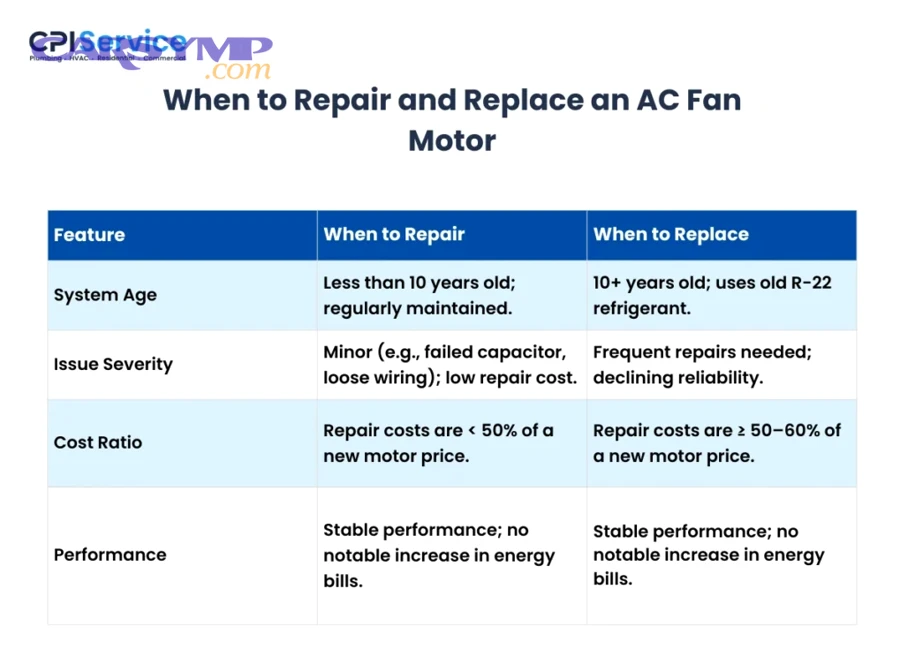
For example, understanding this comparison helps homeowners avoid both the trap of overspending on a system that is nearing end of life and the mistake of discarding a unit that has years of reliable service remaining.
What Factors Determine Whether to Repair or Replace an AC Fan?
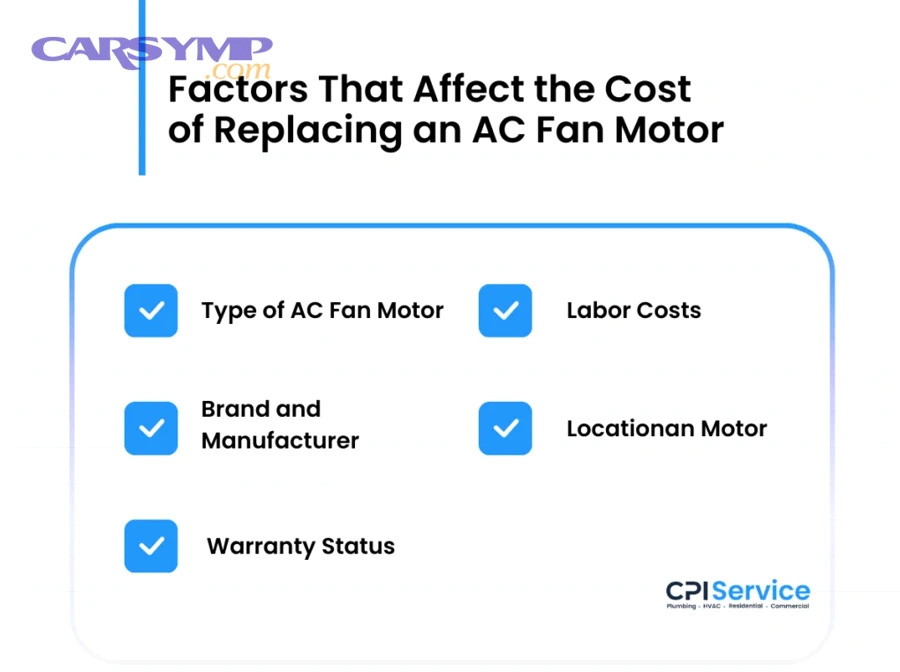
There are four main factors that determine whether to repair or replace an AC fan: the age of the unit, warranty status, frequency of past repairs, and the direct cost comparison, based on their combined impact on long-term value.
The age of the AC unit is the most influential factor. Systems under 10 years old are typically excellent candidates for fan motor repair because the rest of the unit has substantial remaining lifespan. The fan motor repair cost of $200 to $700 represents a small fraction of the system’s remaining value. Systems between 10 and 15 years old require more careful analysis, as other components may be approaching the end of their useful life. Systems over 15 years old often present a situation where repair costs accumulate faster than the value they preserve.
Warranty status can dramatically change the financial equation. Many AC manufacturers offer 5- to 10-year parts warranties that cover the fan motor. If the unit is still under warranty, the homeowner may only need to pay for labor, reducing the total repair cost to $100 to $300. Some extended warranties also cover labor, making the repair essentially free. Homeowners should always check their warranty documentation before authorizing any repair.
Frequency of past repairs is an indicator of overall system health. A single fan motor replacement on an otherwise reliable system is a routine maintenance event. However, if the homeowner has already replaced the capacitor, repaired a refrigerant leak, and dealt with thermostat issues within the past two years, the pattern suggests systemic deterioration. In this context, a fan motor failure is one more signal that a full replacement may be more cost-effective.
The cost comparison table below provides a general framework:
| Scenario | Repair Cost | Replacement Cost | Recommended Action |
|---|---|---|---|
| Unit under 10 years, motor only issue | $200–$700 | $5,000–$12,000 | Repair |
| Unit 10–15 years, one prior repair | $200–$700 | $5,000–$12,000 | Repair, with monitoring |
| Unit 10–15 years, multiple prior repairs | $200–$700 | $5,000–$12,000 | Evaluate total repair history |
| Unit over 15 years, any repair needed | $200–$700 | $5,000–$12,000 | Strongly consider replacement |
Is Repairing an AC Fan More Cost-Effective Than Replacing the Entire Unit?
Yes, repairing an AC fan is more cost-effective than replacing the entire unit in most cases, particularly when the system is under 10 years old and the fan motor is the sole failing component, for at least three financial reasons.
First, the repair cost is a fraction of the replacement cost. Even at the high end, a fan motor replacement at $700 represents less than 10% of the cost of a new central AC system. The return on investment is immediate because the repair restores full cooling capacity and energy efficiency on the same day.
Second, a repaired fan extends the usable life of every other component in the system. The compressor, coils, and ductwork do not need to be replaced simply because the fan motor failed. By repairing the fan, the homeowner preserves the remaining value embedded in these components.
Third, the energy efficiency gains from a fan repair are realized immediately. A new fan motor that operates at its rated amperage and speed restores the system’s energy consumption to its original specification. This means lower utility bills from the first month after repair, which offsets the repair cost over time.
However, repair is not always the better choice. When the AC system has a degraded compressor, refrigerant leaks, or outdated R-22 refrigerant, replacing the fan motor only delays an inevitable system replacement. In these situations, a radiator fan replacement overview should include an honest assessment of the entire system’s condition, not just the fan.
The general rule HVAC professionals recommend is the “50% rule”: if the cost of repair exceeds 50% of the cost of a new system, replacement is the better financial decision. For fan motors, this threshold is almost never reached unless the repair reveals additional hidden damage.
What Preventive Maintenance Keeps AC Fan Performance Optimal After Repairs?
The most effective preventive maintenance method involves a biannual professional inspection combined with monthly homeowner tasks, covering five key areas, to sustain the energy efficiency and cooling performance gains achieved through fan repairs.
More importantly, maintenance is what prevents the need for repeat repairs. A fan motor that has been repaired or replaced will last its full rated lifespan only if the conditions that caused the original failure are addressed and prevented from recurring.
How Often Should Homeowners Service Their AC Fan?
Homeowners should service their AC fan biannually, once in spring before cooling season and once in fall after cooling season, to maintain peak performance and catch early signs of wear.
The spring inspection is the more critical of the two because it prepares the system for its heaviest period of use. During a professional tune-up, a technician inspects the fan motor for signs of bearing wear, measures its amperage draw to confirm it operates within the manufacturer’s specifications, and tests the capacitor’s microfarad rating to ensure it can deliver the startup energy the motor requires.
Air filter replacement is the most important task between professional visits. Homeowners should replace or clean their air filters every one to three months, depending on factors such as household size, pet ownership, and local air quality. A clogged filter restricts airflow to the blower motor, forcing it to work harder and accelerating bearing wear. During peak summer months when the system runs more frequently, monthly filter changes are advisable.
Professional tune-ups also include lubrication of motor bearings (on units that allow external lubrication), cleaning of fan blades to remove dust and debris buildup, inspection of electrical connections for signs of corrosion or looseness, and testing of the thermostat calibration to ensure the system cycles appropriately.
The fall inspection focuses on identifying any damage sustained during the high-use summer months. A motor that developed a slight bearing noise in August may be approaching failure by October. Catching this issue in the fall allows the homeowner to schedule a repair during the off-season when HVAC technicians are more available and pricing is often more competitive.
What DIY Maintenance Steps Protect AC Fan Longevity?
There are four main DIY maintenance steps that protect AC fan longevity: keeping the outdoor unit clear, cleaning return air vents, ensuring proper ventilation clearance, and installing a surge protector, based on their ability to address the most common causes of fan failure.
Keeping the outdoor unit clear of debris is the single most impactful step a homeowner can take. Leaves, grass clippings, dirt, and branches can accumulate around and inside the condenser unit, blocking airflow and causing the fan motor to overheat. Homeowners should maintain a clearance of at least two feet on all sides of the outdoor unit and trim back any vegetation that encroaches on this space. After mowing the lawn, it is good practice to inspect the unit for grass clippings that may have been blown into the condenser fins.
Cleaning return air vents inside the home prevents dust and debris from reaching the blower motor. Dust accumulates on the vent grills and inside the ductwork, reducing the volume of air that passes over the evaporator coil. A simple vacuuming of the return air vents every month keeps airflow strong and reduces the strain on the blower motor.
Ensuring proper ventilation clearance means verifying that furniture, curtains, and other household items are not blocking supply or return vents. A blocked vent creates back pressure in the ductwork system, which the blower motor must overcome by working harder. This increased workload accelerates motor wear and reduces energy efficiency.
Installing a surge protector specifically rated for HVAC systems protects the fan motor, capacitor, and control board from electrical damage caused by power surges. Lightning strikes, utility grid fluctuations, and the startup of large appliances in the home can all send voltage spikes through the electrical system. A whole-house or dedicated HVAC surge protector absorbs these spikes before they reach sensitive components. The cost of a surge protector, typically $100 to $300 installed, is minimal compared to the cost of replacing a motor or control board damaged by a power surge.
Preventing fan failures through these four steps addresses the root causes of most fan motor problems: overheating, debris contamination, airflow restriction, and electrical damage.
What Are the Differences Between Condenser Fan and Blower Motor Repairs?
The condenser fan excels in outdoor heat dissipation and is exposed to weather-related wear, while the blower motor is best for indoor air distribution and is more affected by dust and filter maintenance, and each requires different diagnostic approaches and repair techniques.
For example, understanding these differences helps homeowners communicate more effectively with HVAC technicians and make better-informed decisions about repair priorities. Below, we examine how each fan type fails, what those failures mean for system performance, and how specialized motor technologies affect repair outcomes.
How Does a Condenser Fan Motor Failure Affect Outdoor Unit Performance?
A condenser fan motor failure is a malfunction of the motor housed in the outdoor condensing unit that prevents air from flowing across the condenser coil, resulting in refrigerant that cannot release its heat and a system that blows warm air indoors.
Specifically, the condenser fan sits atop or beside the outdoor unit and draws air through the condenser coil fins. This airflow is essential for converting the high-pressure, high-temperature refrigerant gas back into a liquid. When the fan stops, the refrigerant remains in a gaseous state longer than intended, which raises the pressure inside the system and forces the compressor to work against higher resistance.
One of the most common causes of condenser fan failure is a capacitor malfunction. The capacitor provides the initial burst of electrical energy needed to start the motor spinning. When the capacitor degrades, the motor may hum without spinning, spin slowly, or start intermittently. Capacitor-related failures are among the easiest and least expensive condenser fan repairs, typically costing between $150 and $300 for parts and labor.
Environmental exposure is another major factor in condenser fan failures. Because the outdoor unit is exposed to rain, snow, humidity, and temperature extremes, the motor’s internal components are vulnerable to rust, moisture intrusion, and thermal cycling stress. Homeowners in humid climates may experience condenser fan failures more frequently than those in dry regions.
How Does a Blower Motor Failure Affect Indoor Air Distribution?
A blower motor failure is a malfunction of the motor located inside the air handler that prevents conditioned air from being pushed through the ductwork, resulting in weak or absent airflow from the supply vents and uneven temperatures from room to room.
For example, a homeowner may notice that the room closest to the air handler receives some air while distant rooms receive almost none. This uneven distribution indicates that the blower motor is running but at significantly reduced capacity. The evaporator coil continues to cool the air directly around it, but without sufficient force to push that air through the full length of the duct system, the conditioned air never reaches all areas of the home.
Blower motor failures differ from condenser fan failures in their root causes. While condenser fans are primarily affected by weather exposure and capacitor issues, blower motors are more commonly damaged by clogged air filters, dust accumulation on the blower wheel, and overheating caused by restricted return airflow. A blower motor that operates with a dirty filter for months will draw excess current, overheat, and eventually burn out its windings.
The symptoms also present differently. A failed condenser fan typically causes the outdoor unit to overheat and the system to blow warm air. A failed blower motor causes the indoor air handler to go silent while the outdoor unit may continue running normally. Homeowners who hear the outdoor unit operating but feel no air coming from the vents inside the home are likely dealing with a blower motor problem.
Do Variable-Speed Fan Motors Offer Better Efficiency After Repair?
Yes, variable-speed fan motors offer better efficiency after repair because they adjust their rotational speed to match the system’s real-time cooling demand, resulting in lower energy consumption, quieter operation, and more consistent indoor temperatures compared to single-speed motors.
A standard single-speed fan motor operates at one fixed speed: full power. It is either on or off. This binary operation means the system delivers maximum airflow even when the cooling demand is low, wasting energy during mild conditions. A variable-speed motor, in contrast, can operate at a range of speeds, ramping up during peak heat and slowing down when the demand is lighter.
The efficiency advantage becomes particularly apparent after repair. When a variable-speed motor is restored to full functionality, it immediately resumes its ability to modulate speed, which can reduce fan energy consumption by 50% to 75% compared to a single-speed motor running at full power. This makes the repair investment especially worthwhile because the energy savings accelerate the payback period.
However, variable-speed motors are more expensive to repair and replace. The motors themselves cost more, and they require controllers and electronic circuitry that single-speed motors do not. Repair costs for a variable-speed motor can range from $400 to $1,200, compared to $200 to $700 for a single-speed motor. Despite the higher upfront cost, the long-term energy savings typically justify the investment for homeowners who plan to keep their system for five or more years.
Does the Season You Repair Your AC Fan Impact Performance Results?
Yes, the season you repair your AC fan impacts performance results because spring repairs before peak summer load allow the system to start the cooling season at full capacity, while mid-summer repairs occur under thermal stress conditions that can affect component seating and testing accuracy.
A spring repair gives the technician the advantage of working on a system that is cool and has not been running under heavy load. This makes diagnostic testing more accurate because baseline measurements of motor amperage, capacitor strength, and airflow volume are not influenced by the thermal expansion and elevated temperatures that occur during summer operation. The repaired motor also has time to break in under moderate conditions before facing its most demanding workload.
Mid-summer repairs, while still necessary and effective, carry additional challenges. The outdoor unit may be operating at internal temperatures exceeding 150°F when the technician arrives, requiring a cooldown period before work can begin. Components installed during extreme heat may behave slightly differently once temperatures normalize. Additionally, HVAC service companies experience their highest call volumes during summer heat waves, which can extend wait times for appointments and increase labor costs due to demand-based pricing.
Fall and winter repairs are the most cost-effective for homeowners who are planning ahead. Off-season scheduling typically results in shorter wait times, more flexible appointment availability, and potentially lower labor rates. A motor replaced in October is ready for the following summer without the urgency and premium pricing that accompany emergency repairs in July.
The strategic approach is to schedule a professional inspection each spring, address any fan issues identified during that inspection before the cooling season begins, and reserve mid-summer repairs for unexpected failures. This approach minimizes both the performance disruption and the financial impact of fan repairs throughout the year.