


Hydraulic and solid engine mounts differ mainly in how they trade vibration isolation for drivetrain stability: hydraulic mounts prioritize comfort by damping small vibrations, while solid mounts prioritize control by limiting engine movement, and the “best” choice depends on your tolerance for NVH and your driving goals.
Next, if you’re unsure what these parts actually do, the article clarifies what an engine mount is, how hydraulic mounts work internally, and what “solid” really means in the real world (solid rubber, polyurethane, or reinforced designs).
Then, because “better” depends on context, you’ll get a clear decision framework for daily driving, performance builds, towing, trucks/SUVs, and off-road use, plus what changes when you modify power, suspension, or drivetrain components.
Introduce a new idea: once you understand the comfort-vs-control tradeoff, you can avoid the most common mistake—choosing stiffness blindly—by learning symptoms, failure modes, and install considerations that decide whether your car feels smooth, tight, or just unpleasant.
What are hydraulic and solid engine mounts, and what do they actually do?
Engine mounts are powertrain support-and-isolation components that hold the engine in place, manage torque movement, and reduce vibration transfer into the chassis through a tuned mix of rubber compliance, damping, and structural stiffness.
To better understand the comfort-versus-control tradeoff, you first need a clear picture of what’s happening between the engine’s shaking mass and the vehicle’s body.
At a high level, every engine mount has two jobs that naturally fight each other:
- Support static load (engine weight and geometry) without sagging.
- Manage dynamic load (torque twist, bumps, shifting shocks, misfires) without letting the engine slam around or sending vibration into the cabin.
That tension is exactly why mount design splits into different “personalities.” Some mounts are tuned for isolation (comfort), while others are tuned for constraint (control). And most OEM designs try to balance both—until age, heat, leaks, or modifications push the system out of balance.
What is a hydraulic engine mount, and how does it reduce vibration?
A hydraulic engine mount is a fluid-damped elastomer mount that uses internal chambers and a flow path to dissipate vibration energy, typically delivering a smoother idle and cruise by reducing small-amplitude vibration transmissibility.
Next, because “smooth” isn’t magic, it helps to visualize what makes a hydraulic mount different from plain rubber.
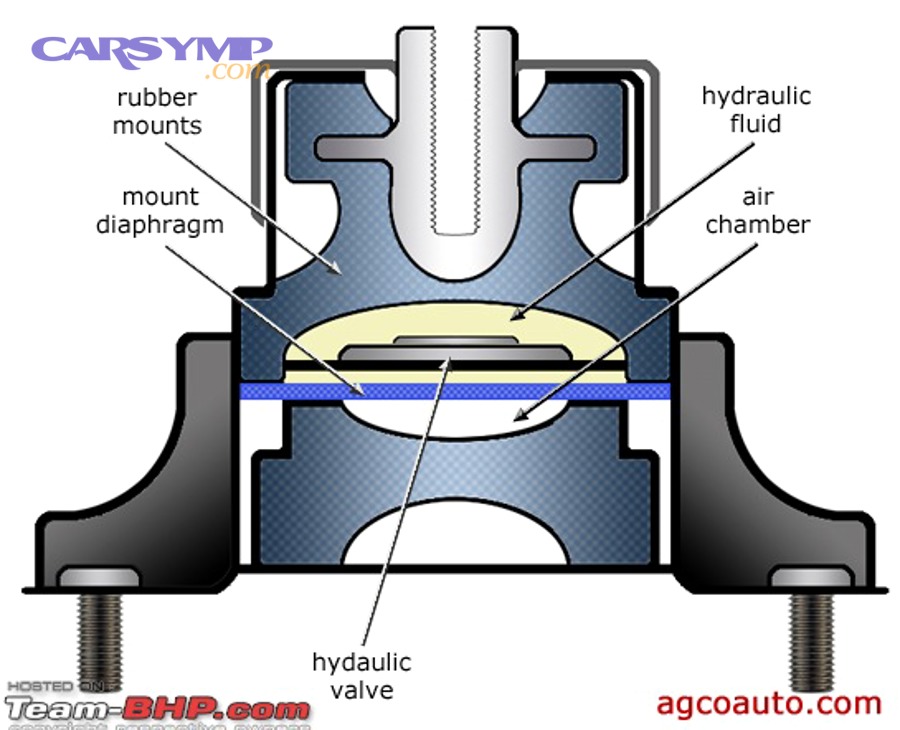
In simple terms, a hydraulic mount usually combines:
- An elastomer (rubber) spring that carries the engine’s weight and provides basic compliance.
- Fluid-filled chambers that behave like a tuned damper.
- A flow channel (inertia track/orifice) where fluid movement converts vibration into heat through resistance.
- Sometimes a decoupler that changes behavior at certain amplitudes/frequencies (common on many modern designs).
Why that matters for comfort: your engine produces constant excitation—combustion pulses, rotating imbalance, accessory loads (A/C compressor cycling), and idle control changes. Hydraulic mounts can be designed to damp the annoying ranges without becoming so stiff that the cabin turns into a vibrating drum.
Hydraulic mounts also tend to fail in a way that’s easy to misunderstand: they can “look okay” externally until the fluid loss or internal collapse becomes severe enough that the rubber is doing all the work, which usually means more vibration at idle and more thump during shifts.
What is a solid engine mount, and why does it increase “control”?
A solid engine mount is a stiffer mount design (often solid rubber, reinforced rubber, polyurethane, or near-solid constructions) that reduces compliance to limit engine movement, improving drivetrain control but typically increasing vibration and harshness.
Then, because “solid” is a loaded word, you need to interpret it the way car owners and aftermarket catalogs actually use it.
In daily automotive language, “solid mount” often means one of these:
- Solid rubber mount: still rubber-based, but less voiding and less compliance than a comfort-tuned hydraulic mount.
- Polyurethane mount / insert: a performance-focused solution that resists deflection under torque.
- Reinforced or filled mount: OEM mount geometry retained, but compliance reduced via inserts or material changes.
- Metal-to-metal true solid mounts: mostly motorsport-only for harsh environments; far beyond typical street tolerance.
Why “solid” improves control: when you step on the throttle, the engine tries to rotate opposite the crank’s direction. A soft mount allows noticeable twist; a stiffer mount keeps geometry stable, which can improve:
- Throttle response feel
- Shift accuracy (especially manual)
- Wheel hop control (in some setups)
- Reduced exhaust/driveline movement (when the rest of the system is aligned)
But there’s no free lunch: the same stiffness that stabilizes the engine can also transmit vibration into the chassis—especially at idle and low RPM where humans perceive vibration more strongly.
How do hydraulic vs solid engine mounts differ in comfort vs control?
Hydraulic mounts win in comfort (NVH isolation), solid mounts are best for movement control under torque, and the optimal choice is the one that matches your tolerance for vibration while meeting your stability needs for your driving style.
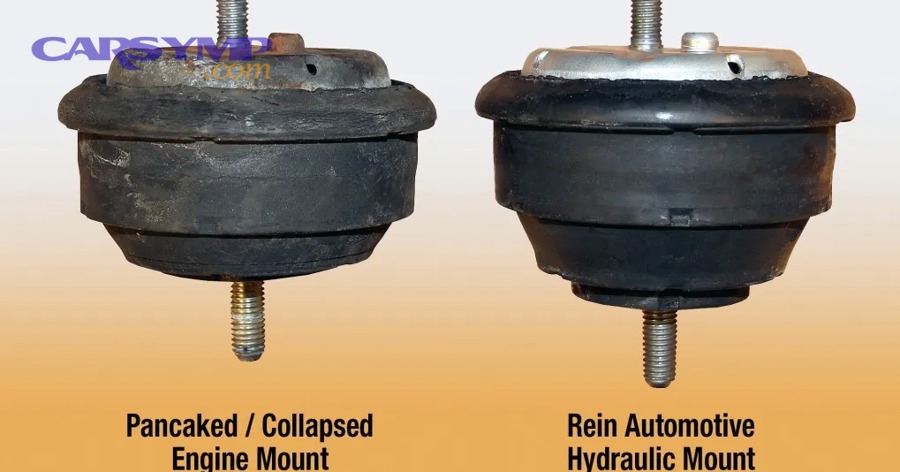
However, the difference isn’t just “soft vs stiff”—it’s about what kinds of vibrations you feel, when you feel them, and how the drivetrain behaves under real load.
Before the details, here’s a quick comparison table to show exactly what “comfort vs control” usually looks like in the real world. This table summarizes what you can expect when both options are installed correctly and in good condition.
| Criteria (what you feel) | Hydraulic Engine Mounts | Solid/Poly/“Solid Rubber” Mounts |
|---|---|---|
| Idle smoothness | Typically smoother | Typically more vibration |
| Cabin noise / buzz | Lower | Higher |
| Engine movement under torque | More movement | Less movement |
| Shift feel (manual) | Softer/forgiving | Crisper/more direct |
| Daily comfort | Higher | Lower (varies by stiffness) |
| Failure mode | Fluid leak/collapse | Wear, cracking, harshness, fastener/fitment sensitivity |
The “best” choice depends on which column you value more and how your vehicle is used: a commuter that spends time idling in traffic has different priorities than a weekend track car.
Do hydraulic mounts always feel smoother than solid mounts?
Yes—hydraulic mounts usually feel smoother than solid mounts because they (1) reduce small-amplitude vibration transfer, (2) damp certain frequency ranges via fluid flow resistance, and (3) maintain comfort under accessory load changes like A/C cycling.
Meanwhile, the exceptions are worth knowing, because they explain why some people “swap mounts and hate the result.”
Hydraulic mounts can feel worse than stiffer mounts when:
- They’re leaking or partially collapsed, so the mount loses its damping function and becomes inconsistent.
- The engine is misfiring or rough, creating large-amplitude shake that overwhelms any mount type.
- Aftermarket hydraulic mounts are poorly tuned, causing new resonances at idle or cruising RPM.
- The rest of the mount system is mismatched, such as stiff torque mounts paired with soft hydromounts in a way that creates weird harmonics.
If your goal is cabin comfort, the “smoothest” mount is not always the softest—it’s the mount that isolates the right frequencies without letting the engine slam into stops.
Which mount type reduces engine movement more under acceleration and braking?
Solid mounts generally reduce engine movement more because they (1) raise effective stiffness against torque twist, (2) limit compliance that allows rotation under load, and (3) keep drivetrain geometry consistent during throttle transitions and shifting.
Specifically, this matters when you feel a “lurch” as you go on/off throttle, or when you notice inconsistent shifts under power.
Here’s what reduced movement typically changes:
- Acceleration: less engine roll can make throttle transitions feel cleaner.
- Braking: less fore-aft rock can reduce clunks and driveline lash sensations.
- Shifting: reduced movement can improve engagement consistency (more noticeable on manual transmissions).
- Exhaust and intake clearance: less movement can reduce contact issues—if the install doesn’t preload the mounts incorrectly.
But tighter isn’t always better. Too much stiffness can turn small vibrations into constant cabin buzz, especially at idle and low speed.
How do the two mount types affect noise and cabin harshness at idle and cruising speeds?
Hydraulic mounts usually reduce idle harshness and cruising buzz, while solid mounts increase those sensations by transmitting more vibration through the chassis and into contact points like the steering column, seat rails, and dashboard structure.
In addition, the most important detail is when the vibration is most noticeable—because your body perceives low-frequency shake more aggressively than high-frequency vibration.
Common “feel” differences:
- At idle:
- Hydraulic: smoother steering wheel, fewer mirror shakes
- Solid: more steering wheel buzz, noticeable seat/floor vibration
- At cruise:
- Hydraulic: fewer “drone-like” vibrations through the cabin
- Solid: possible resonance at specific RPM (e.g., 1,500–2,200 depending on vehicle)
One practical takeaway: if your car already has borderline NVH—old exhaust hangers, stiff suspension, worn bushings—solid mounts can amplify what’s already there. If your car is tight and healthy, a mild solid/insert solution can feel sporty rather than annoying.
Which engine mount should you choose for your car and driving style?
There are three practical choice categories—comfort-first (hydraulic), balanced performance (mild solid rubber/soft poly), and control-first (stiffer poly/near-solid)—and you should choose based on your daily tolerance for NVH, your torque levels, and how often you drive aggressively.
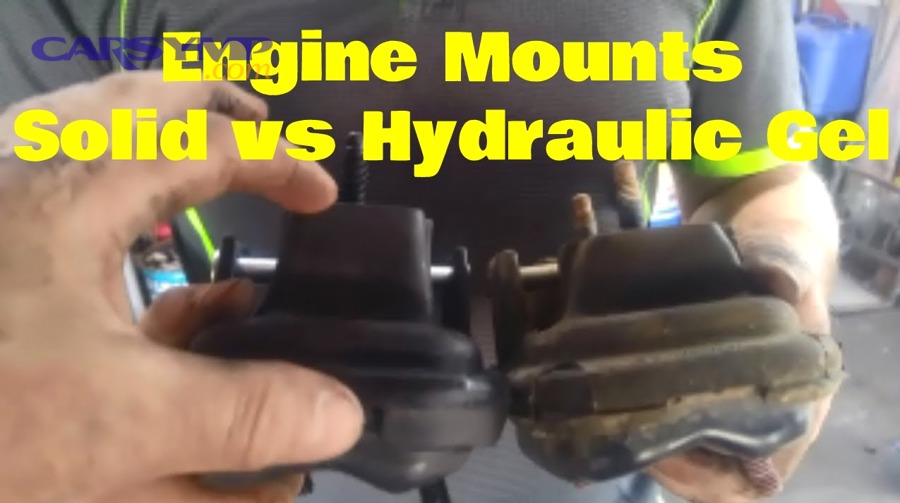
Next, to avoid guesswork, use a simple decision framework that matches real use cases instead of abstract “best vs worst.”
Which is better for daily drivers: hydraulic or solid mounts?
Hydraulic mounts are usually better for daily drivers because they preserve comfort by isolating vibration at idle and cruise while still controlling movement well enough for normal commuting, errands, and highway driving.
For example, if your car sees traffic, cold starts, idling with A/C, and passengers who notice vibration, comfort-tuned mounts are almost always the smarter default.
Choose hydraulic mounts (or OEM-equivalent comfort mounts) when you want:
- Quiet cabin, smooth idle
- Less vibration through wheel/seat
- A “factory” driving feel
- Minimal risk of new rattles or resonance
Daily-driver caveat: if you’ve added significant power, stiffer clutch, aggressive tune, or stiff suspension, your engine’s movement and driveline shock may exceed what a comfort hydraulic mount was designed to manage. In that case, a balanced mount can be a better daily compromise.
Which is better for performance builds and track use: hydraulic or solid mounts?
Solid-style mounts are generally better for performance builds because they keep the drivetrain stable under high torque, quick throttle changes, and aggressive shifting—at the cost of higher vibration and cabin harshness.
However, the key is to match mount stiffness to your build, not your ego.
Performance scenarios where stiffer mounts make sense:
- Track days with repeated high-load transitions
- Manual transmission where shift consistency matters
- Drag launches where engine roll contributes to wheel hop (system-dependent)
- High-torque builds where stock mounts tear or bottom out
But for mixed street/track builds, many drivers prefer mild polyurethane or reinforced mounts rather than extreme stiffness. The goal is to reduce movement enough to feel “locked in” without making the car unpleasant on every commute.
What should you pick for trucks/SUVs, towing, diesel engines, or off-road use?
For trucks/SUVs and towing, you typically choose mounts that prioritize durability and load handling, while for off-road you also prioritize controlled movement that doesn’t over-stress brackets and exhaust flex joints.
Besides, diesel engines and heavy-duty applications can create different vibration profiles, which makes mount tuning even more important.
A practical way to decide:
- Towing / heavy load: favor durable, OEM-quality mounts; consider “uprated” options only if movement is excessive.
- Diesel: comfort matters because diesel vibration is more noticeable; choose mounts known for isolation.
- Off-road: avoid extreme stiffness unless the entire system is designed for it; you want control without cracking components.
In these use cases, the “best mount” is often the one that survives harsh conditions and doesn’t cause secondary failures due to over-stiffening.
What are the common failure modes and symptoms for each mount type?
There are two main failure patterns: hydraulic mounts commonly fail by fluid leakage/collapse, while solid-style mounts commonly fail by material fatigue, cracking, or causing unacceptable NVH—each with specific symptoms you can recognize before damage spreads.
More importantly, mount symptoms often imitate other issues, so you want to spot the patterns rather than guessing based on one noise.
How can you tell if a hydraulic mount is failing or leaking?
A hydraulic mount is likely failing if you see (1) fluid seepage, (2) increased idle vibration that wasn’t there before, and (3) thumps or clunks during shifting or throttle transitions—especially if the mount’s height looks sagged.
Then, because leaks can be subtle, a quick inspection routine helps you avoid missing early failure.
Practical checks (safe, basic):
- Visual: look for wetness, grime stuck to oily residue, or dark streaking around the mount body.
- Height comparison: if one side looks lower, the mount may have collapsed.
- Movement test: excessive engine roll when shifting from Park to Drive (or during quick blips) can indicate a weak mount.
- Noise pattern: a dull thud on throttle tip-in or shift engagement often indicates movement contacting stops.
A key clue: hydraulic mounts can “feel fine” until the damping is lost, then comfort drops quickly. That’s why people often describe mount failure as “it got rough all of a sudden.”
Evidence: According to a study by Hefei University of Technology from the School of Automotive and Transportation Engineering, in 2023, an experimental comparison of an adaptive hydraulic engine mount showed vibration isolation improvements where the maximum value decreased by 16.57% and the average value decreased by 20.89% at 10 Hz and 1 mm excitation amplitude, illustrating how hydraulic tuning materially changes vibration transmission.
How can you tell if a solid mount is “too stiff,” worn, or causing NVH problems?
A solid mount is likely too stiff or problematic if you notice (1) persistent cabin vibration at idle, (2) new rattles or buzzing from interior/exhaust contact points, and (3) harsher engagement during takeoff or shifting—even when the engine is running smoothly.
Meanwhile, because stiffness amplifies the whole vehicle’s weak points, the “symptom” can show up far away from the mount itself.
What to look for:
- Cabin buzz that tracks RPM (not road speed)
- New rattles around dash, heat shields, exhaust hangers
- Exhaust contact marks (scrapes where it hits under torque)
- Fastener loosening over time if the install is not torqued correctly
A worn solid-style mount can also show “slop” the same way a soft mount does—movement under torque—except the cabin still feels harsh because the material no longer isolates cleanly.
When owners say “I installed solid mounts and now everything shakes,” it’s often one of these:
- Mount stiffness is excessive for street use
- Mounts were installed with preload (engine not centered/neutral)
- Aged bushings elsewhere now become audible because mounts transmit more vibration
Do solid mounts cause damage or extra wear elsewhere?
Yes, solid mounts can contribute to extra wear elsewhere because they (1) transmit more vibration and shock into brackets and hardware, (2) reduce compliance that normally protects exhaust and driveline components from sudden load changes, and (3) can create misalignment stress if installed with preload.
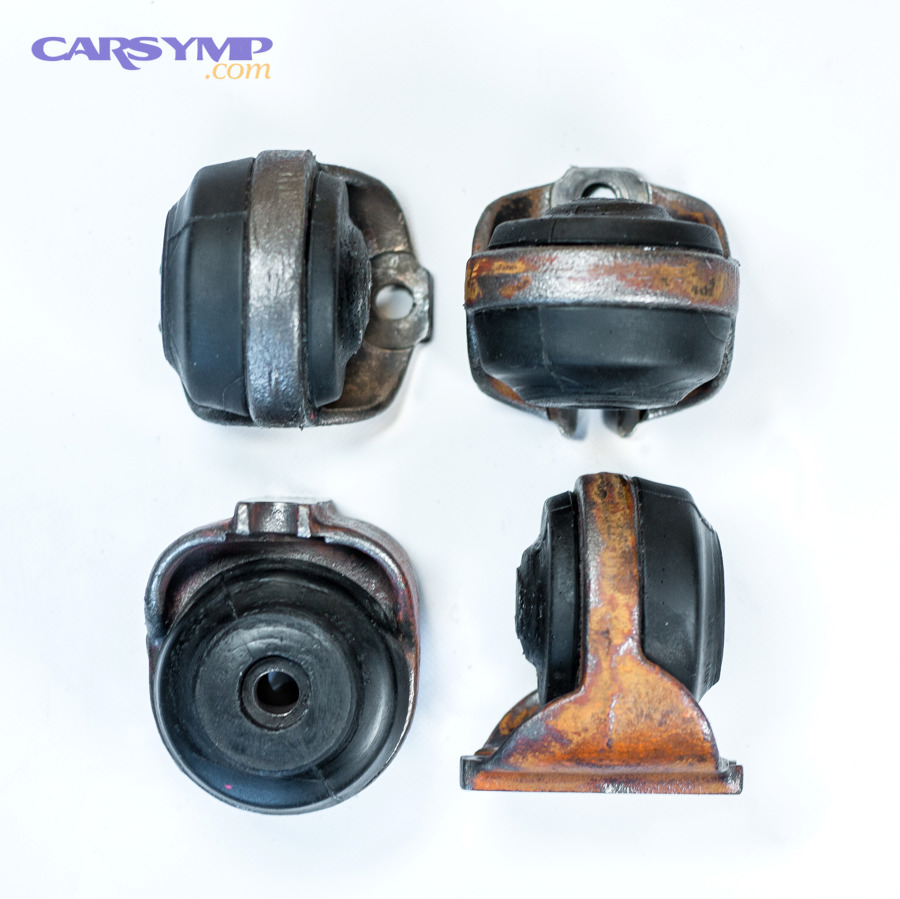
However, the risk depends on how stiff the mounts are, how the rest of the system is designed, and whether the install is done correctly.
The big idea: mounts are not isolated parts. They are part of a mounting system that includes engine mounts, transmission mounts, torque mounts, subframe bushings, exhaust flex sections, and driveline joints. Increasing stiffness in one link changes stress and motion everywhere else.
Can stiffer mounts increase stress on brackets, exhaust, axles, or transmission components?
Yes, they can, especially when the mounts are very stiff or the system is mismatched, because the energy that used to be absorbed by compliance now travels into rigid parts like brackets, fasteners, exhaust joints, and driveline mounts.
More specifically, this doesn’t mean solid mounts “always break cars”—it means they reduce the margin for existing weaknesses.
Where stress often shows up:
- Exhaust flex joints and hangers (more movement force or resonance)
- Mount brackets (especially on older vehicles with corrosion or fatigue)
- Transmission mount area (if engine mounts stiffen but the trans mount remains soft)
- Interior fasteners and clips (rattles from vibration energy)
If you hear new contact noises, don’t ignore them—solid mounts won’t “wear in” if the issue is mechanical interference.
When is “too stiff” actually a problem, and when is it acceptable?
Too stiff is a problem when it makes the vehicle unpleasant, creates resonance at common RPM, or causes contact/fastener issues; it’s acceptable when the vehicle’s purpose is performance and the entire system (mounts, exhaust clearance, bushings) is built to tolerate higher NVH.
In short, stiffness is a tool, not a badge.
A practical guideline:
- Street comfort priority: mild solutions only (soft poly inserts, reinforced rubber, OEM+)
- Mixed street/track: moderate stiffness with careful install and clearance checks
- Dedicated track: higher stiffness is acceptable because comfort is not the target metric
The smartest move is matching stiffness to your actual usage, not what looks impressive in a parts catalog.
What should you know before replacing or upgrading engine mounts?
There are four critical factors—system matching, correct installation, realistic NVH expectations, and total cost—that determine whether a mount change improves comfort/control or creates new problems.
Next, this is where many people make a costly mistake: they treat mounts like a single part swap, but mounts behave like a system.
This is also where the additional phrases matter in real ownership terms: engine mount replacement is not only about new parts; it’s about diagnosing the mount system correctly, understanding what you’re paying for, and Preventing premature mount wear.
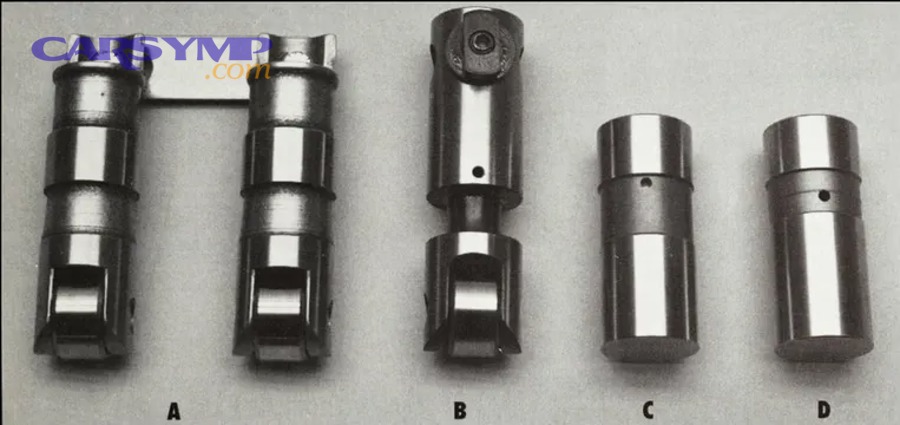
Should you replace engine and transmission mounts together?
Yes, you should often replace engine and transmission mounts together because (1) they share load and movement control, (2) mixing old soft mounts with new stiff mounts can create odd motion and resonance, and (3) the labor overlap often makes combined replacement more cost-effective.
Besides, inconsistent stiffness front-to-back is one of the most common reasons people end up with clunks even after “fixing” a mount.
That said, “together” doesn’t always mean “all at once.” A reasonable approach is to replace the clearly failed mount immediately, then inspect and plan the rest if they show wear, sag, or age cracking.
This is also where Transmission mount vs engine mount diagnosis becomes practical: a harsh shift thump might come from the transmission mount, while a vibration increase at idle might come from an engine mount, and the correct repair depends on which mount is actually failing.
What are the key install checks that prevent extra vibration after replacement?
There are five key checks—supporting the engine correctly, avoiding preload, torquing to spec, confirming clearance, and rechecking fasteners—that prevent new vibration and rattles after mount replacement.
To begin, the easiest way to “ruin” a mount upgrade is to install it with the engine twisted or resting unevenly.
A practical installation checklist (conceptual, not vehicle-specific):
- Support the engine safely and loosen fasteners before final torque.
- Set the engine in a neutral resting position to avoid preload.
- Torque to specification to prevent distortion or loosening.
- Verify exhaust and accessory clearance at idle and under small rev blips.
- Recheck after settling because mounts can seat after initial driving.
If you’re evaluating a quote, use an Engine mount replacement cost estimate as a baseline, but remember accessibility drives labor. Some vehicles allow quick swaps; others require subframe movement or component removal.
Cost evidence: According to a published RepairPal estimate updated recently, the average Engine Mount Replacement Cost Estimate is $607–$747 (labor $294–$431, parts $313–$316), and a transmission mount replacement averages $363–$441, showing why accurate diagnosis (engine vs transmission mount) prevents paying for the wrong repair.
How do you prevent mounts from failing early after replacement?
Preventing premature mount wear comes down to controlling heat, torque shock, alignment stress, and fluid contamination, because mounts fail faster when they’re constantly overloaded, misaligned, or exposed to leaks that degrade rubber and bonded interfaces.
More importantly, prevention is cheaper than repeated replacement—especially when labor access is difficult.
Practical habits and fixes that extend mount life:
- Fix misfires and rough idle early because shake accelerates mount fatigue.
- Repair oil and power steering fluid leaks because many fluids degrade rubber over time.
- Avoid abusive wheel hop events because shock loads can tear mounts.
- Check exhaust hanger condition because binding exhaust parts tug on the powertrain.
- Avoid incorrect preload by centering and torquing mounts in a neutral position.
This is also why choosing the “stiffest possible” mount can backfire: higher stiffness can reduce movement, but it can also increase shock transfer—so lifespan depends on system compatibility, not just material strength.
What hidden factors can change how hydraulic vs solid mounts feel in real life?
Hydraulic mounts can feel dramatically different depending on temperature, resonance, system matching, and NVH mitigation steps, while solid mounts can range from “sporty” to “unbearable” based on stiffness level, install preload, and how the rest of the car transmits vibration.
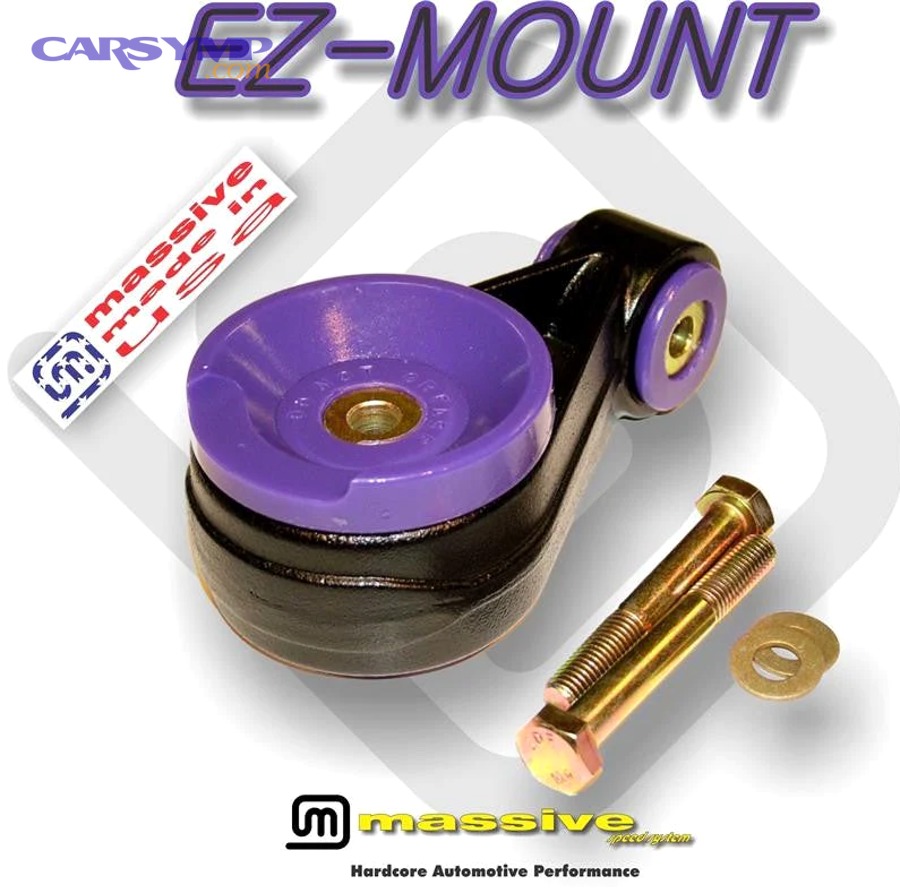
Next, this is where micro-semantics matters: two people can install “solid mounts” and report opposite experiences because their setups are not truly comparable.
Do hydraulic mounts behave differently in cold weather or high heat?
Yes, hydraulic mounts can behave differently with temperature because (1) fluid viscosity changes damping behavior, (2) rubber stiffens in cold conditions, and (3) heat accelerates rubber aging and can change perceived compliance over time.
For example, a mount that feels acceptable once warm can feel harsh on cold starts, especially if it’s already aging.
What you might notice:
- More vibration during the first few minutes of driving in winter
- Improved smoothness as the mount warms
- Faster deterioration in high-heat environments or underhood heat soak
This temperature sensitivity is one reason OEMs tune mounts carefully for the target climate and vehicle class.
How do “frequency tuning” and resonance affect idle boom or cabin drone?
Hydraulic mounts and solid mounts can create cabin drone when the mount system’s effective stiffness aligns with a vibration frequency band the chassis transmits efficiently, causing resonance that amplifies sound and vibration at specific RPM.
Specifically, resonance is why some setups feel fine at 1,200 RPM but buzz harshly at 1,800 RPM—even when nothing is “broken.”
Practical ways resonance shows up:
- Drone at a narrow RPM band on the highway
- Steering wheel vibration that peaks at one engine speed
- Cabin boom when the engine loads slightly (small throttle changes)
Evidence: According to a study published by Karabulut et al. in the International Journal of Automotive Science and Technology (2022), replacing an old mount with a new hydraulic mount reduced average chassis displacement at idle from 0.5 mm to 0.25 mm, demonstrating how mount condition and tuning measurably change vibration transmitted to the chassis.
Is it better to mix mount types (hydraulic + solid) or keep them consistent?
Mixing mount types can work, but consistency is usually safer because it keeps stiffness and damping behavior predictable across the system; mixing becomes useful only when you deliberately target one motion path (like torque reaction) without sacrificing overall comfort.
However, the risk with mixing is creating uneven load paths—one mount becomes the “hard stop,” and the others become along for the ride.
A balanced approach many drivers use:
- Keep main engine mounts comfort-tuned (hydraulic/OEM+)
- Use a mild torque mount insert to reduce twist without turning the cabin into a shaker
- Ensure the transmission mount matches the overall stiffness philosophy
If you mix parts, do it intentionally and test for clearance and resonance after installation.
What are practical ways to reduce NVH if you choose stiffer mounts?
There are four practical NVH mitigation strategies: choose a milder stiffness level, install without preload, correct contact/clearance issues, and address vibration sources (engine health, exhaust hangers) so the mounts aren’t asked to “hide” mechanical problems.
In addition, these steps keep control benefits while avoiding the most common “I regret solid mounts” outcome.
Actionable tactics:
- Pick the mildest performance option that achieves your control goal (soft poly, reinforced rubber).
- Use inserts instead of full mounts when you want a smaller change.
- Fix rattles at the source such as heat shields, exhaust contact, and loose interior hardware.
- Verify engine health because a smooth engine always feels better on stiff mounts.
If you treat mounts as a system—not just a part—you can get the control you want without sacrificing the comfort that makes a street car livable.
Evidence (if any)
- Hefei University of Technology, School of Automotive and Transportation Engineering (2023) — adaptive hydraulic engine mount experimental comparison with reported reductions in vibration metrics.
- Karabulut et al., International Journal of Automotive Science and Technology (2022) — measured displacement/acceleration differences between old and new hydraulic mounts.
- RepairPal estimator (recently updated) — average engine mount and transmission mount replacement cost ranges.