


Yes, you can technically drive with a power steering fluid leak, but it’s not recommended due to three critical safety concerns: progressive loss of steering control that makes maneuvering dangerous, potential pump damage from operating without lubrication, and increased accident risk during emergency situations. While your vehicle won’t immediately stop functioning, continuing to drive transforms a manageable repair into a safety hazard that threatens both you and other drivers on the road.
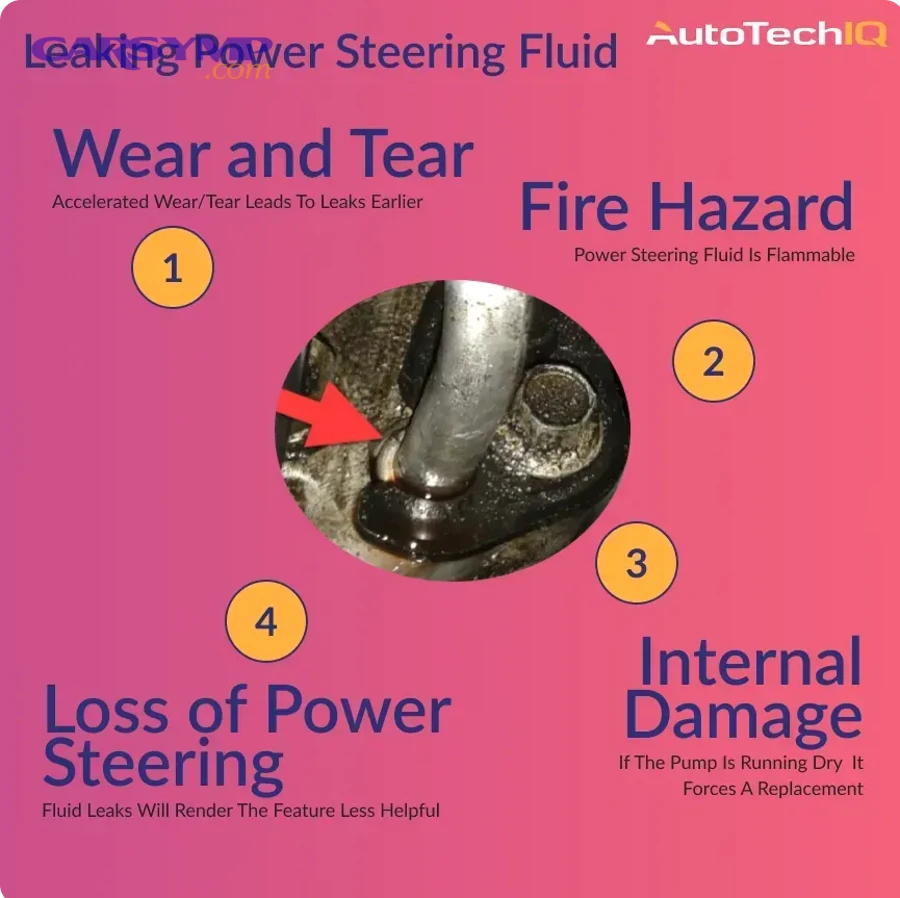
Understanding the immediate risks helps you make informed decisions when you discover a leak. As hydraulic pressure drops, your steering wheel becomes progressively harder to turn, requiring significantly more physical effort especially at low speeds during parking or tight maneuvers. The power steering pump, designed to operate with adequate fluid lubrication, begins overheating and experiencing accelerated wear when fluid levels fall below safe thresholds, creating a cascade of mechanical failures that escalate repair costs.
Recognizing warning signs early can prevent dangerous situations and expensive damage. Power steering leak symptoms and locations vary depending on which component fails, but common indicators include reddish-brown puddles under your vehicle’s front end, squealing or whining noises when turning the steering wheel, unusually heavy steering response, and dashboard warning lights on newer vehicles equipped with monitoring systems.
Knowing what action to take when you notice a leak determines whether you face a minor inconvenience or a roadside emergency. Below, we’ll explore the specific dangers of driving with compromised steering fluid, explain what happens mechanically inside your vehicle, identify all warning signs you should monitor, and provide clear guidance on when to stop immediately versus when you can safely continue to a repair facility.
Can You Safely Drive with a Power Steering Fluid Leak?
Yes, you can drive with a power steering fluid leak for short distances, but it becomes increasingly dangerous due to loss of power steering assistance, progressive pump damage, and elevated accident risk during emergency maneuvers. The technical ability to operate your vehicle doesn’t equate to safe operation.
To understand why this matters, consider how your power steering system functions as a critical safety component rather than a mere convenience feature. Next, let’s examine the specific risks you face and the limited timeframe you have before the situation becomes critical.
What Are the Immediate Risks of Driving with a Steering Fluid Leak?
Driving with a steering fluid leak creates four immediate dangers that compound as fluid levels drop. First, you lose the hydraulic power assistance that makes steering effortless, forcing you to apply significantly more physical force to turn the wheel—a challenge that becomes particularly acute during parking, low-speed turns, and navigating tight spaces where precise control matters most.
Second, emergency maneuvers become extremely hazardous when you need to suddenly swerve to avoid obstacles, change lanes quickly, or execute evasive actions. The delay between your steering input and the vehicle’s response increases dramatically without adequate hydraulic pressure, potentially causing you to under-steer into danger or over-correct and lose control. This reaction time deficit proves especially dangerous on highways where split-second decisions prevent accidents.
Third, the physical strain of wrestling a heavy steering wheel creates driver fatigue that impairs your judgment and reaction time over extended periods. What starts as mild inconvenience evolves into exhausting physical labor that distracts you from monitoring traffic, checking mirrors, and maintaining situational awareness.
Fourth, at intersections and curves where you need smooth, controlled steering inputs, the jerky, unpredictable response of a fluid-starved system makes it difficult to maintain your lane position or execute turns at appropriate speeds. Other drivers expect predictable vehicle behavior, and your compromised steering creates scenarios where their assumptions about your movement become dangerously wrong.
How Long Can You Drive Before It Becomes Dangerous?
You can drive approximately 400 miles with frequent fluid top-offs for minor leaks, but severe leaks require immediate停止 within minutes to prevent total steering failure and catastrophic pump damage. The driving duration depends entirely on leak severity and your diligence in monitoring fluid levels.
For minor seepage where you lose only ounces of fluid over days, maintaining adequate levels through daily checks and top-offs extends your driving window. However, this represents a temporary solution while arranging professional repair, not a sustainable long-term strategy. Each time you start the engine, check the power steering fluid reservoir and add fluid as needed to maintain the level between the minimum and maximum marks.
Moderate leaks that create visible puddles overnight or lose noticeable fluid during single trips demand immediate attention. You might manage 50-100 miles maximum by adding fluid before each drive, but the pump already operates under stress that accelerates wear. Monitor steering response constantly—any increase in effort signals dropping fluid levels that require immediate top-off.
Severe leaks identified by steady dripping, large puddles, or rapid fluid loss necessitate stopping within the next safe location. Continuing to drive risks complete pump seizure, grinding metal-on-metal contact inside the steering rack, and total loss of steering assist that leaves you struggling to control a multi-ton vehicle. If your steering wheel suddenly becomes extremely heavy or you hear grinding noises, pull over immediately and call for a tow truck.
Warning signs that demand immediate停止 include: grinding or metal-scraping sounds from the steering system, complete loss of power assist where turning the wheel requires both hands and substantial effort, visible smoke from under the hood indicating overheating components, or the steering wheel becoming locked or frozen in position.
What Happens When You Drive with Low Power Steering Fluid?
When you drive with low power steering fluid, your hydraulic system loses the pressure needed to assist steering while the pump operates without adequate lubrication, creating progressive mechanical degradation that begins with difficult steering and culminates in complete component failure. The damage occurs gradually but accelerates exponentially as fluid levels drop.
Understanding the mechanical progression helps explain why a simple fluid leak transforms into expensive repairs when ignored. Specifically, the power steering system relies on pressurized hydraulic fluid to amplify the force you apply to the steering wheel, making it possible to turn heavy front wheels with minimal effort.
Your power steering pump draws fluid from the reservoir and pressurizes it through a series of hoses to the steering rack or gearbox. Inside the rack, this pressurized fluid pushes against a piston that moves the steering mechanism, effectively multiplying your steering input force by a factor of 10 to 20. When fluid levels drop, the pump begins drawing air along with fluid, creating foam and air pockets that compress under pressure instead of transmitting force—this phenomenon explains why steering feels “spongy” or unpredictable with low fluid.
Simultaneously, the pump’s internal components—designed to operate submerged in lubricating fluid—begin experiencing metal-on-metal contact and friction-generated heat. The pump vanes, bearings, and seals wear rapidly without the cooling and lubrication that fluid provides. Internal temperatures can exceed 200°F, causing seals to harden and crack, metal surfaces to score and gouge, and bearings to seize.
The steering rack or gearbox faces similar stress as reduced hydraulic pressure forces its internal seals and pistons to work harder, generating more friction and heat than design specifications anticipate. O-rings dry out and crack, allowing the remaining fluid to leak internally and further reducing system pressure. Metal components in the rack experience accelerated wear as they move without adequate lubrication film separating contact surfaces.
What Damage Occurs to Your Vehicle?
Your vehicle suffers five types of progressive damage when operated with insufficient power steering fluid. The power steering pump represents the first casualty, with its internal vanes, rotor, and housing experiencing rapid wear from heat and friction. Pump failure manifests as loud whining or squealing noises, complete loss of pressure, and metal debris contaminating the remaining fluid throughout the system.
The rack and pinion assembly or steering gearbox endures accelerated seal wear, internal scoring, and piston damage that eventually requires complete replacement rather than simple seal renewal. A new rack and pinion costs $400-$800 including labor, compared to $50-$150 for preventive seal replacement before damage occurs.
Serpentine belt strain increases as the seized or binding pump pulley creates excessive resistance, potentially causing the belt to slip, squeal, fray, or snap completely. A broken serpentine belt disables your alternator, water pump, air conditioning compressor, and power steering simultaneously, leaving you stranded with a dead battery and overheating engine.
Hoses and connections throughout the system deteriorate faster as the pump struggles to generate pressure, creating pressure spikes that exceed design limits and cause weak points to rupture. High-pressure hose failure can spray hot fluid onto engine components, creating fire hazards and environmental contamination.
The steering column and steering wheel components experience unusual stress from drivers forcing turns against high resistance, potentially bending the column shaft, damaging the clock spring airbag connector, or stripping gears in the intermediate shaft coupling. These secondary failures add hundreds to thousands of dollars to your total repair bill.
Why Does Steering Become Harder as Fluid Leaks Out?
Steering becomes harder as fluid leaks out because the hydraulic system loses its ability to generate and maintain the pressure necessary to amplify your steering force, essentially reverting your vehicle to manual steering that requires 10-20 times more physical effort to turn the wheels. The force amplification disappears progressively rather than suddenly.
At full fluid capacity, your power steering system generates 1,000-1,500 PSI of hydraulic pressure that acts against a large-diameter piston in the steering rack. This mechanical advantage means a 10-pound force on your steering wheel translates to 150-200 pounds of force pushing the steering mechanism—enough to overcome the weight of your vehicle and the friction between tires and pavement.
As fluid drops to 75% capacity, air enters the system and pressure falls to perhaps 800-1,000 PSI. Your steering feels slightly heavier but remains manageable for most maneuvers. The pump works harder to compensate, generating heat and wear.
At 50% fluid capacity, pressure plummets to 400-600 PSI as the pump cavitates (draws more air than fluid). Steering requires noticeably more effort, especially during parking and low-speed turns. You need both hands on the wheel for tight maneuvers that previously required one-handed control.
Below 25% capacity, the system generates minimal pressure—perhaps 100-200 PSI—and steering approaches manual effort levels. Turning the wheel when the vehicle is stationary becomes nearly impossible without rocking the vehicle back and forth to reduce tire friction. Highway driving remains somewhat manageable because rolling momentum helps, but any turn requiring significant steering input demands substantial physical strength.
Complete fluid loss eliminates all power assist, leaving you with the same steering effort required in vehicles manufactured before power steering became standard in the 1970s. The physical challenge varies by vehicle weight—compact cars remain difficult but controllable, while SUVs and trucks become extremely challenging to steer, particularly for drivers with limited upper body strength.
What Are the Warning Signs of a Power Steering Fluid Leak?
There are five primary warning signs of a power steering fluid leak: visible fluid puddles under the front of your vehicle, squealing or whining noises from the power steering pump, progressively heavier steering wheel resistance, dashboard warning lights on equipped vehicles, and burning odors when fluid contacts hot engine components. Recognizing these indicators early prevents dangerous driving conditions and expensive repairs.
To identify a leak quickly, you need to understand what each symptom indicates about leak severity and location. Below, we’ll examine how to distinguish power steering fluid from other automotive fluids and what specific sounds signal power steering problems.
How Do You Identify Power Steering Fluid?
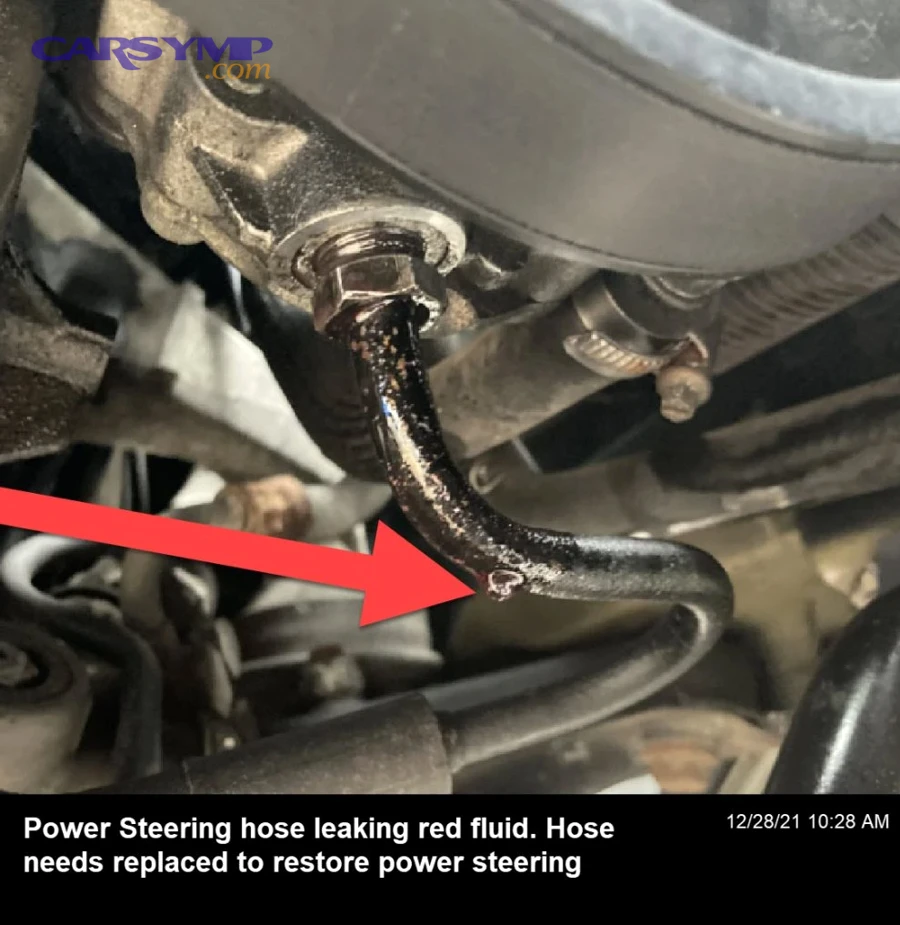
Power steering fluid appears red, reddish-brown, or amber in color with a slick, oily texture similar to motor oil but typically thinner in viscosity, and pools or drips appear primarily under the front-center or driver’s side of your vehicle where steering components concentrate. Fresh fluid resembles automatic transmission fluid in color, while older contaminated fluid turns darker brown or black.
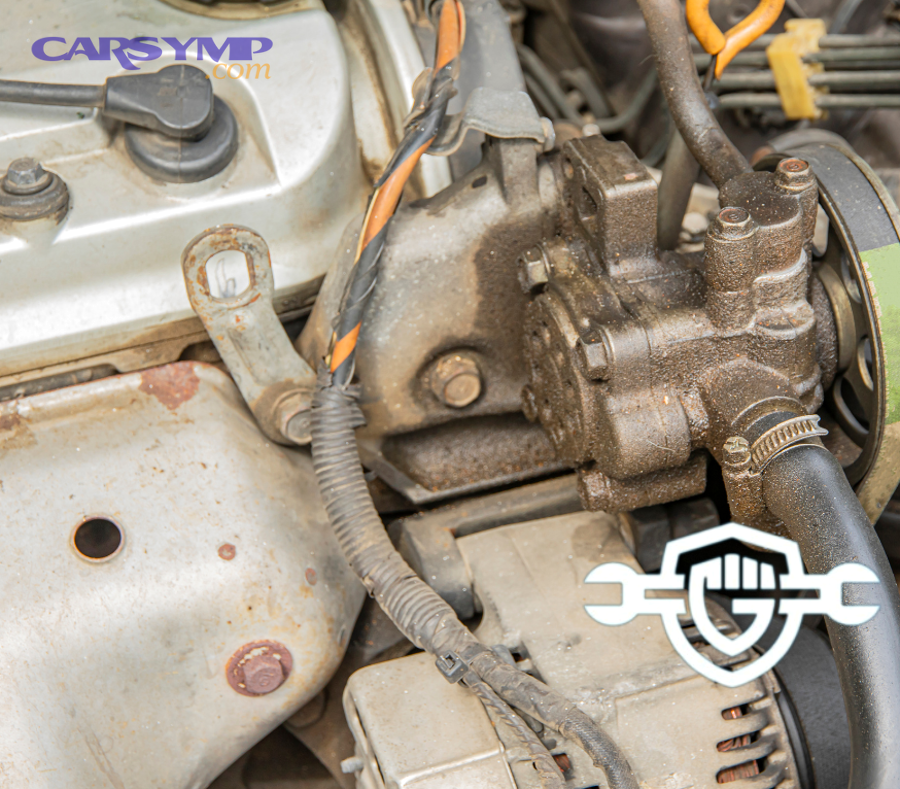
Location provides the most reliable identification method since power steering components cluster in specific areas. Check for wetness or dripping around the power steering pump (typically mounted on the engine’s front or side, driven by the serpentine belt), along the high-pressure and return hoses connecting the pump to the steering rack, near the steering rack itself (behind the engine, where the steering column connects to the front wheels), and around the power steering fluid reservoir (a translucent or opaque plastic container usually mounted near the firewall or fender).
The texture test helps confirm identification—place a drop on your fingers and rub them together. Power steering fluid feels slippery and thin compared to motor oil’s thicker consistency, brake fluid’s slightly slippery feel, or coolant’s watery texture. Unlike coolant, which may feel slightly sticky due to glycol content, power steering fluid maintains a pure oily slickness.
Color comparison against other fluids eliminates confusion. Motor oil appears dark brown to black when used, coolant shows bright green, orange, pink, or yellow depending on type, brake fluid looks clear to light amber, and transmission fluid (often confused with power steering fluid) appears bright red but typically leaks from the center underside of the vehicle near the transmission rather than the front steering area.
Smell offers another clue—power steering fluid has a distinct petroleum odor similar to motor oil but often slightly sweeter. When leaked fluid contacts hot engine parts like the exhaust manifold or engine block, it produces a burning smell accompanied by wisps of smoke. This burning odor signals active leaking onto heated surfaces and indicates the leak’s proximity to high-temperature components.
A UV dye test for steering leaks provides definitive identification when leak sources remain unclear. Add UV-reactive dye to your power steering reservoir, drive the vehicle for 50-100 miles to allow the dye to circulate throughout the system, then use a UV flashlight to inspect all steering components in a darkened area. The glowing dye precisely reveals leak locations invisible to the naked eye.
What Sounds Indicate a Power Steering Problem?
Three distinct sounds indicate power steering problems, each revealing specific conditions within your system. A high-pitched squealing when turning the steering wheel suggests the serpentine belt slipping on the power steering pump pulley due to low fluid causing the pump to seize or bind, or a loose/worn belt unable to grip the pulley properly under load.
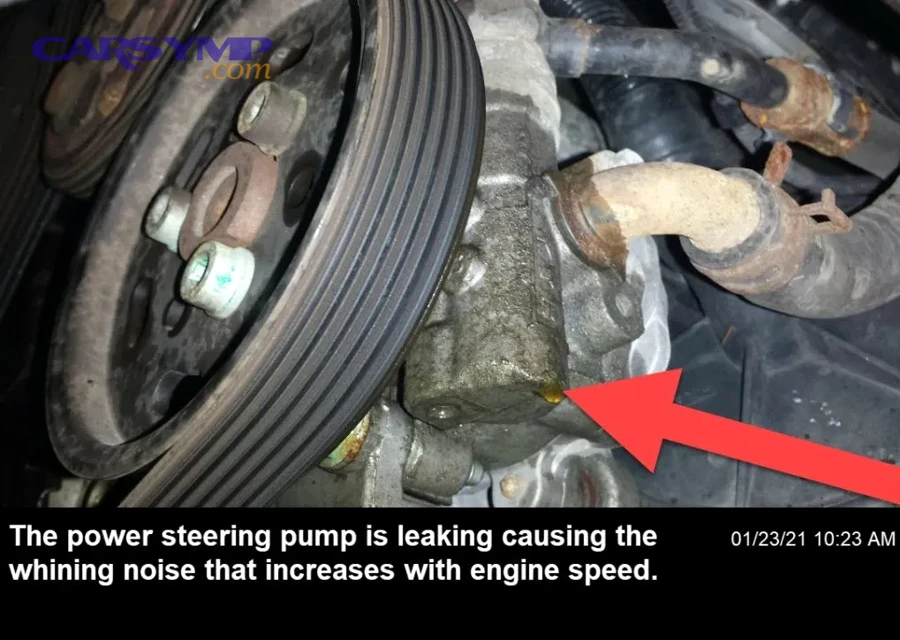
A whining noise that increases in pitch as you turn the wheel faster indicates the power steering pump cavitating—drawing air instead of fluid—or struggling to generate pressure with insufficient fluid levels. This whining often starts quietly when the engine is cold and grows louder as the system warms and fluid viscosity decreases. The sound originates from the pump location (usually near the front of the engine compartment) and may pulse rhythmically with engine speed.
Groaning or moaning sounds during turns, especially at low speeds or when the wheel is turned to full lock, signal extreme stress on the pump and rack. The groaning occurs when fluid levels drop so low that the system can barely generate any pressure, forcing components to work against high resistance without adequate lubrication. This sound often accompanies very heavy steering effort and may be felt as vibration through the steering wheel.
Grinding or scraping noises represent the most serious warning, indicating metal-on-metal contact inside the pump, rack, or steering gearbox. If you hear grinding, stop driving immediately—continued operation will cause catastrophic damage requiring complete component replacement. The grinding sound differs from normal turning noise by its harshness and irregular nature, often accompanied by visible shuddering of the steering wheel.
Clicking or popping sounds during turns typically originate from worn CV joints or suspension components rather than the power steering system itself, but they warrant inspection since they indicate steering-related issues that could worsen if combined with power steering problems.
Should You Stop Driving Immediately or Continue to a Mechanic?
Stop driving immediately if you experience grinding noises, complete loss of steering assist, or visible smoke from the steering system, but you can cautiously continue to the nearest repair facility if you have moderate steering resistance, maintain adequate fluid levels through top-offs, and avoid high-speed driving or extreme steering maneuvers. The decision depends on leak severity and remaining steering functionality.
Evaluating your specific situation requires assessing multiple factors simultaneously. Let’s examine the critical decision points that determine whether continuing poses acceptable risk or demands immediate停止.
What Should You Do If You Notice a Leak While Driving?
When you notice a power steering fluid leak while driving, immediately reduce speed, avoid aggressive steering inputs, find the nearest safe location to stop (parking lot, service station, or wide shoulder), turn off the engine, check the fluid reservoir level, and assess whether the leak is minor seepage or active dripping before deciding to continue or call for towing assistance. Quick assessment prevents escalating a manageable situation into a roadside emergency.
Begin by checking your steering response without making sudden movements. Turn the wheel gently left and right while maintaining your lane to gauge how much effort steering requires. If resistance feels only slightly increased compared to normal, you likely have time to reach a safe stopping point. If steering feels dramatically heavier or requires both hands for normal turns, begin looking for the nearest exit or safe pullover location immediately.
Once stopped safely, locate your power steering fluid reservoir under the hood. Most vehicles position it near the firewall or inner fender, with a cap labeled “Power Steering” or showing a steering wheel symbol. Check the fluid level using the dipstick attached to the cap or by viewing the translucent reservoir against the “MIN” and “MAX” level marks. If fluid appears at or above the minimum line, the leak is probably minor. If the reservoir is nearly empty, the leak is severe.
Inspect under the vehicle for active dripping. Minor leaks create small puddles after extended parking but don’t drip continuously. Severe leaks produce steady dripping visible within seconds of turning off the engine, or create large wet spots on components. Look for fluid on the ground directly under the front of the vehicle, and check whether the power steering pump, hoses, or rack show wet, oily residue.
If the leak appears minor and fluid levels remain above minimum, you can add power steering fluid as a temporary measure. Most auto parts stores, gas stations, and big-box retailers stock universal power steering fluid compatible with most vehicles. Add fluid slowly while checking the level repeatedly to avoid overfilling—excess fluid can foam and actually worsen performance. Top the reservoir to the “MAX” line, replace the cap securely, and start the engine to verify the fluid remains at an adequate level.
Make the continue-or-tow decision based on these criteria:
Continue driving to a repair shop if:
- Fluid level remains above minimum after top-off
- Steering feels heavy but controllable
- The drive to the nearest repair facility is under 10 miles
- You can avoid highway speeds, staying under 45 mph
- No grinding, scraping, or loud whining noises occur
- The leak appears to drip slowly rather than stream
- You have extra fluid bottles to add if needed during the drive
Call for towing if:
- Fluid level cannot be maintained above minimum
- Steering requires extreme effort or both hands for gentle turns
- You hear grinding, metal scraping, or continuous loud squealing
- Smoke appears from under the hood
- The steering wheel feels locked or frozen in any position
- Fluid streams or pours out when the engine runs
- You must drive on highways or through heavy traffic to reach help
- You feel unsafe or uncomfortable operating the vehicle
During emergency driving to a repair facility, avoid turning the wheels to full lock in either direction, make wider turns than normal to reduce steering effort, avoid parallel parking or tight maneuvering, use both hands on the steering wheel at all times, increase following distance to minimize sudden steering corrections, and check mirrors frequently since shoulder checks require taking one hand off the wheel.
If you must add fluid roadside, use a funnel if available to avoid spills, or create a makeshift funnel from a plastic bottle by cutting off the bottom and inverting it. Wipe the reservoir cap and surrounding area clean before opening it to prevent contaminating the fluid with dirt. Add fluid in small amounts, checking level frequently—overfilling creates foam that reduces system performance. Start the engine after filling and turn the wheel lock-to-lock several times while parked to distribute fluid throughout the system and purge air pockets, then recheck the level and add more if needed.
Contact your regular mechanic, a mobile repair service, or roadside assistance for guidance. Many service providers dispatch mobile mechanics who can assess the leak, add fluid, and either perform temporary repairs or determine whether towing is necessary. This professional assessment provides peace of mind and expert judgment when you feel uncertain about continuing.
Document the situation with photos of the fluid puddle, reservoir level, and any visible damage to hoses or components. This documentation helps mechanics diagnose the problem before you arrive and assists with insurance claims if the leak caused steering-related damage or contributed to an accident.
While understanding whether you can drive with a power steering fluid leak addresses your immediate safety concerns, knowing more about the causes, repair options, and prevention strategies will help you make informed long-term decisions about your vehicle’s steering system.
What Causes Power Steering Fluid Leaks and How Can You Prevent Them?
Power steering fluid leaks occur due to worn or cracked hoses, damaged pump seals, rack and pinion seal failure, and O-ring deterioration from age and heat exposure, and you can prevent them through regular fluid flushes every 50,000-75,000 miles, avoiding turning wheels to full lock, and conducting periodic system inspections. Understanding root causes enables proactive maintenance that eliminates leaks before they develop.
Leak prevention costs a fraction of repair expenses and maintains your vehicle’s safety and reliability. Below, we’ll examine specific failure points, repair costs for different leak sources, the effectiveness of stop-leak additives, and comprehensive prevention strategies.
What Are the Most Common Sources of Steering Fluid Leaks?
The six most common power steering fluid leak sources include high-pressure and return hoses that crack or separate at connection points, power steering pump seals that deteriorate from heat and pressure cycles, rack and pinion seals that wear from constant movement and debris exposure, O-rings that harden and shrink with age, loose hose connections and fittings that vibrate free over time, and steering gear housing seals in older steering box systems. Each component fails through distinct mechanisms that respond differently to repair approaches.
High-pressure hoses endure the most extreme conditions, carrying fluid at 1,000-1,500 PSI from the pump to the steering rack. These hoses consist of multiple layers—inner synthetic rubber lining, reinforcing fabric or wire braid, and outer protective rubber cover. Over time, heat from the engine and pressure pulsations cause the inner lining to crack, while exposure to ozone, road salt, and petroleum products deteriorates the outer cover. Cracks typically form at bend points where flexing concentrates stress, or at hose ends where the hose crimps onto metal fittings. Return hoses experience lower pressure but fail through similar age-related deterioration.
Power steering pump seals face extreme operating conditions, with shaft seals rotating at engine speed while containing high-pressure fluid and managing temperature swings from below freezing to over 200°F. The front shaft seal where the pulley attaches represents the most common pump leak point. As the seal hardens with age, it loses contact with the rotating shaft, allowing fluid to seep past and drip onto the serpentine belt or engine. Internal pump seals separating the high and low-pressure chambers can also fail, causing internal leakage that reduces pressure without visible external leaking.
Rack and pinion seals protect the internal piston and rack shaft from the environment while containing pressurized fluid. The rack shaft passes through seals as it moves left and right during steering, creating a wear surface that deteriorates over miles of operation. Road debris, moisture, and salt can contaminate the seal area, accelerating wear. Boot tears expose seals to direct contamination, causing rapid failure. Many vehicles use multiple seals on each end of the rack—outer dust seals and inner pressure seals—and failure of either type causes leaks.
O-rings provide sealing at numerous connection points throughout the system—where hoses attach to the pump, rack, and reservoir, and at any threaded fitting or union. These small rubber rings compress to create pressure-tight seals but eventually lose elasticity from heat cycling, chemical exposure to the power steering fluid itself, and ozone in the atmosphere. Hardened O-rings shrink slightly, creating gaps that allow fluid seepage. O-ring failure often occurs at connections that experience temperature extremes, such as those near the exhaust manifold or turbocharger.
Loose connections develop from vibration over thousands of miles of driving, particularly on rough roads or in vehicles used for towing. Hose clamps can stretch, threaded fittings can back off partial turns, and crimped hose ends can separate from their metal fittings. These leaks often start as minor seepage that worsens progressively as the connection loosens further.
Steering gear housing in older vehicles equipped with recirculating ball steering systems rather than rack and pinion can develop leaks at the input shaft seal, sector shaft seal, or through cracked housings. These traditional gearboxes contain more complex internal sealing than rack and pinion systems and often leak from multiple points simultaneously when age-related deterioration occurs.
How Much Does It Cost to Repair Different Types of Leaks?
Power steering leak repairs range from $50 for simple hose clamp tightening to over $1,200 for complete rack and pinion replacement, depending on leak location, component accessibility, and whether you choose DIY or professional service. Understanding cost breakdowns helps you budget appropriately and evaluate whether prevention or replacement offers better value.
The table below compares typical repair costs for common power steering leak sources:
| Leak Source | Parts Cost | Labor Cost | Total Cost Range | DIY Feasible? |
|---|---|---|---|---|
| Hose clamp tightening | $5-15 | $40-80 | $50-100 | Yes |
| High-pressure hose replacement | $40-120 | $60-180 | $100-300 | Moderate |
| Return hose replacement | $20-60 | $40-120 | $60-180 | Yes |
| O-ring replacement (single) | $2-10 | $50-140 | $50-150 | Moderate |
| Power steering pump seal | $15-40 | $120-200 | $140-240 | Difficult |
| Complete pump replacement | $150-350 | $150-300 | $300-650 | Difficult |
| Rack and pinion seal kit | $30-80 | $200-500 | $230-580 | Very Difficult |
| Complete rack replacement | $300-700 | $400-500 | $700-1,200 | Very Difficult |
| Power steering flush (preventive) | $80-120 | Included | $80-120 | Moderate |
Hose repairs represent the most affordable and DIY-friendly fixes. High-pressure hoses require specific specifications matching your vehicle’s pressure rating and end fitting types, but replacement involves simply removing clamps or threaded connections at each end and installing the new hose. Return hoses use lower pressure ratings and simpler push-on or clamp-type connections. Labor costs vary based on hose accessibility—some run through tight spaces requiring removal of other components for access.
O-ring replacement costs remain low for parts but labor varies dramatically by location. Accessible fittings at the reservoir or visible hose connections take minutes to service, while O-rings inside the pump or buried at rack connections may require partial disassembly that increases labor to an hour or more. Many mechanics recommend replacing all accessible O-rings simultaneously when performing other steering work to prevent repeat repairs.
Power steering pump repairs present a decision point between seal replacement and complete pump replacement. Rebuilding pumps by replacing only seals works if internal components remain undamaged, but if the pump has operated low on fluid or shows signs of bearing wear (noise, wobbling pulley), complete replacement provides better long-term value. New pumps include warranty protection that rebuilt pumps may not offer. Labor remains similar for both approaches since pump removal and installation represent the primary time investment.
Rack and pinion repairs trigger the most difficult cost decisions. Seal kits offer attractive pricing but require complete rack removal, disassembly, cleaning, seal replacement, reassembly, and reinstallation—a 4-6 hour job for experienced mechanics that demands specialized tools and expertise most DIYers lack. Risk of improper reassembly causing continued leaking or poor steering performance makes professional service advisable. Complete rack replacement simplifies the process but costs significantly more for the part. However, a new or remanufactured rack includes warranty coverage and eliminates risk of seal replacement failing to resolve internal wear issues.
Additional costs may include alignment ($75-150) after rack replacement since disconnecting steering components changes suspension geometry, power steering system flush ($80-120) to remove contaminated fluid and metal debris, and serpentine belt replacement ($50-150) if the existing belt shows fluid contamination or damage.
According to repair data from AAA’s Automotive Engineering team, approximately 45% of power steering repairs require only hose or connection fixes under $300, while 35% need pump replacement in the $300-650 range, and 20% demand rack and pinion work exceeding $700.
Can Power Steering Stop Leak Additives Fix the Problem?
Power steering stop leak additives can temporarily seal minor leaks from softened or shrunk seals and O-rings by conditioning and swelling rubber components, but they cannot fix mechanical damage like cracked hoses, damaged pump bearings, or worn rack seals, making them appropriate for slow seepage from aging seals but ineffective for severe leaks requiring component replacement. Understanding when additives work versus when mechanical repair is necessary prevents wasting money on ineffective chemical solutions.
Stop leak additives work through two primary mechanisms. First, they contain seal conditioning agents—typically petroleum distillates and ester compounds—that penetrate rubber seals, O-rings, and gaskets to restore elasticity lost through aging and heat exposure. This conditioning causes slightly shrunken seals to swell back toward their original dimensions, re-establishing contact with mating surfaces and closing small gaps that allow fluid seepage.
Second, these products include particulate materials that temporarily plug tiny imperfections in seals. As fluid leaks through micro-cracks or surface irregularities, the particles lodge in the gaps and accumulate until flow stops. This plugging action provides immediate leak reduction while the conditioning agents work more slowly over days to weeks of driving.
Appropriate applications for stop leak additives include minor seepage from pump shaft seals that create small drips but don’t stream, slow leaking from rack boots indicating early seal deterioration, sweating at O-ring connections that haven’t progressed to dripping, and preventive treatment when seals show early aging but haven’t yet developed leaks. These scenarios involve seals that retain structural integrity but have lost some elasticity or dimensional accuracy.
Ineffective applications where mechanical repair is necessary include cracked or separated hoses that require replacement, pump bearing failure causing metal-on-metal noise and wobble, rack seal damage from torn boots and debris intrusion, severed or loose hose connections, and any leak causing fluid loss faster than one ounce per day. Chemical solutions cannot repair physical damage or replace worn mechanical components.
Popular brands like Lucas Oil Power Steering Stop Leak, Bar’s Leaks Power Steering Repair, and ATP Automotive Stop Leak consistently receive positive reviews for appropriate applications. Application involves adding one bottle (typically 11-16 oz) to your power steering reservoir, then driving the vehicle for 100-200 miles while turning the steering wheel lock-to-lock periodically to circulate the additive throughout the system. Leaks should diminish noticeably within 2-3 days and may seal completely within a week if the problem falls within the additive’s capability range.
Potential drawbacks include additive incompatibility with certain synthetic fluids requiring you to verify compatibility before adding, seal over-swelling that could cause new leaks if you use excessive amounts, and sediment accumulation that might clog fine filters or tight clearances in the steering system. Follow dosage instructions precisely—more is not better with these products.
Cost comparison shows additives at $8-20 per bottle versus $140-1,200 for mechanical repairs, making them worthwhile first attempts for minor leaks even if success isn’t guaranteed. If the leak continues or worsens after proper application and adequate circulation time, chemical treatment has failed and mechanical repair becomes necessary.
What Preventive Maintenance Prevents Power Steering Leaks?
Four preventive maintenance practices significantly reduce power steering leak risk and extend system lifespan: performing power steering fluid flushes every 50,000-75,000 miles to remove contaminants and refresh seal-conditioning additives, avoiding turning wheels to full lock which stresses the pump and seals, monitoring and replacing the serpentine belt before failure, and conducting visual inspections of hoses, connections, and the pump during routine oil changes. Proactive maintenance costs under $200 every few years but prevents $500-1,200 leak repairs.
Power steering fluid flushes remove accumulated moisture, metal particles from normal wear, and oxidized fluid that loses its lubricating and seal-protecting properties. Old fluid turns dark brown or black and may smell burned, indicating chemical breakdown that accelerates seal aging. Fresh fluid contains detergents and conditioners that keep seals pliable and prevent the hardening that leads to leaks. The flush process involves removing old fluid from the reservoir, disconnecting the return hose, running the engine briefly while adding fresh fluid to push old fluid out through the disconnected hose, then reconnecting everything and adding the final fill. This procedure costs $80-120 at service facilities or about $40 for DIY using a fluid exchange kit and the appropriate fluid type for your vehicle (check your owner’s manual).
Avoiding full-lock steering protects your pump and seals from maximum pressure stress. When wheels turn to their mechanical stop (the point where they won’t turn further), the hydraulic system generates peak pressure as the pump fights against the immovable steering components. This maximum pressure stresses pump seals, rack seals, and hose connections beyond normal operating loads. Modern vehicles include pressure relief valves to limit maximum pressure, but repeatedly hitting these limits accelerates wear. When parking or maneuvering, turn the wheel until you feel resistance, then back off slightly—this quarter-inch reduction eliminates full-lock pressure spikes while maintaining nearly the same turning radius.
Serpentine belt maintenance prevents cascade failures where a snapped belt leaves you stranded while also causing pump damage. A deteriorating belt that slips on the power steering pump pulley creates erratic pressure fluctuations that stress seals and can cause the pump to overheat. Inspect the belt every 30,000 miles for cracks, fraying, glazing (shiny, hard surface), or chunks missing from the ribs. Most belts require replacement every 60,000-100,000 miles. The $50-150 replacement cost prevents the $300-650 pump replacement that often follows belt failure.
Visual inspections during routine maintenance catch developing problems before they cause breakdowns. When your vehicle is up for oil changes, ask the technician to inspect power steering components or do it yourself if performing your own maintenance. Look for wet spots or fluid residue on hoses, especially at crimp connections and bend points, dampness around the pump shaft where it enters the housing, fluid on the serpentine belt or pooled on components below the pump, cracked or bulging hoses that haven’t yet started leaking, loose hose clamps or fittings that can be tightened before they leak, and torn rack boots that expose seals to contamination.
Additional preventive measures include using high-quality power steering fluid that meets or exceeds your vehicle manufacturer’s specifications rather than generic universal fluid, parking in covered areas when possible to minimize temperature extremes and UV exposure that age rubber components, addressing minor leaks immediately with either stop-leak additives or mechanical repairs before they worsen, and maintaining proper tire pressure since underinflated tires increase steering effort and system stress.
According to research from the Automotive Maintenance and Repair Association, vehicles receiving regular power steering system maintenance experience 70% fewer leak-related failures compared to vehicles serviced only when problems develop, and proactive maintenance extends average power steering component lifespan from 80,000 to over 150,000 miles.