


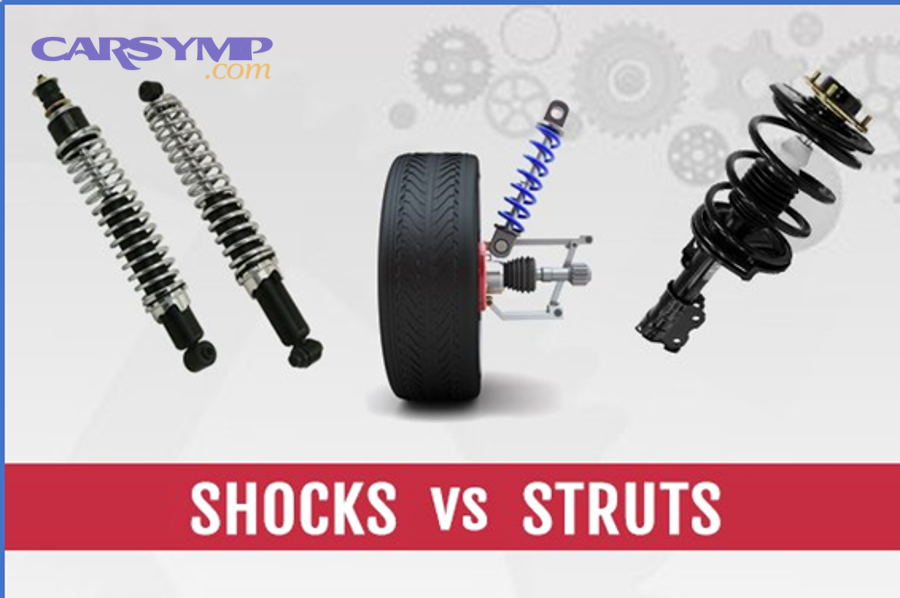
Shock absorbers and struts are fundamentally different suspension components—struts provide structural support to the vehicle chassis while shock absorbers only dampen spring movement. The primary distinction lies in their design and integration: struts combine multiple suspension elements (shock absorber, coil spring, and mounting hardware) into a single structural assembly that replaces the upper control arm, whereas shocks function as standalone hydraulic components that work alongside separately mounted springs. This structural difference means struts affect steering geometry, wheel alignment, and load-bearing capacity, while shocks exclusively control suspension oscillation without supporting vehicle weight.
Understanding how to identify which components your vehicle uses is essential for proper maintenance and replacement decisions. Visual inspection reveals key differences—shock absorbers typically appear as vertical cylindrical units mounted behind the tires with eyelet connections at both ends, resembling a mechanical pump, while struts present as larger assemblies with a visible coil spring wrapped around a central damper unit. Most modern front-wheel-drive vehicles use struts on the front axle, though many configurations combine struts at one end with shocks at the other, creating hybrid suspension systems that leverage the advantages of both designs.
The functional and operational differences between these components directly impact your vehicle’s ride quality, handling characteristics, and safety performance. Struts perform dual roles—they dampen suspension movement like shocks while simultaneously bearing lateral loads, supporting vehicle weight, and maintaining precise wheel alignment throughout suspension travel. Shock absorbers focus exclusively on controlling spring rebound and compression by converting kinetic energy into thermal energy through hydraulic resistance, providing ride comfort without contributing to structural integrity. These functional distinctions determine replacement complexity, cost considerations, and the consequences of component failure.
Knowing when to replace shocks versus struts requires understanding their different wear patterns and failure symptoms. Strut failure often manifests through steering problems, alignment issues, and clunking noises during turns, reflecting their structural role, while worn shocks typically cause excessive bouncing, extended braking distances, and body roll without affecting steering precision. Below, we’ll examine each component in detail, explore identification methods, compare their functions, and provide comprehensive replacement guidance.
What Are Shock Absorbers?
Shock absorbers are hydraulic damping devices that control spring oscillation and suspension movement without providing structural support to the vehicle. A shock absorber consists of a piston attached to a rod that moves through hydraulic fluid contained within a pressure tube, creating resistance that converts the kinetic energy of suspension motion into thermal energy dissipated as heat. Unlike struts, shocks do not bear vehicle weight or serve as mounting points for other suspension components—they function exclusively to prevent excessive bouncing, improve tire contact with the road surface, and enhance ride comfort by limiting spring rebound.
To understand how shocks contribute to suspension performance, it’s essential to examine their internal operation and installation characteristics. Specifically, the hydraulic mechanism and mounting configuration determine how effectively shocks control vehicle dynamics.
How Do Shock Absorbers Work?
The shock absorber operates through a velocity-sensitive hydraulic system where fluid forced through calibrated orifices creates resistance proportional to suspension movement speed. When the suspension compresses or extends, the piston moves through the pressure tube, forcing hydraulic fluid through tiny holes or orifices in the piston head. The restricted fluid flow generates resistance that opposes piston movement, which in turn slows the rate at which springs compress and rebound. This damping effect prevents the springs from oscillating uncontrollably after encountering road irregularities, keeping the tires in continuous contact with the pavement for optimal traction and control.
The amount of damping force a shock generates depends on both the piston speed and the size of the fluid passages—faster suspension movement creates higher pressure differentials and greater resistance. Most modern shocks use asymmetrical valving that provides different damping rates for compression versus extension strokes, allowing engineers to tune ride comfort during compression while maintaining firm control during rebound. Twin-tube shock designs incorporate an inner pressure tube and outer reservoir tube, with fluid transferred between chambers during operation, while monotube shocks contain all components in a single larger-diameter tube, offering improved heat dissipation and more consistent performance under demanding conditions.
Where Are Shocks Located on a Vehicle?
Shock absorbers mount vertically or near-vertically between the vehicle frame and suspension components, typically positioned behind the wheels where they’re visible during inspection. On vehicles with shock absorbers, you’ll find them attached at the top to the frame or body structure through a rubber-isolated mounting bushing, while the bottom connects to the suspension control arm, axle housing, or specialized mounting bracket. Rear-wheel-drive vehicles and trucks commonly use shock absorbers on both axles, whereas many front-wheel-drive cars employ shocks only on the rear suspension while utilizing struts at the front.
The mounting configuration uses either a stud-and-bushing arrangement with rubber isolators or eyelet-style connections at both ends, allowing the shock to articulate as the suspension moves through its travel range. This isolated mounting system prevents shock-generated vibrations from transmitting directly into the vehicle cabin. When visually inspecting for shocks, look for cylindrical components approximately 12-18 inches long with a piston rod extending from one end, often featuring a dust boot to protect the rod from contamination—their standalone appearance distinguishes them clearly from the larger, spring-equipped strut assemblies.
What Are Struts?
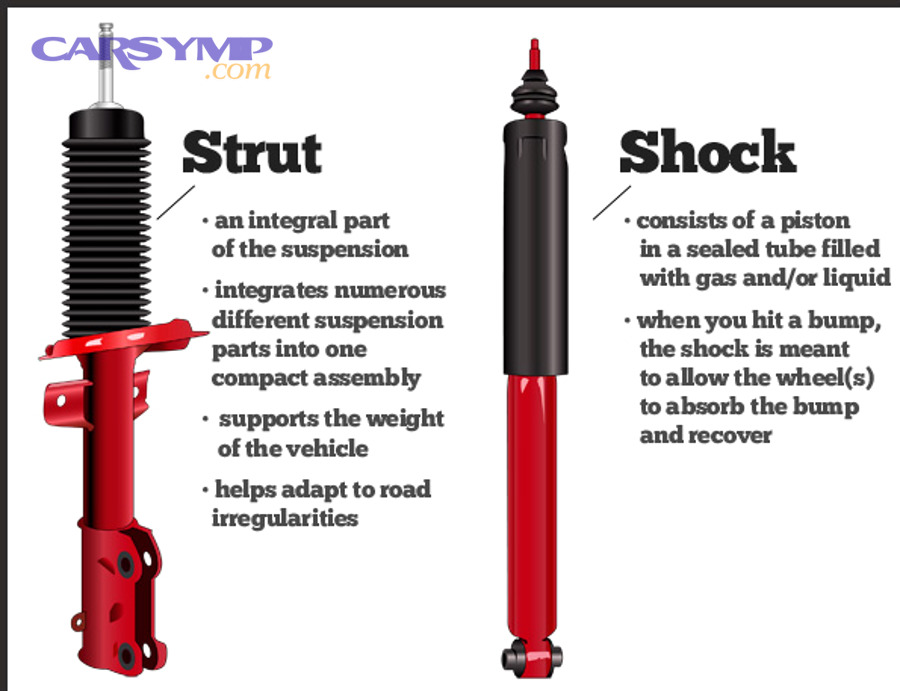
Struts are integrated structural suspension components that combine shock absorption, spring support, and chassis mounting functions into a single replaceable assembly. A complete strut consists of a shock absorber (damping unit) housed within a structural tube, surrounded by a coil spring, and topped with a bearing-equipped upper mount that connects directly to the vehicle body while supporting steering pivot motion. Unlike standalone shock absorbers, struts serve as critical structural members that replace the upper control arm and upper ball joint found in conventional double-wishbone suspension designs, bearing significant lateral loads, supporting vehicle weight, and maintaining wheel alignment geometry throughout suspension travel.
Understanding the dual-purpose nature of struts clarifies why they cost more to replace and why their failure affects multiple vehicle systems simultaneously. More specifically, their structural integration and internal mechanisms reveal why they cannot be substituted with simple shock absorbers.
How Do Struts Work?
Struts perform simultaneous damping and load-bearing functions through their integrated design, with the internal shock mechanism controlling spring oscillation while the outer housing bears lateral forces and supports steering components. Internally, the damping unit operates identically to a shock absorber—a piston moves through hydraulic fluid, creating velocity-sensitive resistance that converts suspension motion into heat energy. However, the strut housing itself forms a rigid structural column that connects the wheel hub to the vehicle body, transferring cornering forces, braking loads, and road impacts directly to the chassis structure.
The coil spring surrounding the strut housing supports the vehicle’s weight and compresses to absorb road irregularities, while the internal damper prevents the spring from bouncing uncontrollably. The upper strut mount incorporates a bearing assembly that allows the entire strut to rotate when the steering wheel turns, enabling front-wheel steering without binding. This bearing must accommodate both rotational movement for steering and vertical suspension travel simultaneously, making it a wear item that often requires replacement during strut service. The lower portion of the strut connects to a steering knuckle through bolts or a clamp arrangement, directly controlling wheel position and alignment angles.
Because struts bear both vertical loads (vehicle weight) and horizontal loads (cornering forces, braking torque), they experience more complex stress patterns than simple shock absorbers. The structural tube must resist bending forces that would alter wheel alignment, while the damping mechanism must continue functioning despite these external loads. This dual-purpose design explains why strut failure often produces multiple symptoms—reduced ride comfort from damping loss plus steering problems, noise, and alignment changes from structural degradation.
Where Are Struts Located on a Vehicle?
Struts mount at the center of the wheel assembly, connecting the steering knuckle at the bottom to a reinforced tower structure in the body/chassis at the top. On most front-wheel-drive vehicles and many modern rear-wheel-drive cars, you’ll find strut assemblies at both front wheels, positioned prominently behind the engine bay’s front fender areas. When you open the hood and look toward the front corners of the engine compartment, the upper strut mount towers typically appear as raised structures with three or four mounting bolts securing the strut bearing plate to the vehicle body.
The lower strut connection bolts directly to the steering knuckle—the component that holds the wheel bearing and connects to the brake caliper. This direct attachment means the strut moves vertically with suspension travel while also rotating with steering inputs, requiring the upper bearing mount to accommodate both motions simultaneously. Some vehicles use MacPherson strut suspension at the front and conventional shock-and-spring arrangements at the rear, while others employ struts at all four corners. Rear struts typically connect to the body through trunk or cargo area mounting points, sometimes visible inside the vehicle with plastic or fabric covers concealing the upper mount.
Visual identification becomes straightforward when you recognize the characteristic appearance: a large coil spring wrapped around a central damper tube, with the assembly spanning from the wheel hub area to the vehicle body. The integrated spring-and-damper design contrasts sharply with separate shock absorbers, which appear as smaller cylindrical components mounted alongside independently positioned springs.
What Is the Main Difference Between Shocks and Struts?
The main difference between shocks and struts is that struts function as major structural components integrated into the suspension system architecture, while shock absorbers serve exclusively as non-structural damping devices. Struts combine the shock absorber, coil spring, spring seats, and mounting hardware into a single assembly that replaces the upper control arm and bears lateral loads, supports vehicle weight, and affects wheel alignment, whereas shocks operate as standalone hydraulic cylinders that control spring movement without supporting weight or contributing to suspension geometry. This fundamental structural distinction determines replacement complexity, cost, safety implications, and the symptoms that appear when each component fails.
However, understanding the practical implications of this structural difference requires examining specific scenarios where these components interact with other vehicle systems. In addition, several common misconceptions about their interchangeability persist among vehicle owners.
Can Shocks and Struts Be Used Interchangeably?
No, shocks and struts cannot be used interchangeably because struts serve as structural suspension members while shocks function only as damping devices. Attempting to replace a strut with a shock absorber would eliminate critical structural support, leaving the suspension without a component to bear lateral loads, maintain wheel alignment, or support the coil spring. The suspension geometry on strut-equipped vehicles specifically accounts for the strut’s structural role—removing it would cause the wheel assembly to lose proper positioning, potentially resulting in complete suspension collapse, dangerous handling characteristics, and inability to maintain directional control.
Conversely, vehicles designed with separate shocks and springs cannot accept strut assemblies as replacements because the suspension architecture includes dedicated upper control arms, ball joints, and spring perches that would conflict with the strut’s integrated design. The mounting points, attachment hardware, and load paths differ fundamentally between these suspension types. Strut-equipped vehicles feature reinforced strut towers built into the body structure to handle the concentrated loads transmitted through the upper mount, while shock-equipped vehicles distribute loads through the control arm and spring seat arrangements.
The engineering requirements dictate component selection—manufacturers choose struts for compact packaging in front-wheel-drive vehicles where engine placement limits available space, while separate shock-and-spring designs appear in applications requiring maximum suspension travel, ease of serviceability, or traditional suspension geometry. Attempting to convert between these fundamentally different architectures would require extensive modifications to mounting points, suspension geometry, and structural reinforcement, making such conversions impractical and dangerous for typical vehicle owners.
Can a Vehicle Have Both Shocks and Struts?
Yes, a vehicle can have both shocks and struts simultaneously, with struts commonly installed on the front axle and shock absorbers on the rear axle. This mixed configuration appears frequently on front-wheel-drive vehicles where strut suspension provides compact packaging for the front-drive components and steering systems, while the simpler rear suspension uses conventional shock absorbers with separate springs or torsion beam designs. The front struts handle the complex demands of supporting the engine weight, managing steering geometry, and controlling drive axle torque reactions, whereas the rear shocks only need to dampen spring oscillations in a less spatially constrained environment.
This combination allows manufacturers to optimize each axle independently based on specific functional requirements. Front struts offer space efficiency critical in transverse-engine layouts while integrating steering components into the suspension assembly. Rear shocks provide adequate damping performance at lower cost and complexity for the rear suspension, which doesn’t require steering capability and typically bears less weight than the engine-laden front end. Some rear-wheel-drive sports cars reverse this arrangement, using double-wishbone suspension with separate shocks at the front for precise handling control while employing rear struts for compact packaging in the trunk area.
Checking your vehicle’s specific configuration requires consulting the owner’s manual, visually inspecting all four corners, or asking a qualified technician during service appointments. The mixed configuration affects maintenance planning—front strut replacement typically costs more and requires more labor than rear shock replacement due to the additional components involved. When replacing suspension components, always match the original design specification; never attempt to substitute shocks for struts or vice versa based on cost considerations alone, as this compromises both safety and vehicle performance.
How Can You Tell If Your Vehicle Has Shocks or Struts?
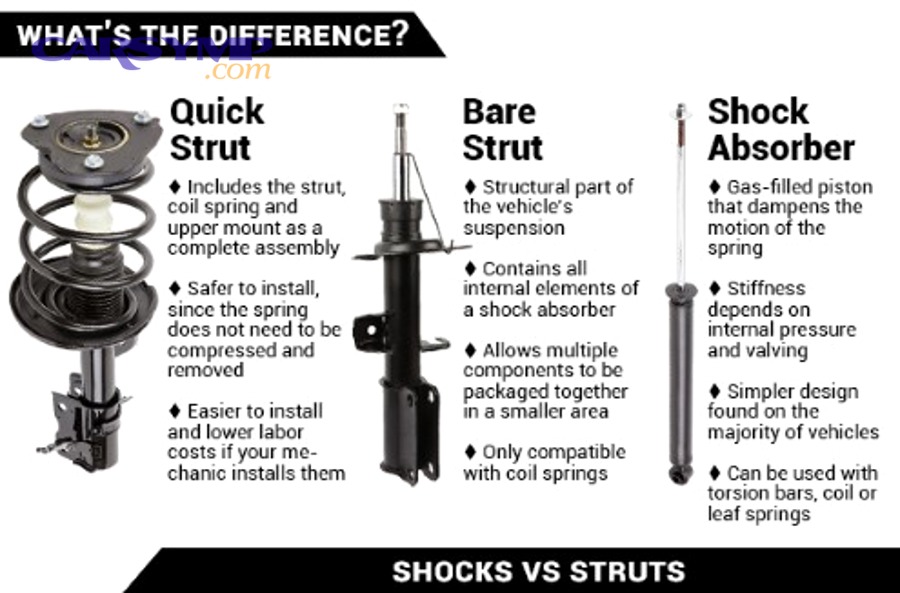
You can tell if your vehicle has shocks or struts by visually inspecting the suspension components, checking your owner’s manual for suspension specifications, or having a professional technician identify the system type. Visual inspection reveals the most obvious differences—struts appear as large assemblies with visible coil springs wrapped around central damper tubes, mounted prominently at the wheel hubs and extending upward into body-mounted towers, while shock absorbers present as smaller cylindrical components positioned vertically or at angles behind the wheels without integrated springs. Most front-wheel-drive vehicles manufactured after 1980 use strut front suspensions, though examining your specific vehicle confirms the actual configuration.
To ensure accurate identification and understand the practical implications of your suspension type, let’s explore the three primary identification methods in detail. Next, we’ll examine each approach to help you confidently determine your vehicle’s suspension components.
Visual Inspection Method
Visual inspection provides immediate identification when you know the distinguishing characteristics of each component type. To inspect your front suspension, turn your steering wheel fully to one side to improve access, then look behind the front wheel into the wheel well area. If you see a large coil spring surrounding a central tube with the assembly extending from the wheel hub area upward toward the engine compartment, you have struts. The spring will be clearly visible as a tightly wound metal coil wrapped around the damper body, and the entire assembly rotates when you turn the steering wheel, confirming the integrated strut design.
For shock absorber identification, look for a smaller cylindrical component (typically 2-3 inches in diameter and 12-18 inches long) mounted vertically or at an angle behind the wheel, with attachment points at top and bottom but no surrounding coil spring. The shock body remains stationary when steering is turned, and you should see a separate coil spring mounted elsewhere in the suspension—often between the lower control arm and frame on independent front suspensions, or as a single leaf spring or coil-over-axle arrangement on solid rear axles. Shocks often feature visible external reservoirs on performance applications or simple monotube/twin-tube cylindrical designs on standard vehicles.
Rear suspension inspection follows similar principles—look behind the rear wheels for either strut assemblies with integrated springs or separate shock absorbers mounted alongside independent spring components. Many vehicles have accessible rear suspension visible from underneath the vehicle or through the trunk/cargo area, where upper mounting points appear through removable access panels. If you see mounting bolts with large rubber bushings passing through the shock body at top and bottom connections, you’re looking at shock absorbers; if you see a bearing assembly with multiple bolts securing a large plate and visible spring surrounding the central tube, those are struts.
Check Your Owner’s Manual
Your vehicle’s owner’s manual contains definitive information about suspension component types, typically found in the specifications section or maintenance schedule. Look for sections titled “Suspension,” “Chassis Specifications,” or “Technical Data” where manufacturers list the suspension design for front and rear axles. The manual may describe the system as “MacPherson strut front suspension” or “independent front suspension with shock absorbers and coil springs,” providing clear confirmation of component types without requiring physical inspection.
The maintenance schedule section often differentiates between shock and strut replacement intervals and procedures, offering additional clues about your vehicle’s configuration. If the manual specifies different replacement procedures or intervals for front versus rear suspension components, this typically indicates a mixed system with struts at one end and shocks at the other. Service recommendations that mention “strut bearing replacement” or “strut mount inspection” confirm strut-equipped axles, while references to “upper and lower control arms” suggest conventional shock-equipped suspension geometry.
Many manufacturers now provide digital owner’s manual access through their websites or mobile applications, allowing you to search electronically for suspension-related terms. If you’ve lost your physical manual, entering your vehicle identification number (VIN) on the manufacturer’s website typically grants access to the correct manual for your specific model year and configuration. This method provides absolute certainty about factory specifications without interpretation or potential misidentification during visual inspection.
Ask a Professional Technician
Professional automotive technicians can immediately identify suspension component types through their training and daily experience with diverse vehicle platforms. During routine maintenance visits like oil changes or tire rotations, technicians inspect suspension components as part of standard multi-point inspections, making these service appointments ideal opportunities to ask about your specific configuration. Technicians can explain not only whether you have shocks or struts but also assess their current condition, identify wear patterns, and recommend replacement timing based on observed degradation.
This professional consultation becomes particularly valuable when visual inspection proves difficult due to underbody covers, splash shields, or complex suspension designs that obscure component visibility. Modern vehicles increasingly incorporate aerodynamic underbody paneling that prevents easy access to suspension components without lifting the vehicle and removing protective covers. Technicians have the equipment, workspace, and familiarity with specific vehicle platforms to quickly identify components that might require extensive effort for DIY inspection.
Additionally, technicians can distinguish between complete strut assemblies and strut cartridge designs where only the internal damper requires replacement while retaining the original spring and housing. They’ll also identify specialized variants like coilover suspension kits, adjustable dampers, or aftermarket performance components that might confuse visual identification for untrained observers. Establishing a relationship with a trusted service facility provides ongoing access to expertise for suspension questions, component condition assessments, and maintenance planning throughout your vehicle’s ownership.
What Are the Key Functional Differences Between Shocks and Struts?
The key functional differences between shocks and struts are that struts perform structural weight-bearing and steering geometry control while providing damping, whereas shocks exclusively dampen suspension oscillations without supporting loads or affecting alignment. Struts influence ride comfort, handling dynamics, steering precision, wheel alignment angles, and chassis structural integrity simultaneously, making their failure significantly more dangerous than shock absorber degradation. Shock absorbers impact only ride quality and tire contact consistency, controlling spring rebound to prevent bouncing without affecting the vehicle’s structural stability or steering response. These functional distinctions determine how each component’s wear affects vehicle safety, the urgency of replacement when failure occurs, and the complexity of diagnosis and repair.
Understanding these functional differences helps vehicle owners recognize symptoms, prioritize maintenance, and comprehend cost variations between shock and strut replacement. Moreover, the specific ways each component affects vehicle dynamics reveal why proper maintenance matters for both safety and performance.
Ride Comfort and Handling Differences
Both shocks and struts affect ride comfort through their damping function, but struts additionally influence handling precision through their structural role in maintaining suspension geometry. Shock absorbers control how quickly springs compress and rebound when encountering road irregularities—worn shocks allow excessive spring oscillation that creates a bouncy, unsettled ride quality where the vehicle continues moving up and down long after passing over bumps. This deterioration reduces comfort but typically develops gradually, allowing drivers to adapt to the declining performance without recognizing the degradation until replacement reveals the dramatic improvement.
Struts affect ride comfort through identical damping mechanisms but introduce additional handling consequences through their structural function. Worn strut damping produces the same bouncy ride quality as failed shocks, but structural degradation in the strut housing, mounting bearings, or attachment points creates handling problems that shocks cannot produce. These include increased body roll during cornering as the strut housing flexes rather than maintaining rigid geometry, steering response delays when worn upper bearings prevent immediate strut rotation with steering inputs, and unpredictable directional changes when degraded lower mounting points allow the wheel assembly to shift position under load.
Performance-oriented vehicles demonstrate these differences most dramatically. Sports cars with separate shock-equipped suspensions allow engineers to tune damping characteristics independently from structural geometry, optimizing both for different performance parameters. The shocks can be valved specifically for controlling body motion without compromising structural stiffness. Strut-equipped vehicles must balance damping performance against structural requirements within a single component, sometimes requiring compromises that dedicated shock-and-spring designs avoid. However, modern strut designs achieve excellent performance through sophisticated valve tuning and structural engineering, making this difference less significant for typical driving applications.
Structural Support and Weight-Bearing
Struts bear vehicle weight through their integrated coil springs and transfer lateral loads directly through the strut housing, while shock absorbers carry no weight and experience only the forces generated by damping resistance. The coil spring surrounding a strut compresses under vehicle weight, with the compression force transmitted through the spring seats into the strut housing and ultimately to the vehicle body through the upper mount assembly. This direct load path makes the strut a critical structural member—failure of the strut housing, upper mount, or lower attachment point eliminates suspension support, potentially causing wheel assembly collapse.
This weight-bearing function explains why strut replacement requires spring compression equipment. The spring stores tremendous energy when compressed under vehicle weight—simply unbolting a strut without properly compressing the spring can cause violent spring release that results in serious injury or death. Professional technicians use specialized spring compressors to safely capture the spring’s stored energy before disassembling the strut, then carefully release the compressors after installing the new strut assembly. DIY strut replacement without proper equipment and training represents a significant safety hazard that has caused numerous injuries.
Shock absorbers experience no static load from vehicle weight because separate springs support the vehicle mass. The shock body only experiences dynamic forces generated by piston movement during suspension travel—these forces relate to damping resistance rather than weight support. This means shock failure doesn’t compromise structural integrity or create collapse risk. A vehicle with completely failed shocks rides poorly and handles unpredictably but maintains basic structural soundness. In contrast, a vehicle with structurally failed struts may experience partial or complete suspension collapse, making the vehicle unsafe to drive even at low speeds.
The weight-bearing responsibility also affects strut replacement intervals and failure modes. Struts support vehicle weight continuously, even when parked, causing constant compression stress on springs, bushings, and mounting components. Shocks rest in extended positions when the vehicle sits stationary, experiencing stress only during driving. This continuous loading accelerates wear in strut components beyond what shock absorbers experience, though both require replacement at similar mileage intervals due to damping fluid degradation and seal wear from cycling during normal driving.
Effect on Steering and Alignment
Struts directly control wheel alignment angles and steering geometry because they serve as the upper suspension attachment point and rotate with steering inputs, while shock absorbers have no effect on alignment or steering. The strut’s upper mount bolts to the vehicle body at a precisely engineered position that establishes camber angle (wheel tilt), caster angle (steering axis tilt), and contributes to overall suspension geometry. When struts wear, the upper bearing degrades, mounting bushings deteriorate, or the housing bends, these alignment angles change from specification, causing uneven tire wear, pulling to one side, and altered steering response characteristics.
The upper strut mount bearing allows the entire strut assembly to rotate when the steering wheel turns, pivoting around the bearing’s center point. Worn bearings create binding that resists smooth rotation, producing steering difficulty, creaking noises during parking maneuvers, and inconsistent steering effort. The bearing’s condition directly affects steering feel—fresh bearings provide smooth, effortless rotation while worn bearings create notchy, resistant steering that requires additional driver effort and reduces precision. This steering integration means strut replacement often requires subsequent wheel alignment service to reset angles to factory specifications, adding cost and complexity compared to shock replacement.
Shock absorbers mount to components that move during suspension travel but don’t pivot during steering inputs. They remain stationary relative to the steering system, experiencing only vertical motion as the suspension compresses and extends. This isolation from steering geometry means shock replacement never affects alignment angles and doesn’t require subsequent alignment service. Bad shocks symptoms include excessive bouncing, poor ride quality, and reduced handling precision, but these shocks won’t cause the vehicle to pull to one side or create uneven tire wear patterns associated with alignment problems—those symptoms specifically indicate strut-related issues or other suspension geometry failures.
When Should Shocks and Struts Be Replaced?
Shocks and struts should be replaced every 50,000 miles under normal driving conditions, with replacement becoming necessary sooner when specific symptoms appear or when driving involves harsh conditions like unpaved roads, heavy loads, or extreme climates. Professional inspection at these intervals determines actual component condition, as individual wear rates vary based on driving habits, road quality, vehicle weight, and original equipment quality. Waiting for complete failure before shock absorber replacement or strut replacement risks compromised vehicle control, extended stopping distances, accelerated tire wear, and potential safety hazards, particularly with struts where structural degradation affects steering stability and suspension geometry beyond simple ride quality concerns.
Recognizing early warning signs enables proactive replacement before component failure creates dangerous driving conditions or damages other suspension and steering components. Specifically, shocks and struts exhibit distinct failure symptoms that reflect their different functional roles.
What Are the Signs of Worn Shocks?
The signs of worn shocks include excessive bouncing after hitting bumps, extended braking distances where the vehicle nose-dives dramatically during stops, and visible fluid leakage from the shock body. The bounce test provides a simple diagnostic—push down firmly on each corner of the vehicle and release; if the vehicle bounces more than 2-3 times before settling, the shocks at that corner have lost damping effectiveness. This excessive oscillation indicates the hydraulic fluid has leaked out, the internal seals have failed, or the piston valving has deteriorated to the point where it no longer creates sufficient resistance to control spring movement.
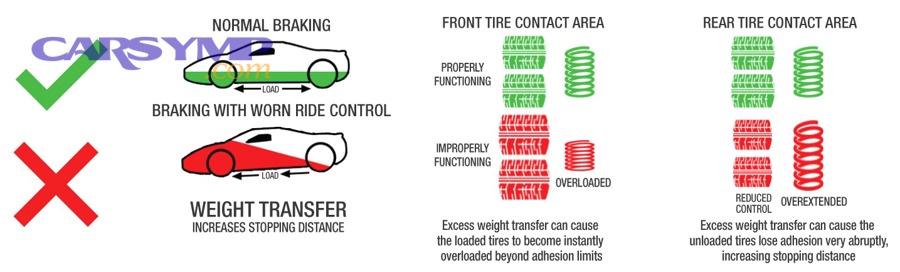
Body roll during cornering increases noticeably as shock damping degrades—the vehicle leans excessively to the outside of turns because the shocks can’t control spring compression rapidly enough to resist the weight transfer. This creates a floating, unstable sensation that reduces driver confidence and degrades handling precision. Similarly, the vehicle may squat excessively during acceleration or nose-dive dramatically during braking as worn shocks fail to control weight transfer effectively. These body motion symptoms develop gradually, often allowing drivers to unconsciously adapt to the deteriorating performance until replacement suddenly reveals how much control was lost.
Visual inspection reveals oil leakage on worn shock absorbers—fresh oil appears wet and shiny on the shock body, while older leakage shows as dark staining with accumulated road dirt. Any visible fluid indicates seal failure and requires shock replacement, as even minor leaks eventually allow complete fluid loss and total damping failure. Check around the piston rod where it enters the shock body and along the shock tube for wetness, staining, or dripping fluid. Uneven tire wear, particularly cupping or scalloping patterns on the tread surface, results from inadequate damping allowing the tire to bounce rather than maintaining consistent road contact, accelerating irregular wear that reduces tire life and creates noise.
According to a study by the Automotive Research Association, vehicles with worn shock absorbers require up to 20 percent additional stopping distance compared to properly functioning dampers, with the increased distance resulting from reduced tire contact during weight transfer. This safety implication makes timely shock replacement critical for maintaining vehicle control during emergency braking situations.
What Are the Signs of Worn Struts?
The signs of worn struts include clunking or knocking noises over bumps, steering problems such as excessive play or wandering, and visible rust or damage to the strut housing or mounting components. Noise symptoms develop as internal components wear—the piston develops play within the cylinder, mounting bushings deteriorate, or the upper bearing assembly degrades, creating metallic impacts during suspension movement. These noises typically occur when traversing rough pavement, speed bumps, or during sharp steering inputs, producing sounds distinctly different from the subtle thuds of worn shock absorbers.
Steering-related symptoms specifically indicate strut problems rather than shock issues due to the strut’s integrated role in steering geometry. Difficulty returning to center after turns suggests worn upper strut bearings that bind during rotation, while excessive steering wander or imprecise directional control indicates structural degradation allowing the wheel assembly to move outside designed geometry. Pulling to one side, especially when this tendency changes after hitting bumps, points to strut mounting wear allowing alignment angles to shift under load. These symptoms require immediate attention as they directly compromise vehicle control and safety.
Visual inspection from inside the engine compartment or trunk area reveals upper mount deterioration—look for rust, separation, or movement in the rubber isolator that should bond the metal mounting plate to the strut bearing assembly. Moisture or rust staining around the upper mount area indicates water intrusion and potential structural corrosion. From underneath, inspect the strut housing for oil leakage, physical damage, or bending that indicates impact damage or metal fatigue. Cracked or torn rubber boots protecting the piston rod allow contamination entry that accelerates internal wear.
Front-end alignment problems that recur shortly after professional alignment service often indicate worn struts unable to maintain stable geometry under driving loads. The alignment may measure correctly on a static alignment rack but shift out of specification when the struts flex during normal driving forces. This condition accelerates tire wear, creates handling unpredictability, and wastes money on repeated alignment services when strut replacement addresses the root cause.
How Often Should You Replace Them?
You should replace shocks and struts every 50,000 miles as a baseline, with adjustments based on driving conditions, vehicle type, and component quality. Vehicles subjected to harsh conditions—unpaved roads, frequent heavy loads, extreme temperatures, or aggressive driving—require more frequent replacement intervals around 40,000 miles, while highway-driven vehicles in mild climates with light loads may extend intervals to 60,000-70,000 miles. Always replace suspension components in pairs (both front or both rear) rather than individually to maintain balanced performance and prevent the new component from working harder to compensate for a worn opposite component.
Manufacturers specify replacement intervals in service schedules, though these recommendations vary widely from conservative 40,000-mile intervals to optimistic 100,000-mile suggestions based on ideal conditions. Real-world experience from suspension specialists typically suggests 50,000 miles represents appropriate replacement timing for most vehicles and driving patterns. Waiting for complete failure risks the gradual performance degradation that develops slowly enough that drivers don’t notice the declining control and safety margins until replacement suddenly reveals how compromised the worn components had become.
Choosing OEM vs performance shocks affects both replacement intervals and performance characteristics. Original Equipment Manufacturer (OEM) components match factory specifications for ride quality and lifespan, typically lasting 50,000-70,000 miles before requiring replacement. Performance aftermarket shocks and struts from quality manufacturers like Bilstein, KYB, or Monroe often exceed OEM durability while offering improved damping characteristics, with premium monotube designs potentially lasting 75,000-100,000 miles. However, performance components tuned for firmer damping may transmit more road harshness into the cabin, creating a trade-off between handling precision and ride comfort.
When replacing struts or shocks, consider replacing associated components that wear similarly—upper strut mounts, bump stops, dust boots, and mounting bushings typically deteriorate on the same timeline as the primary damping components. Many technicians recommend replacing these items during strut service since the labor to access them is already invested, and failure shortly after strut replacement necessitates redundant labor charges. Complete strut assemblies (quick-struts or loaded assemblies) include all these components pre-assembled, offering convenience and ensuring matched component specifications at a premium price compared to replacing only the damper cartridge.
How Much Does It Cost to Replace Shocks vs. Struts?
Shock absorber replacement costs $200-$600 for parts and labor when replacing both front or both rear shocks, while strut replacement costs $400-$1,200 per axle depending on vehicle type, labor complexity, and whether you choose complete assemblies or cartridge replacements. The price difference reflects the strut’s integrated design—complete strut assemblies include the shock damper, coil spring, upper mount, bearings, and hardware as a pre-assembled unit, eliminating the need for dangerous spring compression but increasing parts cost. Labor time for strut replacement exceeds shock replacement due to the additional steps of disconnecting steering components, removing brake lines, and often requiring subsequent wheel alignment service.
Understanding the factors that influence replacement costs helps vehicle owners budget appropriately and make informed decisions between DIY and professional service. Moreover, the various component options and service levels create price ranges that vary significantly based on choices made during the replacement process.
Shock Absorber Replacement Costs
Shock absorber parts cost $25-$150 per shock depending on vehicle application and component quality, with budget aftermarket shocks at the low end and premium gas-charged or performance shocks at the higher range. Labor charges typically add $100-$300 for professional installation of a pair, as the relatively straightforward mounting configuration allows experienced technicians to complete the work in 1-2 hours per axle. Total cost for replacing both front or both rear shocks ranges from $200-$600 for most passenger vehicles, with trucks and performance vehicles at the higher end due to larger, more expensive shock absorbers.
DIY shock replacement saves labor costs but requires basic tools and mechanical ability—jacks, jack stands, wrenches, and penetrating oil for rusted mounting bolts represent the primary equipment needs. Unlike struts, shocks require no spring compression equipment, making the task accessible to home mechanics comfortable working under raised vehicles. However, rusted or seized mounting bolts frequently complicate removal, particularly on vehicles in rust-belt regions where road salt accelerates corrosion. Professional installation ensures proper torque specifications, eliminates bolt extraction difficulties, and includes disposal of old components, justifying the labor expense for many vehicle owners.
Shock selection affects both performance and longevity—budget replacement shocks provide basic functionality at minimum cost but may require replacement sooner than premium components. Mid-range options from established manufacturers like Monroe, Gabriel, or KYB offer proven reliability and performance matching or slightly exceeding OEM specifications at reasonable prices. Performance shocks from Bilstein, Fox, or King provide superior damping control, durability, and often adjustable features, commanding premium prices justified for enthusiast applications or harsh-duty service but offering minimal benefit for typical commuter vehicles.
Strut Replacement Costs
Strut replacement parts cost $150-$400 per complete strut assembly, with basic replacement units at $150-$250 and premium quick-strut assemblies reaching $300-$400 each for typical passenger cars. Labor charges range from $300-$600 for installing a pair of struts, reflecting the 2-4 hour job time required for the more complex procedure. Total cost for front strut replacement typically runs $600-$1,200 per axle including parts and labor, with rear struts sometimes less expensive due to simpler installation that doesn’t involve steering components.
Complete strut assemblies (quick-struts or loaded struts) include all components pre-assembled—the strut housing, damper cartridge, coil spring, upper mount, bearing assembly, bump stops, and hardware. These units simply bolt in place without requiring spring compression, reducing labor time and eliminating the safety hazards associated with spring compression. The premium parts cost offsets some labor savings, making complete assemblies cost-competitive with cartridge-only replacement while offering convenience and safety advantages. For DIY mechanics, complete assemblies represent the only safe approach since spring compression equipment rental adds cost and requires training to use safely.
Cartridge replacement involves disassembling the existing strut, compressing the spring to release stored energy, replacing only the internal damper cartridge, then reassembling with the original spring and mounts. This approach costs less in parts ($50-$150 per cartridge) but increases labor time and requires specialized spring compression equipment. Professional shops typically charge similar or higher labor rates for cartridge replacement compared to complete assembly installation, negating the parts savings. Additionally, reusing old springs, mounts, and bearings means these components may fail shortly after damper replacement, requiring redundant labor charges when they need subsequent replacement.
Should You Replace All Four at Once or Just Front/Rear Pairs?
You should replace suspension components in axle pairs (both front or both rear) rather than individually, with all-four replacement optional but beneficial for maintaining balanced vehicle dynamics. Replacing only one shock or strut creates mismatched damping that forces the new component to work harder compensating for the worn opposite component, accelerating wear and creating handling imbalance. The vehicle may pull to one side or exhibit unpredictable body motion as the two sides dampen differently, particularly during emergency maneuvers when consistent suspension response matters most for maintaining control.
Replacing all four corners simultaneously ensures uniform damping characteristics across the entire vehicle, maximizing performance and handling predictability. This comprehensive approach makes particular sense when all components have similar age and mileage, or when the vehicle experiences poor ride quality from general suspension wear. The combined labor savings offset some additional parts cost since the technician has the vehicle in the shop and workspace setup for suspension work, eliminating duplicate shop charges for separate service visits. However, budget constraints may necessitate prioritizing the worse axle for immediate replacement with plans to address the remaining pair at a future service interval.
Front versus rear priority depends on which components show more severe wear symptoms and the vehicle’s drive configuration. Front-wheel-drive vehicles typically experience more rapid front suspension wear due to the combined weight of engine, transmission, and drive components concentrated over the front axle. Rear-wheel-drive vehicles distribute weight more evenly but still tend to show front wear first due to steering system stress and brake dive forces. If budget allows replacement of only one axle pair, prioritize whichever end exhibits worse symptoms—excessive bouncing, fluid leakage, noise, or handling degradation—while planning to address the opposite end within 10,000-15,000 miles to prevent the mismatched wear progression from creating new problems.
Are Aftermarket Shocks and Struts as Good as OEM?
Aftermarket shocks and struts from reputable manufacturers often equal or exceed OEM quality, with many original equipment suppliers selling identical components through aftermarket brands at competitive prices. Major aftermarket suppliers like Monroe, KYB, Gabriel, Bilstein, and Rancho manufacture suspension components for vehicle manufacturers’ factory installation, then market the same or similar products through aftermarket distribution channels. These components meet or exceed original equipment specifications for fit, function, and durability while typically costing 20-40 percent less than dealer-branded OEM parts.
Quality varies significantly across aftermarket options—premium brands invest in engineering, testing, and quality control producing components that often outperform original equipment, while budget brands sacrifice quality for price competitiveness, using cheaper materials, less sophisticated valving, and minimal testing. Mid-tier brands from established manufacturers represent the best value for typical replacement applications, offering proven reliability and performance at reasonable prices. Reading product reviews, checking warranty coverage, and consulting with experienced technicians helps identify quality options while avoiding problematic budget components.
Warranty considerations favor reputable aftermarket brands offering limited lifetime warranties compared to shorter OEM warranty periods typically limited to 12 months or 12,000 miles. Premium aftermarket components frequently include warranties of 3 years, 5 years, or even lifetime coverage, though warranty claims require proper installation, documentation, and sometimes professional installation to validate coverage. This extended warranty protection provides peace of mind and financial protection against premature failure, offsetting any small price premium over economy alternatives.
Performance characteristics may differ between OEM and aftermarket components even when meeting factory specifications—some aftermarket manufacturers tune damping curves for firmer control improving handling precision while creating slightly harsher ride quality. Others optimize for ride comfort, reducing harshness at the expense of some body control during aggressive driving. Understanding your priorities helps select appropriate components—performance-oriented drivers benefit from firmer aftermarket options, while comfort-focused owners prefer components tuned for compliant ride quality. Consulting product specifications and reviews reveals these tuning differences before purchase, ensuring the replacement components match your driving preferences and expectations.
This comprehensive guide has explained the fundamental differences between shock absorbers and struts, provided identification methods, compared their functional roles, and detailed replacement timing and costs. Understanding these distinctions enables informed maintenance decisions, appropriate component selection, and realistic budget planning for suspension service. Whether your vehicle uses shocks, struts, or a combination of both, maintaining these critical suspension components ensures optimal safety, handling, and ride quality throughout your vehicle’s service life. Regular inspection according to manufacturer recommendations, prompt attention to wear symptoms, and quality component selection during replacement protect your investment while maintaining the driving characteristics you expect from your vehicle.