


You should clear OBD2 codes after you’ve captured the evidence and completed the repair, because clearing too early deletes clues (freeze-frame data) and resets readiness monitors—making it harder to confirm the fix and easier to chase the wrong problem.
Many people also want to know whether to clear codes at all, especially when the check engine light turns on again, or when the vehicle needs to pass an inspection soon—because a “successful repair” and a “ready for inspection” vehicle are not always the same moment.
Another common need is a repeatable retest method that works across most vehicles: what to do right after clearing, what to drive, what to watch on a scan tool, and how to decide if the repair truly solved the root cause.
Introduce a new idea: once you treat clearing codes as a verification tool (not a shortcut), you can build a reliable loop—record → repair → clear → drive-cycle retest → confirm—without losing data or wasting time.
When should you clear OBD2 codes and retest after a repair?
Clear codes and retest using a 3-step decision rule—record, repair, then reset and verify—so you prove the fix without deleting the evidence you still need.
Next, that decision rule becomes much easier when you treat “clearing” as one step inside a verification loop, not the start of diagnosis.

Should you clear codes before diagnosing?
No—don’t clear codes before diagnosing, for at least three reasons: (1) you erase freeze-frame conditions that tell you when the failure happened, (2) you reset readiness monitors and delay verification, and (3) you may hide intermittent patterns that only show up across multiple drive cycles.
To begin, the biggest risk is that you turn a specific, time-stamped fault into a vague “it happened once” mystery.
Reason 1: You lose the “snapshot” that points to root cause. Freeze-frame data often includes engine load, RPM, coolant temperature, fuel trims, speed, and more—exactly the context you need to avoid guessing.
Reason 2: You create a false sense of progress. The light may stay off for a while even if the underlying issue remains, because the vehicle needs time to rerun tests and fail again.
Reason 3: You slow down confirmation. After clearing (or disconnecting the battery), many readiness monitors must rerun before you can confidently say the repair “stuck.” (bar.ca.gov)
What information should you record before clearing codes?
There are 6 key items you should record before clearing codes: (1) stored codes, (2) pending codes, (3) freeze-frame data, (4) readiness monitor status, (5) fuel trims at idle and cruise, and (6) related sensor data (like O2 sensor voltages or misfire counters) based on the suspected system.
Then, if the code returns, you can compare “before vs after” instead of starting from zero.
Here’s the practical checklist (take screenshots if possible):
- Stored DTCs (confirmed faults) and their descriptions
- Pending DTCs (fault seen but not confirmed yet)
- Freeze-frame attached to the primary code (if available)
- Readiness monitors (which ones are “Ready / Not Ready”)
- Short-term & long-term fuel trims at idle + steady cruise
- Live data tied to the fault type (examples below)
To make this easier, this table shows what to capture based on what you’re seeing (so you don’t over-collect random data):
| Symptom / Code family | What to capture before clearing | Why it matters |
|---|---|---|
| Misfire (P0300–P030x) | Misfire counters by cylinder, RPM/load in freeze frame | Confirms whether it’s cylinder-specific or random |
| Fuel trim (P0171/P0174 etc.) | LTFT/STFT idle vs 2500 rpm, MAF, MAP | Separates vacuum leak vs fueling/MAF issues |
| O2 / catalyst efficiency | O2 sensor response, downstream stability, fuel trims | Helps avoid misdiagnosing the sensor vs catalyst |
| EVAP (small/large leak) | Freeze frame temp/fuel level, purge/vent command | EVAP tests only run under specific conditions |
If you’re trying to diagnose check engine light complaints efficiently, this “record-first” step is the difference between targeted testing and expensive guessing.
When is it reasonable to clear codes immediately?
There are 4 situations where clearing codes immediately is reasonable: (1) after a verified repair, (2) after documenting all code data, (3) after fixing a safety-critical drivability issue and needing a clean retest baseline, and (4) after a confirmed false-positive caused by a temporary event (like a loose fuel cap that you corrected).
More specifically, “immediate” is safe only when you’ve already protected your diagnostic information.
Examples:
- You replaced a confirmed failed part (e.g., a cracked vacuum hose that visibly leaked) and recorded freeze-frame and trims first.
- You’re verifying a repair and want to see if the system can complete monitors without faults returning.
- You had a drivability problem (stalling/misfire) that is now resolved and you need to confirm stability under varied loads.
- You corrected a clear, transient cause (fuel cap left loose) and want to remove the light only after recording the event.
If you haven’t done at least a couple of Simple DIY tests before visiting a shop—like checking vacuum hoses, inspecting electrical connectors, verifying battery voltage, and confirming fuel cap seal—clearing immediately usually delays the real fix.
What exactly happens when you clear OBD2 codes?
Clearing OBD2 codes resets fault memory and many adaptive and emissions test states, which is why it can temporarily “quiet” the light but also remove the proof you need to diagnose and confirm.
To better understand the impact, it helps to separate what gets erased (codes/data) from what must be rebuilt (monitors/adaptations).

Does clearing codes delete the underlying problem?
No—clearing codes does not fix the underlying problem, for at least three reasons: (1) the mechanical/electrical fault remains, (2) the ECU will rerun tests and flag the same issue again, and (3) some problems only appear under specific conditions, so they can “hide” until the next qualifying drive cycle.
However, clearing can still be useful because it gives you a clean baseline for a controlled retest.
Think of clearing as deleting the alarm history, not repairing the cause of the alarm.
What’s the difference between clearing codes, disconnecting the battery, and using a scan tool reset?
Scan-tool clearing is the most controlled, battery disconnect is the least predictable, and “reset” functions vary by tool and vehicle—so the best choice depends on what you’re trying to verify.
Meanwhile, the big practical difference is what else gets reset besides the codes.
- Clearing codes with a scan tool: usually clears DTCs, freeze-frame (often), resets readiness and some adaptive states; it’s repeatable and documented.
- Disconnecting the battery: may reset more learned values (idle strategy, transmission adaptives on some vehicles), may create new issues (rough idle, relearns), and still resets readiness monitors.
- Enhanced “reset” functions: some tools can reset specific modules or adaptations; useful but easier to misuse if you don’t know what it changes.
For emissions-related readiness, the California Bureau of Automotive Repair explicitly notes monitors must be rerun after actions like battery disconnect or replacing an emissions component. (bar.ca.gov)
Why do readiness monitors reset after clearing?
Readiness monitors reset because the vehicle’s computer must rerun self-tests under real driving conditions to verify emissions systems are operating correctly after the memory is cleared.
In addition, many monitors only run when enabling criteria are met (coolant temp, steady speed, fuel level range, ambient conditions), so “Ready” can take time.
State inspection programs describe readiness monitors as the computer’s record that required tests have completed during driving. (dmv.ny.gov)
How do you retest correctly after clearing codes?
Retest correctly using a 5-part method—baseline scan, controlled drive cycle, mid-cycle rescan, monitor completion check, and final confirmation scan—so you catch returning faults and verify readiness in the shortest realistic time.
Next, this method works because it aligns your driving with the ECU’s test conditions instead of hoping random errands will trigger the right monitors.
What is the safest “drive cycle” approach for most vehicles?
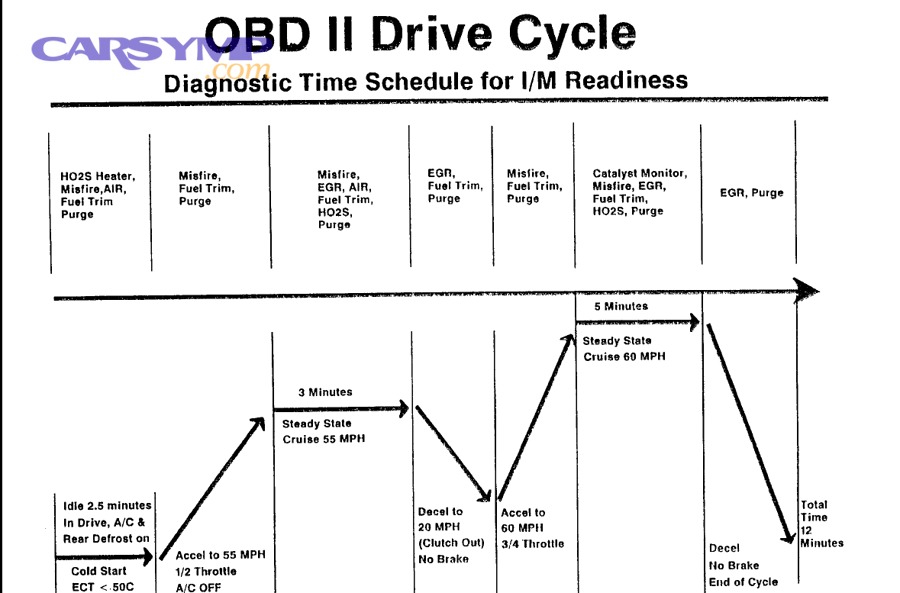
There are 3 safe drive-cycle phases for most vehicles: (1) cold start + idle stabilization, (2) mixed steady-speed cruise, and (3) stop-and-go with several idle periods, based on the criterion of “conditions that commonly enable multiple monitors.”
Specifically, you’re trying to give the ECU clean opportunities to run catalyst, O2, EVAP, and misfire checks without harsh driving.
A practical generic approach (always prioritize your owner’s manual if it provides a specific cycle):
- Cold start (after sitting several hours): idle 1–2 minutes, avoid revving.
- Steady cruise: 10–20 minutes at a consistent highway speed.
- Stop-and-go: 15–25 minutes with at least 4 idle periods (30 seconds each).
- Cool-down / restart: some monitors complete after key-off/key-on transitions.
Ohio’s E-Check guidance notes that a complete check may take several days under normal driving, and provides a mixed highway + stop-and-go pattern as a typical drive cycle example. (ohioecheck.info)
What should you check on a scanner during and after the retest?
You should check (1) pending codes, (2) monitor status changes, (3) fuel trims, and (4) misfire data (if relevant) during and after the retest, because these reveal whether the ECU is failing tests again or simply hasn’t finished testing yet.
Besides, this is how you avoid confusing “Not Ready” with “Fixed.”
During the retest (mid-cycle quick scan):
- Look for pending codes (early warning that the fault is returning)
- Watch misfire counters if you’re chasing a P030x issue
- Check STFT/LTFT: did trims normalize after the repair?
After the retest (full scan):
- Confirm no stored codes
- Confirm no pending codes
- Confirm readiness monitors have progressed toward Ready
If you’re worried about a cylinder misfire returning, pull up your Misfire_attach: coils/plugs/injectors checklist and verify the basics before you assume the ECU is “wrong.”
How long should you wait before declaring the repair successful?
You should wait until (1) the original monitor(s) that triggered the code have run, (2) no pending codes remain after multiple drive cycles, and (3) fuel trims and related live data stay stable—because many faults require repeated failures before a code becomes stored again.
More importantly, “successful” means the ECU had the chance to find the fault and didn’t.
A realistic rule for DIY verification:
- Minimum: 1 full drive cycle + a clean scan (no pending)
- Better: 2–3 mixed trips across different conditions (cold start, cruise, stop-go)
- Best: readiness mostly/fully ready + stable data trend + no pending
Some programs note readiness may take “a few days of normal driving” to complete. (dmv.ny.gov)
How do you confirm the fix without masking an intermittent fault?
You confirm the fix without masking an intermittent fault by using a staged retest (short scan → drive → scan), preserving evidence, and requiring repeated “clean” outcomes across multiple conditions, because intermittent problems often disappear for one trip and return later.
Then, instead of trying to “force” a pass, you’re designing a test that can catch the fault if it’s still there.
What’s the best retest sequence to catch intermittent faults?
There are 4 stages in the best retest sequence to catch intermittent faults: (1) baseline scan and record, (2) controlled conditions that match the freeze-frame, (3) scan for pending codes before you stop driving, and (4) repeat on a second day/cold start, based on the criterion of “repeatability under the same enabling conditions.”
To illustrate, an intermittent EVAP leak might only set after a cold soak and specific fuel level—so a single warm afternoon drive won’t prove anything.
- Baseline scan (key-on): confirm no new codes and note monitor states.
- Match freeze-frame conditions: if the freeze-frame shows 55 mph, moderate load, warm coolant—recreate that safely.
- Mid-drive scan (optional): stop somewhere safe and check pending codes.
- Second-day confirmation: repeat after a cold soak; intermittent faults love cold starts.
How can you use freeze-frame and pending codes to verify the repair?
Freeze-frame and pending codes verify the repair by letting you compare the “failure conditions” to the “post-repair conditions” and detect early recurrence before the MIL fully returns.
However, this only works if you recorded freeze-frame before you cleared.
- If a pending code appears in the same system during your retest, treat it as “the ECU is seeing the fault again,” even if the light is still off.
- If the same code returns under similar freeze-frame conditions, the root cause likely remains (or the repair introduced a new issue like a connector not fully seated).
- If fuel trims normalize and the pending code never appears across repeated conditions, you have stronger confirmation.
What does “readiness complete” actually prove (and what doesn’t it prove)?
Readiness complete proves the vehicle has successfully run its self-tests without detecting a failure significant enough to block completion, but it does not prove every possible intermittent fault is gone forever.
On the other hand, readiness is still one of the strongest practical signals you can get without specialized equipment.
What readiness does prove:
- The ECU ran key emissions tests under qualifying conditions.
- Those tests completed without failing hard enough to stay incomplete.
What readiness doesn’t prove:
- That a rare, temperature-specific, or vibration-related intermittent fault will never reappear.
- That an unrelated system won’t fail next week.
According to a study by the University of California, Riverside from an emissions testing research program, in 2021, diagnostic-guided repairs in inspection and maintenance contexts can deliver substantial emissions reductions, reinforcing the value of verification over simply clearing codes. (sciencedirect.com)
What are the most common mistakes that make codes come back after clearing?
There are 7 common mistakes that make codes come back after clearing: (1) clearing before diagnosing, (2) fixing symptoms not causes, (3) skipping enabling conditions, (4) ignoring pending codes, (5) misreading readiness, (6) using parts-swapping instead of testing, and (7) overlooking related systems and wiring, based on the criterion of “errors that break the repair-verification loop.”
More importantly, these mistakes usually happen when the goal becomes “turn the light off” instead of “prove the system is healthy.”
Why do codes return even after the light stays off for a while?
Codes return after the light stays off because the ECU may need multiple failures across multiple trips to re-store a code, and some monitors only run under specific conditions that you haven’t hit yet.
For example, EVAP leak checks may require a cold soak and a certain fuel level range; catalyst tests may require steady cruise; misfire detection may need load.
What are the most common misdiagnoses after clearing codes?
There are 5 common misdiagnoses after clearing codes: (1) blaming the sensor when the system is at fault, (2) confusing catalyst codes with oxygen sensor failures, (3) treating EVAP as “always a gas cap,” (4) misreading fuel trim codes, and (5) ignoring wiring/connector issues, based on the criterion of “wrong component chosen as root cause.”
Meanwhile, the easiest way to prevent these is to test the system, not the code.
This is where O2 sensor and catalytic converter code pitfalls show up most: a catalyst efficiency code can be triggered by exhaust leaks, misfires, fuel trim problems, or lazy upstream sensors—not only a “bad cat.”
What should you do if codes return during the retest?
Yes—you should stop and reassess if codes return during the retest, for at least three reasons: (1) continuing to drive may add confusing new data, (2) a returning pending/stored code is evidence you haven’t solved the root cause, and (3) you can often narrow it down faster by reproducing conditions and testing right away.
In addition, you can convert that “bad news” into a clean next step.
- Record everything again (stored + pending + freeze-frame + monitor status).
- Compare to pre-repair data: same conditions? same code family? new companion codes?
- Run targeted tests based on code type:
- Misfire: plug/coil swap test, injector balance (if available), compression/leak-down (if needed)
- Fuel trim: smoke test for vacuum leaks, MAF sanity check, fuel pressure test
- EVAP: inspect purge/vent lines, check cap seal, look for cracked hoses
- If it’s outside your tooling, schedule a professional diagnosis—but bring your recorded data so you’re not paying to repeat basics.
At this point, you’ve reached the contextual border: you already know when to clear and how to retest; what follows expands into edge cases that change strategy (inspection rules, permanent codes, and EVAP-specific enabling conditions).
How do readiness monitors, permanent codes, and EVAP conditions change your retest strategy?
They change your strategy by adding timing and condition constraints—readiness may take days, permanent codes may not clear immediately, and EVAP often won’t run unless fuel level and temperature criteria are met.

Next, you’ll get faster results when you plan retesting around these constraints instead of fighting them.
What are “permanent codes,” and can you clear them?
Permanent codes are emissions-related DTCs that remain stored until the ECU verifies the system passes its self-tests, and you generally cannot clear them with a scan tool the way you clear normal stored codes.
More specifically, permanent codes exist to prevent “clear-and-pass” behavior; the car must demonstrate it’s actually fixed through monitored operation.
California’s OBD readiness guidance emphasizes that after a reset/clearing, it takes time and operation to return to a fully ready state and determine the presence/absence of DTCs. (ww2.arb.ca.gov)
How do EVAP monitor enabling conditions affect your retest timing?
EVAP enabling conditions affect timing because the EVAP monitor typically requires specific fuel level, ambient temperature range, and drive patterns, and it may not run on demand during a short test drive.
For example, if your fuel tank is nearly full (or nearly empty), some vehicles delay EVAP testing entirely.
Practical EVAP retest tips:
- Keep fuel level roughly between 1/4 and 3/4 unless your service info says otherwise
- Include a cold soak (park overnight)
- Use mixed driving (steady cruise + stop-and-go)
- Avoid clearing repeatedly—each reset can push EVAP completion farther out
How should you plan for an emissions inspection after clearing codes?
Plan using a monitor-first checklist: confirm your region’s readiness allowance, complete drive cycles until monitors are ready, then scan for pending codes before you show up.
Meanwhile, if you clear codes right before inspection, you’re likely to fail for “Not Ready” even if the repair is real—because the ECU hasn’t finished proving it.
Some inspection guidance explains that readiness monitors indicate whether required tests have completed, and normal driving may be needed to reset them after clearing. (dmv.ny.gov)