


If you’re trying to figure out what a shop is actually doing when it “runs diagnostics”—and why it costs money—this guide breaks down the shop diagnostic process step by step, what you receive for that fee, and how to judge whether the diagnosis was thorough and fair.
You’ll also learn how the diagnostic fee vs repair cost relationship works in real life, including why many shops charge for diagnosis even if you don’t approve the repair, and how some shops credit that fee back once the fix begins.
Next, we’ll compare dealership vs independent shop diagnostics so you can pick the right place for your situation—especially when the problem is intermittent, software-related, or tied to modern electronics.
Introduce a new idea: once you understand the standard process and pricing logic, you can prevent “paying twice” by asking the right questions and setting clear approval checkpoints before deeper testing starts.
What is the shop diagnostic process (and what does “diagnostic fee” mean)?
A shop diagnostic process is a structured, evidence-based workflow technicians use to identify the root cause of a vehicle problem, and a diagnostic fee is the labor charge for the time, tools, and expertise required to reach that conclusion—separate from the repair itself.
More specifically, the diagnostic fee exists because modern problems often require testing, not guessing, and testing takes skilled time and specialized equipment.
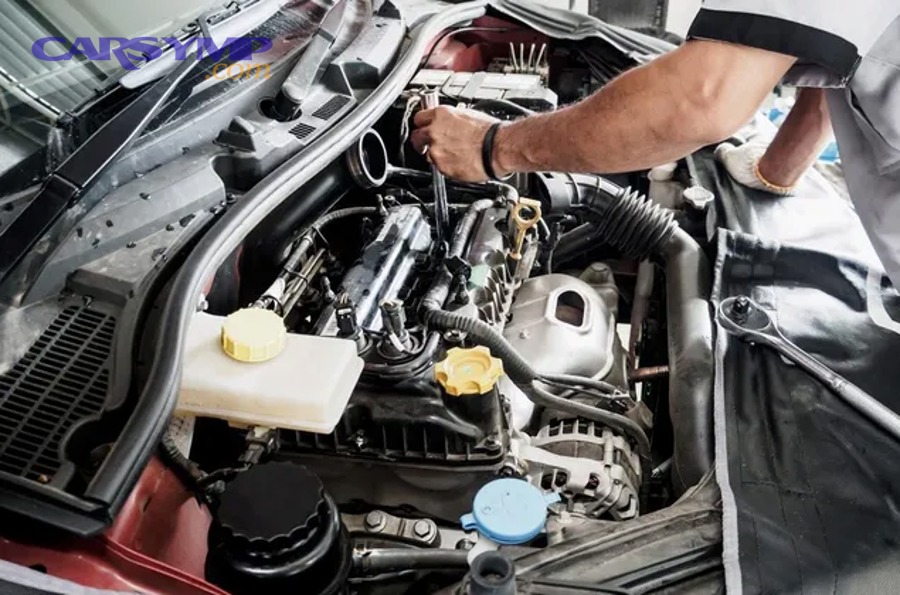
Many drivers assume diagnosis is “plugging in a scanner.” In reality, most professional diagnosis includes:
- Clarifying the symptom (what you felt, heard, smelled, or saw)
- Scanning modules and reading data (not just codes—also live data, freeze-frame, readiness)
- Inspecting likely causes (wiring, vacuum leaks, fluid condition, connectors, mechanical basics)
- Running pinpoint tests (smoke test, fuel pressure, compression/leak-down, scope checks, network checks)
- Documenting results (what was tested, what passed/failed, what evidence supports the conclusion)
A good diagnostic fee pays for a conclusion you can act on: what failed, why it failed, and what the fix should be—not a parts dartboard.
Is reading an OBD2 code the same as a full diagnosis?
No—reading an OBD2 code is not the same as a full diagnosis because (1) a code identifies a system or condition, not a guaranteed failed part, (2) multiple root causes can trigger the same code, and (3) codes can be secondary effects of another problem upstream.
However, the confusion is understandable because a code readout feels like an answer—until it’s wrong.
Here’s the practical distinction:
- Code read = clue: “The system saw something out of range.”
- Diagnosis = proof: “This component or circuit failed, confirmed by tests, and this repair addresses the cause.”
A classic example is when someone tries to diagnose check engine light issues by replacing the part named in a generic code description. That can work—sometimes. But it can also waste money if the real issue is wiring resistance, vacuum leaks, exhaust leaks, or sensor contamination.
A university-level perspective helps explain why “codes aren’t certainty.” In a master’s thesis from Chalmers University of Technology, the author notes many end-user products produce generic fault info that can be hard for users to act on without context and testing. (publications.lib.chalmers.se)
What happens step-by-step during a typical diagnostic appointment?
There are 7 main stages of a typical shop diagnostic process: intake, verification, scan/data review, baseline inspection, test plan, pinpoint testing, and results/estimate—based on the criterion “moving from symptom to verified root cause.”
To better understand what you’re paying for, here’s what each stage usually includes.
- Intake and symptom interview
- When it started, whether it’s intermittent, what conditions trigger it (cold start, rain, highway, idle)
- Recent repairs or battery replacement
- Any drivability changes (stall, hesitation, poor MPG)
- Verification (if possible)
- Technician attempts to reproduce the symptom
- Short road test or idle observation
- Scan and data review
- Reading codes from multiple modules (engine, transmission, ABS, body, etc.)
- Reviewing freeze-frame data and readiness monitors
- Checking technical service info if relevant
- Baseline inspection
- Visual checks: loose connectors, cracked hoses, obvious leaks, damage
- Quick mechanical checks where appropriate (fluids, belt, battery voltage)
- Test plan
- Technician chooses the most likely root-cause path based on evidence
- This is where “experience” matters most: good techs prioritize tests that confirm or eliminate causes quickly
- Pinpoint testing
- Examples: smoke test for EVAP/vacuum leaks, fuel pressure test, voltage drop tests, lab scope waveform checks
- Results + estimate
- Clear explanation of findings and recommended repair options
- Quote or estimate, plus risk/next steps if the fault is intermittent
One image-worthy concept here is that diagnosis is more like a funnel: broad scan → targeted tests → specific proof. That funnel mindset is also why “Common codes by symptom mapping” can help—when used correctly. You map symptoms + conditions + data to narrow the code list before you test.
How much does a shop diagnostic typically cost, and what affects the price?
Diagnostic costs typically reflect diagnostic time × shop labor rate, with pricing commonly ranging from a short “initial diagnostic fee” to multi-hour testing for complex issues—because deeper root-cause confirmation takes longer than a quick scan and inspection.
Next, let’s break down what drives the price so you can predict it before you approve anything.

What are the most common pricing models for diagnostics?
There are 4 main pricing models for diagnostics: (A) flat diagnostic fee, (B) time-based diagnostic labor, (C) tiered diagnostics, and (D) hybrid “scan fee + testing approval,” based on the criterion “how diagnostic time is packaged and authorized.”
For example, your shop might advertise one fee but apply a different model if the problem becomes intermittent or electrical.
- A) Flat diagnostic fee (fixed price)
- Often covers a set amount of time (e.g., “up to 1 hour”) even if not stated
- Works well for common, repeatable problems
- Risk: if the issue is complex, the shop may ask to convert to hourly diagnosis
- B) Time-based diagnostic labor (hourly)
- You pay for the actual time spent testing
- Usually most fair for complex electrical or intermittent issues
- Best when the shop communicates approval checkpoints clearly
- C) Tiered diagnostics (Level 1 / Level 2 / Level 3)
- Level 1: initial scan + basic tests
- Level 2: deeper testing (smoke test, fuel pressure, circuit tests)
- Level 3: advanced diagnostics (scope, network testing, long road test/data logging)
- This model can reduce surprise costs when explained up front
- D) Hybrid: scan fee + additional authorization
- Small fee for scan + initial inspection
- Technician then calls with findings and requests approval for deeper testing
A key consumer protection move is to ask: “How much time does this fee include, and what happens if you need more time?” If they can’t answer, you’re walking into an open-ended situation.
Which factors make diagnostic costs go up or down?
There are 8 main factors that push diagnostic costs up or down: symptom repeatability, number of systems involved, vehicle complexity, access difficulty, required tools/software, test duration, prior modifications, and rust/age-related complications—based on the criterion “how quickly tests can confirm a root cause.”
More importantly, these factors predict whether you’ll need a quick check or a staged diagnostic plan.
Costs tend to be lower when:
- The symptom is repeatable on demand (e.g., consistent misfire on one cylinder)
- Codes and data point to a narrow set of likely causes
- The vehicle has good access (not buried under intake manifolds or rusted shields)
Costs tend to be higher when:
- The issue is intermittent (“only happens once a week”)
- Multiple modules show faults (possible network/voltage issues)
- The vehicle requires OEM-level software access or programming
- Diagnosis requires long road testing or data logging
- Prior modifications complicate baselines (aftermarket wiring, remote start, non-OEM sensors)
This is also where Common codes by symptom mapping becomes useful in a professional way. A skilled technician doesn’t treat codes as answers; they treat them as a ranked hypothesis list, then uses tests to validate the top hypotheses.
A research-based example of why hypotheses and validation matter appears in a thesis tied to Scania, which notes incorrect or misleading diagnostic trouble codes can lead to extra workshop work and potentially wasteful replacements “just in case.” (diva-portal.org)
Diagnostic fee vs repair cost: what are you paying for, exactly?
Diagnostic fee vs repair cost works like this: the diagnostic fee buys verified information and a repair plan, while the repair cost buys the labor and parts to execute that plan—so a good diagnosis can be valuable even before anything is replaced.
However, the confusion usually comes from one moment: when a driver hears “we found the issue” and assumes that includes fixing it.

Here’s the clearest way to separate the two:
- Diagnosis deliverables
- What failed and why (root cause)
- Evidence (test results, readings, confirmed leaks, confirmed signal issues)
- Recommended fixes (often with options)
- Risk notes (what happens if you delay, what could be related)
- Repair deliverables
- Parts replacement/repair work
- Calibration/programming if needed
- Verification (road test, monitor completion, re-check)
- Warranty on parts/labor (varies by shop)
In good shops, the diagnostic fee prevents the expensive mistake of “replace part A, then part B, then part C.”
Should the diagnostic fee be credited toward the repair bill?
Yes—often the diagnostic fee should be credited toward the repair cost, because (1) the diagnosis is part of the repair workflow, (2) it reduces total customer risk when the shop stands behind the conclusion, and (3) it builds trust by aligning incentives toward accurate testing rather than repeated visits.
Meanwhile, some shops don’t credit it—and that can still be legitimate if they spent real test time and you choose not to proceed.
Here’s how to interpret common policies:
- Full credit: diagnostic fee becomes part of the repair labor when you approve the job
- Partial credit: credit up to a capped amount
- No credit: separate line item; you pay for the diagnosis regardless
The key is transparency. Ask this word-for-word before work begins:
- “Is your diagnostic fee applied to the repair if I proceed?”
- “How much time does the diagnostic fee include?”
- “If you need more time, will you call me before continuing?”
If they say “we’ll let you know,” follow up: “Will you stop work until you get approval?” That sentence prevents runaway diagnostic time.
What should a diagnostic invoice include so you can verify value?
A diagnostic invoice should include at least 7 elements: the customer concern, codes (if any), data observations, tests performed, test results, conclusion (root cause), and recommended next steps—based on the criterion “can another qualified person follow the evidence trail?”
To illustrate what “good documentation” looks like, here’s a practical checklist.
Minimum documentation checklist
- Customer complaint: “stall at idle when warm,” not just “check engine light”
- DTCs pulled (module + code) and whether they are current/history/pending
- Freeze-frame or key sensor readings that support the hypothesis
- Tests performed: smoke test, fuel pressure, voltage drop, scope check, etc.
- Results: pass/fail with numbers when possible
- Conclusion: what failed and why it’s the root cause
- Estimate: parts/labor and any contingencies
A smart consumer move is to request the shop’s “findings summary” if the invoice is vague. If a diagnosis is real, it can be summarized clearly.
Dealership vs independent shop: which is better for diagnostics?
Dealership vs independent shop diagnostics is best decided by fit: dealerships often win for brand-specific software/programming and warranty workflows, independent shops often win for cost efficiency and flexibility on common drivability problems, and specialty shops can be optimal for certain electrical or performance issues.
Next, we’ll compare them using criteria that actually affect outcomes.

Is the dealership always more expensive (and is it always more accurate)?
No—the dealership is not always more expensive, and it is not always more accurate, because (1) pricing depends on the job and whether diagnosis is covered by warranty/recall, (2) accuracy depends on technician skill and time allowed, not the sign on the building, and (3) some independents have OEM-level tools while some dealers triage heavily due to volume.
However, dealerships often have advantages for certain module/software tasks.
Where dealerships often shine:
- OEM scan tools and guided test procedures
- Programming, calibration, module replacement workflows
- Access to brand-specific service bulletins and firmware updates
- Warranty/recall coverage that can reduce your out-of-pocket cost
Where independents often shine:
- Lower posted labor rates in many markets
- More flexible time allocation for tricky issues
- Personalized communication with the technician
- Strong diagnostics for common systems (brakes, misfires, fuel/air, cooling, EVAP)
If your issue is a “simple” mechanical fault, the independent shop may be the best value. If it’s a module communication fault or programming requirement, a dealership may reduce risk.
What kinds of problems are a better fit for an independent shop vs a dealership?
There are 6 common problem categories that tend to fit one side better: routine drivability, mechanical noise/feel, EVAP leaks, advanced electronics/programming, warranty/recall issues, and model-specific known issues—based on the criterion “how dependent the diagnosis is on OEM systems and proprietary procedures.”
To better understand, here’s a practical fit map.
Independent shop is often a great fit for:
- Misfires, rough idle, fuel/air problems
- Cooling system faults, overheating, leaks
- Brake noise/vibration and suspension concerns
- EVAP leak diagnostics (especially with smoke testing)
- General “diagnose check engine light” scenarios when symptoms are repeatable
Dealership is often a great fit for:
- Module programming and immobilizer/key issues
- Brand-specific hybrid/EV system faults (model-dependent)
- Warranty/recall-related faults where cost coverage is likely
- Complex network communication issues that require OEM guided diagnostics
A useful technical note from University of Huddersfield discusses how in-vehicle bus networks and protocols shape diagnostic approaches and tooling, which helps explain why some problems demand specialized equipment and procedures. (eprints.hud.ac.uk)
How do you avoid paying twice and still get a correct diagnosis?
Yes—you can avoid paying twice and still get a correct diagnosis by (1) documenting symptoms precisely so the shop can reproduce the fault, (2) setting written approval limits for diagnostic time, and (3) requiring evidence-based findings before authorizing parts—three habits that reduce misdiagnosis and repeat visits.
Besides, the goal isn’t to “avoid diagnosis”; it’s to ensure your diagnosis produces a decision you trust.

What questions should you ask before authorizing diagnostics?
There are 10 questions you should ask before authorizing diagnostics: fee amount, time included, escalation policy, deliverables, credit policy, communication timing, test methods, parts approval, documentation, and retest plan—based on the criterion “does the shop control cost and prove conclusions?”
For example, these questions turn an uncertain process into a managed process.
The 10 questions
- What is the diagnostic fee and how much time does it include?
- Do you charge hourly after that, or do you use tiers?
- Will you call me before any additional diagnostic time?
- What deliverables will I receive (findings summary, readings, photos)?
- Is the diagnostic fee credited toward repair labor if I proceed?
- Will you road test the vehicle if needed?
- Will you test before replacing parts (pinpoint testing)?
- If the problem is intermittent, what is your plan (data logging, follow-up)?
- Will you document “pass/fail” results for major tests?
- What is the retest plan after repair, including readiness monitors?
This is also the right place to ask When to clear codes and retest. A careful rule is: clear codes only after you’ve captured data (codes + freeze-frame) and after the repair is completed, so you can confirm the fix with a controlled drive cycle rather than erasing clues early.
A quick table to reduce miscommunication
The table below shows how symptom clarity changes diagnostic speed and cost risk.
| What you say | What the tech hears | Diagnostic risk |
|---|---|---|
| “Check engine light is on” | Unknown condition | High (needs broad triage) |
| “Light came on after fueling; slight fuel smell” | Possible EVAP leak | Medium (targeted tests) |
| “Stalls at idle when warm; restarts after 5 minutes” | Heat-related failure pattern | Medium–High (may be intermittent) |
| “Misfire under load at 2,500–3,000 RPM; code P0302” | Repeatable load misfire | Lower (pinpoint tests likely fast) |
If you want a shortcut, you can help the shop by doing “Common codes by symptom mapping” at home (without guessing parts): write down symptom + conditions + any code. That gives the technician a prioritized starting point.
When is it smart to get a second opinion—and when is it just delaying the fix?
A second opinion is best for high-cost repairs and weak evidence, while proceeding is best when evidence is clear: a second opinion wins for expensive uncertainty, proceeding wins for repeatable proof, and delaying is worst when safety is at stake.
Meanwhile, you can make the decision rational by applying three criteria: evidence strength, consequence of delay, and diagnostic transparency.
Get a second opinion when:
- The shop cannot explain the test results, only the parts list
- The proposed repair is expensive and the fault wasn’t reproduced
- The diagnosis changes repeatedly without new evidence
- The shop won’t provide a written findings summary
Proceed without delay when:
- The symptom is repeatable and tests confirm the root cause
- Safety systems are involved (brakes, steering, severe misfire risk to the catalyst)
- The shop shows clear pass/fail results and explains why that points to the failure
A practical “don’t pay twice” tactic is to ask whether your diagnostic findings can be used elsewhere (printout, readings, photos). You’re paying for information—make sure it’s portable.
What makes some diagnostics unusually difficult (and more expensive) compared to straightforward cases?
Some diagnostics become unusually difficult and expensive when the fault is intermittent, system-to-system, or network/electrical in nature, because confirming a root cause requires extended testing, data capture, and specialized tools rather than a quick scan and inspection.
Especially with modern vehicles, the hard part is often proving the failure under the right conditions—not just seeing a code.

What is “tiered diagnostics,” and how does it reduce surprise costs?
Tiered diagnostics is a staged pricing method where the shop performs diagnosis in levels (Level 1/2/3), with each level adding time and test depth, so you approve cost increases before the shop continues.
Then, instead of one open-ended charge, you get checkpoints that control budget.
- Level 1: scan + baseline inspection + quick verification tests
- Level 2: targeted system testing (smoke test, fuel pressure, circuit voltage drop)
- Level 3: advanced diagnostics (scope waveforms, network checks, long drive/data logging)
This model reduces surprise costs because it forces communication. If your shop uses tiers, ask what tests are included at each level and what “success” looks like at each stage.
Why do intermittent problems (random misfires, sporadic stalls) cost more to diagnose?
Intermittent problems cost more because the shop must capture evidence while the fault is happening, which often requires longer road tests, data logging, repeated attempts to reproduce the symptom, and a plan to eliminate variables one by one.
For example, a stall that happens only after 30 minutes of driving can’t be proven in a 10-minute bay check.
What good shops do for intermittent faults:
- Create a reproduction plan (conditions, temperature, load, road type)
- Use data logging to capture the moment the fault occurs
- Check power/ground integrity under load (not just at rest)
- Inspect connectors for micro-movement faults and heat-related opens
- Provide “next step” options if the fault doesn’t occur during the visit
This is also why documentation matters. If the shop can’t reproduce the issue, they should still explain what they tested and what that eliminates.
When do shops need advanced tools like a lab scope or network testing—and why does that matter?
Shops need advanced tools like a lab scope or network testing when the fault involves electrical signals, timing, communication errors, or sensor waveforms—because those issues cannot be confirmed reliably with a basic code reader alone.
On the other hand, a basic scanner can miss problems like noisy crank signals, intermittent voltage drops, or CAN communication disruptions.
Advanced tool examples (and what they prove):
- Lab scope: confirms sensor waveform integrity (crank/cam, throttle, injectors)
- Network testing (CAN/LIN): identifies communication errors, bus loading, module dropouts
- Current ramp tests: evaluates motor/pump health without disassembly
- Thermal methods: heat/cool testing to trigger heat-related failures
One technical example of how diagnostics can move beyond basic scanning appears in research on automotive diagnostic approaches and bus-network behavior (see the thesis from University of Huddersfield). (eprints.hud.ac.uk)
How can you tell the difference between a cautious diagnostic plan and unnecessary upselling?
A cautious diagnostic plan is defined by test-based checkpoints and documented evidence, while upselling is defined by vague recommendations, repeated part suggestions without proof, and refusal to explain results—because real diagnosis produces traceable reasoning.
In addition, the communication style tells you a lot: real diagnosis sounds specific.
Green flags (cautious, professional)
- “We confirmed X failed because test Y showed Z.”
- “Here are the readings/photos and why they matter.”
- “If we proceed, the next test costs N and will confirm/eliminate these causes.”
- “We’ll stop and call you before additional diagnostic time.”
Red flags (upsell risk)
- “It needs a sensor” with no test results
- “We’ll try this first” repeatedly
- No documentation of pass/fail tests
- Pressure to approve repairs without a clear root-cause explanation
If you want a single best practice: always ask what test would prove the proposed repair is necessary. If they can’t name one, the plan is not anchored in evidence.
According to a study by Abubakar Tafawa Balewa University from the Department of Vocational and Technology Education, in 2024, surveyed service technicians rated core diagnostic skills as “highly needed,” with a grand mean around 3.75 for fault detection skills—supporting the idea that diagnosis is a specialized labor task, not a free add-on. (cambridgeresearchpub.com)