


If you’re seeing drivability issues and wondering whether the EGR system is to blame, the fastest way forward is to match symptoms + operating conditions + codes—not guess parts. EGR failure symptoms often show up as rough running, hesitation, pinging, poor fuel economy, higher emissions, or a check engine light, but the exact “feel” depends on whether the valve is stuck open, stuck closed, carbon-clogged, or the control circuit is failing.
To narrow it down, start with what EGR does and when it’s commanded on. Once you understand that EGR flow is typically higher at light-to-mid load (not wide-open throttle), you can connect the dots between when symptoms happen and what the EGR system is doing.
Next, you’ll want to separate EGR-related symptoms from look-alikes like vacuum leaks, ignition misfires, dirty throttle bodies, or faulty oxygen sensors. Similar complaints can come from different root causes, so comparing symptom patterns is a key step before buying parts.
Introduce a new idea: below is a structured, intent-driven guide that helps you identify EGR failure symptoms, interpret common codes, and decide whether cleaning, testing, or EGR repair makes sense.
What does the EGR system do, and why do engines use it?
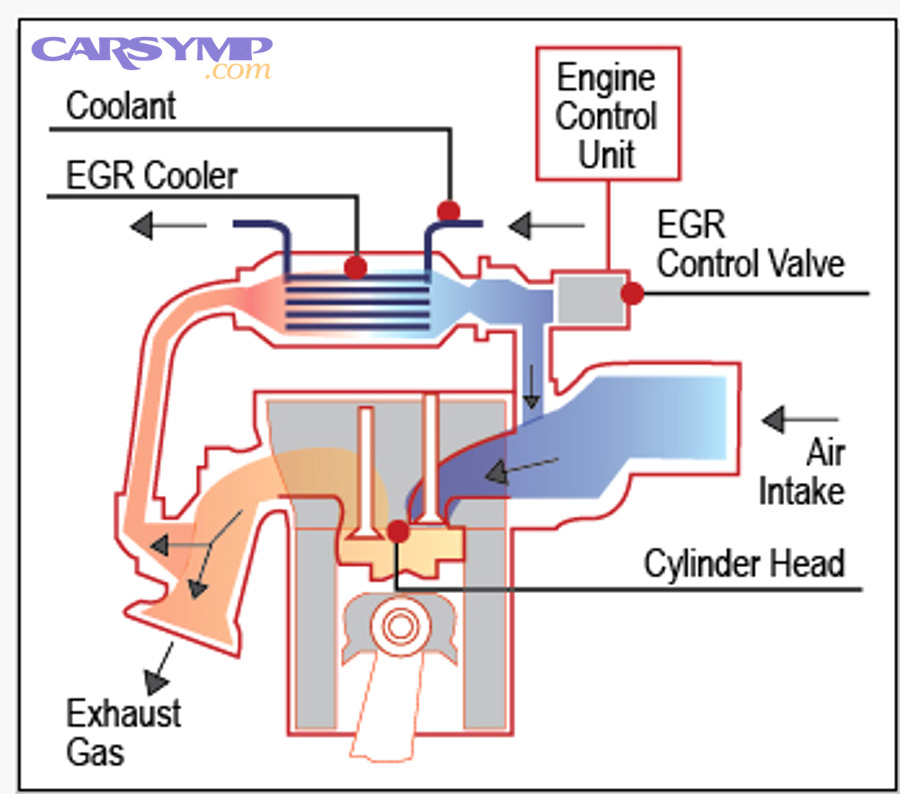
The EGR (Exhaust Gas Recirculation) system is an emissions-control system that routes a measured amount of exhaust gas back into the intake to lower combustion temperatures and reduce NOx formation, especially during cruising and light acceleration.
Specifically, the EGR system works because inert exhaust gas displaces some oxygen in the intake charge and slows combustion, which lowers peak flame temperature—the main condition that encourages NOx formation. That’s why most engines do not run heavy EGR at idle or wide-open throttle; they typically use it most during steady driving where NOx would otherwise climb.
How EGR operation connects directly to “symptoms”
When EGR flow is wrong, drivability can change in predictable ways:
- Too much EGR at the wrong time (often stuck open) can dilute the mixture when the engine needs stable combustion (idle/low RPM), leading to roughness or stalling.
- Too little EGR when it should be flowing (often stuck closed or clogged) can raise combustion temperature under cruise/load, contributing to spark knock/pinging and higher NOx, and it may trigger a check engine light because the ECU doesn’t see expected flow changes.
According to a study by Tongji University from the School of Automotive Studies, in 2022, increasing EGR valve opening increased NOx reduction significantly (with measured average NOx reduction rates rising as valve opening increased, and diminishing returns beyond certain openings).
What are the most common EGR failure symptoms?
There are 7 core EGR failure symptoms—rough idle, stalling, hesitation, pinging/knock, reduced fuel economy, emissions test failure, and a check engine light—most commonly caused by carbon buildup, a failing valve actuator, vacuum/control issues, or sensor/circuit faults.
More specifically, the symptoms differ depending on whether you’re dealing with a bad EGR valve that’s stuck open, stuck closed, intermittently sticking, or an EGR system that’s clogged and cannot flow enough gas.

Symptom cluster A: Rough idle, stumble, and “Rough idle and stalling related to EGR”
A valve that is stuck open (or opening too far at idle) often creates the most noticeable drivability problem:
- Rough idle that feels like the engine can’t stabilize RPM
- Stumble on tip-in (light throttle from a stop)
- Stalling when coming to a stop or idling in gear (automatic transmissions)
Why it happens: at idle, the engine needs a relatively clean, predictable air charge. Introducing exhaust gas at that moment can make combustion unstable—especially on engines that are already sensitive due to deposits, weak ignition components, or small vacuum leaks.
A practical clue: If the engine runs better when you temporarily block EGR flow (only as a short diagnostic step, not a permanent “fix”), EGR over-flow becomes more likely.
Symptom cluster B: Pinging/knock, hotter running feel, and power loss under load
A valve stuck closed or a system clogged enough to act like it’s closed tends to show up differently:
- Pinging/spark knock during cruising or light acceleration (gas engines)
- Surging at steady speed
- Loss of power that feels worse in midrange
- Possible higher coolant/oil temperatures in some cases due to higher combustion temps
Why it happens: EGR’s job is often most important during those light-to-mid load conditions where NOx would spike. Without correct EGR flow, combustion temperature rises, and the ECU may pull timing to protect the engine, reducing efficiency and power.
Symptom cluster C: Fuel economy drop and “doesn’t feel right” driving
When EGR isn’t working as expected, you might notice:
- Reduced MPG (especially highway MPG)
- Throttle response changes (lazy or inconsistent)
- Intermittent behavior that comes and goes with heat soak and carbon sticking
This is the category where people frequently replace the wrong part because many issues (MAF contamination, vacuum leaks, misfires, low fuel pressure) can create similar “off” behavior.
Symptom cluster D: Check engine light and readiness/emissions issues
Even when drivability feels only slightly off, the ECU may flag EGR performance faults:
- Check engine light with EGR-related DTCs
- Failed emissions test due to NOx or readiness monitors not completing
- In some vehicles, a reduced-power strategy (varies by manufacturer)
EGR failure symptoms vs. other problems: how can you tell the difference?
EGR failure symptoms are most likely when problems appear at idle/low RPM (stuck open) or at steady cruise/light acceleration (stuck closed/clogged), while vacuum leaks and ignition misfires often show stronger symptoms across a wider range of conditions.
To better understand, use a simple comparison framework: When does it happen? What changes it? What does the ECU report? This avoids the common trap of treating “rough idle” as a single diagnosis.

A quick symptom-pattern comparison table
The table below summarizes common look-alikes and the clues that separate them from EGR-related faults.
| Symptom pattern | More consistent with EGR stuck open | More consistent with EGR stuck closed/clogged | Common look-alikes |
|---|---|---|---|
| Rough idle that improves off-idle | Yes | Sometimes | Vacuum leak, misfire, dirty throttle body |
| Stalling when coming to a stop | Yes | Less common | Idle air control issues, torque converter, vacuum leaks |
| Pinging at cruise/light load | Less common | Yes | Low-octane fuel, overheating, timing issues |
| Hesitation/surge at steady speed | Possible | Yes | MAF/MAP issues, fuel delivery, ignition |
| CEL with EGR performance code | Yes | Yes | Sensor wiring faults can mimic flow problems |
Three “separator” tests that don’t require guessing parts
- Condition test (idle vs cruise):
If the problem is strongest at idle and low-speed maneuvers, suspect over-flow (stuck open). If it’s strongest at cruise/light acceleration, suspect under-flow (stuck closed/clogged). - Fuel trim context (scan tool):
Incorrect EGR can skew fuel trims indirectly. But big positive trims at idle often point to vacuum leak more than EGR, while misfires often show as misfire counters incrementing by cylinder. - Commanded vs actual behavior:
Many cars can show EGR command/position and related sensor responses. If the ECU commands EGR but sees no expected change, under-flow/clogging is likely. If EGR position seems abnormal at idle, over-flow is likely.
According to a study by Colorado State University from Mechanical Engineering, in 2019, applying EGR in a controlled engine test expanded the knock limit while reducing NOx and, under optimized conditions, improved efficiency (reported gains up to about 4.5% through increased compression ratio and power density).
What are the most common EGR codes and what do they mean?
There are several Common EGR codes—most often in the P0400–P0409 family—that indicate either insufficient flow, excessive flow, or an electrical/control fault in the EGR circuit.
Next, treat the code as a directional clue, not a parts shopping list. A code tells you what the ECU observed, not always what failed.

The most common EGR-related DTCs (what they usually point to)
- P0400 (EGR Flow Malfunction): General EGR flow fault; could be clogged passages, valve issue, vacuum/control issue, or sensor feedback mismatch.
- P0401 (Insufficient EGR Flow): Often clogged EGR ports/passages, stuck-closed valve, bad vacuum supply/solenoid, or incorrect sensor feedback.
- P0402 (Excessive EGR Flow): Often valve stuck open, carbon preventing full closure, or incorrect control causing too much flow at the wrong time.
- P0403 (EGR Control Circuit): Electrical fault—wiring, connector, solenoid, or driver issue.
- P0404 (EGR Range/Performance): Position/feedback mismatch; could be sticking valve, carbon, or sensor/actuator issue.
- P0405/P0406 (EGR Position Sensor Low/High): Sensor circuit issues, reference voltage problems, wiring faults, or failed position sensor.
- P0409 (EGR Sensor “A” Circuit): Electrical circuit fault; depends on manufacturer naming.
Why codes and symptoms must be used together
- P0401 + pinging at cruise strongly supports insufficient flow.
- P0402 + rough idle/stalling strongly supports excessive flow at idle.
- Circuit codes (P0403, P0405, P0406) mean you should inspect wiring/connectors and command tests before pulling the valve.
One practical note about “intermittent” EGR codes
A sticking valve can behave like two different failures on different drives: it may stick open one day (rough idle) and stick closed the next (pinging at cruise). That’s why freeze-frame data (RPM, load, temp) matters.
How do you diagnose a bad EGR valve at home and at a shop?
A reliable EGR diagnosis combines 5 steps—confirm the symptom conditions, read codes and freeze-frame, check for vacuum/electrical integrity, verify commanded response with a scan tool, and inspect for carbon blockage—to pinpoint whether the valve, passages, or controls are failing.

Then, follow a process that reduces risk: start with non-invasive checks and only move to removal/cleaning once you’ve gathered enough evidence.
Step 1: Confirm the “when” of the symptom
Write down:
- Does it happen only at idle, only at cruise, or both?
- Does it worsen when hot?
- Does it improve after a restart?
This matters because EGR is not commanded the same way across all operating conditions.
Step 2: Read codes + freeze-frame data
Use a scan tool to capture:
- DTCs (including pending codes)
- Freeze-frame (RPM, load, coolant temp, vehicle speed)
- Fuel trims (STFT/LTFT)
- Misfire counters (if available)
If you see a misfire code set, don’t assume EGR is the root cause—misfire can be the primary fault or a secondary effect.
Step 3: Check basics (vacuum and wiring)
Depending on your system type:
Vacuum-actuated EGR (older designs):
- Inspect vacuum lines for cracks, disconnections, melted sections
- Confirm the control solenoid receives and switches vacuum
- Test the diaphragm with a hand vacuum pump (if applicable)
Electronic EGR (common on newer cars):
- Check connector condition (oil intrusion, corrosion, pin fit)
- Look for harness rub-through near hot components
- Verify reference voltage/ground integrity where appropriate
Step 4: Verify response (the “does EGR flow change anything?” test)
With a capable scan tool (or at a shop):
- Command EGR open under safe conditions (some vehicles allow this in service mode)
- Watch for expected changes (idle quality change, sensor feedback change)
No change when commanded can mean blocked passages or a non-functioning valve/actuator. A huge negative reaction at idle can mean the valve is flowing too much or the engine is sensitive to EGR at idle (often because it shouldn’t be commanded there).
Step 5: Inspect for carbon restriction (the most common physical cause)
Carbon buildup often:
- Prevents the valve from sealing
- Narrows EGR passages
- Clogs the intake ports where EGR gas enters
Removing and inspecting the valve and ports can be diagnostic and corrective—if done carefully. Use manufacturer-recommended cleaning methods and avoid pushing debris deeper into the intake.
A helpful video walkthrough (optional)
According to a study by Colorado State University from Mechanical Engineering, in 2019, the researchers reported an optimal EGR range in their test setup (with beneficial gains around the high teens to low 20% range, and performance degrading at higher rates due to instability/misfire behavior in their controlled conditions).
What does EGR repair involve, and what does it usually cost?
EGR repair typically involves 3 categories—cleaning carbon buildup, replacing the EGR valve or control components, and restoring proper flow through clogged passages—with total cost depending on engine layout, labor access, and whether sensors/coolers are also involved.

Moreover, the “right” repair depends on what actually failed. A clogged passage and a failed actuator can trigger similar codes, but the fix and cost are different.
Category 1: Cleaning and restoring flow (often the best first step)
This is common when:
- You have P0401 (insufficient flow)
- The valve moves but flow seems weak
- Visual inspection shows heavy deposits
Cleaning may include:
- EGR valve cleaning (if design allows)
- Intake/EGR port cleaning
- Throttle body cleaning (when appropriate, because airflow control affects idle stability)
Risk note: if carbon chunks break loose, they can cause new issues. That’s why careful technique matters.
Category 2: Component replacement (valve, solenoid, sensors, wiring)
Replacement is more likely when:
- You have circuit codes (P0403, P0405, P0406)
- The valve position feedback is erratic
- The actuator motor is dead or the pintle is stuck mechanically
In practical terms:
- EGR valve replacement cost varies widely by vehicle.
- Control solenoids (on vacuum systems) are often cheaper but still require correct diagnosis.
- Wiring repairs can be inexpensive in parts but time-consuming in labor.
Category 3: Cooler-related repairs (more common on many diesel applications)
Some engines use an EGR cooler. When that fails, symptoms can expand beyond drivability:
- Coolant loss (sometimes without visible external leaks)
- White smoke/steam in exhaust
- Overheating or temperature instability
- Contamination risks (depending on failure mode)
If you suspect a cooler issue, treat it as higher urgency than a simple flow code.
What “good” EGR repair looks like (quality checklist)
After EGR repair, you want:
- No returning codes after a complete drive cycle
- Stable idle (if that was your symptom)
- Normal fuel trims and no misfire counts
- Successful readiness monitors for emissions testing
Can you drive with a bad EGR valve, or should you stop driving?
Yes, you can sometimes drive short-term with EGR failure symptoms, but you should minimize driving because a bad EGR can (1) cause stalling or dangerous hesitation, (2) increase combustion temperatures and knock risk, and (3) lead to catalytic converter or emissions-system damage over time.
Especially, the risk level depends on the failure mode:
If the EGR valve is stuck open (higher immediate drivability risk)
- Stalling at intersections can be a safety issue.
- Severe roughness can cause misfires, which can overheat and damage the catalytic converter.
- If the car dies repeatedly at idle, it’s often smarter to stop driving and diagnose immediately.
If the EGR valve is stuck closed/clogged (higher heat/emissions risk)
- You may experience pinging/knock under light load.
- The ECU may pull timing, reducing efficiency and power.
- Long-term operation can raise thermal stress and increase emissions.
A practical “stop driving” threshold
Stop driving and tow/repair sooner if you have:
- Repeated stalling in traffic
- Flashing check engine light (often indicates severe misfire risk)
- Persistent knock/pinging you can’t eliminate
- Overheating or coolant loss signs (possible cooler issue)
Contextual Border: At this point, you can usually identify whether EGR is the likely cause and whether you need cleaning, testing, or replacement; next, we’ll expand into prevention and habits that reduce repeat EGR problems.
How can you prevent EGR problems in the future?
You can reduce repeat EGR issues by keeping intake airflow and combustion clean, addressing misfires early, using appropriate driving cycles, and maintaining the systems that indirectly accelerate carbon buildup—especially on engines prone to deposits.

Next, think of prevention as “reduce soot + reduce sticking + keep passages flowing.”
Prevention step 1: Fix small engine problems before they create big deposits
Carbon buildup accelerates when:
- The engine runs rich
- Misfires occur (unburnt fuel/soot)
- PCV issues increase oil vapor in the intake
- Short trips never fully heat-soak and clear moisture/deposits
So prevention includes:
- Keeping ignition components healthy (plugs/coils as scheduled)
- Fixing vacuum leaks and MAF/MAP issues promptly
- Ensuring the PCV system is functioning correctly
Prevention step 2: Use a driving pattern that completes warm-up cycles
Short trips can promote deposit formation in some engines. If your usage is mostly short drives:
- Occasionally take a longer drive that fully warms the engine and stabilizes operating temps
- Avoid repeated cold-start idle warmups as a habit (follow manufacturer guidance)
Prevention step 3: Periodic inspection/cleaning for known-prone engines
Some engines are known for EGR passage clogging. For those, it’s reasonable to:
- Inspect EGR passages at major service intervals
- Clean intake/EGR components when symptoms or fuel trims suggest restriction
- Use only methods compatible with your engine design
Prevention step 4: Validate the fix with scan data
After any work:
- Confirm readiness monitors complete
- Confirm trims normalize
- Confirm no pending EGR codes
That final verification step is what keeps an EGR issue from becoming an expensive “parts cannon” cycle later.
Evidence
According to a study by Tongji University from the School of Automotive Studies, in 2022, measured data showed NOx reduction increasing as EGR valve opening increased, with diminishing returns beyond certain openings under similar conditions.

According to a study by Colorado State University from Mechanical Engineering, in 2019, controlled testing found EGR could expand knock limits while reducing NOx and, under optimized conditions, improve efficiency—while too much EGR could harm stability and performance.