


Passing emissions after an EVAP repair is mostly about one thing: making sure the car has no active EVAP faults and the EVAP readiness monitor has had the chance to run and show Ready (or meets your local “allowed incomplete monitor” rule). In practice, you don’t “force” readiness—you create the right conditions and verify results before you pay for a test.
The next issue is confusion around what “Not Ready” actually means. After you clear codes or disconnect the battery, the car’s computer often resets its self-tests, so EVAP can look “Not Ready” even when your repair worked—until the car completes its checks again.
Then there’s the practical question: what’s the fastest, most reliable way to set EVAP readiness without guessing? The answer is a simple workflow—pre-check → cold soak → drive pattern → re-check—built around common EVAP enabling conditions like fuel level and stable cruising.
Introduce a new idea: even if you do everything “right,” EVAP may still refuse to set if there’s a remaining fault, a blocked vent path, or a condition mismatch (temperature, fuel level, time between cycles), so the guide also shows you how to tell drive-cycle delay from a real EVAP problem.
What does “EVAP readiness monitor not ready” mean, and why does it matter for a smog test?
EVAP readiness monitor “Not Ready” means your car’s computer hasn’t completed its evaporative-emissions self-test since the last reset, and it matters because many emissions programs will reject or fail an OBD inspection when key monitors are incomplete.
To better understand why this blocks your smog visit, you need to separate “readiness” from “codes” and see how the test station reads your car’s OBD status.
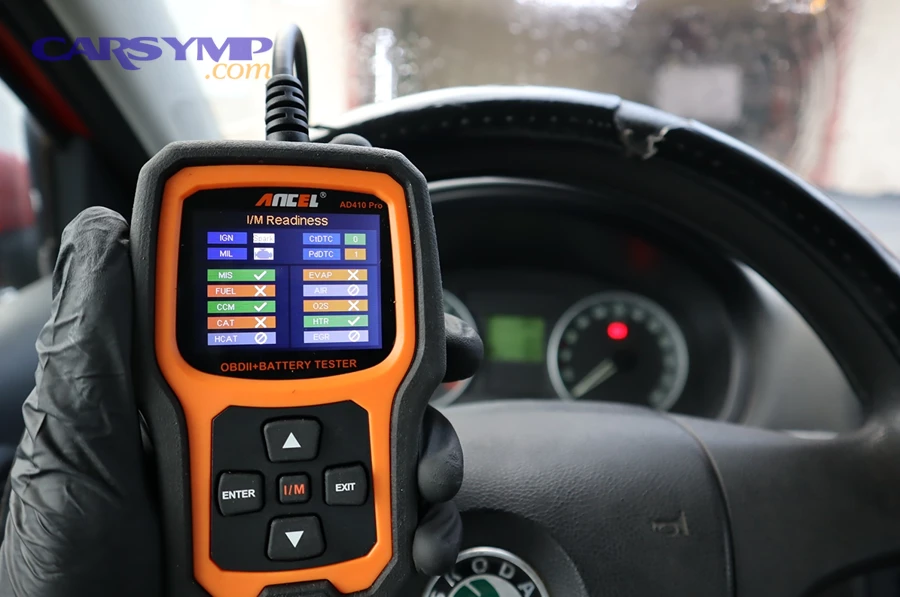
At a high level, the emissions/smog “OBD test” isn’t sniffing the tailpipe on most newer vehicles—it’s checking what your car’s computer reports about emissions controls. The computer runs a set of internal self-tests called readiness monitors (often labeled I/M readiness). EVAP is one of the non-continuous monitors: it usually runs only when conditions are right, not constantly while you drive.
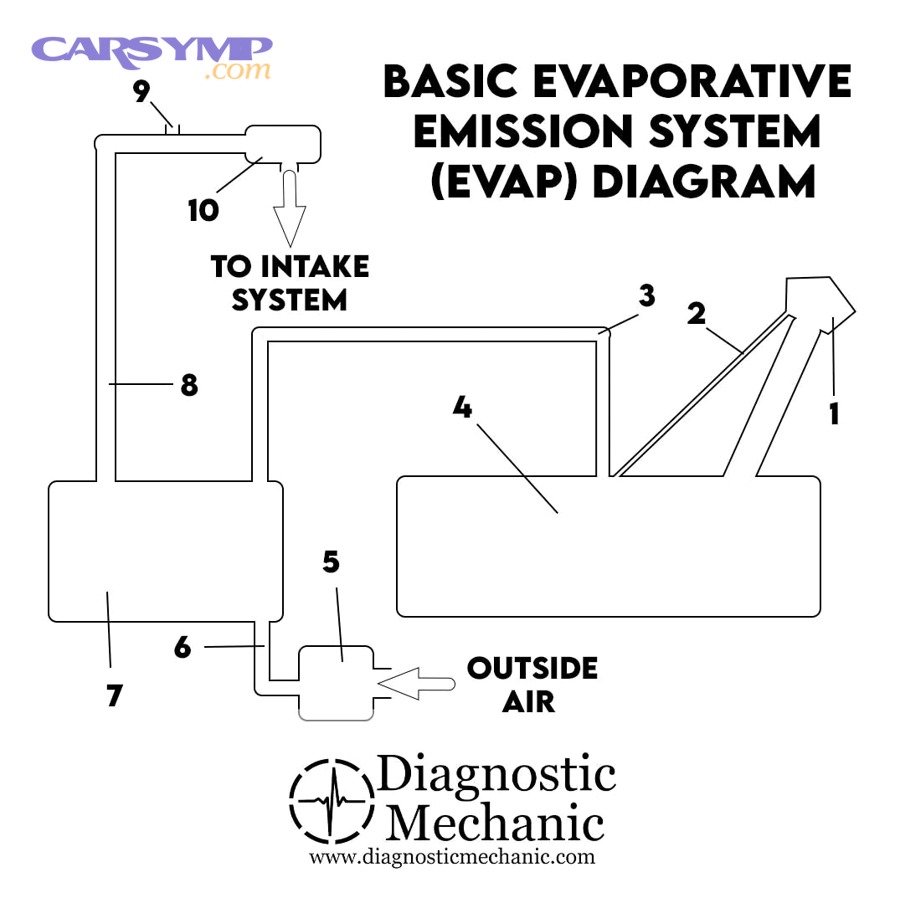
EVAP itself is the system that prevents raw fuel vapors from venting to the air. Vapors are captured (typically in a charcoal canister) and later purged into the engine to be burned under controlled conditions. Because vapor leaks can be tiny, EVAP testing often requires a sealed system and specific temperature/fuel conditions—so it’s normal for EVAP to be the last monitor to turn “Ready.”
A crucial point: “Not Ready” is not the same as “Failed.” It’s closer to “not tested yet.” But in many states, an inspection station can’t ignore that status—especially if your local rules require all monitors set. For example, California’s Bureau of Automotive Repair publishes readiness limits and has also updated readiness-related regulations over time, so requirements can change by date and program. (bar.ca.gov)
What’s the difference between “Not Ready,” “Failed,” and “Check Engine Light on”?
“Not Ready” means the EVAP test hasn’t completed; “Failed” usually means the EVAP test ran and detected a problem; and “Check Engine Light (MIL) on” means the computer has stored a fault serious enough to command the light—almost always an automatic inspection failure.
Here’s how it plays out in real life:
- Not Ready (Incomplete):
- No proof yet that EVAP passed since the last reset.
- Often happens after code clearing, battery disconnect, or repairs.
- Can cause a rejection (can’t test) or a fail, depending on local rules.
- Failed (EVAP-related DTC stored):
- The car ran an EVAP test and found a leak, flow issue, or electrical problem.
- Common codes: P0440–P0457 family (leaks), P0443/P0449 (circuits), P0446 (vent control).
- A stored DTC tied to emissions usually fails OBD inspection.
- MIL/Check Engine Light on:
- The computer is confident enough in the fault to illuminate the warning.
- Even if the car drives “fine,” emissions programs treat this as fail.
The practical takeaway is simple: you’re trying to show the inspection computer two things at the same time—no emissions-related faults, and EVAP readiness completed.
Is “clearing codes” the same as “fixing EVAP,” and why can it delay readiness?
No—clearing codes resets the scoreboard; fixing EVAP repairs the game. Clearing codes can temporarily hide a problem, but it also resets readiness monitors to “Not Ready,” which can delay your ability to pass until the car completes its self-tests again.
When you clear codes, many vehicles wipe (or reset) readiness status, and EVAP typically needs the most specific conditions to re-run. That’s why people feel stuck: the repair may be finished, but the EVAP monitor still needs time and the right scenario to confirm it.
This is also why the fastest route is rarely “clear codes and go test.” The fastest route is: repair → verify no active/pending EVAP faults → complete EVAP conditions → verify readiness → test.
Can you pass emissions right after an EVAP fix?
Yes—you can pass emissions right after an EVAP fix if (1) there are no active or pending EVAP-related faults, (2) the EVAP readiness monitor is “Ready” (or your state allows it incomplete), and (3) you haven’t just reset monitors by clearing codes or disconnecting the battery.
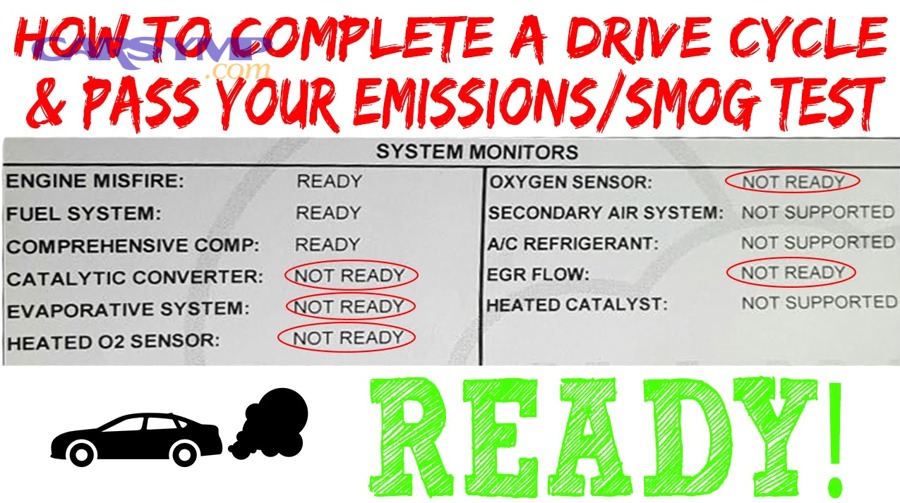
Next, the key is knowing exactly what must be true before you head to the station so you don’t pay for a preventable rejection.
A big caution: local rules vary, and they can change. Some programs allow a limited number of incomplete monitors for certain model years and fuel types, while others require everything set. California, for instance, publishes monitor allowances and has implemented new readiness-related rules effective on specific dates. (bar.ca.gov)
What must be true before the EVAP monitor will run? (Pre-check checklist)
Before you try to “set” EVAP readiness, you want to remove the most common blockers—because EVAP is picky. Use this checklist as your pre-flight:
- No active Check Engine Light (MIL)
- No stored EVAP codes (anything in the P0440–P0457 range is a warning sign)
- No pending codes (some inspections consider pending faults; even when they don’t, a pending code often means the monitor is about to fail)
- Fuel cap sealed properly (tightened until it clicks; if the seal is cracked, replace the cap before anything else)
- Fuel level in a typical “EVAP-friendly” range — many vehicles won’t run EVAP if the tank is nearly empty or nearly full; staying near mid-tank is the safest general strategy.
- Battery voltage stable — low voltage and recent battery disconnect can interrupt EVAP tests and reset readiness.
- No obvious vapor leak symptoms — strong fuel smell, hard-to-fill fuel tank, or hissing can point to remaining EVAP issues.
If you’ve just finished an EVAP system repair, run this checklist before you spend time “driving for readiness.” It prevents the most common failure pattern: doing drive cycles for days when a small leak or valve fault is still present.
What happens if you test with EVAP “Not Ready” vs with an EVAP code present?
If EVAP is Not Ready, the station’s system may read your vehicle as not testable (rejection) or not compliant (fail) depending on local rules and model year. If an EVAP code is present, you’re far more likely to get a straight fail because the car is declaring an emissions fault.
Think of it like this:
- Not Ready: “I haven’t completed the test yet.”
- Code present: “I completed (or attempted) the test and found a problem.”
So, if you’re short on time, your first priority is always no codes—because even if you manage to set readiness, a code will still kill the result. Your second priority is readiness status, based on what your local program requires. (bar.ca.gov)
How do you set the EVAP readiness monitor fast after an EVAP repair?
You set the EVAP readiness monitor fastest by following a 4-step workflow—(1) pre-check for codes, (2) plan fuel level + cold soak, (3) drive a steady mixed route, and (4) verify readiness with a scan tool—so the EVAP self-test completes and flips to “Ready.”
Then, once you stop guessing and start verifying each step, you’ll usually get readiness in fewer attempts.
Here’s the workflow that works for most DIY drivers—without pretending one “magic” drive cycle fits every make and model.
What are the typical EVAP enabling conditions (fuel level, cold soak, temperature) you should target?
EVAP enabling conditions vary by vehicle, but the most repeatable “best practices” are consistent across many platforms:
- Fuel level: stay around mid-tank — avoid topping off or running near empty. A mid-range fuel level is the safest bet because many EVAP tests are disabled at very high or very low fill levels.
- Cold soak: give it time — many EVAP tests need the vehicle to sit long enough for fuel vapor pressure and temperature to stabilize—often an overnight soak. Drive-cycle guidance commonly references extended soak periods to enable EVAP testing. (motor.com)
- Moderate temperature window — extreme cold or heat can block EVAP tests on some vehicles. If EVAP refuses to run in a cold snap or heat wave, it may not be your repair—it may be conditions.
- Stable driving conditions — EVAP often prefers steady cruise, gentle transitions, and limited aggressive throttle.
If you want the “fastest” path, the trick is scheduling: set your fuel level in the afternoon, let the car cold-soak overnight, then run your drive pattern the next morning when conditions are stable.
What drive pattern should you follow to maximize the chance EVAP completes?
Use this practical, safety-first pattern. It’s not a manufacturer-specific recipe; it’s a proven structure that gives EVAP opportunities to run:
- Start cold and idle briefly — let the engine settle for 30–60 seconds. Avoid revving.
- Warm up with light city driving (10–15 minutes) — gentle acceleration, normal stops. The goal is stable engine temperature.
- Steady cruise segment (10–20 minutes) — get to a consistent speed on a safe road (highway or open roadway). Hold speed smoothly.
- A few gentle decelerations — ease off the throttle and coast (when safe and legal). Some monitors like specific decel conditions.
- Return to mixed driving (5–10 minutes) — normal traffic driving to finish the cycle.
Two cautions that save time:
- Don’t do this with a low battery, intermittent starting problem, or unstable idle—voltage drops and stalls can interrupt monitor completion.
- Don’t do repeated “short trips” and expect EVAP to finish. EVAP is often the monitor that punishes short-trip patterns.
Should you use a scan tool before you go to the test station?
Yes—you should use a scan tool before the station because it (1) confirms EVAP readiness status, (2) reveals pending codes that can soon become failures, and (3) prevents wasted inspection fees by catching “Not Ready” early.
Moreover, a scan tool turns this from guesswork into a measurable checklist.
What to check on the scanner:
- I/M Readiness screen: Is EVAP marked complete/ready?
- MIL status: Off
- Stored codes: None
- Pending codes: None (or at least understand what you see and why it’s there)
If your tool supports it, Mode $06 data can provide deeper clues about EVAP test results, but you don’t need that to follow the basic workflow.
You can also use a clear, practical guide to readiness monitors to understand what the scanner is showing and why monitors reset after code clearing. (iamcarhacker.com)
If EVAP still won’t set, is it your driving cycle—or a remaining fault?
If EVAP still won’t set, it’s usually either (1) enabling conditions aren’t being met, (2) the monitor is running but aborting due to a borderline issue, or (3) there’s a remaining EVAP fault that will eventually trigger a code—so you need a simple decision process to separate delay from defect.
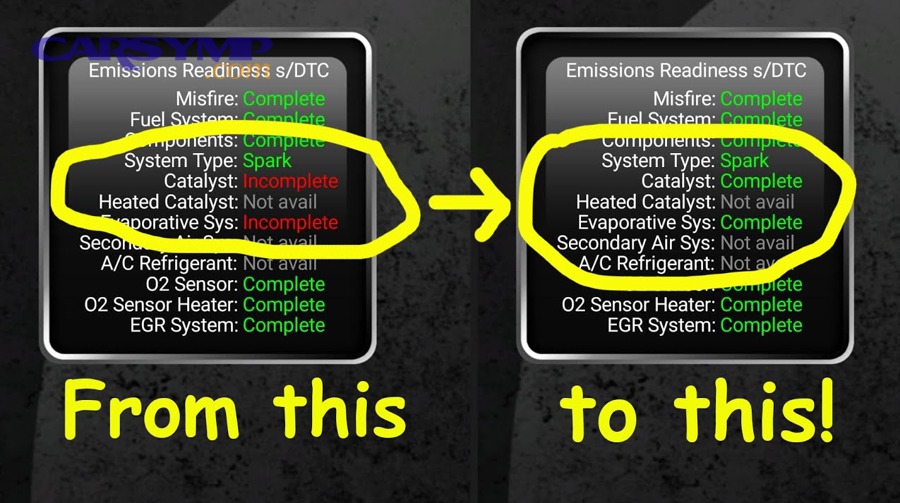
In addition, once you know which bucket you’re in, you can stop wasting drive cycles and fix the real blocker.
This is where many DIY drivers get trapped: they keep driving “the cycle,” but EVAP is either not attempting the test at all—or it’s attempting it and failing quietly until the computer is confident enough to set a code.
What are the most common reasons EVAP readiness won’t complete after a repair?
The most common blockers fall into a few groups. Treat this like a triage list:
A) Conditions are wrong (most common)
- Fuel level too high/too low
- No true cold soak (car didn’t sit long enough)
- Temperature out of range
- Too many short trips / no steady cruise time
B) EVAP system still isn’t sealing or flowing correctly
- Loose or failing gas cap seal
- Cracked EVAP hose or canister connection
- Stuck vent valve (system can’t seal when commanded)
- Stuck purge valve (flow wrong at the wrong time)
This is where the phrase Purge valve vs vent valve failure signs matters, because these two parts fail differently:
- A purge valve stuck open can cause rough idle, hard starts after fueling, or fuel trims that look wrong.
- A vent valve stuck open often prevents the system from sealing for leak testing, which can look like a “large leak” even when hoses are fine.
C) Electrical or sensor issues
- Vent/purge solenoid circuit faults
- Fuel tank pressure sensor bias or intermittent readings
- Wiring damage near the canister area (road debris, corrosion)
D) The repair fixed one problem but exposed another
- A brittle line cracks during service
- An aftermarket cap doesn’t seal like OEM
- The canister is saturated or restricted
If you suspect a sealing issue, this is also where a Small leak vs large leak diagnosis approach helps you avoid chasing the wrong component. Small leaks tend to be hairline cracks, tired seals, or tiny line leaks; large leaks are often an open vent path, missing cap, disconnected hose, or stuck-open vent valve.
Which quick checks tell you ‘not ready because conditions’ vs ‘not ready because EVAP is still failing’?
Use these quick checks to separate “give it time” from “there’s still a problem.”
Signs it’s mostly conditions/time:
- No stored EVAP codes and no pending codes
- EVAP is the only monitor not ready
- You recently cleared codes or replaced the battery
- Fuel level was near full/empty during attempts
- You haven’t done an overnight cold soak + steady cruise in one continuous run
Signs it’s likely still failing:
- A pending EVAP code appears after you try to set readiness
- The same EVAP code returns after a short period
- You have refueling symptoms (hard to fill, pump clicks off repeatedly)
- You smell fuel vapor consistently near the rear of the vehicle
- Readiness refuses to set across multiple proper attempts in good conditions
If your scanner shows pending EVAP codes after a drive, assume the monitor is attempting and catching something—your “Not Ready” may be a temporary state before it becomes a “Fail.”
When should you stop trying drive cycles and get a professional EVAP smoke test or advanced diagnosis?
Yes—you should stop trying drive cycles and get professional diagnosis if (1) EVAP won’t set after multiple correct cold-soak attempts, (2) any EVAP pending/stored code keeps returning, or (3) you have strong fuel-vapor symptoms—because repeated attempts won’t overcome a real leak, stuck valve, or sensor fault.
Especially, a smoke test can locate vapor leaks far faster than guess-driving.
A good rule of thumb:
- If you’ve done two or three properly planned attempts (mid fuel, true cold soak, steady cruise) and EVAP still won’t set and you see any code activity, it’s time to diagnose instead of repeating cycles.
This is also where understanding EVAP regulation targets adds perspective: EVAP monitoring is designed to catch very small leaks—down to the equivalent of tiny orifices—so you may be fighting a problem that’s too small to see without proper tools. For example, research from Linköping University’s Department of Electrical Engineering notes tightened detection requirements down to approximately 0.040 in (1 mm) and 0.02 in (0.5 mm) leak-equivalent sizes and discusses methods evaluated under lab conditions. (fs.isy.liu.se)
Evidence: According to a study by Linköping University from the Department of Electrical Engineering, in 2009, a vacuum-decay EVAP leak-detection approach was evaluated in a laboratory setup using artificial leak orifices ranging from 0.5 mm to 5 mm, with a stated 1% false-alarm probability setting in the evaluation. (fs.isy.liu.se)
What are the lesser-known EVAP edge cases that can delay readiness even after a correct fix?
Lesser-known EVAP edge cases include system-design differences, code-status quirks, non-OEM sealing issues, and environmental constraints—each of which can delay EVAP readiness even when your EVAP system repair was done correctly.
More importantly, these edge cases explain why one driver “sets EVAP in one day” while another needs a week with the same apparent fix.
One of the biggest misconceptions is that EVAP is a single universal test. In reality, different manufacturers use different approaches (vacuum decay, pressure decay, NVLD-style detection, etc.), and that changes when and how EVAP completes.
How do different EVAP test designs (NVLD vs pump-based systems) change readiness behavior?
Some vehicles create vacuum using engine intake and then watch vacuum decay; others use pressure methods or specialized detection hardware. The practical effect for DIY drivers is that enabling conditions differ—especially around soak time, ambient temperature, and whether the test runs key-off or key-on.
That’s why a generic drive cycle can feel inconsistent: your car might need a longer soak, a narrower temperature window, or a specific steady-cruise pattern to trigger the test sequence.
Can “pending” or “permanent” codes affect readiness or test outcomes even when the car feels fine?
Pending codes can absolutely derail your plans, because they indicate the computer is seeing a problem but hasn’t confirmed it enough to turn on the light. If you ignore them and keep driving cycles, you may simply be waiting for the moment the car promotes that pending fault to a stored code—right before your inspection.
Permanent codes are program-dependent and can linger after fixes; the key is to focus on whether the fault is truly gone and whether the vehicle’s monitors have completed normally. When in doubt, use a scanner to read status carefully and consider local inspection rules.
Do aftermarket gas caps, capless systems, or filler-neck sealing issues interfere with EVAP completion?
Yes—these are underrated causes of “my EVAP won’t set.” A cap that “fits” but doesn’t seal correctly can prevent the system from holding pressure/vacuum during a leak test. Capless systems can have sealing surfaces that collect dirt or wear in ways that are hard to spot.
If you’ve replaced a cap, consider returning to an OEM-equivalent cap if EVAP readiness suddenly became difficult after the change.
Can weather, altitude, or seasonal temperature shifts prevent EVAP from running?
Yes—environment and conditions can block EVAP tests on some vehicles. Very cold nights followed by hot days (or vice versa) can keep EVAP from meeting its internal thresholds. In those cases, the “fix” is not another part—it’s timing: run your attempt when temperatures are moderate and your soak and drive window are stable.
Evidence: According to a study by Linköping University from the Department of Electrical Engineering, in 2009, the authors note that as leak detection requirements tighten and checks must be performed more frequently, EVAP detection must operate under more diverse operating conditions, which increases sensitivity to conditions like temperature and system state. (fs.isy.liu.se)