


If you’re trying to choose between an on-car injector clean and an off-car ultrasonic bench service, the best method depends on one thing: how much “proof” you need that the injectors are actually restored, not just temporarily improved. In most cases, on-car cleaning wins for convenience and mild issues, while off-car ultrasonic bench cleaning wins for deep cleaning plus measurable results.
Next, it helps to understand what each method really does inside the injector. On-car cleaning pushes a solvent through the fuel rail and injectors while they’re installed, while ultrasonic bench cleaning removes the injectors and uses cavitation plus controlled pulsing to break up deposits in tiny passages.
Then, the decision becomes much easier when you know how shops verify outcomes. Bench services can include flow rate tests, leak checks, and spray pattern checks so you can confirm whether the “fix” is real or just a short-term change in how the engine feels.
Introduce a new idea: the most accurate choice comes from comparing effectiveness, limitations, verification, and cost side by side—so you can pick the method that fits your symptoms, engine type, budget, and risk tolerance.
What is on-car fuel injector cleaning (pressurized rail/flush service)?
On-car fuel injector cleaning is an in-vehicle cleaning method that runs a concentrated cleaning solvent through the fuel rail and injectors (often with the fuel pump disabled) to dissolve light deposits and restore spray consistency without removing parts.
To better understand why this method is so popular, start with what makes it practical: it’s fast, requires minimal disassembly, and can be performed by many shops in under an hour.
What typically happens during an on-car service
On-car cleaning usually follows a predictable flow:
- Setup: The technician connects a pressurized canister or machine to the fuel rail via a service port or adapter.
- Isolation: The fuel pump is disabled or bypassed so the engine runs on the cleaning solution.
- Run cycle: The engine idles (and sometimes is held at a higher RPM) while the solvent passes through injectors.
- Finish: The system returns to normal fuel supply, and the engine is checked for improved idle/stability.
The standout feature is convenience: you are cleaning “in place,” which reduces labor. However, convenience also implies a limit—because the injector is never removed, you can’t fully inspect it, backflush it, or confirm flow balance cylinder-to-cylinder with the same precision as a bench test.
What on-car cleaning is best at (and what it’s not)
On-car cleaning tends to work best when:
- The engine has mild varnish from heat-soak and normal aging.
- Symptoms are early-stage (slight hesitation, mild rough idle, small MPG drop).
- The goal is maintenance rather than rehabilitation.
It is less reliable when:
- One injector is heavily restricted compared to others.
- Deposits are hard carbon or internal contamination that needs backflushing.
- You need measurable confirmation (flow numbers, spray pattern consistency).
What is off-car ultrasonic bench fuel injector cleaning (and why is it called “bench cleaning”)?
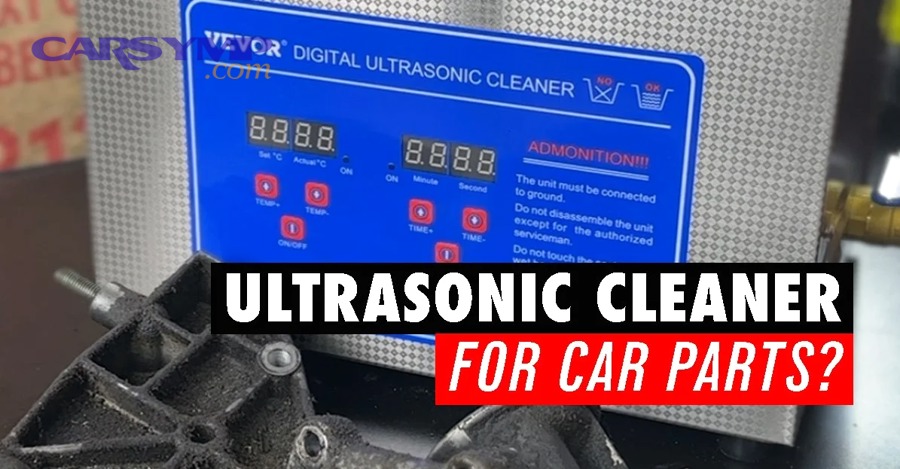
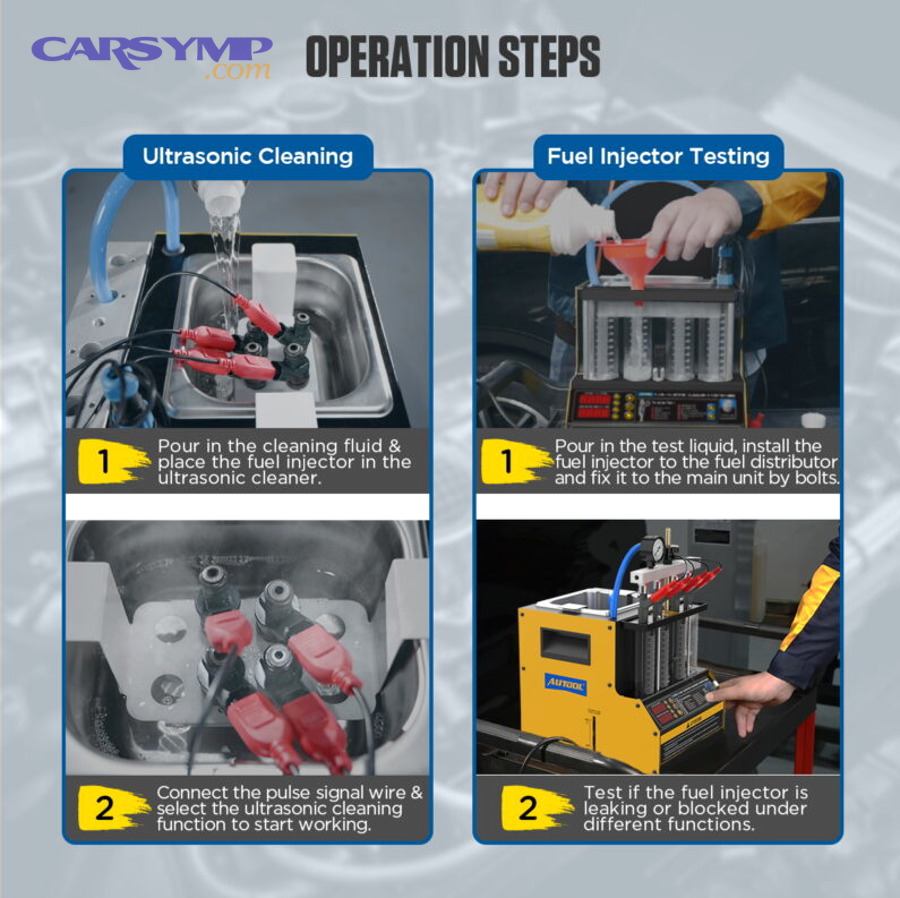
Off-car ultrasonic bench fuel injector cleaning is a removed-injector service that uses ultrasonic cavitation and controlled injector pulsing to break down deposits, often followed by flow testing and spray pattern evaluation to confirm performance.
Next, the key to “bench cleaning” is the word bench: the injector is serviced on a test bench where the operator can control pressure, pulse width, and measurement—things you cannot do precisely on the car.
What makes ultrasonic cleaning different
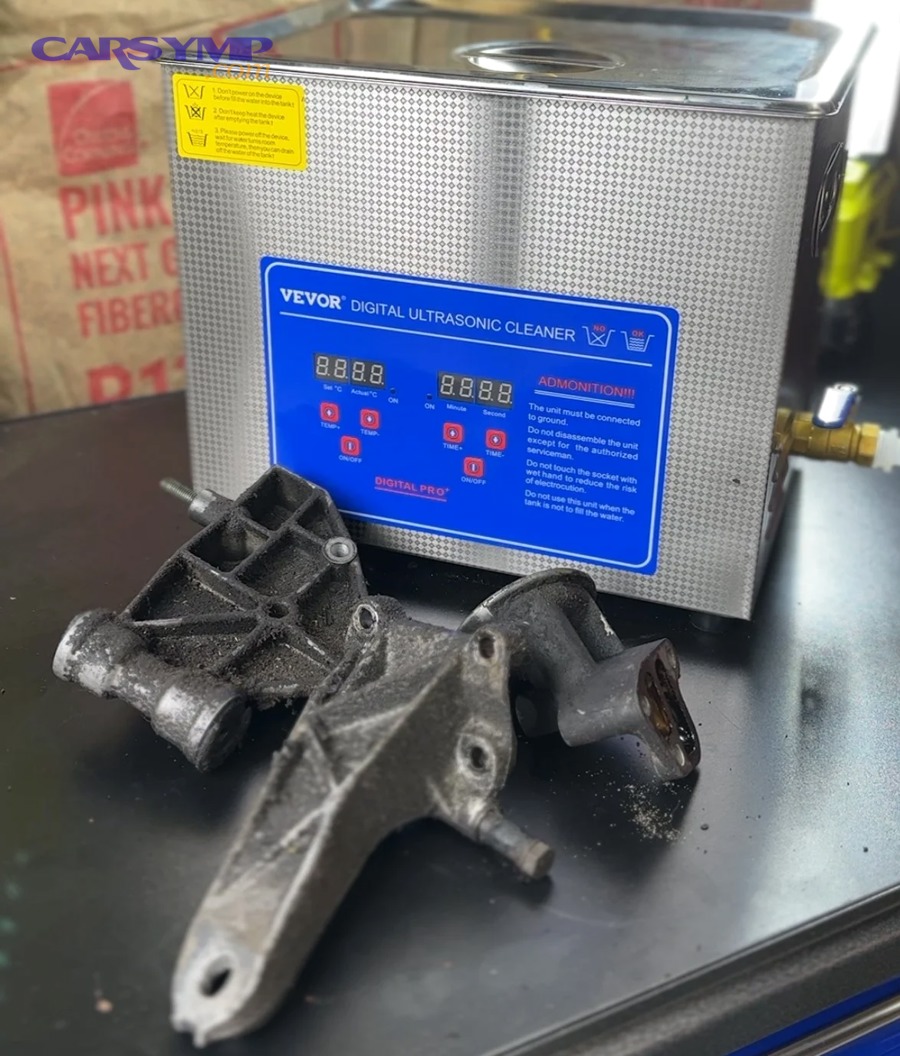
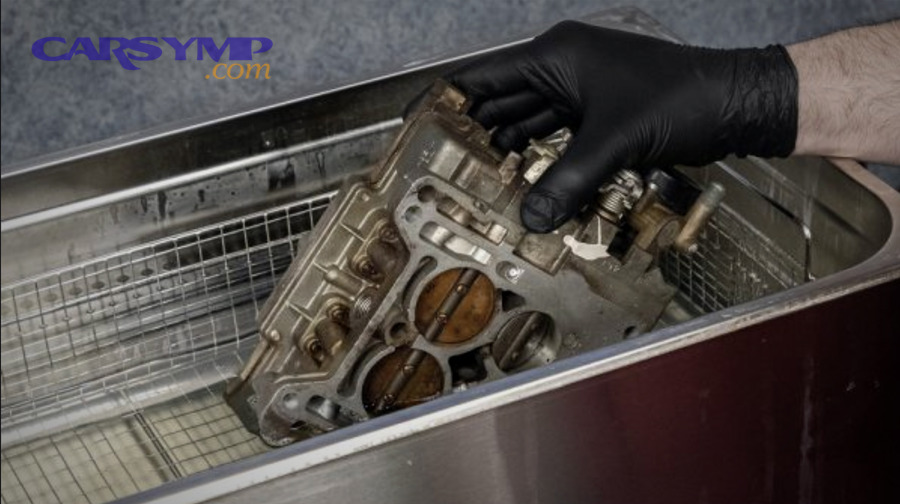
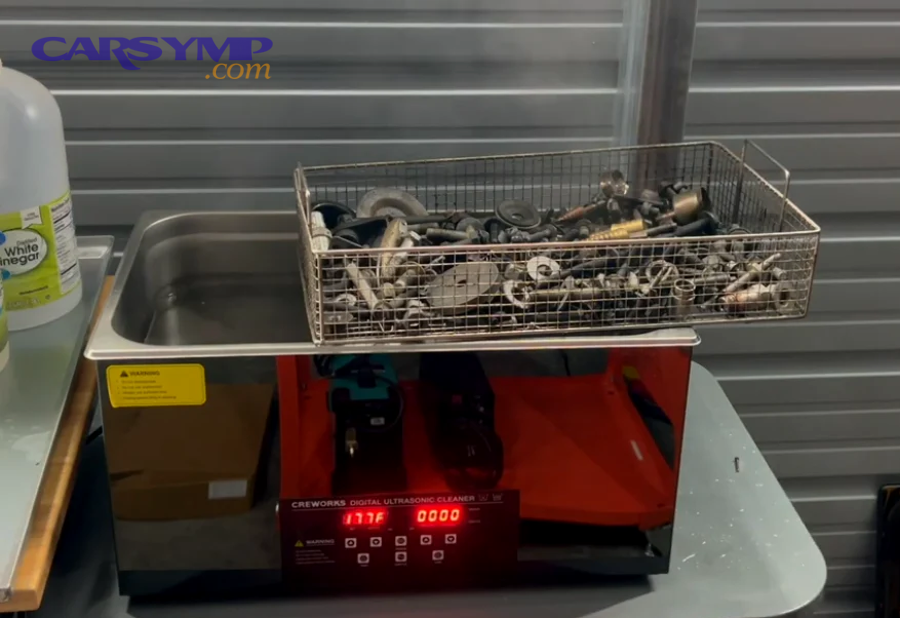
Ultrasonic cleaning works through cavitation—tiny bubbles form and collapse in a cleaning solution, creating micro-agitation that can reach into small channels and around inlet screens. The standout features are:
- Deep cleaning potential: Helps loosen deposits inside tight passages.
- Controlled pulsing: Many services energize the injector during cleaning so the pintle/valve moves.
- Backflushing capability: Some setups reverse flow direction to push contaminants out the way they came in.
- Consumables replacement: O-rings and filter baskets are often replaced, reducing vacuum leaks and contamination risks.
Why “bench” matters for results
Because the injector is off the car, the operator can:
- Test electrical health (resistance/current draw)
- Check leakdown (does it drip when it should seal?)
- Compare flow rate between injectors
- Inspect spray pattern for atomization and symmetry
That’s why this method is usually chosen when the objective is not just “cleaning,” but restoration plus verification.
Is ultrasonic bench cleaning better than on-car cleaning for clogged injectors?
Yes—ultrasonic bench cleaning is better for clogged injectors because it (1) cleans more deeply with cavitation and pulsing, (2) allows backflushing and parts replacement, and (3) enables measurement-based confirmation like flow rate and spray pattern testing.
However, “better” only matters when you define the goal, so the next step is to clarify whether you’re chasing convenience, symptom relief, or measurable injector performance.
Does “better” mean more flow, a cleaner spray pattern, or fewer symptoms?
“Better” means the outcome that matches your problem—and injector problems show up in more than one metric.
Specifically, here’s how the three most common “better” definitions differ:
- More flow: A restricted injector delivers less fuel for the same command, which can push trims positive and create lean misfires under load.
- Cleaner spray pattern: Poor atomization can lead to rough combustion, hesitation, higher emissions, and sometimes increased particulate formation on certain engines.
- Fewer symptoms: Smoother idle and improved throttle response are meaningful, but they don’t always prove injectors are balanced across cylinders.
Then, a smart approach is to rank your goal:
- If you want a quick maintenance refresh, symptom relief may be enough.
- If you want to fix a persistent drivability problem, flow and pattern matter more.
- If you’re tuning or protecting an engine under heavy load, balance and consistency matter most.
How do on-car and ultrasonic bench cleaning compare by effectiveness?
On-car cleaning wins in speed and convenience, ultrasonic bench cleaning is best for deep restoration and measurable verification, and injector replacement is optimal when injectors are damaged, leaking, or electrically faulty beyond cleaning.
To better understand the differences, compare them by deposit severity and by what you can prove after the job is done—because effectiveness is not just “clean vs dirty,” it’s consistent fuel delivery under real conditions.
Which method works best for light varnish vs heavy deposits?
On the other hand, light varnish and heavy deposits behave differently, so effectiveness changes with severity.
Light varnish / early deposits (best match: on-car cleaning)
- Usually forms from heat cycling and normal fuel residue.
- Often responds to concentrated solvents pushed through the rail.
- Typical effect: improved idle smoothness and throttle response.
Moderate deposits / uneven flow (best match: ultrasonic bench cleaning)
- One injector may lag behind others, creating imbalance.
- Ultrasonic cavitation plus pulsing can loosen deposits in finer passages.
- Backflushing can help when the inlet screen or internal path holds debris.
Severe clogging / hard carbon / internal corrosion (best match: replacement)
- Cleaning may not restore design flow or may produce inconsistent results.
- Physical wear or corrosion can prevent proper sealing and atomization.
- Replacement becomes the safer reliability choice.
Then, a practical rule of thumb is this: the more your issue looks like one-cylinder imbalance, the more you should lean toward bench service or replacement rather than on-car cleaning.
Which method is more likely to fix misfires, rough idle, and hesitation?
However, symptoms can come from many systems, so the “most likely” method depends on whether injector issues are the root cause.
Rough idle
- On-car cleaning may help if deposits are mild and evenly distributed.
- Bench cleaning is more likely if one injector is under-delivering or dribbling.
Misfire under load
- Bench cleaning or replacement is often more effective because load misfires frequently reveal flow restriction, poor atomization, or imbalance.
- On-car cleaning can help if the misfire is early-stage and deposit-related, but it may not fix a severely restricted injector.
Hesitation and surging
- Can improve with either method if injector response is sluggish.
- If hesitation persists, look for vacuum leaks, ignition issues, or sensor problems before repeating cleaning.
In addition, consider a simple diagnostic mindset: if symptoms come and go with fuel quality or long storage, cleaning is more promising; if symptoms are consistent and cylinder-specific, testing becomes more important.
What can on-car cleaning NOT fix, even if symptoms improve temporarily?
There are 4 main categories of injector problems on-car cleaning typically cannot fix—electrical failures, mechanical wear, sealing/leak defects, and severe internal restriction—because the injector stays installed and cannot be fully inspected, backflushed, or measured for balance.
More importantly, understanding these limits prevents the most common mistake: mistaking short-term smoothness for a true repair.
Why temporary improvement can be misleading
On-car solvent can change combustion behavior quickly:
- It may dissolve enough surface varnish to reduce hesitation.
- It may temporarily improve spray breakup.
- It may shift fuel trims as deposits soften.
But if a deeper defect exists—like an injector that leaks when closed or one that is electrically weak—symptoms can return fast, and sometimes worsen because the engine is now relying on a component that still isn’t stable.
Which injector problems require removal (off-car service) or replacement?
There are 6 common injector problem types that usually require removal or replacement based on the root cause:
- Electrical faults (replacement likely)
- Open circuit, short, inconsistent current draw
- Cleaning cannot repair coils or internal electrical damage
- Mechanical wear (replacement likely)
- Worn pintle/valve surfaces
- Sticky action that returns even after cleaning
- Leakdown / dribble (bench test required; replacement if persistent)
- Injector does not seal properly
- Can cause rich starts, fuel smell, cylinder wash
- Severe restriction (bench service first; replacement if not restored)
- Large flow imbalance or low output despite multiple cycles
- Often needs backflushing and prolonged ultrasonic pulsing
- Internal corrosion (replacement often)
- From water contamination or long storage
- May cause unpredictable flow and poor sealing
- Damaged inlet filter basket / debris contamination (bench service helpful)
- Requires removal to replace filters and flush out contaminants properly
In short, if your goal is dependable performance—not just “it feels better today”—you need a method that can reveal these failure modes.
How do you verify results—flow testing and spray pattern testing vs “seat-of-pants” improvement?
Flow testing wins for measuring fuel delivery consistency, spray pattern testing is best for confirming atomization quality, and scan-data road verification is optimal for proving the engine’s trims and misfire counters improved under real driving conditions.
To better understand Verifying improvement after cleaning, treat it like a three-layer check: numbers on a bench, visuals in a pattern test, and behavior on the road.
What is injector flow testing and what numbers actually matter?
Injector flow testing is a controlled measurement of how much fuel an injector delivers over a defined time at a set pressure and pulse width, typically compared across a set to evaluate balance and restriction.
Specifically, the numbers that matter are:
- Relative flow matching: How close each injector is to the others in the same set
- Before/after change: Whether cleaning restored lost capacity
- Stability: Whether repeated runs produce consistent results
- Leakdown/hold: Whether the injector seals when commanded closed
For car owners, the most useful output is not “Injector A flows 103 ml,” but “All four injectors are now within a tight spread of each other,” because the engine cares about cylinder balance as much as absolute flow.
Evidence: According to a study by University of Birmingham from its research publications, in 2020, test injectors were mildly fouled with an average 1.5% flow rate loss (and the test also reported changes in commanded fueling) before deposits were removed, highlighting how even small deposit levels can measurably affect injector delivery. (research.birmingham.ac.uk)
What is spray pattern testing and why does it matter for combustion?
Spray pattern testing is a visual and comparative test that evaluates whether each injector produces a consistent cone/jet shape, atomizes evenly, and avoids dribble or directional bias that can cause uneven combustion.
For example, pattern testing helps detect:
- Streamers: A “stringy” output that reduces atomization
- Asymmetry: Fuel favoring one side of the cone
- Dribble: Fuel leaking after the pulse ends
- Delayed response: Slow opening/closing that disrupts metering
Then, connect pattern to real results: poor atomization can reduce combustion stability and worsen hesitation, especially during transients like tip-in acceleration.
How to do practical road verification after any cleaning method
Road verification is the bridge between lab-style testing and daily driving. A practical checklist includes:
- Cold start quality: Smoothness, idle stability, fuel smell
- Idle misfire counters: If your scan tool provides them
- Short- and long-term fuel trims: Trends toward normal over several drives
- Throttle response: Especially at light load where poor atomization shows up
- Fuel economy: Over a full tank, not a single trip
In addition, remember that the engine may need a short relearn period. Evaluate trends over a few drive cycles rather than judging in the first 10 minutes.
Which method should you choose for your car: a quick on-car clean or off-car ultrasonic bench service?
There are 3 main decision paths for choosing injector service—on-car cleaning for mild maintenance, ultrasonic bench service for deeper restoration with proof, and replacement for damaged or non-recoverable injectors—based on severity, verification needs, and budget/time.
To better understand the decision, focus on the one question that keeps you out of trouble: “Do I need measurements, or do I just need maintenance?”
A simple decision checklist (severity-first)
Use this severity checklist to choose confidently:
Choose on-car cleaning when:
- Symptoms are mild and recent
- No cylinder-specific misfire data points to a single injector
- You want preventative maintenance
- You prefer minimal downtime
Choose ultrasonic bench service when:
- Rough idle or misfire feels uneven or cylinder-specific
- The vehicle has long storage varnish risk
- You want confirmed balance and leak checks
- You’ve tried lighter methods and symptoms return
Choose replacement when:
- Injectors fail electrical tests
- Leakdown persists after cleaning
- Flow remains significantly restricted or unstable after bench service
- You see physical damage or corrosion
Which method is best for DIY mechanics vs drivers who want a shop to handle it?
On-car cleaning is best for most drivers who want fast service, ultrasonic bench service is best for DIY mechanics (or performance-minded owners) who want measurable results, and replacement is best when DIY time would exceed the value of saving questionable injectors.
Specifically, think in terms of tools and tolerance:
- DIY-friendly factors (lean toward bench service):
- You can remove injectors safely (depressurize, manage O-rings, avoid tearing seals)
- You can address reinstall risks (vacuum leaks, fuel leaks)
- You can wait for shipping/turnaround if using a service
- Shop-friendly factors (lean toward on-car cleaning):
- You want minimal downtime and don’t want to disturb seals
- You prefer a single appointment
- You’re treating early symptoms or doing maintenance
Then, remember the hidden variable: injector removal can be easy on some engines and frustrating on others. If removal risks breaking brittle connectors or stuck injectors, a professional bench service may still be worth it even if you’re mechanically confident.
Is off-car ultrasonic bench cleaning worth the cost compared with on-car cleaning?
Yes—off-car ultrasonic bench cleaning is worth the cost because it (1) provides measurable verification like flow and pattern testing, (2) can restore balance across injectors more reliably than in-car solvent cleaning, and (3) can prevent repeat “guess-and-clean” spending by revealing when replacement is truly necessary.
However, cost only makes sense when you separate what you’re paying for—cleaning versus certainty—so the next step is to unpack the real cost drivers.
When bench cleaning saves money (even if it costs more upfront)
Bench service can be the better value when:
- You’re chasing a persistent drivability issue and want to stop repeating smaller fixes
- You suspect cylinder imbalance but want to confirm it before replacing parts
- You want injectors matched as a set for smoother operation and tuning stability
On the other hand, on-car cleaning can be better value when:
- You’re doing routine maintenance
- Symptoms are mild and not cylinder-specific
- You don’t need pre/post documentation
Replacement becomes the best value when:
- One injector is clearly failed (leak or electrical fault)
- Bench results show the injector cannot be restored to stable performance
- The cost of repeated service exceeds the price of a reliable replacement set
What are typical cost drivers: labor, testing, replacement parts, and downtime?
There are 4 major cost drivers for injector service based on what’s included:
- Labor complexity
- Injector access varies widely by engine design
- More disassembly increases labor and risk
- Testing scope
- Basic cleaning alone is cheaper
- Flow testing, pattern testing, and leakdown checks add value and cost
- Parts replaced
- New O-rings, filter baskets, seals, and spacers
- These reduce post-service leaks and contamination risk
- Downtime and logistics
- Shipping time (if mailed to a service)
- Vehicle downtime if injectors are removed and sent out
In short, “worth it” usually correlates with how expensive uncertainty is for you. If you can’t afford recurring symptoms—or you’re protecting an engine under load—paying for measurement is often the smart play.
How do injector type and engine technology change the best cleaning method?
On most vehicles, on-car cleaning wins for mild issues on port injection, ultrasonic bench cleaning is best for deeper restoration and verification (especially when imbalance is suspected), and replacement is optimal for specialized high-pressure injectors that are damaged or cannot meet stability targets after service.
More importantly, injector design and engine type change both the deposit pattern and the risk of removal—so the same method is not equally “best” for every platform.
Does GDI vs port injection change whether off-car bench cleaning is necessary?
Yes—GDI often makes bench cleaning more relevant because deposit formation and spray sensitivity can be more consequential, while port injection more commonly responds to maintenance-focused cleaning unless restriction is severe.
Specifically, the difference is about where and how fuel is delivered:
- Port injection (PFI): Fuel sprays into the intake port, typically at lower pressures, and deposits may build differently.
- Gasoline direct injection (GDI): Fuel is injected directly into the combustion chamber, where spray pattern and atomization strongly affect combustion stability and emissions behavior.
If your GDI engine shows persistent hesitation, rough combustion, or cylinder imbalance behavior, a bench service with verification can reduce guesswork.
Are piezo injectors and high-pressure systems riskier to clean than solenoid injectors?
Yes—some high-pressure and piezo-based systems can be riskier to handle because they are more sensitive to contamination, sealing integrity, and precise control behavior, so replacement or specialized service may be the safer route if faults appear.
Then, the practical takeaway is simple: when injectors are highly specialized, the value of professional testing increases—and the penalty for a bad seal or mishandled component increases too.
Do flow balancing and matched injectors matter more for performance builds or high-mileage daily drivers?
Flow balancing matters most for performance builds, while matched injectors are still valuable for high-mileage daily drivers when cylinder smoothness and fuel trim stability are priorities, and replacement becomes the performance choice when you need guaranteed headroom and repeatability.
Specifically:
- Performance/tuned setups: small imbalances can become large problems under boost or heavy load.
- Daily drivers: balanced injectors reduce roughness, improve consistency, and can prevent chasing intermittent drivability issues.
So if your use case is “set it and forget it,” balanced injectors can be less about peak horsepower and more about stable, predictable driving.
Can ultrasonic frequency and cleaning solution choice affect injector longevity?
Yes—ultrasonic frequency and cleaning chemistry can affect longevity because aggressive cavitation or incompatible solutions can stress delicate components, while injector-safe solutions and controlled cycles reduce risk and improve cleaning consistency.
In addition, treat chemistry as part of quality: reputable services choose solutions designed for injector materials and avoid “strong enough to strip everything” formulas that can harm seals or finishes.
Evidence (if any)
According to a study by University of Birmingham from its research publications, in 2020, test injectors were mildly fouled with an average 1.5% flow rate loss before deposits were removed, highlighting how even small deposit levels can measurably affect injector delivery. (research.birmingham.ac.uk)