


When a vehicle won’t start and the security light is acting up, the most effective fix is a structured diagnosis that separates a true immobilizer lockout from ordinary ignition switch problems, battery voltage drop, or starter circuit faults—so you repair the right part the first time.
Many drivers also need a clear explanation of what the immobilizer actually does in the start chain (key → antenna ring → immobilizer/BCM → ECU/PCM), because that understanding makes symptoms like “crank/no-start” or “no-crank” instantly more predictable.
If you’re trying DIY steps, the key is knowing which resets/relearns are safe and which actions can cause deeper lockouts, especially on transponder keys and smart-key systems that require programming.
Introduce a new idea: once you’ve confirmed what’s blocking the start, you can choose the fastest repair path—DIY checks, a locksmith key program, or a shop-level electrical diagnosis—without guesswork.
Is the security/immobilizer system actually preventing the car from starting?
Yes—an immobilizer can be the cause when the security indicator is abnormal, the engine behavior matches start inhibition, and basic power/starter checks look normal, because immobilizers (1) deny start authorization, (2) interrupt starter/fuel/ignition paths, and (3) respond to key authentication failures.
Next, the easiest way to avoid misdiagnosis is to classify the start symptom first, because immobilizer lockouts look different depending on whether the starter is allowed to crank.

Is the engine cranking normally, not cranking at all, or starting and stalling?
The start symptom usually falls into three buckets, and each bucket points to a different “cut point” in the security-to-ignition interaction:
- No-crank (starter never spins)
This can happen when the immobilizer (or BCM) denies the starter relay signal, or when you have ignition switch problems, neutral safety switch issues, a dead battery, or a starter relay fault. Immobilizer involvement becomes more likely if you also see a security light warning and a known-good battery. - Crank/no-start (starter spins, engine won’t fire)
This is classic immobilizer territory because the engine can crank but fuel injection or spark is disabled. It can also be fuel pump, crank sensor, or injector issues—so you need confirmation steps. - Starts and stalls after 1–3 seconds
Many systems allow a brief start, then shut it down when the authorization check fails. This pattern often shows up when a key is not learned, the transponder is not read, or an aftermarket bypass isn’t functioning.
Then, once you’ve picked the bucket, you can match it to the “what to check first” list:
- No-crank → battery voltage under load, starter relay click, ignition switch output in START, immobilizer/starter enable status.
- Crank/no-start → security light behavior, key recognition, scan data for immobilizer status, spark/fuel enable flags.
- Starts then stalls → key authentication, antenna ring, key learning, immobilizer fault codes.
Does the security light pattern indicate a key recognition failure?
Yes—often the security light (or key icon) is the fastest clue, because (1) it directly reports theft-deterrent state, (2) it changes predictably during key authentication, and (3) it tends to appear alongside “key not recognized” events even when other electronics seem fine.
To illustrate, here are common pattern interpretations (always verify with your vehicle manual or scan tool, because behavior varies by make/model):
- Flashing rapidly while trying to start: the system is actively in “theft” or “not authorized” state.
- Solid on while cranking: the system may be seeing a fault and denying start.
- Flashes when parked/locked: may be normal armed indicator (not a starting problem by itself).
If the light changes dramatically when you try a spare key, that’s a strong sign the immobilizer/key side is involved rather than a mechanical starter failure.
What does an immobilizer/anti-theft system do in the ignition start chain?
An immobilizer is an electronic anti-theft system that authenticates a coded key or fob near the ignition, then allows the ECU/PCM to enable starting—typically by permitting fuel injection and/or spark—only after the vehicle verifies a valid credential.
To better understand why the car won’t start, it helps to picture the system as a permission gate that sits between “you turned the key” and “the engine is allowed to run.”

What gets disabled when the immobilizer triggers—starter, fuel, ignition, or all three?
There are three common immobilizer “deny” strategies, based on how the manufacturer designed the theft deterrent:
- Fuel injection disabled (common in crank/no-start):
The starter cranks, but injectors are shut off or fuel enable is denied, so the engine never catches. - Ignition/spark disabled:
The engine may crank and even show signs of trying to fire, but spark is inhibited. - Starter enable disabled (common in no-crank):
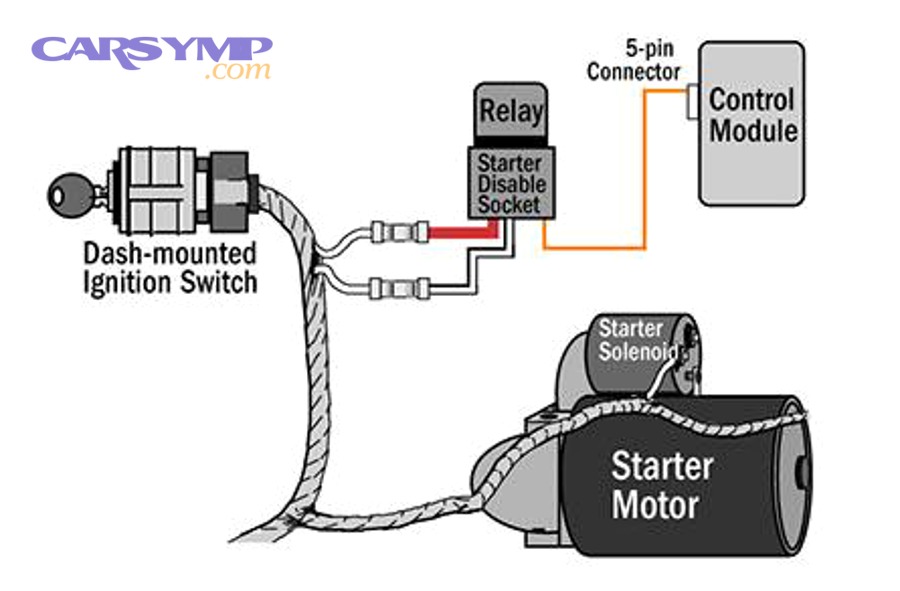
The immobilizer/BCM denies the starter relay or inhibits the start request signal.
In real-world diagnosis, you don’t need to guess which strategy your car uses—you infer it from the symptom bucket and confirm with scan data or simple circuit checks.
Evidence: According to a study by Tufts University from the Department of Computer Science, in 2015, immobilizers deter theft by interrogating an RFID transponder in the ignition key as a condition of enabling systems like fuel injection, meaning a car may crank but still be prevented from running when authentication fails. (cs.tufts.edu)
What’s the difference between an immobilizer and a car alarm?
The immobilizer wins at preventing the engine from running, a traditional alarm is best for deterring entry and drawing attention, and aftermarket “security systems” vary because they may combine both.
- Immobilizer: focused on start authorization (run permission). It’s usually passive—if the right key is present, it quietly allows the start.
- Alarm: focused on intrusion detection (door/tilt/glass sensors) and siren/horn output.
- Aftermarket security: may add a starter-kill relay or ignition cut. That can mimic an immobilizer fault and is a major reason people chase the wrong repair.
This distinction matters because a factory immobilizer problem usually requires key authentication or module-side diagnosis, while an aftermarket alarm issue often lives in added wiring and relays.
What are the most common causes of immobilizer–ignition interaction problems?
There are 6 main causes of immobilizer–ignition interaction problems—key/fob issues, antenna ring faults, ignition cylinder/switch faults, voltage problems, wiring/connector issues, and module failures—based on whether the system fails to read the key, fails to communicate, or fails to deliver the start-enable signal.
Besides, grouping causes this way prevents the classic trap: replacing the ignition switch when the key is the real problem, or blaming the immobilizer when the battery is collapsing under load.

Here’s what each cause looks like in practice:
- Key or fob problem (transponder not recognized)
Worn/damaged key head, transponder chip failure, wrong key, or an unprogrammed spare. On smart keys, a weak fob battery can prevent authorization (some cars have a backup “hold-to-start” or slot procedure). - Antenna ring / receiver issue (key can’t be read)
The ring around the ignition cylinder (or a proximity antenna for push-button start) doesn’t read the key reliably. Symptoms can be intermittent—works on warm days, fails on cold mornings, or fails after steering column movement. - Ignition cylinder / ignition switch issue (signal path broken)
Steering lock and ignition cylinder problems can prevent proper key rotation or alignment for reading, especially if the steering wheel is bound. Electrical ignition switch problems can drop power to the immobilizer/BCM during START, causing a “false theft” state. - Low battery or voltage drop (modules brown out)
The immobilizer and BCM are sensitive to low voltage during cranking. If voltage dips hard, module communication can fail and the car may behave like it’s locked out. - Wiring/connector fault (communication or enable line disrupted)
Corrosion at steering column connectors, loose grounds, damaged harness near the column, or intermittent open circuits. - Module-level fault or mismatch (BCM/ECU/immobilizer pairing)
After a module replacement, the vehicle may need immobilizer “pairing” (sometimes called a marriage procedure). Without it, the car will deny start regardless of the key.
Can a weak car battery or low voltage trigger immobilizer-like symptoms?
Yes—low voltage can mimic an immobilizer lockout because (1) the BCM/immobilizer may reboot during cranking, (2) communication between modules can drop, and (3) the key read process can fail when the system voltage is unstable.
More importantly, this is one of the most common “it only happens sometimes” stories: the car starts fine after a jump, then acts immobilized the next morning. The fix is not an immobilizer reset—it’s a battery/charging diagnosis.
Practical checks that save time:
- Measure battery resting voltage (rough clue) and, more importantly, voltage during cranking (real clue).
- Check battery terminals for looseness/corrosion.
- Verify charging voltage after it starts.
Can a worn ignition cylinder/switch cause the anti-theft system to misread the key?
Yes—a worn cylinder or failing switch can contribute because (1) the key may not sit or rotate correctly for the reader, (2) the steering lock can bind and prevent full rotation, and (3) worn ignition switch contacts can momentarily cut power to the immobilizer/BCM during START.
This is where people confuse mechanical and electrical failure:
- Ignition cylinder = mechanical key interface (tumbling/rotation, steering lock interaction).
- Ignition switch = electrical contact set feeding ACC/IGN/START circuits.
If you notice accessories flicker, intermittent dash power, or “key won’t turn” moments, treat it as a combined possibility: mechanical binding plus electrical instability.
How do you diagnose the problem step-by-step without guessing?
Use a 7-step diagnostic flow—symptom bucket → battery/voltage → spare key → security light behavior → starter/ignition circuit checks → scan immobilizer status → isolate aftermarket wiring—to identify the real failure point and restore a consistent start.
Then, follow the sequence in order; skipping ahead is how drivers end up replacing parts that were never bad.
- Define the symptom bucket (no-crank vs crank/no-start vs starts/stalls).
Write it down. “It won’t start” is too vague for electrical diagnosis. - Check battery health and cranking voltage.
A weak battery can create immobilizer-like behavior and also cause starter relays to chatter. - Try a known-good spare key (or perform the vehicle’s approved backup start method).
This single step can cut diagnosis time in half. - Observe the security indicator during key ON and during START.
Note whether it changes state, flashes, or stays solid. - Verify ignition switch outputs and starter request (if no-crank).
This is where Electrical accessories cutting out diagnosis matters—if ACC/IGN circuits drop unexpectedly, the immobilizer may never complete authorization. - Scan for immobilizer/BCM/PCM codes and live data (if available).
Generic OBD2 readers often miss immobilizer data; you may need a tool that reads body modules. - Inspect for aftermarket security/remote-start wiring and relays.
Starter-kill relays and bypass modules can fail and perfectly imitate immobilizer faults.
To make this easier, the table below shows what each early test “means” so you can choose the next step logically.
What this table contains: a quick decision matrix that maps your test result to the most likely direction for diagnosis.
| Test result | What it suggests | Best next step |
|---|---|---|
| Starts with spare key | Key/fob/transponder issue | Program/replace key; inspect key wear |
| No-crank + security light abnormal | Starter enable denied OR switch/circuit issue | Check ignition switch START output + scan BCM |
| Crank/no-start + security light abnormal | Fuel/ignition enable denied | Scan immobilizer status; check antenna ring |
| Starts then stalls | Authentication fails after initial run | Key recognition, antenna ring, module pairing |
| Accessories flicker/cut out in START | Ignition switch contacts or wiring | Trace IGN/ACC feeds; test switch |
Does a spare key (or re-learning the existing key) isolate the issue to the key vs the vehicle?
A spare key wins for isolating the problem quickly, relearning is best when the vehicle supports a DIY procedure, and professional programming is optimal when smart keys or module replacement is involved.
- If a spare key works immediately, your vehicle-side circuits are likely okay and you’re looking at a key/fob issue.
- If neither key works, suspect the reader (antenna ring), module-side fault, or power/communication issues.
- If the car works only when you hold the fob in a specific spot (some push-button systems), you’re likely seeing a weak fob battery or proximity read limitation.
The key insight: you’re not “trying random things”—you’re performing a controlled experiment with two variables (key A vs key B).
What OBD2/immobilizer codes and live data should you check?
There are 4 useful categories of codes/data for immobilizer-start issues, based on what fails in the chain:
- Key authentication / key not learned
Clues: “unrecognized key,” “key not programmed,” “transponder fault.” - Antenna/receiver faults
Clues: “antenna circuit,” “receiver communication,” “key signal missing.” - Module communication errors
Clues: “lost communication with BCM/immobilizer,” CAN/LIN faults. - Start enable / starter request issues
Clues: “starter relay control,” “start request invalid,” “park/neutral signal.”
Live data (when available) is even better than codes because it can show:
- Key recognized: Yes/No
- Immobilizer status: Authorized/Not authorized
- Starter enable: On/Off
- Fuel enable: On/Off
If you can’t access these with your scanner, that itself is a diagnosis step: you may need a body-capable scan tool or a shop/locksmith.
What fixes can you try safely at home, and what should you avoid?
There are 5 safe DIY fixes—battery stabilization, spare key testing, steering lock release, basic connector checks, and approved relearn steps—while you should avoid actions that can deepen lockouts, damage wiring, or create new faults.
More specifically, the best home fixes are the ones that don’t require guessing and don’t alter vehicle programming unless you’re following a manufacturer-approved method.
Safe DIY actions:
- Stabilize power first
Charge the battery; clean terminals; verify ground connections. - Try a spare key or backup start procedure
This is the most informative “fix attempt” because it doubles as diagnosis. - Release steering lock binding
If the wheel is hard-locked, gently rock the wheel while turning the key. This addresses Steering lock and ignition cylinder problems without forcing parts. - Check fuses related to BCM/immobilizer/IGN circuits
Replace only with correct ratings. - Inspect accessible connectors
Look for loose plugs near the steering column area (no airbag interference), corrosion, or obvious damage.
Actions to avoid:
- Random battery disconnects as a “reset” strategy
It can erase learned states, create new trouble codes, and doesn’t fix the underlying cause. - Bypassing immobilizer circuits
Aside from legality/ethics concerns, it’s easy to damage modules or create unsafe wiring. - Forcing a stuck key
That can break the ignition cylinder and turn a diagnosis into a tow.
Can you reset or relearn the immobilizer without special tools?
Yes—sometimes, because (1) some vehicles support a timed key relearn, (2) some allow limited onboard key programming, and (3) some “soft fault” states clear once stable voltage and valid key authentication returns.
However, success depends on the system type:
- Many transponder-key vehicles may support a timed relearn under specific conditions.
- Many smart-key vehicles require scan-tool-based programming, security PIN access, or dealer/locksmith equipment.
If your vehicle has an approved relearn procedure, follow it exactly; if it doesn’t, repeated attempts can waste hours and still end at professional programming.
Is disconnecting the battery a reliable fix for immobilizer no-start?
Battery disconnect “wins” only for clearing temporary glitches, a proper diagnosis is best for repeated no-starts, and targeted circuit testing is optimal when symptoms include flickering power or accessory dropouts.
In addition, if you are seeing intermittent dash power, radio resets, or dead accessories while turning the key, you should treat it as an electrical integrity issue—this is where Electrical accessories cutting out diagnosis becomes a primary clue that the ignition switch or its wiring is unstable, not that the immobilizer is “mad.”
When should you call a locksmith or mechanic, and what will it likely involve?
Call a locksmith or mechanic when DIY checks don’t isolate the cause, when you suspect key programming/module pairing, or when the vehicle repeatedly denies start—because professional tools can read immobilizer data, program keys, and confirm ignition switch signal integrity quickly.
Moreover, the “right pro” depends on what the diagnosis suggests:
- Locksmith: key programming, transponder issues, many immobilizer reprogram tasks.
- Mechanic/electrical specialist: ignition switch problems, wiring faults, module power/ground issues, BCM/ECU pairing after repairs.
- Dealer: some late-model security systems require OEM access for key provisioning or module replacement procedures.
Do you need key programming, module pairing, or parts replacement?
There are 3 primary pro-level repair types, based on what failed:
- Key programming / replacement
Needed when keys are lost, unlearned, damaged, or when the system shows “not recognized.” - Module pairing (“marriage”)
Needed after BCM/ECU/immobilizer replacement or when modules don’t agree on authorization. - Parts replacement (switch/cylinder/antenna/wiring repair)
Needed when the key is good but the system can’t read it, can’t maintain power, or can’t pass enable signals.
If your symptom includes intermittent accessory power, random stalls when hitting bumps, or “everything goes dead in START,” the vehicle is begging for a structured electrical check—not another key.
How much does each fix path typically cost and how long does it take?
There are four cost/time buckets most drivers encounter, depending on key type and access:
- Basic battery/terminal repair: low cost, often same-day.
- Transponder key cut + program: moderate cost, often 30–90 minutes once on-site.
- Smart key programming: higher cost, time varies with parts availability and security access.
- Ignition switch/cylinder replacement + programming (if needed): moderate-to-high, typically a few hours including diagnosis.
The biggest cost driver is rarely the part alone—it’s the combination of diagnosis time, programming requirements, and whether the vehicle must be towed.
Which vehicle-specific systems and edge cases most often confuse “immobilizer vs ignition” diagnosis?
There are 4 categories of vehicle-specific and edge-case issues—OEM system variants, aftermarket starter-kill setups, rare electrical faults, and prevention practices—based on whether the confusion comes from naming, wiring changes, unusual failure modes, or repeat lockouts.
Below, these micro-cases help you avoid repeating the same no-start cycle after you fix it once.
What are the common OEM immobilizer names (PATS, Passlock/Passkey, SKIM, etc.) and how do they differ?
PATS is best known for Ford key authentication workflows, Passlock/Passkey are common GM naming families, and SKIM/SKREEM/WIN are Chrysler-family names—but the practical difference is what modules participate and how keys are learned.
In short, the name doesn’t fix the car; the name tells you:
- Which module holds key memory (BCM vs immobilizer module vs ECU)
- Whether timed relearns are possible
- Whether a scan tool is required
When you search for procedures, always include the OEM system name plus year/model, because “immobilizer reset” is too generic to be safe.
Can an aftermarket alarm or remote start create a “starter kill” that looks like an immobilizer fault?
Yes—aftermarket systems commonly mimic immobilizer behavior because (1) they add a starter-kill relay, (2) they splice ignition/start circuits, and (3) bypass modules can fail and deny the start request even when the factory key is valid.
Clues you’re dealing with aftermarket wiring:
- Non-factory fob, extra valet switch, odd blinking LED on dash
- Remote-start behavior that recently stopped working
- Splice bundles under dash that don’t look OEM
If you suspect this, a professional diagnostic is often faster than repeated resets, because the fault might be in a relay or bypass module rather than the factory immobilizer.
What rare electrical issues (corrosion, antenna ring alignment, EMI, module water intrusion) can block start authorization?
There are 4 rare-but-real electrical problems that can block authorization:
- Corrosion at steering column connectors
Creates intermittent open circuits that appear as “key not recognized.” - Antenna ring misalignment or damage
The key is valid, but the reader can’t “see” it consistently. - Module water intrusion
A wet BCM area can cause phantom security behavior and communication faults. - Voltage sag + communication noise
Low voltage combined with poor grounds can create intermittent no-starts that look like theft lockouts.
If your no-start correlates with rain, humidity, or after interior cleaning, treat water intrusion as a serious candidate.
What is the safest way to prevent repeat immobilizer lockouts after the fix?
Prevention is a maintenance routine that keeps power stable, keeps keys reliable, and avoids wiring disruptions—so the immobilizer can authenticate consistently and the ignition circuit can deliver clean ACC/IGN/START signals.
- Keep the battery healthy; replace aging batteries before winter.
- Maintain clean, tight battery terminals and grounds.
- Test your spare key annually (so it’s a real backup, not a surprise).
- Avoid cheap aftermarket splices in ignition/start circuits.
- If you had Testing ignition switch with multimeter results showing unstable contacts, replace the switch rather than living with intermittent power.
If you want a visual demonstration of switch testing, here’s one suitable walkthrough:
Evidence (if any)
According to a study by Tufts University from the Department of Computer Science, in 2015, an immobilizer can prevent starting by requiring successful RFID-based key interrogation before enabling engine-running functions such as fuel injection—explaining why a vehicle may crank yet remain disabled when authentication fails. (cs.tufts.edu)