


If you want to prevent engine overheating after a cooling-system repair, follow a repeatable post-repair routine: refill with the correct coolant, remove trapped air, verify fan and thermostat operation, pressure-check for leaks, then confirm stability with a staged road test and cooldown checks.
Next, if the car still runs hot after parts have been replaced, you need a troubleshooting mindset that targets the most common “post-repair” causes—air pockets, incorrect cap pressure, fan control faults, restricted radiator flow, or a small leak that only shows under pressure or heat.
Besides that, long-term prevention depends on what you do after the first week: use the right coolant chemistry, keep fins and airflow clean, and inspect hoses, clamps, and caps on a schedule so a small weakness doesn’t turn into another overheating event.
Introduce a new idea: once you understand what “stable temperature after repair” looks like, you can use the checklist below to make sure your overheating repair actually stays fixed.
What does “prevent overheating after cooling-system repair” actually mean in the first 7–14 days?
Preventing overheating after cooling-system repair is a short monitoring phase where the cooling system proves it can hold coolant, circulate it without trapped air, control temperature with the thermostat and fans, and complete multiple heat cycles without pushing coolant out or climbing into the danger zone.
To better understand what “success” looks like, start by defining the window: the first 7–14 days is when small air pockets purge, hose clamps settle, and a marginal radiator cap or tiny seep can show itself.
In this period, you are not chasing “the lowest temperature possible.” You are chasing stable control:
- The temperature rises to normal operating range and stabilizes.
- The heater output becomes consistently hot once warmed up.
- The radiator fan(s) cycle on and off when expected.
- The coolant level stops “mysteriously dropping.”
- There is no smell of coolant, wetness at joints, or crusty residue at seams.
If you treat the first week like a verification phase, you reduce repeat overheating and protect the expensive parts that overheating can damage.
Is it normal for the coolant level to drop after a repair?
Yes—some coolant level drop after a repair can be normal, and it usually happens for three reasons: trapped air purges, the thermostat opens and fills more volume, and the reservoir stabilizes to its true “cold” level after heat cycles.
More specifically, a cooling system is a network of passages, high points, and components that can trap air when it’s emptied. Once you warm the engine, open the thermostat, and push coolant through the heater core, small pockets can move to the top and escape. That escape replaces air volume with liquid volume, so the reservoir may drop slightly.
Use this simple rule to separate “normal settling” from “problem”:
- Normal: a small drop after the first full heat cycle, then the level stabilizes for the next 2–3 drives.
- Not normal: repeated drops every drive, visible wetness, steam, sweet smell, or the overflow bottle fills and vents.
If you’re topping off every morning, you are not “still bleeding,” you are likely losing coolant somewhere or pushing it out because the system is boiling locally.
What are the early warning signs that overheating will return?
There are 7 early warning signs that overheating will return, grouped by what they reveal about the system: airflow control, coolant circulation, pressure control, and sensor behavior.
Then, because these signs often show up before the gauge hits red, treat them like “pre-overheat alerts”:
- Temperature climbs at idle but improves on the move (often fan control or airflow).
- Temperature spikes suddenly, then drops (often air pocket movement or intermittent flow).
- No cabin heat even when engine is warm (often trapped air or blocked heater flow).
- Gurgling sounds behind the dash (often air in heater core).
- Coolant smell or dried crust near a joint (often a small leak that grows with heat).
- Overflow bottle rises quickly or vents (often boiling/pressure cap issue).
- Fans never turn on, or run constantly (often sensor, relay, fan module, or wiring).
Air pockets are a frequent post-repair culprit because they break coolant circulation and create hotspots; trapped air can also make the temperature gauge swing up and down as bubbles temporarily block flow. (ericscarcare.com)
What is the post-repair checklist to prevent overheating on the first drive?
The post-repair checklist is a 6-part process—coolant correctness, controlled filling, air bleeding, leak inspection, fan verification, and staged warm-up—designed to prevent repeat overheating by ensuring the system is full, sealed, and circulating before the first real drive.
Next, use it like a pilot checklist: do it in order, don’t skip steps, and don’t assume a new part guarantees correct operation.
This is the core of a “Post-repair bleeding and road test checklist,” and it matters because many repeat overheating cases are not “bad parts”—they are incomplete fill/bleed or a small sealing/pressure issue.
Did you refill with the correct coolant type and mix ratio for your vehicle?
Yes, you should refill with the correct coolant type and mix ratio, because it delivers three benefits that directly prevent overheating: proper boil protection, proper corrosion protection, and correct heat transfer behavior for the system design.
Specifically, “correct coolant” means two things:
- Chemistry type (what the manufacturer specifies—often listed in the owner’s manual or on the reservoir cap/label).
- Concentration (commonly around a 50/50 mix unless the manufacturer specifies otherwise for climate or performance).
The wrong coolant chemistry can accelerate corrosion and deposit formation, which narrows passages and reduces radiator efficiency. The wrong concentration can reduce the system’s safety margin: too much water can lower boil protection; too much glycol can reduce heat transfer efficiency and raise operating temps under load.
A practical approach that avoids mistakes:
- If you drained completely: use premixed coolant approved for your vehicle, or mix concentrate with distilled water to the recommended ratio.
- If you did a partial drain: do not guess—measure concentration with a refractometer or coolant tester so you don’t drift into a poor range over time.
How do you bleed (burp) the cooling system correctly after repair?
Bleeding the cooling system is a step-by-step air removal method that moves trapped air to the highest point and replaces it with coolant, so the water pump can circulate continuously and the thermostat can see true coolant temperature.
Then follow a repeatable method that fits most vehicles (while always checking for a bleed screw or special procedure for your engine):
- Start cold and safe. Let the engine cool fully before opening any cap.
- Position the fill point high if possible. Park on a slight incline with the radiator neck or reservoir as the highest point.
- Install a spill-free funnel or use the correct fill neck tool. This creates a small “head” of coolant above the radiator neck so air can burp out without drawing new air in.
- Set the heater to HOT. This opens coolant flow through the heater core on many vehicles and helps purge air.
- Idle and monitor. Watch for bubbles, level drops, and temperature rise.
- Wait for thermostat opening. You’ll often feel the upper radiator hose go from cooler to hot as flow starts through the radiator.
- Top off gradually. Add coolant as bubbles purge so the funnel never runs dry.
- Lightly raise RPM a few times. Short, gentle revs can move stubborn bubbles.
- Seal, cool, and recheck cold. Once bubbles stop and the level stabilizes, cap it, let it cool completely, then set the level to the cold mark.
Trapped air can prevent proper circulation and create hot spots, which is why bleeding is not optional after many cooling-system repairs. (ericscarcare.com)
Which leak-check points should you inspect immediately after the repair?
You should inspect 8 leak-check points immediately after the repair: hose ends, clamps, thermostat housing, radiator seams, water pump area, radiator cap/neck, heater hoses, and the reservoir connections.
Next, do this inspection twice—once cold, once hot—because some leaks only appear when pressure expands the hose and heat softens a seal:
- Upper and lower radiator hose ends: look for wetness and crusty residue.
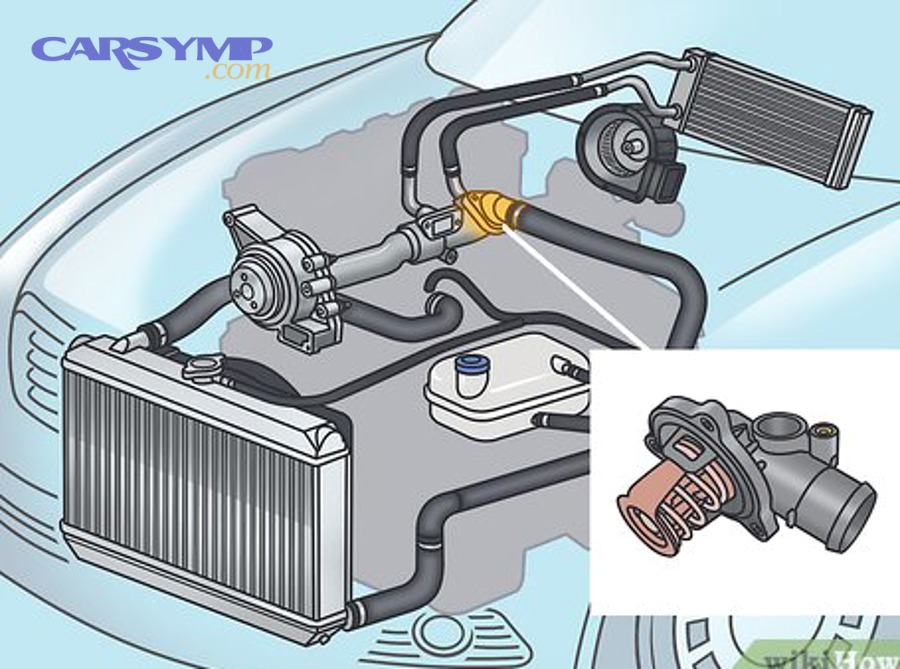
- Thermostat housing seam: a common seep point after a thermostat replacement.
- Radiator end tanks and core seam: especially where plastic meets aluminum.
- Water pump weep hole area: any trail can indicate a failing seal.
- Bleed screws and O-rings: a tiny nick can leak under pressure.
- Heater hose connections at firewall: often hidden but critical.
- Reservoir hose nipples and seams: hairline cracks can vent.
- Radiator cap seal and filler neck: poor sealing can push coolant out.
If you have a hand pressure tester, pressurizing the system to the radiator cap’s rated PSI can reveal leaks without driving. A how-to guide on cooling system pressure testing explains that if the gauge drops after pumping to operating PSI, there’s a leak to find. (onallcylinders.com)
Which repaired parts most commonly cause “still overheating” and how do you verify them?
There are 5 common post-repair “still overheating” causes tied to repaired parts—thermostat function, fan control, radiator flow, pressure cap performance, and water pump circulation—and you verify them by matching symptoms to quick tests rather than swapping parts again.
More importantly, this is where many people waste money: they replace a thermostat, then a radiator, then a fan, without confirming the true failure mode. A structured check prevents the “parts cannon” and helps your overheating repair actually hold.
Is your thermostat actually opening at the right temperature?
Yes, you should confirm the thermostat is opening at the right temperature, because a stuck-closed or misbehaving thermostat can create rapid overheating, poor radiator circulation, and erratic heater output—even if it is brand new.
However, don’t rely on “it’s new” as proof. Verify with simple observations:
- Hose temperature change test: during warm-up, the upper radiator hose often stays cooler until the thermostat opens, then it suddenly becomes hot as flow begins.
- Cabin heat behavior: once warm, heat should be steady; intermittent heat can signal air or flow issues.
- Scan-tool correlation: if you have a scan tool, compare engine coolant temperature (ECT) to gauge behavior to spot sensor/gauge mismatch.
If the engine temperature rises quickly and the radiator stays cool, flow may not be reaching the radiator—thermostat, air lock, or pump/impeller problems are higher on the list.
Are the cooling fans turning on when they should—at idle and with A/C?
Yes, cooling fans should turn on when commanded by temperature and often when the A/C is engaged, because they provide the airflow the radiator needs at idle and low speed, preventing heat soak and temperature creep.
Meanwhile, fan verification is straightforward:
- A/C trigger check: on many vehicles, switching A/C on should command at least one fan on quickly.
- Idle warm-up check: as ECT rises, fans should cycle on and off rather than never running or running constantly.
- Electrical checks: inspect fuses, relays, fan connectors, and grounds for heat damage or corrosion.
- Control module checks: many newer vehicles use a fan control module with variable speed (PWM); a failed module can cause intermittent fan behavior.
A classic symptom map helps:
- Overheats mainly at idle, cools on highway: likely airflow/fan control.
- Overheats on highway too: likely flow restriction, low coolant, pressure loss, or combustion gas intrusion.
How can you tell if the radiator is restricted or not flowing?
A restricted radiator is a heat exchanger that cannot pass enough coolant or cannot shed enough heat, and you can identify it by checking for uneven temperatures, weak flow signs, and pattern-based overheating under load.
Specifically, use a combination of observations:
- Heat pattern: the engine gets hot, fans run, but temperature doesn’t drop much.
- Hose behavior: upper hose is very hot; lower hose stays much cooler than expected (suggesting poor heat transfer or flow).
- Infrared scan (if available): cold spots across the radiator face often suggest internal blockage; a uniformly hot radiator suggests poor airflow instead.
- Debris check: a radiator blocked externally by dirt, bugs, or bent fins can act “restricted” even if internal flow is fine.
This is where the “Radiator replacement vs cleaning decision” becomes practical: if fins are packed with debris or the radiator face is damaged, cleaning and straightening may restore airflow; if internal blockage or end-tank seam issues exist, replacement is often the smarter long-term fix.
Is the radiator cap the correct pressure rating and sealing properly?
Yes, the radiator cap must be the correct pressure rating and seal properly, because cooling system pressure raises the coolant’s boiling point and prevents boil-over that can mimic or cause overheating symptoms.
In addition, the cap is not just a lid. It is a pressure regulator and recovery valve. If it vents too early, coolant can boil at lower temperatures, push into the reservoir, and leave the engine low on coolant.
A training organization for mobile A/C and engine cooling systems explains a widely used rule of thumb: coolant boiling point rises by about 3°F per PSI, so a 15 PSI cap can add roughly 45°F of boiling margin compared with an unpressurized condition. (macsmobileairclimate.org)
Practical verification steps:
- Inspect the rubber seals: cracks, flattening, or missing sections can cause early venting.
- Inspect the filler neck: corrosion or nicks can prevent sealing.
- Confirm the rating: match the PSI rating to the factory specification (not “higher is better” by default).
- Test if possible: a cap tester can confirm the cap holds and releases pressure correctly.
What road-test and heat-cycle routine confirms the repair is stable?
A stable post-repair verification routine is a 3-stage road test plus two cold checks that confirm the system can handle idle heat soak, city cycling, and highway load without overheating, losing coolant, or showing abnormal fan behavior.
Then, treat it as the final “pass/fail” for your overheating repair:
Stage 1: Warm-up validation (driveway/idle)
- Start cold, monitor gauge/ECT, confirm heater on HOT provides consistent heat.
- Confirm the thermostat opens and fans cycle normally.
- Look for bubbles or sudden level drops in the reservoir (if visible).
Stage 2: City loop (10–15 minutes)
- Drive at varying speeds with stoplights to test fan control.
- Watch for creeping temp at idle.
- After parking, let it idle 2–3 minutes to test heat soak.
Stage 3: Highway load (10–20 minutes)
- Drive at steady speed and moderate acceleration.
- Confirm temperature stays stable and does not climb under load.
- After exit, observe how quickly the system stabilizes at lower speed.
Cooldown and recheck
- Park and look for drips.
- After full cooldown, recheck coolant to the cold mark.
- Repeat the next morning: the second cold check is where slow leaks reveal themselves.
Should you recheck coolant level when the engine is hot or cold?
Cold wins for accuracy, hot is best for quick detection—so you should do both, but for different reasons: cold checks give a true reference level, while hot checks reveal abnormal venting, boiling, or overflow behavior.
More specifically:
- Cold check (best for level): coolant contracts, giving a consistent baseline at the reservoir’s “COLD” line.
- Hot check (best for behavior): you can see if the reservoir rises excessively or vents, which can point to cap issues, boiling, or combustion gas intrusion.
Safety rule: never open a radiator cap on a hot engine. Use the reservoir markings and visual inspection instead.
What temperature readings are “normal” versus “danger” after repair?
Normal temperature readings are the stable operating range your vehicle was designed to hold under typical conditions, while danger readings are temperatures that climb continuously, trigger warnings, or approach boiling risk—especially if the system is losing pressure or coolant.
However, many drivers rely only on the dash gauge, which may be buffered and not linear. Use a scan tool if you can. Your practical “danger logic” should be based on trend:
- Normal: rises to operating temp, then stabilizes; fans cycle and temp responds.
- Danger: keeps climbing at idle or under load; fans don’t change behavior; heater goes cold; you smell coolant or see steam.
A pressure-cap discussion from an industry training organization notes that with a typical pressurized system, boiling risk is pushed much higher than many drivers assume, which is why “creeping to 210–220°F” is not automatically a crisis in many vehicles—what matters is whether it stabilizes or continues to rise. (macsmobileairclimate.org)
What should you do if the car overheats again right after repair?
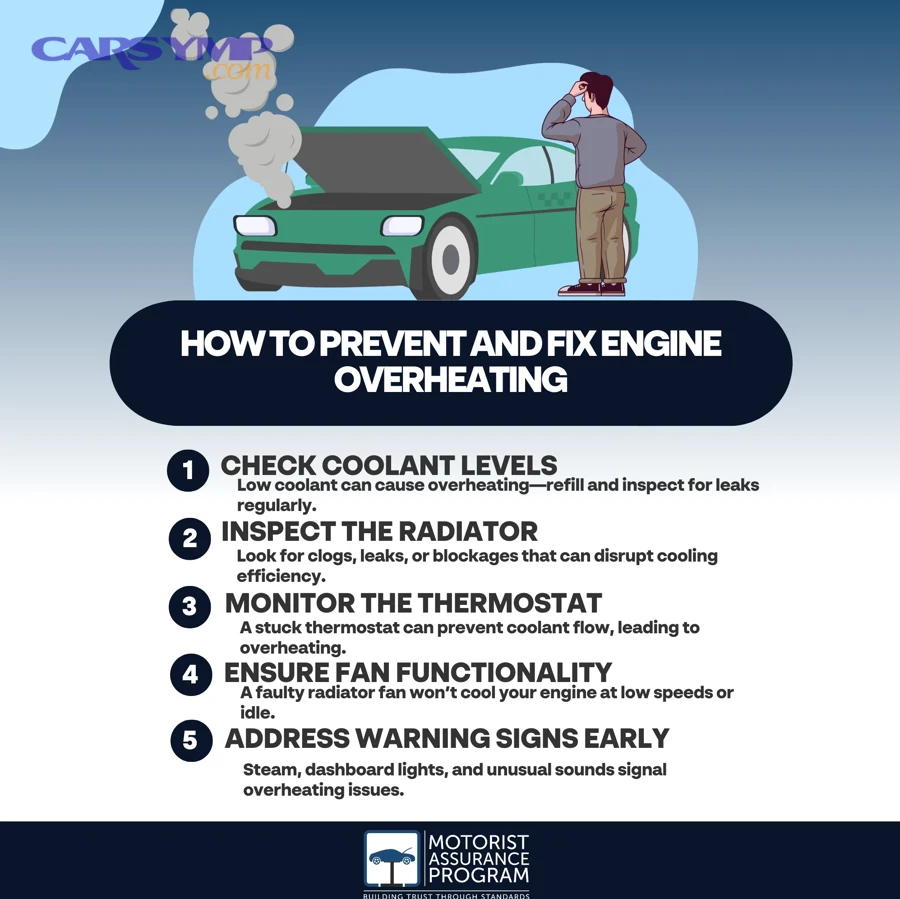
If the car overheats again right after repair, the safest response is a 4-step emergency routine: reduce load, pull over, cool down safely, and diagnose the cause before driving again, because repeated overheating can warp components and turn a fixable issue into major engine damage.
Next, act early—waiting until the gauge is buried can create expensive consequences.
Should you keep driving if the temperature rises after a repair?
No, you should not keep driving if the temperature continues rising after a repair, because (1) overheating can warp cylinder head surfaces, (2) boiling coolant can force coolant out and leave the engine dry, and (3) continued heat can damage hoses, seals, and the head gasket.
More specifically, “keep driving” only makes sense if the temperature briefly rises and immediately stabilizes after you reduce load and airflow improves—otherwise you should treat it as an active overheating event.
Your safe action sequence:
- Turn off A/C and reduce load.
- Turn heater to HOT and fan to high (if it helps, it can pull heat from coolant).
- Pull over as soon as safely possible.
- Shut down and let it cool before inspecting.
Which actions can make overheating worse (and should be avoided)?
There are 6 actions that make overheating worse, and each one increases the chance of injury or engine damage:
- Opening the radiator cap while hot (steam and scalding coolant risk).
- Pouring cold water into a hot engine (thermal shock risk).
- Ignoring steam (you are likely losing coolant rapidly).
- Driving with a low-coolant warning (hot spots form fast).
- Over-revving a hot engine (adds heat and pressure).
- Using stop-leak as a primary fix (can clog passages and worsen flow).
If overheating repeats after your initial bleed and inspection, stop treating it as “still needs more air out” and start treating it as: pressure loss, flow restriction, fan control failure, or combustion gas intrusion until proven otherwise.
What long-term maintenance and edge-case checks help prevent repeat overheating in the future?
Long-term prevention is a maintenance and verification strategy that reduces the root causes of repeat overheating—coolant degradation, airflow blockage, weak hoses/caps, and hidden pressure leaks—while also covering rare edge cases like coolant incompatibility and combustion gas intrusion.
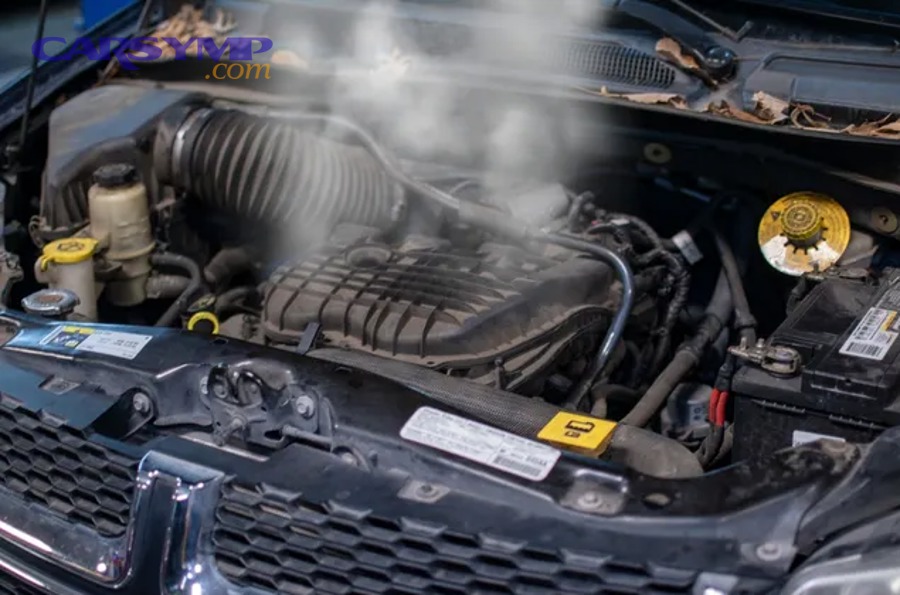
In addition, this is where you build “cooling system resilience” so your next hot day, long climb, or traffic jam doesn’t undo your overheating repair.
What maintenance schedule best prevents overheating—coolant service, inspections, and cleaning?
There are 4 main maintenance groups that prevent repeat overheating: coolant condition, pressure integrity, airflow efficiency, and hose/clamp integrity.
More specifically, use this practical schedule (adjust to your vehicle manual if it specifies different intervals):
- Every month (or every 1,000 miles):
- Check reservoir level (cold).
- Quick visual scan for wetness/crust at joints.
- Every oil change:
- Inspect hoses for soft spots, swelling, or cracks.
- Inspect radiator fins for debris and bent sections.
- Confirm fans operate when engine warms or A/C is on.
- Every 1–2 years (or as specified):
- Replace radiator cap if it tests weak or shows seal wear.
- Refresh coolant if testing shows poor concentration or contamination.
- After any cooling-system work:
- Repeat the staged road test and cold recheck routine.
A simple airflow step prevents many “mystery overheating” complaints: clean the radiator and condenser face (gently) so the fan and ram air can actually pass through.
Can mixing coolant types cause overheating even after a successful repair?
Yes, mixing coolant types can contribute to overheating later, because it can (1) reduce corrosion protection, (2) form deposits or gel in bad combinations, and (3) narrow passages that reduce flow and heat transfer.
However, the risk depends on which chemistries are mixed and the condition of the system. The safest habit is consistency: use the coolant specification your vehicle calls for, avoid “universal” top-offs unless they are truly approved for your spec, and flush properly when switching types.
If you suspect contamination or incompatible mixing, don’t keep “topping off and hoping.” Drain, flush, and refill correctly so the system returns to known chemistry and concentration.
When is combustion-gas testing warranted after repeat overheating?
Combustion-gas testing is warranted when repeat overheating shows patterns that bleeding and leak checks cannot explain, especially if the system builds pressure abnormally fast, pushes coolant out repeatedly, or shows signs of combustion gases entering the cooling system.
More specifically, consider testing if you see any of these:
- The upper hose becomes rock-hard quickly from cold start.
- The reservoir bubbles continuously after warm-up.
- Coolant pushes out even with a verified cap and correct fill level.
- Overheating happens under load and returns quickly after cooldown.
In those cases, a block test (combustion gas test) can help you confirm whether gases are entering the coolant, which changes pressure behavior and can force coolant out even when there is no external leak.
Should you use a vacuum fill tool vs a spill-free funnel after repair?
A vacuum fill tool wins for air removal reliability, a spill-free funnel is best for simplicity, and your best choice depends on system complexity: vacuum fill is optimal for stubborn air pockets and complex systems, while a spill-free funnel is often sufficient for straightforward refills.
Meanwhile, the advantage of vacuum filling is that it evacuates air first, then draws coolant in with reduced chance of leaving bubbles behind. A performance-oriented automotive article describing a vacuum purge/refill kit explains that the tool creates a vacuum and draws in coolant with “little or no chance of creating air bubbles,” which is exactly what you want after a repair. (onallcylinders.com)
If you want a visual walk-through, this video demonstrates what a vacuum coolant refiller is and why it’s used:
Decision guide:
- Choose vacuum fill if: the vehicle is known for air locks, the fill point is low, the system was fully drained, or you’ve already had repeat overheating after “normal bleeding.”
- Choose spill-free funnel if: you did a partial drain, the vehicle bleeds easily, and you can confirm stable temps after the road test.
Evidence (selected)
- Cooling system pressure meaningfully raises boiling margin; a commonly cited rule is ~3°F boiling increase per PSI, so a 15 PSI cap can add ~45°F of margin. (macsmobileairclimate.org)
- Trapped air can prevent coolant circulation and create hot spots that lead to overheating; proper bleeding steps are recommended to eliminate air pockets after service. (ericscarcare.com)
- Vacuum purge/refill tools reduce air bubble formation by drawing coolant in under vacuum and can also support pressure testing for leaks. (onallcylinders.com)