


Loose exhaust hangers and clamps cause rattling noises, vibrations, and potential safety hazards that require immediate attention through proper diagnosis and repair. The exhaust mounting system relies on rubber isolators and metal clamps to suspend the exhaust securely beneath your vehicle, and when these components fail, the entire exhaust can sag, drag, or even detach completely while driving.
Understanding the warning signs helps you catch problems early before they escalate into expensive repairs. A rattling noise under car during acceleration, visible exhaust pipe sagging, or increased exhaust noise all indicate failing hangers or clamps that need replacement. These symptoms often appear gradually as rubber isolators dry out from heat exposure or metal clamps rust from road salt and moisture.
The repair process involves identifying which components have failed, selecting the correct replacement parts, and following proper installation procedures to ensure long-lasting results. DIY repairs can save significant money on labor costs, but certain situations require professional expertise, especially when welding or complete exhaust section replacement becomes necessary.
Prevention strategies extend the life of your exhaust mounting system and reduce the frequency of repairs. Next, we’ll explore exactly what these components are and how they function to keep your exhaust system properly positioned.
What Are Loose Exhaust Hanger and Clamp Problems?
Loose exhaust hanger and clamp problems occur when the rubber isolators or metal fasteners that suspend the exhaust system beneath the vehicle fail to maintain secure connections, allowing excessive movement, sagging, or separation of exhaust components. These mounting failures compromise the exhaust system’s structural integrity and create dangerous driving conditions.
To better understand these issues, we need to examine the specific roles each component plays in the exhaust mounting system.
What Do Exhaust Hangers Do?
Exhaust hangers serve two critical functions: supporting the weight of the exhaust system and isolating vibrations from reaching the vehicle’s cabin. The modern hanger design consists of a rubber isolator bushing that fits between metal pegs welded to the exhaust pipe and brackets attached to the vehicle’s underbody. This rubber component absorbs engine vibrations and road shock while allowing the exhaust to move slightly with normal engine movement.
The peg system features arrow-shaped metal rods with cone-shaped tips that pass through the rubber isolator. The large cone prevents the peg from sliding back out once installed, creating a secure yet flexible connection. When the rubber deteriorates, cracks, or breaks, the exhaust loses support at that mounting point and begins to sag toward the ground.
Universal strap hangers represent an older design still found on some vehicles and aftermarket exhaust kits. These consist of a rubber strip with multiple holes for chassis mounting and a metal bracket on one end that secures to the exhaust pipe using a U-bolt clamp. While functional, this design requires more frequent maintenance because the U-bolt connection can loosen over time.
What Types of Exhaust Clamps Exist?
Four main types of exhaust clamps secure different connection points throughout the exhaust system: U-bolt clamps, band clamps, V-band clamps, and ball-and-socket clamps. Each design addresses specific engineering requirements based on the connection type, pipe diameter, and expected stress levels.
U-bolt clamps consist of a U-shaped bolt that wraps around the exhaust pipe with a metal saddle plate on top. Two nuts tighten down on the threaded ends to compress the saddle against the pipe. These clamps work well for securing hangers and slip-fit pipe connections but provide the weakest sealing force among all clamp types. They’re commonly found on budget exhaust systems and universal repair kits because they’re inexpensive and easy to install.
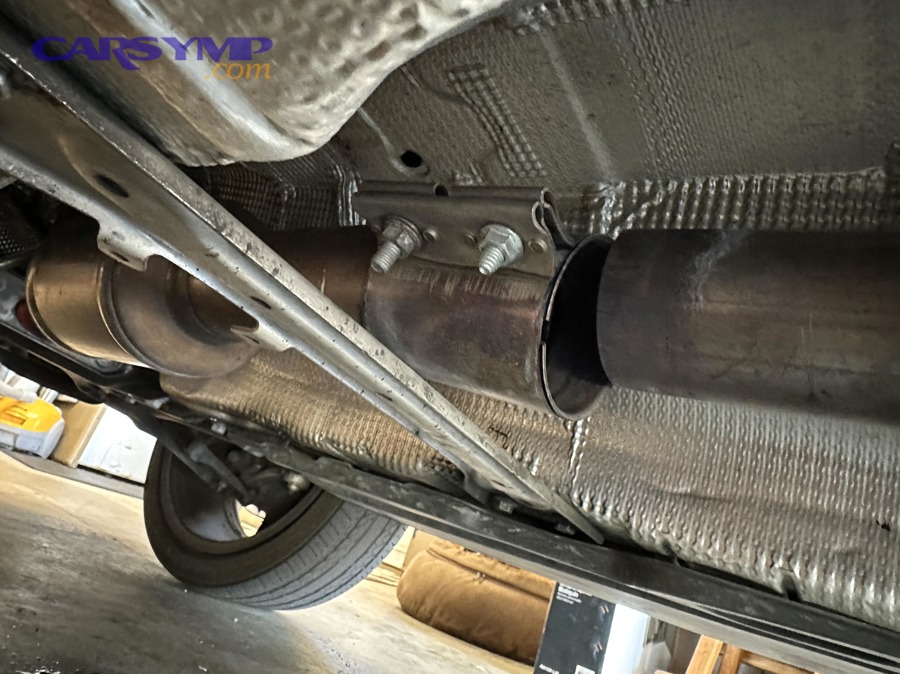
Band clamps, also called flat band clamps, wrap completely around the pipe circumference and tighten via a bolt mechanism. This design distributes clamping force more evenly than U-bolt clamps and creates better sealing at slip-fit connections. Most factory exhaust systems use band clamps at critical connection points where exhaust leaks would cause emissions problems or performance issues.
V-band clamps represent the highest quality connection method for performance and racing applications. These clamps feature machined flanges welded to each pipe end that interlock when the V-band ring tightens around them. The design creates an extremely secure, leak-proof connection that can withstand high exhaust temperatures and pressures. However, V-band clamps require professional installation because the flanges must be precisely welded to the pipes.
Ball-and-socket clamps allow angular movement between connected pipes, making them ideal for locations where the exhaust must flex with engine movement. These specialized clamps cost more than standard designs but prevent stress fractures in the exhaust system caused by rigid connections.
What Are the Symptoms of Failing Exhaust Hangers and Clamps?
The main symptoms of failing exhaust hangers and clamps include rattling or clunking noises from underneath the vehicle, visible exhaust pipe sagging, increased exhaust noise during acceleration, vibrations felt through the floor or seat, and exhaust components hanging lower than normal. These warning signs typically appear gradually as components deteriorate but can occur suddenly after impact damage.
Recognizing these symptoms early prevents minor issues from escalating into major repairs. Let’s examine the specific indicators in detail.
What Sounds Indicate Loose Exhaust Components?
Rattling, clunking, and dragging sounds from beneath the vehicle directly indicate loose exhaust mounting components. A metallic rattling noise under car acceleration occurs when broken hangers allow the exhaust to bounce against the underbody, heat shields, or suspension components. This rattling intensifies over bumps and rough roads as the unsupported exhaust moves more violently.
Clunking sounds happen when the exhaust shifts position suddenly, particularly during gear changes or hard acceleration when engine torque causes maximum exhaust movement. The clunk represents the exhaust pipe hitting its travel limit against a chassis component or the hanger reaching the end of its range of motion.
Dragging or scraping noises indicate the exhaust has sagged low enough to contact the road surface during driving. This extremely dangerous condition can cause the exhaust to catch on speed bumps, potholes, or uneven pavement and tear completely free from the vehicle. Any scraping sound requires immediate repair to prevent total exhaust system failure.
A deep rumbling or throaty exhaust note that suddenly becomes louder suggests a clamp has loosened at a slip-fit connection, creating an exhaust leak. The leak allows high-pressure exhaust gases to escape before reaching the muffler, bypassing the sound-dampening chambers that normally quiet the exhaust. This leak also disrupts exhaust backpressure, potentially affecting engine performance.
Catalytic converter internal rattle signs present differently than loose mounting components. A rattling that only occurs at idle or low RPMs and comes from the middle section of the exhaust typically indicates broken ceramic substrate inside the catalytic converter. This internal rattle sounds higher-pitched and more metallic than the low-frequency clunking of loose hangers.
What Visual Signs Show Hanger or Clamp Failure?
Sagging exhaust pipes represent the most obvious visual indicator of hanger failure. The exhaust should maintain consistent ground clearance along its entire length, typically hanging 4-6 inches above the lowest point of the vehicle’s frame. When one or more hangers break, that section drops noticeably lower than adjacent sections, creating an uneven appearance.
Broken rubber isolators show obvious cracks, tears, or complete separation when inspected closely. The rubber material should appear uniform and intact, stretching slightly when the exhaust moves but returning to its original shape. Deteriorated rubber looks dry, cracked, or chalky, with visible stress fractures radiating from the mounting holes. Complete separation occurs when the rubber tears through, leaving the metal peg hanging freely without support.
Rust on clamps compromises their structural integrity and sealing ability. Surface rust appears as orange or brown discoloration on the clamp body but doesn’t necessarily require replacement. Deep rust that creates pitting, flaking, or visible corrosion holes indicates the clamp has lost significant strength and will likely fail soon. Rust specifically around the bolt threads makes the clamp difficult or impossible to tighten properly.
Missing components are sometimes difficult to notice during casual inspection but become obvious when you know what to look for. Count the number of hangers along the exhaust and compare them to factory specifications or the obvious mounting points. Missing clamps at slip-fit connections leave visible gaps between pipe sections where they should overlap by at least ¾ inch.
Exhaust components hanging at odd angles or rotated from their normal position indicate multiple mounting failures or improper installation. The exhaust pipes should run parallel to the vehicle’s frame rails and maintain consistent spacing from surrounding components. Twisted or misaligned sections create stress points that accelerate wear on remaining hangers and increase the risk of exhaust leaks.
Can Loose Hangers Cause Engine Performance Issues?
Yes, loose hangers can cause engine performance issues through exhaust leaks that trigger emissions test failures, check engine lights, and altered air-fuel ratios. When clamps loosen at connection points, exhaust gases escape before passing through emissions control components, disrupting the carefully calibrated exhaust system operation.
The P-0420 diagnostic trouble code specifically indicates catalyst system efficiency below threshold, often caused by exhaust leaks near the catalytic converter. Modern vehicles use oxygen sensors before and after the catalytic converter to monitor its performance. When a loose clamp creates a leak between these sensors, fresh air gets drawn into the exhaust stream during the negative pressure pulses created by engine operation. This introduces extra oxygen that confuses the sensors, making them report that the catalytic converter isn’t functioning properly even when the converter itself works perfectly.
Exhaust leaks upstream of the oxygen sensors can cause the engine control computer to incorrectly adjust the air-fuel mixture. The sensors detect excess oxygen from the leak and signal the computer to add more fuel, enriching the mixture beyond optimal levels. This rich condition wastes fuel, increases emissions, and can eventually damage the catalytic converter through excessive unburned hydrocarbons.
Emissions testing failures occur when loose exhaust components create leaks that allow unmeasured gases to escape. Most jurisdictions measure emissions at the tailpipe outlet, but some testing equipment includes sniffer probes that detect leaks anywhere along the exhaust system. Even small leaks can cause test failures by exceeding allowable limits for hydrocarbons, carbon monoxide, or nitrogen oxides.
Backpressure changes from loose connections or separated pipes affect engine performance, particularly on turbocharged vehicles. The exhaust system maintains specific backpressure levels that help scavenge exhaust gases from cylinders during valve overlap. Too little backpressure from exhaust leaks reduces low-end torque and can cause rough idle or hesitation during acceleration.
What Causes Exhaust Hangers and Clamps to Become Loose?
Exhaust hangers and clamps become loose primarily due to heat-accelerated rubber deterioration, road salt corrosion, impact damage from road hazards, vibration-induced fatigue, and normal wear from thermal expansion cycles. These failure mechanisms often work together, with one type of damage accelerating the progression of others.
Understanding the root causes helps you prevent premature failures through proper maintenance and driving habits. Let’s examine each cause in detail.
How Does Rust and Corrosion Affect Exhaust Mounting?
Rust and corrosion attack metal exhaust clamps and brackets through electrochemical reactions accelerated by road salt, moisture, and high temperatures. Road salt used for winter ice control contains sodium chloride and calcium chloride that dissolve in water and create a highly corrosive electrolyte solution. When this solution splashes onto exhaust components, it penetrates surface coatings and initiates oxidation of the underlying steel.
The corrosion process weakens metal in two distinct ways. Surface corrosion creates rough, flaky rust that reduces the effective thickness of clamp bands and brackets, diminishing their clamping force and structural strength. Pitting corrosion creates deep holes that concentrate stress and can lead to sudden failure even when surrounding metal appears sound.
Exhaust system temperatures accelerate corrosion rates significantly. Metal surfaces that reach 300-500°F during operation experience condensation when the vehicle sits idle and cools. This condensation combines with road salt residue to form a corrosive solution that attacks the metal during thermal cycles. The repeated heating and cooling creates stress cycles that crack protective coatings, exposing fresh metal to corrosion.
Dissimilar metal galvanic corrosion occurs when different metals contact each other in the presence of an electrolyte. Stainless steel exhaust pipes connected to mild steel clamps with aluminum heat shields create galvanic cells where the less noble metal corrodes preferentially. This explains why clamps and brackets often rust severely while the exhaust pipes they hold remain relatively intact.
Crevice corrosion develops in tight spaces where moisture accumulates but air circulation is limited. The gap between a band clamp and the pipe surface creates the perfect environment for this type of attack. Oxygen-depleted water in the crevice becomes more acidic and corrosive than the surrounding environment, eating through the metal from the inside out.
According to research by the National Association of Corrosion Engineers, road salt exposure can reduce exhaust component lifespan by 40-60% compared to vehicles operated in salt-free environments. This explains why exhaust repairs are far more common in northern climates where salt use is heavy during winter months.
What Impact Damage Causes Hanger Failures?
Impact damage from potholes, speed bumps, road debris, and curb strikes causes immediate hanger and clamp failures by exceeding the design limits of mounting components. Potholes create the most common form of impact damage when a tire drops into a depression and the vehicle’s momentum carries the chassis downward faster than the suspension can react. The exhaust system’s inertia keeps it moving upward relative to the chassis, creating violent compression of rubber hangers and shock loads on clamps.
Speed bumps produce similar damage when drivers cross them too quickly. The chassis rises rapidly over the bump while the exhaust lags behind due to its mass, stretching hangers beyond their elastic limit. This overstretching permanently deforms the rubber, creating loose connections that allow excessive exhaust movement during normal driving. High-profile vehicles face particular risk because their increased ground clearance allows more potential travel before the exhaust contacts the bump surface.
Undercarriage strikes against road debris, parking curbs, or off-road obstacles can knock the exhaust completely out of position. A direct impact on the exhaust pipe bends mounting brackets, tears hangers from their mounting points, and can even dent or crush the pipe itself. These strikes often break multiple mounting points simultaneously, causing the entire exhaust to hang at a severe angle.
Accident damage affects exhaust mounting even in relatively minor collisions. Rear-end impacts transmit force through the vehicle structure to exhaust mounting points, particularly those attached to the rear axle or frame rails. Side impacts can push body panels into the exhaust system, bending pipes and breaking hangers on the impacted side.
Off-road driving subjects exhaust components to repeated impacts and vibrations that accelerate fatigue failures. Even vehicles designed for off-road use eventually experience mounting failures when operated regularly in rough terrain. The combination of vertical impacts from bumps and lateral forces from articulating suspension eventually overstresses hangers and loosens clamps.
Why Do Rubber Hangers Dry Out and Crack?
Rubber exhaust hangers dry out and crack due to continuous heat exposure, ozone degradation, UV radiation, and normal material aging that breaks down the polymer chains within the rubber compound. Heat represents the primary aging mechanism because exhaust temperatures regularly reach 300-800°F, with rubber hangers positioned just inches away from this heat source.
The heat-aging process causes cross-linking of rubber polymer chains, making the material progressively harder and more brittle over time. Fresh rubber feels soft and pliable, stretching easily when pulled. Aged rubber becomes stiff and inflexible, developing surface cracks that propagate deeper with each thermal cycle. Eventually, the cracks extend completely through the rubber, causing sudden failure.
Ozone in the atmosphere attacks rubber through oxidation reactions that break carbon-carbon double bonds in the polymer chains. This ozone cracking appears as fine surface cracks oriented perpendicular to stress lines in the rubber. Hangers under constant tension show obvious cracking patterns radiating from the mounting holes where stress concentration is highest. Environmental ozone levels vary by location, with urban areas experiencing higher concentrations that accelerate rubber degradation.
UV radiation from sunlight degrades rubber through photochemical reactions that cleave polymer chains. Exposed rubber hangers on the outer edges of the exhaust system experience more severe UV damage than those positioned closer to the center of the vehicle where they’re shaded. This explains why outer hangers often fail first on vehicles parked outdoors regularly.
Material fatigue from cyclic loading contributes to rubber hanger failures independent of chemical degradation. Every acceleration, deceleration, and bump creates stress cycles as the exhaust moves relative to the chassis. These stress cycles create micro-tears in the rubber that gradually coalesce into visible cracks. High-performance vehicles with heavy exhaust systems experience accelerated fatigue damage due to increased loads.
According to a study by the Rubber Manufacturers Association, typical automotive rubber components lose approximately 10% of their physical properties per year when exposed to normal operating conditions. This means a rubber hanger reaches critical degradation levels after 5-7 years of service, regardless of mileage.
How Do You Fix Loose Exhaust Hangers and Clamps?
You fix loose exhaust hangers and clamps through a systematic process of inspection, diagnosis, part replacement, proper alignment, and secure fastening that restores the exhaust system’s structural integrity and eliminates excessive movement. The repair typically takes 1-3 hours depending on the number of failed components and accessibility.
Successful repairs require the correct parts, appropriate tools, and proper installation procedures. Let’s examine each repair method in detail.
How Do You Replace Broken Rubber Exhaust Hangers?
Replacing broken rubber exhaust hangers requires supporting the exhaust weight, removing old hangers, installing new isolators, and verifying proper alignment before lowering the support. Start by raising the vehicle on jack stands to gain safe access to the underside, ensuring the vehicle is stable and secure before working underneath.
Support the exhaust section near the broken hanger using a floor jack with a block of wood between the jack pad and the exhaust pipe. The wood distributes load and prevents denting the pipe. Raise the jack until it barely contacts the exhaust, taking no weight yet. This positioning allows you to lower the exhaust slightly for hanger removal and raise it back into position for installation.
Remove the old hanger by pulling the rubber isolator off the metal pegs. Fresh hangers require significant force to remove because the rubber grips tightly around the cone-shaped peg tips. Deteriorated hangers often pull apart with minimal effort, confirming they needed replacement. If the rubber is severely degraded, you may need to cut it away with a utility knife to access the mounting points.
Some hanger designs bolt to the chassis rather than using pegs. For these applications, remove the mounting bolts using a socket wrench, then detach the hanger from the exhaust pipe bracket. Apply penetrating oil to rusted bolts several hours before beginning the repair to ease removal. Seized bolts sometimes require heat from a propane torch to break the corrosion bond.
Install the new rubber isolator by first positioning it on the chassis-mounted peg or bolt, then raising the exhaust with the floor jack to align the exhaust-mounted peg with the isolator. Push the pegs into the rubber, which requires substantial force. Some technicians lubricate the pegs with soapy water to ease installation, though this reduces initial grip. The rubber’s natural elasticity eventually creates full tension once the lubricant dries.
Verify proper alignment by checking that the exhaust hangs level without twisting or binding against other components. The pipes should maintain consistent clearance from the chassis, typically 1-2 inches minimum. Insufficient clearance causes contact that wears through heat shields or damages wiring and brake lines. Excessive clearance indicates misalignment that needs correction before lowering the support.
Lower the floor jack slowly while observing the exhaust position. The hangers should support the weight evenly without excessive deflection. Properly installed hangers show slight compression but should not stretch to their maximum extension. Start the engine and verify that the exhaust doesn’t contact surrounding components during engine vibration.
The table below shows typical replacement intervals for rubber exhaust hangers based on operating conditions:
| Operating Condition | Expected Lifespan | Replacement Interval |
|---|---|---|
| Moderate climate, highway driving | 7-10 years | Inspect at 60,000 miles |
| Salt belt winter operation | 4-6 years | Inspect at 40,000 miles |
| High-performance/heavy exhaust | 3-5 years | Inspect at 30,000 miles |
| Extreme heat climates | 5-7 years | Inspect at 50,000 miles |
How Do You Tighten or Replace Exhaust Clamps?
Tightening or replacing exhaust clamps involves inspecting the clamp condition, determining whether tightening or replacement is necessary, positioning the clamp correctly, and torquing the fasteners to manufacturer specifications. Begin by cleaning the clamp area with a wire brush to remove rust and debris that prevents proper inspection.
Inspect the clamp for damage, corrosion, and thread condition. Acceptable clamps show minimal surface rust with intact threads and no cracks in the clamp body. Replace clamps that show deep pitting, thread damage, cracks, or severe corrosion. Attempting to tighten damaged clamps often results in bolt breakage or failure to maintain clamping force.
For clamps that pass inspection, loosen the fastener completely before attempting to reposition or tighten. This allows the clamp to move freely around the pipe and ensures even pressure distribution when retightened. Clean the pipe surface in the clamping area to remove carbon deposits and rust that create high spots preventing good sealing.
Position band clamps so the bolt mechanism sits on top of or beside the pipe, not underneath where it can contact the ground. The pipe overlap at slip-fit connections should measure ¾ to 3 inches for optimal strength and sealing. Insufficient overlap creates weak joints prone to separation, while excessive overlap restricts exhaust flow and may interfere with other components.
Apply anti-seize compound to the clamp bolt threads before tightening. This prevents thread galling from high temperatures and corrosion, making future removal possible. Do not use standard lubricants like WD-40, which evaporate quickly under exhaust heat and provide no long-term protection.
Tighten band clamps to 30-40 ft-lbs torque using a torque wrench for optimal results. Hand-tightening without a torque wrench often under-tightens the clamp, allowing subsequent loosening. Over-tightening crushes the pipe or strips the threads, creating a failure that requires emergency repairs. U-bolt clamps require less torque, typically 15-25 ft-lbs, because they concentrate force in two smaller areas.
The double-clamping technique provides enhanced holding power for problem connections that repeatedly loosen. Install the first clamp normally, then add a second clamp immediately adjacent, oriented 180 degrees relative to the first. This creates even pressure distribution around the entire pipe circumference and prevents rotational movement. Position the clamps close together with their edges nearly touching for maximum effectiveness.
Reusable clamps must show no signs of thread damage, stretching, or deformation. Examine the threads carefully with a flashlight, looking for pulled or crossed threads that indicate previous over-tightening. Test-fit the clamp on a similar diameter pipe to verify it still provides adequate clamping range. Stretched clamps reach maximum thread engagement before achieving sufficient clamping force, making them unsuitable for reuse regardless of appearance.
According to Walker Exhaust Systems technical documentation, properly installed exhaust clamps should maintain clamping force for the life of the exhaust system when protected from corrosion. However, real-world conditions often require clamp inspection and potential replacement every 3-5 years.
How Do You Neutralize Exhaust System Load?
Neutralizing exhaust system load involves loosening all connection points, repositioning the exhaust to eliminate hanger stress, verifying proper component alignment, and retightening all fasteners in sequence to achieve optimal load distribution across all mounting points. This critical procedure prevents premature hanger failure and excessive noise from improperly stressed components.
Begin the neutralization process by warming the vehicle to operating temperature, which causes the exhaust to expand to its normal operating length and position. Performing this procedure on a cold exhaust results in incorrect positioning because the system will shift when heated during subsequent operation. Allow the engine to run for 10-15 minutes, then shut it off and work quickly before the system cools significantly.
Loosen all exhaust clamps, flange bolts, and hanger connection points along the entire exhaust system. Do not remove fasteners completely, but loosen them enough to allow the exhaust to move freely in all directions. This typically means loosening clamps until they’re hand-tight only, and backing off flange bolts until threads barely engage.
Reposition affected exhaust components by grasping the pipes and gently moving them until rubber hangers hang freely without tension in any direction. Properly positioned hangers show slight compression from the exhaust weight but no stretching, twisting, or binding. The exhaust pipes should hang parallel to the chassis with consistent clearance from surrounding components.
Check slip-fit connections to ensure pipes overlap within the recommended ¾ to 3-inch range. Insufficient overlap weakens the joint and increases leak risk, while excessive overlap restricts exhaust flow and may interfere with other components. Mark the correct overlap position with a paint marker to maintain it during final tightening.
Inspect flange connections for proper gasket compression and bolt hole alignment. Flanges should mate flush with no visible gaps that indicate misalignment. Replace crushed or damaged gaskets before proceeding, as they cannot seal properly after the initial compression cycle.
Tighten all connection points starting from the engine and working toward the rear of the vehicle. This sequence prevents creating stress at the forward connections that would pull the rear of the exhaust out of position. Tighten clamps to specification using a torque wrench, then move to the next connection point rearward.
Verify final alignment by starting the engine and observing the exhaust during operation. The system should vibrate slightly but maintain consistent clearance from all surrounding components. Listen for contact noises that indicate insufficient clearance or misalignment requiring adjustment.
The neutralization procedure is particularly critical after installing aftermarket exhaust systems or replacing major sections. Factory exhaust systems are pre-aligned during manufacturing, but aftermarket systems require field neutralization to account for tolerance variations and installation differences.
What Temporary Fixes Can You Use for Emergency Repairs?
Temporary emergency fixes for loose exhaust hangers and clamps include wire coat hanger supports, exhaust repair tape, pipe clamp splices, and makeshift isolator reinforcements that restore basic functionality until permanent repairs can be performed. These solutions work for days to weeks depending on driving conditions but should never be considered permanent.
Wire coat hanger exhaust supports represent the most common roadside repair method. Straighten a wire coat hanger and wrap it around the exhaust pipe, then secure it to a nearby chassis component like a suspension arm or frame rail. Use multiple wraps to create a strong support point, and ensure the wire cannot slip along the pipe. This method works surprisingly well for emergency situations but exposes the wire to high temperatures that eventually anneal the metal and cause failure.
Exhaust repair tape creates temporary seals at leaking clamp connections or small holes. This high-temperature aluminum tape withstands exhaust heat and provides gas-tight sealing when properly applied. Clean the pipe surface thoroughly with a wire brush, wrap the tape around the damaged area with 50% overlap on each turn, and press it firmly to eliminate air bubbles. The repair typically lasts several hundred miles before heat and vibration cause the tape to delaminate.
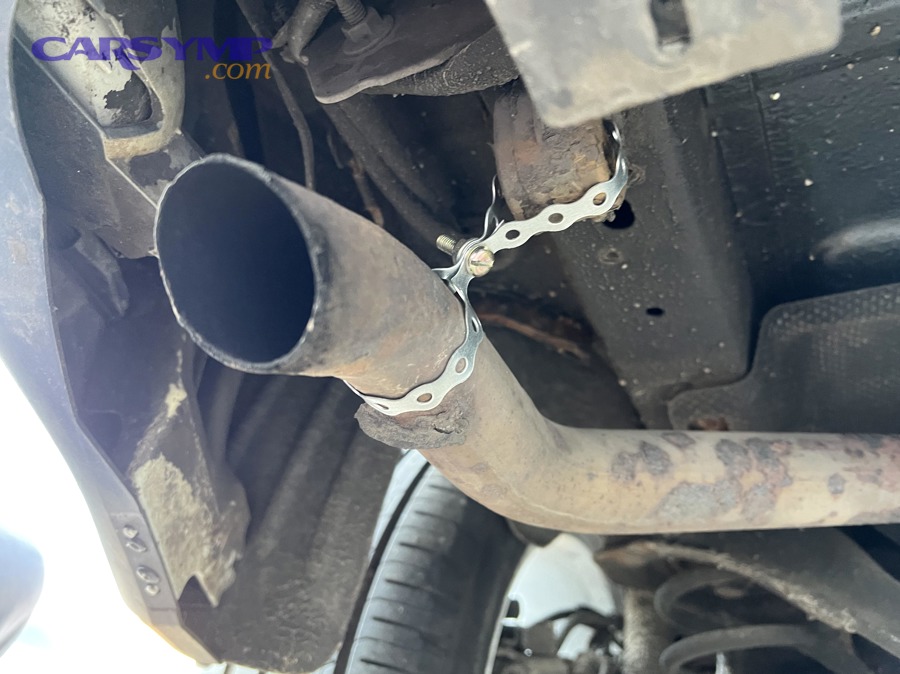
Pipe clamp splices use hardware store plumbing clamps to secure separated exhaust sections. Purchase clamps sized for the outside diameter of the exhaust pipe, typically 2-3 inches for most applications. Install one clamp on each side of the separation, tightening them to draw the pipes back together. This creates a rigid connection that prevents further separation but may leak exhaust gases if the pipes don’t align perfectly.
Makeshift isolator reinforcement using hose clamps can extend the life of cracking rubber hangers for short periods. Wrap a large hose clamp around the rubber isolator perpendicular to the stress cracks, positioning it to compress the crack faces together. Tighten the clamp moderately, not so tight that it crushes the rubber but firm enough to prevent crack propagation. This technique can add several days of service life to a failing hanger.
Exhaust sealant paste provides temporary leak repair at clamp connections. Apply the paste to the pipe overlap area before tightening the clamp, which helps seal small gaps and irregularities. High-temperature exhaust sealants remain pliable up to 2000°F and can seal minor leaks for several months. However, sealants cannot compensate for improperly sized clamps or severely damaged pipes.
Important safety note: All temporary repairs should be considered emergency measures only. Driving extended distances with compromised exhaust mounting risks complete exhaust system failure, which can damage fuel lines, brake lines, or electrical wiring if the exhaust contacts these components. Schedule permanent repairs as quickly as possible after implementing temporary fixes.
When Should You Replace vs Repair Exhaust Components?
You should replace exhaust components when corrosion damage exceeds 30% of the material thickness, when structural integrity is compromised, when the cost of multiple repairs approaches replacement cost, or when safety concerns outweigh repair viability. Repair is appropriate when damage is localized, components remain structurally sound, and replacement parts are unavailable or prohibitively expensive.
Making the correct decision between repair and replacement saves money while maintaining safety. Let’s examine the key decision factors.
Can You Reuse Old Exhaust Clamps?
You can reuse old exhaust clamps if they show no thread damage, maintain adequate clamping range, exhibit only surface rust without pitting, and have not been over-torqued previously. Inspection criteria determine reusability more accurately than age or mileage alone.
Thread condition represents the most critical inspection point. Examine threads carefully under good lighting, looking for cross-threading, stripped sections, or metal pulled from the thread valleys. Roll the nut onto the bolt by hand through the entire range of travel—it should thread smoothly without binding or requiring force. Damaged threads cause uneven clamping force and often fail catastrophically shortly after installation.
Clamping range measures the distance from minimum to maximum diameter the clamp can secure. Test this by installing the clamp on a pipe of the correct diameter and tightening until the clamp body begins to close. At least ½ inch of gap should remain between the clamp ears at full tightening. Insufficient gap indicates the clamp has stretched from previous over-tightening and cannot generate adequate clamping force.
Surface rust appears as light orange or brown discoloration that easily removes with a wire brush. This superficial corrosion doesn’t affect structural strength and actually improves reusability by providing a rough surface that resists loosening from vibration. Deep rust creates pitting—small craters in the metal surface that reduce effective thickness. Pitting depth exceeding 25% of the material thickness makes the clamp unsuitable for reuse.
Previous over-tightening is often difficult to detect visually but reveals itself during installation. Clamps that were tightened excessively show permanent deformation where the metal has yielded beyond its elastic limit. The clamp body may appear bent or twisted, and the bolt may be permanently bent near the clamp body. These deformations create stress concentrations that lead to premature failure.
Band clamps show specific reuse limitations based on their construction. Single-use band clamps feature a rolled edge that deforms during initial tightening to create the seal. Attempting to reuse these clamps results in poor sealing because the already-deformed edge cannot reform to match the pipe surface. Multi-use band clamps have machined surfaces designed for repeated installation and can be reused indefinitely if undamaged.
V-band clamps typically tolerate reuse better than other designs because their sealing relies on machined flange surfaces rather than the clamp itself. Inspect the V-band ring for cracks at the hinge point and verify the bolt operates smoothly. Replace damaged V-band rings immediately, as failure during operation allows complete exhaust section separation.
According to automotive repair industry standards, properly installed exhaust clamps maintain integrity for 100,000 miles or more in moderate climates. Salt belt operation reduces this to 50,000-70,000 miles due to accelerated corrosion. These figures apply to clamps that remain installed continuously, while removed and reinstalled clamps experience additional stress that shortens their lifespan.
Should You Choose OEM or Aftermarket Parts?
OEM parts win for guaranteed fitment and longevity exceeding 5-7 years, aftermarket parts are best for cost savings of 30-50%, and high-performance aftermarket components are optimal for specialized applications requiring enhanced durability. The choice depends primarily on vehicle age, budget constraints, and performance requirements.
Quality differences between OEM and aftermarket parts vary significantly by manufacturer. OEM hangers and clamps are engineered specifically for each vehicle model, accounting for exact exhaust weight, mounting point locations, and expected service loads. This precise engineering ensures proper fit and function without modifications. Top-tier aftermarket brands like Walker, Bosal, and Magnaflow use OEM specifications to create nearly equivalent parts, while budget brands may use inferior materials or non-optimal designs that compromise longevity.
Cost represents the primary advantage of aftermarket parts. Typical price comparisons show rubber hangers at $3-8 for aftermarket versus $12-25 for OEM, and exhaust clamps at $5-15 aftermarket versus $20-40 OEM. These savings become substantial when replacing multiple components, with complete hanger and clamp replacement potentially costing $50 aftermarket versus $200+ OEM.
Longevity expectations differ based on material quality. OEM rubber compounds are specifically formulated to withstand the exact heat and vibration characteristics of each application, typically lasting 7-10 years in moderate climates. Budget aftermarket rubber often uses generic compounds that may harden and crack in 3-5 years. Premium aftermarket brands using silicone-enhanced rubber can match or exceed OEM longevity while costing 40% less.
Material specifications reveal quality differences. OEM and premium aftermarket hangers use EPDM (ethylene propylene diene monomer) rubber with specific hardness ratings between 60-70 durometer. Budget alternatives may use natural rubber or inferior synthetic blends that deteriorate rapidly under heat exposure. Examine manufacturer specifications before purchasing to verify proper material selection.
Warranty coverage varies dramatically between brands. OEM parts typically carry 12-month warranties through dealership parts departments. Premium aftermarket manufacturers offer 1-2 year warranties, while budget brands provide minimal or no warranty protection. Lifetime warranty claims require careful evaluation, as they often include numerous exclusions that limit practical value.
Availability affects repair timing and convenience. OEM parts for common vehicles ship quickly from dealer networks but may require days for less common models. Aftermarket parts are usually available same-day from local auto parts stores, making them preferable for emergency repairs. However, fitment issues with aftermarket parts can negate time savings if returns and exchanges become necessary.
Performance applications demand specialized components that exceed OEM specifications. High-performance exhaust systems weighing 20-40% more than stock require upgraded hangers and clamps designed for increased loads. Polyurethane hangers provide superior heat resistance and longevity compared to standard rubber but transmit more vibration to the chassis. Competition applications may warrant titanium or stainless steel clamps that withstand extreme temperatures and pressures.
The following comparison table illustrates key differences between OEM and aftermarket exhaust mounting components:
| Factor | OEM Parts | Premium Aftermarket | Budget Aftermarket |
|---|---|---|---|
| Fitment accuracy | Guaranteed perfect | 95-99% accuracy | 80-90% accuracy |
| Cost | Highest (baseline) | 40-60% less | 60-80% less |
| Longevity | 7-10 years | 5-8 years | 3-5 years |
| Warranty | 12 months | 12-24 months | Limited/none |
| Availability | 1-3 days typical | Same day common | Same day common |
| Material quality | Optimized for application | Meets/exceeds OEM | Variable quality |

How Can You Prevent Exhaust Hanger and Clamp Failures?
You can prevent exhaust hanger and clamp failures through regular inspection every 12-15 months, protective coating applications, careful driving to avoid impact damage, and addressing minor issues before they escalate into major repairs. Proactive maintenance extends component life by 50-100% compared to reactive repair approaches.
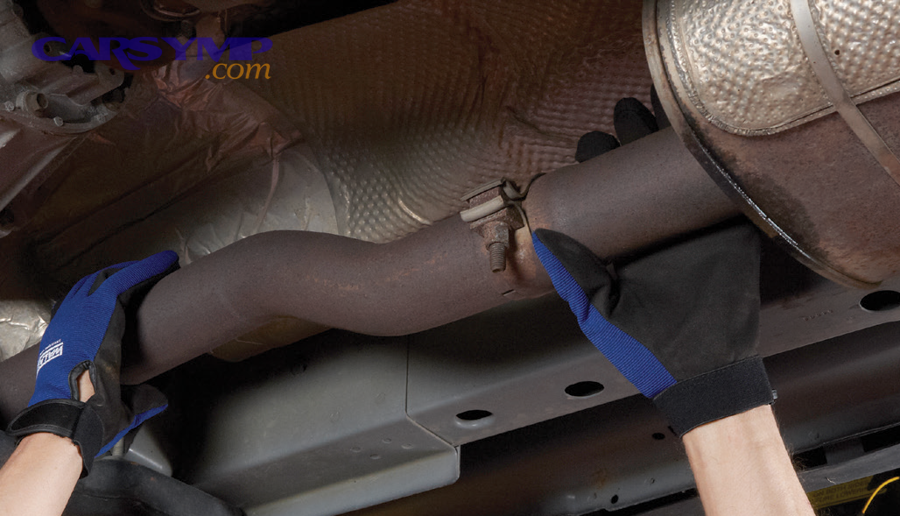
Prevention strategies save significant money compared to frequent repairs. Let’s examine the most effective preventive measures.
How Often Should You Inspect Exhaust Mounts?
You should inspect exhaust mounts every 12,000-15,000 miles or annually, whichever occurs first, with more frequent inspections recommended for vehicles operating in salt-exposed regions, high-heat climates, or severe-duty applications. Inspection intervals should decrease to 6,000-8,000 miles for vehicles exhibiting any symptoms of exhaust mounting problems.
Inspection timing should align with regular maintenance services like oil changes to ensure consistent attention. Many repair facilities offer free exhaust inspections during routine service appointments, making this an economical preventive measure. Request specific attention to exhaust mounting components rather than assuming they’re included in general vehicle inspections.
Comprehensive exhaust mount inspection involves examining all rubber hangers, metal clamps, mounting brackets, and chassis attachment points. Raise the vehicle on a lift or jack stands to gain clear access to the entire exhaust system. Use proper lighting to illuminate dark underbody areas where damage may hide.
Rubber hanger inspection focuses on cracks, hardening, and deformation. Flex each hanger by hand to assess pliability—the rubber should stretch slightly and return to its original shape. Hardened rubber feels stiff and may show surface cracks radiating from stress points. Any visible crack extending more than ¼ inch into the rubber thickness indicates impending failure requiring replacement.
Metal clamp inspection requires wire brushing to remove surface contamination before assessing condition. Look for rust pitting, thread damage, and cracks at stress points like bolt holes and hinge areas. Test clamp tightness by attempting to rotate the clamp around the pipe—properly tightened clamps should not move with hand force. Loose clamps need immediate retightening or replacement.
Mounting bracket inspection checks for bends, cracks, and attachment point integrity. Brackets welded to the exhaust or chassis should show no cracks in the weld beads or parent material. Bolted brackets should have tight, rust-free fasteners with no elongated mounting holes indicating movement. Damaged brackets require welding repair or replacement before they fail completely.
Document inspection findings with photographs and written notes to track degradation patterns over time. This documentation helps identify accelerated wear from specific operating conditions and guides preventive replacement timing. Note the date, mileage, and specific condition of each component to establish baseline references for future comparisons.
Early detection saves money by catching problems while simple repairs suffice. A cracking rubber hanger identified early costs $5-15 to replace, while delayed replacement often leads to exhaust damage costing $200-500 when the hanger fails and allows the exhaust to drag on the pavement.
What Driving Habits Protect Exhaust Hangers?
Driving habits that protect exhaust hangers include avoiding potholes and road debris when safely possible, crossing speed bumps at reduced speeds and proper angles, maintaining awareness of ground clearance in parking situations, and preventing overloading that increases exhaust system stress. These practices reduce impact damage that causes 40-60% of premature hanger failures.
Pothole avoidance requires attention to road surfaces and planned route selection when conditions permit. When potholes cannot be avoided, reduce speed before impact to minimize the force transmitted through the chassis. The exhaust system’s inertia causes it to continue moving upward while the chassis drops into the pothole, creating violent compression of hangers. Slower speeds reduce this differential motion and associated stress.
Speed bump technique significantly affects exhaust mounting stress. Approach speed bumps at angles rather than straight-on when possible, which allows one side of the vehicle to crest the bump before the other. This reduces the vertical travel distance and associated hanger compression. Maintain speeds below 5 mph when crossing speed bumps to minimize impact forces.
Ground clearance awareness prevents undercarriage strikes that damage exhaust components. Know your vehicle’s ground clearance specification and visually assess steep driveways, parking curbs, and rough terrain before proceeding. Approach steep transitions at angles to maximize clearance at the lowest point of the exhaust, typically the rear muffler section or middle catalytic converter.
Loading practices affect exhaust stress on vehicles with rear-mounted heavy loads. Pickup trucks and SUVs carrying maximum cargo weights experience rear suspension compression that reduces exhaust ground clearance. The additional weight also increases forces transmitted to hangers during acceleration and braking. Distribute loads evenly and avoid exceeding manufacturer payload ratings to protect exhaust components.
Aggressive driving habits accelerate exhaust mounting wear through excessive vibration and force cycling. Hard acceleration creates violent engine torque reactions that stress hangers, while aggressive braking causes forward pitch that compresses front hangers. Smooth, moderate driving reduces these force cycles and extends component life.
Off-road operation subjects exhaust systems to severe impact and vibration. If off-road driving is unavoidable, consider installing heavy-duty hangers and skid plates to protect the exhaust. Reduce speed over rough terrain to minimize impact forces, and inspect exhaust mounts immediately after off-road trips to catch damage early.
Seasonal considerations affect exhaust stress and failure patterns. Winter operation in salt-belt regions demands more frequent inspection and protective coating application. Summer heat accelerates rubber degradation, making shade parking beneficial when possible. Cold starts in extreme temperatures create maximum thermal stress as the exhaust rapidly heats from ambient to operating temperature.
According to data from automotive service chains, vehicles operated with careful driving habits experience exhaust hanger replacement intervals 60-80% longer than those driven aggressively. This translates to potential savings of $300-500 over the vehicle’s lifetime through reduced repair frequency.
What Are Advanced Solutions for Persistent Exhaust Mounting Problems?
Advanced solutions for persistent exhaust mounting problems include specialized reinforcement techniques, upgraded component materials, custom fabrication solutions, and systematic approaches to recurring failures that standard repairs cannot adequately address. These methods become necessary when repeated conventional repairs fail to provide acceptable longevity or when specialized applications demand enhanced performance.
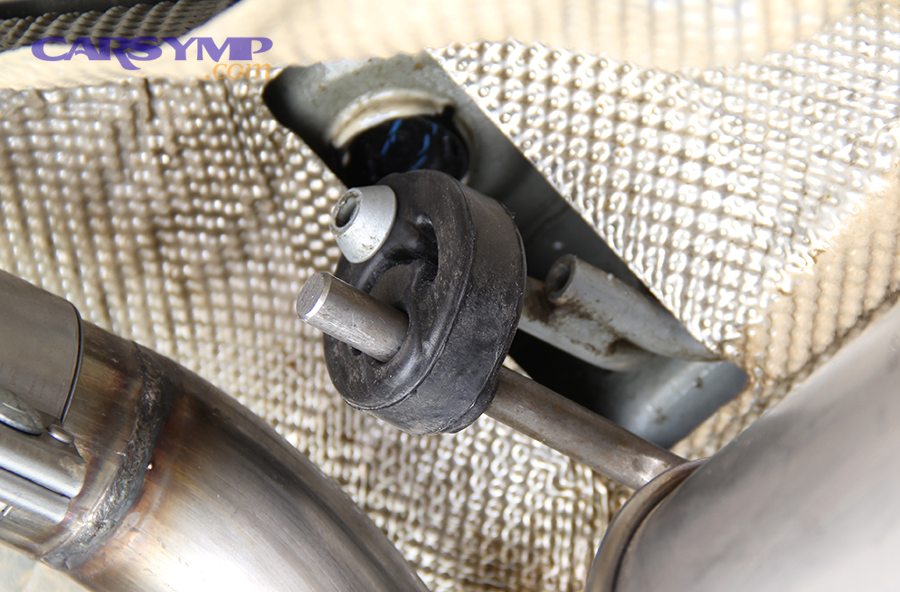
These advanced techniques require more skill and effort but provide superior results for challenging situations. Let’s examine each solution.
How Does the Hose Clamp Reinforcement Method Work?
The hose clamp reinforcement method strengthens rubber exhaust hangers by installing large stainless steel hose clamps around the rubber isolator perpendicular to primary stress directions, creating physical barriers that prevent crack propagation and excessive stretching under load. This technique extends hanger life by 200-300% in high-stress applications.
Material selection for this method requires stainless steel hose clamps rated for continuous temperatures up to 400°F. Standard galvanized clamps corrode rapidly in the exhaust environment and provide insufficient longevity. Select clamps sized appropriately for the hanger dimensions—typically 1½ to 2 inch diameter clamps work for most automotive applications.
Installation begins with a new, undamaged rubber hanger to maximize effectiveness. Used or cracked hangers benefit minimally from reinforcement because existing damage has already compromised the rubber structure. Mount the hanger normally on the vehicle, then position the hose clamp around the center of the rubber isolator, oriented so the worm drive mechanism sits on top away from road spray.
Tightening the hose clamp requires careful judgment. Excessive tightness crushes the rubber and reduces its ability to absorb vibration, while insufficient tightness allows the clamp to slip and provides minimal reinforcement. Tighten until the clamp firmly grips the rubber without visible deformation, typically when the rubber just begins to bulge slightly at the clamp edges.
Multiple clamp placement increases effectiveness for heavy exhaust systems. Install two clamps spaced approximately 1 inch apart along the hanger length, oriented 90 degrees relative to each other. This cross-pattern distribution prevents stress concentration and provides support in multiple directions.
Long-term performance monitoring shows this reinforcement method works best for preventing premature failures on vehicles with heavy aftermarket exhausts or those operated in extreme heat environments. The method provides minimal benefit for hangers failing primarily from rubber dry-rot rather than mechanical stress.
Limitations include slightly increased vibration transmission to the chassis because the reinforced hanger becomes less compliant. This typically manifests as barely perceptible increased cabin noise at idle. The trade-off between longevity and slight noise increase makes the technique worthwhile for persistent failure situations.
Cost analysis shows hose clamp reinforcement adds approximately $3-5 per hanger compared to standard replacement. The extended service life often makes this investment worthwhile, particularly when labor costs for repeated replacements exceed the material cost difference.
What Is Thread Peening for Exhaust Clamps?
Thread peening for exhaust clamps involves using a center punch and hammer to plastically deform threads on the bolt, creating mechanical interference that prevents the nut from loosening due to vibration while maintaining sufficient holding power for future removal. This technique solves persistent loosening problems on motorcycles and performance vehicles.
The peening process requires precise execution to achieve effectiveness without damaging the fastener. Position the center punch point on a thread approximately ½ inch from the nut, aligning it perpendicular to the bolt axis. Strike the punch with moderate force using a ball-peen hammer—one solid blow suffices for most applications. The impact deforms the thread slightly inward, creating a high spot that the nut must compress when vibration attempts to loosen it.
Multiple peen locations increase resistance to loosening but make future removal more difficult. Two peen marks spaced 180 degrees apart on the bolt circumference provide optimal balance between security and serviceability. Avoid peening too close to the nut, as this makes initial tightening difficult and may prevent achieving proper torque.
Thread peening works best on through-bolts where the threads extend beyond the nut by at least 1 inch. Insufficient thread extension limits peening locations and reduces effectiveness. V-band clamps and band clamps with extended bolts respond well to this technique, while U-bolt clamps with minimal thread extension show limited improvement.
Material compatibility affects peening success. Stainless steel bolts peen effectively and resist corrosion that would eliminate the peened interference. Mild steel bolts also work but may rust over time, making removal difficult. Avoid peening hardened bolts, which resist deformation and may crack under impact.
Removal techniques for peened fasteners require care to avoid damage. Apply penetrating oil 24 hours before removal, then use a breaker bar or impact wrench to overcome the increased breakaway torque. The peened threads may show slight scoring during removal but remain serviceable for re-installation if undamaged.
Application frequency should be limited to problem connections that repeatedly loosen despite proper torque. Routine use of thread peening on all exhaust clamps is unnecessary and makes maintenance more difficult. Reserve the technique for specific trouble spots identified through repeated failures.
According to professional motorcycle mechanics, thread peening reduces exhaust clamp loosening complaints by approximately 75% on vibration-prone applications like V-twin engines. The technique provides similar benefits on automotive applications experiencing persistent loosening from rough road operation.
How Do You Address Performance Exhaust Hanger Stress?
Addressing performance exhaust hanger stress requires upgrading to reinforced polyurethane hangers rated for 150-200% of stock exhaust weight, adding supplementary mounting points, redistributing load across more hangers, and potentially installing mid-pipe support braces for extremely heavy systems. Performance exhausts typically weigh 20-60% more than stock systems due to larger diameter pipes and additional components.
Polyurethane hanger upgrades provide the most straightforward solution for moderate weight increases. Polyurethane offers superior tear strength, heat resistance, and longevity compared to standard EPDM rubber. The material maintains flexibility across wider temperature ranges and resists dry-rot that degrades rubber hangers. However, polyurethane transmits approximately 30% more vibration to the chassis, resulting in slightly increased cabin noise.
Hanger hardness selection balances support and vibration isolation. Polyurethane durometer ratings from 70A to 90A are common for automotive applications. Lower durometer (70A-75A) provides better vibration isolation at the cost of reduced load capacity, while higher durometer (80A-90A) supports heavier loads but transmits more vibration. Match hardness to your specific weight and noise tolerance requirements.
Supplementary mounting point addition requires identifying suitable chassis locations that can support additional load. Welding new brackets to the chassis or exhaust provides the strongest mounting, but bolt-on solutions work for lighter supplementary loads. Position additional hangers at stress concentration points identified through visual inspection—look for areas where the exhaust sags noticeably between existing mounts.
Load redistribution involves relocating existing hangers to more optimal positions or replacing single hangers with dual-hanger assemblies. This approach works well when chassis design permits alternative mounting locations. Calculate approximate load on each hanger by dividing total exhaust weight by the number of support points, then relocate hangers to equalize loads.
Mid-pipe support braces provide targeted reinforcement for particularly heavy sections like large resonators or high-flow catalytic converters. These braces consist of adjustable rods connecting the exhaust to chassis mounting points, creating rigid supports that eliminate sagging. Install braces with slight upward pressure to pre-load the system and compensate for thermal expansion.
Exhaust neutralization becomes critical after installing upgraded hangers or additional mounting points. The system must be properly aligned at operating temperature to prevent creating stress that negates the hanger upgrades. Follow the neutralization procedure outlined earlier, paying particular attention to even load distribution across all mounting points.
Cost considerations for performance exhaust hanger upgrades range from $50-200 for polyurethane hanger sets to $200-500 for systems requiring welded brackets and mid-pipe braces. This investment protects performance exhaust systems costing $1000-3000 from damage caused by inadequate mounting.
The table below compares different hanger upgrade options for performance exhausts:
| Upgrade Type | Load Capacity Increase | Vibration Increase | Cost | Installation Difficulty |
|---|---|---|---|---|
| Polyurethane 75A | 40-50% | +15-20% | $60-100 | Easy (direct replacement) |
| Polyurethane 85A | 60-80% | +25-35% | $80-120 | Easy (direct replacement) |
| Additional mounts | 50-100% | Minimal | $100-300 | Moderate (welding may be required) |
| Mid-pipe braces | 100-150% | +30-40% | $150-400 | Moderate to difficult |
What Alternative Clamps Work for Non-Standard Applications?
Alternative clamps for non-standard exhaust applications include electrical conduit clamps for vintage vehicles, plumbing pipe clamps for custom fabrication, wire-wound clamps for flex-pipe connections, and fabricated strap assemblies for unique mounting situations. These solutions address fitment challenges when conventional automotive clamps cannot accommodate specific requirements.
Electrical conduit clamps serve vintage vehicle applications where original equipment is unavailable. Standard 1½ to 2-inch conduit clamps match common exhaust pipe diameters and feature bolt-through designs similar to original hangers on many classic cars. The zinc-plated finish provides adequate corrosion resistance for short-term use, though stainless steel variants last longer. Thread the mounting bolt through existing chassis brackets, then tighten the clamp around the exhaust pipe to create a functional hanger replacement.
Plumbing pipe clamps offer heavy-duty alternatives for large-diameter custom exhausts. These industrial clamps provide higher clamping forces than automotive clamps and accommodate pipes up to 4-6 inches in diameter. Band-style plumbing clamps create secure slip-fit connections on custom fabricated exhausts where welded joints are undesirable. Verify temperature ratings before application, as some plumbing clamps use materials unsuitable for exhaust heat.
Wire-wound clamps excel at securing flex-pipe sections that must accommodate movement while maintaining sealed connections. These clamps consist of high-tensile wire wound in a coil pattern around the pipe with tightening screws that compress the coil. The design allows radial expansion and contraction while maintaining constant clamping force. Install wire-wound clamps at each end of flex-pipe sections, positioning them over the corrugated area for maximum grip.
Fabricated strap assemblies solve unique mounting challenges on modified vehicles or custom applications. Create straps from 1-inch wide by 1/8-inch thick stainless steel bar stock, bending them to match required mounting geometry. Drill holes for mounting bolts and weld nut plates as needed. This custom approach accommodates odd angles, multiple mounting points, or unusual spacing requirements that defeat commercial clamp designs.
Hose clamps provide emergency or temporary exhaust mounting solutions despite not being designed for this application. Large automotive hose clamps (3-4 inch diameter) can support exhaust pipes in emergency situations when proper clamps are unavailable. The worm-drive mechanism allows tool-free adjustment and installation. However, heat eventually degrades the clamp body, limiting service life to weeks or months rather than years.
Safety considerations become paramount when using non-standard clamps. Ensure all alternative clamps provide adequate temperature resistance for continuous exhaust heat exposure. Verify mounting strength exceeds expected loads with appropriate safety margin. Inspect non-standard installations more frequently than conventional systems to catch degradation early.
Availability of alternative clamps varies by application. Hardware stores stock conduit and plumbing clamps suitable for many exhaust applications, providing same-day solutions for vintage or custom vehicle repairs. Industrial supply houses carry heavy-duty variants for extreme applications. Price advantages make alternative clamps attractive—conduit clamps cost $3-8 versus $20-40 for automotive-specific equivalents.
According to vintage vehicle restoration specialists, properly selected alternative clamps provide service life equivalent to original equipment when matched to application requirements. The key lies in understanding load, temperature, and corrosion requirements specific to each installation.
Repair cost estimate for common rattles: Typical exhaust hanger and clamp repairs range from $75-200 for DIY parts and basic tools, $150-400 for professional repair of 2-4 components, and $400-800 for comprehensive exhaust mounting system rehabilitation including multiple hangers, clamps, and brackets. Prevention through regular inspection costs essentially nothing but saves hundreds in avoided repairs over vehicle ownership.