


It depends on the cause—under-car rattling can range from harmless loose components to critical safety hazards requiring immediate attention. While some rattling noises indicate minor issues like a vibrating heat shield that can wait for a scheduled repair, others signal dangerous failures in your suspension, brakes, or steering systems that make continued driving unsafe. The key difference lies in recognizing specific warning signs that accompany the rattling sound.
Understanding what causes rattling noise under car systems helps you make informed decisions about your vehicle’s safety. Most under-car rattles originate from the exhaust system, suspension components, or loose undercarriage parts, each presenting different urgency levels. The sound characteristics—whether metallic grinding, intermittent clattering, or persistent knocking—provide crucial clues about the underlying problem and its severity.
Knowing when to stop immediately versus when you can continue to a repair shop could prevent catastrophic failures or accidents. Seven specific warning signs distinguish dangerous rattling from benign noises, helping you assess whether your vehicle poses an immediate safety risk. These indicators include changes in steering response, brake performance, and handling characteristics that signal component failures requiring urgent professional attention.
Beyond immediate safety concerns, understanding Rattle under car causes checklist empowers you to take preventive measures and maintain your vehicle’s long-term reliability. Next, we’ll explore the critical question of driving safety and examine the specific warning signs that demand your immediate attention.
Is It Safe to Drive With a Rattling Noise Under Your Car?
Driving with under-car rattling is conditionally safe depending on the sound’s characteristics, accompanying symptoms, and the affected system—immediate停止 is required for brake, steering, or wheel bearing failures, while loose heat shields allow careful short-distance driving. The safety determination hinges on identifying whether the rattling affects critical safety systems or represents cosmetic component looseness.
To better understand when rattling becomes dangerous, you must evaluate multiple factors beyond just the noise itself. The decision framework involves assessing sound intensity, location, driving condition triggers, and whether the rattling coincides with performance changes. Vehicles communicate potential failures through specific noise patterns, and distinguishing between urgent warnings and minor annoyances requires systematic evaluation.
When Under-Car Rattling Means You Should Stop Driving Immediately
Certain rattling patterns indicate critical failures that compromise your ability to control or stop the vehicle safely. Loud metallic grinding accompanied by steering resistance or pulling to one side suggests tie rod or ball joint failure, which can cause complete loss of steering control. If the rattling occurs during braking with reduced stopping power or a soft brake pedal, brake caliper or rotor damage may be present, creating extreme accident risk.
Wheel bearing failures produce a humming or grinding rattle that intensifies with speed and often causes wheel wobbling or excessive play when you shake the tire. This condition can lead to wheel separation while driving, making it one of the most dangerous under-car issues. Additionally, any rattling that causes vibrations severe enough to shake the steering wheel or shift the entire vehicle suggests drivetrain or suspension mounting failures that require immediate停止.
Critical停止 signals include:
- Steering becomes difficult, unresponsive, or pulls strongly to one side
- Brake performance deteriorates with longer stopping distances or pedal softness
- Rattling creates violent vibrations felt throughout the cabin
- Warning lights illuminate on the dashboard coinciding with the noise
- The vehicle feels unstable or bouncy, especially during turns
When You Can Continue Driving to a Repair Shop (With Caution)
Moderate-risk rattling allows short-distance driving at reduced speeds to reach professional service, particularly when the noise originates from non-critical components. Loose heat shields around the exhaust system create metallic rattling, especially during acceleration or when the engine is cold, but they don’t immediately compromise vehicle operation. Similarly, minor exhaust hanger failures produce clunking sounds over bumps but typically maintain exhaust functionality temporarily.
Intermittent rattling that appears only over specific road conditions or at certain speeds often indicates worn suspension bushings or loose underbody panels rather than complete component failure. These issues warrant prompt attention but don’t necessarily require immediate roadside停止. However, even in these scenarios, you should limit driving to the shortest safe route to a repair facility and avoid highway speeds or aggressive maneuvers.
Conditional driving parameters include:
- Keep speeds below 35 mph and avoid highway travel
- Choose smooth roads and minimize driving over bumps or potholes
- Monitor continuously for any worsening symptoms or new noises
- Plan the shortest possible route to a trusted repair shop
- Avoid carrying passengers if possible to reduce vehicle stress
Minor Rattling Issues That Can Wait for a Scheduled Appointment
Low-priority rattling typically involves cosmetic or protective components that don’t affect vehicle safety or performance directly. Underbody splash shields and skid plates can become loose from road debris impacts, creating plastic or fiberglass rattling sounds that vary with speed. These protective panels prevent dirt and water intrusion but aren’t structural or safety-critical components.
Debris caught in wheel wells, suspension springs, or exhaust components often produces mysterious rattling that stops once the foreign object dislodges naturally. Small stones, plastic bags, or branches wedged in the undercarriage create concerning noises without representing actual mechanical failures. Visual inspection often reveals these trapped items, which can be safely removed during routine maintenance.
Low-risk indicators include:
- Rattling occurs only at specific speeds or road conditions
- No changes in steering, braking, or acceleration performance
- Visual inspection reveals loose plastic shields or trapped debris
- Sound disappears when temperature or weather conditions change
- Vehicle handling and ride quality remain normal
According to automotive safety research from the National Highway Traffic Safety Administration, suspension and steering component failures account for approximately 3% of vehicle crashes, emphasizing the importance of addressing these rattling warnings promptly.
What Are the 7 Warning Signs That Under-Car Rattling Is Dangerous?
The seven critical warning signs that under-car rattling poses immediate danger are: steering or handling changes, metallic grinding during braking, speed-dependent loud rattling, vibrations in the steering wheel or cabin, persistent exhaust rattling with reduced performance, rattling over bumps with poor ride quality, and post-impact rattling after hitting obstacles. These indicators distinguish catastrophic failures from benign noises through their direct connection to vehicle control and safety systems.
Understanding these warning signs requires recognizing that dangerous rattling rarely occurs in isolation. Instead, critical failures manifest through multiple symptoms that compound the primary noise, creating a constellation of warning signals. The presence of even one of these warning signs demands immediate professional evaluation, as the consequences of ignoring them range from expensive repairs to life-threatening accidents.
Warning Sign #1: Rattling Accompanied by Steering or Handling Changes
Rattling combined with steering difficulty, excessive play in the wheel, or vehicle pulling indicates tie rod, ball joint, or control arm failures that directly compromise your ability to maintain directional control. These steering and suspension linkage components connect your steering wheel inputs to the wheels, and their failure creates dangerous unpredictability in vehicle response. When these parts wear or break, the rattling noise often sounds like knocking or clunking during turns or when traveling over uneven surfaces.
The steering system operates through precise mechanical connections that allow minimal play or looseness. Any degradation in these connections creates both noise and functional impairment. Tie rod ends, which connect the steering rack to the wheel assemblies, develop excessive wear in their ball-and-socket joints, allowing the components to rattle against each other while simultaneously creating steering vagueness. Ball joints serve similar functions in the suspension geometry, and their failure produces comparable symptoms with potentially catastrophic consequences.
Specific symptoms of steering-related dangerous rattling include:
- Steering wheel requires more effort to turn or feels loose and disconnected
- Vehicle wanders or drifts across the lane without steering input
- Clunking or knocking sounds occur when turning the steering wheel
- Front end feels unstable or bouncy, especially over small road imperfections
- Uneven tire wear patterns appear, particularly on the inner or outer edges
Warning Sign #2: Metallic Grinding or Scraping Sounds While Braking
Metallic grinding or scraping rattling during braking signals brake pad wear-through, caliper failures, or rotor damage that critically impairs stopping ability. When brake pads wear completely down to their metal backing plates, the exposed metal grinds directly against the brake rotors, creating distinctive grinding rattles accompanied by significantly reduced braking effectiveness. This metal-on-metal contact rapidly damages rotors, potentially leading to brake failure.
Brake calipers, which squeeze the brake pads against the rotors, can develop seized pins or broken mounting hardware that allows the caliper assembly to rattle and move excessively. This movement creates metallic rattling sounds and prevents proper brake pad contact with the rotor surface. Additionally, anti-rattle clips—small metal springs designed to hold brake pads firmly in place—can break or corrode, allowing the pads to vibrate and rattle inside the caliper bracket during both braking and normal driving.
Brake-related dangerous rattling manifests through:
- Grinding or scraping noises that occur specifically when pressing the brake pedal
- Increased stopping distances or a soft, spongy brake pedal feel
- Vehicle pulling to one side during braking
- Pulsating or vibrating brake pedal during normal停止
- Visible metal shavings or brake dust accumulation on wheels
Warning Sign #3: Loud Rattling That Increases With Speed
Speed-dependent rattling that grows louder as velocity increases typically indicates wheel bearing failure, CV joint damage, or driveshaft problems that pose serious safety risks. Wheel bearings allow wheels to rotate smoothly with minimal friction, and their failure creates a humming, growling, or rattling noise that intensifies proportionally with vehicle speed. As the damaged bearing deteriorates further, the noise evolves from a subtle hum into loud grinding, often accompanied by wheel wobble or vibration.
Constant velocity (CV) joints, found in front-wheel and all-wheel drive vehicles, transfer power from the transmission to the wheels while accommodating suspension movement and steering angles. When CV joint boots tear and allow lubricant to escape, the joints develop clicking or rattling noises during turns that progress to constant rattling at all speeds as damage worsens. Driveshaft components, including universal joints and center support bearings, can also produce speed-related rattling when they wear or lose lubrication.
Speed-dependent dangerous rattling characteristics:
- Noise volume directly correlates with vehicle speed, doubling in volume when speed doubles
- Rattling may be more pronounced during acceleration or deceleration
- Loose or grinding sensation felt through the steering wheel or floor
- Wheel wobble visible when observing the vehicle from outside while someone drives slowly
- Noise may change pitch during turns or lane changes
Warning Sign #4: Rattling Combined With Vibrations in the Steering Wheel or Cabin
Rattling accompanied by vibrations throughout the vehicle indicates engine mount, transmission mount, or driveshaft imbalance issues that affect powertrain stability and can lead to component separation. Engine mounts secure the engine to the vehicle’s frame using rubber isolators that absorb vibrations and prevent engine movement during acceleration. When these mounts fail, the engine shifts excessively, creating rattling noises while allowing the powertrain to vibrate against surrounding components.
Transmission mounts serve similar purposes for the transmission assembly, and their failure produces comparable symptoms with vibrations often most noticeable during gear shifts or acceleration. The combination of rattling and vibration indicates that heavy components are no longer properly secured, creating dangerous potential for catastrophic failure. Driveshaft imbalance or damaged universal joints create vibrations that resonate through the entire vehicle structure, often intensifying at specific speed ranges.
Vibration-related dangerous rattling symptoms:
- Steering wheel shakes or vibrates, especially during acceleration or at idle
- Entire cabin shakes or resonates at specific engine speeds or vehicle velocities
- Clunking sensation felt through the floor or seats during acceleration or deceleration
- Increased vibration when shifting from park to drive or reverse
- Visual observation reveals excessive engine movement when revving in park
Warning Sign #5: Persistent Rattling From the Exhaust With Reduced Performance
Persistent exhaust rattling accompanied by power loss, reduced fuel economy, or strong exhaust odors indicates catalytic converter failure, exhaust manifold cracks, or pipe separation that affects engine performance and emissions. The catalytic converter contains ceramic honeycomb structures coated with precious metals that convert harmful exhaust gases into less toxic emissions. When these internal structures break apart from age, overheating, or contamination, the loose pieces rattle inside the converter housing while simultaneously reducing exhaust flow and engine efficiency.
Exhaust manifold cracks develop from repeated thermal cycling and engine vibration, creating exhaust leaks that produce rattling, hissing, or ticking noises most noticeable during cold starts and acceleration. These cracks allow hot exhaust gases to escape before reaching the catalytic converter, triggering check engine lights and potentially causing exhaust system fires if leaking gases contact flammable materials. Separated exhaust pipes or broken hangers create loud rattling as unsecured exhaust components strike the undercarriage during driving.
Performance-affecting exhaust rattling indicators:
- Noticeable reduction in acceleration or engine responsiveness
- Check engine light illuminates with catalyst efficiency or oxygen sensor codes
- Strong sulfur or rotten egg smell from exhaust
- Rattling sounds metallic and originates clearly from the exhaust system area
- Fuel economy decreases by 10-20% compared to normal consumption
According to emissions research from the Environmental Protection Agency, a failing catalytic converter can reduce engine power by up to 15% while increasing harmful emissions by 300%, making prompt repair essential for both performance and environmental compliance.
Warning Sign #6: Rattling Over Bumps With Poor Ride Quality
Rattling specifically triggered by bumps, potholes, or rough roads combined with a harsh or bouncy ride indicates strut, shock absorber, or coil spring failures that compromise suspension function and vehicle stability. Struts and shock absorbers control suspension movement, preventing excessive bouncing and maintaining tire contact with the road surface. When these components wear out or leak hydraulic fluid, they lose dampening ability, creating clunking or rattling noises over bumps while allowing the vehicle to bounce excessively.
Coil springs, which support vehicle weight and absorb road impacts, can break or separate from their mounting perches, creating loud rattling or clanking noises combined with visible vehicle sagging on the affected corner. Broken springs represent serious safety hazards as they can puncture tires, damage brake lines, or become completely dislodged during driving. Control arm bushings, sway bar links, and other suspension connection points wear over time, developing excessive play that produces rattling over road irregularities.
Suspension-related dangerous rattling characteristics:
- Rattling occurs specifically when driving over bumps, potholes, or railroad crossings
- Vehicle bounces excessively after hitting bumps or continues bouncing after stops
- One corner of the vehicle sits noticeably lower than others
- Harsh, jarring ride quality with poor impact absorption
- Steering feels loose or imprecise, especially during turns
Warning Sign #7: Rattling That Appears After Hitting a Pothole or Curb
New rattling sounds that develop immediately after impact with potholes, curbs, or road debris indicate impact damage to suspension components, wheels, or undercarriage parts requiring immediate inspection. Road impact forces can bend control arms, crack wheel rims, damage strut mounts, or dislodge protective shields and panels. Unlike gradual wear-related rattling, impact-induced noises signal sudden structural failures or component displacement that may worsen rapidly.
Wheel rim damage from pothole impacts often creates vibrations and rattling as the bent section repeatedly strikes the tire bead or brake caliper during rotation. Control arm bends or cracks from curb strikes compromise suspension geometry and alignment while creating rattling as the damaged component moves excessively. Undercarriage impacts can dislodge skid plates, exhaust heat shields, or splash guards, leaving them partially attached but rattling against the frame or body.
Post-impact dangerous rattling signs:
- Rattling begins immediately or within minutes after hitting an obstacle
- Visual inspection reveals bent, cracked, or displaced components
- Vehicle pulls to one side or steering feels different than before impact
- Tire pressure warning light activates following the impact
- Visible fluid leaks appear under the vehicle after the incident
What Causes Rattling Noises Under Your Car?
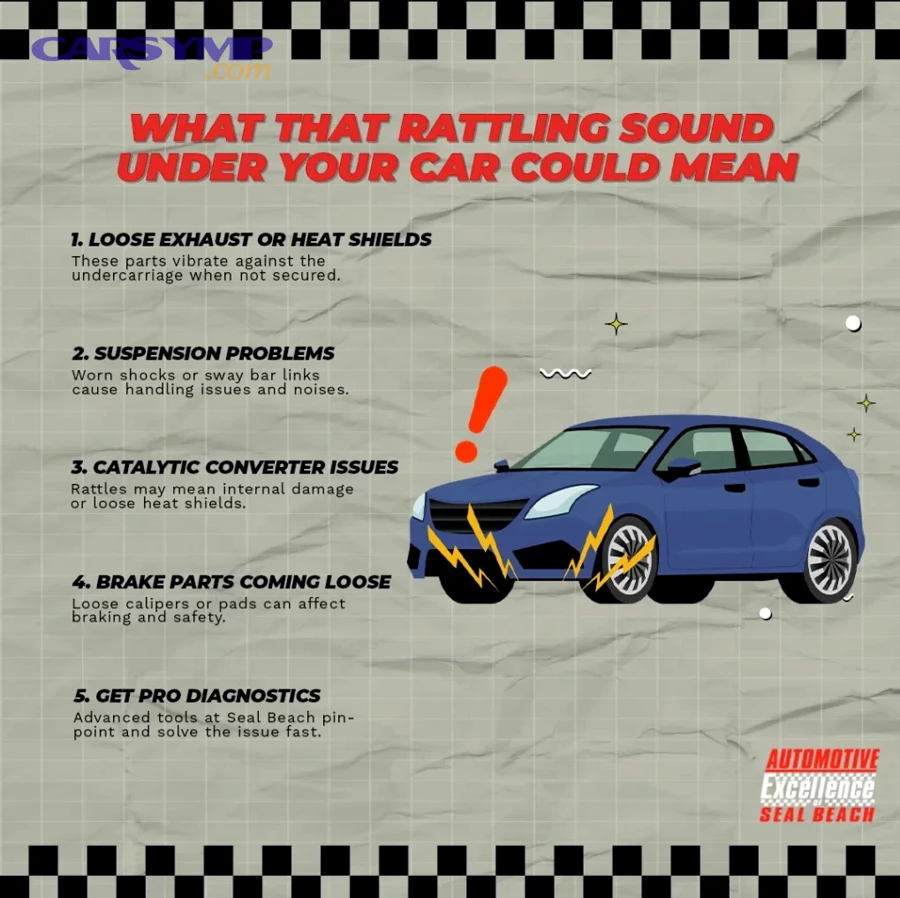
Under-car rattling noises originate primarily from exhaust system components (heat shields, catalytic converters, hangers), suspension wear (struts, bushings, sway bar links), and loose undercarriage parts (splash shields, skid plates), with causes categorized by the affected system. These rattling sources represent normal component aging, impact damage, or neglected maintenance, each producing characteristic sound patterns and driving condition correlations.
Identifying the specific cause requires systematic evaluation of when, where, and how the rattling occurs. Different automotive systems produce distinct rattling characteristics that serve as diagnostic fingerprints. For example, Rattle only at idle vs while driving clues help distinguish exhaust heat shields (louder at idle) from suspension issues (louder while driving over bumps). Understanding these cause-and-effect relationships empowers vehicle owners to communicate effectively with mechanics and assess repair urgency.
Exhaust System Rattling (Heat Shields, Catalytic Converter, Hangers)
Exhaust system rattling represents the most common source of under-car noise, accounting for approximately 40% of all rattling complaints according to automotive service data. Heat shields, thin metal panels positioned around exhaust components to protect surrounding parts from extreme temperatures, develop looseness as their mounting brackets rust or vibrate free. These shields rattle against exhaust pipes or the vehicle’s undercarriage, creating distinctive metallic sounds that intensify during acceleration when exhaust temperatures and vibrations increase.
Catalytic converters develop internal rattling when their ceramic substrate breaks apart from thermal stress, physical impact, or contamination from engine oil consumption or coolant leaks. The loose ceramic pieces create a sound resembling marbles shaking in a can, particularly noticeable during cold starts before exhaust heat dampens the noise. Exhaust hangers—rubber isolators that suspend the exhaust system from the vehicle’s underside—deteriorate from heat exposure and age, eventually breaking and allowing exhaust pipes to hang lower and strike the undercarriage during normal driving.
Exhaust rattling characteristics and identification:
- Heat shield rattling sounds metallic and hollow, often described as “tin can” noise
- Noise typically louder during cold starts and acceleration, quieter at highway cruise
- Visual inspection reveals rust, corrosion, or loose mounting brackets
- Rattling may stop temporarily when pressing upward on exhaust components
- Catalytic converter rattling often coincides with check engine light and efficiency codes
Suspension Component Failures (Struts, Bushings, Sway Bar Links)
Suspension system rattling develops as rubber bushings dry-rot, hydraulic struts leak fluid, and metal connection points wear beyond design tolerances. Sway bar links, which connect the anti-roll bar to the suspension struts or control arms, contain ball-and-socket joints with rubber or polyurethane bushings that deteriorate over time. As these bushings wear, excessive play develops, allowing the metal components to knock against each other during suspension movement over bumps or during body roll in turns.
Strut mounts, located at the top of each strut assembly where it connects to the vehicle body, incorporate rubber isolators and bearings that absorb impacts and facilitate steering pivot. When these mounts fail, they produce clunking or rattling noises during turns, over bumps, or when the suspension compresses and extends. Control arm bushings serve similar isolation functions throughout the suspension system, and their failure creates rattling as metal components contact each other directly instead of being cushioned by rubber.
Suspension rattling patterns and diagnosis:
- Clunking or rattling over bumps, potholes, or rough road surfaces
- Noise during turns, especially tight low-speed parking lot maneuvers
- Visible rubber cracking, tearing, or complete separation from metal sleeves
- Excessive play detected when pushing up and down on vehicle corners
- Uneven tire wear patterns indicating suspension geometry problems
Loose or Damaged Undercarriage Components
Undercarriage protective components including splash shields, skid plates, and underbody panels become loose from mounting tab breakage, fastener loss, or impact damage from road debris. These plastic or composite panels protect sensitive components from road spray, dirt, and minor impacts while improving aerodynamics. When mounting points fail, the panels hang partially detached and vibrate or strike the undercarriage during driving, creating intermittent or speed-dependent rattling.
Engine oil pan skid plates on trucks and SUVs can bend from bottoming out on obstacles, creating misalignment that allows the plate to contact the oil pan or frame during normal driving. Transmission heat shields may develop looseness after transmission service if not properly reinstalled, rattling against the transmission housing or exhaust components. Fender liners and wheel well splash guards deteriorate from road salt exposure and mechanical stress, eventually sagging into contact with rotating tires or suspension components.
Undercarriage rattling identification methods:
- Plastic or fiberglass rattling sound rather than metallic
- Noise often speed-dependent or triggered by specific road surface types
- Visual inspection reveals hanging panels, missing fasteners, or impact damage
- Rattling may stop when pushing upward on suspected loose panels
- Recent undercarriage impacts or service work preceded the noise onset
How Can You Diagnose the Source of Under-Car Rattling?
Diagnosing under-car rattling source involves listening for when the noise occurs (idle, acceleration, bumps, braking), locating the sound spatially (front, rear, center), and conducting visual inspections for damage or looseness—combining these three diagnostic approaches identifies the specific component or system causing the rattling. Systematic diagnosis saves time and money by narrowing possibilities before professional inspection.
Effective diagnosis requires methodical evaluation rather than guessing. Many vehicle owners waste resources replacing components that aren’t actually causing the noise because they skip systematic diagnostic steps. Professional technicians use the same three-part approach—condition correlation, location identification, and physical inspection—to efficiently pinpoint rattling sources among hundreds of potential components.
Listen for When the Rattling Occurs (Idle, Acceleration, Bumps, Braking)
Condition-specific rattling provides critical diagnostic clues by correlating the noise with particular vehicle operations or circumstances. Rattling that occurs only at idle when the engine is running but the vehicle is stationary typically originates from exhaust heat shields, loose engine covers, or failing engine mounts that vibrate at specific RPM ranges. This idle-specific pattern eliminates suspension and drivetrain components from consideration since those systems aren’t under load when stationary.
Acceleration-triggered rattling suggests exhaust system issues (particularly catalytic converter substrate breakage or heat shield vibration), engine accessory problems, or transmission mount failures. The increased load and vibration during acceleration amplifies noises from these systems while potentially masking other sounds. Deceleration rattling may indicate exhaust system movement as engine vacuum changes or transmission issues as the powertrain shifts between power delivery modes.
Diagnostic correlation table for timing-based rattling:
| When Rattling Occurs | Most Likely Causes | Secondary Possibilities |
|---|---|---|
| Only at idle | Heat shields, engine mounts, loose covers | Catalytic converter substrate |
| During acceleration | Exhaust components, transmission mounts | Engine accessories, heat shields |
| Over bumps/potholes | Suspension components, loose panels | Exhaust hangers, skid plates |
| When braking | Brake components, anti-rattle clips | Loose wheel well components |
| During turns | Sway bar links, CV joints | Strut mounts, tie rod ends |
| Constant all conditions | Wheel bearings, driveshaft | Multiple component failures |
Bump-induced rattling almost exclusively indicates suspension-related issues including worn struts, broken sway bar links, deteriorated bushings, or loose skid plates. The suspension system actively responds to road surface irregularities, so any looseness or wear becomes immediately apparent when driving over bumps. Braking-specific rattling points directly to brake system components including loose brake pads, failing calipers, or damaged dust shields.
Locate Where the Sound Is Coming From (Front, Rear, Center Undercarriage)
Spatial location identification narrows diagnostic focus to specific vehicle areas and their associated systems. Front-end rattling typically involves steering and suspension components, engine accessories, or front exhaust sections including the catalytic converter and manifolds. The concentration of moving parts and high-stress components in the front end makes it the most common rattling source location. Safe identification methods include having an assistant drive slowly while you observe from outside, or using the “drive and compare” technique where you temporarily stop the noise source to confirm location.
Rear rattling commonly originates from rear suspension components, rear exhaust sections (muffler and tailpipe), or loose underbody panels near the fuel tank area. Rear suspension rattling often sounds less severe than front issues due to the simpler rear suspension designs in many vehicles. Center undercarriage rattling frequently involves the exhaust system’s mid-section, transmission components, or driveshaft assemblies in rear-wheel or all-wheel drive vehicles.
Location-based diagnostic approaches:
- Front-end focus areas: Strut assemblies, control arms, sway bar links, engine mounts, catalytic converter, heat shields around manifolds
- Rear-end focus areas: Rear shocks or struts, trailing arms, muffler, exhaust hangers, fuel tank heat shields
- Center undercarriage areas: Mid-pipe exhaust sections, transmission mounts and shields, driveshaft and center support bearing, underbody panels
Professional technicians often use automotive stethoscopes to precisely locate rattling sources by placing the probe on different suspected components while the vehicle operates. This tool amplifies sounds and helps distinguish between multiple potential sources in close proximity. For DIY diagnosis, using a long screwdriver or rod as a makeshift stethoscope—placing one end on suspected components and the handle against your ear—provides similar functionality.
Check for Visible Damage or Loose Parts
Visual inspection reveals obvious damage, looseness, or missing components that often cause rattling without requiring complex diagnostic equipment. Safe inspection requires proper vehicle support on jack stands (never rely solely on jacks) with the engine off and parking brake engaged. Begin inspection by looking for hanging or displaced panels, missing bolts, cracked components, or anything that appears obviously damaged or out of place.
Exhaust system inspection focuses on heat shield attachment points, exhaust hanger condition, and pipe joint integrity. Gently push upward on various exhaust sections to check for looseness or excessive movement—properly secured exhaust systems have minimal vertical play. Look for rust-through on heat shield brackets and examine rubber exhaust hangers for cracking or complete separation. Suspension component inspection involves checking for torn rubber bushings, leaking strut shafts, loose bolts, or bent components.
Systematic visual inspection checklist:
- Exhaust system: Rust on heat shields, separated hangers, loose clamps, damaged pipes
- Suspension components: Torn bushings, leaking struts, bent arms, loose fasteners
- Undercarriage panels: Missing clips or screws, cracked plastic, hanging shields
- Brake system: Worn pads visible through wheel spokes, loose calipers, damaged dust shields
- Drivetrain: Leaking CV joint boots, play in driveshaft, loose transmission shields
Any component that moves excessively when pushed or pulled likely contributes to rattling during normal vehicle operation. Documentation through photos or videos helps communicate findings to repair professionals and provides baseline references for future comparisons. Remember that some rattling sources may require test driving to reproduce, making combination of static inspection and dynamic listening essential for complete diagnosis.
According to automotive diagnostic research from SAE International, systematic diagnostic approaches combining auditory assessment, visual inspection, and condition correlation identify the correct rattling source in approximately 85% of cases without requiring specialized equipment.
How Can You Prevent Under-Car Rattling Problems?
Preventing under-car rattling requires regular undercarriage inspections every 6-12 months, protecting components from harsh environmental conditions through rustproofing and undercoating, adopting careful driving habits that minimize impact damage, and applying protective treatments based on climate and driving conditions. These four preventive strategies significantly reduce rattling occurrence by addressing root causes before component failures develop.
Proactive prevention proves far more cost-effective than reactive repairs, as early intervention stops minor issues before they escalate into expensive failures. Most under-car rattling develops gradually through accumulated wear, corrosion, or repeated minor impacts rather than sudden catastrophic events. By addressing these degradation factors consistently, vehicle owners can extend component lifespan and maintain quiet, reliable operation.
Regular Undercarriage Inspections and Maintenance Schedules
Scheduled undercarriage inspections identify developing problems before they produce rattling or safety issues, with inspection frequency determined by driving conditions and vehicle age. Vehicles driven primarily on smooth paved roads in moderate climates benefit from annual inspections, while those subjected to rough roads, off-road use, or harsh winter conditions with road salt require semi-annual or quarterly examinations. Professional inspections during oil changes provide convenient opportunities for undercarriage assessment since the vehicle is already elevated.
Comprehensive inspections should evaluate exhaust system integrity including heat shield attachment, hanger condition, and pipe corrosion; suspension component wear including bushing condition, strut leakage, and joint play; undercarriage panel security including all protective shields and skid plates; and brake system condition including pad thickness and caliper mounting. Early detection of rust, looseness, or wear allows addressing issues through simple tightening, cleaning, or minor repairs before complete replacement becomes necessary.
Maintenance schedule recommendations by vehicle type:
- Daily drivers in moderate climates: Annual comprehensive inspection, bi-annual visual checks
- Vehicles in snow belt/salt exposure: Semi-annual inspections, monthly visual monitoring during winter
- Off-road or rough road use: Quarterly inspections, post-trip checks after severe use
- High-mileage vehicles (100k+ miles): Semi-annual inspections regardless of conditions
- Performance or modified vehicles: Quarterly inspections, immediate post-event checks after track use
Inspection records create valuable maintenance history documentation that helps identify recurring problem areas and supports warranty claims or resale value. Noting specific component conditions, replacement dates, and observed wear patterns enables predictive maintenance planning rather than reactive emergency repairs.
Protecting Your Car’s Undercarriage in Harsh Conditions
Environmental protection through rustproofing, undercoating, and regular cleaning significantly extends undercarriage component lifespan in challenging conditions. Road salt used in winter snow management represents the primary corrosion accelerator for undercarriage components, penetrating protective coatings and rapidly oxidizing steel components. Regular undercarriage washing during winter months removes salt accumulation before significant corrosion develops, with wash frequency ideally matching road salt application intensity.
Rustproofing treatments create protective barriers between metal surfaces and corrosive elements, with various products offering different protection mechanisms. Oil-based rustproofing penetrates seams and enclosed areas while providing ongoing corrosion resistance through self-healing properties as the vehicle flexes. Rubberized undercoating provides durable impact resistance and sound dampening in addition to corrosion protection, though it requires careful application to avoid trapping existing moisture.
Environmental protection strategies by condition:
- Heavy road salt exposure: Monthly undercarriage washing during winter, annual oil-based rustproofing
- Coastal saltwater environments: Quarterly undercarriage washing, rubberized undercoating on exposed surfaces
- Dusty or unpaved road use: Regular air cleaning to prevent dust accumulation, protective skid plates
- High humidity/rainfall areas: Annual rustproofing, ensure proper drainage from enclosed areas
- Combined harsh conditions: Multi-layer protection combining oil treatment and undercoating
Professional application ensures complete coverage and proper preparation, but DIY maintenance washing provides substantial protection at minimal cost. Focus washing efforts on suspension components, exhaust system hangers, frame sections, and anywhere salt or mud accumulation is visible. Allow adequate drying time after washing to prevent trapped moisture from accelerating corrosion in enclosed areas.
Driving Habits That Reduce Undercarriage Damage
Careful driving techniques minimize impact forces and component stress that lead to rattling development over time. Avoiding potholes, road debris, and severe bumps when possible prevents sudden impact damage to suspension components, wheels, and undercarriage panels. When impacts are unavoidable, reducing speed significantly decreases force magnitude—hitting a pothole at 25 mph generates approximately 60% less impact force than hitting the same pothole at 40 mph.
Speed bumps and railroad crossings require specific approach techniques to minimize component stress. Approaching these obstacles at 45-degree angles distributes impact forces across the suspension system more evenly than straight-on approaches that concentrate force on individual wheels. Reducing speed to walking pace (5-10 mph) for speed bumps and slowing to 10-15 mph for railroad crossings prevents bottoming out that damages exhaust systems and undercarriage panels.
Impact-minimizing driving techniques:
- Pothole navigation: Reduce speed and avoid swerving suddenly, which can cause loss of control
- Speed bump approach: Slow to 5-10 mph, approach at angle when possible, accelerate gently after crossing
- Railroad crossings: Cross at 10-15 mph at perpendicular angle to minimize wheel drop
- Curb parking: Allow 6-inch minimum clearance, avoid driving over curbs during parking
- Off-road driving: Straddle obstacles when clearance allows, use low range for steep descents
Proper loading practices prevent component overload that accelerates wear. Excessive cargo weight increases suspension deflection and bottoming likelihood, while uneven weight distribution creates asymmetric loading that stresses one side disproportionately. Following manufacturer payload recommendations and distributing weight evenly across the cargo area reduces suspension stress and extends component life.
When to Apply Rust Protection and Undercoating
Timing of protective treatment application significantly influences effectiveness, with new vehicles benefiting from immediate protection before corrosion begins and used vehicles requiring surface preparation to address existing rust. Applying rustproofing to new vehicles within the first year provides maximum protection by creating barriers before any corrosion develops. Factory undercoating varies widely in quality and coverage, with many manufacturers applying minimal treatment to reduce production costs.
Used vehicle protection requires assessing existing corrosion severity before treatment selection. Surface rust (light orange discoloration) responds well to wire brushing removal followed by protective treatment application. Scale rust (flaking with pitting underneath) requires more aggressive removal and may need professional evaluation to determine structural integrity. Penetrating rust (complete metal perforation) cannot be addressed through protective treatments alone and requires component replacement.
Protection application timing by scenario:
- New vehicle: Within first 6 months for oil-based treatment, first winter for undercoating
- Used vehicle with no visible rust: Immediate application after cleaning and inspection
- Used vehicle with surface rust: After mechanical rust removal, before next winter season
- Pre-winter application: 2-4 weeks before first snow/salt application for maximum curing
- Post-winter application: After final spring undercarriage wash and complete drying
Geographic considerations influence protection needs significantly. Vehicles in the “salt belt” states (northern United States and Canada) face severe corrosion environments requiring annual protective treatment reapplication. Coastal areas experience constant salt spray exposure from ocean air, making frequent treatment equally important. Desert regions with minimal moisture experience slower corrosion but still benefit from undercoating’s impact and debris protection.
According to corrosion prevention research from the University of Michigan Transportation Research Institute, vehicles receiving annual rustproofing treatments in high-salt environments demonstrate 60-70% less structural rust development over 10-year periods compared to untreated vehicles, significantly extending vehicle lifespan and reducing rattling-related component failures.
Under-car rattling demands immediate assessment using the seven warning signs outlined in this guide to determine driving safety. While some rattling indicates minor issues allowing scheduled repairs, others signal critical failures requiring immediate professional attention. Regular inspections, protective treatments, and careful driving habits prevent most rattling problems before they develop, saving substantial repair costs and maintaining vehicle safety. When in doubt about any under-car noise, prioritizing professional evaluation protects both your safety and your vehicle’s long-term reliability.