


Yes, in most cases you should replace your water pump at the same time as your cambelt — and for good reason. These two components share the same service interval, the same engine access point, and the same catastrophic failure consequences if either one gives out unexpectedly. Replacing both together during a single workshop visit is one of the smartest, most cost-effective maintenance decisions a car owner can make. The question is not really if you should do it, but why so many drivers still hesitate — and what the real cost of that hesitation looks like.
Understanding why these two parts are so closely connected begins with their mechanical relationship inside the engine. In a large number of vehicles, the timing belt (cambelt) physically drives the water pump, meaning the pump spins because the belt turns it. This is not a coincidence of engineering — it is a deliberate design choice that makes simultaneous replacement not just advisable but, in many cars, functionally mandatory. A water pump failure in this configuration does not just leave you stranded with an overheated engine; it can destroy the cambelt mid-rotation and trigger a chain of catastrophic engine damage.
Beyond the mechanical link, there is a powerful financial argument for tackling both jobs together. Labour is the dominant cost in any cambelt service, and the engine disassembly required to access the belt is virtually identical to what is needed to reach the water pump. Doing the jobs separately means paying that labour cost twice — a decision that can add hundreds of pounds or dollars to your total maintenance bill for no mechanical benefit whatsoever.
Knowing when to act and how to carry out the replacement correctly — including what additional components to swap at the same time — is what separates a thorough, long-lasting repair from one that sends you back to the workshop six months later. This guide walks through every dimension of the decision, from the mechanical fundamentals to the step-by-step replacement process, so you can approach your next cambelt service with complete confidence.
What Is the Relationship Between the Water Pump and the Cambelt (Timing Belt)?
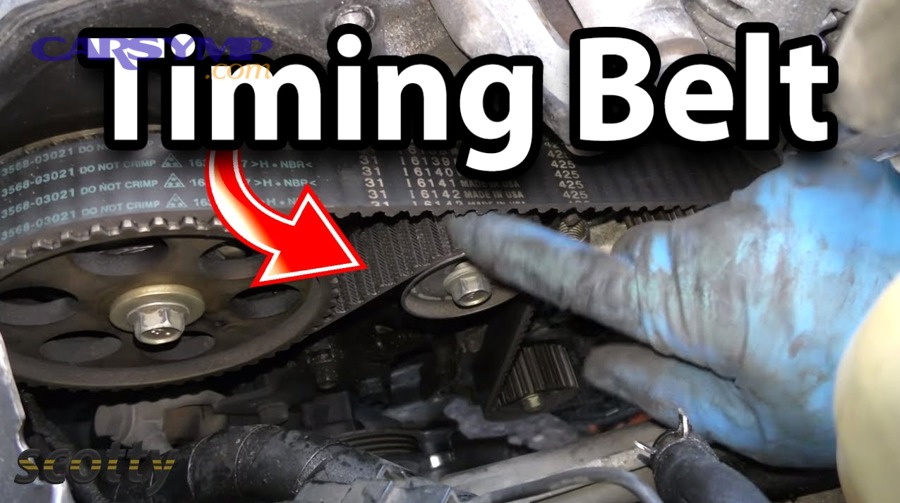
The water pump and cambelt are mechanically interdependent components: in many engines, the timing belt directly drives the water pump, meaning both components must function correctly for the engine to run safely and cool effectively.

To better understand why replacing both at the same time is so widely recommended, it helps to examine each component’s individual role — and then see how those roles converge.
What Does a Water Pump Do in Your Engine?
The water pump is the heart of your engine’s cooling system. Its primary job is to circulate coolant (antifreeze) continuously through the engine block, cylinder head, radiator, and heater core, maintaining the engine at a stable operating temperature and preventing it from overheating.
The pump is driven by a rotating shaft with an impeller at its centre. As the impeller spins, it forces coolant through the system under pressure. When the pump begins to fail — whether through a worn bearing, a cracked impeller, or a leaking seal — that circulation slows or stops entirely. Without adequate coolant flow, engine temperatures rise rapidly. Left unchecked, this leads to warped cylinder heads, blown head gaskets, or a seized engine — all of which are significantly more expensive than any preventive maintenance job.
What Does a Timing Belt (Cambelt) Do — and How Long Does It Last?
The cambelt is a reinforced rubber belt with internal teeth that synchronises the rotation of the crankshaft and one or more camshafts. This synchronisation ensures that the engine’s intake and exhaust valves open and close at precisely the right moment relative to the pistons’ position. If the belt skips a tooth, stretches, or snaps, that timing is lost — with potentially catastrophic results.
A typical Timing belt replacement interval guide from most manufacturers specifies replacement every 60,000 to 100,000 miles, or roughly every five to seven years — whichever comes first. The rubber compound degrades over time even if the mileage target has not been reached, which is why age matters just as much as distance. Ignoring this interval is one of the most expensive mistakes a car owner can make.
Is the Water Pump Always Driven by the Timing Belt?
No — the water pump is not always driven by the timing belt, but in a significant proportion of vehicles it is, and this distinction is critical. There are two main configurations:
- Timing belt-driven water pump: The pump sits within the timing belt circuit and is turned directly by the belt. In this setup, water pump failure can cause the belt to jump or snap, and a belt failure can seize the pump. Simultaneous replacement is strongly recommended — often considered mandatory by professional mechanics.
- Accessory/serpentine belt-driven water pump: The pump is driven by a separate auxiliary belt outside the timing system. In this case, the mechanical dependency is lower, but accessing the pump on some vehicles may still require partial or full timing belt removal, making simultaneous replacement labour-efficient regardless.
Checking your vehicle’s service manual or consulting a qualified mechanic will confirm which configuration your engine uses before deciding on your replacement strategy.
Should You Replace the Water Pump at the Same Time as the Cambelt?
Yes — you should replace the water pump at the same time as the cambelt in the vast majority of cases, for at least three compelling reasons: the components share the same service life, the labour overlap makes it significantly cheaper, and leaving a worn pump in place creates serious failure risk.
This is the core question that most car owners face when a cambelt service comes due, and the answer from professional mechanics is almost universally consistent. Let’s explore each reason in detail.
Do Both Components Wear Out at the Same Time?
Yes, both the water pump and the cambelt are typically rated to approximately 60,000–100,000 miles, which means they reach the end of their expected service life at virtually the same time. This alignment is not accidental — manufacturers design both components to similar durability standards because they operate under comparable mechanical stress throughout the engine’s working life.
By the time a vehicle reaches its first or second cambelt replacement interval, the water pump’s internal bearing has accumulated the same mileage of rotation, its seal has been exposed to the same thermal cycling, and its impeller has circulated the same volume of coolant. Even if the pump shows no obvious external symptoms of failure, internal wear is well advanced. Waiting for visible signs — a coolant leak, a whining noise, an overheating engine — means waiting until the pump has already begun to fail, which introduces unnecessary risk.
The practical implication is straightforward: if your cambelt is due for replacement, your water pump is statistically at or near the end of its reliable service life at the same moment. Replacing one without the other means knowingly leaving a worn component in a high-stress environment.
How Much Money Do You Save by Replacing Both Together?
Replacing both together can save between £150 and £500 (or the equivalent in your currency), depending on vehicle make and model, because the labour for both jobs overlaps almost entirely — the engine disassembly is the same regardless of whether one or two components are being swapped.
Labour is the dominant cost in a cambelt service. Depending on the vehicle, accessing the cambelt requires removing the engine undertray, the auxiliary belt, the crankshaft pulley, and the timing cover — a process that can take anywhere from two to eight hours on complex engines. Once that disassembly is complete, accessing the water pump requires only a few additional bolts and draining the coolant, typically adding no more than 30–60 minutes to the total job time.
The table below illustrates why separating these jobs is financially unjustifiable in most cases:
| Service Scenario | Parts Cost | Labour Cost | Total Estimated Cost |
|---|---|---|---|
| Cambelt only (first visit) | £80–£150 | £250–£500 | £330–£650 |
| Water pump only (second visit, later) | £40–£90 | £250–£500 | £290–£590 |
| Both together (single visit) | £120–£220 | £270–£520 | £390–£740 |
| Saving vs. two separate visits | — | — | £230–£500 saved |
Estimates vary by vehicle make, model, and regional labour rates. The table is intended to illustrate the labour overlap saving principle.
As the table shows, the water pump part itself is relatively inexpensive — the cost of a second visit is almost entirely labour. Doing both jobs together eliminates that duplicated labour cost entirely.
What Are the Risks of Not Replacing the Water Pump During a Cambelt Change?
The risks of not replacing the water pump during a cambelt change include timing belt failure triggered by pump seizure, engine overheating from coolant leaks around a deteriorating pump seal, and the full cost of a second engine teardown if the pump fails before the next belt interval.
More specifically, in a timing belt-driven configuration, a water pump whose bearing seizes mid-operation can lock up the belt drive, causing the belt to snap instantly. On an interference engine — where the valves extend deeper into the combustion chamber — a snapped belt at operating speed allows the pistons and valves to collide, bending valves, cracking the cylinder head, and potentially destroying the engine entirely. Repair costs in this scenario routinely exceed £2,000–£5,000, far outweighing the cost of a proactive water pump replacement.
Even on non-interference engines, a failed pump still leaves the vehicle stranded, risks overheating damage, and requires the engine to be disassembled again — with full labour charges applied a second time.
How Do You Know When Your Water Pump and Timing Belt Need Replacing?
There are several clear warning signs indicating that your water pump and timing belt need replacing: engine ticking or misfiring, coolant leaks near the front of the engine, bearing noise from the pump, and exceeding the manufacturer’s recommended mileage or age interval.
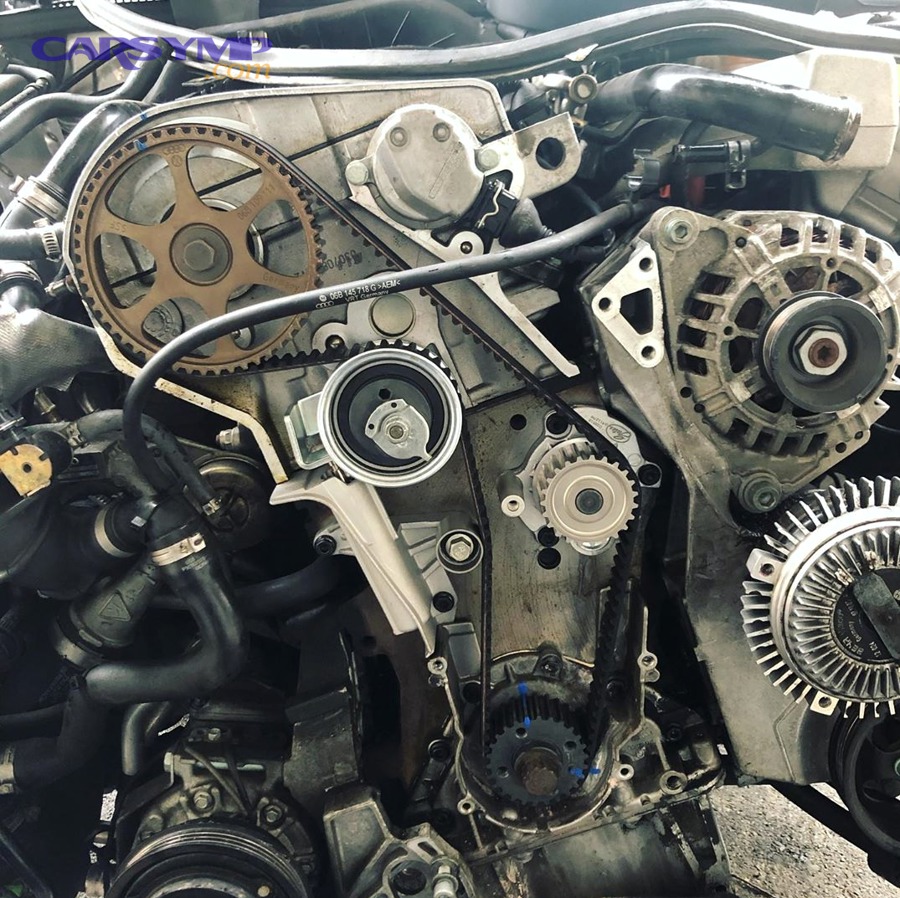
Recognising these signals early gives you the opportunity to plan the replacement proactively rather than reacting to a roadside failure.
What Are the Warning Signs of a Failing Timing Belt?
A failing timing belt typically presents the following warning signs, though in many cases there are no symptoms until the belt breaks:
- Ticking or rattling noise from the engine: A worn or loose belt can produce a rhythmic ticking as it moves over tensioner pulleys under tension.
- Engine misfire or rough idle: If the belt has stretched and timing is slightly off, combustion events become desynchronised, causing misfires under load.
- Difficulty starting or engine fails to turn over: A severely worn or broken belt means the camshaft no longer rotates when the starter motor turns the crankshaft, preventing ignition entirely.
- Visible cracking, fraying, or glazing: On vehicles where the timing cover can be removed without full disassembly, a visual inspection may reveal surface cracking or worn teeth on the belt.
- Exceeding service interval: The most reliable indicator is mileage or age. If your vehicle has reached or passed the manufacturer’s timing belt replacement interval guide threshold, replacement is overdue regardless of whether symptoms are present.
What Are the Warning Signs of a Failing Water Pump?
A failing water pump gives several identifiable warning signs that should prompt immediate inspection:
- Coolant leak near the front-centre of the engine: The pump’s mechanical seal deteriorates over time, allowing coolant to seep out around the pump housing. This often appears as a wet patch or white crystalline residue (dried coolant) below the front of the engine.
- Rising temperature gauge or overheating warning light: As pump efficiency drops, coolant circulation slows, causing engine temperatures to climb above the normal operating range.
- Whining, grinding, or rumbling noise from the front of the engine: A worn pump bearing produces an audible noise that increases with engine speed. When spun by hand during inspection, a worn bearing feels rough or has detectable play.
- Coolant loss without visible external leak: Internal pump wear can cause slow seepage into the engine bay that evaporates before pooling visibly, resulting in gradual coolant level drops.
How Are a Timing Belt and Water Pump Replaced Together — Step by Step?
Replacing a timing belt and water pump together involves approximately 8–12 key steps, requires 2–5 hours depending on vehicle complexity, and results in a fully refreshed engine timing and cooling system when carried out correctly.
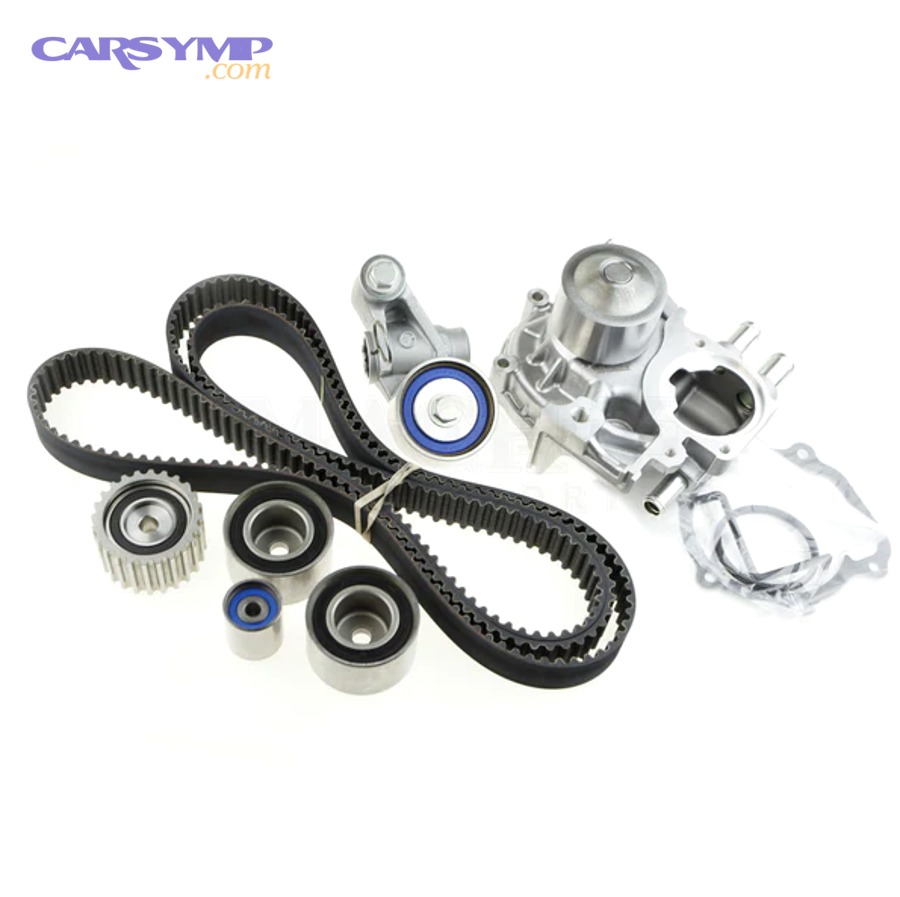
The following guide covers the essential stages of a combined replacement. Note that exact procedures vary significantly between vehicle makes and models — always consult the manufacturer’s workshop manual or a qualified mechanic before attempting this job.
What Tools and Parts Do You Need for a Combined Replacement?
Before beginning, gather all necessary tools and components. Attempting the job without the correct parts on hand mid-disassembly is a common and avoidable mistake.
Tools required:
- Hydraulic floor jack and axle stands
- Socket set (metric and imperial)
- Torque wrench
- Camshaft and crankshaft locking/alignment tools (vehicle-specific)
- Coolant drain bucket (minimum 5-litre capacity)
- Permanent marker or white correction fluid (for timing marks)
- Plastic zip-lock bags and a marker pen (for labelling removed bolts and components)
Parts required:
- New timing belt (OEM or OEM-equivalent specification)
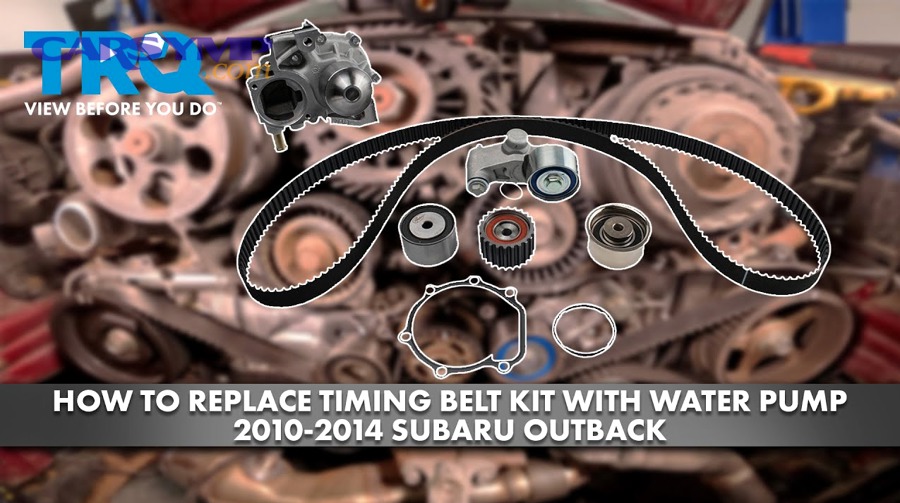
- New water pump with gasket
- New belt tensioner
- New idler pulley(s)
- Fresh coolant (correct specification for your vehicle — check the manual)
- Water pump gasket sealant (if required by your vehicle’s specification)
Purchasing a complete timing belt kit that includes the water pump, tensioner, and idler pulleys from a single manufacturer is strongly recommended. Mixing components from different brands introduces the risk of dimensional incompatibility and uneven wear. A comprehensive Timing belt replacement cost estimate should include all of these kit components, not just the belt itself.
What Is the Step-by-Step Process for Replacing Both Together?
The following steps outline the standard combined replacement procedure:
- Prepare the vehicle: Park on a level surface, allow the engine to cool completely, engage the handbrake, and jack up the front of the vehicle to access the undertray. Place a coolant-collection bucket beneath the water pump location.
- Drain the coolant: Open the radiator drain tap or remove the lower radiator hose to drain the cooling system fully.
- Remove ancillary components: Depending on the vehicle, this may include the engine undertray, the auxiliary/serpentine belt, the crankshaft pulley bolt and pulley, and the plastic timing cover(s).
- Mark the timing positions: Using a marker, clearly mark the alignment positions of the crankshaft sprocket, camshaft sprocket(s), and any balance shaft sprockets against the belt’s existing position. Fit camshaft and crankshaft locking tools if available for your vehicle.
- Release the tensioner and remove the old belt: Loosen the tensioner bolt to relieve belt tension, then carefully slide the old timing belt off all sprockets. Do not rotate any sprockets independently once the belt is removed.
- Remove and replace the water pump: Undo the water pump retaining bolts, carefully remove the old pump, and clean the mating surface thoroughly. Fit the new pump with a fresh gasket, applying sealant if specified, and torque the bolts to the manufacturer’s specification.
- Replace the tensioner and idler pulleys: While the belt is off, replace the tensioner and all idler pulleys as a matter of course. A new belt running on old, worn bearings will fail prematurely.
- Fit the new timing belt: Route the new belt over the sprockets in the correct order specified in the workshop manual, ensuring that all timing marks remain aligned throughout.
- Set and lock the tensioner: Apply the correct belt tension using the tensioner mechanism and lock it in position according to the manufacturer’s method — this is often a specific rotation of the tensioner body to a marked index position.
- Verify timing alignment: Double-check that all sprocket timing marks align precisely with their reference points before reassembling any covers.
- Reassemble and refill: Refit all covers, the crankshaft pulley, and ancillary components. Refill the cooling system with the correct coolant mixture, bleed any air pockets from the system, and check for leaks.
- Start and verify: Start the engine and allow it to reach operating temperature. Confirm the temperature gauge sits in the normal range, check for coolant leaks, and listen for any unusual noises.
What Common Mistakes Should You Avoid During This Replacement?
Several preventable errors account for the majority of post-replacement failures in timing belt and water pump jobs:
- Using the wrong coolant: Different engine alloys require specific coolant chemistries. Mixing incompatible coolants — for example, OAT (organic acid technology) and HOAT types — causes the chemicals to react, forming a gel-like substance that blocks coolant passages and causes rapid overheating. Always check the vehicle manufacturer’s coolant specification.
- Skipping the tensioner and idler pulleys: This is the single most common cost-cutting mistake. A new timing belt running on old bearings will fail within one service interval, requiring the entire job to be repeated in full.
- Incorrect timing alignment after reassembly: Even one tooth of misalignment on a cambelt can cause erratic engine behaviour; multiple teeth of misalignment on an interference engine can cause valve-to-piston contact at first startup. Verify alignment marks methodically before closing up.
- Under- or over-torquing bolts: The crankshaft pulley bolt in particular requires precise torque — often specified in two stages — and is a common source of post-job leaks or failures when incorrectly torqued.
- Reusing the old water pump gasket: The old gasket compresses and deforms during its service life and will not seal reliably when reused. Always fit a new gasket, and use gasket sealant only where the manufacturer specifies it.
Is It Worth Replacing the Water Pump Even If It Isn’t Belt-Driven?
Yes — even when the water pump is not driven by the timing belt, replacing it at the same time as the cambelt service is still worth considering, because accessing the pump on many vehicles requires the same engine disassembly, and the pump’s age and mileage will be similarly advanced.
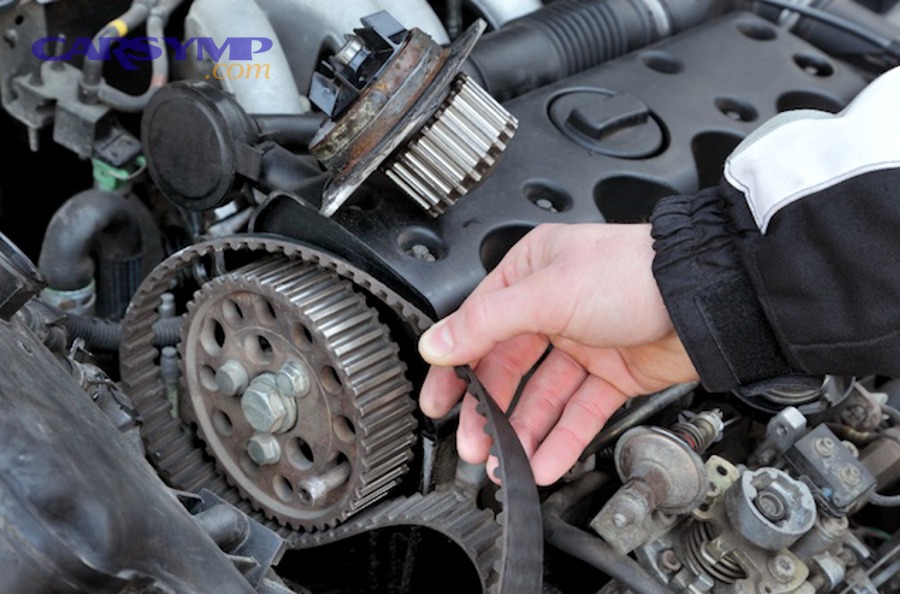
On vehicles with an accessory belt-driven water pump, the mechanical risk of mutual failure is lower than in a timing belt-driven setup. However, the labour cost argument still applies strongly on models where the pump sits behind or adjacent to the timing system. On some Audi, Volkswagen, and Honda platforms, for example, the pump is on the serpentine belt but is only practically accessible once the timing covers are removed — at which point the incremental labour cost of swapping the pump is minimal.
The decision in this configuration should be guided by three factors: the vehicle’s total mileage, the pump’s service history (or lack of it), and the labour cost estimate from the workshop. If the combined timing belt replacement cost estimate already includes significant teardown time, adding a water pump — typically costing £40–£90 for the part itself — is almost always the rational choice. Conversely, on a low-mileage vehicle with a fully documented pump replacement within the last 40,000 miles, waiting may be a reasonable and economical decision.
What Else Should You Replace During a Timing Belt and Water Pump Service?
There are four additional components worth replacing during a timing belt and water pump service: the belt tensioner, the idler pulleys, the cam and crank seals, and the thermostat — all of which become accessible during the same engine disassembly and represent relatively low parts costs against significant labour savings.
This section moves from the primary decision into the broader scope of a comprehensive cambelt service, addressing the micro-semantic detail that separates a basic replacement from a truly thorough one.
Should You Replace the Belt Tensioner and Idler Pulleys at the Same Time?
Yes — replacing the belt tensioner and idler pulleys at the same time as the cambelt is strongly recommended, because these components carry the same mileage as the old belt and their bearing failure is as catastrophic as the belt snapping.
The tensioner is a spring-loaded or hydraulic mechanism that maintains the correct tension on the timing belt throughout its service life. When the tensioner bearing fails, tension is lost, the belt skips or snaps, and the engine suffers the same damage as a direct belt failure. The idler pulleys serve a similar function, routing the belt correctly around the engine. Both are inexpensive relative to the labour involved in the cambelt job — typically £15–£50 per pulley — and are always included in quality timing belt replacement kits.
During inspection at 100,000 miles or more, it is common to find that the bearings in tensioners and idler pulleys produce audible noise and perceptible play when spun by hand with the belt removed. Fitting a new belt on worn pulleys is a well-documented cause of premature belt failure within the following service interval.
Is It Worth Replacing Cam Seals and Crank Seals During This Service?
Yes — replacing the cam seals and crank seals during a cambelt service is worth doing on higher-mileage vehicles, because the engine is already partially disassembled, the incremental labour is minimal, and an oil leak from a degraded seal onto a new timing belt will destroy the belt rapidly.
The camshaft and crankshaft oil seals are rubber components that prevent engine oil from escaping around the rotating shafts. Over time, the rubber hardens and shrinks, allowing small amounts of oil to seep past the seal lip. When that oil contacts the rubber cambelt, it causes the belt material to swell and degrade — dramatically shortening its service life and creating a failure risk well before the next scheduled interval.
On vehicles with a known oil-leak history, or where the service history is incomplete or unknown, proactive seal replacement at the time of the cambelt job is one of the highest-value preventive measures available. The seals themselves cost £5–£20 each; the labour to return later and replace a prematurely oil-soaked belt is several times greater.
Should You Replace the Thermostat When Changing the Water Pump?
Yes — replacing the thermostat at the same time as the water pump replacement is a logical and cost-effective decision, because the coolant is already fully drained for the water pump job and the thermostat is an inexpensive, failure-prone component in the same cooling circuit.
The thermostat regulates coolant flow based on engine temperature, opening at a set temperature to allow hot coolant to flow to the radiator and closing when the engine is cold to accelerate warm-up. A thermostat that sticks open causes the engine to run below optimal operating temperature, reducing fuel efficiency and increasing emissions. One that sticks closed causes rapid overheating.
Thermostat replacement typically costs £10–£30 for the part, and fitting it while the cooling system is already drained and partially disassembled adds minimal time to the overall job. Given that thermostats are subject to the same thermal cycling fatigue as the water pump and often fail around the same service intervals, including it in a combined cambelt service is sound preventive maintenance.
Does a Turbocharged Engine Change the Advice on Water Pump Replacement?
Yes — a turbocharged engine makes the case for proactive water pump replacement even stronger, because the additional heat generated by the turbocharger places significantly greater thermal stress on the water pump bearing, seal, and impeller throughout its service life.
Turbocharged engines operate at higher sustained temperatures than naturally aspirated units, and the cooling system works harder to manage the additional heat from the turbo. This elevated thermal load accelerates wear on the water pump’s internal components — particularly the bearing and the mechanical seal — meaning that a turbocharged water pump may be closer to the end of its reliable life at 60,000–70,000 miles than an equivalent pump in a naturally aspirated engine would be at 100,000 miles.
Additionally, the turbo itself relies on the cooling system to manage heat soak after the engine is switched off. A compromised water pump that reduces post-shutdown coolant circulation can accelerate turbo bearing wear and, in extreme cases, cause coking of the oil in the turbo bearing housing — a condition that substantially shortens turbocharger life. On any turbocharged vehicle, replacing the water pump at each timing belt replacement is the professional standard recommendation, without exception.
Taken together, the case for replacing your water pump at the same time as your cambelt is built on three solid pillars: mechanical necessity, financial logic, and long-term engine protection. The timing belt replacement interval guide set by your vehicle’s manufacturer is the clearest signal you have that both components are due — and treating that service as an opportunity to refresh the entire timing and cooling system in one visit is the approach that professional mechanics, OEM kit manufacturers, and seasoned car owners consistently endorse. Whether you are managing the job yourself or instructing a workshop, arriving with this knowledge means you are equipped to make the right call — and avoid the far more expensive alternative.