


Cam/crank correlation codes are a family of OBD-II diagnostic trouble codes — most commonly P0016, P0017, P0018, and P0019 — that your vehicle’s powertrain control module (PCM) sets when it detects that the crankshaft and camshaft positions are no longer properly synchronized. Unlike a simple sensor failure, a correlation code signals a relationship problem between two critical engine components. That distinction matters enormously, because replacing a sensor without understanding why the correlation error occurred will almost always result in the check engine light returning within days. Understanding what these codes actually mean is the essential first step toward a correct, lasting repair.
The symptoms that accompany cam/crank correlation codes can range from an illuminated check engine light with no drivability complaints, all the way to a rough idle, hard start, misfires, reduced power, and even a complete no-start condition. The severity depends directly on how far out of time the camshaft has drifted relative to the crankshaft. A minor deviation may only store a fault code; a major one disrupts fuel injection sequencing and ignition timing enough to prevent the engine from running reliably. Recognizing these symptoms early — and taking them seriously — can mean the difference between a relatively straightforward timing chain repair and catastrophic internal engine damage.
Diagnosing the root cause of a cam/crank correlation code requires a systematic approach that moves from the simplest possible cause to the most complex. Many technicians and experienced DIYers begin with an oil and filter change on VVT-equipped engines, since dirty or low oil is a surprisingly common trigger for false correlation faults through the variable valve timing system. From there, the process advances to scan tool live data, visual inspection of sensors and tone rings, and if necessary, oscilloscope waveform analysis to compare the actual cam and crank signal relationship against a known-good reference.
Once the root cause is confirmed, the fix must address the underlying mechanical or sensor condition — not simply clear the code. Timing chain repair, VVT solenoid replacement, cam phaser service, or sensor and tone ring correction each require their own specific procedures. To help you navigate every stage of this process, this article covers each layer in full detail: what the codes mean, what causes them, how to diagnose them accurately, and how to fix them correctly the first time.
What Are Cam/Crank Correlation Codes?
Cam/crank correlation codes are a specific category of OBD-II diagnostic trouble codes indicating that the PCM has detected an unacceptable positional deviation between the crankshaft and one or more camshafts during engine operation.
To better understand why this distinction matters, it helps to start with what the word “correlation” actually means in this context — and why engineers designed the PCM to monitor it continuously.
How Do the Crankshaft (CKP) and Camshaft (CMP) Sensors Work Together?
The crankshaft position sensor (CKP) and the camshaft position sensor (CMP) are two separate sensors performing two complementary roles, and the engine management system depends on both working in precise harmony.
The CKP sensor functions as the primary ignition trigger. It monitors a reluctor ring — also called a tone ring — mounted on the crankshaft. This ring has a series of evenly spaced teeth with one deliberate gap, called the missing-tooth reference. As the ring rotates past the magnetic sensor, each passing tooth generates a voltage pulse. The PCM reads this pulse train to determine exact crankshaft position and speed, and uses it to control spark timing.
The CMP sensor performs a related but distinct function. It reads a similar reluctor wheel mounted on the camshaft and sends that positional data to the PCM, which uses it to identify which cylinder is on its compression stroke. This identification is essential for sequential fuel injection — the system that fires each injector in a specific order matched to the engine’s firing sequence.
What physically links these two shafts and their sensors is the timing belt or timing chain. The chain connects the crankshaft sprocket to the camshaft sprocket(s) with a fixed gear ratio, ensuring that for every two full crankshaft revolutions, each camshaft completes exactly one revolution. As long as the chain maintains that relationship, the CKP and CMP signals remain synchronized, and the PCM sees no fault.
What Does “Out of Correlation” Actually Mean?
“Out of correlation” means the PCM has compared the CKP and CMP signal timing and found that the gap between them has exceeded an acceptable threshold — typically somewhere around 10 degrees of crankshaft rotation or more, though the exact threshold varies by manufacturer and is defined in vehicle-specific service data.
Specifically, the PCM continuously calculates the angular offset between the crankshaft reference signal and the first rising edge of the camshaft signal. On a healthy engine, this offset is fixed and predictable. When the timing chain stretches, a tooth slips, a cam phaser shifts incorrectly, or a sensor moves out of position, that offset changes. Once the deviation surpasses the PCM’s programmed tolerance, a correlation DTC is stored.
This is a fundamentally different fault from a circuit code. A circuit code — such as P0335 or P0340 — means the PCM is receiving no signal, or an erratic signal, from one of the sensors. A correlation code means both sensors are generating clean, readable signals, but the relationship between those signals is wrong. That distinction is what makes cam/crank correlation codes uniquely diagnostic: a clean oscilloscope waveform can rule out an electrical fault and point directly toward a mechanical or positional cause.
What Do the Specific Cam/Crank Correlation Codes Mean?
There are four primary cam/crank correlation codes — P0016, P0017, P0018, and P0019 — classified based on which bank and which camshaft (intake or exhaust) is out of phase with the crankshaft.

Understanding exactly which code has been stored is important before beginning diagnosis, because it narrows the search to a specific bank and camshaft. The table below summarizes the full correlation code family and maps each code to its bank and sensor designation.
| DTC | Description | Bank | Sensor |
|---|---|---|---|
| P0016 | Crankshaft/Camshaft Position Correlation | Bank 1 | Sensor A (Intake) |
| P0017 | Crankshaft/Camshaft Position Correlation | Bank 1 | Sensor B (Exhaust) |
| P0018 | Crankshaft/Camshaft Position Correlation | Bank 2 | Sensor A (Intake) |
| P0019 | Crankshaft/Camshaft Position Correlation | Bank 2 | Sensor B (Exhaust) |
Each of these codes follows the same diagnostic logic, but the specific cam affected determines where to focus the physical inspection.
What Is Code P0016 — Crankshaft Position/Camshaft Position Correlation Bank 1 Sensor A?
P0016 is the most frequently encountered correlation code and indicates that the Bank 1 intake camshaft position is out of phase with the crankshaft by more than the PCM’s tolerance threshold.
Bank 1 is the engine bank that contains cylinder number one. Sensor A refers to the intake camshaft on that bank. This code appears widely across a broad range of vehicles and platforms, from General Motors 2.4L Ecotec and 3.6L V6 engines, to Ford EcoBoost four-cylinders, to various Toyota and Honda VVT-equipped engines.
The severity of P0016 should not be underestimated. Even a minor timing deviation degrades fuel economy, increases emissions, and produces rough idle. A significant deviation disrupts injection timing enough to cause hard starting, misfires, or a complete no-start. Left unaddressed, continued operation with a jumped or slipping timing chain can allow valve-to-piston contact on interference engines, resulting in catastrophic internal damage.
What Is Code P0017 — Crankshaft Position/Camshaft Position Correlation Bank 1 Sensor B?
P0017 targets the Bank 1 exhaust camshaft, making it distinct from P0016 and particularly common on engines equipped with independent variable valve timing on both the intake and exhaust cams.
On dual-VVT engines — where separate cam phasers actuate the intake and exhaust camshafts independently — P0017 often appears alongside P0014 (Camshaft Position B Over-Advanced or System Performance). When both codes appear together, the most likely cause is a mechanical timing problem rather than an isolated sensor or solenoid fault, since an over-advanced exhaust cam timing condition directly creates a correlation error between the exhaust cam and the crankshaft.
This code is particularly prevalent on GM 2.4L and 3.6L VVT engines, where the crankshaft reluctor gear is pressed onto the crankshaft rather than keyed. Over time and mileage, this pressed-on gear can slip, causing a sudden and severe correlation error that no sensor replacement will correct.
What Are Codes P0018 and P0019 — Bank 2 Correlation Codes?
P0018 and P0019 mirror P0016 and P0017 exactly in their diagnostic logic, but apply to the intake and exhaust camshafts on Bank 2 — the engine bank opposite the one containing cylinder number one.
These codes only appear on V6, V8, or other multi-bank engine configurations where the second bank has its own independent camshaft sensor(s) and, on VVT-equipped engines, its own phaser and solenoid circuit. Diagnosing Bank 2 correlation codes follows the same process as Bank 1, but the physical inspection must be directed to the correct side of the engine. On engines with four camshaft sensors — such as certain GM 3.6L LLT/LFX engines and many BMW inline-six and V8 platforms — storing codes on both banks simultaneously is a strong indicator of a mechanical timing problem affecting the entire timing system rather than an isolated sensor or solenoid fault.
What Are the Symptoms of a Cam/Crank Correlation Code?
Cam/crank correlation codes produce three main categories of symptoms: warning light illumination, drivability complaints such as rough idle or misfires, and in severe cases, a hard-start or complete no-start condition.

Symptom severity scales directly with the degree of timing deviation, which means that the same root cause — a stretched timing chain, for example — can present very differently at 8 degrees of deviation versus 20 degrees. Let’s explore how these symptoms develop and what they reveal about the underlying fault.
Does a Cam/Crank Correlation Code Always Cause Noticeable Symptoms?
No, a cam/crank correlation code does not always produce noticeable drivability symptoms, particularly in the early stages when the timing deviation is small and the PCM has stored the code without reaching the threshold that disrupts normal engine operation noticeably.
In many vehicles, a deviation of just over the PCM’s minimum threshold — perhaps 10 to 12 degrees — will set the check engine light and store the DTC, but the engine may still idle smoothly and accelerate normally under light loads. This is actually one of the more dangerous presentations of a correlation code, because the driver may dismiss the warning light without urgency, unaware that the underlying cause (typically a stretching timing chain) is progressively worsening.
As the deviation grows, symptoms become increasingly obvious. Rough idle develops as fuel injection sequencing becomes less precise. Hesitation and stumbling appear under acceleration. Fuel economy decreases measurably as combustion efficiency drops. In some cases, symptoms appear only under load and disappear at idle — a behavior directly related to the dynamic cam deviation that occurs when a worn timing chain whips and flexes under engine torque, temporarily shifting the cam signal further out of phase than at rest.
Can a Cam/Crank Correlation Code Cause a No-Start Condition?
Yes, a cam/crank correlation code can absolutely cause a no-start condition when the timing deviation is severe enough to prevent the PCM from establishing proper injection sequencing and spark delivery simultaneously.
The PCM uses the CMP signal to identify the beginning of the injection sequence — specifically, to confirm which cylinder is on its compression stroke before firing its injector. When the camshaft position is so far out of phase that the PCM cannot reliably identify cylinder position, it may fail to initiate the injection sequence correctly, resulting in extended cranking without a clean start. The engine may fire briefly and then stall, or it may crank for 10 to 20 seconds before catching — a symptom frequently reported on vehicles with jumped timing chains.
This hard-start pattern is characteristically intermittent in the early stages: the engine eventually starts after prolonged cranking, then starts normally for a period before the problem recurs. Over time, as the mechanical condition worsens, the starts become progressively harder until the engine will not start at all. A timing chain that has jumped multiple teeth — not just stretched — will typically produce an immediate no-start, since the phase error at that point far exceeds anything the PCM can compensate for.
What Causes Cam/Crank Correlation Codes?
Cam/crank correlation codes have three main categories of causes: mechanical timing system failures, sensor and tone ring faults, and lubrication-related failures affecting the variable valve timing system.

Correctly identifying which category applies before beginning repairs is essential, because each category demands a different diagnostic approach and a different repair path. More importantly, applying the wrong repair — such as replacing sensors when the timing chain has jumped — wastes money and leaves the actual problem unresolved.
Can a Worn or Stretched Timing Chain Cause a Correlation Code?
Yes, a worn or stretched timing chain is one of the most common mechanical causes of cam/crank correlation codes, and it works by allowing the camshaft to gradually retard its timing relative to the crankshaft as the chain loses its ability to maintain a fixed positional relationship.
A timing chain does not stretch in the literal sense — the metal links do not elongate. Instead, wear occurs at the pins and bushings connecting each link, and the accumulated play across dozens of link connections effectively lengthens the chain’s functional pitch. On a 30-tooth crankshaft sprocket, each tooth represents 12 degrees of crankshaft rotation. A chain worn enough to allow the camshaft to slip by even one tooth produces an immediate 12-degree correlation error — well above the PCM’s typical 10-degree threshold.
A related but distinct failure mode involves the crankshaft reluctor gear pressing off its crankshaft seat. On certain GM engines where this gear is pressed on rather than keyed, the gear can rotate independently of the crankshaft under high mileage and thermal cycling, creating a sudden, severe correlation error that cannot be resolved by any amount of sensor replacement or solenoid service.
On belt-driven engines, the equivalent failure is a timing belt that has jumped a tooth on one of the cam sprockets. This can occur when a belt tensioner fails and momentarily allows belt slack, or when a worn belt loses a tooth under load. The diagnostic result is identical to a chain jump: a sudden shift in cam timing that exceeds the PCM’s correlation tolerance.
Can a Bad Camshaft or Crankshaft Sensor Cause a Correlation Code?
Yes, a faulty sensor can contribute to a correlation code, but the relationship is more nuanced than it appears — and simply replacing the sensor resolves the fault only in a minority of cases.
A sensor that has completely failed — producing no signal — will typically generate a circuit code (P0335, P0340, etc.) rather than a correlation code, because the PCM cannot calculate a correlation without two valid signals to compare. A correlation code is more likely when a sensor is functioning but producing a shifted or erratic signal due to physical misalignment, incorrect installation depth, or a damaged tone ring.
Tone ring damage is a particularly important cause to inspect. The reluctor ring must be securely seated on its shaft, properly keyed, and free of damaged, missing, or bent teeth. A ring that has come loose and rotated slightly on its journal — or one whose alignment key has sheared — will present the PCM with a cam or crank signal that is consistently offset from its correct position, generating an apparently stable correlation error that looks mechanical but is actually a sensor/tone ring positioning problem. Inspecting the ring requires removing the relevant cover and visually confirming the ring’s seating and tooth condition before condemning the timing chain.
Can Low or Dirty Engine Oil Cause a Cam/Crank Correlation Code?
Yes, low or dirty engine oil is a legitimate and frequently overlooked cause of cam/crank correlation codes on engines equipped with variable valve timing systems, because the VVT cam phaser operates entirely on oil pressure.
The VVT system advances or retards camshaft timing by routing pressurized oil into chambers within the cam phaser (also called the CVVT hub or cam actuator). The VVT solenoid — a small electrically controlled valve on the cylinder head — directs oil flow to the appropriate phaser chamber based on PCM commands. If oil pressure is insufficient due to a low oil level, excessive oil viscosity from cold temperatures, or degraded oil that has lost its flow properties from sludge buildup, the phaser cannot respond accurately to PCM commands. The camshaft then drifts to an unintended position, and the PCM logs a correlation code.
Clogged VVT solenoids are a directly related failure mode. Sludge and carbon deposits from infrequent oil changes or incorrect oil specification can block the small passages inside the solenoid, preventing it from directing oil to the phaser. On many platforms — particularly Honda, Toyota, Chevrolet Colorado/GMC Canyon with the I5, and Volvo T5 engines — an oil and filter change with the correct OEM-specified oil is the recommended first diagnostic step when a correlation code appears with no obvious mechanical symptoms, because it resolves the fault entirely in a meaningful percentage of cases.
How Do You Diagnose a Cam/Crank Correlation Code?
Diagnosing a cam/crank correlation code correctly requires a four-phase process: record and evaluate stored codes and freeze frame data, perform preliminary checks including oil condition, progress to scan tool live data analysis, and advance to oscilloscope testing if necessary — completing each phase before moving to the next.

This structured workflow prevents the most common diagnostic error: replacing parts based on the code alone without confirming the root cause. Let’s work through each phase in sequence.
What Are the First Steps When Diagnosing a Cam/Crank Correlation Code?
Step 1 — Record all stored codes and freeze frame data. Before clearing anything, document every DTC present and review the freeze frame data, which captures engine operating conditions at the moment the fault was stored. Multiple codes stored together — for example, P0016 alongside P0014 — often tell a more complete story than a single code in isolation. Freeze frame RPM and load values can indicate whether the fault occurred at idle or under acceleration, which is diagnostically significant.
Step 2 — Check oil level and condition. Pull the dipstick. If the oil is low, dark, or sludgy, an oil and filter change is warranted before any other diagnostic step on a VVT-equipped engine. This takes 20 minutes and costs very little compared to replacing components unnecessarily. Refill with the manufacturer-specified viscosity and OEM-grade filter, then clear the code and perform a test drive before proceeding further.
Step 3 — Visually inspect the cam and crank sensor connectors and harnesses. Look specifically for oil contamination inside the connector body — a sign that the sensor O-ring has failed and allowed oil to migrate into the circuit. Check for chafed or pinched wiring, broken connector locks, and corrosion on the terminals. Oil-saturated connectors can create resistive connections that distort the sensor signal subtly enough to trigger a correlation fault without generating a circuit code.
Step 4 — Use a scan tool to read live cam timing variance. Many modern scan tools — and virtually all professional-grade tools such as Autel, Snap-on, and Bosch — can display a live PID showing the actual measured camshaft timing deviation in degrees. This is the single most important data point in initial diagnosis. A variance value that fluctuates widely under load and returns to near-zero at idle strongly suggests a mechanical timing issue (chain stretch or phaser fault). A variance that is consistently elevated regardless of operating condition is more consistent with a sensor positioning or tone ring problem.
How Do You Use a Scan Tool to Identify the Root Cause?
A scan tool identifies the root cause of a cam/crank correlation code by comparing live camshaft timing deviation data against known thresholds, testing VVT solenoid response, and distinguishing mechanical faults from sensor faults through real-time observation.
Specifically, the key live data values to monitor are the camshaft timing deviation PID (measured in degrees), the cam actuator commanded position versus actual position, and the VVT solenoid duty cycle. On most platforms, if the PCM is commanding 0 degrees of cam advance and the actual cam position reads 12 to 15 degrees retarded consistently, the timing chain has likely stretched or slipped. If the commanded and actual positions track each other but both deviate from the crankshaft reference, the issue may be a slipped crankshaft reluctor ring.
Many professional scan tools also support bi-directional controls for the VVT solenoid, allowing the technician to command the solenoid fully open or closed while observing the cam timing response. A healthy phaser and solenoid system will show the cam timing advancing and retarding smoothly in response to commands. A sluggish or unresponsive cam timing change under solenoid command — on an engine with clean oil and confirmed adequate oil pressure — points toward a failed VVT solenoid or a worn cam phaser that cannot hold position.
How Do You Perform a Cam/Crank Correlation Test with an Oscilloscope?
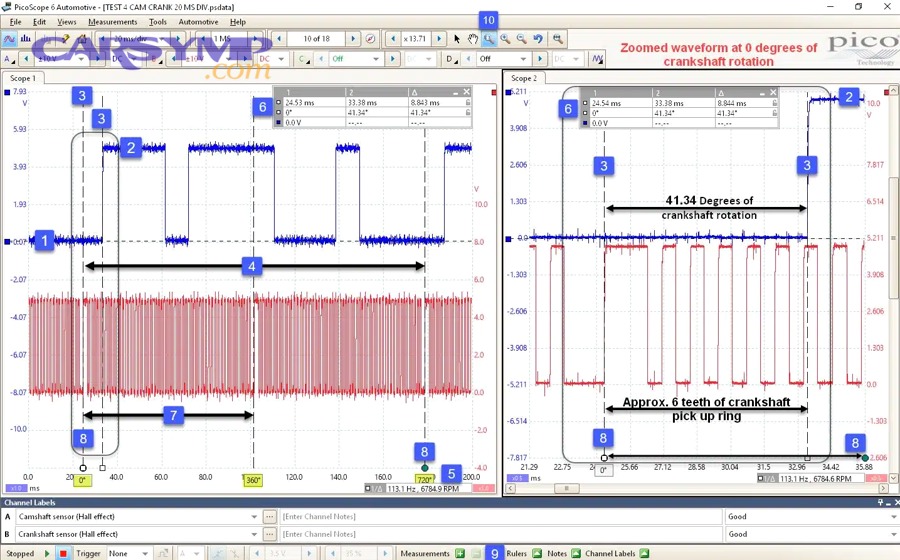
A cam/crank correlation oscilloscope test is performed by connecting Channel A to the CKP signal wire and Channel B to the CMP signal wire, capturing a minimum of two full engine revolutions, and comparing the angular offset between the crankshaft reference gap and the first camshaft pulse against a known-good waveform reference.
More specifically, the test proceeds as follows. Connect the scope’s Channel A to the crankshaft position sensor signal wire — identified through the vehicle’s wiring diagram. Connect Channel B to the camshaft position sensor signal wire for the bank and sensor corresponding to the stored DTC. Set the time base to approximately 20 ms/div for a four-cylinder at idle, or 50 ms/div to capture more complete crankshaft revolutions for reference clarity.
With the engine running, the crankshaft signal will display a repeating pattern of evenly spaced pulses with a single gap — the missing-tooth reference. Identify two consecutive missing-tooth gaps; the distance between them represents 720 degrees of crankshaft rotation (two full revolutions, which equals one complete four-stroke cycle). The camshaft signal should show its first rising edge at a specific, repeatable angular position after the crank reference gap. Measure this offset using the scope’s cursor tools.
Compare this offset against a known-good waveform for the same vehicle platform. Resources such as the Pico Automotive Waveform Library, which contains labeled, verified waveforms submitted by technicians globally, provide reliable reference data. A correlation fault will be visually obvious: the cam signal’s reference point will be shifted earlier or later relative to the crank gap compared to the known-good capture.
An important caution: evaluate the waveform at idle and under load. A timing chain with moderate wear may appear correctly correlated at idle but drift significantly when engine torque increases — a phenomenon called dynamic cam deviation that the PCM itself detects during normal driving but that a static idle test will miss.
How Do You Fix a Cam/Crank Correlation Code?
Fixing a cam/crank correlation code requires matching the repair to the confirmed root cause: timing chain or belt service for mechanical timing faults, sensor or tone ring correction for positional sensor faults, and VVT solenoid or cam phaser replacement for variable valve timing system failures.

Clearing the code without addressing its cause is not a repair. Each of the following repair paths applies to a specific confirmed diagnosis — and in complex cases, more than one repair may be required simultaneously.
How Do You Fix a Correlation Code Caused by a Timing Chain or Belt?
Fixing a correlation code caused by a worn or jumped timing chain requires complete timing chain system replacement — including the chain, all tensioners, all guide rails, and both the crankshaft and camshaft sprockets if worn.
Timing chain repair is not a job that benefits from partial measures. Replacing only the chain while leaving worn tensioners and guides in place virtually guarantees an early repeat failure, since the new chain will experience accelerated wear against degraded guides almost immediately. The Timing chain repair labor time for a typical front-wheel-drive four-cylinder — such as a GM Ecotec, Honda K-series, or Toyota 2AR — ranges from four to eight hours at a shop, depending on how deeply buried the timing cover is and whether oil pan removal is required for access.
A Timing chain repair cost estimate varies considerably by vehicle. On accessible engines, parts and labor together typically range from $700 to $1,500. On more complex platforms — such as the GM 3.6L LLT/LFX V6, where the timing chain kit alone can cost $300–$500 in parts and labor runs 10–14 hours — total repair costs can reach $2,000 to $3,500 or more at dealer rates.
After the timing system is reassembled, the absolute requirement is confirming that all timing marks are aligned precisely according to the vehicle-specific service procedure before rotating the engine. On interference engines, a single tooth of misalignment during reassembly is enough to cause valve-to-piston contact on the first start attempt.
How Do You Fix a Correlation Code Caused by a Faulty Sensor or Tone Ring?
Fixing a correlation code caused by a sensor or tone ring issue requires confirming the exact nature of the positional fault — whether the sensor itself is defective, the tone ring has shifted, a tooth is damaged, or the alignment key has sheared — and correcting the specific condition found.
For a defective sensor, replacement is straightforward: remove the old sensor, apply a small amount of clean engine oil to the new sensor’s O-ring, install to the correct torque specification, and verify that the sensor sits flush without any gap that would affect signal amplitude. Using the vehicle manufacturer’s specified part — or a quality OEM-equivalent — is important, since aftermarket sensors occasionally have marginally different magnetic field strengths that can affect signal threshold detection on sensitive PCM calibrations.
For a shifted or damaged tone ring, the repair scope depends on the ring’s design. Many camshaft tone rings are integral to the camshaft sprocket and cannot be serviced separately — the sprocket must be replaced. Crankshaft tone rings integral to the harmonic balancer require balancer replacement. Where the ring is a separate pressed component, confirming that it seats fully and that the alignment key is intact is essential before reassembly. A sheared key — a rare but definitive failure — requires either a new shaft or a shaft repair that restores the keyway.
How Do You Fix a Correlation Code Caused by a VVT Solenoid or Cam Phaser?
Fixing a correlation code rooted in the variable valve timing system involves either replacing the VVT solenoid — a relatively accessible and inexpensive external component — or replacing the cam phaser itself, which is an internal timing system component requiring special tooling and full timing system disassembly.
VVT solenoid replacement is typically a straightforward repair. The solenoid is located on the cylinder head, often directly accessible after removing an engine cover. It is retained by one or two bolts, and replacement requires careful cleaning of the oil gallery port before installation to prevent contamination of the new solenoid. On many platforms, solenoid replacement combined with a fresh oil and filter service resolves the correlation code completely, making it a cost-effective first step before committing to phaser replacement.
Cam phaser replacement is significantly more involved. The phaser — also called the CVVT hub — is an internal component that sits between the camshaft sprocket and the camshaft itself, using pressurized oil to rotate the camshaft through its advance/retard range. Because it is part of the timing assembly, replacing it requires complete timing system disassembly, special locking tools to hold the cams and crankshaft at their reference positions during service, and meticulous reassembly to factory timing specifications. There is no external visual inspection that confirms phaser failure; the diagnosis is made by elimination after confirming clean oil, adequate oil pressure, and a functional solenoid.
Do You Need to Perform a Cam/Crank Relearn After Repairs?
Yes, a cam/crank relearn procedure is required after certain repairs — particularly timing chain replacement, cam phaser service, and tone ring repositioning — because the PCM must reestablish its reference baseline for the new component positions before it can accurately monitor correlation.
Specifically, many modern vehicles store a learned value for the expected cam/crank offset at idle and across the operating range. After a timing repair changes the physical relationship between the sensors and their respective shafts, the old learned value no longer reflects reality. If the PCM uses the outdated baseline for comparison, it may either set a new fault code when the repaired system is functioning correctly, or — more dangerously — fail to detect a future correlation fault because the new baseline has absorbed part of the error.
The relearn procedure varies by platform. On some vehicles, a specific drive cycle — typically including a cold start, idle warm-up, steady cruise, and deceleration — completes the relearn automatically without technician intervention. On others, a scan tool with bi-directional capability must initiate the relearn explicitly through a “Cam/Crank Relearn” or “CKP Variation Learn” function. Professional-grade scan tools from Autel, Snap-on, and Bosch support this procedure on most domestic and import platforms. After completing the relearn, clear all stored DTCs, perform a complete drive cycle, and confirm no correlation codes return before returning the vehicle to service.
Advanced Scenarios and Vehicle-Specific Cam/Crank Correlation Issues
Beyond the standard diagnostic path, cam/crank correlation faults also appear in four specialized scenarios that require more nuanced understanding: dynamic VVT behavior, multi-cam engine architectures, PCM-level false codes, and the fundamental distinction between correlation codes and circuit codes.

These advanced topics are most relevant to professional technicians and experienced DIYers who have already ruled out the common mechanical and sensor causes described above and are searching for explanations for a persistent or atypical fault.
How Does Variable Valve Timing (VVT) Affect Cam/Crank Correlation Diagnosis?
Variable valve timing significantly complicates cam/crank correlation diagnosis because VVT systems are designed to continuously move the camshaft through a range of timing positions, meaning that a “correct” cam/crank offset is not a single fixed value but a dynamic one that changes with engine speed, load, and temperature.
On a non-VVT engine, the cam/crank relationship is mechanically fixed at a single value by the timing chain and sprocket geometry. Any deviation from that value is unambiguously a fault. On a VVT engine, the PCM actively commands cam timing changes throughout normal operation — advancing the intake cam under low-load cruise for fuel economy, retarding it under high load for power, and adjusting the exhaust cam for emissions optimization. The PCM’s correlation monitoring must account for this continuous motion and only flag a fault when the actual cam position deviates from the commanded position by more than the threshold, not from a static reference value.
This is why correlation codes on VVT engines can appear under load but not at idle. At idle, the PCM typically commands zero cam advance, the phaser sits at its mechanical stop, and the cam/crank relationship is effectively static — any chain stretch is visible, but minor. Under acceleration, the PCM commands maximum advance, and a worn timing chain that cannot deliver the full commanded range will show a larger deviation between commanded and actual cam position, triggering the fault. Preventing timing chain problems with maintenance — specifically regular oil changes at manufacturer-specified intervals using the correct viscosity — is the most effective long-term strategy for preserving phaser and solenoid function on VVT engines.
How Do You Diagnose Cam/Crank Correlation on Engines with 4 Camshaft Sensors?
Diagnosing cam/crank correlation on engines with four camshaft sensors requires capturing all four CMP signals simultaneously alongside the CKP signal, isolating which bank and which cam (intake or exhaust) is deviating, and interpreting each signal’s relationship to the shared crankshaft reference.
Engines with four cam sensors — such as the GM 3.6L LLT/LFX V6, BMW N52/N54/S65 inline-six and V8 platforms, and various V8 engines with independent VVT on all four cams — present the most complex correlation diagnostic scenarios. A five-channel oscilloscope capture (CKP + four CMP signals) gives the most complete picture, though not all technicians have access to a five-channel scope. In that case, begin by identifying which specific codes are stored: P0016 or P0018 (Bank 1 or Bank 2 intake) versus P0017 or P0019 (Bank 1 or Bank 2 exhaust) narrows the starting point.
When correlation codes appear on both banks simultaneously — for example, P0016 and P0018 stored together — the most logical interpretation is a primary mechanical fault affecting the entire timing system rather than independent sensor or phaser failures on two separate banks. A slipped crankshaft reluctor ring is a particularly important cause to investigate in this scenario, since a shifted crank reference position would create apparent correlation errors on every cam simultaneously, mimicking a catastrophic multi-bank timing failure when the actual repair is limited to the crankshaft tone ring.
Can the PCM Itself Cause a False Cam/Crank Correlation Code?
Yes, in rare circumstances, the PCM can generate a false cam/crank correlation code without any underlying mechanical or sensor fault — most notably in a specific failure mode where the engine momentarily rotates in reverse during shutdown, and the PCM misinterprets this reverse rotation as a correlation error.
This phenomenon occurs on some gasoline direct injection engines where combustion chamber pressure causes the engine to rock slightly backward when switched off. Because the PCM remains active for a brief period after key-off to complete its shutdown routines, it continues monitoring the CKP and CMP signals during this reverse rotation event. The reverse rotation produces a cam/crank signal sequence that appears identical to a severe correlation fault, and the PCM dutifully stores a DTC — even though the engine’s actual timing components are in perfect condition.
The fix for this specific condition, documented in manufacturer technical service bulletins, is a PCM calibration update (reflash) that modifies the shutdown monitoring logic to ignore the brief reverse rotation event. This is a last-resort diagnosis reached only after all mechanical, sensor, and oil-related causes have been definitively eliminated. Replacing the timing chain or any other timing component based on a correlation code without confirming the root cause first is a costly mistake that this rare PCM behavior illustrates clearly.
How Is a Cam/Crank Correlation Code Different from a Cam or Crank Circuit Code?
A cam/crank correlation code (P0016–P0019) indicates a positional relationship fault between two functioning signals, while a cam or crank circuit code (P0335–P0340 range) indicates a signal generation fault — either absent, intermittent, or out of range — from a single sensor.
This comparison is arguably the most important conceptual distinction for anyone diagnosing these codes, because confusing the two categories leads directly to unnecessary sensor replacements. The table below clarifies the key differences between these two fault categories to help technicians and DIYers make the correct diagnostic decision quickly.
| Characteristic | Correlation Code (P0016–P0019) | Circuit Code (P0335–P0340) |
|---|---|---|
| Both sensors producing signal? | Yes — both signals present | No — one signal absent or erratic |
| Visible on oscilloscope | Both waveforms clean; offset is wrong | One waveform missing, noisy, or intermittent |
| Primary cause | Mechanical timing, phaser, tone ring position | Failed sensor, wiring fault, power/ground issue |
| Does sensor replacement fix it? | Rarely | Usually |
| PCM behavior | Compares two valid signals; flags the offset | Cannot compute correlation; flags missing input |
To illustrate with a practical example: if an oscilloscope test shows clean, stable digital switching waveforms on both the CKP and CMP channels, but the camshaft pulse sequence is visibly shifted earlier or later relative to the crankshaft missing-tooth gap compared to a known-good reference, the diagnosis is a correlation fault — and the investigation must focus on the timing chain, cam phaser, or tone ring positioning. Replacing the cam sensor in this situation will produce a new, clean waveform in exactly the same wrong position, and the code will return within one drive cycle. Correctly distinguishing these two fault categories is what separates an accurate, efficient diagnosis from a parts-replacement guessing game.