


Whine is a word that carries two distinct but connected meanings: a prolonged, high-pitched sound made by a person, animal, or machine, and the act of complaining in a petulant, self-pitying way. Most people encounter “whine” first as a behavior — a child dragging out a request, a coworker who gripes endlessly — but the word’s acoustic dimension is equally rich, describing everything from jet engines to power saws. Understanding both sides of the word unlocks a clearer picture of how English captures human (and non-human) distress in a single syllable.
Beyond its core definition, whine belongs to a dense cluster of complaint-related words that English speakers frequently confuse. Grumble, moan, complain, and whimper all orbit the same emotional territory, yet each carries a different register, intensity, and social implication. Knowing where whine sits within that group makes both reading and writing more precise — and helps anyone avoid accidentally using the wrong word in a professional or academic context.
For writers, ESL learners, and anyone looking to sharpen their vocabulary, the practical side of whine matters just as much as its definition. How do you conjugate it? What does its adjective form look like? And why does it sound identical to wine — a quirk that English teachers and comedians have exploited for decades? These usage questions have clear, learnable answers.
Finally, there is a dimension of whining that goes beyond grammar entirely: why does the behavior exist, and why does hearing it feel so uniquely irritating? The science of whining reaches into evolutionary biology, child development, and even cross-species communication. Next, this guide walks through every layer of the word, from its Old English roots to the neuroscience of why a whining voice is so hard to ignore.
What Does Whine Mean?
Whine is a word — functioning as both verb and noun — that describes a sustained, high-pitched sound or a repetitive, self-pitying complaint, originating from Old English hwīnan meaning “to whiz or squeal,” with standout features including its dual acoustic and behavioral meaning.
To fully understand “whine explained,” it helps to start at the foundation and work outward — because the word carries more semantic weight than most people realize.
At its most fundamental level, whine describes two overlapping phenomena: a sound and a behavior. The sound is a prolonged, nasal, high-pitched cry or noise — the kind made by a dog scratching at a door, a jet engine at takeoff, or an electric saw cutting through hardwood. The behavior is a mode of complaining: repetitive, self-pitying, and emotionally grating in a way that simple griping is not. What makes the word fascinating is that these two meanings reinforce each other — human whining literally sounds like the acoustic whine, which is why the single word covers both.
What Does Whine Mean as a Verb?
As a verb, whine has two closely related senses that English dictionaries consistently identify as its primary definitions.
Sense 1 — To make a prolonged high-pitched sound: This applies to any source — human, animal, or mechanical — producing a sustained, thin, unpleasant noise. The subject performing this action can be a child in distress, a dog wanting attention, a vacuum cleaner, or a turbine engine.
- The dog whined at the back door until someone let it inside.
- The engine whined as the driver pushed the car to its limits.
- She could hear the electric saw whining through the wall of the workshop.
Sense 2 — To complain in a petulant, self-pitying way: This is the behavioral use and carries a distinctly disapproving register. When someone is described as whining, the speaker is typically criticizing not just the complaint itself, but the tone, repetitiveness, and childishness of the delivery. Oxford’s Advanced Learner’s Dictionary notes explicitly that whine in this sense is “rather informal” and “disapproving,” and that it is especially used to describe how children complain — though adults are certainly not exempt.
- He’s always whining about the cost of everything.
- “I don’t want to go,” she whined.
- Stop whining and just finish your homework.
The verb conjugates as: whine → whines → whined → whining. All four forms are in common everyday use, with whining being particularly frequent as both a present participle and an adjective modifier (a whining child, a whining tone).
What Does Whine Mean as a Noun?
As a noun, whine refers either to the sound itself or to a specific complaint delivered in that characteristic tone. It is a countable noun, so it takes both singular and plural forms (a whine, several whines).
The noun appears naturally in two main contexts:
Acoustic noun: Referring to a sustained, high-pitched mechanical or animal sound.
- The whine of the jet engines filled the departure lounge.
- There was a faint whine from inside the engine bay — a classic symptom in tire noise diagnosis and broader mechanical troubleshooting.
Behavioral noun: Referring to a specific complaint or pattern of complaining.
- His perennial whine about the weather had become background noise to everyone in the office.
- I need to have a quick whine about this before we move on.
The noun form is slightly less common than the verb form in everyday speech, but it appears regularly in journalism, fiction, and formal writing — particularly when describing mechanical sounds, where whine is often the most precise available word.
Where Does the Word Whine Come From?
Whine traces directly to Old English hwīnan, meaning “to rush, whiz, buzz, or squeal” — notably, the original sense was purely acoustic, referring to the sound of an arrow in flight or wind through a gap, not to human complaining behavior.
The word’s Proto-Germanic root is hwīnaną, and it has clear cognates across the North Germanic languages: Old Norse hvīna, Icelandic hvína, Norwegian Nynorsk kvina, Swedish vina, and Danish hvine — all meaning roughly the same thing: a high, thin, sustained sound. This shared root confirms that the acoustic meaning is the original, and the behavioral/complaint sense developed later as speakers metaphorically mapped the irritating quality of the sound onto the irritating quality of petulant complaining.
It is worth noting a common point of confusion: despite its very close sound and meaning similarity, whine is not etymologically related to German weinen (“to weep”) or Dutch wenen, which come from the entirely separate Proto-Germanic root wainōną. The similarity is a coincidence of phonetic convergence, not shared ancestry.
How Is Whine Pronounced and Used Correctly in a Sentence?
Whine is pronounced /waɪn/ — identical to wine for the vast majority of English speakers — and it is used correctly in a sentence by pairing it with a subject that either makes a high-pitched sound or complains in a petulant, repetitive way.
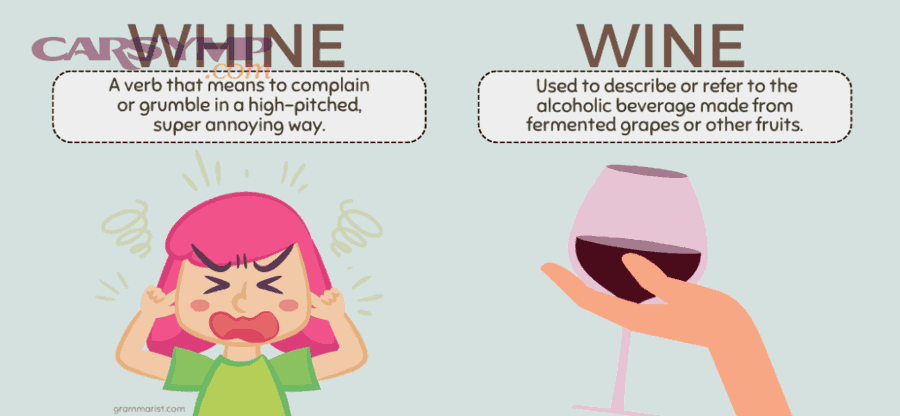
Understanding pronunciation and usage is especially important for ESL learners and writers, because the wine–whine homophone creates both confusion and opportunity in English. Specifically, this overlap is one of the most frequently cited examples in lessons on English homophones.
Is Whine Spelled the Same as Wine?
No — whine and wine are spelled differently, but they are pronounced identically as /waɪn/ by most modern English speakers, making them homophones.
The distinction in spelling reflects a historical difference in pronunciation. In older forms of English, whine began with a voiceless labiovelar approximant — the wh sound represented as /ʍ/ in phonetic notation — which was distinctly different from the plain /w/ in wine. Many dialects, particularly in Scotland, Ireland, and parts of the American South, still maintain this distinction. However, the so-called wine–whine merger has eliminated the difference for most speakers of standard American and British English.
This homophonic relationship has become a well-worn joke in English-speaking cultures: “Would you like some cheese with your whine?” is perhaps the most common example, playfully substituting the complaint meaning of whine for the drink wine to mock someone who is complaining excessively.
How Do You Use Whine in a Sentence?
Here are eight varied example sentences demonstrating correct use of whine across its different forms and contexts:
- The toddler whined for twenty minutes before finally falling asleep. (verb, behavioral)
- She could hear a high-pitched whine coming from beneath the hood. (noun, acoustic)
- He’s been whining about the same problem for three weeks. (verb, present participle, behavioral)
- The engines whined as the aircraft climbed steeply after takeoff. (verb, acoustic)
- “I already told you I don’t want to,” she whined. (verb, reporting speech)
- Stop whining — everyone has the same deadline. (imperative verb, behavioral)
- The whine of the power drill echoed through the empty apartment. (noun, acoustic)
- His constant whine about the workload was wearing his colleagues thin. (noun, behavioral)
Notice that in sentences 1, 3, 5, and 6, whine refers to human behavior and carries a negative, disapproving tone. In sentences 2, 4, and 7, whine is purely acoustic and neutral. Sentence 8 uses the noun form metaphorically, treating a pattern of complaints as a continuous sound.
What Are the Different Forms of the Word Whine?
Whine generates a small but useful family of related word forms that appear regularly in both spoken and written English. The table below outlines all the main forms, their grammatical category, and a brief usage note.
The following table summarizes every major grammatical form of whine and how each one is typically used:
| Form | Type | Example |
|---|---|---|
| whine | base verb / noun | She began to whine. / The whine of the engine. |
| whines | third-person singular verb / plural noun | He whines constantly. / Three distinct whines. |
| whined | past tense / past participle | The dog whined all night. |
| whining | present participle / gerund / adjective | Stop whining. / The whining is exhausting. |
| whiner | noun (person) | Don’t be a whiner. |
| whiners | plural noun | A group of chronic whiners. |
| whiny / whiney | adjective | A whiny child. / A whiny voice. |
| whinier / whiniest | comparative / superlative adjective | The whiniest student in the class. |
| whiningly | adverb | She spoke whiningly throughout the meeting. |
Of these forms, whining is by far the most frequently encountered in everyday use — appearing as a present participle, a gerund, and an attributive adjective in constructions like whining noise or whining complaint.
What Are the Different Types of Whining?
There are three main types of whining — human behavioral whining, animal whining, and mechanical whining — classified based on the source and communicative function of the sound or behavior.
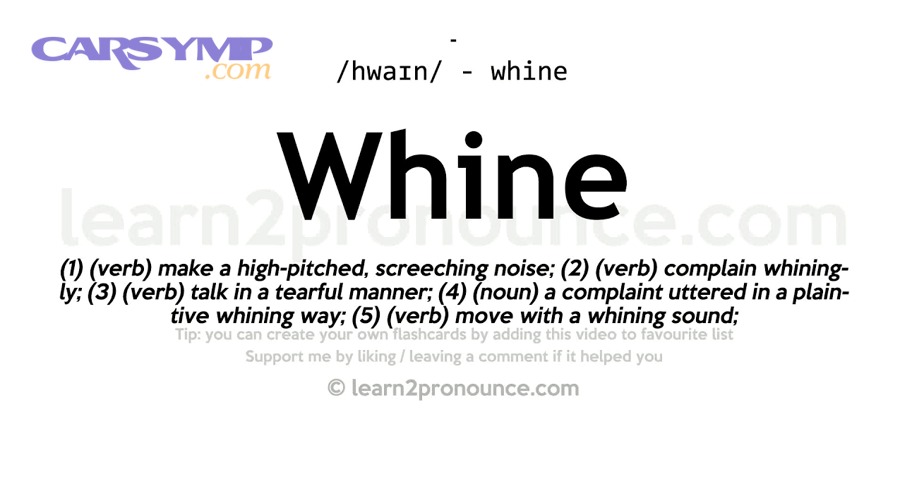
This grouping matters because the word whine is applied across genuinely different contexts, and understanding which type is meant helps readers and writers choose the most precise language. Let’s explore each type in turn.
What Is Human Whining?
Human whining is the behavioral act of complaining in a prolonged, nasal, repetitive, and self-pitying way — typically at a higher pitch than normal speech and with an exaggerated, drawn-out vowel quality.
The key characteristics that separate whining from ordinary complaining are:
- Tone: Nasal, high-pitched, slightly sing-song in quality
- Register: Informal and almost always carries a disapproving connotation when used by an observer
- Repetition: Whining tends to be cyclical — the same complaint voiced again and again rather than once
- Emotional texture: Self-pity is central; the whiner presents themselves as a victim of circumstance
Human whining is associated most strongly with young children, because it often emerges as a pre-verbal or limited-vocabulary communication strategy — a way of expressing need or frustration when the child lacks words for a more precise complaint. However, adults whine too, and the word is regularly used (critically) to describe adult speech in political commentary, workplace writing, and social criticism. Collins English Dictionary’s corpus examples include references to politicians, athletes, and office workers whining — demonstrating that the label is applied across age groups.
What Is Animal Whining?
Animal whining refers to the high-pitched, sustained vocalizations made by animals — most commonly dogs — to signal distress, discomfort, excitement, or a desire for attention.
Dogs are the animal most associated with whining in everyday English, and the behavior serves a clear communicative function: the dog is attempting to get a response from a human or another animal. Common triggers for dog whining include:
- Wanting to be let outside
- Separation anxiety or distress
- Physical pain or discomfort
- Greeting behavior (excitement-based whining)
- Seeking food or play
The word whine is considered the most accurate term for this specific vocalization, distinguishing it from bark (sharp, percussive), howl (long, open-throated), and whimper (quieter, more fearful). A dog that whines is generally making a continuous or semi-continuous nasal sound — acoustically very close to a human whine — which is precisely why the same word covers both.
What Is Mechanical Whining?
Mechanical whining describes the sustained, high-pitched sound produced by engines, motors, electrical equipment, or other machinery under load or during operation.
This is a purely acoustic use of the word, carrying no behavioral or emotional implication. It appears frequently in automotive writing, engineering descriptions, journalism, and fiction — any context where a writer needs to convey a specific type of machine noise with precision. The sound is typically continuous, thin, and at a frequency that makes it audible and distinctive against background noise.
Common examples in published writing include:
- The whine of jet engines during takeoff
- An electric saw whining through lumber
- The air conditioning unit’s constant whine
- A vacuum cleaner’s high-pitched whine
In automotive contexts, a whining noise from a vehicle is often one of the first diagnostic clues mechanics use in tire noise diagnosis and drivetrain troubleshooting. A whine from the wheel area, for example, is a classic indicator in Wheel bearing vs tire noise comparison — wheel bearing failure typically produces a consistent whine that changes with vehicle speed, while tire noise tends to vary with road surface. Similarly, Cupping and uneven tread noise diagnosis often involves distinguishing between a rhythmic thumping and a higher-pitched whine, and the Tire pressure and noise relationship is another practical area where the word whine appears in mechanical diagnosis: under-inflated tires can produce unusual tonal sounds including whining under certain load conditions.
According to acoustic engineers, the frequency range most commonly described as a “whine” in mechanical systems falls between approximately 1,000 Hz and 5,000 Hz — the same general range as a human whining voice, which helps explain why the metaphor transferred so naturally from human behavior to machinery.
What Is the Difference Between Whine, Complain, Grumble, and Moan?
Whine wins in emotional texture and disapproval, complain is best for neutral, factual dissatisfaction, grumble is optimal for low-level ongoing discontent, and moan sits between whine and grumble — more emotional than grumble but less childish than whine.

These words cluster together as synonyms in most thesauruses, but treating them as interchangeable produces imprecise writing. However, the distinctions are learnable, and once understood, they become powerful tools for precise communication.
Is Whining the Same as Complaining?
No — whining and complaining are similar but not the same. Complain is the neutral, unmarked term for expressing dissatisfaction; whine carries an additional layer of criticism directed at the manner of the complaint, not just its content.
When someone complains, the speaker is simply reporting that a person has expressed dissatisfaction. The word is emotionally neutral: you can complain legitimately and reasonably. When someone whines, however, the speaker is also passing judgment: the complaint is repetitive, annoying, childish, or self-pitying. The tone is being criticized alongside the content.
Key distinction: You can complain once and stop. Whining implies repetition or a persistent tone that grates on those around the whiner. This is why whine is classified as disapproving by Oxford, Cambridge, and most major dictionaries — while complain is listed without a usage label.
What Is the Difference Between Whine, Grumble, and Moan?
The following table provides a direct comparison of the three words across five key criteria. Understanding these distinctions makes it easy to select the right word in any context:
| Criterion | Whine | Grumble | Moan |
|---|---|---|---|
| Tone | High-pitched, nasal, prolonged | Low, muttering, subdued | Sustained, vocal, expressive |
| Emotional register | Self-pity, helplessness | Mild dissatisfaction, irritation | Suffering, exasperation |
| Disapproval level | High (very disapproving) | Moderate | Moderate to high |
| Typical speaker | Children; also adults (critically) | Adults, often older | Adults; also used for physical pain |
| Repetition implied | Yes — ongoing, circular | Yes — background grumbling | Yes — but less circular than whine |
Specifically, grumble is the most understated of the three — it suggests a person who is chronically but quietly dissatisfied, muttering complaints without necessarily seeking resolution. Think of a grumpy older neighbor who grumbles about noise but never knocks on the door. Moan, on the other hand, is more emotionally expressive — it conveys genuine suffering or exasperation and is also used for physical pain. Whine is the most socially criticized of the three: it implies not just dissatisfaction but an annoying, childish delivery that makes others want to tune out.
What Is the Difference Between Whine and Whimper?
Whimper is a hyponym of whine — a more specific subtype that describes a quieter, more fearful, or more suppressed version of the same general sound.
Where whine can be loud, prolonged, and behaviorally assertive (demanding attention), whimper is soft, tentative, and associated primarily with fear, pain, or vulnerability. A child who has been frightened might whimper; a dog injured in an accident might whimper. The whimper is a signal of helplessness rather than a demand for attention.
The key contrasts are:
- Volume: Whine = louder; Whimper = quieter, more suppressed
- Function: Whine = demand or complaint; Whimper = expression of fear, pain, or distress
- Connotation: Whine = often annoying; Whimper = evokes sympathy more than irritation
- Typical context: Whine is more common for behavioral complaints; Whimper is more common for physical or emotional pain responses
Oxford’s Advanced Learner’s Dictionary lists whimper as a synonym-adjacent term under whine but notes the distinction in usage — whimper collocates most naturally with fear and physical pain, while whine collocates most naturally with complaint and irritation.
Why Do People Whine — and Why Is It So Annoying?
People whine because the behavior evolved as a high-priority distress signal — one designed to be difficult to ignore — and it remains so universally irritating precisely because the human brain is wired to respond to it urgently.

This supplementary dimension of “whine explained” moves beyond grammar and definition into the psychology, neuroscience, and cross-species biology of whining behavior. More importantly, it reveals why understanding whine is not just a vocabulary exercise but a window into how humans and animals communicate need and distress.
What Makes the Sound of Whining So Irritating to the Human Brain?
Research suggests that whining is uniquely disruptive to cognitive function — more so than many other types of unpleasant sound — because of its frequency range and its similarity to infant distress cries, which the brain is evolutionarily primed to treat as urgent.
A landmark study published in the Journal of Social, Evolutionary, and Cultural Psychology by Dr. Rosemarie Sokol Chang and Nicholas Thompson found that participants exposed to whining sounds performed significantly worse on math tasks compared to those exposed to other sounds including crying, a high-pitched machine sound, or silence. The researchers concluded that whining may be the most distracting sound for humans — more disruptive even than a baby’s cry or a standard alarm — because its combination of pitch, nasality, and repetition triggers a persistent attentional response that is difficult to suppress.
The acoustic profile of a human whine typically falls in the frequency range of roughly 2,000–4,000 Hz — the same range that human hearing is most sensitive to, and the range that overlaps with infant crying. This is not coincidental: the hypothesis is that whining evolved as a scaled-down, persistent version of the infant cry, trading the urgency of a full cry for a longer-duration, lower-intensity signal designed to wear down resistance rather than trigger immediate alarm.
Why Do Children Whine More Than Adults?
Children whine more than adults primarily because whining serves as a communication bridge — a way of expressing need or frustration when a child’s vocabulary and emotional regulation skills are not yet sufficient for more articulate expression.
From a developmental perspective, whining typically intensifies between the ages of two and four — the period when children have enough language to communicate but not enough to express complex emotions precisely or to regulate their emotional responses effectively. The whine fills the gap: it conveys urgency, emotional intensity, and a request for response without requiring the vocabulary or emotional control that direct verbal communication demands.
Several reinforcement dynamics sustain whining beyond the developmental phase where it first emerges:
- Intermittent reinforcement: When caregivers sometimes give in to whining and sometimes do not, the behavior is maintained on a variable reinforcement schedule — one of the most persistent behavioral patterns in psychology
- Attention as reward: Even negative attention (being told to stop whining) signals to a child that the behavior has successfully captured adult focus
- Modeling: Children who observe adults complaining in a whiny tone are more likely to adopt the same communication pattern
As children develop stronger language skills, emotional vocabulary, and self-regulation capacities, whining typically decreases — though it never entirely disappears, even in adults.
Do Animals Whine for the Same Reasons as Humans?
Yes — animals, particularly social mammals, whine for functionally similar reasons to humans: to signal distress, communicate need, or elicit a response from a caregiver or social partner.
Dogs are the most studied non-human whiner in the English-speaking research literature. Their whining behavior serves multiple communicative functions that closely parallel human whining:
- Need signaling: Wanting food, water, access to a space, or physical contact
- Separation distress: Vocalizing when separated from an attachment figure
- Pain or discomfort: A sustained whine can indicate physical distress requiring veterinary attention
- Greeting behavior: Some dogs produce brief, excited whines when greeting familiar humans
The evolutionary argument is compelling: social mammals that live in close proximity to caregivers (whether canine mothers or human guardians) benefit from a persistent, hard-to-ignore vocalization that signals need without triggering the full alarm response of a bark or a howl. Whining occupies a middle ground — urgent enough to demand attention, low-key enough to be sustained over time.
According to researchers at the Family Dog Project at Eötvös Loránd University in Budapest, dogs have evolved particularly sophisticated vocalization strategies for communicating with humans, and whining is one of the signals that humans are most reliably responsive to — suggesting that the dog’s whine and the human brain’s response to it have co-evolved through centuries of domestication.
Is Whining Seen Differently Across Cultures and Generations?
Yes — tolerance for whining varies significantly across cultures and generations, shaped by differing values around emotional expression, complaint behavior, and the relationship between individuals and authority.
In cultures that place a high value on stoicism — the expression of patience, emotional restraint, and endurance of hardship without vocal complaint — whining is viewed with particularly strong disapproval. The stoic ideal is, in many ways, the direct antonym of whining: where whining broadcasts suffering outwardly and repeatedly, stoicism involves containing it internally. Northern European cultures, certain East Asian cultural contexts, and traditional military and working-class British culture have historically valorized stoic endurance, making whiners a particularly negatively coded social category in those environments.
Generational perceptions add another layer. The word whiner has become a pointed generational label in media and political discourse — with older generations frequently accusing younger ones of excessive whining about economic hardship, workplace conditions, or social circumstances. Whether this critique is fair is a matter of ongoing debate, but it illustrates how the act of whining is not just a linguistic category — it is a socially charged behavior that intersects with power, privilege, and whose complaints are considered legitimate.
The cultural and generational dimensions of whining reveal something important: whether a complaint is labeled a whine or a valid concern often depends less on the content of the complaint and more on the social position of the person making it and the audience receiving it. Understanding this dynamic is part of understanding the full semantic weight of the word — and why “whine explained” ultimately means more than any single dictionary entry can capture.