


Checking tire pressure correctly means using a cold-tire reading with a reliable gauge, comparing your result against the manufacturer’s recommended PSI, and adjusting inflation before every long trip and at least once a month. This single habit protects your safety, extends tire life, and keeps your fuel costs in check — yet surveys consistently show that most drivers skip it entirely until a warning light appears.
To check tire pressure accurately, you need the right tools: a quality tire pressure gauge — digital, dial, or stick — plus access to an air compressor. Before you touch the valve stem, you also need to know your vehicle’s correct PSI figure, which lives on the driver-side door jamb sticker or in your owner’s manual, not on the tire sidewall.
Timing matters just as much as technique. The best moment to check is when your tires are cold — either first thing in the morning or after the vehicle has been parked for at least three hours. Warm tires from recent driving hold more pressure, which produces a falsely high reading and can lead you to unknowingly drive on underinflated wheels.
Beyond the basic how-to, understanding what incorrect pressure actually does to your car puts the routine in perspective. Underinflation and overinflation both degrade handling, accelerate wear, and increase blowout risk — consequences that a five-minute monthly check eliminates entirely. Next, this guide walks you through every step, every tool choice, and every timing decision you need to get this right.
What Is Tire Pressure and Why Does It Matter for Your Car?
Tire pressure is the measured amount of air inside a tire, expressed in PSI (pounds per square inch), and it is the single variable that determines how well your tire supports the vehicle’s weight, grips the road surface, and dissipates heat generated by driving.
To better understand why this number is so consequential, consider what a tire actually does. It is not the rubber itself that carries the weight of your car — it is the compressed air trapped inside. When that air level drops or rises outside the manufacturer’s specified range, the tire’s shape, contact patch, and heat behavior all change, and every one of those changes works against you.
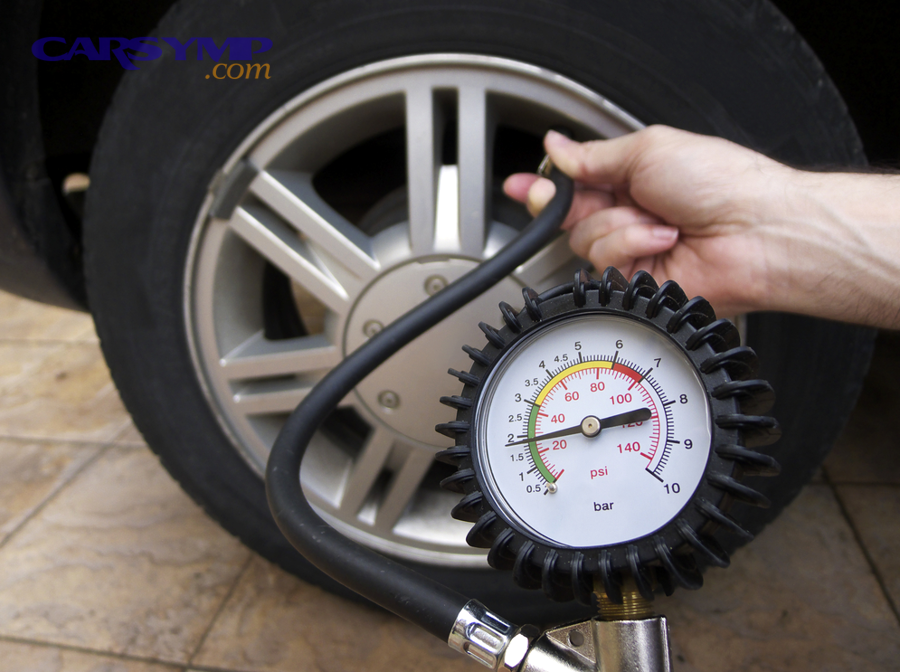
Specifically, correct tire pressure affects four critical performance areas: vehicle handling and steering response, braking distance, fuel economy, and the rate at which your tires wear. When all four are optimized through proper inflation, your car behaves predictably, your tires last longer, and your engine doesn’t work harder than necessary to move the vehicle forward.
According to the U.S. Department of Energy, properly inflated tires can improve fuel economy by up to 3%, and keeping tires at the correct PSI prevents the roughly 0.2% fuel economy loss that occurs for every 1 PSI drop across all four tires.
What Happens If Your Tire Pressure Is Too Low?
Yes, underinflated tires are genuinely dangerous, for at least three well-documented reasons: they compromise steering control, dramatically increase blowout risk, and cause accelerated, uneven tread wear that shortens tire life.
More specifically, when a tire is underinflated, its sidewalls flex more than they are designed to. That excess flexing generates heat — the primary cause of tire blowouts. At the same time, the tire’s contact patch widens and deforms, reducing the precision with which the tread engages the road. Drivers often first notice this as vague or sluggish steering, but the structural damage to the tire is already accumulating.
From a financial perspective, underinflation also increases rolling resistance, which forces the engine to burn more fuel. The pressure drop doesn’t have to be dramatic to cause problems: a tire that is just 8 PSI below the recommended level is technically 25% underinflated on a standard 32 PSI vehicle — the threshold at which most tire pressure monitoring systems will trigger a warning light.
- Handling: Wider contact patch causes imprecise steering
- Safety: Excess sidewall flexion generates dangerous heat buildup
- Economy: Higher rolling resistance increases fuel consumption by measurable margins
- Longevity: Uneven wear on outer edges shortens usable tire life
What Happens If Your Tire Pressure Is Too High?
No, overinflated tires do not improve performance — they actually reduce traction, harden the ride, and cause accelerated center-tread wear that leads to premature tire replacement.
When a tire holds more air than the manufacturer recommends, the rubber bulges outward and the contact patch shrinks to a narrow band in the center of the tread. That reduced contact area means less rubber is gripping the road at any given moment, which worsens braking distance on both dry and wet surfaces. On wet roads in particular, a stiff, overinflated tire is far more prone to hydroplaning.
A common source of overinflation is misreading the MAX PSI figure embossed on the tire sidewall. That number represents the maximum pressure the tire casing can safely contain — not the recommended operating pressure. The correct PSI for your specific vehicle is always found on the door jamb sticker or owner’s manual, and it is almost always lower than the sidewall maximum.
What Tools Do You Need to Check Tire Pressure Correctly?
There are 3 essential tools for checking tire pressure correctly: a reliable tire pressure gauge, an air compressor or access to a gas station pump, and your vehicle’s recommended PSI specification — found on the door jamb sticker or owner’s manual.
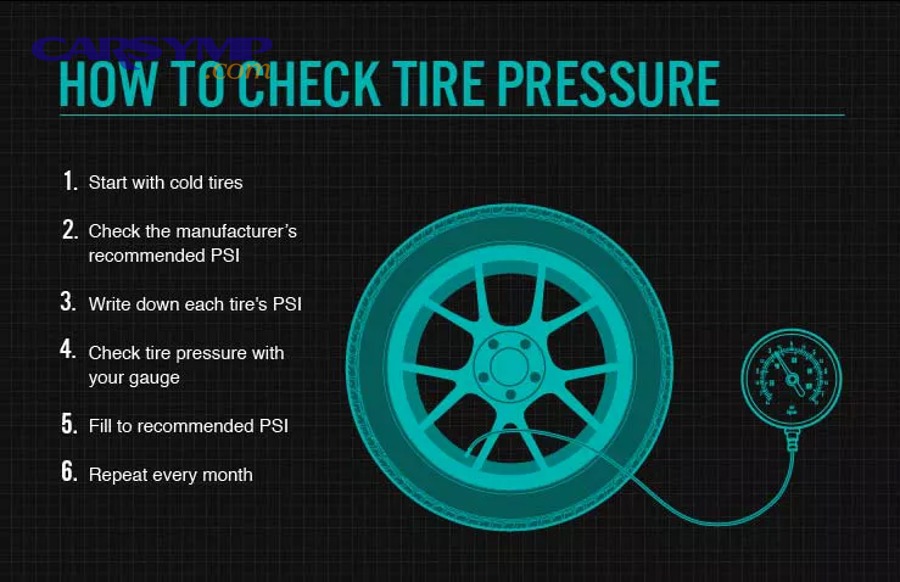
Gathering these three things before you start ensures the process is accurate and efficient. Attempting to check pressure without a known-accurate gauge, or without knowing your target PSI in advance, turns a five-minute maintenance task into a guessing exercise that can leave your tires worse off than before.
What Are the Different Types of Tire Pressure Gauges?
There are 3 main types of tire pressure gauges — stick/pencil, dial/analog, and digital — each suited to different priorities around cost, accuracy, and ease of use.
The table below summarizes how the three gauge types compare across the criteria that matter most for everyday drivers:
| Gauge Type | Accuracy | Ease of Use | Price Range | Best For |
|---|---|---|---|---|
| Stick/Pencil | Moderate | Simple | $2–$10 | Budget-conscious drivers, glove box storage |
| Dial/Analog | Good | Moderate | $10–$25 | Clear visual readout, no battery needed |
| Digital | Excellent | Very easy | $10–$30 | Precision readings, backlit display for night use |
Stick/Pencil gauge: This is the most common and affordable option. A graduated plastic rod pushes out from the bottom when pressed onto a valve stem, and the PSI is read from the markings on the rod. It requires no battery, fits easily in a glove box, and is entirely adequate for monthly checks. Its weakness is that the rod can be difficult to read in poor lighting and the mechanism can lose calibration if dropped.
Dial/Analog gauge: This type uses a needle on a circular dial to display pressure, similar to a clock face. The readout is larger and easier to interpret than a stick gauge, and it holds its reading until you manually reset it. It remains accurate without a battery and is a solid mid-range option for most drivers.
Digital gauge: A digital gauge provides an immediate numerical readout on an LCD screen, eliminating any ambiguity in reading the result. Many models include backlighting, making them practical in low-light conditions. The only maintenance consideration is battery replacement, but most digital gauges use standard button cells that last for years under normal use. For drivers who want the most accurate and readable result, a digital gauge is the recommended choice.
One important caution: the gauges built into gas station air pumps are often inaccurate due to heavy use and lack of maintenance. Always cross-check with your own gauge rather than trusting the pump’s built-in display alone.
Where Can You Find the Recommended PSI for Your Vehicle?
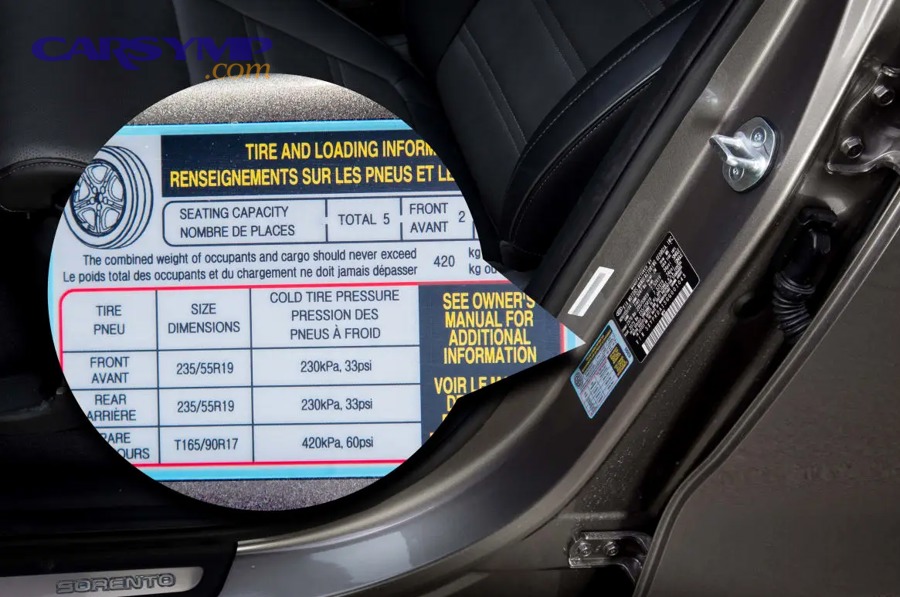
Your vehicle’s correct tire PSI is located in three places: the driver-side door jamb sticker (most convenient), the owner’s manual, and the manufacturer’s official website for your vehicle model and year.
The door jamb sticker is the most practical reference point because it is always with the vehicle. It specifies both front and rear tire pressures, which may differ — a detail that matters when you are working your way around all four tires. Some vehicles, particularly sports cars, SUVs, and trucks designed to carry varying loads, list multiple PSI values depending on load conditions.
- Recommended PSI for front tires
- Recommended PSI for rear tires
- Tire size specification for your vehicle
- Spare tire PSI (sometimes listed separately)
The critical point bears repeating: never use the MAX PSI molded into the tire sidewall as your inflation target. That figure is a structural limit for the tire casing, not an operating recommendation. Using it as a target will result in overinflation with all the associated handling and safety penalties described above.
When Is the Best Time to Check Tire Pressure?
The best time to check tire pressure is when the tires are cold — ideally first thing in the morning or after the vehicle has been stationary in the shade for at least 3 hours — because heat from driving artificially raises pressure readings by several PSI.
This timing requirement is not just a best practice — it is the basis on which all manufacturer PSI specifications are set. Vehicle manufacturers define their recommended tire pressure values assuming the tires are at ambient temperature, not road temperature. Checking a warm tire produces a reading that may be 4–6 PSI higher than the true cold value, which can lead you to believe your tires are properly inflated when they are actually borderline low.
How Often Should You Check Your Tire Pressure?
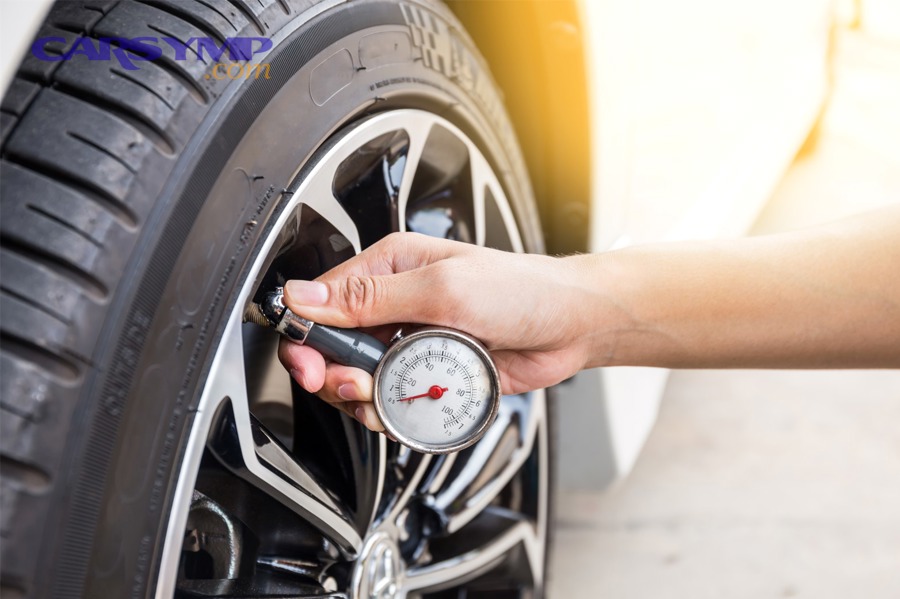
Yes, you should check your tire pressure at least once a month, and also before any long-distance trip, for three concrete reasons: monthly pressure loss is normal even in healthy tires, temperature fluctuations cause PSI to shift between checks, and the TPMS warning light activates only after significant underinflation has already occurred.
Even a tire with no puncture or leak loses roughly 1–3 PSI per month through normal permeation of air molecules through the rubber. Over two or three months without a check, a tire can drift from an optimal 34 PSI down to 28 PSI — a 17% drop that is enough to affect handling and fuel economy noticeably, yet still not enough to trigger the TPMS dashboard light.
The most effective habit is to check tire pressure every time you stop for fuel. Since most drivers refuel every one to two weeks, this schedule easily covers the recommended monthly minimum. It also keeps the check firmly tied to an existing routine, which dramatically improves follow-through.
Does Cold Weather Affect Tire Pressure?
Yes, cold weather directly reduces tire pressure because lower ambient temperatures cause air molecules inside the tire to lose kinetic energy, contract, and exert less force on the tire walls — measurably dropping PSI.
The rule of thumb is a 1–2 PSI drop for every 10°F (approximately 5.5°C) decrease in ambient temperature. In practical terms, a tire that was correctly inflated to 34 PSI on a 70°F autumn day can drop to approximately 30–32 PSI when temperatures fall to 30–40°F in winter — potentially triggering a TPMS warning on the first cold morning of the season, even though no air has escaped and no damage has occurred.
- Fall: Check and top off tires as temperatures begin dropping consistently
- Winter: Expect monthly checks to reveal pressure loss faster than in warmer months
- Spring: Tires inflated during winter may read slightly high as temperatures warm — check and release excess air if needed
- Summer: Heat from both ambient temperature and driving increases pressure; always check cold tires before driving, never deflate a hot tire to reach cold PSI
One caution that trips up many drivers: if you check your tires after they have been driven and the reading is 3–4 PSI over the recommended value, do not let air out. That elevated reading is normal for a warm tire. Wait until the tire has cooled completely, then re-check. Releasing air from a hot tire to reach the cold PSI target will leave the tire genuinely underinflated once it returns to ambient temperature.
How Do You Check Tire Pressure Step by Step?
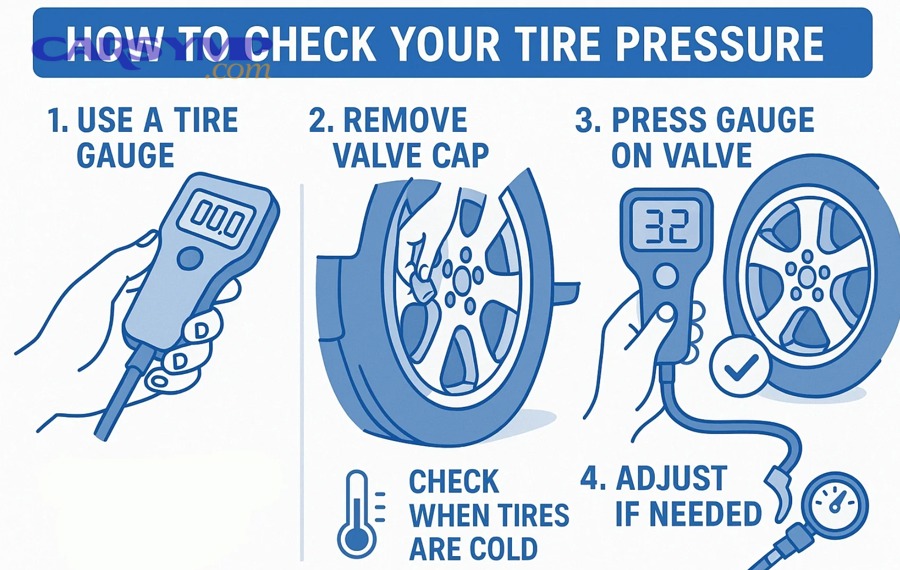
Checking tire pressure correctly involves 5 steps — gathering your tools, removing the valve cap, pressing the gauge onto the valve stem, reading and recording the PSI, and then adjusting inflation to match the manufacturer’s specification — with the entire process taking under 10 minutes for all four tires.
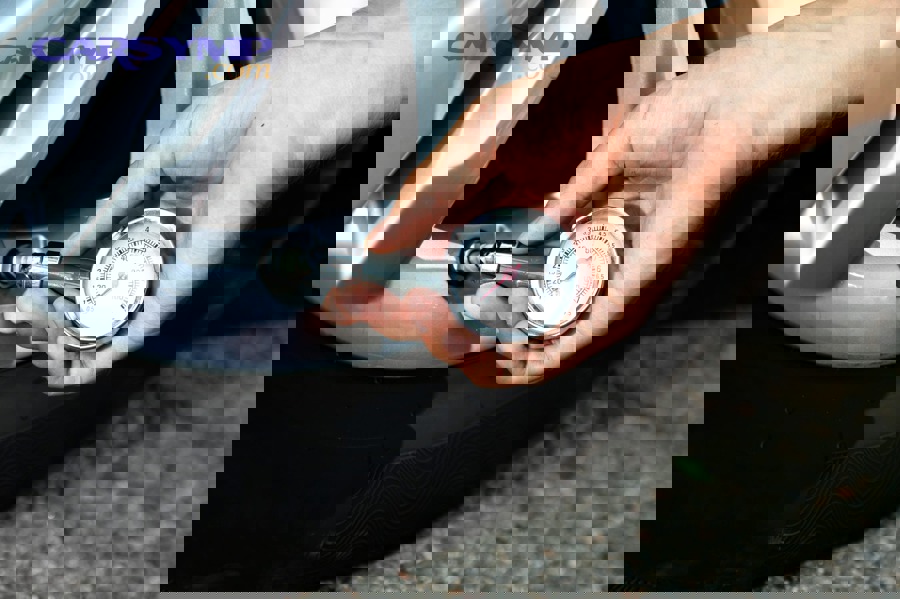
This is the core skill that makes everything else in tire maintenance meaningful. A clear, repeatable process ensures your reading is accurate, your adjustment is correct, and no air is wasted or unintentionally lost during the check.
Step-by-Step: How to Read a Tire Pressure Gauge Correctly
Reading a tire pressure gauge correctly requires a firm, straight press onto the valve stem with no air escaping during the reading, followed by noting the PSI value and repeating the measurement two to three times to confirm consistency.
Follow these steps for each tire:
- Remove the valve cap — Unscrew the small plastic cap from the tire’s valve stem and place it somewhere safe (a pocket, not the ground). Losing valve caps leads to debris contamination of the valve, which causes slow leaks over time.
- Position the gauge firmly on the valve stem — Press the open end of the gauge directly onto the valve stem in one straight, confident motion. Apply enough downward pressure that any hissing sound of escaping air stops immediately. A persistent hiss means the gauge is not fully seated — reposition and press again.
- Read the PSI display — On a stick gauge, the graduated rod will have pushed out; read the number at the point where the rod meets the gauge body. On a dial gauge, note where the needle rests. On a digital gauge, read the number on the screen. Take this reading within 2–3 seconds of contact for the most accurate result.
- Repeat 2–3 times per tire — Remove the gauge, wait a moment, and re-seat it to confirm the reading is consistent. Variation of more than 1–2 PSI between attempts suggests the gauge is not seating cleanly or the valve stem may need attention.
- Record each tire’s reading — Write down or note in your phone the PSI for each tire before moving to the next. This prevents confusion, especially on vehicles where front and rear tires have different recommended pressures.
- Check the spare tire — The spare is frequently overlooked. A spare that has been sitting at low pressure for months is useless in an emergency. Full-size spares typically use the same PSI as road tires; compact “doughnut” spares often require a significantly higher pressure — around 60 PSI — so check the door jamb sticker or the spare tire itself for the correct value.
How Do You Add or Release Air to Reach the Correct PSI?
To add or release air correctly, use short bursts from an air compressor to add pressure and the center pin of the valve stem to release it, rechecking with your gauge after each adjustment until the reading matches the manufacturer’s recommended PSI.
Adding air:
- Connect the air compressor hose or gas station pump nozzle firmly to the valve stem
- Dispense air in short 3–5 second bursts rather than one continuous flow
- Re-check pressure with your gauge after each burst — it is easy to overfill
- Continue adding and checking until the gauge reads the target PSI
- Replace the valve cap when finished
Releasing air:
- Locate the small metal pin at the center of the valve stem
- Use the release tip on the back of your gauge, a fingernail, a key, or a pen tip to depress the pin briefly
- Air will rush out audibly — release the pin and re-check immediately
- Repeat in short intervals until the correct PSI is reached
Critical caution: Never deflate a warm tire to the recommended cold PSI. If your tires are warm from driving and reading 3–5 PSI above the target, leave them alone. As they cool to ambient temperature, the pressure will naturally drop back to the correct range. Releasing air from a warm tire to hit the cold PSI target will result in genuine underinflation once the tire cools.
How Do You Know If Your Tire Pressure Check Was Accurate?
A tire pressure check is accurate when 3 conditions are confirmed: the tires were cold at the time of measurement, the gauge was fully seated on the valve stem with no audible air loss during the reading, and the result was consistent across two to three repeated attempts on the same tire.
Each of these conditions eliminates a specific source of error. Cold tires remove the inflation effect of heat. A properly seated gauge eliminates the false-low readings that occur when air escapes around an improperly positioned gauge head. Repeated readings catch mechanical inconsistencies in lower-quality gauges or a valve stem that isn’t sealing properly.
If you are unsure whether your gauge is accurate, cross-check it against a second gauge — ideally a quality digital model or a gauge at a dealership’s service counter. Gas station gauges are convenient but notoriously unreliable; their high use and infrequent calibration make them unsuitable as your only reference. Investing $10–$15 in a personal digital gauge eliminates this variable entirely and pays for itself in the confidence it provides at every monthly check.
According to a study by the National Highway Traffic Safety Administration (NHTSA), nearly one in three passenger vehicles on U.S. roads has at least one significantly underinflated tire — a statistic that directly reflects how often drivers either skip monthly checks or rely on inaccurate gas station gauges.
What Else Should Car Owners Know About Maintaining Correct Tire Pressure?
Beyond the monthly check routine, there are 4 deeper aspects of tire pressure management that car owners benefit from understanding: how the Tire Pressure Monitoring System (TPMS) actually works and where its limits lie, whether front and rear tires should be inflated equally, whether nitrogen offers real advantages over air, and how altitude and towing conditions change the correct PSI target.
These topics sit at the intersection of tire maintenance and broader vehicle care, and each one addresses a specific gap that standard how-to guides leave unanswered. Understanding them helps drivers make better decisions in less common but genuinely important situations — and informs the DIY vs shop TPMS service considerations that come up when dashboard warning systems need attention.
What Is a Tire Pressure Monitoring System (TPMS) and Can You Rely on It?
A Tire Pressure Monitoring System is an onboard electronic system that uses wheel-mounted sensors to monitor air pressure in each tire and alerts the driver via a dashboard warning light when pressure falls to a critically low level — but it cannot replace manual monthly checks.
TPMS has been federally mandated on all new passenger vehicles sold in the United States since the 2008 model year, a response to high-profile blowout incidents linked to chronically underinflated tires. The system uses sensors embedded in each wheel that transmit pressure data wirelessly to the vehicle’s ECU, which triggers the dashboard warning light when any tire drops to approximately 25% below the recommended PSI.
That 25% threshold is the critical limitation. On a vehicle with a recommended tire pressure of 32 PSI, the warning light only activates at approximately 24 PSI — a level at which the tire has already been operating in a degraded, dangerous condition for some time. A tire at 28 PSI — 12.5% below the recommendation — will cause measurable handling degradation and increased fuel consumption, yet produce no dashboard warning at all.
For drivers who receive a TPMS warning light, the situation calls for immediate attention. Check all four tires with a gauge, identify and correct the underinflated tire, and then address the underlying cause — whether a slow puncture, a failing valve stem, or simple long-term pressure loss. When the sensor itself fails (TPMS sensors have batteries that typically last 5–10 years), a TPMS service cost estimate from a dealership or tire shop typically ranges from $50 to $250 depending on whether one or all four sensors require replacement and whether reprogramming is needed. Some drivers handle basic TPMS resets after tire rotations themselves, while others prefer shop service — the right DIY vs shop TPMS service consideration depends on whether the issue is a simple reset or a failed sensor requiring hardware replacement. Scheduling a tire pressure monitoring system service appointment proactively, rather than waiting for repeated warning lights, keeps the system working as the safety net it was designed to be.
Should Front and Rear Tires Have the Same Pressure?
No, front and rear tires do not always require the same pressure — many vehicles specify different PSI values for front and rear axles based on weight distribution, and using a uniform PSI across all four tires when the manufacturer specifies otherwise will compromise handling and wear patterns.
The front axle of most front-wheel-drive vehicles carries the weight of the engine, transmission, and drivetrain components, making it significantly heavier than the rear. Manufacturers account for this in their tire pressure specifications, sometimes recommending 2–4 PSI more in the front tires to match that additional load. Rear-wheel-drive and all-wheel-drive vehicles may have different differentials depending on where the heavier mechanical components sit.
The door jamb sticker will explicitly list front and rear PSI separately if they differ. When both values are the same, a single PSI applies to all four tires. The key discipline is checking the sticker for your specific vehicle rather than assuming a universal inflation standard applies.
For performance vehicles, high-load trucks, and SUVs rated for towing, the owner’s manual often includes a load-inflation table that specifies different target pressures based on how many passengers and how much cargo the vehicle is carrying at a given time. Using those tables for road trips or hauling situations meaningfully improves stability and tire longevity.
Is Nitrogen Better Than Air for Inflating Tires?
Nitrogen is slightly better than compressed air for maintaining consistent tire pressure over time, because its larger molecules permeate rubber more slowly than oxygen — but for everyday passenger vehicle drivers, the practical benefit is marginal compared to the benefit of simply checking air-filled tires monthly.
The case for nitrogen rests on two genuine properties. First, nitrogen molecules are larger than oxygen molecules, which means they escape through the microscopic pores in tire rubber at a slower rate. Second, nitrogen is a dry, inert gas — unlike compressed air, which contains moisture. Moisture expands and contracts with temperature changes, contributing to the pressure fluctuations that are most noticeable between summer and winter.
These properties make nitrogen the standard choice for aircraft tires, racing slicks, and heavy commercial truck tires, where pressure consistency under extreme conditions has significant safety and performance implications. For a family sedan driven at normal road speeds, the difference is measurably smaller: studies suggest nitrogen-filled tires maintain pressure roughly 2–3 times longer than air-filled tires, but since the recommended check interval is already monthly, the practical gap narrows considerably.
Nitrogen is increasingly available at dealerships, tire shops, and some auto parts retailers, typically at a cost of $5–$10 per tire for an initial fill. If your vehicle is already running on compressed air, a full switch to nitrogen requires purging the existing air and refilling — a tire pressure monitoring system service appointment at a shop is a convenient time to ask about nitrogen conversion if you are interested.
How Does Tire Pressure Change at High Altitude or When Towing?
Tire pressure behaves differently at high altitude and under towing loads for two distinct physical reasons: altitude changes the pressure differential between the tire’s interior and the surrounding atmosphere, while towing increases the structural load the tire must support, raising the required inflation target.
At high altitude: Atmospheric pressure decreases as elevation rises. Since tire PSI is measured as gauge pressure — the difference between tire interior pressure and ambient air pressure — a tire inflated to 34 PSI at sea level will display a slightly higher gauge reading at 8,000 feet of elevation, even though no air has been added. The practical effect is minor for most drivers, but those who regularly travel between sea level and high mountain roads may notice a consistent 1–2 PSI variance. No adjustment is typically necessary, but awareness prevents unnecessary release of air at altitude that would leave tires underinflated at lower elevations.
When towing or hauling: Heavier loads compress tires more and require higher inflation to maintain proper shape and load-carrying capacity. Most vehicle owner’s manuals include a specific tire pressure recommendation for maximum load conditions, often 4–8 PSI higher than the standard recommendation. Always check and adjust tire pressure before a loaded towing trip, not after you’ve already reached highway speed.
For electric vehicle owners: EVs carry significantly heavier battery packs than equivalent internal combustion vehicles — often 1,000–1,500 lbs more. Manufacturers account for this in their tire pressure specifications, which tend to run 2–4 PSI higher than those for comparable ICE vehicles. Always use the door jamb sticker or owner’s manual for your specific EV model rather than applying general passenger car inflation guidelines, as the consequences of underinflation are amplified by the additional weight bearing down on the tires.
According to research published by the Tire Industry Association, correct tire inflation across all driving conditions — including seasonal adjustment, load compensation, and altitude awareness — can extend average tire life by 4,700 miles compared to tires maintained only at a static baseline PSI throughout their service life.