


tire rotation patterns are the specific sequences used to reposition each tire on your vehicle — and choosing the wrong one doesn’t just waste your time, it accelerates uneven tread wear, compromises handling, and can void your tire warranty. The four primary patterns — Forward Cross, Rearward Cross, X-Pattern, and Front-to-Rear — each serve a distinct purpose based on your drivetrain, tire type, and whether your front and rear tires share the same size. Understanding which pattern applies to your vehicle is the most important decision in any rotation service.
Beyond pattern selection, knowing how to physically execute a tire rotation — the correct jacking sequence, torque specifications, and repositioning logic — separates a rotation that protects your investment from one that creates new problems. Whether you plan to perform the work yourself or simply want to verify your shop is doing it right, a step-by-step understanding of the process gives you confidence and control.
Comparing rotation patterns also reveals something most drivers overlook: not all patterns are interchangeable. A Forward Cross applied to a rear-wheel-drive vehicle can cause faster wear on the wrong tires, and a straight front-to-rear swap on a non-directional tire misses the opportunity to balance wear across all four corners. The differences between patterns are not cosmetic — they reflect engineering logic tied to load, torque, and steering forces at each wheel position.
Perhaps most importantly, tire rotation is not simply a maintenance checkbox. Regular rotation, performed with the correct pattern, actively extends tread life, reduces road noise over time, preserves handling balance, and surfaces early warning signs of alignment and balance issues before they become expensive repairs. This guide covers every pattern, every drivetrain, and every edge case so you can make the right call the first time.
What Is a Tire Rotation Pattern?
A tire rotation pattern is a specific, structured sequence that determines how each tire is moved to a different wheel position on the vehicle during a rotation service, based on drivetrain type and tire design. It is not a random swap — it is an engineered repositioning plan designed to equalize wear across all four (or five) tires over time.
To better understand why this definition matters, it helps to consider what happens without a correct pattern. Every wheel position on a vehicle experiences different forces. The front tires manage steering friction, braking load, and — on front-wheel-drive vehicles — the additional stress of driving torque. The rear tires, especially on rear-wheel-drive platforms, absorb acceleration forces. Without structured repositioning, the tires in the highest-stress positions wear down far faster than those in lower-stress positions, creating a dangerous imbalance.
Why Does the Rotation Pattern Matter for Tread Life?
The rotation pattern matters for tread life because it directly controls how evenly wear is distributed across all four tires, which determines how long the full set remains serviceable. When one or two tires consistently carry more load or friction than the others, those tires wear through their tread faster, forcing early replacement and breaking the uniformity of the set.
Specifically, the front axle on most vehicles carries a disproportionate share of braking and steering forces. On FWD vehicles, the front tires also transmit engine power to the road, adding drive torque to an already demanding position. On RWD platforms, the rear tires absorb the majority of acceleration stress. By rotating tires through these positions in a structured pattern, each tire spends time in both high-wear and low-wear positions, averaging out the total tread loss across the set.
The financial benefit is substantial. A set of tires rotated correctly and on schedule can outlast an unrotated set by tens of thousands of miles. More importantly, when all four tires wear at the same rate, they can be replaced as a complete set — which is critical for AWD and 4WD vehicles, where mismatched tread depths can damage the drivetrain’s transfer case and differentials.
How Often Should You Rotate Your Tires?
The standard tire rotation interval is every 5,000 to 7,500 miles, or approximately every other oil change under a conventional 3,000-mile oil service schedule. However, the most reliable guidance always comes from your vehicle owner’s manual, which may specify a different interval based on the manufacturer’s wear testing for your specific drivetrain and tire combination.
Certain driving conditions justify rotating sooner than the standard interval. Drivers who frequently operate in stop-and-go urban traffic, regularly carry heavy loads, tow trailers, or drive on rough road surfaces should consider rotating closer to the 5,000-mile mark. Similarly, if you notice uneven wear developing between rotations — such as the outer or inner edge of a front tire wearing faster than the center — early rotation combined with an alignment check is the appropriate response.
How often to rotate tires is also influenced by the type of vehicle. AWD and 4WD vehicles typically require more frequent rotation than FWD or RWD vehicles because all four tires share driving forces simultaneously, making tread depth uniformity especially critical. Some EV manufacturers recommend intervals as short as 3,000 to 4,000 miles due to the high torque output of electric motors. When in doubt, more frequent rotation causes no harm — skipping rotation does.
What Are the Main Types of Tire Rotation Patterns?
There are four main types of tire rotation patterns — Forward Cross, Rearward Cross, Front-to-Rear, and X-Pattern — classified based on whether tires cross sides between axles and which direction the cross occurs, determined primarily by drivetrain type and tire design.
Each pattern serves a different wear-equalization purpose, and using the wrong one for your drivetrain can produce suboptimal or even counterproductive results. The table below summarizes the four patterns and their primary applications before each is explored in detail.
| Pattern | Primary Use | Side Crossing? | Directional Tires? |
|---|---|---|---|
| Forward Cross | FWD vehicles | Rear tires cross to front | No |
| Rearward Cross | RWD, AWD, 4WD | Front tires cross to rear | No |
| Front-to-Rear (Straight) | Directional tires | No crossing | Yes |
| X-Pattern | FWD, some AWD | All four cross | No |
This table maps each pattern to the conditions that require it, giving you a quick reference before diving into the mechanics of each.
What Is the Forward Cross Pattern and When Should You Use It?
The Forward Cross pattern is the standard rotation method for front-wheel-drive vehicles equipped with non-directional tires of uniform size. In this pattern, the front tires move straight back to the rear axle, staying on the same side of the vehicle. The rear tires move diagonally forward, crossing to the opposite side of the front axle — the rear-left tire moves to the front-right position, and the rear-right tire moves to the front-left.
This diagonal movement for the rear tires is deliberate. Because FWD front tires wear faster due to the combined demands of steering, braking, and driving torque, moving the rear tires diagonally to the front ensures they arrive in different stress environments than the position they came from, promoting more balanced wear across all four tires over multiple rotation cycles.
A common variation for FWD vehicles is the X-Pattern, where all four tires move diagonally rather than just the rear pair. This is addressed in detail in its own section below. For most FWD drivers, the Forward Cross remains the default recommendation from tire manufacturers and industry standards bodies.
What Is the Rearward Cross Pattern and When Should You Use It?
The Rearward Cross pattern is recommended for rear-wheel-drive vehicles and is also the preferred pattern for most AWD and 4WD applications. It is essentially the mirror image of the Forward Cross: the rear tires move straight forward to the front axle on the same side, while the front tires move diagonally backward, crossing to opposite sides of the rear axle.
The logic behind this reversal reflects the different wear dynamics of RWD drivetrains. On a rear-wheel-drive vehicle, the rear tires manage acceleration torque and carry more stress than the front tires during hard acceleration. Moving those higher-wear rear tires to the relatively lower-stress front positions — while bringing the fresher front tires diagonally to the rear — redistributes the cumulative wear load effectively.
For AWD and 4WD vehicles, the Tire Industry Association recommends a variation sometimes called the Double-X pattern, where all four tires move diagonally, switching both axle and side simultaneously. This ensures tread depth remains as uniform as possible across all four corners — a requirement that protects the differential and transfer case components that are sensitive to tread depth discrepancies between front and rear axles.
What Is the Front-to-Rear (Straight) Pattern and When Should You Use It?
The Front-to-Rear pattern — sometimes called the straight rotation — is a specialized method used exclusively for directional tires, which are tires engineered with a tread design that must rotate in one specific direction to function correctly. In this pattern, tires move from front to rear and from rear to front, but they stay on the same side of the vehicle throughout. The front-left tire moves to the rear-left; the rear-right moves to the front-right.
Side-to-side movement is not possible with directional tires without dismounting the tire from the rim and remounting it — a labor-intensive process that requires a tire machine. If a directional tire were crossed to the opposite side of the vehicle, its tread pattern would rotate backward relative to its design intent, significantly reducing wet-weather performance, hydroplaning resistance, and the noise-reduction benefits built into the tread geometry.
How rotation affects ride noise and handling is particularly relevant here. Directional tires are specifically engineered to channel water outward and reduce road noise when spinning in their designated direction. A correctly executed Front-to-Rear rotation on directional tires preserves these benefits while still allowing some degree of wear equalization between the front and rear axle positions.
What Is the X-Pattern and How Is It Different from Forward Cross?
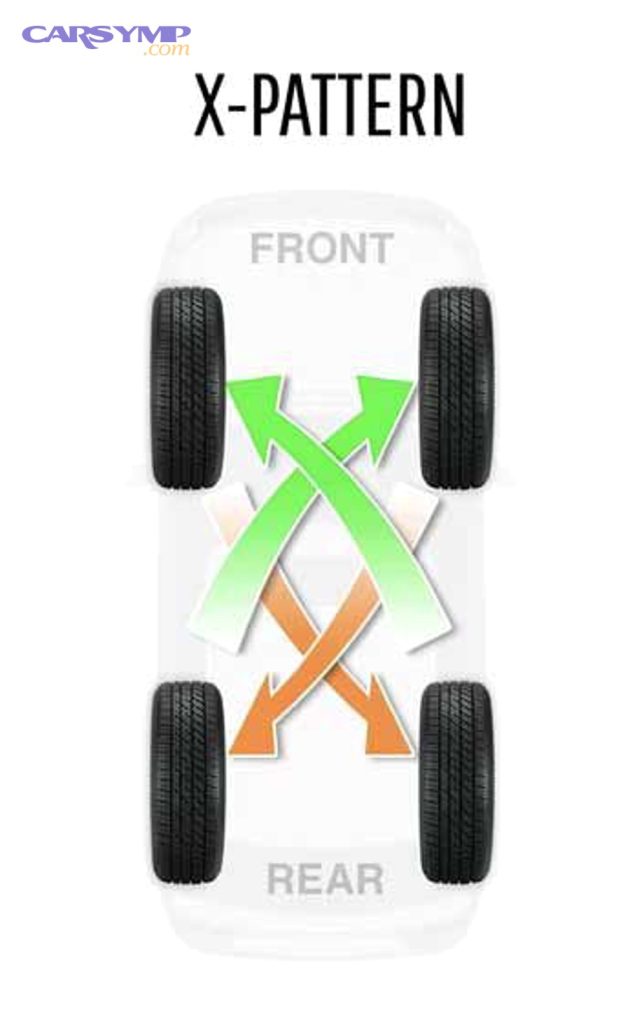
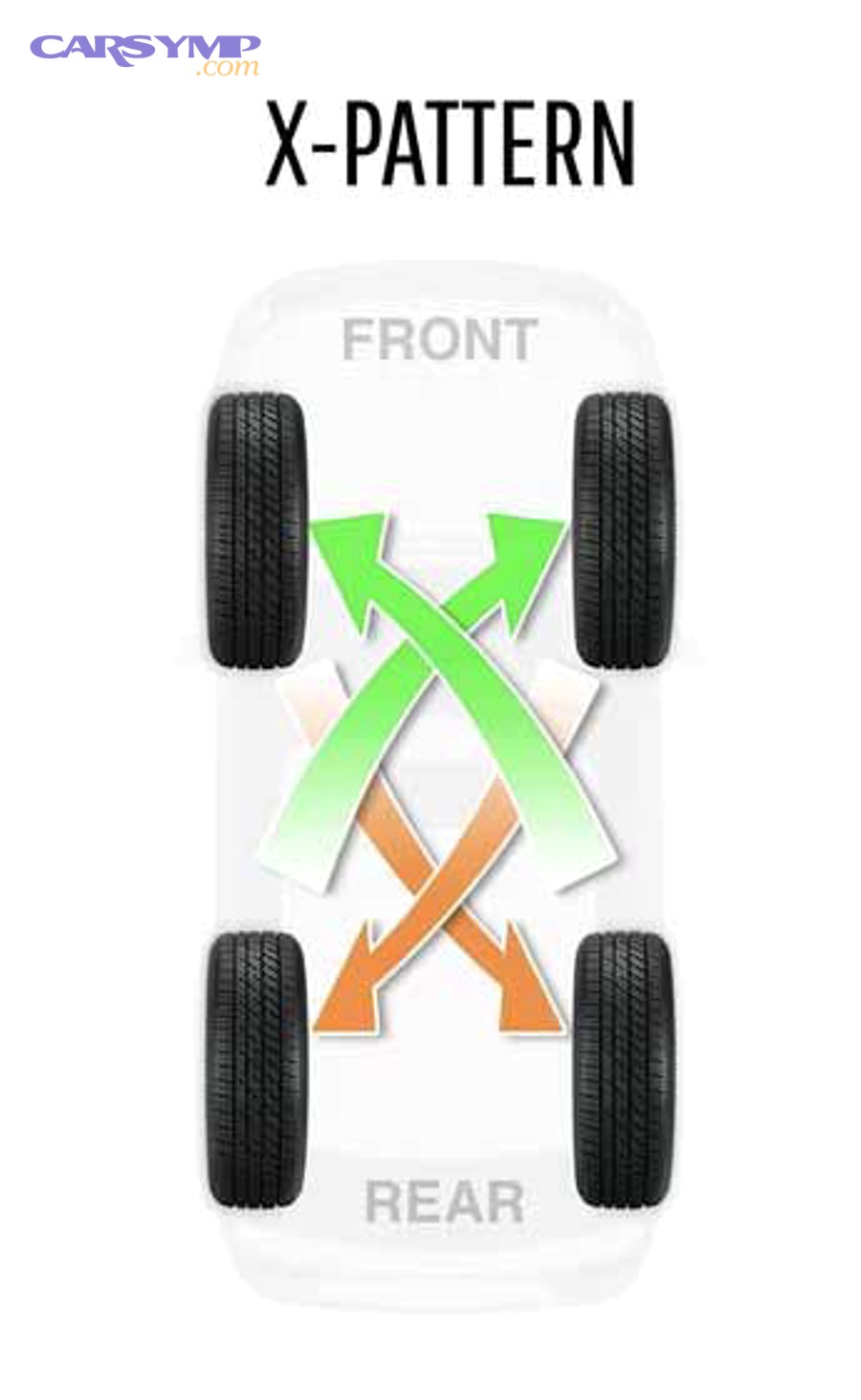
The X-Pattern is a rotation method in which all four tires move diagonally, simultaneously crossing both their axle position and their side of the vehicle. The front-left tire moves to the rear-right; the front-right moves to the rear-left; the rear-left moves to the front-right; and the rear-right moves to the front-left. Every tire changes both its axle and its side in a single rotation cycle.
The key difference from the Forward Cross is scope: in the Forward Cross, only the rear tires cross diagonally to the front, while the front tires move straight back. In the X-Pattern, the crossing is universal. This creates a more aggressive redistribution of wear positions and is particularly useful when noticeable wear differences have already developed between the front and rear tires — the full diagonal movement accelerates the rebalancing process.
The X-Pattern is appropriate for FWD vehicles with non-directional, uniformly sized tires, and is sometimes applied to light-duty AWD vehicles. It is not suitable for directional tires or staggered fitments. Drivers who notice their FWD front tires wearing significantly faster than the rear should ask their tire technician about using the X-Pattern to catch up on wear equalization more quickly.
Which Tire Rotation Pattern Is Right for Your Vehicle?
Choosing the correct tire rotation pattern requires evaluating three factors in sequence: your vehicle’s drivetrain (FWD, RWD, AWD, or 4WD), your tire type (directional or non-directional), and whether your front and rear tires are the same size. These three variables together determine which patterns are available — and which is optimal.
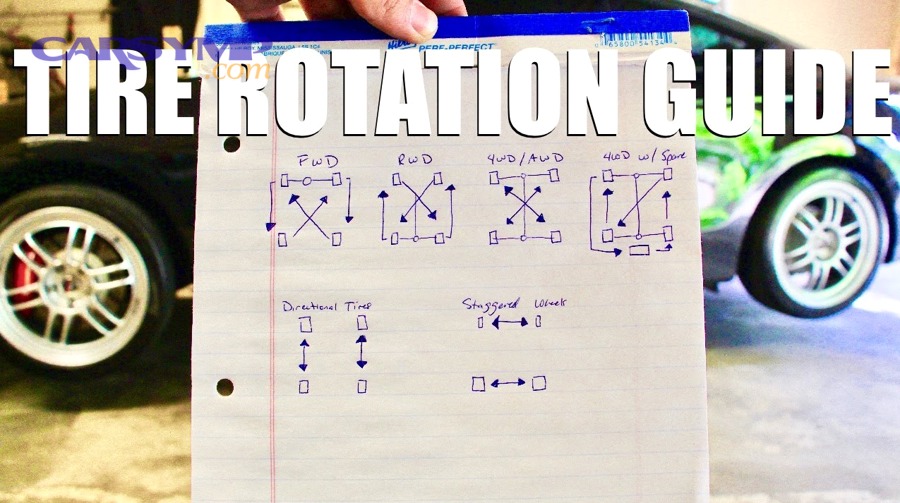
The decision tree is straightforward once you understand the logic. Directional tires eliminate all side-crossing options regardless of drivetrain, leaving only Front-to-Rear as the viable pattern. Non-directional tires of uniform size open up all four patterns, with the correct choice then determined by drivetrain. Staggered fitments — where front and rear tires are different sizes — eliminate all front-to-rear movement and restrict rotation to side-to-side only.
What Is the Best Rotation Pattern for Front-Wheel Drive (FWD) Vehicles?
The best rotation pattern for FWD vehicles with non-directional, same-size tires is the Forward Cross, with the X-Pattern as a viable alternative when more aggressive wear rebalancing is needed. In the Forward Cross, rear tires cross diagonally to the front while front tires move straight to the rear — positioning the freshest tires in the most demanding positions.
FWD vehicles place an unusually high load on front tires because those tires perform three simultaneous functions: transmitting engine torque to the road, steering the vehicle, and managing the majority of braking friction. This combination makes FWD front tires the fastest-wearing tires in the vehicle lineup. Rotating them to the rear — where demands are lower — gives them time to recover wear rate while the rear tires take their turn in the high-stress positions.
Drivers of FWD vehicles should be especially consistent with their rotation interval. Because the front-rear wear differential on FWD platforms develops faster than on RWD vehicles, extending the interval beyond 7,500 miles can allow the front tires to wear so much further than the rear that a single rotation can no longer fully equalize the set.
What Is the Best Rotation Pattern for Rear-Wheel Drive (RWD) Vehicles?
The best rotation pattern for RWD vehicles is the Rearward Cross, in which rear tires move straight to the front and front tires cross diagonally to the rear. This pattern is designed to address the specific wear asymmetry of rear-wheel-drive platforms, where the driven rear tires absorb acceleration torque while the front tires manage steering and braking.
On RWD vehicles, the rear tires tend to wear more quickly during acceleration — particularly in performance driving or when towing. Moving those higher-wear rear tires forward places them in a position where they primarily handle steering input and some braking force, giving the tread time to wear more gradually. The front tires cross diagonally to the rear, where they experience the drive torque that was previously handled by the rear set.
Crossing the front tires diagonally rather than moving them straight back ensures that each tire experiences different wear patterns across multiple rotation cycles, which produces more even tread depth across the set over the long term.
What Is the Best Rotation Pattern for AWD and 4WD Vehicles?
The best rotation pattern for AWD and 4WD vehicles is the Rearward Cross or, for permanent four-wheel-drive applications, the Double-X (full diagonal) pattern recommended by the Tire Industry Association. Both patterns ensure that all four tires cycle through every position on the vehicle — a requirement that is more critical for AWD and 4WD systems than for two-wheel-drive configurations.
AWD and 4WD drivetrains distribute power to all four wheels simultaneously, which means all four tires wear at a more similar rate than on FWD or RWD vehicles. However, even small differences in tread depth — as little as 2/32 of an inch on some AWD systems — can create rotational speed mismatches between axles that force the center differential or transfer case to compensate, generating heat and accelerating internal wear.
For this reason, AWD and 4WD vehicles should be rotated more frequently — often every 3,000 to 5,000 miles — and tread depth should be measured at each rotation to confirm the set is wearing uniformly. If one tire has worn significantly more than the others, a full four-tire replacement may be necessary to protect the drivetrain rather than simply rotating an uneven set.
What Is the Right Pattern for Directional vs. Non-Directional Tires?
Directional tires require Front-to-Rear straight rotation only, while non-directional tires support all four rotation patterns with the correct choice determined by drivetrain. This distinction is one of the most important — and most frequently misunderstood — variables in tire rotation planning.
Directional tires feature a tread pattern shaped like a V or arrowhead, engineered to expel water in a specific direction as the tire spins forward. These tires deliver superior wet-traction performance and reduced hydroplaning risk — but only when rotating in their designed direction. An arrow or “rotation” label on the tire sidewall indicates the required direction of travel.
Non-directional tires, by contrast, have a symmetrical or asymmetrical tread pattern that performs equally well regardless of which way the tire rotates. This flexibility is what allows non-directional tires to be crossed from one side of the vehicle to the other, making the full range of rotation patterns available. Most all-season tires sold for everyday passenger vehicles are non-directional, which is why the Forward Cross and Rearward Cross patterns are so widely used.
How Do You Rotate Tires Step by Step?
Yes — you can rotate tires at home using basic tools in 6 steps: loosen lug nuts, jack and secure the vehicle, remove all four tires, reposition each tire according to the correct pattern for your drivetrain, reinstall and torque to specification, then verify tire pressure before driving. The process takes approximately 45 to 60 minutes for an experienced DIYer.
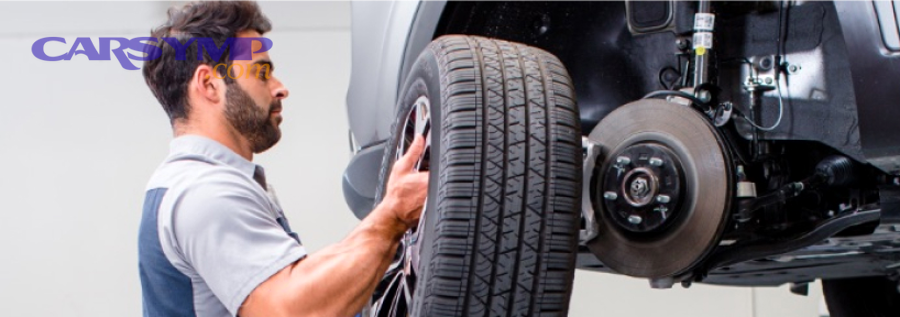
Performing a rotation at home is straightforward for FWD and RWD vehicles on flat, solid ground. However, for AWD and 4WD vehicles — where tread depth uniformity is mechanically critical — professional service is recommended to include tread depth measurement and verification alongside the rotation itself.
What Tools Do You Need to Rotate Tires at Home?
To rotate tires at home, you need five essential tools: a hydraulic floor jack, a minimum of four jack stands, a torque wrench, a lug wrench or impact wrench, and your vehicle’s owner’s manual for torque specifications and the recommended rotation pattern.
The floor jack lifts the vehicle, but the jack stands are what keep it safely elevated while you work. Never rely on a floor jack alone to support a vehicle with tires removed — hydraulic jacks can fail, and the consequence is catastrophic. Position jack stands at the vehicle’s designated lift points, which are typically reinforced sections of the frame or unibody marked in the owner’s manual.
The torque wrench is the most frequently overlooked tool in a DIY rotation. Lug nuts must be tightened to the manufacturer’s specified torque — commonly between 80 and 120 ft-lbs depending on the vehicle — using a star or cross-tightening sequence to seat the wheel evenly against the hub. Over-tightening stretches wheel studs and warps brake rotors; under-tightening risks a wheel separating from the vehicle under load.
What Is the Step-by-Step Process to Rotate Tires by Drivetrain?
The correct tire rotation process follows these six steps, with the repositioning sequence at Step 5 varying by drivetrain according to the pattern selected:
Step 1 — Prepare the vehicle. Park on a flat, solid surface. Engage the parking brake. If the vehicle has a manual transmission, leave it in gear. Gather all tools and confirm your rotation pattern using the owner’s manual or the guide above.
Step 2 — Loosen lug nuts before lifting. With the tires still on the ground, break the lug nuts loose by turning them counterclockwise approximately one-half turn. Do not remove them fully yet — the resistance of the ground contact prevents the tire from spinning while you break the initial torque.
Step 3 — Jack and secure the vehicle. Use the floor jack to raise one axle at a time or all four corners depending on your workflow. Place jack stands at all four lift points before removing any tire. Confirm the vehicle is stable before proceeding.
Step 4 — Remove all four tires. Remove lug nuts fully and set each tire aside, noting its current position (front-left, front-right, rear-left, rear-right) to ensure correct repositioning per your chosen pattern.
Step 5 — Reposition tires per your drivetrain pattern.
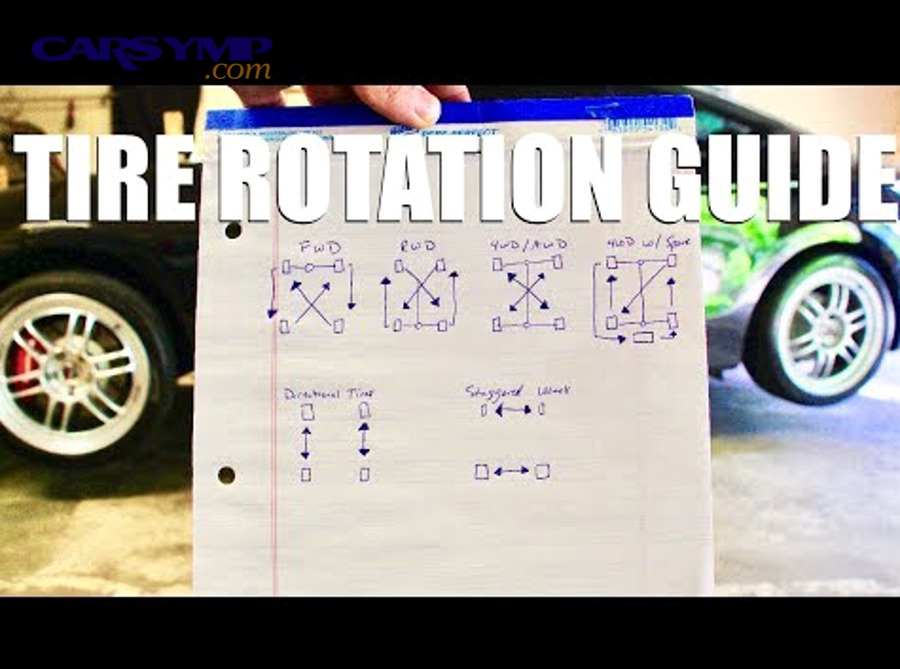
- FWD (Forward Cross): Front-left → Rear-left; Front-right → Rear-right; Rear-left → Front-right; Rear-right → Front-left
- RWD (Rearward Cross): Rear-left → Front-left; Rear-right → Front-right; Front-left → Rear-right; Front-right → Rear-left
- AWD/4WD (Double-X): All tires move diagonally — front-left → rear-right; front-right → rear-left; rear-left → front-right; rear-right → front-left
- Directional (Front-to-Rear): Front-left → Rear-left; Front-right → Rear-right; Rear-left → Front-left; Rear-right → Front-right
Step 6 — Reinstall, torque, and verify. Thread lug nuts by hand first, then tighten in a star pattern to the manufacturer’s torque specification. Lower the vehicle fully before applying final torque. Check and adjust tire pressure on all four tires to the recommended PSI from the door jamb sticker. Drive normally for 50 miles, then re-check torque — thermal expansion and settling can slightly loosen lug nuts after initial installation.
A note on TPMS: Tire rotation and TPMS considerations are important after any DIY rotation. Most modern vehicles with a Tire Pressure Monitoring System require a TPMS relearn procedure after rotation so the system correctly associates each sensor with its new wheel position. Failing to perform the relearn means the TPMS warning light may illuminate incorrectly or assign pressure alerts to the wrong corner. Consult your owner’s manual for the specific relearn procedure — some vehicles relearn automatically after driving a short distance, while others require a button sequence or scan tool.
Does Tire Rotation Actually Extend Tread Life?
Yes — tire rotation genuinely extends tread life, for three key reasons: it equalizes wear rates across all four tires, it keeps all tires within a serviceable tread depth range simultaneously, and it allows early detection of uneven wear caused by alignment or balance issues before those problems consume significant tread. Together, these benefits consistently produce a longer-lasting tire set compared to unrotated tires under otherwise identical driving conditions.
The most direct mechanism is wear equalization. Tires in high-stress positions — the front tires on FWD vehicles, the rear tires on RWD vehicles — lose tread material faster than tires in lower-stress positions. Without rotation, the high-stress tires can wear to the replacement threshold while the opposite-axle tires still have significant tread remaining, forcing a partial replacement that wastes usable tire life. With regular rotation, all four tires approach the replacement threshold together, maximizing the total mileage extracted from the set.
How rotation affects ride noise and handling is another measurable benefit. Tires that wear unevenly — developing cupping, feathering, or edge wear — generate significantly more road noise and produce vibration that drivers feel through the steering wheel and seat. By keeping wear uniform through regular rotation, the tread surface remains flat and consistent, preserving the quiet ride and balanced steering response the tires were designed to deliver.
According to data cited by the Tire Industry Association, regular tire rotation in accordance with manufacturer intervals is one of the most impactful single maintenance actions for preserving tire tread life, with properly rotated tires capable of lasting tens of thousands of miles longer than those serviced irregularly or not at all.
Are There Special Tire Rotation Scenarios That Require a Different Approach?
Yes — four specific scenarios require departures from standard rotation patterns: including a full-size spare in the rotation cycle, rotating run-flat tires, managing staggered fitment configurations, and adjusting rotation frequency for electric vehicles. Each of these situations involves unique constraints that the four standard patterns do not fully address on their own.
These edge cases are more common than many drivers realize. High-trim trucks and SUVs often come with full-size spare tires. Performance coupes and luxury sedans frequently use staggered fitments. Run-flat tires are now standard equipment on many European brands. And the EV market is growing rapidly, bringing with it a set of tire wear dynamics that conventional rotation schedules were not designed to handle.
How Do You Rotate Tires If You Want to Include a Full-Size Spare?
Including a full-size spare in your tire rotation cycle requires a five-tire rotation pattern, and it is strongly recommended for AWD and 4WD vehicles where spare tire tread depth must stay consistent with the other four tires to protect the drivetrain.
For FWD vehicles using the Forward Cross with a full-size spare, the standard five-tire sequence works as follows: the rear tires move diagonally to the front; the spare moves to the right rear position; the left front tire moves straight back to the left rear; and the right front tire becomes the new spare. This cycle rotates each tire through all five positions over three complete rotation services, ensuring even wear across the full set including the spare.
The critical caveat: never include a temporary spare — commonly called a “donut” — in any rotation cycle. Temporary spares are not designed for sustained highway use and are built to different size and load specifications than the four primary tires. Including a temporary spare in rotation would produce tread depth mismatches that could stress AWD components and compromise vehicle handling.
Can You Rotate Run-Flat Tires the Same Way as Regular Tires?
No — run-flat tires require a mandatory inspection before rotation, and in some cases should not be rotated at all if they have previously been driven at low or zero pressure. While the rotation pattern itself follows the same logic as standard tires, the pre-rotation inspection step is non-negotiable and distinguishes run-flat rotation from conventional tire service.
Run-flat tires are reinforced with stiffened sidewalls that allow the tire to continue supporting the vehicle even when air pressure is lost — typically for up to 50 miles at reduced speed. However, driving on a run-flat tire at low or zero pressure subjects the internal structure to stresses that are not visible from the outside. Internal damage — crushed cords, delaminated layers, or compromised bead seats — can exist in a tire that appears normal to visual inspection.
Before any run-flat tire is rotated, a qualified technician should dismount and inspect it for internal damage, particularly if it has been driven in a low-pressure condition. If internal damage is found, the tire must be replaced regardless of remaining tread depth. Rotating a structurally compromised run-flat to a different position on the vehicle introduces a serious safety risk.
What Is the Tire Rotation Pattern for Vehicles with Staggered Fitments?
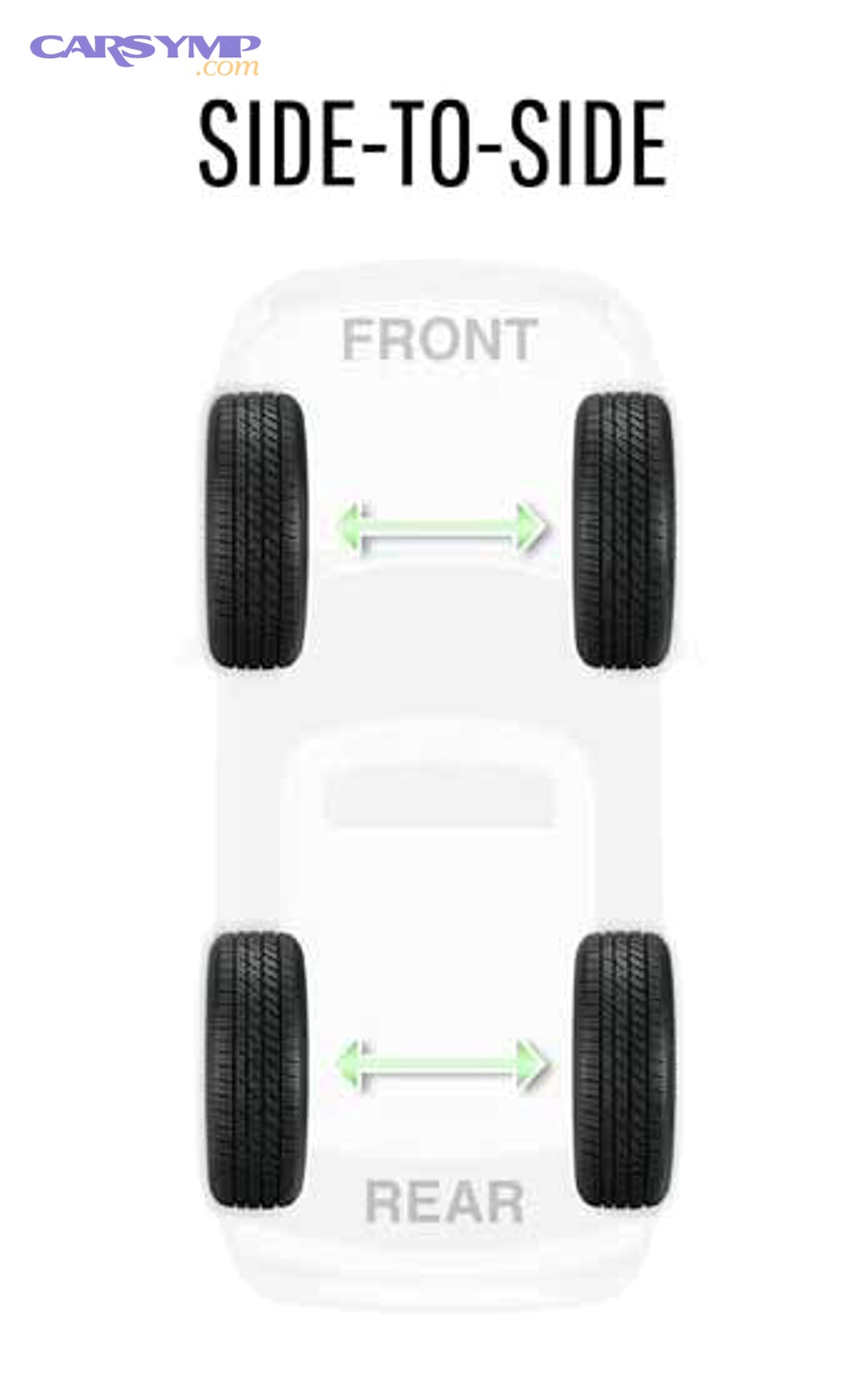
Vehicles with staggered fitments — where the front and rear tires are different widths or diameters — can only use side-to-side rotation, and some staggered configurations cannot be rotated at all without dismounting the tires from their rims. Front-to-rear rotation is physically impossible when the tires are different sizes, because a wider rear tire cannot mount on a narrower front rim and vice versa.
Side-to-side rotation swaps the left and right tires on each axle independently: front-left to front-right, front-right to front-left, rear-left to rear-right, rear-right to rear-left. This allows some degree of wear equalization between the left and right sides of each axle, which is particularly useful for vehicles with aggressive negative camber settings that cause inner edge wear on one side. However, it does not equalize front-to-rear wear, which means staggered fitment vehicles inherently sacrifice the full benefits of conventional rotation.
For vehicles with both staggered fitments and directional tires — a combination common on high-performance sports cars — side-to-side rotation is impossible without dismounting and remounting each tire on the opposite rim in reverse orientation. In practice, many owners of such vehicles simply accept reduced tire longevity as the trade-off for the performance benefits of the staggered, directional setup, and budget for more frequent front and rear tire replacements on separate schedules.
Do Electric Vehicles (EVs) Need a Different Tire Rotation Schedule or Pattern?
Yes — electric vehicles require more frequent tire rotation than comparable internal combustion engine vehicles, typically every 3,000 to 5,000 miles rather than the standard 5,000 to 7,500 miles, due to the higher instantaneous torque output of electric motors that accelerates tread wear — particularly on driven axles. The rotation pattern itself follows the same logic as any other drivetrain, but the shortened interval is critical.
Electric motors deliver maximum torque from zero RPM, which means EV tires experience significant shear stress during every acceleration event — far more than a comparably powered gasoline engine produces at low RPM. This characteristic is especially pronounced on performance EVs and on AWD electric vehicles where both front and rear motors deliver torque simultaneously. The result is measurably faster wear on all driven tires compared to equivalent ICE vehicles.
The additional weight of EV battery packs — which can add 300 to 1,000 pounds or more to a vehicle’s curb weight versus a gasoline equivalent — further loads all four tires and increases wear rates independent of drivetrain torque. Several EV manufacturers, including Tesla and Rivian, now explicitly recommend rotation intervals shorter than the industry standard in their owner’s manuals. EV owners who apply the standard 5,000–7,500 mile interval without adjustment risk developing significant tread depth imbalances between rotations, particularly on rear-driven configurations. Checking the specific manufacturer interval for your EV model is the most reliable way to stay ahead of the wear curve.