


tire rotation directly affects ride noise and handling by changing how each tire’s worn tread pattern contacts the road surface. When tires are moved to a new position, tread that has gradually shaped itself to one axle’s load, steering forces, and braking stress is suddenly asked to perform a different job. The result is a temporary — and sometimes permanent — shift in how quietly and confidently your vehicle drives. Understanding this relationship is the single most important step toward diagnosing post-rotation noise and making smart maintenance decisions.
Noise is the most immediately noticeable effect drivers experience after a rotation. A humming sound, a helicopter-like whomp, or a persistent whine can appear within the first few miles of leaving the shop. These sounds are not random. Each noise type maps to a specific cause — cupping, imbalance, directional tread reversal — and knowing which sound points to which problem allows you to respond correctly rather than simply waiting and hoping the noise disappears on its own.
Handling changes after rotation are subtler but equally important. A car that suddenly pulls to one side, feels vague in corners, or brakes unevenly after a rotation is communicating that its tires no longer share tread depth evenly — or that an alignment problem has been hiding in the rear axle and is now exposed at the front. Addressing these handling shifts promptly protects not just your tires but your suspension, steering components, and safety margins.
Beyond troubleshooting, there is a proactive dimension to this topic that most drivers overlook. Choosing the correct rotation pattern for your drivetrain type, rotating at the right intervals, and understanding which vehicles cannot follow standard rotation rules are all factors that determine whether your tires deliver a quiet, well-handling ride across their full lifespan. The sections below cover every layer of this topic — from the mechanics of what happens during a rotation to the edge cases that apply to electric vehicles, directional tires, and staggered fitments.
What Is Tire Rotation and Why Does It Matter for Ride Quality?
Tire rotation is a scheduled maintenance service that repositions each tire to a different axle or wheel location on the vehicle, with the direct purpose of equalizing tread wear and preserving ride quality across all four corners. To understand why rotation matters so deeply for how your car sounds and handles, it helps to first understand what is happening to your tires every time you drive.
Specifically, each tire on your vehicle is subjected to a different combination of forces depending on where it sits. Front tires on a front-wheel-drive vehicle, for example, handle steering, braking, and power delivery simultaneously — a workload that causes them to wear significantly faster than rear tires. Without periodic repositioning, this imbalance compounds until the front tires are dangerously thin while the rears still have substantial tread remaining. The resulting difference in tread depth across the four tires directly degrades ride smoothness, increases road noise, and reduces grip consistency.
What Happens to Your Tires During a Rotation Service?
During a rotation service, a technician removes each wheel and tire assembly from the vehicle and reinstalls it at a different position — typically moving front tires toward the rear and rear tires toward the front, with lateral crossing applied depending on the vehicle’s drivetrain type.
This physical repositioning means that a tire which spent its first 6,000 miles absorbing steering loads on the front-left corner is now sitting on the rear-right, where it will primarily handle straight-line driving and light braking. The tread blocks, which had been slowly shaping themselves to the stresses of one position, must now adapt to an entirely new set of forces. This adaptation period is the root cause of the temporary noise and handling changes that many drivers notice immediately after rotation.
- The front-to-rear move reduces the load on the tires that have been doing the most work.
- Moving rear tires to the front exposes any wear irregularities — like cupping — because the front position amplifies noise and vibration.
- The cross pattern (moving rear-left to front-right, for example) ensures that no tire always stays on the same side, preventing side-specific wear from camber or road crown.
How Does Uneven Tread Wear Develop Before Rotation?
Uneven tread wear develops because no two wheel positions on a vehicle impose the same combination of load, heat, lateral force, and braking stress on a tire, meaning every tire on the car wears at a different rate and in a different pattern even under normal driving conditions.
Three specific wear patterns are most responsible for post-rotation noise and handling changes:
Cupping (also called scalloping): A wavy, up-and-down wear pattern that develops when a tire bounces slightly as it rolls, often caused by worn shock absorbers or simply by the tire spending too long in one position without rotation. Cupped tires produce the loud helicopter or whomp-whomp noise that drivers report after rotation, because the cupped sections now create rhythmic impacts with the road from a new position where the sound is more audible in the cabin.
Feathering: A pattern in which the tread blocks are worn down on one side and rounded on the other, typically caused by a toe alignment issue. Feathered tires produce a swooshing or hissing sound that intensifies after rotation because the feathered blocks now face a different direction of travel.
One-sided edge wear: Caused by camber misalignment, this pattern wears one shoulder of the tire faster than the other. When rotated, the heavily worn shoulder may now contact the road differently, reducing grip on that corner.
Does Tire Rotation Cause Increased Ride Noise?
Yes, tire rotation can cause increased ride noise — but in most cases the noise is temporary, self-resolving, and a normal consequence of changing how worn tread patterns contact the road surface.
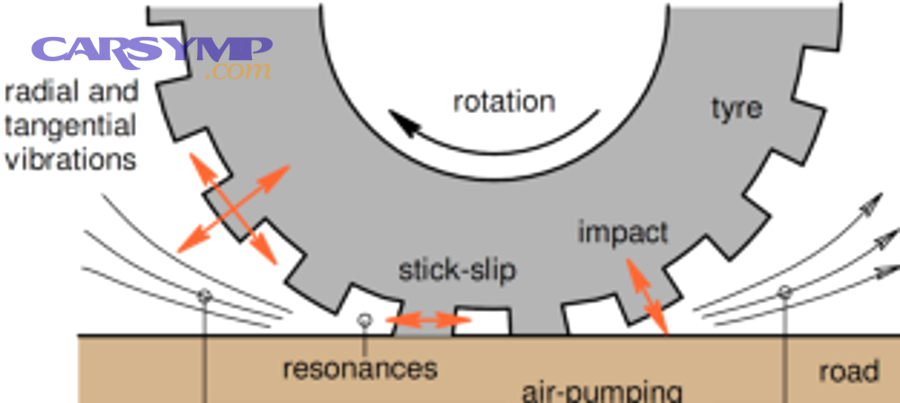
To understand this more completely, it is important to recognize the distinction between expected break-in noise and noise that signals an unresolved mechanical problem. The former is simply the sound of tread adapting to its new position; the latter is a warning that rotation has exposed an alignment, balance, or wear issue that requires active intervention.
What Types of Noise Can Appear After a Tire Rotation?
There are four main types of noise that commonly appear after a tire rotation: humming, helicopter/whomp-whomp sounds, whining, and scraping — each caused by a different underlying condition.
The following table maps each noise type to its most likely cause and the recommended response, giving drivers a quick diagnostic reference.
| Noise Type | Description | Most Likely Cause | Recommended Action |
|---|---|---|---|
| Humming | Low, steady drone that increases with speed | Mild uneven wear or slight imbalance | Monitor; rebalance if it persists beyond 1,000 miles |
| Helicopter / Whomp-Whomp | Rhythmic thumping or chopping sound | Cupped tires moved to front axle | Get alignment checked; tires may need replacement if severe |
| Whining | High-pitched steady sound, speed-sensitive | Feathered tread or directional tire reversed | Check toe alignment; verify directional tire orientation |
| Scraping | Metallic or abrasive intermittent sound | Wear indicator contacting rotor; bent brake shield | Have brakes and shields inspected immediately |
This table shows that not all post-rotation noises carry the same urgency. A faint hum is almost always benign; a persistent scraping sound requires same-day inspection.
Is It Normal for Tires to Be Louder After Rotation?
Yes, it is normal for tires to be louder after rotation in the majority of cases, because tread blocks that have worn into a specific contact patch shape must re-conform to a new position’s road contact demands — a process that temporarily generates more noise until the tread smooths out.
However, “normal” post-rotation noise has recognizable characteristics that distinguish it from noise requiring a mechanic’s attention:
- Normal noise is mild to moderate, appears evenly from all four corners, does not worsen progressively, and begins to subside within a few hundred miles.
- Abnormal noise is loud from the outset, localized to one or two corners, worsens at higher speeds, or is accompanied by vibration in the steering wheel or seat.
The most common reason post-rotation noise feels alarming is that drivers are used to the previous tire positions — the tires were quiet because the worn patterns had settled in, not because the tires were healthy. Rotation correctly disrupts this false comfort and brings underlying wear issues to the surface.
How Long Does Tire Noise Last After Rotation?
Post-rotation tire noise typically lasts between a few days and 1,000 miles for mild cases, while more significant cupping or wear-related noise may take up to 1,500 miles to subside — or may never fully resolve if the underlying cause is severe enough.
Here is a practical timeline that drivers can use as a reference:
- 0–300 miles: Some noise and minor vibration is completely expected. Tires are adapting to new positions.
- 300–1,000 miles: Normal break-in noise should be noticeably decreasing. If the noise is the same intensity or worse, schedule a rebalance and alignment check.
- 1,000–1,500 miles: Any remaining significant noise — especially helicopter sounds or consistent humming — indicates that the tires have a wear problem that will not self-correct. Inspection and potentially tire replacement are needed.
- Beyond 1,500 miles: Persistent loud noise is not a break-in issue. It is a structural wear or alignment problem requiring professional diagnosis.
How Does Tire Rotation Affect Vehicle Handling?
Tire rotation affects vehicle handling by redistributing tread depth across all four wheel positions, which directly determines how evenly the car grips, steers, and stops — but it can also temporarily alter handling feel if significant wear differences existed between the front and rear tires before rotation.
More specifically, handling is governed by how much usable tread each tire presents to the road at any given moment. When front and rear tires carry dramatically different tread depths, the vehicle behaves asymmetrically: the wheels with less tread generate less lateral grip, require more stopping distance, and respond less precisely to steering inputs. Rotation corrects this asymmetry over time by moving the most-worn tires to positions where they receive less stress, allowing the tread to even out across the set.
Why Does My Car Pull to One Side After a Tire Rotation?
A car that pulls to one side after a tire rotation is most commonly experiencing one of two conditions: unequal tread depths between the left and right front tires, or a pre-existing wheel alignment problem that was hidden at the rear axle and has now been moved to the front where it directly influences steering.
Tread depth imbalance between sides occurs when the left and right tires of a set have worn differently — often due to road crown (roads are slightly angled for drainage, which puts more load on the right front tire), localized pothole damage, or inconsistent inflation pressure. When the more worn tire is rotated to the front, the grip difference between the two front corners causes the car to drift toward the side with less tread.
Alignment problems exposed by rotation are particularly common. A rear tire with a significant toe or camber issue wears in a specific pattern. When that tire moves to the front during rotation, the pattern now directly affects the steering axis. What felt like a stable rear suddenly becomes a pulling, drifting front.
- First action: Swap the front-left and front-right tires (a side-to-side swap on the front axle) and test drive. If the pull reverses direction, the tire is the cause. If the pull stays in the same direction, alignment is the cause.
- Second action: Book a wheel alignment check if the pull does not change or does not resolve after a few hundred miles of break-in.
Can Tire Rotation Improve Handling and Traction Over Time?
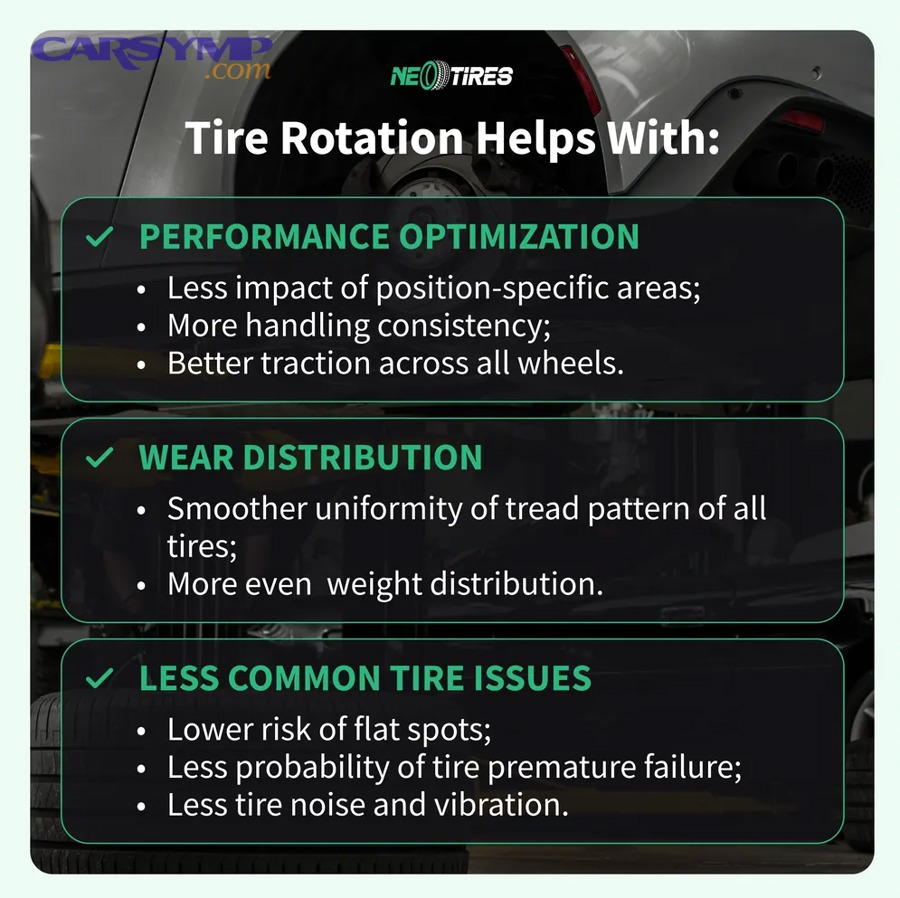
Yes, consistent tire rotation genuinely improves handling and traction over time, because it maintains uniform tread depth across all four tires — which is the single most important factor in ensuring that the vehicle grips the road evenly during braking, cornering, and acceleration.
The handling benefits of regular rotation compound across the life of a tire set:
- Braking distance: Tires with equal tread depth produce a balanced braking response. When front and rear tread depths diverge significantly, the vehicle can develop a front-heavy or rear-heavy braking bias, increasing stopping distances.
- Wet and snow traction: Tread depth channels water and snow away from the contact patch. Uneven depths mean two tires are hydroplaning at a threshold that the other two can still handle safely — a dangerous asymmetry on wet roads.
- Cornering stability: Lateral grip is proportional to tread depth and condition. Rotating tires keeps grip balanced between the inside and outside corners during turns, reducing understeer and oversteer tendencies.
- AWD driveline protection: On all-wheel-drive vehicles, significant tread depth differences between the front and rear axles force the driveline to compensate for the speed differential created by different rolling circumferences. This stresses the center differential and transfer case, adding expensive mechanical wear on top of the handling degradation.
According to data published by the Tire Industry Association, vehicles that follow a consistent tire rotation schedule maintain up to 20% more even tread wear across all four tires compared to vehicles with irregular or skipped rotations — directly translating to more predictable handling throughout the tire’s service life.
What Are the Correct Tire Rotation Patterns for Different Vehicles?
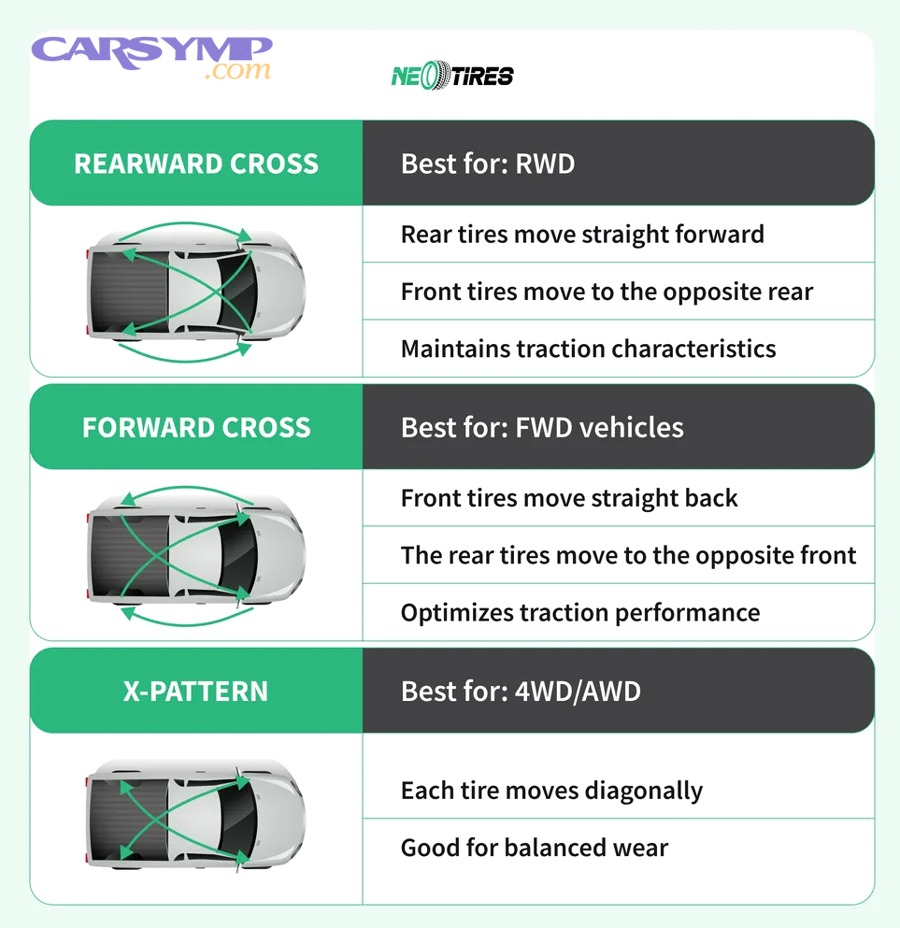
There are four primary tire rotation patterns used across different vehicle types — Forward Cross, Rearward Cross, X-Pattern, and Front-to-Rear — classified based on the vehicle’s drivetrain configuration and tire design.
This Tire rotation pattern guide exists because applying the wrong pattern does not simply fail to help — it can actively worsen wear, create new noise problems, and accelerate tread degradation. The correct pattern ensures that each tire travels to a position that compensates for the unique wear bias of its previous location.
Which Rotation Pattern Is Best for Front-Wheel Drive, Rear-Wheel Drive, and AWD?
The correct rotation pattern is Forward Cross for front-wheel-drive vehicles, Rearward Cross for rear-wheel-drive vehicles, and full X-Pattern for AWD and 4WD vehicles — with Front-to-Rear as the only option for vehicles equipped with directional tires.
Forward Cross (FWD vehicles):
- Front tires move straight back to the rear on the same side.
- Rear tires cross diagonally to the opposite front corner (rear-left to front-right; rear-right to front-left).
- Why it works: FWD front tires carry the heaviest combined load (steering + drive + braking). Moving them straight back gives them a rest period in a lower-stress position. The diagonal cross from rear to front ensures the rested rears experience the full front-axle stress environment evenly.
Rearward Cross (RWD vehicles):
- Rear tires move straight forward to the same-side front position.
- Front tires cross diagonally to the opposite rear corner.
- Why it works: RWD rear tires absorb all drive torque and tend to wear faster in a straight-ahead pattern. Promoting them to the front keeps tread depth higher on the corners that most influence steering.
X-Pattern (AWD/4WD vehicles):
- All four tires cross diagonally to the opposite corner simultaneously.
- Why it works: AWD systems distribute drive torque to all four corners variably. No single axle dominates wear, so the full cross ensures every tire experiences every position equally across multiple rotations.
Front-to-Rear / Straight Rotation (Directional tires):
- Tires move only front-to-rear on the same side — no crossing.
- Why it is mandatory: Directional tires have a V-shaped tread pattern engineered to rotate in one specific direction, indicated by an arrow on the sidewall. Crossing them to the opposite side would reverse their rotation direction, destroying the tread’s water-evacuation and noise-reduction performance.
How Often Should You Rotate Tires to Prevent Noise and Handling Problems?
Rotating tires every 5,000 to 7,500 miles — or every six months, whichever comes first — is the standard interval that prevents the accumulation of uneven wear patterns that cause post-rotation noise and handling changes.
That said, certain driving conditions and vehicle types require more frequent attention as part of a complete strategy for Extending tire life with proper rotation:
- Heavy city driving: Frequent braking and acceleration in stop-and-go traffic accelerates front tire wear on FWD vehicles. Rotating every 5,000 miles is advisable.
- Towing and hauling: The additional weight over the rear axle on RWD trucks accelerates rear wear. Rotate at 5,000-mile intervals.
- Aggressive or spirited driving: Hard cornering and acceleration create lateral wear faster than normal. Rotate closer to the 5,000-mile mark.
- Electric vehicles: EV instant torque — delivered from a standing stop on every acceleration — wears rear tires significantly faster than equivalent gasoline vehicles. Many EV manufacturers recommend rotation intervals as short as 3,000 to 5,000 miles.
- Low-mileage drivers: Even at low mileage, rotate at least every six months. Tires develop flat spots and localized wear from sitting in one position under a vehicle’s weight, regardless of miles driven.
A practical tip: synchronize tire rotation with oil changes if your oil change interval aligns with your rotation schedule. This removes the need to track two separate maintenance timelines.
How Do You Fix Noise and Handling Problems After a Tire Rotation?
Fixing noise and handling problems after a tire rotation involves three targeted steps: confirming the noise is not a normal break-in response, rebalancing the wheels if vibration or humming is present, and scheduling a wheel alignment check if pulling or uneven wear is detected.
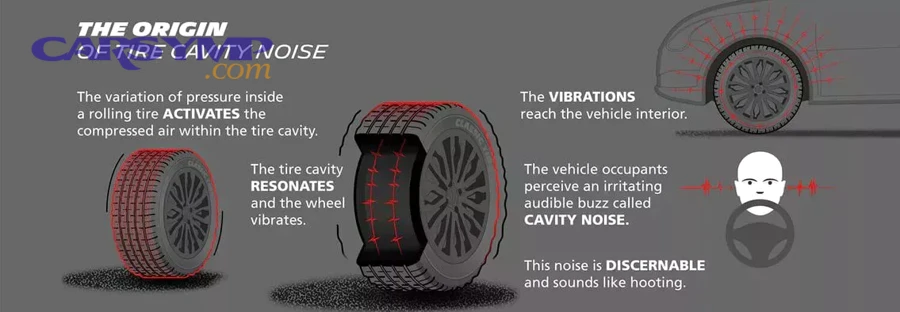
To better understand the appropriate response, it is essential to match the symptom to the correct fix rather than applying every solution at once. Rebalancing will not fix a pull caused by alignment; alignment will not resolve a vibration caused by a lost wheel weight. Diagnosis first, action second.
Should You Rebalance Your Tires After a Rotation?
Yes, you should rebalance your tires after a rotation if you notice new humming, vibration through the steering wheel or seat, or a wobbling sensation at highway speeds — because rotation service occasionally dislodges wheel weights, and existing imbalance problems become more noticeable when tires move to new positions.
Tire and wheel assemblies gradually fall out of balance as rubber wears unevenly, but this process is slow and typically does not cause sudden dramatic changes. What does cause sudden imbalance is a wheel weight falling off during the rotation process — a small but meaningful counterweight that was previously keeping the assembly spinning smoothly is now missing. This lost weight creates an immediate heavy spot on the wheel, generating the rhythmic vibration and humming that drivers attribute incorrectly to the rotation itself.
- Steering wheel vibration at 55–70 mph typically indicates a front wheel imbalance.
- Seat or floorboard vibration at highway speeds usually indicates a rear wheel imbalance.
- Vibration at all speeds may indicate severe imbalance or a structural tire problem, both of which require immediate inspection.
If a rotation and balance are requested together in a single shop visit, the technician will spin each wheel and tire assembly on a balancing machine and add or remove small counterweights as needed — a five-minute process that eliminates balance-related noise entirely when performed correctly.
When Should You Get a Wheel Alignment After Tire Rotation?
You should schedule a wheel alignment check after tire rotation when the car pulls to one side, when post-rotation noise does not begin to reduce after 1,000 miles, or when inspection during rotation reveals one-sided or feathered tread wear on the tires being moved.
It is important to understand that tire rotation does not cause misalignment. Alignment is a property of the suspension geometry — the angles at which your wheels contact the road — and rotation cannot change those angles. What rotation does is reveal misalignment problems that were previously hidden at the rear axle.
When a badly aligned rear tire moves to the front during rotation, it now directly affects steering. The pull that was imperceptible from the rear is suddenly amplified through the steering wheel at the front. This is not a rotation mistake — it is a diagnostic success. The rotation has surfaced a problem that needed addressing regardless.
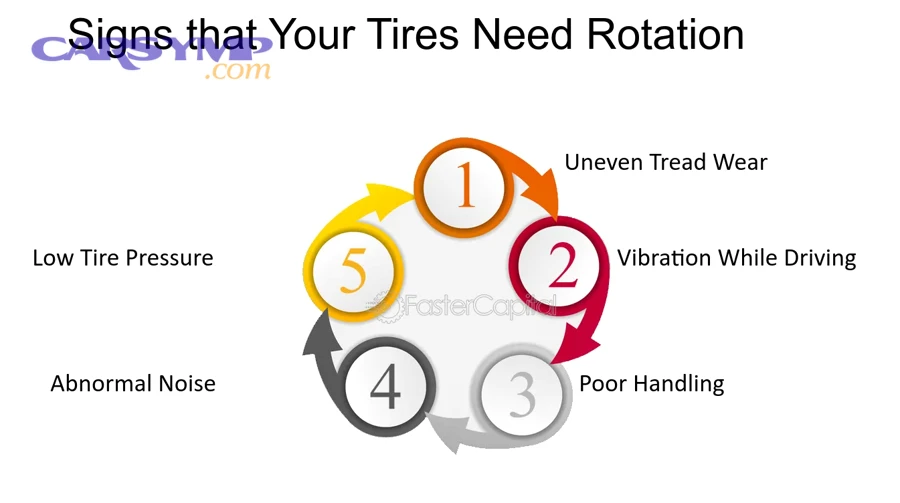
Signs that alignment is needed after rotation:
- The vehicle drifts or pulls consistently to one side even after a front-to-front swap test.
- The steering wheel is off-center when driving straight on a flat road.
- Post-rotation noise (especially whining or helicopter sounds) does not begin to improve after 1,000 miles.
- Tread inspection reveals feathering, one-sided wear, or rapid inner/outer edge wear on multiple tires.
According to the National Highway Traffic Safety Administration (NHTSA), proper wheel alignment combined with regular tire rotation can extend tire life by up to 12,000 additional miles compared to vehicles with uncorrected alignment running on unrotated tires. Combining both services whenever abnormal wear is detected is the highest-value maintenance decision a driver can make.
Are There Special Cases Where Tire Rotation Works Differently?
There are four main special cases where standard tire rotation rules do not apply or require significant modification: directional tires, staggered fitment performance vehicles, electric vehicles, and vehicles equipped with run-flat tires — each presenting unique constraints that affect how rotation is performed and how often.
These cases matter because applying standard rotation advice to a vehicle with directional tires or staggered fitments does not just produce suboptimal results — it can void tire warranties, damage tread performance, or in the case of AWD vehicles with staggered setups, stress the driveline. Knowing which category your vehicle and tires fall into is essential before scheduling any rotation service.
Can You Rotate Directional Tires the Same Way as Regular Tires?
No, you cannot rotate directional tires the same way as regular tires — they must only move front-to-rear on the same side of the vehicle, because their V-shaped or unidirectional tread pattern is specifically engineered to rotate in one direction only.
Directional tires are identifiable by an arrow molded into the sidewall, pointing in the direction the tire must rotate when the vehicle moves forward. This tread design optimizes water evacuation, reduces aquaplaning risk, and often lowers road noise in the forward direction. Reversing the rotation direction by crossing a directional tire to the opposite side negates all of these benefits and can actually increase noise and reduce wet-weather grip.
If you need to cross directional tires — for example, to even out side-specific wear caused by road crown — the tires must be dismounted from their wheels and remounted in the opposite orientation before being installed on the other side of the vehicle. This adds a tire dismount and remount charge to the rotation service but is the only safe way to cross directional fitments.
Why Can’t Some Performance and Sports Cars Have Their Tires Rotated?
Some performance and sports cars cannot have their tires rotated using any standard pattern because they use a staggered fitment — meaning the rear tires are physically wider than the front tires — making it impossible to move rears to the front or fronts to the rear without installing a tire on a rim it was not sized for.
Staggered fitments are common on rear-wheel-drive sports cars and luxury performance vehicles. The wider rear tire provides more lateral grip and a more stable platform during hard acceleration. The narrower front tire reduces steering effort and allows more precise turn-in response. Because the two sizes are incompatible with each other’s wheel widths and in most cases incompatible with each other’s fender clearances, cross-axle rotation is mechanically impossible.
The practical consequence for owners of staggered fitment vehicles is unavoidable: rear tires — which carry the drive load — will always wear faster than fronts, and there is no rotation strategy that can redistribute that wear. These owners should budget for replacing rear tires approximately twice as often as fronts and inspect rear tread depth more frequently than the standard schedule.
Run-flat tires present a related but distinct restriction. Their reinforced sidewalls, which allow continued driving after air pressure loss, are stiffer than conventional tires. On certain vehicles, mixing rotated run-flats with positions they were not designed for can alter the vehicle’s ride characteristic and, on some platforms, trigger the vehicle’s suspension calibration to behave incorrectly. Always verify the vehicle manufacturer’s recommendation before rotating run-flat tires.
Do Electric Vehicles Need More Frequent Tire Rotation to Manage Noise?
Yes, electric vehicles need more frequent tire rotation — ideally every 3,000 to 5,000 miles — because the instant, high torque delivered from a standstill on every acceleration cycle wears rear tires dramatically faster than the same driving would on a gasoline-powered vehicle.
Beyond the mechanical wear rate, EVs introduce a secondary complication: their near-silent powertrains eliminate the engine noise that traditionally masked tire road noise in conventional cars. An EV driver will notice mild tire hum, cupping resonance, or rotation-related noise at tread wear levels that would go completely undetected in a gas-powered vehicle. This acoustic sensitivity means that EVs effectively reach the noise threshold that demands rotation sooner than mileage alone would suggest.
Several EV manufacturers — including Tesla and Hyundai — explicitly recommend 5,000-mile or even shorter rotation intervals in their owner’s manuals, departing significantly from the conventional 7,500-mile standard. Owners who follow standard gasoline-car rotation schedules on their EVs consistently report accelerated rear tire wear, increased road noise, and reduced range efficiency from the increased rolling resistance of heavily worn rear tires.
How Is Tire Rotation Different from Wheel Balancing and Alignment?
Tire rotation, wheel balancing, and wheel alignment are three distinct services: rotation wins for equalizing tread wear across all four positions, balancing is the correct solution for vibration caused by weight distribution imbalance within a single wheel assembly, and alignment is the essential fix for directional pulling and uneven side-to-side wear caused by incorrect suspension geometry.
However, these three services interact so closely that understanding where one ends and another begins is fundamental to correct vehicle maintenance:
Tire Rotation addresses position — it moves tires between axles and sides to equalize how much work each tire does over its lifetime. It does not correct any imbalance within a tire, and it does not change the angles at which wheels contact the road.
Wheel Balancing addresses weight distribution — a small heavy spot anywhere on the wheel or tire assembly causes it to vibrate as it spins. A balancing machine detects this imbalance and counterweights are added to neutralize it. Balancing corrects steering vibration and seat vibration, but does not move tires between positions and does not fix alignment.
Wheel Alignment addresses suspension geometry — the angles (camber, toe, caster) at which each wheel sits relative to the vehicle and the road surface. Misalignment causes tires to scrub across the road at a slight angle rather than rolling perfectly straight, which accelerates wear and pulls the vehicle off course. Alignment does not redistribute tires and does not correct imbalance.
The practical interaction between these three services is why rotation often reveals the need for balancing or alignment. Rotation does the diagnostic work of moving tires to positions where their symptoms become visible or audible — and then balancing and alignment do the corrective work that removes the underlying cause.
In short, a complete tire maintenance strategy for extending tire life with proper rotation combines all three services: rotate on schedule to redistribute wear, balance whenever vibration appears, and align whenever uneven wear or pulling is detected. Each service protects the investment made in the other two.