


Lock-up clutch problems are among the most misdiagnosed issues in automatic transmissions because the symptoms — shuddering, stalling, and fuel economy loss — overlap with several other drivetrain faults. The lock-up clutch, also known as the Torque Converter Clutch (TCC), is responsible for creating a direct mechanical connection between the engine and the transmission at cruising speed, eliminating the hydraulic slippage that wastes energy in a standard fluid coupling. When this component fails, drivers often notice the problem long before they understand its source. Identifying the fault early is the single most effective way to avoid a much more expensive transmission repair.
The symptoms of a failing lock-up clutch are specific enough to distinguish from general transmission problems, once you know what to look for. Shuddering between 40 and 65 mph, an engine that stalls when braking to a stop, and a noticeable drop in highway fuel economy are the three most common warning signs that the TCC is no longer functioning correctly. Each symptom points to a distinct failure mode — and understanding the difference between a clutch that will not engage and one that will not release is essential for accurate diagnosis.
The causes of lock-up clutch failure fall into three clear categories: electrical faults, mechanical wear, and fluid-related degradation. A failed TCC solenoid is the most frequently cited culprit, but sensor failures, contaminated transmission fluid, and worn clutch friction material all play a role. Because the lock-up system is controlled jointly by the vehicle’s ECM and a hydraulic valve circuit, a single broken wire or a dirty valve body can disable lock-up entirely — even when the clutch itself is physically intact.
Fixing a lock-up clutch problem ranges from a straightforward transmission fluid change or solenoid swap to a full torque converter replacement, depending on the root cause. The following sections cover all of it — starting with how the lock-up clutch actually works, moving through every symptom and cause, and finishing with a practical repair guide and the deeper mechanical and electronic details that help drivers and technicians understand the full picture.
What Is a Lock-Up Clutch and What Does It Do in an Automatic Transmission?
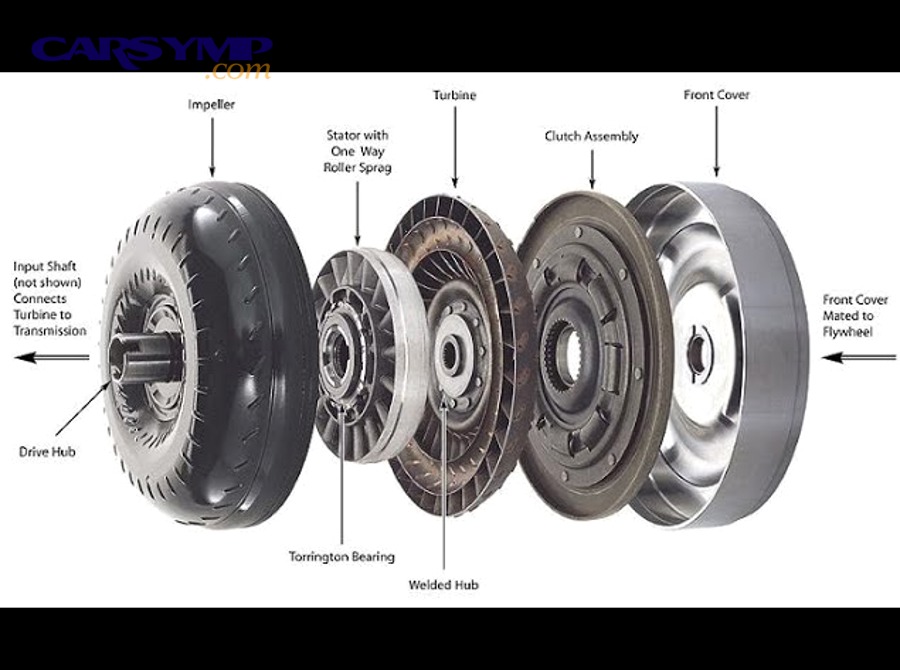
A lock-up clutch is a mechanical friction clutch mounted inside the torque converter that creates a direct 1:1 drive connection between the engine and transmission, eliminating hydraulic slippage and reducing energy loss at cruising speed.
To better understand why this component matters, it helps to start with the problem it was designed to solve. A standard torque converter transmits power through fluid — the impeller spins the fluid, which drives the turbine, which turns the transmission input shaft. This fluid coupling is smooth and forgiving at low speeds, but it is inherently inefficient. Even at highway cruise, there is approximately 4–5% rotational speed difference between the impeller and turbine, meaning the torque converter is never transmitting 100% of engine output. That constant slippage generates heat and wastes fuel. The lock-up clutch solves this by physically clamping the turbine to the converter housing once the vehicle reaches a suitable speed — typically around 37–50 mph — creating a solid mechanical link that eliminates the fluid gap entirely.

How Does a Lock-Up Clutch Engage and Disengage?
Engagement and disengagement of the lock-up clutch are controlled entirely by hydraulic pressure differentials on either side of the clutch piston — not by a mechanical lever or a direct electronic actuator.
Specifically, the system uses two pathways for transmission fluid entering the torque converter. When the vehicle is traveling at low speed, pressurized fluid flows into the front of the lock-up clutch, equalizing pressure on both sides of the piston. With equal pressure, the clutch piston is not forced against the converter case, so the clutch remains disengaged and the converter operates normally in fluid coupling mode. When the vehicle reaches medium to high cruising speed, the relay valve redirects fluid to enter behind the lock-up clutch piston instead. The front side of the piston is simultaneously connected to a drain, creating a low-pressure zone. The hydraulic pressure differential then forces the piston against the inside face of the converter front cover, clamping the clutch and locking the turbine directly to the impeller. A dampening spring assembly absorbs the torsional shock of this engagement, preventing a harsh mechanical jolt from being transmitted through the drivetrain. The same fluid circuit that controls engagement also carries heat away from the converter through a cooler integrated into the engine cooling system.
What Is the Difference Between a Standard Torque Converter and a Lock-Up Torque Converter?
A standard torque converter operates entirely through fluid coupling, while a lock-up torque converter adds a mechanical friction clutch that bypasses the fluid link at higher speeds — the key difference being efficiency, heat generation, and fuel consumption at cruise.
More specifically, the table below summarizes how the two converter types compare across the criteria that matter most to everyday drivers:
| Criterion | Standard Torque Converter | Lock-Up Torque Converter |
|---|---|---|
| Power transfer at cruise | ~95–96% (always slipping) | 100% (direct drive when locked) |
| Heat generation at highway speed | Higher — continuous slip | Lower — no slip when engaged |
| Fuel economy impact | Lower MPG at cruise | Improved MPG at cruise |
| Drivetrain feel | Smooth, always fluid-coupled | Slight transition feel at lock-up point |
| Transmission longevity | More heat = faster fluid degradation | Reduced heat = longer fluid/transmission life |
This table illustrates why lock-up torque converters have become standard equipment on virtually every modern automatic transmission. The efficiency gains are not marginal — a slipping one-way torque converter clutch alone can reduce fuel economy by 20 to 30%, according to transmission diagnostic resources used by professional technicians.
Can You Tell If Your Lock-Up Clutch Is Failing While Driving?
Yes — you can identify a failing lock-up clutch while driving because it produces a specific set of symptoms that appear primarily at highway or cruising speeds, when the TCC is expected to be engaged.
However, there is an important diagnostic trap that catches many drivers off guard. The transmission may continue to shift through all gears completely normally even when the lock-up clutch has already failed. Gear shifts are controlled by a separate hydraulic and electronic system within the transmission, so normal shifting does not rule out a TCC problem. The symptoms that do appear are felt through speed, vibration, and fuel consumption — not through gear selection behavior.
What Are the Most Common Symptoms of a Failing Lock-Up Clutch?
There are five main symptoms of a failing lock-up clutch, each corresponding to a specific failure mode of the TCC system.
1. Shuddering or vibration at 40–65 mph. This is the most widely reported symptom and is often the first sign drivers notice. The shudder occurs at the exact speed range where the TCC is attempting to engage or is partially engaged with a worn friction surface. It typically feels like driving over a rumble strip — a rapid, rhythmic vibration that disappears when you accelerate past the lock-up threshold or decelerate below it. This symptom is directly tied to what technicians call a Shudder at cruise diagnosis — a specific diagnostic category that looks at TCC engagement quality rather than transmission shifting behavior.
2. Engine stalling when coming to a stop. This symptom indicates the opposite failure mode — the TCC is engaging correctly but failing to disengage when the vehicle slows down. When the converter stays locked at low speed or at a stop, it stalls the engine because the transmission is mechanically tied to the wheels with nowhere for the torque to dissipate. This is particularly common in older General Motors vehicles where a stuck TCC solenoid is a known failure pattern.
3. Slipping or delayed power transfer at highway speeds. When the TCC fails to engage at all, the converter continues operating in fluid coupling mode indefinitely. The driver may notice the engine revving slightly higher than expected for a given speed, or a sensation that power delivery feels “soft” or disconnected at cruise.
4. Noticeable drop in fuel economy. Because lock-up eliminates parasitic slippage losses, a TCC that fails to engage will directly reduce MPG. A slipping one-way lock-up clutch typically produces a 20–30% reduction in fuel economy. A TCC that fails to release reduces fuel economy even more — by 30–50% — because the transmission is fighting against itself at low speed.
5. Overheating transmission. Lock-up is designed partly to reduce heat inside the torque converter. Without it, the converter generates sustained high heat at highway speeds, which degrades transmission fluid faster and accelerates wear on all internal components.
Is a Shuddering Transmission Always a Lock-Up Clutch Problem?
No — a shuddering transmission is not always a lock-up clutch problem, though TCC failure is the most common cause of shudder specifically at highway cruise speeds.
Other potential causes of transmission shudder include worn engine mounts, which allow the powertrain to physically move during torque application, and worn driveline components such as universal joints or driveshaft imbalance. Contaminated or degraded transmission fluid can also mimic TCC shudder because the friction modifier additives in the fluid play a direct role in how smoothly the lock-up clutch engages. The key differentiator is when the shudder occurs. TCC shudder typically appears at a consistent, predictable speed range — usually between 40 and 65 mph — and disappears when you accelerate out of that range or when you tap the brake pedal to trigger TCC disengagement. Shudder caused by engine mounts or driveline components tends to be less speed-dependent and more load-dependent.
What Causes Lock-Up Clutch Problems in Automatic Transmissions?
There are three main categories of lock-up clutch problems — electrical faults, mechanical wear, and fluid-related issues — each producing distinct failure patterns that require different diagnostic and repair approaches.
Understanding the failure mode is critical before attempting any repair, because replacing a solenoid when the real problem is degraded fluid, or flushing fluid when the solenoid has physically failed, wastes time and money without resolving the underlying fault. torque converter problems of all kinds — not just lock-up clutch issues — share this diagnostic challenge, which is why a systematic approach matters.
What Electrical and Sensor Failures Cause Lock-Up Clutch Problems?
Electrical failures are the most common cause of a TCC that refuses to engage or refuses to release, because the entire engagement sequence depends on the ECM completing a ground circuit to activate the TCC solenoid.
- Failed TCC solenoid. The solenoid is a spring-loaded valve inside the transmission that redirects fluid flow to engage the lock-up clutch when energized by the ECM. When the solenoid sticks in the open position, the TCC stays engaged and the vehicle stalls at low speed. When it sticks in the closed position, the TCC never engages, fuel economy drops, and the converter runs hot. Unplugging the TCC solenoid connector at the transmission and checking whether the stall symptom disappears is a standard first isolation test.
- Failed sensors. The ECM uses multiple sensor inputs — vehicle speed, coolant temperature, throttle position, engine vacuum, and gear selector position — to determine when lock-up is appropriate. If any one of these sensors sends an incorrect or absent signal, the ECM may disable lock-up entirely as a protective measure. This means the TCC system can fail functionally without the clutch or solenoid having any physical damage at all.
- Wiring faults and corroded connectors. The ground signal that activates the TCC solenoid passes through the transmission wiring harness. Corroded connectors, damaged insulation, or a broken ground circuit at the ECM can interrupt engagement just as effectively as a failed solenoid. These faults are often intermittent, making them particularly difficult to diagnose without a systematic electrical check.
What Mechanical and Fluid-Related Issues Cause Lock-Up Clutch Failure?
Mechanical wear and fluid degradation account for the remaining causes of lock-up clutch problems, and they are responsible for the shudder and slippage symptoms that electrical faults typically do not produce.
- Worn clutch friction material. The lock-up clutch piston is lined with friction material identical to the clutch discs used in the rest of the transmission. Over time and mileage, this material wears down or glazes, reducing its ability to hold a clean mechanical engagement. A worn friction surface partially grips at engagement speed instead of clamping cleanly, producing the characteristic highway shudder.
- Low or incorrect transmission fluid pressure. The hydraulic pressure differential that clamps the lock-up piston requires adequate system pressure to function. Low fluid level, a worn transmission pump, or a faulty pressure regulator valve can reduce this pressure below the threshold needed for full TCC engagement.
- Contaminated or degraded transmission fluid. Transmission fluid contains friction modifier additives specifically formulated to produce the correct engagement behavior of the lock-up clutch. As fluid ages, these additives break down. Contaminated fluid — dark in color, burnt in smell, or mixed with coolant — loses its friction properties and causes shudder on engagement or erratic lock-up behavior. This is particularly relevant for Torque converter vs transmission slip diagnosis because contaminated fluid can cause symptoms that mimic both TCC slip and broader transmission slip simultaneously.
- Worn stator one-way clutch. The stator roller clutch inside the torque converter — distinct from the lock-up clutch — can also wear and slip, causing poor acceleration and reduced fuel economy. This component is sometimes misidentified as a lock-up clutch problem because the symptoms partially overlap.
- Worn dampening springs. The torsional dampening springs cushion the mechanical shock of lock-up engagement. When these springs weaken or break, engagement becomes harsh or produces a thud — a symptom that can be confused with a worn friction surface.
How Do You Fix Lock-Up Clutch Problems in an Automatic Transmission?
Fixing a lock-up clutch problem follows a structured diagnostic path — starting with the lowest-cost, most-accessible checks and escalating to internal transmission work only when simpler solutions have been ruled out.

Attempting repairs out of sequence is one of the most common mistakes in TCC service. Replacing a torque converter when a solenoid swap would have solved the problem is an expensive error that proper diagnosis prevents. The steps below follow the correct escalation sequence.
What Are the First Steps to Diagnose a Lock-Up Clutch Problem?
The most effective diagnostic method for a lock-up clutch problem uses 4 sequential checks before any parts are replaced: fluid inspection, connector inspection, fault code retrieval, and solenoid isolation testing.
Step 1 — Inspect the transmission fluid. Pull the dipstick (on vehicles equipped with one) or use the transmission service port to assess fluid condition. Healthy automatic transmission fluid is red or light pink and has no burnt smell. Dark brown, black, or milky fluid indicates contamination or oxidation — and a transmission flush may resolve shudder symptoms without further repair.
Step 2 — Inspect electrical connectors at the transmission. With the ignition off, locate the transmission wiring harness connector — typically on the driver’s side of the transmission housing — and check for corrosion, bent pins, or loose connections. Clean corroded contacts with electrical contact cleaner before reassembling.
Step 3 — Scan for fault codes. Connect an OBD-II scanner and check for TCC-specific codes. The P0740–P0744 code range covers TCC circuit faults, solenoid performance issues, and engagement failures. A stored code in this range points directly at the TCC system and narrows the diagnosis considerably.
Step 4 — TCC solenoid isolation test. With the vehicle idling in park, unplug the TCC solenoid connector. Road test or perform a lift test at 50–60 mph. If the shudder or stall symptom disappears with the solenoid unplugged, the solenoid is the likely cause. Note that this test disables lock-up entirely, so fuel economy will drop temporarily during testing.
When Does a Lock-Up Clutch Problem Require Professional Transmission Repair?
A lock-up clutch problem requires professional transmission repair when the diagnostic process confirms internal mechanical failure — specifically a worn clutch friction surface, failed torque converter internals, or a valve body fault — rather than an electrical or fluid-related issue.
The following table categorizes repair types by complexity and typical access level:
| Repair Type | Access Required | Typical Cost Range | DIY Feasible? |
|---|---|---|---|
| Transmission fluid flush | Drain plug or cooler line | Low | Yes |
| TCC solenoid replacement | Transmission pan removal | Moderate | With basic tools |
| Valve body cleaning/replacement | Transmission pan removal | Moderate–High | With mechanical experience |
| Torque converter replacement | Full transmission removal | High | Requires lift and expertise |
The critical escalation point is this: if a full fluid flush and solenoid replacement do not resolve the shudder or engagement fault, the friction material inside the torque converter is likely worn and the converter must be replaced as a unit. Lock-up clutch friction material is bonded to the converter piston — it cannot be serviced independently without disassembling the converter, which is not a field-serviceable repair. Ignoring this stage and continuing to drive with a slipping TCC accelerates heat accumulation inside the transmission, degrades fluid faster, and risks catastrophic transmission failure.
How Do Lock-Up Clutch Problems Affect Fuel Economy and Transmission Life?
A properly functioning lock-up clutch improves fuel economy by 3–8% at highway cruise, but a failed TCC reduces fuel economy by 20–50% and significantly shortens transmission lifespan through accelerated heat buildup.
The performance difference between a functioning and a failed lock-up clutch is not subtle — it is measurable on every tank of fuel and every transmission service interval. To better understand the real-world impact, the three operating states of the TCC tell a clear story:
Normal lock-up operation — the TCC engages cleanly at cruise speed, the engine runs at lower RPM for a given road speed, the converter generates minimal heat, and transmission fluid maintains its properties longer. This is the design condition for all modern automatic transmissions.
Slipping TCC (fails to engage fully) — the lock-up clutch piston partially contacts the converter face but does not create a solid connection. This partial contact generates friction heat inside the converter, degrades transmission fluid at an accelerated rate, and produces a 20–30% fuel economy penalty. The engine runs at higher-than-normal RPM for the vehicle’s speed.
Non-releasing TCC (fails to disengage) — the clutch stays engaged at low speed, stalling the engine or creating severe drivetrain shock at deceleration. When this fault occurs at highway speed and the vehicle attempts to slow down with the TCC locked, the transmission is forced to absorb torque reversals it was not designed to handle continuously. Fuel economy impact in a persistent non-releasing TCC can reach 30–50% under certain driving cycles.
The heat cascade is the mechanism that connects TCC failure to shortened transmission life. Automatic transmission fluid begins to oxidize and lose its friction modifier properties at sustained temperatures above approximately 200°F (93°C). A slipping torque converter generates heat in exactly this temperature range. Once the fluid degrades, every other friction surface in the transmission — the clutch packs, bands, and planetary gear bushings — begins to wear faster. This is why transmission specialists consistently describe lock-up function as vital to overall transmission longevity, not merely a fuel efficiency feature.
What Else Should You Know About How the Lock-Up Clutch System Really Works?
Beyond the basics of engagement, symptoms, and repairs, the lock-up clutch system involves a layer of electronic control logic, fluid chemistry, and application-specific behavior that explains many of the edge cases drivers and technicians encounter.

This section addresses the mechanical and electronic depth behind TCC operation — covering the ECM engagement logic that most drivers never see, the specific role of transmission fluid chemistry, the way lock-up behavior changes under towing loads, and how performance applications deliberately exploit lock-up for competitive advantage.
How Does the ECM/PCM Control Lock-Up Clutch Engagement Electronically?
The ECM controls lock-up clutch engagement by monitoring a multi-parameter logic chain — and if any single input in that chain falls outside its expected range, the ECM will not activate the TCC solenoid, preventing engagement even when the clutch is physically intact.
The parameters the ECM evaluates before enabling lock-up typically include:
- Coolant temperature — lock-up is disabled when the engine is cold to protect drivability during warm-up
- Vehicle speed — lock-up is only permitted above a calibrated threshold, typically 37–50 mph
- Throttle position — lock-up is suspended during heavy acceleration to allow torque multiplication
- Gear selector position — lock-up is disabled in reverse, first, and often second gear
- Cruise control state — many vehicles modify lock-up behavior when cruise control is active
- Brake switch state — the ECM disengages lock-up the moment the brake pedal is pressed, which is why lightly tapping the brake is a standard field test for confirming TCC engagement
In some older General Motors applications, a 10-second delay timer is used after the transmission enters fourth gear before the TCC solenoid ground circuit is completed. This prevents premature lock-up engagement during city driving where fourth gear may be briefly selected. The brake switch also functions as an override in these systems, cutting the +12V supply to the lock-up module whenever braking is detected. Understanding this multi-parameter logic explains why a sensor failure — rather than any clutch or solenoid problem — can silently disable lock-up across an entire vehicle’s operating range.
How Does Transmission Fluid Condition Directly Impact Lock-Up Clutch Performance?
Transmission fluid condition directly controls lock-up clutch engagement quality because the same fluid that hydraulically actuates the TCC piston also carries the friction modifier chemistry that determines whether the clutch grabs cleanly or shudders.
This dual role makes transmission fluid uniquely important to lock-up clutch performance. Most drivers understand that fluid lubricates moving parts — fewer understand that its friction modifier additives are specifically engineered to produce a precise coefficient of friction at the clutch interface. When those additives deplete through heat cycling and oxidation, the friction characteristic of the fluid changes, and the lock-up clutch begins to engage inconsistently. This is the direct mechanism behind fluid-induced TCC shudder — a symptom that is chemically caused but feels mechanical.
Fluid specification also matters. Different manufacturers specify different fluid types — Dexron VI, Mercon LV, Toyota WS, and others — each formulated for the friction characteristics of that specific transmission’s lock-up clutch. Using an incompatible fluid, or mixing fluid types, alters the engagement behavior and can induce shudder in a converter whose clutch surface is otherwise in perfect condition. A transmission fluid flush using the correct specification fluid has resolved TCC shudder complaints without any mechanical repair in a significant number of documented cases, making it the correct first intervention before any internal work is attempted.
Does Towing or Heavy Load Change How the Lock-Up Clutch Behaves?
Yes — towing and heavy-load driving significantly change lock-up clutch behavior because sustained high-torque operation at highway speed creates heat inside the torque converter that the TCC cooling circuit must manage continuously.
When a vehicle tows near its rated capacity, the torque converter operates under much higher load than normal highway driving. If the TCC engages normally in this condition, it carries the full mechanical load of the drivetrain — which increases heat generated at the clutch interface. If the TCC fails to engage during towing, the converter fluid-couples under high load, generating even more heat through hydraulic slippage. Either way, the thermal demand on the transmission increases substantially.
Most modern trucks and SUVs address this through a dedicated Tow/Haul mode, which reprograms the transmission’s shift logic and modifies TCC engagement thresholds to reduce thermal cycling. Specifically, Tow/Haul mode typically raises the lock-up engagement point, allows the transmission to downshift more aggressively on grades, and adjusts the TCC release strategy to minimize heat spikes. For older vehicles without factory Tow/Haul mode, aftermarket lock-up controllers are available — particularly for applications like older GM 700R4 or 4L60E-equipped trucks — that allow manual or timer-based control of the TCC solenoid to optimize lock-up behavior during towing.
How Is Lock-Up Clutch Behavior Different in Performance and Racing Applications?
In performance and racing applications, the lock-up clutch is deliberately engaged at wide-open throttle to eliminate converter slippage losses and achieve a direct 1:1 mechanical drive from the engine to the transmission — producing measurable acceleration gains at the cost of accelerated clutch wear.
In a standard street application, the ECM prevents lock-up during hard acceleration to allow the torque converter to multiply engine torque during the early stages of acceleration. This torque multiplication is beneficial for everyday driving but represents an efficiency loss during wide-open-throttle racing, where the driver wants every bit of engine output to reach the wheels immediately.
Drag racers using vehicles equipped with lock-up torque converters — such as Buick Grand National or similar doorslammer applications — have documented approximately 0.1-second improvements in quarter-mile elapsed times by locking the converter at WOT using a manual switch or a performance ECM chip. The trade-off is real: forcing mechanical engagement at high torque levels accelerates friction material wear on the lock-up clutch piston, shortening converter service life compared to a street-driven application.
In motorcycle racing applications, particularly those using aftermarket lock-up clutch systems such as those produced by MTC Engineering for Hayabusa drag bikes, the engagement behavior is tuned through spring pressure calibration. The static spring pressure controls how aggressively the lock-up engages off the launch — too much pressure and the bike over-hooks and becomes unmanageable; too little and the drive comes in too late. This level of lock-up tuning represents the far end of the performance spectrum from everyday automatic transmission diagnostics, but it illustrates the same fundamental principle: controlling the engagement point and clamping force of the lock-up clutch is the key variable in all applications, from a commuter car’s fuel economy to a race vehicle’s quarter-mile time.
Understanding lock-up clutch problems from their mechanical foundation through to their symptoms, causes, and fixes gives automatic transmission drivers a decisive advantage — both in catching failures early and in communicating accurately with technicians when repair is needed. The TCC is a small component with an outsized influence on fuel economy, drivetrain temperature, and long-term transmission life. Treating the first shudder or stall symptom as a diagnostic signal rather than a nuisance is the most cost-effective decision any automatic transmission driver can make.