7 Warning Signs of Torque Converter Problems Every Driver Should Know
Torque converter problems are among the most misunderstood — and most misdiagnosed — issues in automatic transmission vehicles. The torque converter sits between your engine and transmission, silently managing hydraulic pressure and power transfer every time you accelerate, coast, or come to a stop. When it begins to fail, the consequences range from subtle vibrations and sluggish acceleration to complete drivetrain failure. Recognizing the warning signs early is the difference between a manageable repair and a transmission replacement that costs thousands of dollars.
Understanding what causes a torque converter to deteriorate is equally important. Overheated fluid, worn internal bearings, a faulty lock-up clutch solenoid, and aggressive driving habits all contribute to premature failure. Because the converter and transmission share the same fluid circuit and work in tight mechanical coordination, the root cause is rarely obvious without a systematic approach to diagnosis.
One of the most frustrating aspects of Torque converter failure symptoms is how closely they mimic transmission problems. Gear slipping, shuddering, and overheating can point to either component — or both simultaneously. Separating a torque converter issue from a broader transmission problem requires understanding the specific behaviors tied to each component, and knowing how to perform or request the right diagnostic tests.
Once the source of the problem is confirmed, the repair path is not always straightforward. A transmission fluid flush may resolve early-stage issues, while a failed needle bearing or cracked weld inside the converter demands full replacement. Below, this guide walks through all seven warning signs, their underlying causes, how to diagnose them correctly, and what your repair or replacement options actually look like — so you can make an informed decision before setting foot in a shop.
What Is a Torque Converter and Why Does It Matter for Your Car?
A torque converter is a type of hydraulic coupling device — specifically a fluid flywheel — that connects a running engine to the automatic transmission, multiplying torque at low RPM to enable smooth power delivery and gear engagement without a manual clutch.
To better understand why torque converter failure has such a serious impact on your vehicle, it helps to first understand what this component actually does and what it is made of. Specifically, the torque converter performs three distinct jobs: it allows the engine to keep running while the vehicle is stationary, it multiplies engine torque during acceleration, and it locks up mechanically at highway speeds for fuel efficiency. When any part of this system fails, the entire driving experience is affected.

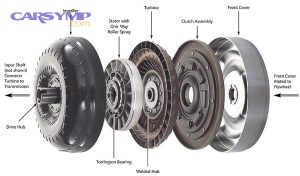
The torque converter is made up of five primary components: the impeller (pump), the turbine, the stator, the torque converter clutch (TCC), and the transmission fluid that circulates through all of them. The impeller is driven by the engine crankshaft and pushes fluid toward the turbine. The turbine, connected to the transmission input shaft, receives that fluid energy and begins to rotate — transferring motion to the transmission without any mechanical contact. The stator sits between them and redirects returning fluid to multiply torque, acting as the hydraulic amplifier in the system. The TCC then locks the impeller and turbine together at cruising speed, eliminating fluid slip and improving fuel economy.
Because this system relies entirely on pressurized fluid to function, any degradation in fluid quality, pressure, or flow immediately affects the converter’s performance. This is why regular transmission service — including fluid changes — is one of the most effective ways to prevent converter-related failures before they start.
How Does a Torque Converter Work in an Automatic Transmission?
A torque converter operates through three sequential phases: the stall phase, the acceleration phase, and the coupling (lock-up) phase — each governing a different driving condition.
During the stall phase, the vehicle is stopped with the engine running. The impeller spins, but the turbine remains stationary because the load on the drivetrain exceeds the fluid force. This is what allows you to sit at a red light in “Drive” without the car creeping forward excessively. During the acceleration phase, as engine RPM rises, fluid force increases enough to overcome drivetrain resistance, and the turbine begins to spin — driving the transmission and moving the vehicle. The torque multiplication effect during this phase can reach a ratio of 2:1 or higher in many vehicles, providing strong initial acceleration.
The coupling phase begins once the turbine reaches approximately 90% of the impeller’s speed. At this point, the torque converter clutch engages, mechanically locking the two halves together. This lock-up clutch eliminates the energy loss inherent in fluid coupling, directly improving fuel economy at highway speeds. Lock-up clutch problems are a common source of the shuddering and hunting behavior many drivers experience between 45 and 60 mph.
What Parts of the Torque Converter Are Most Prone to Failure?
There are five internal components in a torque converter, and three of them account for the vast majority of real-world failures.
The table below summarizes the five internal components, their relative failure risk, and the most common failure mode associated with each.
| Component | Failure Risk | Most Common Failure Mode |
|---|---|---|
| Torque Converter Clutch (TCC) | High | Worn friction material causing shudder or slip |
| Needle Bearings | High | Wear from contaminated or low fluid; produces metallic noise |
| TCC Solenoid | High | Electrical or mechanical fault disrupting lock-up command |
| Internal Seals / Gaskets | Moderate | Deterioration from heat; causes fluid leaks and pressure loss |
| Stator One-Way Clutch | Low | Seizure or freewheeling failure; reduces torque multiplication |
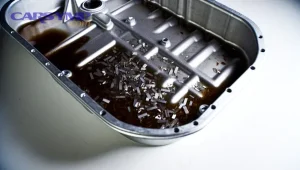
The TCC friction disc is the most commonly replaced item during a torque converter rebuild. Needle bearings fail when Metal debris and fluid condition clues — such as a burnt smell, dark fluid, or metallic particles on the drain plug — indicate that the fluid has been degraded beyond its service life. The TCC solenoid, though technically external to the converter body, directly governs its most critical function and is often the first part replaced when TCC-related fault codes appear.
What Are the 7 Warning Signs of Torque Converter Problems?
There are 7 primary warning signs of torque converter problems: shuddering, gear slipping, transmission overheating, strange noises, surging or lagging, fuel economy drop, and check engine light codes — each indicating a specific type of internal failure.

These torque converter failure symptoms do not always appear in isolation. More importantly, they share significant overlap with general transmission fault patterns, which is why understanding the specific character of each symptom is critical before committing to any repair. Next, each of the seven warning signs is examined in detail so you can confidently identify which one — or which combination — your vehicle is displaying.
Warning Sign #1 — Is Your Car Shuddering or Vibrating While Driving?
Yes, shuddering or vibrating while driving is one of the clearest signs of torque converter problems, and it is almost always linked to a worn or contaminated torque converter clutch (TCC) failing to engage and disengage cleanly.
The shudder typically occurs between 1,500 and 2,500 RPM, most noticeably during light throttle acceleration at highway on-ramps or during cruise control operation. It feels distinctly like driving over a rumble strip — a rapid, rhythmic vibration transmitted through the floorboard and seat. Shudder at cruise diagnosis involves checking whether the sensation disappears when you accelerate harder or decelerate; if it does, the TCC is the primary suspect, because the clutch only engages within a specific RPM and load window. The symptom tends to worsen progressively and is exacerbated by degraded transmission fluid that has lost its friction-modifier additives.
Warning Sign #2 — Are Your Gears Slipping for No Apparent Reason?
Yes, unexplained gear slipping is a confirmed sign of torque converter problems, specifically caused by insufficient hydraulic pressure preventing the transmission from maintaining a firm gear engagement.
Torque converter vs transmission slip diagnosis is one of the more technically demanding aspects of identifying this symptom. In a healthy torque converter, hydraulic pressure is consistent and well-regulated. When the converter’s internal seals fail or the fluid becomes contaminated, pressure drops — and the transmission’s clutch packs cannot hold gear engagement under load. The practical result is that engine RPM rises sharply while vehicle speed lags behind, particularly during acceleration. This differs from a transmission-internal slip, which tends to occur during specific gear-change events rather than during steady-state acceleration. If your slip occurs mid-gear rather than during a shift, the converter is more likely the source.
Warning Sign #3 — Is Your Transmission Overheating?
Yes, transmission overheating is directly caused by torque converter problems when degraded or insufficient fluid loses its ability to manage heat, leading to thermal breakdown of internal components.
A malfunctioning torque converter forces the fluid to work harder to maintain pressure and coupling efficiency. This generates excess heat that the cooling system cannot always dissipate fast enough. Many modern vehicles will display a transmission temperature warning on the dashboard; others will enter limp mode — locking the transmission into a single gear to prevent further damage. If your transmission repeatedly overheats without an obvious cooling system fault, the torque converter should be evaluated as the root cause. Prolonged overheating accelerates seal deterioration, degrades the TCC friction material, and can cause the converter housing itself to warp — at which point replacement becomes unavoidable.
Warning Sign #4 — Do You Hear Strange Noises Like Clicking or Whining?
Yes, clicking, whining, or rattling noises from the drivetrain area are warning signs of torque converter problems, and they indicate specific types of internal mechanical damage depending on the character of the sound.
- Clicking or rattling: Almost always points to damaged or worn needle bearings inside the converter. These bearings support the rotating components under high load, and when they fail — typically due to metal debris and fluid contamination — they allow microscopic movement between precision-clearance parts. The result is an audible metallic rattle that changes pitch with engine speed.
- Whining or humming: Suggests fluid starvation, a failing hydraulic pump, or internal cavitation — a condition where air bubbles form in the fluid circuit and collapse violently against internal surfaces.
- Grinding: A more severe sound indicating that bearing failure has progressed to metal-on-metal contact inside the converter housing.
It is important to distinguish these sounds from wheel bearing noise (which changes with lateral load in corners) or differential noise (which varies with vehicle speed rather than engine speed). Converter-origin noises typically correlate with engine RPM, not road speed.
Warning Sign #5 — Is Your Vehicle Surging or Lagging Unexpectedly?
Yes, unexpected surging or lagging in vehicle speed is a warning sign of torque converter problems, caused by erratic hydraulic pressure resulting from internal seal failure or solenoid malfunction.
Surging describes a situation where the vehicle accelerates in unintended spurts — the engine and transmission appear to be “hunting” for the right power level. Lagging is the opposite: a sudden loss of speed or power while driving, as if the engine’s output is being momentarily disconnected from the drivetrain. Both behaviors stem from the same underlying cause — inconsistent fluid pressure inside the converter circuit. A failing internal seal allows pressure to fluctuate unpredictably. A malfunctioning TCC solenoid may command lock-up engagement at inappropriate times, causing the driveline to jerk. These symptoms are particularly dangerous at highway speeds and should be treated as an urgent repair priority.
Warning Sign #6 — Has Your Fuel Economy Dropped Noticeably?
Yes, a noticeable drop in fuel economy is a warning sign of torque converter problems, specifically when the torque converter clutch fails to engage properly at cruising speeds, forcing the engine to spin faster than necessary to maintain vehicle speed.
The TCC lock-up function is designed to eliminate the 10–15% energy loss that occurs during fluid coupling at highway speeds. When the TCC friction disc wears out or the solenoid fails to command engagement, the torque converter operates in an open (slipping) state even at 60–70 mph. The engine must run at higher RPM to compensate, burning more fuel in the process. Drivers typically notice this as a 2–4 MPG reduction on highway driving. Before attributing this fuel economy drop to spark plugs, oxygen sensors, or air filters, confirm that the transmission is properly engaging lock-up by monitoring TCC status through an OBD-II scanner during a highway drive.
Warning Sign #7 — Is Your Check Engine Light On with Transmission-Related Codes?
Yes, a check engine light accompanied by specific OBD-II trouble codes is a confirmed warning sign of torque converter problems, as the vehicle’s transmission control module (TCM) monitors TCC performance and logs faults when behavior falls outside calibrated parameters.
Torque converter problem codes and scan data are among the most direct diagnostic tools available to drivers and technicians. The following table summarizes the most common codes associated with converter faults:
| OBD-II Code | Description | Most Likely Cause |
|---|---|---|
| P0740 | TCC Circuit Malfunction | Solenoid failure or wiring fault |
| P0741 | TCC Performance / Stuck Off | Worn TCC friction disc; fluid contamination |
| P0742 | TCC Stuck On | Solenoid mechanically stuck closed |
| P0743 | TCC Electrical Circuit Fault | Open/short in solenoid wiring harness |
| P0744 | TCC Intermittent | Intermittent solenoid or fluid pressure issue |
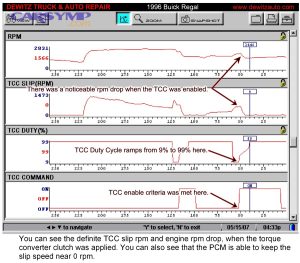
A basic OBD-II scanner available for under $30 at any auto parts store can retrieve these codes in minutes. More advanced scan tools can display live TCC engagement data, transmission fluid temperature, and solenoid duty cycle — providing a much clearer picture of what the converter is actually doing during a test drive. If you see any P074x code, prioritize a torque converter inspection before the issue cascades into broader transmission damage.
What Causes Torque Converter Problems in the First Place?
There are 4 primary causes of torque converter problems: fluid degradation and contamination, overheating from excessive thermal load, mechanical wear of internal components, and operational stress from driver behavior — all of which interact and compound over time.

Specifically, most real-world torque converter failures are not caused by a single dramatic event but by the gradual accumulation of stress factors that erode the converter’s internal components. Understanding these causes is essential not just for repair, but for Preventing converter problems from recurring after service.
How Does Low or Contaminated Transmission Fluid Damage a Torque Converter?
Low or contaminated transmission fluid damages a torque converter by degrading hydraulic pressure, stripping away the lubricating film from internal components, and introducing abrasive particles that accelerate mechanical wear.
Transmission fluid performs two simultaneous jobs inside the torque converter: it acts as the hydraulic medium that transfers rotational energy between the impeller and turbine, and it acts as a lubricant and coolant for all moving parts. When fluid becomes contaminated — through normal oxidation, seal degradation, or metal debris from worn components — it loses both properties. Oxidized fluid turns dark brown or black, develops a burnt odor, and its friction modifier additives break down, causing the TCC friction disc to shudder rather than engage smoothly. Low fluid level reduces hydraulic pressure directly, causing slip and overheating.
Most manufacturers recommend automatic transmission fluid changes every 30,000 to 60,000 miles, though vehicles subjected to towing, stop-and-go traffic, or extreme temperatures benefit from more frequent service. A transmission fluid flush that includes a converter drain is the most effective preventive maintenance step available for converter longevity.
Can Driving Habits and Overloading Cause a Torque Converter to Fail?
Yes, aggressive driving habits and chronic overloading are significant causes of torque converter failure, because they impose thermal and mechanical stress far beyond the design tolerances of the converter’s internal components.
Towing a trailer beyond the vehicle’s rated capacity forces the torque converter to remain in a high-slip, high-heat state for extended periods. In this condition, the fluid temperature can spike above 300°F — a threshold at which most ATF formulations begin to break down rapidly. Stop-and-go urban driving subjects the TCC to constant engagement and disengagement cycles, accelerating friction disc wear. Aggressive launches from a standstill (“power braking”) hold the converter at maximum stall speed, generating intense localized heat at the impeller and turbine interface.
The practical guidance is straightforward: respect your vehicle’s towing rating, allow the transmission to warm up before heavy loading in cold weather, and avoid prolonged wide-open throttle launches. These habits directly extend the service life of the torque converter and reduce the likelihood of needing a Torque converter repair cost estimate prematurely.
How Do You Diagnose Torque Converter Problems vs. Transmission Problems?
Diagnosing torque converter problems versus transmission problems requires comparing symptom patterns, performing a stall speed test, and reviewing live OBD-II scan data — because both components share fluid and exhibit overlapping failure behaviors that cannot be separated by symptoms alone.

However, there are reliable methods to isolate the converter as the source, and understanding those methods prevents unnecessary transmission rebuilds. Let’s explore the two most effective diagnostic approaches available to drivers and technicians.
What Is a Stall Speed Test and How Does It Help Diagnose a Bad Torque Converter?
A stall speed test is a diagnostic procedure that measures the maximum RPM an engine reaches when the transmission is in gear and the drivetrain is fully braked — revealing whether the torque converter’s impeller-to-turbine energy transfer is within the manufacturer’s specification.
To perform a stall speed test safely:
- Bring the transmission to normal operating temperature.
- Apply the parking brake firmly and press the service brake with your left foot.
- Shift into Drive and apply full throttle briefly — no longer than 3–5 seconds.
- Note the RPM at which the engine stabilizes (the stall speed).
- Compare this RPM to the manufacturer’s specified stall speed for your vehicle.
- Higher than spec stall speed: The converter is slipping internally — worn TCC or damaged impeller blades.
- Lower than spec stall speed: The stator one-way clutch may be seizing, reducing fluid redirection efficiency.
- Within spec: The converter’s basic mechanical function is intact; investigate the solenoid or fluid condition instead.
This test must not be held for more than 5 seconds to prevent fluid overheating. Always allow a 60-second cool-down between attempts.
Torque Converter vs. Transmission: How Are the Symptoms Different?
The torque converter wins in diagnosing shudder and slip at cruise, the transmission is more clearly implicated in hard or delayed gear shifts, and both must be evaluated when overheating or check engine codes are present.
The following table outlines the key symptom differences to guide your diagnosis:
| Symptom | More Likely: Torque Converter | More Likely: Transmission |
|---|---|---|
| Shudder at 45–60 mph under light throttle | ✓ TCC friction failure | |
| Hard shift between specific gears | ✓ Valve body or clutch pack | |
| Slip during steady-state acceleration | ✓ Converter pressure loss | |
| Delayed engagement from Park to Drive | ✓ Pump or accumulator issue | |
| Overheating with no shift complaints | ✓ Converter fluid degradation | |
| Overheating with shift complaints | ✓ Both — requires full diagnosis | |
| P0741 code (TCC stuck off) | ✓ TCC disc wear or solenoid | |
| P0730 code (incorrect gear ratio) | ✓ Internal transmission fault |
Can you drive with torque converter issues? Technically yes, in the short term — but continuing to drive with an active converter fault accelerates wear on the transmission’s valve body and clutch packs, turning a $600–$900 converter replacement into a $2,500–$4,000 transmission rebuild. Early action on any of these symptoms is always the financially sound choice.
How Do You Fix Torque Converter Problems — Repair or Replace?
Fixing torque converter problems involves choosing between three options — fluid service, solenoid replacement, or full converter replacement — depending on which internal component has failed and how far the damage has progressed.

Repair vs rebuild vs replacement options are not interchangeable; each addresses a different failure severity level, and selecting the wrong path wastes money or leaves the underlying problem unresolved. More specifically, the decision tree works as follows.
Can You Fix a Bad Torque Converter Without Replacing It?
Yes, some torque converter problems can be resolved without full replacement, but only when the failure is limited to the fluid condition or the external solenoid — internal mechanical failures universally require replacement.
- Stage 1 — Transmission Fluid Flush: If symptoms are recent and mild (early-stage shudder, slight fuel economy drop), a full transmission service including a converter drain flush and fresh fluid with correct friction modifier spec may resolve the issue. This costs $150–$250 and should always be attempted first.
- Stage 2 — TCC Solenoid Replacement: If OBD-II codes P0740–P0744 are present and the fluid is in acceptable condition, replacing the TCC solenoid (an external component accessible without removing the transmission) can resolve the fault for $150–$400 including labor.
- Stage 3 — Full Converter Replacement: Failed needle bearings, cracked converter welds, destroyed TCC friction discs, and damaged impeller blades cannot be repaired in the field. The torque converter must be removed (which requires dropping the transmission) and replaced as a complete unit.
Most independent mechanics and dealerships do not rebuild individual torque converters — the precision required for balancing and welding the converter shell makes professional rebuilding economically impractical compared to replacement with a remanufactured unit.
How Much Does Torque Converter Replacement Cost?
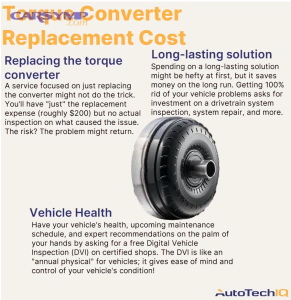
A full torque converter replacement costs between $600 and $1,200 for most passenger vehicles, broken down as $150–$500 for the converter unit itself and $400–$900 for labor — with the total varying significantly based on vehicle make, transmission type, and shop rates.
For a more detailed torque converter repair cost estimate, the following breakdown applies:
| Repair Type | Parts Cost | Labor Cost | Total Estimated Cost |
|---|---|---|---|
| Transmission Fluid Flush | $30–$80 | $100–$150 | $150–$250 |
| TCC Solenoid Replacement | $20–$100 | $100–$300 | $150–$400 |
| Torque Converter Replacement (economy vehicle) | $150–$300 | $400–$600 | $600–$900 |
| Torque Converter Replacement (truck/SUV) | $300–$500 | $600–$900 | $900–$1,400 |
| Full Transmission Rebuild (if neglected) | $1,200–$2,000 | $1,000–$2,000 | $2,500–$4,000+ |
This cost table illustrates why early diagnosis and action on torque converter failure symptoms is so financially important. The jump from a solenoid replacement at $300 to a full converter replacement at $1,000 — and then to a transmission rebuild at $3,500+ — represents the real cost of delayed service. Addressing the problem at the fluid or solenoid stage, when possible, represents by far the most cost-effective outcome.
What Else Should Drivers Know About Torque Converter Health and Long-Term Prevention?
Drivers should understand that long-term torque converter health depends on three factors beyond basic maintenance: the behavior of the TCC solenoid under electronic control, the stall speed compatibility of the converter with the engine’s power profile, and the known failure patterns of their specific vehicle make and model.

In addition, as automatic transmission technology evolves — particularly with the rise of dual-clutch transmissions — understanding how the torque converter compares to alternative coupling systems helps drivers make better-informed decisions about vehicle selection and service. The supplementary sections below expand on these micro-semantic areas to give you a more complete picture of converter health management.
How Does the Torque Converter Clutch Solenoid Affect Converter Performance?
The TCC solenoid is an electronically controlled valve that receives a pulse-width modulated (PWM) signal from the transmission control module (TCM) to regulate hydraulic pressure to the torque converter clutch — and when it malfunctions, it directly mimics the symptoms of a mechanically failed converter.
The solenoid opens and closes a fluid passage that fills the TCC apply circuit. When the TCM commands lock-up, it increases the solenoid’s duty cycle, building pressure behind the TCC piston until the clutch disc contacts the converter cover. A solenoid that is stuck open keeps the TCC disengaged, causing constant fluid slip, reduced fuel economy, and P0741 codes. A solenoid stuck closed forces the TCC to engage at all times — even at low speed — causing severe shudder, stalling, and P0742 codes. Because the solenoid costs a fraction of a full converter replacement and can often be accessed without removing the transmission, it should always be tested and ruled out before authorizing converter replacement work.
Does Stall Speed Mismatch Cause Problems in Performance or Modified Vehicles?
Yes, stall speed mismatch causes significant drivetrain problems in performance and modified vehicles, particularly when aftermarket camshaft upgrades shift the engine’s peak torque RPM above the converter’s designed stall speed range.
A stock torque converter is calibrated to match the factory engine’s torque curve — typically stalling between 1,800 and 2,400 RPM in a passenger vehicle. When a performance camshaft raises the engine’s power band to 3,500–5,000 RPM, the factory converter stalls far below the engine’s productive range. The result is sluggish acceleration, excessive heat generation (because the converter spends more time in high-slip operation), and premature fluid degradation. Enthusiast drivers running modified engines — particularly in truck pulling, towing builds, or performance street applications — should select a converter with a stall speed matched to their camshaft’s RPM range, typically a high-stall converter in the 2,800–3,500 RPM range, built with upgraded clutch material and reinforced internal components.
Are Certain Car Makes and Models More Prone to Torque Converter Problems?
Yes, certain vehicle platforms have well-documented torque converter failure patterns tied to factory fluid specifications, design generation choices, and manufacturing tolerance issues — and knowing your vehicle’s history can inform a proactive service strategy.
Several notable examples include:
- GM 6L80 / 6L90 (2006–present): Widespread TCC shudder complaints, typically resolved by a fluid change using Dexron HP fluid with friction modifier. GM issued multiple technical service bulletins (TSBs) addressing this issue.
- Ford 6F35 (2009–present): Known for TCC slip and shudder in Escape, Fusion, and Edge models; often tied to fluid degradation and solenoid wear.
- Chrysler 45RFE / 68RFE (2000–present): Common in Ram trucks; prone to TCC solenoid failure and converter clutch burnout under heavy towing loads.
- Honda / Acura (early 2000s): Several models required revised ATF-Z1 fluid to address converter shudder caused by original fluid formulation incompatibility with TCC friction material.
If your vehicle appears on any of these known problem lists, checking for active TSBs through your dealership or the NHTSA database before your next transmission service can help you get ahead of the issue — sometimes at no cost if a TSB covers the repair under an extended warranty.
How Is a Torque Converter Different from a Dual-Clutch Transmission (DCT) Coupler?
The torque converter wins in smoothness and low-speed driveability; the dual-clutch transmission (DCT) is best for shift speed and fuel efficiency at steady speeds; the traditional automatic with a torque converter is optimal for towing and off-road applications.
The torque converter uses hydraulic fluid as its power transfer medium, providing inherently smooth engagement, built-in torque multiplication at low RPM, and tolerance for high-slip conditions — making it ideal for towing, stop-and-go driving, and vehicles that need broad usable torque at low speeds. Its main weakness is the energy loss inherent in fluid coupling, which the TCC lock-up system partially mitigates at highway speeds.
The DCT, by contrast, uses two sets of mechanical clutch packs — one for odd gears, one for even — to pre-select the next gear before the current one disengages. This allows shifts in under 100 milliseconds and maintains near-direct mechanical efficiency with no fluid coupling loss. However, DCTs are notoriously sensitive to low-speed, high-slip driving conditions such as heavy traffic and hill starts, where their dry-clutch variants are prone to overheating and jerky engagement. Wet-clutch DCTs address this partially but add complexity and maintenance cost.
For most daily drivers and truck owners, the hydraulic torque converter remains the more durable, versatile, and low-maintenance option — particularly in applications where load variability is high. For performance sedans and sports cars prioritizing shift speed and efficiency, the DCT offers a meaningful engineering advantage. Understanding this distinction helps drivers evaluate whether their next vehicle purchase should include a traditional automatic, a DCT, or a continuously variable transmission (CVT) — each of which carries its own service and failure profile.
Torque converter problems rarely announce themselves dramatically. More often, they begin as a subtle shudder at highway speeds, a slight dip in fuel economy, or an occasional gear slip that is easy to dismiss — until the symptoms compound and the repair bill multiplies. The seven warning signs covered in this guide, from TCC shudder and gear slip to OBD-II fault codes and unexplained overheating, give every driver a concrete framework for early detection. Paired with a clear understanding of causes, a systematic approach to diagnosis, and a realistic picture of repair and replacement costs, this knowledge is the most effective tool you have for protecting your vehicle’s drivetrain and avoiding an avoidable transmission failure.