


Wheel bearing problems can cause ABS sensor issues because the ABS system depends on a clean, stable wheel-speed signal, and a worn or incorrectly installed bearing can change that signal through excess play, encoder-ring misalignment, or damaged sensor clearance. In practice, that means an ABS light, traction-control warning, pulsation at low speed, and a humming or growling wheel noise can all belong to the same fault pattern rather than two unrelated problems.
The first thing most drivers want to know is how to recognize the pattern early. A failing bearing often adds mechanical clues that a standalone sensor fault usually does not: road-speed-related humming, roughness when the wheel is spun, looseness at the hub, or a noise that changes while cornering. Those clues matter because they help you separate a real wheel-end problem from a simple wiring or sensor failure before you order parts.
The second question is how to diagnose the issue correctly. That usually means comparing symptoms, checking for wheel play, inspecting the sensor and wiring, and reading live wheel-speed data with a scan tool. Modern diagnostic guidance emphasizes looking at what the ABS module sees in real time, because a dropping or unstable wheel-speed signal can reveal bearing movement, sensor air-gap issues, or encoder-ring damage that a basic visual check can miss.
The third question is what to do next, especially if the warning appeared after service. Incorrect orientation of a magnetic bearing, a sensor that is not fully seated, a pinched wire, or improper axle-nut torque can all trigger ABS faults after repair. Introduce a new idea: the rest of this guide explains the symptoms, diagnosis, repair choices, and the Safe-to-drive guidance with failing bearing that car owners need before deciding on a wheel bearing replacement.
Can a Bad Wheel Bearing Cause ABS Sensor Issues?
Yes, a bad wheel bearing can cause ABS sensor issues because it can create excess hub movement, disturb the sensor-to-encoder relationship, and produce unstable wheel-speed data that the ABS module interprets as a fault.
To better understand that connection, it helps to see the ABS sensor and wheel bearing as neighboring parts in one wheel-end system rather than separate problems that only happen to appear at the same time.
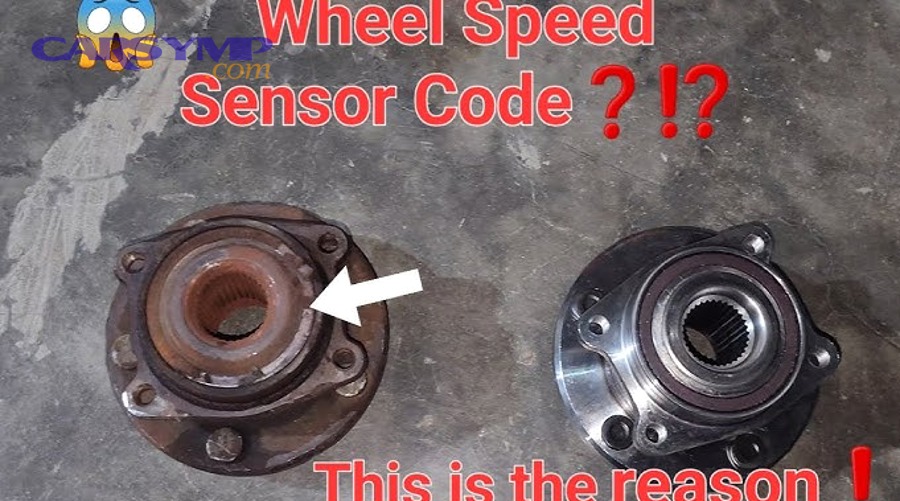
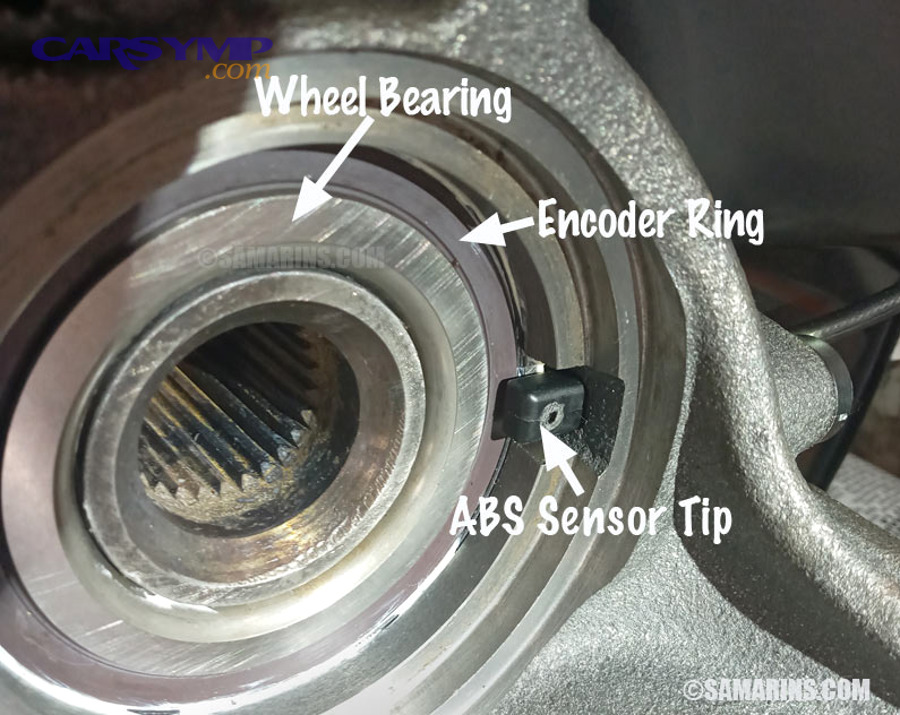
A wheel bearing supports the wheel hub and keeps it rotating on a controlled path. The ABS sensor, whether separate or integrated into the hub assembly, reads wheel speed from a tone ring or magnetic encoder. When the bearing wears, the hub can wobble more than it should. That wobble changes the distance and alignment between the sensor and the signal source. Even a small change in air gap can be enough to cause an intermittent or incorrect reading, especially at low speeds when the signal is already weaker and the ABS module is watching closely for irregularities.
That is why a bad wheel bearing does not just make noise. It can also create electronic symptoms. Some vehicles will turn on the ABS light. Others will add traction-control or stability-control warnings because those systems also rely on wheel-speed information. In a few cases, the car may still brake normally during gentle stops but behave oddly during hard braking or while creeping to a stop sign, which leads drivers to suspect the sensor first. AAA’s dashboard warning guidance specifically notes that an ABS light can point to a bad sensor, damaged wiring, or a bad wheel bearing, which shows how closely these systems are linked in real-world diagnosis.
Why does bearing play affect the ABS sensor signal?
Bearing play affects the ABS sensor signal because hub movement changes the sensor’s working clearance and can distort the magnetic or tone-ring reading.
More specifically, the signal becomes less reliable when the bearing no longer holds the wheel hub in a consistent path.
In a healthy assembly, the wheel turns smoothly and the sensor receives a predictable pattern. In a worn assembly, the hub can tilt or shift under load. That matters most in turns, during braking, and at low speed. A technician watching live wheel-speed data may see one wheel momentarily drop out, lag behind the others, or produce a jagged trace. Tire Review’s recent guidance explains that scan tools can reveal sudden drops in wheel speed during a turn when bearing play shifts the air gap enough to interrupt the reading.
Drivers often notice this as a symptom chain: first a humming noise, then a warning light, then an occasional low-speed ABS pulse or traction-control intervention. That chain is useful because it links the mechanical fault to the electronic symptom. Hook-chain thinking matters here: when the title asks how wheel bearing problems cause ABS sensor issues, the real answer is not abstract theory but physical movement at the hub changing the data the ABS controller depends on.
Is the problem always the sensor, or can the bearing be the real cause?
The problem is not always the sensor; the bearing can be the real cause when mechanical wear or incorrect assembly corrupts the sensor signal.
However, the easiest mistake in ABS diagnosis is to replace the coded part instead of the failed cause.
A wheel-speed sensor code only tells you where the ABS module noticed bad information. It does not guarantee the sensor itself has failed. The sensor might be fine while the encoder ring is damaged, the bearing is loose, the hub was installed incorrectly, or the wiring was stretched during service. That is why parts-swapping can get expensive. A lot of car owners who search symptom databases such as carsymp.com are really trying to avoid that mistake: they want the cause, not just the code.
This matters even more after recent repairs. Dayco highlights that improper wheel bearing installation can trigger an ABS warning right after service, and GSP North America points out several common post-repair causes, including a sensor not fully seated, a wrong hub, contamination, and loose bearing preload from incorrect torque. In other words, the sensor may report the problem while the bearing or installation created it.
What Are the Signs That a Wheel Bearing Is Triggering ABS Problems?
The main signs are an ABS light combined with wheel noise, vibration, looseness, or false ABS engagement, especially when symptoms change with speed or turning.
Next, the key is to look for symptom clusters rather than judging the warning light alone.

A standalone ABS sensor fault can light the dashboard warning and store a code, but it usually does not create the classic mechanical soundtrack of a failing bearing. A wheel bearing-related ABS fault often includes a humming, growling, or grinding noise that rises with road speed. The sound may get louder when the vehicle loads one side in a turn. Some drivers also feel a vibration in the steering wheel or floor. If the wear becomes severe, they may notice looseness when the wheel is rocked by hand on a lift.
Those combined symptoms matter because the ABS module is only one observer in the chain. The wheel bearing is a physical part, so it usually leaves physical clues. When you see both electronic and mechanical evidence together, the diagnosis becomes stronger.
What warning signs appear together when the bearing is affecting ABS?
The most telling combination is ABS or traction-control warnings plus bearing noise, roughness, or wheel play.
Specifically, the closer those symptoms appear together, the more likely the wheel-end assembly is the true fault zone.
Common combined signs include:
- ABS warning light
- Traction-control or stability-control light
- Humming, growling, or grinding from one corner
- Pedal pulsation at low speed
- Steering vibration or vehicle wobble
- Wheel looseness or roughness when spun by hand
A useful rule for car owners is this: if the dashboard warns you and the wheel corner also sounds or feels wrong, treat the bearing as part of the diagnosis immediately. NHTSA recall documentation has described loose hub conditions that can cause wobbling, grinding, and an ABS malfunction light together, which reinforces the safety importance of reading the symptoms as one chain instead of separate annoyances.
Can a wheel bearing cause ABS activation at low speed?
Yes, a wheel bearing can cause false ABS activation at low speed because inconsistent wheel-speed data can make the module think a wheel is locking when it is not.
Meanwhile, this symptom often confuses drivers because it feels like a braking problem rather than a wheel-bearing problem.
Low-speed false activation usually shows up as pedal pulsation, clicking, grinding, or brief pump noise when you are almost stopped on dry pavement. GM service information referenced by NHTSA notes that metallic debris on a magnetic encoder ring can create low-speed ABS or traction-control events without clear current trouble codes, and Brake & Front End has also documented false ABS activation after hub-bearing replacement. That means both contamination and bearing-related signal issues belong on the suspect list.
For drivers, this symptom is important because it often appears before the system fails completely. If your car pulses the pedal while coasting to a normal stop, and one wheel corner also hums or has recently been serviced, the issue deserves prompt inspection.
How Do You Diagnose Wheel Bearing Problems vs. a Bad ABS Sensor?
The best diagnosis combines four checks—symptoms, mechanical inspection, scan-tool data, and installation review—to separate wheel bearing faults from true sensor failures.
Then, once you compare both mechanical and electrical clues, you can stop guessing and decide which part actually needs attention.
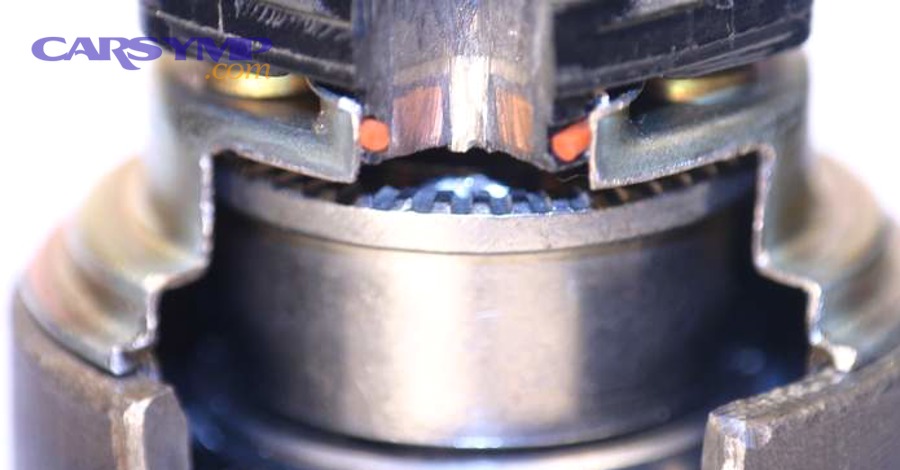
The process should move from simple to specific. Start with a road test. Listen for a speed-related hum and note whether it changes while turning. After that, inspect the affected corner for torn wiring, sensor misrouting, rust buildup, or signs of recent work. Then check for wheel play and roughness. Finally, use a scan tool to compare live wheel-speed data from all four corners. If one signal drops, spikes, or lags compared with the others, you have strong evidence that the problem is local to that wheel-end assembly.
That method is better than replacing the wheel-speed sensor first because it respects how ABS systems actually fail. The code points you toward the affected circuit or wheel, but the mechanical inspection tells you why it happened.
What checks confirm the bearing is the cause?
The strongest bearing indicators are wheel play, roughness, speed-related humming, and live-data dropouts that change with load or turning.
For example, if the noise rises with speed and the scan trace for one wheel breaks up in a corner, the bearing becomes a leading suspect.
A practical checklist looks like this:
- Road-test for hum or growl that changes with steering load.
- Lift the vehicle and check wheel play at the suspected corner.
- Spin the wheel and feel for roughness.
- Inspect the sensor mount, wiring, and encoder area for damage or debris.
- Compare live wheel-speed data during straight driving and gentle turns.
- Review recent repair history, especially hub or axle work.
This is also where repair economics matter. A Wheel bearing replacement cost estimate varies widely by vehicle design, labor time, and whether the ABS sensor is integrated into the hub. Spending a little time confirming the root cause often saves the cost of an unnecessary sensor or module. Professional articles in both Tire Review and Tomorrow’s Technician emphasize graphing sensor data during motion precisely because real-time comparison exposes the faults that a static resistance check may miss.
How is a bad ABS sensor different from a bad wheel bearing?
A bad ABS sensor is mainly an electrical or signal-source fault, while a bad wheel bearing is mainly a mechanical support fault that can secondarily corrupt the sensor reading.
However, both can set similar warnings, so the difference comes from the symptom pattern and inspection results.
A sensor-only fault may show a code, warning light, or intermittent speed loss without the familiar bearing hum. The wiring may be cut, corroded, or pinched, and the wheel may still feel tight and smooth. A bearing-related fault usually adds mechanical evidence: noise, looseness, roughness, or symptoms that change with turning. GSP’s post-repair guide also points out that a sensor can be fine but improperly seated, which creates a signal problem that looks electrical until you inspect the mount and fit.
That difference is why scan data alone is not enough. You need the code, the feel, the sound, and the assembly history together.
What Causes ABS Sensor Issues When the Wheel Bearing Fails or Is Replaced Incorrectly?
The main causes are bearing wear, encoder-ring damage, wrong bearing orientation, improper sensor seating, damaged wiring, and incorrect installation torque.
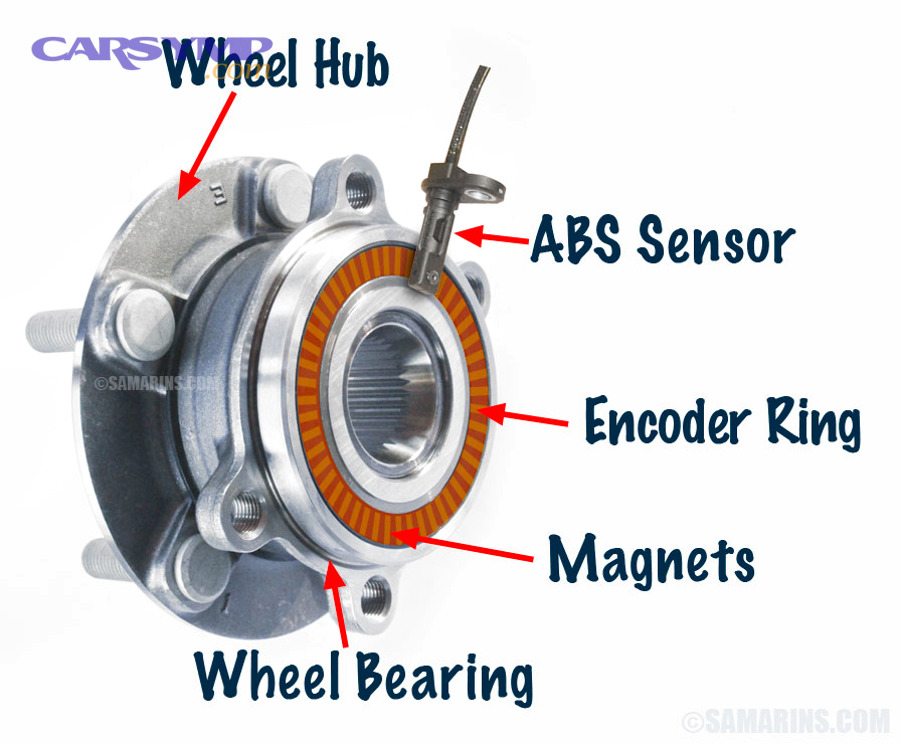
In addition, many post-repair ABS faults happen because the bearing and sensor relationship is extremely sensitive to fit and direction.
Some modern press-in bearings use a magnetic encoder built into one side of the seal. If that bearing is pressed in backward, the sensor cannot read the magnetic pattern correctly. Dayco highlights this exact assembly error as a common reason an ABS warning appears after wheel-bearing service. Other vehicles use bolt-on hub units with an integrated sensor or encoder, where wrong-part installation or axle-nut torque errors can leave the hub wobbling or the signal missing.
This is also where DIY bearing replacement risks and tools become relevant. Wheel bearing replacement is not impossible for a skilled home mechanic, but some jobs require a press, pullers, torque-angle procedures, scan-tool verification, and strict attention to sensor routing and magnetic-side orientation. A job that looks purely mechanical can quietly create an ABS problem if the installer damages a wire, contaminates the encoder area, or torques the axle nut incorrectly.
How do encoder ring and magnetic seal problems create ABS faults?
Encoder-ring and magnetic-seal problems create ABS faults by preventing the sensor from reading a stable wheel-speed pattern.
Specifically, the signal fails when the ring is damaged, contaminated, misoriented, or placed too far from the sensor.
On many vehicles, the ABS sensor does not read a toothed ring you can easily see. It reads a magnetic pattern built into the seal or hub. That design works well, but it makes installation errors easier to miss. If the magnetic side faces away from the sensor, the signal disappears. If ferrous debris sticks to the encoder area, the signal can become uneven. GM service information notes that metallic debris on the encoder ring can cause intermittent low-speed ABS or traction events, and GSP notes that contamination on the sensor tip or encoder can block a proper reading after replacement.
This is why a careful visual inspection matters, even when the fault code seems straightforward. The issue may be on the reading surface, not in the sensor body itself.
What installation mistakes can cause ABS problems after wheel bearing replacement?
The most common mistakes are reversed bearing orientation, improper torque, a sensor not fully seated, wrong hub selection, and damaged or pinched wiring.
More importantly, these errors can produce an ABS light immediately after repair even when the new bearing itself is not defective.
That pattern is frustrating because drivers expect the warning to disappear after service. Instead, it stays on or returns as soon as the vehicle moves. GSP’s list of seven common causes includes sensor seating, wire damage, wrong hub fitment, contamination, and loose bearing preload from incorrect torque, while NHTSA recall information has documented wheel-speed sensor harness issues in some bearing assemblies and loose-hub conditions that can trigger warning lights.
So, after any wheel bearing replacement, the verification step matters. Clear the code, confirm the sensor connector is locked, inspect routing, verify torque to spec, and road-test the vehicle. Skipping that last step is one reason comebacks happen.
What Should Car Owners Do If a Wheel Bearing Is Causing ABS Sensor Issues?
Car owners should inspect the vehicle promptly, limit driving if there is noise or looseness, and repair the bearing or hub correctly before relying on the ABS system again.
Besides restoring warning-free operation, the goal is to protect braking stability and prevent a worn hub from becoming a bigger safety problem.
The right response depends on severity. If the ABS light is on but the car is quiet and stable, normal braking may still work, but emergency braking performance and steering control on slippery surfaces may be reduced. If the wheel corner also hums, grinds, wobbles, or feels hot, treat the issue as more urgent. AAA advises getting professional service as soon as possible when the ABS light is on, and NHTSA recall language shows why: loose or damaged hub conditions can escalate into wobble, overheating, or, in extreme cases, wheel-end separation risk.
That is the practical safe-to-drive guidance with failing bearing: an ABS light alone may not mean instant brake loss, but a noisy or loose wheel bearing is not something to ignore. Drive only as much as needed to get the vehicle inspected, avoid highway speed if the bearing is clearly failing, and do not postpone repair just because the car still rolls and stops.
Should you replace the sensor, the bearing, or the complete hub assembly?
You should replace the failed component configuration that matches the diagnosis: sensor only when it is proven faulty, bearing only when serviceable separately, or the complete hub when the assembly is integrated.
Thus, the repair path depends on vehicle design as much as on the fault itself.
Many modern vehicles use a complete hub assembly, so wheel bearing replacement means replacing the entire unit, sometimes with the sensor or encoder built in. Other vehicles use a separate press-in bearing with a reusable hub and independent sensor. In those cases, the bearing can be replaced without changing the sensor, but the job demands more precision. This is where DIY bearing replacement risks and tools become decisive: a press-in design can punish rushed work, especially if the magnetic side is installed backward or the sensor is disturbed during reassembly.
For budget planning, the wheel bearing replacement cost estimate usually rises when labor is high, rust is severe, or a hub assembly includes wiring and sensor components. That cost is still easier to justify when the diagnosis is solid and the repair fixes both the warning light and the mechanical symptom in one visit.
How do you confirm the ABS issue is fixed after repair?
You confirm the repair by clearing codes, checking for warning-light return, verifying correct sensor routing and torque, and comparing live wheel-speed data on a road test.
In short, a repair is not complete until the system proves itself under motion.
The post-repair checklist should include:
- Clear stored ABS codes.
- Confirm the wheel spins smoothly with no play.
- Verify sensor connector lock and wire routing.
- Check axle nut or hub fastener torque to specification.
- Road-test at low and moderate speeds.
- Watch live wheel-speed data for consistency.
If one wheel still drops out, the problem is not solved, even if the noise improved. Conversely, if the noise is gone, the light stays off, and all wheel-speed traces match, you have good evidence the repair corrected the root cause. That final validation step is what separates a successful fix from a parts-changing exercise.
What Related ABS and Wheel-End Problems Can Be Mistaken for a Bad Wheel Bearing?
Several problems can mimic a bad wheel bearing-related ABS fault, including a damaged tone ring, contaminated encoder, wiring damage, wrong parts, and sensor mounting issues.

To sum up, broad semantic coverage matters here because many look-alike faults trigger the same warning light but require different repairs.
The reason this section matters is simple: the wheel bearing sits in a busy neighborhood. The sensor, encoder, axle, brake hardware, and harness all live close together. A fault in any one of them can look similar at first. That is why experienced diagnosis uses comparison rather than assumptions.
How is a tone ring or encoder ring problem different from bearing failure?
A tone ring or encoder ring problem affects the signal source directly, while bearing failure affects the signal indirectly through movement, damage, or altered clearance.
However, both can cause the same ABS code and the same low-speed braking oddities.
A cracked, dirty, or magnetically damaged encoder can create an erratic signal even if the bearing itself still feels reasonably tight. A worn bearing, on the other hand, may physically shift the encoder away from the sensor or wobble enough to interrupt the read. The distinction matters because one fault may need cleaning or part correction, while the other demands hub or bearing replacement. GM’s bulletin about ferrous debris on the encoder ring is a good example of a non-bearing issue that can imitate a bearing-related ABS complaint.
Can incorrect wheel bearing installation cause ABS faults even with a new part?
Yes, incorrect wheel bearing installation can cause ABS faults even with a brand-new part because orientation, fit, and torque are as important as the part itself.
For example, a new bearing installed backward or a new hub fitted with the wrong encoder configuration can fail immediately.
This is one of the most common comeback scenarios after service. The new part may be fine, but the assembly relationship is wrong. Dayco’s guidance on reversed bearing orientation and GSP’s list of common post-repair causes make that clear. So does the broader lesson from real-world service: “new” does not automatically mean “correctly installed.”
What does scan tool wheel-speed data reveal in borderline cases?
Scan-tool data reveals whether one wheel is reporting differently from the others during straight driving, turning, or low-speed stopping.
Especially in borderline cases, live graphs can show signal dropouts that physical inspection alone does not catch.
That matters when the bearing has only slight play or the encoder issue is intermittent. A graph that shows one wheel suddenly lagging or dropping to zero for a moment can point you to the correct corner even when the noise is subtle. Tire Review and Tomorrow’s Technician both emphasize graphing all four wheel-speed sensors in real time for this reason.
How are wheel bearing ABS issues different from wiring or connector faults?
Wheel bearing ABS issues are mechanical-electronic faults at the hub, while wiring or connector faults are circuit interruptions that may exist even when the wheel-end hardware is physically sound.
On the other hand, recent service can blur the line because wheel bearing work often disturbs the same wiring harness.
A cut or pinched wire can create a clean electrical failure with no bearing noise. A loose bearing can create a messy signal with noise, wobble, and load-sensitive symptoms. Yet the two can overlap after repair, which is why connector checks and harness inspection remain part of every diagnosis. If you keep that distinction clear, you avoid blaming the wrong part and you give the vehicle the correct repair the first time.
According to guidance published by AAA, when the ABS warning light comes on, the fault can involve the sensor, the wiring, or a bad wheel bearing, which supports the need for full wheel-end diagnosis rather than code-only repair.